Showing posts with label utter lunacy. Show all posts

Friday, 20 October 2023

Exploito All’Italiana:
Black Magic Rites
(Renato Polselli, 1973)

 So, having managed to maintain this blog for the better part of fifteen years, it feels remiss of me not have dedicated at least a few paragraphs to discussing the indescribable cinematic singularity which is Renato Polselli’s ‘Riti, Magie Nere e Segrete Orge nel Trecento’ [‘Rites, Black Magic and Secret Orgies of the Fourteenth Century’], aka ‘The Reincarnation of Isobel’, allegedly aka ‘The Ghastly Orgies of Count Dracula’… but known to most of us (for the sake of brevity, if nothing else) simply as ‘Black Magic Rites’.

So, what with it being October, and having just spent some time luxuriating in the glow of Indicator’s never-thought-I’d-see-the-day 4k restoration… now would seem to be the time to take a deep breath and get on with it.

It must be admitted from the outset that this is a very difficult movie to try to review in any conventional sense, as those who have seen it will surely appreciate.

It is not only the film’s almost total lack of narrative which causes difficulties for the potential critic, but the seeming lack of any unifying pattern or purpose whatsoever. Faced with the onslaught of audio-visual anarchy found herein, the idea of understanding what Polselli’s intentions were in creating this thing, or of positing any framework against which his success may be assessed, seems nigh on impossible.

‘Black Magic Rites’ is, essentially, about as close as a piece of ostensibly commercial cinema has ever come to a state of utter, formless chaos, a celluloid equivalent of the mad piping of the servitors of Lovecraft’s blind idiot god crouching vacantly at the centre of the uncaring universe.

If you go in with enough determination, and pay close enough attention, you can identify discrete scenes and sections within the film, albeit generally interrupting and overlapping with each other to no clearly defined purpose. (This time around for instance, I was particularly taken by the whole funeral / premature burial sequence).

But, basically, this is a 100-minute hypnotic drone of a movie - no form, no progression. Most of the characters here are doing exactly the same thing at the end that they were doing at the start. The intermittent fragments of narrative which do creep in from time to time feel a bit like a heavy psychedelic rock band half-heartedly trying to add lyrics and song structure to their music, only for it to be totally drowned out by the roar of their amplifiers.

And what exactly, the uninitiated may ask, might that metaphorical roar consist of?

Well, you know - fire, screaming, gurning faces, crimson gore, kaleidoscopic psychedelic hoo-hah, awkwardly framed tableaux of female and male bodies squeezed into all kinds of outré costumes (both 14th and 20th century vintage), frantic time-and-space shredding jump cuts and cross-edits, lurid red and green disco lighting, erotic torture, breath-taking scenery and groovy castles, anonymous, drooling creeps lurking in shadows, more fire, more screaming faces, hypnotism, witch burnings, widescreen vistas of ritual depravity, pitchfork wielding mobs, chintzy birthday parties, frantic, awkward softcore sex, outbursts of alarming, screechy comic relief, and Count Dracula (apparently). 

The usual, basically - just a whole lot more of it. An all-you-can-eat buffet of all purpose, fumetti-style gothic horror/sleaze.

Within the pantheon of Italian genre directors who have become admired and/or infamous amongst the fans who have painstakingly unearthed their work over the decades, Polselli stands out as the kind of figure who, if he didn’t exist, someone would have had to invent him.

I mean, he had to be out there somewhere on the margins, didn’t he? The guy whose films were more extreme, more hysterical, more chaotic and senseless than anyone else’s, and who was stricken by censorship, public indifference and critical bafflement to such an extent that many of his films were barely even released at all, languishing in unfathomable obscurity for decades, and in some cases remaining almost impossible to see to this day.

And yet, despite these catastrophic set-backs, he kept dusting himself off and coming back to make more of the damned things, driven on by who knows what unfathomable personal demons. Certainly, the few public comments he made during his lifetime shed little light on why he persisted in ploughing his long-suffering financiers’ money into such grotesque, bizarre and (crucially) unprofitable productions. Indeed, reading the sparse interviews conducted with Polselli whilst he was still with us, his attempts to explain himself seem alternately gnomic, cynical and entirely irrelevant to the work at hand.

Suffice to say that, if you were putting together some ‘Berberian Sound Studio’-styled fiction based around the world of Italian cult cinema, you could scarcely hope to create such a fascinating, baffling and hilarious character - and yet, here he is, large as life, with ‘Black Magic Rites’ standing as his defining artistic statement.

Enthusiasts such as myself often tend to praise Euro-horror films for achieving passages of surrealistic delirium. In ‘Black Magic Rites’ though, Polselli begins in a state of surrealistic delirium and keeps his foot down hard on the accelerator right through to the closing ‘FINE’.

As a result, it stands as an example of a piece of pulpy, cynical exploitation assembled with such fevered intensity that it goes full circle on the artistic spectrum, swallowing its own tail and emerging as an experimental art piece; an overwhelming sensory experience that would probably sit better on a double bill next to ‘Flaming Creatures’ or ‘Inauguration of the Pleasure Dome’ than with a Paul Naschy or Sergio Martino movie.

To return to my earlier music metaphor, watching ‘Black Magic Rites’ for the first time as a fan of Euro-horror feels a bit like growing up listening to canonical ‘60s rock, loving the occasional moments of dissonance and feedback... then suddenly discovering Les Rallizes Denudes or Mainliner. Whoa. Too much, man.

Before we get too carried away though, it’s worth splashing our faces with cold water and remembering that, of the individual elements which make up the totality of ‘Black Magic Rites’, none are entirely unique within the Italio-cult context.

The voluminous output of that nation’s cinema during the early ‘70s did, after all, include low budget horror films which, whether by accident or design, were almost entirely incoherent (Angelo Pannacciò’s ‘Sex of the Witch’), or formally and tonally inexplicable (Francesco Mazzei’s The Weapon, The Hour, The Motive). 

There were films which simply pushed WAY TOO FAR to ever see widespread, uncut distribution at the time of their production (Fernando Di Leo’s ‘Slaughter Hotel’ aka ‘Cold Blooded Beast’), and other entries in the “sexy gothic” sub-genre which knowingly plunged over the precipice into full-blown parody and deliberately disjointed, rambling nonsense (Luigi Batzella’s ‘Nude For Satan’) - all trends redolent of a pre-porno film culture which routinely allowed questionably committed filmmakers to essentially go out and shoot whatever the hell they felt like, so long the requisite nudity and softcore groping was delivered on time.

‘Black Magic Rites’ though is the only film I’m aware of which managed to simultaneously cash in on ALL of these crazy possibilities, creating a maximalist overload of ‘70s witch-smut insanity which has never been equalled.

Trying to account for all this on a rational basis, I’m tempted to consider the suggestion floated by Stephen Thrower in his supplement to the Indicator release, that, perhaps, Polselli had intended to make a somewhat more structured, narrative film but (as per the Pannacciò film cited above) simply lost control of the production, discovering after the money had run out and the actors fled the set that he was missing whatever footage he needed to pull the whole thing together.

Hitting the editing room therefore, perhaps with only a few days to spare before delivering a rough cut, he simply panicked, resorting to the only tool available to a director of crazy horror movies in such circumstances - Art! Or, more specifically - jump cuts, and dreams-within-flashbacks-within-dreams, special / temporal disorientation, overlapping images and audio tracks and hypnotic repetition of footage - all cut to the beat of Franco Reverberi’s freaky, ritualistic score. Yeah!

In other circumstances, such an endeavour could have emerged as simply unwatchable (and many would no doubt claim ‘Black Magic Rites’ is just that), but, even for the less fanatical viewer, the film’s aesthetic pleasures and unexpected outbursts of beauty certainly help to sweeten the pill.

‘Black Magic Rites’ was shot in Italian weirdo horror’s home-from-home, the 15th century Castello Piccolomini in Balsorano, previously home to everyone from The Crimson Executioner to Lady Frankenstein, and it must be said, Polselli uses the castello’s potential quite brilliantly in places, especially when he breaks away from the suffocating, colour-saturated gloom of the interiors to stage scenes on the castle battlements, showcasing the astonishing vistas of snow-capped mountains which form the backdrop to the valley in which the castle stands. (1)

A necessary refresher amid all the madness going on down in the ballrooms and dungeons, you can almost smell the fresh air during these sequences, and a similar chill wind of melancholic atmos can also be felt during the funeral / burial sequence I mentioned above, which is really beautifully put together, acting both as a reference to the best scene in Polselli’s earlier The Vampire and the Ballerina, and indeed to its original inspiration, Carl Dreyer’s Vampyr.  

Though I prefer to avoid going into ‘consumer guide’ mode in these reviews, it must be said that the new transfer of the film really helps to highlight the beauty of some of the individual images Polselli and his collaborators conjured up here amidst all the carnage and peek-a-boo nudity and cheap special effects, perhaps helping to lend the whole thing a bit more of a sense of artistry than was really evident in earlier editions. God knows the travails Director of Photography Ugo Brunelli probably had to go through whilst shooting all this stuff, but he certainly delivered the goods in technical terms.

His work, together with Reverberi’s appropriately wigged out yet infernally catchy score (heavy on hand percussion, primitive electronics and reversed/echoed vocal weirdness), work to ensure the film remains an aesthetically intoxicating experience, as well as a simply overpowering one - with this intention often succeeding in spite of Polselli’s feverish, ADHD-afflicted editing and obsession with rubbing our noses in the most unpleasant imagery he can conjure up at any given point.

By far the funniest thing about the new transfer though is that it retains the grandly ornate interval cards from the movie’s original Italian cinema screenings, which I don't recall seeing before. What a hoot! I mean, can you imagine the poor, unsuspecting audience, staggering out into the sunlight for a smoke after 45 minutes of this shit? (“Say pal, whatcha think's gonna happen next?”) 

Simply amazing - as indeed is every aspect of this astounding, unrepeatable film’s genesis, existence and continued survival.

Check it out, please, before the thousand-faced messengers of Azathoth think better of letting it out in the wild, and pull remaining copies through some black trans-dimensional vortex, leaving no trace but a lingering, half-forgotten memory, ready to be shaken off with tomorrow morning’s much needed coffee.

---

(1) As I believe I noted in my ‘Lady Frankenstein’ review a few years ago, I’m intrigued by the fact that, of the four noteworthy Italian horror film Mickey Hargitay appeared in, three were shot in the Castello Piccolomini! I mean, was this just a coincidence, or did he live nearby, or know the owners of the castle or something..? Sadly the man himself is no longer with us to provide an answer, but - any insight welcomed.

Monday, 27 February 2023

Exploito All’Italiana:
The Weapon, The Hour, The Motive
(Francesco Mazzei, 1972)

Although you wouldn’t necessarily know it from reading this weblog, I spend a lot of my time watching Italian gialli. Why I’ve so rarely written about them over the years, I’m not quite sure, as there is undoubtedly still a lot to be said about this feverishly creative and endlessly rewarding genre, even beyond the efforts made by the multitude of English language critics and commentators who’ve taken a crack at it over the years.

It feels fittingly perverse therefore that I should break the fast of giallo content in these pages, not by looking at any of the more celebrated or representative examples of the genre, but by instead turning my attention to what is, by anyone’s standards, an extremely marginal entry in the canon. Indeed, it’s probably fair to say that one-shot director Francesco Mazzei’s 1972 magnum opus ‘L’arma, L’ora, Il Movente’ languished in near total obscurity until Arrow saw fit to reissue it as part of a blu-ray box set last year. (1)

Suffice to say, even now that it’s easily obtainable, ‘L’arma..’ is unlikely to make it onto many giallo fanatics’ top ten lists. To be honest, I’m not even sure it would even make my top fifty at this point. But, it is at least incredibly strange, which counts for a lot around these parts - especially when it comes to inspiring me to hit the keyboard and begin trying to figure out what the bloody hell I just watched.

Of course, we all know there are a lot of very strange gialli out there, and seasoned fans of Italian genre cinema will have long since learned delight in these films’ refusal to abide by the dreary rules of narrative logic which American (and indeed British) culture have hammered into most of us from birth. But… ‘L’arma..’ is not really one of those films, if you know what I mean.

In fact, for much of its run time, it’s a perfectly linear murder mystery / police procedural kind of joint, doggedly moving from A to B…. except when it suddenly decides it would rather spend some time hanging around in Q or X instead, which is where the fascination begins. Returning to the jigsaw metaphor I was utilising just last month, it’s a film full of bulbous, misshapen pieces which stubbornly fail to coalesce into any kind of coherent whole, no matter how long you spend trying to force them into place.

So, let’s get down to cases. Basically our setting here seems to be a convent, located somewhere in rural southern Italy. Our characters are the strange gaggle of people who either live at the convent, work there, or just inexplicably hang around, enjoying the suspiciously boozy and indulgent meals which seem to be frequently served in the institution’s bucolic gardens.

Central to this social milieu is Don Giorgio (Maurizio Bonuglia), an attractive, blonde-haired young priest, who is soon revealed to be having affairs with not one, but two, married women. In fact, he is currently in the process of ditching teacher and wife-of-rich-businessman Orchidea (Bedy Moratti) in order to devote more of his time to tarot card reader and alleged ‘witch’ Giulia (Eva Czemerys). In addition, he has also attracted the steadfast devotion of almond-eyed nun Sister Tarquinia (played by the magnificently named Claudia Gravy), who insists with barely-concealed lust that Don Giorgio is “..a saint”. (1)

In a certain sense, perhaps Don Giorgio’s enthusiastic embrace of the ways of the flesh could be seen to reflect a devotion to the same kind of transcendent, non-denominational spirituality practiced by Oliver Reed’s character in Ken Russell’s ‘The Devils’, carrying with it the same implied critique of papal dogma and clerical celibacy… but, as with so many things, Mazzei’s film never really gets its ducks in line sufficiently well to express this idea very clearly.

Meanwhile, much screen time is also devoted to the travails of a small boy named Ferruccio (Arturo Trina), who appears to live at the convent. Late in the film, a throwaway line of dialogue belatedly informs us that he is an orphan whom the nuns have unofficially adopted, but I don’t think we’re ever offered an explanation as to why they keep him confined to his bedroom, or why the aforementioned Orchidea visits him each day to administer some kind of injection.

Anyway, before long, Don Giorgio is found dead - stabbed in the back whilst seated at the organ in the convent’s chapel - and down-at-heel, motorcycle-riding Commissario Bioto (veteran comedy actor Renzo Montagnani) is soon on the scene, determined to crack the case in his best bumbling Maigret / Columbo type manner.

Soon though, the Commissario also finds himself smitten by Orchidea, instigating a romantic relationship which takes him way beyond the realm of professionalism, given that she is both a prime suspect in the murder case, and, lest we forget, already married.

So far then, a pretty standard issue whodunit, seasoned with a heady mix of religion, rural Southern superstition, sexual intrigue and implied child abuse which will inevitably remind genre fans of Lucio Fulci’s classic ‘Don’t Torture a Duckling’, even as Mazzei immediately steers things in an entirely different direction.

Because, really, it is the extraordinary series of non-sequiturs which accumulate on the fringes of this central plotline which make ‘L’arma, L’ora, Il Movente’ stand out.

We’ve already mentioned the strangeness of poor Ferruccio’s situation, which in most films would surely be treated as an immediate red flag that something nefarious is going on at the convent. But here, everybody - the police included - just seems to take it for granted that the nuns keep a drugged orphan locked in his bedroom.

Meanwhile, we’re also treated to what I can only describe as several one-off outbursts of gratuitous nunsploitation (an addition which is certainly in keeping with director Mazzei’s history as the producer of several mondo and sexploitation titles during the ‘60s).

At one point, the nuns strip off and begin indulging in an extended bout of topless self-flagellation, working themselves up into a state of orgasmic frenzy as a gliding camera tracks them against a black background; a scene which, again, invites comparison to ‘The Devils’, but, beyond its value as pure exploitation, it has no wider significance to anything else which happens in the film in thematic/narrative terms.

Even stranger is a subsequent scene, in which the nuns all take a shower together (still wearing their bloomers and gym slips), and appear entirely unconcerned when the heretofore unmentioned leering, snaggle-toothed ex-con gardener character suddenly wanders in to invade their privacy. The “joke”, I suppose, is that they then all lose their shit in predictably comedic fashion when the Commissario’s bungling sidekick Moriconi (Salvatore Puntilo) inadvertently intrudes on them, but… so many unanswered questions here. Rather than the sexy comic interlude which was presumably intended, it basically all just seems - at the risk of repeating myself - really strange.

The incongruous antics of the nuns pale into insignificance though once we get deeper into the film and find ourselves assaulted with several full strength descents into - albeit potentially unintentional - surrealism.

One of these occurs when young Ferruccio, fleeing from Orchidea as she pursues him wielding a syringe, descends to the cellars beneath the convent, where, incredibly, he enters a chamber full of cobweb-covered skeletons, arranged in some kind of morbid diorama, clad in moth-eaten regal vestments and bearing bejewelled medieval goblets!

Up to this point, I should clarify, the film has featured no hint of overt gothic horror imagery whatsoever, and yet here we are suddenly in the midst of an extraordinary feat of production design, straight out of Mario Bava or Riccardo Freda’s darkest nightmares.

Of course, neither Ferruccio nor Orchidea seem at all perturbed by this. It’s never mentioned in dialogue, never explained, and the set is never returned to. The characters simply run straight through it all as if it weren’t there.

So, what in the absolute hell is going on here?! Has something crucial been lost in translation, perhaps? Do convents in southern Italy routinely keep ancient skeletons posed in elaborate tableaus in their basements? Would domestic audiences have recognised this as an accepted phenomenon and taken it in their stride? I have no idea. (A more likely explanation perhaps is that the film’s crew just stumbled upon the set for a gothic horror movie shooting on a adjacent sound stage and decided, “eh, why not”?)

Either way though, this merely amplifies the confusion for those of us earnestly trying to figure out where in the hell ‘L’Arma..’ is coming from. I mean - murdered horny priests, sexually frenzied nuns with very strange showering arrangements, imprisoned orphans, skeleton dioramas in the basement… not to mention the fact there’s a ‘witch’ hanging around the place, and boozy dinners for sleazy local benefactors regularly going on in the gardens. In any - ahem - ‘normal’ film, a picture would surely be being painted here of a corrupt/decadent institution in which something very, very bad indeed is going on - but, nope.

Somehow, ‘L’arma..’s narrative never draws any connection between these isolated events. Outside of those directly suspected of Don Giorgio’s murder, no one at the convent is ever accused of conspiracy or foul play by the screenplay. Seemingly, day-to-day life in this whacko nunnery is going just fine so far as Mazzei and his co-writers are concerned, give or take perhaps some broad criticism of Catholic dogma and its attendant hypocrisies.

Weirder still though is the segment of the film which I will simply refer to as, “all that business with the restaurant”.

Long story short: in the throes of their new love, Orchidea and Commissario Bioto at one point go motoring off into the countryside, and stop on a whim at a restaurant located within an idyllic country villa. Therein, things take on an almost fantastical / fairy tale quality, as they are seated at a grand table in the centre of an otherwise empty palatial living room, and presented with a ridiculously extravagant bill of fare (bowls piled high with fruit, entire cakes, decanters of wine, etc.).

Suddenly though, it’s ‘David Lynch directs’, as Orchidea disappears, and the restaurant’s proprietors (an older lady and - we presume - her daughter) lurk around in the corners of the room, staring menacingly at their remaining guest.

“I have a son in Haiti,” the older lady announces. 
“Tahiti..?” ventures Bioto, confused. 
“No, Haiti.” 
The conversation ends there.

Bioto then rises, and POV camerawork takes us on a tour through the labyrinthine corridors of the building, until he eventually finds Orchidea reclining in a bedroom, ready to receive him in her arms for a bout of off-screen passion.

Again, I feel there may be a certain element of cross-cultural confusion playing out here. Would this whole set-up have been something contemporary Italian viewers would have recognised? Was this restaurant, say, the kind of place where rich folk in rural areas might have routinely gone to enjoy illicit liaisons of one kind or another? Was there some some element of the food or decor which may have explained the elderly lady’s strange conversation?

Anyway. Back at the convent, Commissario Bioto receives an anonymous note, advising him to investigate the restaurant he just visited in connection with Don Giorgio’s death. Returning, he finds a workman taking down the restaurant’s shingle. This man casually informs him that the joint has closed down because, “the proprietors have been murdered(!)”

Entering the building, Bioto engages in a brief chase and scuffle with an initially unseen intruder, who is soon revealed to be his own colleague Moriconi, who also saw the note and got there before him. After a bit of mutual backslapping and exasperation, the pair leave, and the whole business with the restaurant is never mentioned again.

So, let me get this straight. Our protagonist here is a homicide detective. When visiting a restaurant to follow up a lead on the case he’s investigating, he’s told that the people he wishes to question have been murdered, and, after mooching around for a few minutes, his reaction is basically, “eh, never mind then, none of my business”..?

And from a commercial filmmaking POV meanwhile…. wouldn’t a scene in which a pair of women are stalked and killed within a beautiful old villa have been just this ticket to boost this film’s (otherwise rather scant) giallo / horror credentials..? We know from events elsewhere in the film that Mazzei wasn’t averse to a bit of totally gratuitous exploitation, so why just report this potentially shocking and exciting occurrence second-hand via a throwaway line of dialogue?

I can’t claim any insight into what might have been going on behind the scenes on ‘L’arma, L’ora, Il Movente’, but - to repeat myself once again - some of the decisions taken here seem very strange.

Speaking of giallo / horror credentials meanwhile, based on what I’ve written so far, readers might be forgiven for questioning the extent to which ‘L’arma..’ even qualifies as a giallo at all, at least in the Argento/Bava-derived sense usually employed in the English-speaking world.

Indeed, I was wondering the same thing myself up until the exact halfway point of the film, when somebody seems to have suddenly woken up and remembered the conventions of the then-extremely popular genre the film’s financing and eventual marketing was clearly geared toward [see the poster at the top of this review]. So, without further ado, a female character is murdered by a scissor-wielding POV camera, in a startling and technically well-executed scene as shocking, fetishistic and borderline misogynistic as anything you’d find in a contemporary Sergio Martino or Umberto Lenzi picture.

This scene is brief, only loosely motivated by the plot, and - you will probably not be surprised to hear by this point - nothing remotely similar happens at any other point in the film. But, it earns it its “Hi! I’m a giallo” badge, which was presumably the point of the exercise.

Now, dedicated genre fans will be aware of course that there is a distinct sub-set of lower tier Italian movies (often by first-time / one-time directors) which are disjointed to the point of being almost entirely incoherent. (Angelo Pannacciò’s lamentable ‘Sex of the Witch’ (1973) immediately springs to mind as an example.)

The difference though is that those films tend to be cheap, obviously amateurish affairs, whereas ‘L’arma, L’ora, Il Movente’ is actually quite a lavish production by comparison. The staging and camerawork is generally very good, executed with a certain amount of stylistic flair. The locations and production design are excellent, and most of the performances are entirely credible. Somebody clearly spent some money on this thing, and put some thought into it.

And, as I outlined towards the start of this review, neither is this one of those Italian horror movies which seek to evoke a flat-out crazy or disorientating atmosphere, revelling in delirium and oneiric weirdness for its own sake. Outside of the assorted oddities I’ve outlined above, the setting of ‘L’arma..’ is broadly realistic, and the tone is measured, assured and, if not exactly ‘serious’, at least fairly sincere in its intent - a fact which makes all the head-scratching diversions feel even stranger.

In trying to make sense of the succession of non-sequiturs which comprises so much of ‘L’arma..’s run time therefore, I found myself turning to some of the ideas explored by the critic Mikel J. Koven in his 2006 book La Dolce Morte: Vernacular Cinema and the Italian Giallo Film.

Therein, amongst other things, Koven seeks to draw attention to the context in which these movies were consumed and experienced by domestic audiences at the time of their release, and how this may in turn have fed into the development of subsequent films within the genre - an aspect of their existence which is all too easy to overlook in an era when we are far more likely to view them in an isolated, epicurean manner in our own homes.

In a review of Koven’s book published by Senses of Cinema, Alexia Kannas concisely summarises his arguments on this point as follows:

“..Koven draws on Wagstaff’s analysis of prima, seconda and terza visione (first, second and third run) cinemas. Both writers liken the giallo’s terza visione audience to that of a televisual (rather than cinematic) audience who talk, drink, smoke and are mobile during the screening. This is certainly useful for both indicating to and reminding the reader that, with gialli, we are not necessarily looking at classical narratives of cohesion or linear construction, but to something else of cinematic value.”

It is probably worth noting at this point that, unlike many higher profile Italian exploitation films, ‘L’arma, L’ora, Il Movente’ was clearly not made with foreign distribution in mind. Aside from the cultural specificities discussed above, no English dub ever seems to have been created for the film, suggesting that Mazzei and his collaborators were not under pressure to consider the expectations of an overseas (for which read: American) audience when assembling their final cut.

Reframed through this lens, and via the context of the terza visione screening experience which Koven helpfully reminds us of, a film like ‘L’arma..’ suddenly, miraculous, starts to make sense.

What might our hypothetical terza visione patron - say, a working joe in some provincial town - have taken away from a movie like this, assuming he took it in which one eye on the screen, in between heading out to the lobby for a few smokes, buying a lollypop, chatting to a local shop owner about business, and yelling at so-and-so’s son for trying to feel up such-and-such’s daughter in the back row..?

Well, I reckon our man probably have broadly followed the drift of Commissario Bioto’s murder investigation and been satisfied with its mildly ingenious conclusion, much in the same way we might get the gist of an episode of a TV detective show whilst absent-mindedly flipping between channels.

He might have enjoyed Renzo Montagnani’s eminently likeable performance as the Commissario, and might even have been touched by his ill-fated romance with the leading lady, or his burgeoning paternal relationship with the young orphan.

Beyond that though, he would totally have remembered a few of the way-out images which might have forcibly drawn his attention back to the screen every now and then. Freaky nuns! Skeletons! A chick in a mini-skirt getting slashed across her tits!

For better or for worse, these are the kind of things that tend to make an impression on an inattentive audience, then as now. And, whether our man was exhilarated or appalled by such spectacles, maybe, just perhaps, they might have inspired him to start telling his co-workers about the film the next day, prompting them to get down to the cinema in turn to check this shit out for themselves.

As to why all these things happen in the film, how they all fit together, the jarring shifts in tone they create, and all the other things which are liable to torment us 21st century cinephiles as we sit down in our darkened screening rooms paying close attention to ‘L’arma, L’ora, Il Movente’ from beginning to end…. well, that’s just so much water under the bridge, so long as it kind of feels like a proper movie from a distance, and so long as our man’s pals turned out the next night and coughed up a few lira for their tickets.

Francesco Mazzei’s brief filmography as a producer suggests he’d had a hard scrabble through the lower depths of the Italian film industry in the decade or so before he finally stepped up to make ‘L’arma, L’ora, Il Movente’. Contrary to what we self-styled giallo connoisseurs might think as we try to puzzle our way through his oblique intentions today, I’m sure he knew his business well enough to understand exactly what he doing back in 1972 - and there’s a fair chance it paid off for him too. 

 ----

(1) Also including Giuseppe Bennati’s excellent gothic giallo ‘The Killer Reserved Nine Seats’ and Silvio Amadio’s enjoyably frivolous, Rosalba Neri-starring trifle ‘Smile Before Death’, safe to say Giallo Essentials: Black gets a big thumbs up from these quarters, even though I’d question the deeply misleading “essentials” tag assigned to these sets.

(2) To save clogging up the main text with an extended round of who-was-in-what, let’s get it all out of the way here instead. Maurizio Bonuglia has prime giallo cred, having appeared as Mimsy Farmer’s arsehole boyfriend in ‘The Perfume of The Lady in Black’, and Franco Nero’s pal in ‘The Fifth Cord’. Eva Czemerys is probably best remembered for meeting with a memorably sadistic end as one half of the ill-fated lesbian couple in the aforementioned ‘The Killer Reserved Nine Seats’. Claudio Gravy became something of a minor sexploitation star during the ‘70s, with appearances in the likes of ‘Byleth: The Demon of Incest’, ‘The Nun and the Devil’ and ‘La Llamada de Sexo’, as well the expected avalanche of largely forgotten sex comedies; she continued to work prolifically in film and TV right through the ‘90s and ‘00s. Despite being effectively second billed, Bedy Moratti is probably the least recognisable face in the central cast here; though she played small roles in a handful of noteworthy films between 1968 and 1975, her career never seems to have really taken off.

Saturday, 16 October 2021

Horror Express:
A Reencarnação do Sexo /
‘The Reincarnation of Sex’
(Luiz Castellini, 1982)

‘80s Brazilian sex-horror films don’t come down the pike very often round these parts, so you’ll need to forgive the total lack of cultural context and background info in the review that follows. But, sometimes, that’s the very best part of being a quote-unquote ‘cult movie fan’ isn’t it? Diving in blind and seeing what kind of three-headed guppy you come back up with. Suffice to say, ‘A Reencarnação do Sexo’ is definitely a catch worth making a fuss about.

Story-wise, things get off to pretty mundane start here, as the father of a family living on a remote rural homestead becomes enraged when he overhears his daughter shagging the gardener. Dismissing his wife’s not unreasonable protestations that their daughter has the right to make her own decisions (and that the gardener’s not such a bad guy anyway), the father contrives to drive the gardener to an even more remote spot somewhere down the road, and murders him with an axe.

Thereafter, not for the last time, things get a little weird. The mother appears to take the daughter’s side in the ensuing familial conflict, and together they dig up the gardener’s body, re-burying his severed head in a potted plant, which the daughter then sits next to, looking distraught and rubbing her body with her dead beau’s blood. Subsequently, the daughter appears to become sick with grief, and dies.

SUDDENLY - ten years later! A sleazy estate agent sells a lease on the now empty homestead to a pair of virile young newlyweds. After they move in however, the wife og the couple begins hearing a creepy voice calling her name, emanating from a familiar plant pot in the living room (apparently the décor and contents of the house have remained unchanged over the preceding decade). As a result of this, the wife soon becomes sexually insatiable, exhausting her down-to-earth, wood-chopping husband and causing him to worry for her mental health, especially after she begins stripping off and masturbating at the plant pot-voice’s command.

Soon of course, the plant-voice’s demands become violent, and the wife’s uncle, called in by the husband to provide some help vis-a-vis her troubling behaviour, arrives to find his niece naked and blood splattered, waving the severed head of her husband around like a prize-winning pumpkin.

The next tenant the estate agent finds for the property is an emotionally troubled lesbian whose rich parents are paying for her to live in a rural retreat, apparently so she won’t embarrass them, and…. by this point, it’s pretty clear that ‘A Reencarnação do Sexo’s flimsy supernatural plotline is basically just going to function as a delivery mechanism for near-constant sex and violence. If you’re comfortable with that though, strap in, because it’s gonna be one hell of a ride.

The sex here is of the Jess Franco-style ‘hard soft’ variety, which is to say, it’s clearly simulated, but the cast really go for it nonetheless, leaving little to the imagination, even as director Luiz Castellini tends to favour heavily shadowed long-shots over Franco’s more, uh, intimate approach to capturing the action on camera.

Once it gets going, the film’s tone is shamelessly prurient and exploitative (one of the high/low points [delete as applicable] involves the lesbian character’s lover bloodily choking to death on a vibrator), but, from your jaded correspondent’s perspective at least, the frequent, highly sexualised violence is presented in a manner which never really becomes overly sadistic or difficult to sit through.

It helps of course that the film is pretty well made, with an imaginatively lurid colour palette of toxic purples and greens and all manner of OTT ‘horror’ effects (thunder and lightning, crash-zooms etc) helping to accentuate the fantastical nature of the proceedings, leaving us in no doubt that we’re watching a a crazy, pulpy soft-porn bloodbath, rather than something which aspires to be genuinely degrading or upsetting.

Also adding greatly to the film’s atmosphere meanwhile is the music, which seems to consist of a series of needle drops taken from every LP the filmmakers’ could dig up which sounded creepy or discordant. The opening credits proudly proclaim “music by Vangelis, Penderecki and Pierre Henry”(!), but, hilariously, variations on Les Baxter’s theme from The Dunwich Horror (1970) play during most of the sex scenes.

As the movie goes on, things become increasingly phantasmagorical, eventually descending into total, blood-curdling delirium, as the haunted plant grows toward ‘Audrey II’-like proportions, swinging its rubbery tendrils around in delight, whilst it also receives assistance from the white-clad ghost of the daughter from the film’s prologue, who happily assists with the slaughter; when she’s not standing outside the house as the thunder roars, swinging the huge axe which once killed her lover around like a golf club, that is.

Once a VW vanload of happy-go-lucky hippies take shelter in the seemingly empty house and swiftly find themselves descending into an involuntary blood orgy, well…. all bets for a return to relative sanity are well and truly off, even as cut-aways to “the city” begin to show us the sleazy estate agents guy, in cahoots with the shaky-handed, wheelchair-bound father from the prologue, receiving some hassle from assorted relatives and survivors of the preceding massacres, who understandably want to see this shit sorted out once and for all… but you don’t really need to know about that, do you?

What you do need to know is that ‘A Reencarnação do Sexo’ is staggeringly lurid, hypnotically repetitious and utterly bananas - clearly some kind of a landmark in worldwide-weird horror cinema, even as issues around music rights (aside from anything else) make it extremely unlikely that we’ll be seeing a legit re-release/restoration any time soon. If you’ve read this far without throwing your laptop aside in disgust though, consider it essential viewing. Seek and ye shall find. 


Monday, 21 September 2020

Golden Queen’s Commando
(Chu Yen-Ping, 1982)

Although I can’t find a way to shoehorn it into any of my existing blog categories, today I’m going to go off-piste to tell you all about ‘Golden Queen’s Commando’, a lackadaisical action spectacular from the depths of Taiwan’s b-movie netherworld which charmed and mystified me in equal measure as it unfolded before my sleepy, post-midnight eyes last weekend.

[Quick note: Where possible, I’ve tried to present both the Chinese and English names of cast members when crediting them, but given the extent of misinformation and general obscurity which surrounds the Taiwanese popular film industry, confusion is bound to ensue, so apologies in advance for any mistakes.]

On first glance, ‘Golden Queen’s Commando’ seems like a pretty fool-proof proposition: an all-female riff on ‘The Dirty Dozen’, set in war-torn Manchuria circa 1944. Pretty straightforward stuff, you may think, but just try telling that to director Chu Yen-Ping, a man best known in the West for bringing the world the unforgettable, allegedly Triad-financed all-star headfuck Fantasy Mission Force a year later.

Suffice to say, anyone familiar with that film will anticipate trouble brewin’ with this one, and indeed, the same delirious mixture of full-spectrum sloppiness, misplaced ambition, relentless forward momentum and sheer, unadulterated craziness is already in full effect in ‘Golden Queen’s Commando’, as Yen-Ping leaves any semblance of real world logic way back in the rear view mirror right from the outset.

As seems fairly sensible, the film begins with a series of short vignettes introducing us to each of our ‘commandos’, illustrating the circumstances which led to them being incarcerated together in what we’re forced to assume must be some kind of hellish, pan-Asian prison camp.

And, boy howdy, what a fantastic line-up of ladies we have to root for here! Much in the spirit of Nobuhiko Ôbayashi’s ‘House’ (1977), each of our heroines has a simple, one-personality-trait identity, a distinctive costume, and an easy name to help us remember them.

There’s a tattooed lady wrestler from Inner Mongolia (‘Amazon’, played by Chun-Chun Hsu/Theresa Tsui), a master safecracker and cat burglar (‘Quicksilver’, Hsueh-Fen (Silvia) Peng), and ‘Sugar Plum’ (Joyce H. Cheng), who appears to be some kind of man-eating femme fatale / call girl with a cupid’s bow tattooed on her cheek.

 Even more memorable though is ‘Brandy’ (Hao-Yi (Hilda) Liu), an alcoholic swordswoman who we we initially see debasing herself terribly as she tries to scrounge a drink in a filthy, crowded bar. Once she’s managed to glug down a flask of wine however, it’s ‘Drunken Master’ time, as she is transformed into a fearsome fighter, slicing up her goon-ish tormenters in classic chanbara fashion! Wow!

A somewhat more aesthetically complex creation, ‘Black Cat’ (Hui-Shan Yang / Elsa Yeung) meanwhile boasts a spectacular, period-defying teased hair-do, new wave make-up and ray-bans, as well as wearing an oversized black cross around her neck.

Apparently some kind of Old West-styled outlaw / gambler / preacher(?), Black Cat makes up for the fact she was born forty years too early to audition to play bass in The Gun Club by bringing her own brand of rough, frontier justice to the saloons of old… Asia?

In one of several tributes to ‘For a Few Dollars More’ scattering through ‘Golden Queen’s Commando’, we initially see her calling out some no good varmint who’s unsuccessfully tried to stack a card game against her, blowing him away with a hidden pistol concealed inside a bible.

Eventually emerging as the movie’s Charles Bronson / second-in-command figure, Black Cat is undoubtedly pretty awesome, but when it comes to picking my favourite Golden Queen Commando, she narrowly loses out to ‘Dynamite’, played by Sally Yeh (who went on to star in Tsui Hark’s ‘Peking Opera Blues’ and John Woo’s ‘The Killer’ (both 1986)).

Swaggering across the Tibetan Plateau in hot-pants and a red bandana, Dynamite keeps a lit cigarette permanently dangling from her lips and specialises in – you guessed it – blowing stuff up, sometimes even using an oversized, cartoon-style detonator. (At one point later in the film, Dynamite further cements her infinite coolness by literally bringing a knife to a gunfight, and winning. Too much, man.)

As you can imagine, the various episodes required to introduce us to this mob of ass-kicking oddballs eat up so much screen-time that I was wondering whether there would actually be any time left for them to be assembled into a crack team of commandos and sent on a dangerous mission. Not that I’m complaining you understand - I could happily have watched a few dozen more of these action-packed vengeance vignettes, hit the end credits and headed off to slumberland feeling pretty satisfied.

But, ‘Dirty Dozen’ movie’s gotta do what a ‘Dirty Dozen’ movie’s got to do, and so eventually the aforementioned bad-ass dames find themselves incarcerated together in the aforementioned prison camp, being bossed around by soldiers who, in view of the historical setting, must presumably be Japanese, even though their uniforms and equipment appear to be German. Seriously though, let’s not even go there. They’re just baddies, ok?

Incredibly for a film of this vintage and general type however, the rote ‘Women In Prison’ segment which follows is entirely lacking in the kind of exploitative sadistic / sexual content one would usually expect of such material. In fact, the evil Asian Nazis don’t even so much as leer at any of the attractive women under their command, insofar as I recall. (There is a food fight instead though, if that’s any consolation.)

It’s almost as if Yen-Ping was setting out to make a family friendly movie or something. Albeit, one of those family friendly movies which involve hundreds of people being slaughtered, dismembered body parts flying across the screen and so forth - but still.

Anyway, it is whilst hanging around in this strangely non-threatening prison hell-camp that our heroines first encounter the formidable Brigitte Lin, heading up the cast list as our eye patch-sporting Lee Marvin surrogate, ‘Black Fox’.

“The Black Fox was really hot before the war – her two guns were enough to panic any mobster from Hong Kong to Chicago,” Black Cat helpfully explains. (Yes, there’s both a Black Cat and a Black Fox in this film, get used to it.)

[Hopefully Brigitte Lin will require no introduction for many of this blog’s readers, but given that I rarely cover Chinese-language cinema to any great extent, let’s just say – deep breath – ‘Zu: Warriors from the Magic Mountain’ (1983), ‘Police Story’ (1985), ‘Peking Opera Blues’ (1986), ‘Dragon Inn’ (1992), ‘The Bride With White Hair’ (1993), ‘Chungking Express’ (1994). You get the idea.]

Masquerading as a fellow inmate, Black Fox undertakes assorted chicanery in order to get our six heroines committed to the prison’s ‘black hole’ punishment room (basically it’s just an empty room with no lights where they hang around together, smoking cigarettes), from whence she orchestrates their escape.

Unfortunately however, the lengthy ‘prison break’ sequence that follows takes place at night, rendering the action largely incomprehensible on the badly degraded print of the film included on Golden Ninja Video’s recent Ninja Vortex compendium of IFD/Joseph Lai related films.

Presumably sourced from a Japanese VHS release if the burned in subs are anything to go by, this sadly seems to represent the only version of this film currently available in any format. Looking on the bright side though, at least it’s widescreen. Given that about 90% of the soundtrack consists of stolen Ennio Morricone music, I’m not really expecting a legit, remastered blu-ray edition to pop up any time soon either, so let’s just be thankful for what we’ve got.

A typically moody nocturnal action shot from the extant print of ‘Golden Queen’s Commando’.

So, as you’ll appreciate, I don’t really know how the ladies get out of prison. There seem to be a lot of soldiers being massacred, some jeeps zooming around and some buildings catching fire, but the whys and wherefores are all lost in the tape-sourced murk. Eventually though, they regroup in some kind of hideout which Black Fox has set out for them, where they are – finally! - briefed on the details of the mission they are supposed to carry out.

A spectacularly half-hearted attempt at exposition, this briefing lasts around thirty seconds, accompanied by a single chalkboard map, and basically consists of: “so there’s this underground enemy chemical lab, and some revolutionaries are threatening to unleash a chemical attack, so we get there first and blow it all up before them, any questions?”

Well, ok, how about - whose enemies? What revolutionaries? What the hell is going on here? I seem to recall there was also some reference made to a ‘queen’ at this point, which I suppose goes some way toward addressing this film’s grammatically awkward English title, but… which queen would that be then? I confess, the complex politics of war-time Taiwan and mainland China aren’t exactly my area of expertise, but… on reflection I should stop tormenting myself with these questions and just roll with it really, shouldn’t I?

I mean, I suspect I’ve already put more effort into trying to set the scene for this thing than Yen-Ping ever did, and even if he did deign to address his story’s historical background to some extent, you can be damn sure none of his efforts would have survived IFD’s typically horrendous English dubbing process (and make no mistake, this one is an absolute shocker in that regard).

Anyway, next thing we know, we’re in some dusty rural locale, and our heroines are all riding horses! They all seem to have reclaimed their preferred costumes and weapons from the pre-prison section of the movie, and Brigitte Lin has acquired a big, furry hat which she proceeds to wear through the remainder of the picture, even though the weather looks quite warm.

Meanwhile, someone in the editing room is absolutely caning their old copy of the ‘The Good, The Bad and The Ugly’ soundtrack LP, and ‘Golden Queen’s Commando’ seems determined to transform itself into a western. There are many bad men on the Commandos’ tail, which we know because we see atmospheric, low angle shots of the black-hatted riders thundering over the camera, wielding flaming torches. Cripes! 

From hereon in, the narrative more or less degenerates into a series of unrelated set pieces with zero connective tissue linking them together. So, at one point, the Commandos enter a forested area, where they all ensnared by a variety of elaborate booby traps, one of which involves Black Fox getting clobbered by a bunch of human skeletons which swing down from the sky (or something).

Unfeasibly, the instigators of these traps turns up to just be a bunch of slobbish militia type dudes. Could they those ‘revolutionaries’ we were just hearing about? I’m not sure, but whoever they are, they’re a fairly good natured bunch, which leads us to our next set piece, wherein they promise our heroines their freedom, provided they can prove their mastery of various disciplines by defeating their captors in a series of challenges involving noodle-eating, beer-drinking, archery etc.

Sadly, whilst all of these hi-jinks are going on, there’s very little time for us to spend getting to know the individual Commandos, which is a shame, because they’re all such outstanding characters I could easily have watched a spin-off solo movie featuring any of them.

There is some rather minimal back-biting / in-fighting along the way, but the chief takeaway from this is simply the realisation that Quicksilver is by far the most annoying member of the group, prefiguring Winona Ryder’s angsty android character from ‘Alien Resurrection’ by several decades as she brings the action grinding to a halt on several occasions in order to start whining about the fact that she’s an orphan and had to make her own way in the world, and so on and so forth.

I mean, I’m sure each of these women has just as much of a hard luck story to tell, but do you see them tearing up and complaining about it every five minutes? Just look at poor Amazon – she’s been snatched away from her prize-fighting career in darkest Mongolia with nothing but an animal skin bikini to her name, and she barely even gets any screen-time. She’s just quietly takin’ care of business, trying to get this action movie / western / whatever thing done, as should you Quicksilver, you ungrateful cow. Just because you’re slightly less cool than the other characters, you think you’ve got a right to monopolise our attention. Go and crack a safe or something, why don’t you!

Sorry, where were we? Oh yes, the next big set piece finds the Commandos holing up in some sand dunes for a showdown with the army of baddies who have been following them – apparently led by the heretofore unmentioned “Flash Harry, the best tracker around”. (“But it can’t be him, he’s in Brazil,” Quicksilver exclaims, inexplicably.)

This sequence soon develops into a seemingly endless series of stylish, low angle shots of silhouetted stuntmen being thrown from their horses in slow mo, as multiple explosive charges set in advance by Dynamite explode around them.

Grabbing these extremely effective pyro / horse stunt shots was presumably a big deal for director Chu, and he seems determined to milk them for as much production value as he possibly can, throwing together what I imagine must have been every single piece of footage shot for these sequences and looping ‘The Ecstasy of Gold’ endlessly behind them, creating a slo-mo, cowboy blasting montage which goes on for so long it eventually blurs into complete abstraction, resembling some avant garde / psychedelic re-appropriation of violent western imagery – an impression only intensified by cutaways to close-ups of the warrior women, rocking their assorted early ‘80s fashion statements as they blast away at their attackers with rifles.

After all this, we’re left feeling thoroughly discombobulated as the surviving Commandos (yes, some of them have sadly copped it, but no spoilers here) finally reach their destination, which appears to be a system of caves. Here, after more close-quarters soldier slaughter and more weepy shit from Quicksilver as she finally serves her purpose by cracking the lock on the big, metal door, they infiltrate the “chemical plant”, where…. well… good grief. I think this is where I finally lost it.

Imagine if you will, a cornucopia of bubbling, mad scientist beakers and chemistry equipment, full of wildly coloured liquid, all lorded over by cackling, Nazi-uniformed Asian soldiers. Meanwhile, the room’s big, raised central panel spins around (a common motif in crazy, early’80s Taiwanese films, in my experience), revealing - for some goddamned reason - the guy who was in charge of the prison way back at the start of the movie!

He is enthroned, Blofeld-style, upon a red upholstered armchair, stroking a cat, and is attended by a hefty, Eunuch-like servant wearing a one-piece yellow bodysuit. (Those still determined to wring some real world context out of this nonsense may wish to note that there is kind of white-on-red crescent/bull horns motif going on here, whatever that might imply.)

“I beg of you please, you mustn’t destroy any of this, this is not evil, it is art and science, all those wonderful theories,” the Eunuch guy pleads with the Commandos. “With this, we can take man to a higher level of civilisation, where there is peace, no pain, a paradise beyond dreams,” adds the prison boss/warlord.

“That’s a load of horseshit if ever I heard any,” Black Cat immediately responds, before opening fire and machine-gunning everything to smithereens – which I for one couldn’t help thinking seemed at least a bit premature.

I mean, admittedly, the cackling Nazis and cat-stroking Bond villain are assuredly not good signs, but this man in the yellow seems fairly sincere, at least. And after all, we haven’t actually seen any proof that this outfit are up to no good, have we? Wouldn’t it make sense to wait around and ascertain whether or not they have actually made any discoveries vital to humanity’s future, before going for full-on obliteration?

Well, apparently not. Still determined to turn itself into a western by any means necessary, ‘Golden Queen’s Commando’ takes one last deep breath and goes for a kind of Bond movie-ish variation on the ‘Wild Bunch’ ending. Chaos! Blood! Screaming! Slaughter! Will anyone get out alive…?

To find out, you will simply have to commit ninety minutes to watching whatever ragged copy of ‘Golden Queen’s Commando’ the internet and/or grey market can provide you with. I’m confident you won’t regret it.

Resorting to a tired cooking metaphor (last refuge of the speechless movie reviewer), this film feels as if someone cleared out everything sweet or salty from the kitchen cupboard, mixed it all up in a bowl, and served it up raw for dinner. Crazy, indigestible and quite possibly dangerous to one’s continued well-being it may be… but it’s kind of irresistible too.

Filleting through errant genre tropes like an ADHD-afflicted kid trapped in a comic book archive, it finds Chu Yen-Ping dishing out happy, context free pulp adventure mayhem like the unhinged b-movie savant which for the moment I’m going to assume he is.

Justin Decloux, who compiled and annotated the aforementioned ‘Ninja Vortex’ set from which I sourced my copy of this film, informs us that ‘Golden Queen’s Commando’ is “…shockingly coherent for a Yen-Ping production”. Goddamn.

‘Pink Force Commandos’, with most of the same cast and crew, followed in ’83. Wish me luck, I’m going in.

---

At the time of writing, a version of ‘Golden Queen’s Commando’ comparable to the one I watched (actually, I think it might be a bit more cropped around the edges, if yr feeling picky) can be enjoyed on Youtube here.

Wednesday, 15 July 2020

Lovecraft on Film:
From Beyond

(Stuart Gordon, 1986)


I.

“That Crawford Tillinghast should ever have studied science and philosophy was a mistake. These things should be left to the frigid and impersonal investigator, for they offer two equally tragic alternatives to the man of feeling and action; despair if he fail in his quest, and terrors unutterable and unimaginable if he succeed.”
- H. P. Lovecraft, ‘From Beyond’ (1920)

“It ate him. It bit - off - his - head... like a gingerbread man!”
- Crawford Tillinghast (Jeffrey Combs), ‘From Beyond’ (1986)

After the surprise success of 1985’s ‘Reanimator’, a follow up was inevitable. Rather than embarking upon a direct sequel however (producer Brian Yuzna would later fill that gap in the market), director Stuart Gordon seems to have envisioned a thematically linked series of H.P. Lovecraft adaptations – presumably mirroring the pattern set by the Corman/AIP Poe cycle of the 1960s, which exerted a strong influence on Gordon’s work in the horror genre throughout his career.

Gordon’s initial proposal apparently involved adapting ‘The Shadow Over Innsmouth’ (written 1931, published 1936), one of the most conventionally structured and comparatively action-packed of Lovecraft’s Cthulhu mythos tales, but Empire Pictures boss and executive producer Charles Band put the nix on that idea.

Band was reportedly of the opinion that rampaging fish people wouldn’t make for good box office (whatever could have given him that idea?), but to give him his due, perhaps he was also concerned about the budgetary implications and/or the story’s rather icky racial/miscegenation sub-text. Either way, Gordon had to wait nearly fifteen years to realise his ‘..Innsmouth’ project, completing his quartet of Lovecraft films with ‘Dagon’ in 2001.

Back in the mid ‘80s though, Gordon, Yuzna and screenwriter Dennis Paoli instead went back to the drawing board and worked up a script based upon ‘From Beyond’, a short but perfectly formed Lovecraft tale which comprised part of the author’s first burst of literary creativity at the dawn of the 1920s, although again, it was inexplicably overlooked for publication until 1934, when he deigned to dig it out of his archives for the June issue of a small press publication named ‘The Fantasy Fan’. (1)

Weighing in at barely 3,000 words, ‘From Beyond’ is an important but oft-overlooked entry in Lovecraft’s oeuvre, arguably marking the earliest point at which the morass of imagery and ideas which we’re now inclined the throw together under the umbrella adjective “Lovecraftian” first began to coalesce – and, if you’ll forgive me a brief digression, it is an important story for me personally too.

When I first became aware of Lovecraft’s work as a teenager, some circumstance now lost to history prevented me from getting hold of the essential third volume of the then-standard Grafton / Harper Collins paperback anthology series, which contained the bulk of the core Cthulhu mythos stories. Instead, I had to make do for a while with volume # 2 (‘Dagon and Other Macabre Tales’), largely comprised of the earlier Dunsay/Poe-inspired tales and assorted other odds and ends.

Coming to these tales as a fan of reality-bending science fiction seeking gruesome new thrills, ethereal, pulp-poetic fragments like ‘The Tomb’ and ‘The White Ship’ initially left me rather non-plussed, but ‘From Beyond’ really grabbed me. I recall re-reading it multiple times, thinking, “ok, I get it now – this guy was really on to something”.

The June 1934 edition of ‘The Fantasy Fan’ – see footnote for further info.

Essentially, the story explores the notion that electrical waves keyed to certain frequencies can serve to activate “..unrecognised sense-organs that exist in us as atrophied or rudimentary vestiges”, expanding the range of human perception to allow us a glimpse of parallel layers of being which overlap with our day-to-day reality, causing us to realise that shapeless monsters float through the air around us in an incessant, seething throng. A simple idea, yet such a horribly compelling one.

Prefiguring the ‘multiverse’ theories first proposed by Schrödinger in the 1950s, whilst also touching upon weird, quasi-medieval notions of monads, ‘humours’ and other such unseen guff lurking within the firmament, ‘From Beyond’ finds Lovecraft tapping into the uniquely uncanny eldritch sweet spot midway between science and demonology which would go on to inform all of his best subsequent work.

In fact, ‘From Beyond’s mad scientist character, the splendidly named Crawford Tillinghast, squares that particular magick circle almost immediately, pushing his scientific fervour to the point where it impinges upon the realm of spirituality, as his ranting (which comprises a fairly hefty proportion of the text) begins to echo the kind of rhetoric espoused by advocates of the LSD experience and other such new age psychonauts over forty years later;

“‘Our means of receiving impressions are absurdly few, and our notions of surrounding objects infinitely narrow. We see things only as we are constructed to see them, and can gain no idea of their absolute nature. With five feeble senses we pretend to comprehend the boundlessly complex cosmos, yet other beings with a wider, stronger, or different range of senses might not only see very differently the things we see, but might see and study whole worlds of matter, energy, and life which lie close at hand yet can never be detected with the senses we have.’”

The manner in which Lovecraft manages to pull these high-falutin’ notions back into the horror genre is pretty inspired (“We shall see that at which dogs howl in the dark, and that at which cats prick up their ears after midnight”), and the inevitable revelation that “we are able to be *seen* as well as to see” provides the perfect hook upon which to hang the grisly denouement of this extraordinarily effective little story. (“Remember we’re dealing with a hideous world in which we are practically helpless,” Tillinghast reminds our unnamed narrator. “Keep still!”)


Initially likened to polyps or jellyfish, the “semi-fluid” things glimpsed by our narrator whilst under the influence of Tillinghast’s whirring electrical machine are soon revealed to be merely an appetiser on the story’s full menu of cosmic terrors, as the increasingly hysterical scientist begins to insist that he has “drawn down daemons from the stars”, leaving him hunted by “things that devour and dissolve”;

“‘My pets are not pretty, for they come out of places where aesthetic standards are— very different. Disintegration is quite painless, I assure you—but I want you to see them. I almost saw them, but I knew how to stop. You are not curious? I always knew you were no scientist!’”

Factor into this the story’s rich, Edwardian atmosphere of clanking, electrical machinery powered by “huge chemical batteries”, and the more conventional candle-lit, barely glimpsed horrors of the “..the ancient, lonely house set back from Benevolent Street” in which Tillinghast has been reduced to “..a shivering gargoyle” over the course of ten weeks of solitude, and you’ve got one hell of a potent little pulp yarn here. A pure, concentrated dose of head-fuckery for eager young minds, ‘From Beyond’ stands as one of most efficient summations of his strange art that HPL ever produced.

All of which presumably helps explain why the ‘Reanimator’ gang picked this story out as a good prospect for their next film, but, as you might well have imagined, bringing something like this to the screen was not without its challenges, to put it mildly.


II.

“Suddenly I myself became possessed of a kind of augmented sight. Over and above the luminous and shadowy chaos arose a picture which, though vague, held the elements of consistency and permanence. It was indeed somewhat familiar, for the unusual part was superimposed upon the usual terrestrial scene much as a cinema view may be thrown upon the painted curtain of a theatre.”
- H. P. Lovecraft, ‘From Beyond’ (1920)

Surprisingly, the chief issue faced by Gordon, Paoli and Yuzna in working up their script for ‘From Beyond’ was not the obvious difficulty of translating Lovecraft’s wild, inter-dimensional visions into a form which can be assembled by special effects technicians and stuck in front of a camera - but rather the more prosaic issue of the fact the source material is so narratively slight.

Boil it down to crude, storytelling terms in fact, and for all of ‘From Beyond’s mind-bending ideas and heady, delirious prose, in terms of earthbound cause and effect there’s not much going on here besides “man visits friend in creepy house, sees unspeakable stuff, goes mad”. An interesting, masculine take on the minimalist “girl gets scared in old house” formula which animated so many ‘60s gothic horror films, perhaps - but a difficult one to try to stretch out to ninety minutes.

In trying to work around this, the writers hit upon the same solution utilised so effectively by Richard Matheson in his scripts for the ‘60s Poe movies (specifically, ‘The Pit & The Pendulum’ (1961) and ‘The Raven’ (1963)) – namely, using up the entire source story during the pre-credits prologue, then just spending the rest of the run time riffing wildly off the loose thematic threads of the original tale, figuring out an entirely new story along the way. (2)

To reverse their achievement and cut a long story short though, let’s just say that the Gordon/Paoli/Yuzna adaptation of (or perhaps more correctly, ‘extrapolation from…’) ‘From Beyond’ is really quite the thing - an overpowering, hugely enjoyable and exuberantly tasteless horror film whose tone of barely controlled hysteria makes it difficult to fully digest on first viewing – or indeed to reduce to an easy capsule summation even on the fourth or fifth go-round.

In spite of its singularity and strength of vision however, I’ve always come away from the film feeling that something was slightly amiss – perhaps simply as a result of the fact that it sidesteps the essential idea which I found so compelling in Lovecraft’s story.


Here, the “thousand sleeping senses” of which HPL waxes lyrical are boiled down to mere stimulation of the pineal gland, which can't help but strike me as at least a bit reductionist, whilst the film’s idea of allowing said gland to physically change and expand, eventually bursting through the forehead of Crawford Tillinghast (Jeffrey Combs), causing him to spend the final act of the movie as an albino zombie - sucking out victims brains through their eye-sockets no less - feels like an all too obvious attempt to inject some crowd-pleasing, ‘Reanimator’-style medical gore into proceedings. (Having said that however, the horror fan in me of course can’t claim that Combs’ blood-drenched rampage through the wards of Arkham General Hospital is anything less than a joy to behold.)

Though somewhat updated to include flashing banks of both computer and valve-driven equipment, ‘From Beyond’s impressive attic laboratory set, built around the fluorescent, glowing tuning forks and central Van de Graaff generator-like sphere of the all important “resonator”, retains the spirit of that described by Lovecraft. At the same time though, I’ve always found the film as a whole to be curiously over-lit, notably lacking in the kind of shadow and decay stipulated by the story’s quasi-gothic atmospherics.

Even as sickly, over-saturated shades of red, green and purple play havoc over the screen once the effect of the resonator takes hold, we’re in a considerably more earthy – more fleshy - realm here than that described by HPL’s narrator, who likens Tillighast’s unnaturally hued attic to “..some vast and incredible temple of long-dead gods; some vague edifice of innumerable black stone columns reaching up from a floor of damp slabs to a cloudy height beyond the range of my vision.” (3)

In truth though, this change in visual emphasis is entirely appropriate to the new direction in which the film’s script takes the material. For all its gothic bells and whistles, Lovecraft’s story is essentially a coldly scientific nightmare. The denizens of his hidden layer of reality remain those we might encounter under a microscope – polyps, protozoa, and stranger, more unknowable alien life-forms.

After treating us to the sight of a few toothy, conga eel/hookworm-like beasties and spectral jellyfish though, the film largely jettisons the ‘parallel dimensions’ concept (or at least, fails to communicate it very clearly). Instead, it chooses to populate its unseen realm with something a great deal more recognisable to the experience of most human beings, even if, according to most accounts, it would have had Lovecraft himself reaching for the smelling salts.

To not put too fine a point on it, the new order of reality which is revealed when that naughty, bulbous pineal gland is vibrated just so in Gordon’s movie is full of nothing but SEX.


III.

DR KATHERINE MCMICHAELS: Don't you understand? This is the greatest discovery since van Leeuwenhoek first looked through a microscope and saw an amoeba.
BUBBA BROWNLEE: Yeah, but he wasn't down there *with* the amoebas!
- ‘From Beyond’ (1986)

Of course, bringing an element of, ahem, feminine allure into screen versions of Lovecraft’s pointedly sexless tales wasn’t exactly a new innovation at this point. Until John Carpenter made the case for men-only horror with his tangentially Lovecraftian ‘The Thing’ in 1982, keeping a pretty girl or two on hand to be frightened and imperilled (if not actually slaughtered) was considered the key commercial imperative of all horror cinema, for better or for worse, and filmmakers tackling material derived from Lovecraft were happy to follow convention.

Given that mid 20th century horror cinema could be seen to represent the most misogynistic corner of the most chauvinistic of creative industries, it is perhaps no surprise that when it ran headfirst into the fear-driven psycho-sexual dynamics bubbling away beneath the surface of Lovecraft’s fiction, the results were… less than progressive, shall we say, with the female characters conveniently parachuted into HPL-derived plotlines being largely defined in terms of violence, helplessness and victimhood, even more-so than we would normally have expected within genre product of this era.

Although such a scenario never actually occurred in Lovecraft’s writing, the recurrent idea of a damsel in distress being tied down on a stone slab and sacrificed to the Great Old Ones goes all the way back to The Haunted Palace in 1963, and by the end of the decade, things were taken considerably further, with Dean Stockwell’s icky, somewhat Mansonite ritual rape of the drugged Sandra Dee in The Dunwich Horror (1970) - a scene which finds its natural successor in the even more delirious sexual assault perpetrated upon Barbara Crampton in what soon became by far the most notorious scene in Re-animator.

None of these films though had the wherewithal to fuse sex and horror in anything like the manner attempted by ‘From Beyond’.

In the most significant change the Paoli/Gordon/Yuzna team made to ‘From Beyond’s source story, Crawford Tillinghast is essentially downgraded here from his central ‘mad genius’ role, instead assuming the function of a mere traumatised assistant and witness to events, pitched somewhere between the unnamed narrator of Lovecraft’s tale and the obligatory cringing hunchback of the Universal-derived Frankenstein movie tradition.

The latter in particular seems an apt comparison, given that primary responsibility for the film’s mad science maleficence falls instead upon the shoulders of a newly created character, Dr Edward Pretorius (Ted Sorel) - the name presumably borrowed from another camp-skirting, taboo-shattering horror sequel, James Whale’s ‘Bride of Frankenstein’ (1935).

Much like the character so memorably portrayed by Ernest Thesiger in Whale’s film (though of a more aggressively heterosexual inclination, to put it mildly), our Dr Pretorius here is an imperious sadist who seems to relish the opportunity of using science to tear down conventional limits of taste and decency, colouring the nature of his scientific breakthroughs with his own egomaniacal obsessions.


More than merely making folks horny, the pineal stimulation process perfected by Pretorius seems to accelerate the human libido like some crazed horror movie variant on Wilhelm Reich’s Orgone therapy, causing all living matter within range of the ‘resonator’ to eventually fuse into a kind of polymorphous perversion of undifferentiated flesh, held under the thrall of a dominant, alpha male will (that of Pretorius himself in this case, needless to say).

By raising the idea of jaded thrill seekers being being driven insane and/or propelled beyond bodily restrictions by sheer sensation, ‘From Beyond’ jettisons the austere cosmicism of Lovecraft, touching instead upon a mixed up set of ideas stretching all way back to the aesthetic extremism of J.K. Huysmans’ ‘Against Nature’ (1884), or perhaps even to antiquarian mutterings of Roman decadence which inspired it, whilst the story’s sub/dom, battle of wills element brings us back, somewhat inevitably, to that inadvertent progenitor of so many of sex-horror’s most compelling cinematic manifestations, De Sade himself.

Closer to home meanwhile, the predatory/devouring aspect of ‘From Beyond’s take on supernatural sexual hysteria directly pre-empts Clive Barker’s ‘Hellraiser’ (which hit big the following year), whilst its startlingly lurid body horror, together with Dr Pretorius’s post-human advocacy for the idea of the spirit unleashed from the limitations of the body, also puts the film on a similar trajectory to the shape-shifting, pan-sexual hallucinations of William S. Burroughs, or the treacherous world of David Cronenberg’s ‘Videodrome’ (1983).

Heady stuff indeed for a low budget horror flick, even if the film, perhaps wisely, works these ideas through not so much with actual human bodies, but via one of the most grotesquely chaotic parades of over-sized latex abominations that had ever been seen on screen up to this point, with the hardship that Sorel in particular must have experienced in the make-up chair frankly defying belief. (Always a keen proponent of the ‘crazed latex overload’ approach to horror, producer Yuzna would take these ideas to even further extremes in his own directorial debut ‘Society’ in 1989.)

With hyper-sensual sadist Dr Pretorius thus established as the film’s Big Bad, ‘From Beyond’s most inspired departure from horror movie convention has Barbara Crampton’s Dr Katherine McMichaels, rather than the top-billed Combs, emerge as the story’s prime motivator and central ‘doomed protagonist’ figure, creating in the process the most complex and interesting female character Lovecraftian cinema has seen before or since.


IV.

“‘You see them? You see them? You see the things that float and flop about you and through you every moment of your life? You see the creatures that form what men call the pure air and the blue sky? Have I not succeeded in breaking down the barrier; have I not shown you worlds that no other living men have seen?’”
- H. P. Lovecraft, ‘From Beyond’ (1920)

As ridiculous as it might sound, even today it’s extremely unusual to find a horror film in the gothic lineage in which the character inhabiting what we might call the ‘Vincent Price role’ – the domineering, morally ambiguous central figure who changes over the course of the story, becoming fascinated and/or possessed by the forces of evil – is a woman, but that’s essentially what Gordon & co give us here.
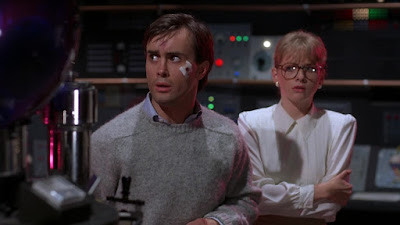
Although Jeffrey Combs provides a pretty much definitive reading of the nervous, weak-willed Lovecraftian protagonist here (it is difficult to read HPL’s description of Tillinghast’s “..high and unnatural, though always pedantic, voice” without recalling Combs’ unique line readings), he nonetheless seems aware that he is essentially a supporting character – a victim rather than instigator of events – this time around, despite his top billing on the poster, and he steps back accordingly. No match for the force of Pretorius’s malevolent sexual energy, Tillinghast essentially exits prior to the film’s final act, transformed into a mindless, albino monster before he meets his sorry fate.
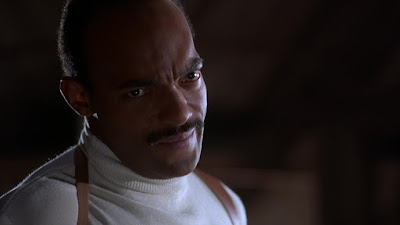
As for Ken Foree’s turn as good-natured cop ‘Bubba’ Brownlee meanwhile, he seems to have wandered in from another film entirely (perhaps taking a wrong turn on his way to audition for a pre-‘Lethal Weapon’ buddy-cop movie?), with his light-hearted banter and comedic appetite feel absurdly out of place in the Lovecraftian universe. It’s always nice to see Foree (whom you’ll recall from Romero’s ‘Dawn of the Dead’ (1977)) getting a good role, and it’s impossible not to be charmed by his shtick - but nonetheless, Bubba’s materialist attitude and steadfast refusal to countenance the ‘other’ clearly indicate that he is no fit protagonist for this story. Indeed, his former football pro libido counts for little in the relentlessly hetero eyes of Pretorius, whose shapeless minions proceed to eat him at the first convenient opportunity.


It is Barbara Crampton’s Dr Katherine McMichaels therefore who lives on to battle ‘From Beyond’s inter-dimensional overlord, experiencing by far the most well developed arc doled out to any of this film’s characters in the process, with her earth-bound transformations between different female pulp archetypes in a way mirroring the trans-dimensional shape-shifting of Pretorius himself.

Crampton’s solid performance in ‘Re-animator’ gave us some hints that she was more than just yr average ‘80s ‘scream queen’ (or rather, more than just a somewhat competent actress who was willing to go all the way re: the singular demands of that film’s finale), but with ‘From Beyond’, the filmmakers really gave her a chance to step up and turn the tables on genre expectation, essentially taking centre stage amid the libidinous, latex excesses of the movie’s hyper-sexualised take on cosmic horror, and the results are pretty wonderful.

A radical psychiatrist who, we are told, disapproves of locking up schizophrenics, Dr McMichaels is initially introduced to us her through her antagonistic relationship with the more authoritarian Dr Bloch (Carolyn Purdy-Gordon), who accuses her younger colleague of exploiting rather than rehabilitating her patients, using them as guinea pigs for her research as they are presumably allowed to run free to indulge their most destructive whims.

Be that as it may (and to be honest, the script is clearly just using these argument to set the stage for the mayhem which will occur once Dr McMichaels is assigned custody of the incarcerated Tillinghast, rather than attempting make any grander point about contemporary psychiatry), Crampton presents an almost comically buttoned up and repressed figure during these early scenes, complete with tightly bunned hair, woollen overcoat and oversized glasses. Even here though, she already manages to inject a hint of submerged kinkiness into her performance, failing to hide her obvious excitement when Tillinghast, confined to his asylum cell, begins to tell her of the work he and Pretorius carried out.

Once our gang are back at the Pretorius house, ostensibly in an attempt to help Tillinghast by repeating the experiments which led to his collapse, Crampton gradually dials up the more sensual aspect of her character, as her prim mannerisms and fusty exterior begin to feel more and more like some kind of perverse dress-up, as the true scale and freakery of Pretorius’s activities (both earthbound and supernatural) become increasingly clear to the good doctor.

It’s almost a relief therefore when, in classic camp / fairy tale fashion, Crampton lets her blonde locks down and dons the obligatory frilly nightie in preparation for bed time, allowing things to get really charged as she knowingly takes on the role of the timorous gothic heroine, practically role-playing it for Pretorious’s unseen spirit as she takes that same nocturnal walk toward the cursed attic that thousands have trod before her. Approaching, and indeed fondling, the rather phallic edifice of the resonator, she uses it to summon her learned lover from beyond as if it were some tribal fetish object, prompting a traumatic, slimy encounter with Sorel’s by now thoroughly inhuman patriarch, apparently magnifying both her attraction and repulsion to the heavily sexualised Other.
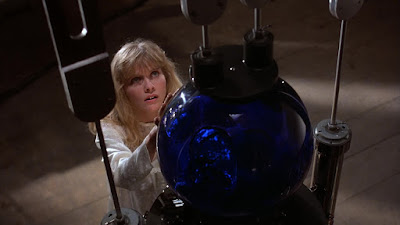
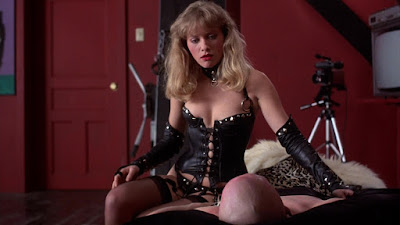
By the time Katherine has transformed herself, via the contents Pretorius’s on-site sex dungeon, into a kind of mind-blown, insatiable dominatrix, we’re heading into pretty uncomfortable territory here, as the warped hues of the film’s lighting and garish sleaziness of its interior décor becoming increasingly nauseous.

Following a delirious special effects showcase which sees Foree (in startling tight red y-fronts) and Combs (in a Miskatonic Uni t-shirt) battling a decidedly vaginal (yet also kinda phallic) giant worm in the infernal, flooded basement, Gordon leads us on helplessly toward the trademark, “this is going considerably further than I expected” / envelope-pushing type scene which he likes to include in each of his horror movies – which in this case involves Crampton, in full black leather fetish get-up, mounting the bruised and unresponsive body of Combs, who has been reduced to a hairless, shuddering albino after being swallowed and spat out by the suggestive, spectral worm. (And honestly, they wonder why the MPAA had some issues!)

If we can reclaim our jaws from the floor whilst all this is going on, we may again wish to award the filmmakers a gold star for defying expectation by casting Crampton as the aggressor here, and concede that ‘From Beyond’s weird detournement of the kind of titillation which hetero-male horror fans tend to consider their birth-right is in many ways quite admirable (for it is here that the dark mystery of the sex-horror ideal truly resides, cf: Cronenberg’s ‘Shivers’ or Franco’s Lorna the Exorcist). By this point in proceedings in fact, things have become infused with such a miasma of sickness – of, for want of a better word, grossness - that we can’t help but be to some extent relieved when Foree intrudes upon the scene, pulling us back to reality with a dose of good ol’ fashioned restraint and self-respect and/or slut-shaming reinforcement of patriarchal values [delete according to taste].

In terms of the moral schema through which the film’s script deals with all of these inter-dimensional sexual shenanigans, submission to one’s desires is framed as triumph of pure ego over collective human responsibility. Satisfaction, under the terms imposed here by the predatory Pretorius, can only be achieved through the destruction of another soul. When Foree’s character tries to snap Katherine out of her new persona as a kind of sleazoid, brain-washed nymphomaniac, there is more than just mere puritanism at work. Bubba, as an archetypical down-to-earth realist, realises that the kind of idealistic quest for mindless sensation embodied by Pretorius can lead only to destruction – first of the bodies and souls of others, and ultimately or oneself.

Trying to extrapolate some kind of real world analogue from all this, it occurs to me that proponents of sado-masochism and/or so-called polyamorous relationships might well be inclined to take offence at ‘From Beyond’s approach to sexual ethics, but, I’ll leave that battle for them to fight, should they wish to. Instead, I’ll merely state that, in terms of a horror movie, the conflict which rages within our characters between all-consuming ego rampage and the inter-personal respect for the bodily and cerebral identities of others, works very well.

Whether or not ‘From Beyond’ ultimately works as a film however, will largely be a matter of personal taste. Even if the production veers dangerously close to outright cheesiness in places, I’ve certainly grown to love it over the years, largely thanks to the excellent set of performances delivered by the cast (another Gordon trademark) and the astounding special effects work (that basement worm battle is really a thing to behold).

Many viewers though will doubtless find the excesses of the movie’s visuals and ideas difficult to process, and, whatever fans may have had in mind for a follow up to ‘Re-animator’ back in 1986, some lunatic fusion of ‘The Rocky Horror Picture Show’ and ‘The Thing’ on an Empire Pictures budget was probably not it. Though the film has amassed a considerable cult following over the years, the initial reaction of audiences and critics was far from kind, with the response of many leaving theatres probably best summed up by one of the more memorable lines uttered by Combs’ Tillighast; “That… will be quite enough of that.”

Though Brian Yuzna proceeded to follow this particular strain of latex insanity even further in the aforementioned ‘Society’, he soon retreated to the comparatively safer ground of ‘Bride of Re-animator’, and ‘From Beyond’ meanwhile seems to have led to a decade long hiatus in Gordon and Paoli’s Lovecraftian adventures, as the director transitioned straight into a series of considerably more audience-friendly (or perhaps more to the point, producer-friendly) ventures, beginning with the thoroughly wholesome ‘Dolls’ (1987). Thus, ‘From Beyond’ is left to stand on its own merits as a kind of fascinating historical aberration. All of the film’s principal creatives and cast members would go on to make good horror films after this, and all of them would return to Lovecraft in some form or another, but none of them ever again attempted anything quite this unconventional and tonally extreme.

----


(1) Published between 1933 and 1935, ‘The Fantasy Fan’ was founded by an Elizabeth, NJ based teenager named Charles D. Hornig. Although its circulation remained minimal (subscribers numbered around 60, and the print run never exceeded 300 copies), ‘The Fantasy Fan’ is remembered an an important title within the earl ‘weird fiction’ community, publishing work by Lovecraft, Howard, Derleth and Bloch, as well as correspondence from HPL, Clark Ashton Smith and Forrest J. Ackerman. Surprisingly given their rarity and fragility, extant copies begin at a not unreasonable $150 at Abebooks. Further info via Wikipedia.

(2) In fact, there are numerous parallels between ‘From Beyond’ and Corman’s ‘The Pit & The Pendulum’ in particular. Both are the second movies in a series, coming hot on the heels of an initial big success, and both make a point of pushing the envelope far further than their respective predecessor, incorporating uncomfortable sexual content with a concentration on torture and/or S&M. Both have a rather unhinged, hysterical tone and encourage a dreamlike sense of shifting, uncertain realities, and on some level they also tell similar tales of a younger character losing his/her identity to the fleshy, sensual obsessions of an absent patriarchal figure. Both films even make extensive use of red in their colour schemes, for goodness sake. Coincidence? Quite possibly, but just putting the idea out there.

(3)Interestingly, both the extreme colour scheme used in ‘From Beyond’ and the discussion of ultra-violet light in Lovecraft’s original story seem to mirror the approach to visualising ‘impossible’ colours utilised by Richard Stanley in his recent adaptation of ‘The Color Out of Space’. As both films make clear, MAGENTA is clearly the colour of cosmic horror.