Showing posts with label vampires. Show all posts

Thursday, 10 October 2024

October Horrors # 5:
The Sex Serum of Dr Blake
[aka Voodoo Heartbeat]


(Charles Nizet, 1973)

Las Vegas-based filmmaker Charles Nizet’s berserk drive-in oddity ‘Help Me.. I’m Possessed!’ was one of the unexpected highlights of my 2022 October horror marathon, so naturally I was curious to check out Nizet’s other foray into horror territory, previously considered a lost film, but now happily rescued from oblivion (albeit in an alternate softcore sexploitation cut, with burned in Dutch and French subtitles) by Vinegar Syndrome, as part of their Lost Picture Show box set.

The first thing to note here is that, compared to decidedly lo-fi production values showcased in ‘..Possessed’, this one actually seems a bit more ambitious in scope (relatively speaking). By which I mean, Nizet employs a fairly wide range of locations, with shots stolen around airports, military bases and highways, along with some actual, choreographed action scenes, camera set ups that occasionally extend beyond basic ‘point and shoot’ methodology, and so on.

Reassuringly though, the whole affair is also still lurid as a strip club basement and mad as a bag of snakes, with a wild, “absolutely anything could happen next” vibe which makes it feel like an entertainment for a strange and debased form of humanity, beamed in from another dimension.

All of this weirdness however is parsed out on this occasion with lengthy passages of almost transcendental boredom, as if the filmmakers were determined to make every goddamned frame they sent to the lab count.

So, a scene in which a man breaks into a locked briefcase and carefully examines its contents plays put pretty much in real time. A close up of a needle being injected into an arm holds for so long that I actually undertook a brief exchange of messages on my phone, looked back to the screen, and realised it still hadn’t cut. There are many, many phone calls and office meetings in which secondary characters calmly explain the plot to each other. A sixty second shot of a policeman descending a ladder, anyone? You get the idea.

In the context of a film like this though you understand, I am not necessarily criticising the inclusion of all this extraneous footage. On the contrary, it actually has a kind of hypnotic effect after a while, and, whether in a 1973 drive-in or a 2024 living room, it allows ample opportunity for toilet breaks, food and drink preparation and so on - which is helpful, especially within this kind of movie’s natural environment, sandwiched mid-way through a continuously rolling, multi-film marathon of some kind. Grotesque, inexplicable madness, presented in an admirably relaxed, ambient package.

Don’t dawdle too long though, or you’ll miss some of the many “highlights” (for which please interpret those quotation marks to denote a wry and sardonic tone of voice, leavened by a certain underlying leeriness).

These begin with a lengthy, exotica-tastic “African” tribal ritual, in which a gaggle of dancing girls strip out of their zebra-print bikinis, screw a guy and then cut his heart out (shades of Love Goddesses of Blood Island?), observed by a pith-helmeted explorer who sneaks in after the show to steal a vial of what (for some reason) he takes to be the fabled elixir of youth.

Then, at different points, we’re treated to a car chase AND a boat chase, both fairly elaborately staged.

Sleaze junkies meanwhile will want to note the presence of both a harrowing, roughie-esque vampire sex murder, and a later threesome with a few borderline hardcore shots, staged in a desert canyon, which culminates in the participants being shot to death from above and vampirised.

Perhaps best of all from my point of view though was the most awkward father/daughter dinner date in cinema history, which… well, you’ll just have to witness it first-hand, that’s all I’m saying.

Speaking of cinema history though, I would also like to take this opportunity nominate the titular Dr Blake (played by Ray Molina) as a contender for the single sleaziest and most misguided motherfucker ever to grace the screen.

As exhibit A, I present his hairstyle, combining sideburns which extend all the way to the corners of his mouth with a disgusting, tangled, oily kiss-curl which hangs down across his forehead, almost reaching his eyebrows. If I walked into a doctor’s office and he looked like this, I would leave immediately, no questions asked.

It is no surprise therefore to discover that Dr Blake has recently been in hot water for performing unlicensed abortions, and is now being prosecuted for manslaughter by the parents of one of his patients, who died following the procedure. (The doc insists it was nothing to do with him, but I don’t believe him for a second.)

During his drive home after another hard day of.. this sort of thing, Dr Blake happens upon a flaming, overturned wreck on the side of the highway. Rather than notifying the authorities or trying to help any survivors however, his first reaction is instead to steal a briefcase with a severed arm handcuffed to it(!) from inside the wreckage, after which he jumps back in his car and heads straight back to his ugly suburban tract home, where he casually sticks the arm in the icebox(!?), and gets to work on opening the case (see above).

Extracting a vial of unidentified, colourless fluid from the case, he immediately digs out a syringe and ties off, injecting the fluid straight into his veins… only to then remember that - oh no - he’s forgotten to pick his daughter up from the airport!

Gentlemen, I put it to you - in all facets of life, Do Not Do What Dr Blake Does, and your life will proceed in a more harmonious and worthwhile direction.

Charles Nizet, one of cinema’s great moralists - truly he hardly knew ye. 


---

Bonus screengrab - the doctor takes a call in his office...


Thursday, 26 October 2023

Horror Express:
The Vampire’s Ghost
(Lesley Selander, 1945)

I had a lot of fun with Lesley Selander’s The Catman of Paris earlier this month, so thought I’d make some time (only 58 minutes required) to check in on the other b-horror he directed for Republic Pictures in the mid ‘40s.

As with ‘Catman..’, the title is intriguingly silly, betraying an attempt to hang onto the coattails of Universal’s waning horror output (they’d released both ‘The Mummy’s Ghost’ and ‘The Ghost of Frankenstein’ in the proceeding years), but... mixed results here, I'd say.

From the outset, ‘The Vampire’s Ghost’ proves to be a rather inert and talky affair, set amid the confines of a pokey and generally uninspiring backlot version of darkest Africa, wherein a largely undistinguished cast of white colonial types trudge through their allotted paces with no great surfeit of enthusiasm.

On the plus side though, it sure has some interesting notions buried within it.

Though he’s certainly no ghost, our resident vampire here turns out to be a former member of Queen Elizabeth I’s court, who - perhaps uniquely in the annals of cinematic vampirism - now finds himself running a gin joint in a fictional central African state, fleecing sailors in dice games and ruing the weary burden of his immortal condition, like some cut-price, blood-drinking Rick Blaine.

An odd fit for the vampire role, John Abbott initially looks more like the kind of guy you’d cast as an accountant or an elevator operator. But, he has a deep, sonorous voice and Peter Lorre-worthy bug-eyes, and ultmately leans into his unusual characterisation very well.

There’s an absolutely sublime scene for instance where, after being wounded by a spear whilst out on ‘safari’, Abbott uses his powers of mental persuasion to command the film’s hero (Charles Gordon) to carry him to the summit of a nearby mountain, where he luxuriates in the healing light of the full moon, his head resting on the precious Elizabethan box containing the grave soil of his original resting place, presented to him by the Queen after the Armada. Great stuff.

At first, it seems as if the vampire is going to be characterised as a variation on the Wandering Jew/Wolfman archetype - condemned to walk the earth for all eternity whilst seeking an escape from his supernatural affliction, and trying to warn the other characters away from him, lest they fall victim to his curse.

Later on though, he seems to have lost this benevolent streak, and, having given fair warning, gets straight on with the business of dominating Gordon’s mind, reducing him to a brain-dead slave, whilst he claims the leading lady (Peggy Stewart) for himself, whisking her off to the remote, abandoned temple of a supposed “death cult”, where, inexplicably in view of the film’s geography, a four-armed Hindu idol awaits them. (I liked the way Abbott plays all this with  “another day, another dollar” resignation, as though he’s been through it all a hundred times before.)

Many of these interesting and unconventional story elements can presumably be traced back to legendary screenwriter and SF pioneer Leigh Brackett, who takes co-writer and original story credits here, the same year she worked for Howard Hawks on ‘The Big Sleep’. And, as I can’t locate any additional background on her involvement with this film... that’s about all I have to say about that.

Stylistically meanwhile, the movie seems to draw heavily from Val Lewton’s then-recent series of b-horror successes at RKO, even directly mimicking ‘I Walked With A Zombie’ (1943) during scenes in which the white folks sit nervously in their bamboo-shaded bungalows, muttering darkly about the jungle drums affecting the productivity of the natives down at the ol’ plantation and so on, whilst the presentation of the vampire’s killings seems to echo both ‘The Leopard Man’ (1943) and ‘Cat People’ (1942) in places.

Unfortunately though, Selander proves unable to muster even a fraction of the atmosphere Jacques Tourneur brought to those projects - largely through no fault of his own, I’m assuming, as a “first take, best take” policy clearly seems to have been in operation, whilst even the film’s best ‘horror’ moment (the vampire’s murder of the bar's sultry dancing girl Adele Mara, in a shadowed bedroom with the incessant pounding of the drums as a backdrop) is subjected to a disappointing early fade.

As ever with movies like this, I’m also obliged to note that events play out in what is very much the boilerplate “white man’s Africa” of the era’s pulp magazines and Jungle Jim serials. So, even if it can’t quite summon up the energy to be overtly racist about it, if you’re looking for sympathetic portrayals of indigenous African characters or veiled commentary on the vampiric nature of colonialism or somesuch, well, I’m afraid you won’t find it here, partner.

As usual with these things, the sight of African-American actors forced to play benign, half-witted tribespeople gabbling away in pidgin English also rather grates, especially in view of the film’s failure to conjure any of the gravitas or sense of place which Tourneur, or even Victor Halperin (‘White Zombie’), brought to their respective entries in the sub-genre. So, if you’re the sort of sensible viewer who doesn’t feel the need to tolerate this kind of crap when watching old movies - be forewarned.

Indeed, whilst dedicated scholars of pulp horror, vampire lore or off-beat poverty row programmers are sure to find enough intriguing content in ‘The Vampire’s Ghost’ to keep them occupied long after the credits have rolled, purely in terms of the film’s entertainment value, I’m going to have to close by suggesting that more general horror fans might want to think twice and/or keep their expectations in check when approaching this one.

Friday, 20 October 2023

Exploito All’Italiana:
Black Magic Rites
(Renato Polselli, 1973)

 So, having managed to maintain this blog for the better part of fifteen years, it feels remiss of me not have dedicated at least a few paragraphs to discussing the indescribable cinematic singularity which is Renato Polselli’s ‘Riti, Magie Nere e Segrete Orge nel Trecento’ [‘Rites, Black Magic and Secret Orgies of the Fourteenth Century’], aka ‘The Reincarnation of Isobel’, allegedly aka ‘The Ghastly Orgies of Count Dracula’… but known to most of us (for the sake of brevity, if nothing else) simply as ‘Black Magic Rites’.

So, what with it being October, and having just spent some time luxuriating in the glow of Indicator’s never-thought-I’d-see-the-day 4k restoration… now would seem to be the time to take a deep breath and get on with it.

It must be admitted from the outset that this is a very difficult movie to try to review in any conventional sense, as those who have seen it will surely appreciate.

It is not only the film’s almost total lack of narrative which causes difficulties for the potential critic, but the seeming lack of any unifying pattern or purpose whatsoever. Faced with the onslaught of audio-visual anarchy found herein, the idea of understanding what Polselli’s intentions were in creating this thing, or of positing any framework against which his success may be assessed, seems nigh on impossible.

‘Black Magic Rites’ is, essentially, about as close as a piece of ostensibly commercial cinema has ever come to a state of utter, formless chaos, a celluloid equivalent of the mad piping of the servitors of Lovecraft’s blind idiot god crouching vacantly at the centre of the uncaring universe.

If you go in with enough determination, and pay close enough attention, you can identify discrete scenes and sections within the film, albeit generally interrupting and overlapping with each other to no clearly defined purpose. (This time around for instance, I was particularly taken by the whole funeral / premature burial sequence).

But, basically, this is a 100-minute hypnotic drone of a movie - no form, no progression. Most of the characters here are doing exactly the same thing at the end that they were doing at the start. The intermittent fragments of narrative which do creep in from time to time feel a bit like a heavy psychedelic rock band half-heartedly trying to add lyrics and song structure to their music, only for it to be totally drowned out by the roar of their amplifiers.

And what exactly, the uninitiated may ask, might that metaphorical roar consist of?

Well, you know - fire, screaming, gurning faces, crimson gore, kaleidoscopic psychedelic hoo-hah, awkwardly framed tableaux of female and male bodies squeezed into all kinds of outré costumes (both 14th and 20th century vintage), frantic time-and-space shredding jump cuts and cross-edits, lurid red and green disco lighting, erotic torture, breath-taking scenery and groovy castles, anonymous, drooling creeps lurking in shadows, more fire, more screaming faces, hypnotism, witch burnings, widescreen vistas of ritual depravity, pitchfork wielding mobs, chintzy birthday parties, frantic, awkward softcore sex, outbursts of alarming, screechy comic relief, and Count Dracula (apparently). 

The usual, basically - just a whole lot more of it. An all-you-can-eat buffet of all purpose, fumetti-style gothic horror/sleaze.

Within the pantheon of Italian genre directors who have become admired and/or infamous amongst the fans who have painstakingly unearthed their work over the decades, Polselli stands out as the kind of figure who, if he didn’t exist, someone would have had to invent him.

I mean, he had to be out there somewhere on the margins, didn’t he? The guy whose films were more extreme, more hysterical, more chaotic and senseless than anyone else’s, and who was stricken by censorship, public indifference and critical bafflement to such an extent that many of his films were barely even released at all, languishing in unfathomable obscurity for decades, and in some cases remaining almost impossible to see to this day.

And yet, despite these catastrophic set-backs, he kept dusting himself off and coming back to make more of the damned things, driven on by who knows what unfathomable personal demons. Certainly, the few public comments he made during his lifetime shed little light on why he persisted in ploughing his long-suffering financiers’ money into such grotesque, bizarre and (crucially) unprofitable productions. Indeed, reading the sparse interviews conducted with Polselli whilst he was still with us, his attempts to explain himself seem alternately gnomic, cynical and entirely irrelevant to the work at hand.

Suffice to say that, if you were putting together some ‘Berberian Sound Studio’-styled fiction based around the world of Italian cult cinema, you could scarcely hope to create such a fascinating, baffling and hilarious character - and yet, here he is, large as life, with ‘Black Magic Rites’ standing as his defining artistic statement.

Enthusiasts such as myself often tend to praise Euro-horror films for achieving passages of surrealistic delirium. In ‘Black Magic Rites’ though, Polselli begins in a state of surrealistic delirium and keeps his foot down hard on the accelerator right through to the closing ‘FINE’.

As a result, it stands as an example of a piece of pulpy, cynical exploitation assembled with such fevered intensity that it goes full circle on the artistic spectrum, swallowing its own tail and emerging as an experimental art piece; an overwhelming sensory experience that would probably sit better on a double bill next to ‘Flaming Creatures’ or ‘Inauguration of the Pleasure Dome’ than with a Paul Naschy or Sergio Martino movie.

To return to my earlier music metaphor, watching ‘Black Magic Rites’ for the first time as a fan of Euro-horror feels a bit like growing up listening to canonical ‘60s rock, loving the occasional moments of dissonance and feedback... then suddenly discovering Les Rallizes Denudes or Mainliner. Whoa. Too much, man.

Before we get too carried away though, it’s worth splashing our faces with cold water and remembering that, of the individual elements which make up the totality of ‘Black Magic Rites’, none are entirely unique within the Italio-cult context.

The voluminous output of that nation’s cinema during the early ‘70s did, after all, include low budget horror films which, whether by accident or design, were almost entirely incoherent (Angelo Pannacciò’s ‘Sex of the Witch’), or formally and tonally inexplicable (Francesco Mazzei’s The Weapon, The Hour, The Motive). 

There were films which simply pushed WAY TOO FAR to ever see widespread, uncut distribution at the time of their production (Fernando Di Leo’s ‘Slaughter Hotel’ aka ‘Cold Blooded Beast’), and other entries in the “sexy gothic” sub-genre which knowingly plunged over the precipice into full-blown parody and deliberately disjointed, rambling nonsense (Luigi Batzella’s ‘Nude For Satan’) - all trends redolent of a pre-porno film culture which routinely allowed questionably committed filmmakers to essentially go out and shoot whatever the hell they felt like, so long the requisite nudity and softcore groping was delivered on time.

‘Black Magic Rites’ though is the only film I’m aware of which managed to simultaneously cash in on ALL of these crazy possibilities, creating a maximalist overload of ‘70s witch-smut insanity which has never been equalled.

Trying to account for all this on a rational basis, I’m tempted to consider the suggestion floated by Stephen Thrower in his supplement to the Indicator release, that, perhaps, Polselli had intended to make a somewhat more structured, narrative film but (as per the Pannacciò film cited above) simply lost control of the production, discovering after the money had run out and the actors fled the set that he was missing whatever footage he needed to pull the whole thing together.

Hitting the editing room therefore, perhaps with only a few days to spare before delivering a rough cut, he simply panicked, resorting to the only tool available to a director of crazy horror movies in such circumstances - Art! Or, more specifically - jump cuts, and dreams-within-flashbacks-within-dreams, special / temporal disorientation, overlapping images and audio tracks and hypnotic repetition of footage - all cut to the beat of Franco Reverberi’s freaky, ritualistic score. Yeah!

In other circumstances, such an endeavour could have emerged as simply unwatchable (and many would no doubt claim ‘Black Magic Rites’ is just that), but, even for the less fanatical viewer, the film’s aesthetic pleasures and unexpected outbursts of beauty certainly help to sweeten the pill.

‘Black Magic Rites’ was shot in Italian weirdo horror’s home-from-home, the 15th century Castello Piccolomini in Balsorano, previously home to everyone from The Crimson Executioner to Lady Frankenstein, and it must be said, Polselli uses the castello’s potential quite brilliantly in places, especially when he breaks away from the suffocating, colour-saturated gloom of the interiors to stage scenes on the castle battlements, showcasing the astonishing vistas of snow-capped mountains which form the backdrop to the valley in which the castle stands. (1)

A necessary refresher amid all the madness going on down in the ballrooms and dungeons, you can almost smell the fresh air during these sequences, and a similar chill wind of melancholic atmos can also be felt during the funeral / burial sequence I mentioned above, which is really beautifully put together, acting both as a reference to the best scene in Polselli’s earlier The Vampire and the Ballerina, and indeed to its original inspiration, Carl Dreyer’s Vampyr.  

Though I prefer to avoid going into ‘consumer guide’ mode in these reviews, it must be said that the new transfer of the film really helps to highlight the beauty of some of the individual images Polselli and his collaborators conjured up here amidst all the carnage and peek-a-boo nudity and cheap special effects, perhaps helping to lend the whole thing a bit more of a sense of artistry than was really evident in earlier editions. God knows the travails Director of Photography Ugo Brunelli probably had to go through whilst shooting all this stuff, but he certainly delivered the goods in technical terms.

His work, together with Reverberi’s appropriately wigged out yet infernally catchy score (heavy on hand percussion, primitive electronics and reversed/echoed vocal weirdness), work to ensure the film remains an aesthetically intoxicating experience, as well as a simply overpowering one - with this intention often succeeding in spite of Polselli’s feverish, ADHD-afflicted editing and obsession with rubbing our noses in the most unpleasant imagery he can conjure up at any given point.

By far the funniest thing about the new transfer though is that it retains the grandly ornate interval cards from the movie’s original Italian cinema screenings, which I don't recall seeing before. What a hoot! I mean, can you imagine the poor, unsuspecting audience, staggering out into the sunlight for a smoke after 45 minutes of this shit? (“Say pal, whatcha think's gonna happen next?”) 

Simply amazing - as indeed is every aspect of this astounding, unrepeatable film’s genesis, existence and continued survival.

Check it out, please, before the thousand-faced messengers of Azathoth think better of letting it out in the wild, and pull remaining copies through some black trans-dimensional vortex, leaving no trace but a lingering, half-forgotten memory, ready to be shaken off with tomorrow morning’s much needed coffee.

---

(1) As I believe I noted in my ‘Lady Frankenstein’ review a few years ago, I’m intrigued by the fact that, of the four noteworthy Italian horror film Mickey Hargitay appeared in, three were shot in the Castello Piccolomini! I mean, was this just a coincidence, or did he live nearby, or know the owners of the castle or something..? Sadly the man himself is no longer with us to provide an answer, but - any insight welcomed.

Wednesday, 4 October 2023

Gothic Originals:
La Llamada del Vampiro
[‘Cry of the Vampires’]

(José María Elorrieta, 1972)

In view of the cult which has built up around Euro-horror cinema, I’m surprised that this prime-era Spanish vampire flick has remained so determinedly obscure over the years. Rarely acknowledged or discussed even amongst genre die-hards, José María Elorrieta’s film is still only accessible (insofar as I’m aware) as a murky, fan-subbed TV rip with a very intrusive station logo burned into the top right corner (channel 18, folks).

Telling the tale of a sexy doctor (Diana Sorel) and her even sexier assistant (Beatriz Elorrieta - any relation?) who travel to a remote town afflicted by an outbreak of vampirism and soon agree to move into the local castle to care for the bed-ridden Baron and hang out with his feckless, would-be Byronic son (Nicholas Ney in his only screen credit), it’s probably fair to say that ‘La Llamada del Vampiro’ often feels quite a lot like an early Paul Naschy movie, minus the unique sense of imagination and enthusiasm which the great man brought to his productions.

In fact, I’d go one further and humbly suggest that quite a lot of what goes on in ‘La Llamada..’ comprises a direct imitation of the preceding year’s smash hit ‘La Noche de Walpurgis’ [aka ‘Werewolf Shadow’, aka ‘The Werewolf vs The Vampire Woman’].

Qualified professionals who clearly don’t let their intellectual acumen prevent them from expressing their femininity and indulging their fondness for wearing baby doll nighties and/or hot pants, Sorel and Elorrieta’s characters are clearly modelled on the glamorous archaeological researchers at the centre of Naschy and León Klimovsky’s film, even to the extent that, in both cases, one half of the learned duo gets romantically involved with a moody, black-clad fellow who wonders the woods bemoaning his cursed lineage, whilst the other instead becomes enslaved by a predatory lady vampire.

Meanwhile, in the course of presenting Ney’s scraggle-haired, “moping teenager” type character as an extremely unconvincing stand-in for Naschy’s Waldemar Daninsky, the film even manages to bungle things by getting its vampire and werewolf mythos all mixed up, presenting Ney (and, by extension, the other vampires) as folks who are pretty normal most of the time, but freak out, grow fangs and set off against their will to seek the blood of the living whenever the moon is full.

As if all this didn’t constitute enough of a ‘homage’ to ‘La Noche de Walpurgis’, ‘Llamada..’s debt becomes blindly obvious later on, when we’re treated to slo-mo shots of the vampire women dancing around in flowing night gowns, showing off their fangs - an effect shamelessly cribbed from one of the more memorable images in the earlier film.

Furthermore I might add, ‘Llamada’ even has the gall to shoot in many of the same locations as ‘..Walpurgis’, with both the Castillo de la Coracera and the familiar Monasterio de Santa María de Valdeiglesias once again pressed into service.

(Very much hallowed ground for Spanish horror, the extraordinary ruins and imposing castillos in the province of San Martín de Valdeiglesias near Madrid have provided a home for everyone from The Blind Dead to The Blancheville Monster, making it difficult to imagine any fans being unfamiliar with them by the time they get around to a lower tier picture like this one.)

Even leaving aside the issue of plagiarism in early ‘70s Euro-gothic though, suffice to say that we’re looking here at a pretty run-of-the-mill example of the genre - but, the thing is, I like the genre, so still managed to have a lot of fun with it regardless.

Indifferently directed, blandly photographed and entirely lacking in originality though ‘La Llamada del Vampiro’ may be, the simple pleasures of looking at the pretty ladies in their groovy costumes, taking another tour of the spectacular locations, and hearing some way-out bits of canned music from the CAM archives provided my refined sensibilities with all the stimuli required to keep me happily enthralled through the film’s double bill friendly 84 minute run time.

Speaking of the pretty ladies meanwhile, it’s also worth noting that the version of the film screened by good ol’ Channel 18 appears to have been the international export cut, complete with a variety of easily snippable naughty bits clearly intended to entice us saucy foreigners into the (presumably very few) cinemas which played this thing in territories beyond the reach of the still highly censorious Franco regime.

For the first half hour or so in fact, I thought this was going to be a pretty chaste, old fashioned exercise in gothic horror, notwithstanding a few of our heroines’ fashion-forward costume choices. But then, without warning, we start to get a few surprising flashes of full frontal female nudity, before, during the final half hour, we’re suddenly hit with a pretty full-on softcore lesbian scene, followed by some extended kinky business with chains and feathers in the castle dungeons, as the ever-growing legion of vampire ladies titillate their victims in the lead up to the film’s agreeably action-packed and chaotic finale.

All of which serves, I suppose, to belatedly edge the film into the ‘erotic horror’ category, although viewers approaching it primarily for this reason will be in for a good long wait before getting their jollies, that’s for sure.

Commentators of a more cynical disposition may be apt to question exactly what else anyone might want to approach it for, but personally I’d advise shunning such cynicism and embracing the half-hearted vision of le fantastique sloppily conjured up here by Elorrieta and his time-pressed collaborators. As outlined above, I still found plenty to give me a warm glow within this almost reassuringly routine and unexceptional addition to the Euro-horror canon.

Though certainly not any kind of overlooked classic, ‘La Llamada del Vampiro’ is definitely worth seeking out and saving up for that moment when you find yourself jonesing for another dose of that very particular ‘70s Spanish horror vibe, but have already seen all the good ones too many times. 


Saturday, 29 October 2022

Horror Express / Gothic Originals:
The Horrible Sexy Vampire
[‘El Vampiro de la Autopista’]

(José Luis Madrid, 1971)

Well, I've got to hand it to ‘em - his behaviour is horrible, he’s somewhat more sexy than most movie monsters, and he is, indisputably, a vampire… as well as an invisible man to boot!

Leaving aside its modest success in living up to its unforgettable English language title however, it saddens me to report that, in most other respects, José Luis Madrid’s film is unimaginative, amateurish and astoundingly dull.

Disappointingly short on action or what most viewers would define as ‘interest’, this hum-drum tale of an atavistic bloodsucker returning from the great beyond to (oddly) strangle a bunch of women in the countryside around Stuttgart instead relies heavily on extended, procedural dialogue/investigation scenes, many of which drag on for so long that listening to the long-suffering English dubbing team desperately trying to come up with enough mindless banter to fill all the dead air becomes more entertaining than anything being enacted on the screen.

Even the frequent scenes of female nudity, which have earned the film a certain notoriety over the years, and which must have been quite risqué for some markets at the time of release, now seem laughably quaint. 

Misogynistic to a fault, these diversions tend to centre around the inherently comic notion that the very first thing most women do upon returning home is take off all their clothes and look at their boobs in the mirror (just to check they’re still there, I suppose); thus making best use of those few, valuable seconds before the horrible, sexy invisible-vampire-man inevitably barges in and throttles them.

Why does the vampire become invisible, exactly? This seems to be a question whose answer is lost to the vagaries of time, but possible explanations include: a) to allow additional footage to be shot in the absence of star Waldemar Wohlfahrt, b) to assist in overcoming the technical challenges of shooting scenes in which Wohlfahrt, who also plays the great-grandson of the vampiric baron, needs to struggle with his undead forebear, or c) just for the sheer bloody-minded hell of it.

Although ‘The Horrible Sexy Vampire’ is not a film which could be honestly recommended to anyone on any conventional basis, it does at least present us with such a succession of oddities such as the one outlined above that it nonetheless makes for strangely compulsive viewing for… well, for me, at least. I can’t claim to speak for anyone else around here.

Not least among these eccentricities is the extraordinary presence of Wohlfahrt himself. 

Later known as Wal Davis (in which capacity he stared as an extremely unlikely Maciste in two of the strangest and most elusive films Jess Franco ever made, ‘Les Glutonnes’ and ‘Maciste Contre la Reine des Amazones’ (both 1972)), Wohlfahrt is a lanky weirdo with a shock of unkempt, peroxide blonde hair, who plays the film’s ‘present day’ protagonist, Count Obelnsky, as a kind of gloomy, self-serious aristocrat who wants nothing more out of life than to be left alone to spend his evenings indulging his passion for taxidermy and getting absolutely hammered on hard liquor.

This unusual characterisation becomes even stranger when one learns that ‘The Horrible Sexy Vampire’ was essentially a vanity project for Wohlfahrt, dreamt up to capitalise on the tabloid notoriety he’d gained after being falsely accused of a series of serial strangulation murders which took place on German highways during the 1960s. (Hence the film’s original Spanish release title, which translates as ‘Vampire of the Autobahn’.)

Although Wohlfahrt - who appears to have been some kind of roving playboy chiefly resident in the German tourist enclave of Benidorm - was acquitted of involvement in the crimes when it was proven beyond doubt that he was in Spain when several of the murders were committed, parallel charges brought against him for illegal possession of a firearm (also overturned), and pimping (for which he served a short prison sentence) suggest he was not exactly what you’d call a gentleman of good character - a suspicion borne out by his highly questionable attempts to use the publicity surrounding his arrest to launch a career in show business.

After a novelty pop single (released in Spain under the name ‘Waldemar El Vampiro’) failed to chart, Wohlfahrt appears to have turned to the film industry… which brings us to ‘The Horrible Sexy Vampire’.

Tastefully, the film was shot around Stuttgart, near to the locations of the real life crimes of which its star was accused, and its script is packed with references to the murders and to the details of Wohlfahrt’s highly publicised arrest… all of which proves a lot more interesting than anything which actually occurs on-screen in ‘The Horrible Sexy Vampire’, sad to say.

[Readers wishing to appraise themselves of the full details of this sordid affair are advised to consult either Ismael Fernandez’s booklet accompanying Mondo Macabro’s recent blu-ray release of the film, or David Flint & Adrian J. Martin’s audio commentary on the same disc.]

Meanwhile, another aspect of the film which helped to keep me engaged was its English dubbing, which is executed with a vibe of perfect, dead-pan absurdity which put me in mind of classics like ‘The Devil's Nightmare’ (1971).

This is perhaps best exemplified by the faux-British accent assigned to Count Oblensky (who has flown in from London to reclaim his ancestral seat), which has him preface every other remark with “I say..” or “Now look here..”, and also by the unfortunate decision to name the film’s vampire ‘Baron Winninger’ - invariably pronounced by the voice actors as ‘Baron Vinegar’.

Bonus points need to be awarded too for the bit where, having being asked a fairly reasonable question re: how come a coffin happens to be empty, a police detective responds, “there could be lots of reasons... why should I bother to explain? It's stupid!” A feeling keenly shared by everyone involved in the writing or translation of this film, I’m sure.

In a similar vein, I also liked Count Oblensky's weird insistence that, having taken possession of his family’s castle, he must act in strict adherence to the strange rules imposed in the will of his ancestor, who died in 1886. (I mean, who the hell does he think is going to take him to court to enforce them?)

As you’d hope, the wardrobe choices sported by both Wohlfahrt and leading lady Susan Carvasal (who, as the only female character who does anything other immediately stripping and dying, is introduced way after the film’s halfway point) are frequently jaw-dropping in their gaudy splendour, and, finally, I also really enjoyed the score, which contains several memorable cues composed by Spanish film music mainstay Angel Arteaga.

Most notable of these is an absolutely delightful, somewhat Morricone-esque piece for acoustic guitar, vibraphone and shrill female vocals which plays incessantly during the second half of the film, following Carvasal’s belated arrival. It’s a real ear worm, and I’d love to be able to obtain a copy on 7” or something. (“Love theme from The Horrible Sexy Vampire”, anyone?)

And…. that’s all I got. ‘The Horrible Sexy Vampire’, ladies and gents. You can meet him if you wish, but don’t say I didn’t warn you. (If nothing else, the disc will look good on the shelf.)


Tuesday, 23 November 2021

Horror Express / Gothic Originals:
Blood For Dracula
(Paul Morrissey, 1974)

On first viewing, ‘Blood for Dracula’ was by far my favourite of the two Paul Morrissey / Udo Kier horror films. Long story short: upon returning to the film for the first time in many years, my opinion remains unchanged.

‘Blood..’ has a genuinely funny / sexy premise (helpfully summarised by the Italian release title, which translates as ‘Dracula Seeks a Virgin’s Blood… and He is Dying of Thirst!!!’), and an interesting and unconventional take on the Dracula/vampire mythos, but more importantly, it also feels far more tonally consistent and comfortable in its own skin than Flesh For Frankenstein had a year earlier.

I’m not quite sure how to quantify that impression exactly, but… this one feels more like the kind of European film which an actual European filmmaker might have made, if that makes any sense? It is a film which actually seems to have risen from the culture in which the story takes place, rather than reflecting the perspective of a cynical outsider looking to tear shit up and upset people. As a result, we’ve got less sniggering from the back row this time around, and more actual stuff-which-is-funny. Taken purely as a black comedy in fact, ‘Blood for Dracula’ is often pretty sublime.

Once again, Udo Kier must be singled out for praise here. Dialling it down slightly from his mincing fascist Baron in ‘Flesh..’, his malnourished, hypochondriac Count Dracula is a truly pitiful creation. It is often reported that Kier starved himself to the point of infirmity before taking on the role, and his frighteningly cadaverous, translucently pale visage certainly bears this out. Barely keeping it together during moments when he is required to present himself in public or interact with other human beings, Keir’s performance is, in its own strange way, just as much of a compelling vision of the vampire-as-other as Max Shreck’s Graf Orlok in Murnau’s ‘Nosferatu’.

For all this though, the energy Kier puts into the nauseous bathroom freak-outs we’re subjected to as Dracula expels torrents of tainted blood from his system is remarkable. Both horrifyingly intense and disconcertingly intimate, these scenes of physical collapse prefigure the similarly unforgettable transformations Kier put himself through in Walerian Borowczyk’s ‘Docteur Jekyll et les Femmes’ (1981), whilst the fact that he manages to carry off this disconcerting business without undercutting the film’s comedy is little short of extraordinary. (Indeed, he even manages to deliver one of the greatest lines in film history whilst in the midst of his unnatural convulsions.) (1)

Here though, unlike in ‘Flesh..’, Udo is assisted by the presence of a supporting cast who (for the most part) prove strong and/or interesting enough to go toe-to-toe with him. Arno Jürging is once again very good, playing it less broad and rather more cunning than in the previous film as Dracula’s dedicated valet/servant, and I was also very impressed by British-born actress Maxime McKendry, who is absolutely dead-on as the harried, snobbish matriarch of the poverty-stricken aristocratic family Dracula infiltrates in search of a bride.

Best-known for her work in the fashion industry, McKendry was seemingly cast here as a result of her friendship with Andy Warhol (perhaps his only tangible contribution to these films, beyond lending his name to their American release), but she is so good, it is almost impossible to believe that this was her only acting credit.

Her matter-of-fact response to walking in on the sight of her youngest daughter being raped by the gardener is one of the film’s blackly comedic highlights, although her doddering, crackpot husband, played by no less a personage than Vittorio De Sica, proves equally amusing, seemingly improvising the lion’s share of deeply eccentric performance.

Elsewhere, Elsa Lanchester-lookalike Milena Vukotic is also memorable as the family’s eldest daughter, and even ol’ Joe Dallesandro is served better here than he was in ‘Flesh..’, despite making no effort either to exhibit any emotion or to disguise his incongruous New York drawl.

Once again, Joe is called upon to embody the brutish, proletariat assassin of Kier’s aristocratic entitlement, but the script’s decision to go all out in making his scowling, sex pest gardener an early-doors communist proves inspired; the sheer misery he manages to pile upon the poor Count’s head, quoting simplified Marx-Leninism as he shags his way through through his employer’s assorted daughters, is comedy gold.

Meanwhile, ‘Blood..’ is, if anything, even more grandly appointed than ‘Flesh..’, with the familiar Villa Parisi, which serves as the film’s primary location, looking absolutely beautiful here, augmented by Enrico Box’s exquisite set dressing and Luigi Kuveiller’s hazy, diffused photography. Ancient and austere yet decrepit, chilly and depressing, the villa provides a perfect visual metaphor for the fading, dysfunctional dynasty who dwell within it, whilst its bright, airy spaces offer a stark contrast to the dusty, shadowed chambers occupied by both the film’s peasants, and its vampires.

Claudio Gizzi’s stately, orchestral score feels more appropriate here than it did amid the comic book slaughter of ‘Flesh..’, particularly during the film’s strikingly melancholy Transylvanian title sequence, during which we see Dracula swathed in near total darkness, painstakingly applying the make up which allows him to pass as human in preparation for his reluctant departure from his ancestral estate.

Largely devoid of camp/comedic intent, these opening scenes are in fact extremely sad. In spite of everything, we feel for the Count, as he is pulled away from his crepuscular world of taxidermy and dried flower arrangements by the ugly realities of seeking sustenance in a cruel world which no longer defers to his aristocratic pedigree.

Sequences such as that in which Kier and Jürging inter the remains of Dracula’s now-expired vampiric sister (Eleonora Zani), who after untold centuries has expired from her ‘thirst’, are simply fine, atmospheric filmmaking, and, in using vampirism as a prism by which to explore aging and mortality, Morrissey even finds himself pre-empting the funereal tone of Tony Scott’s The Hunger to some extent. (Which also makes this pretty much Goths on Film 101, children of the dark should take note.)

Assuming viewers are prepared to roll with the total absence of sympathetic characters (pretty much a given for a Paul Morrissey film), ‘Blood for Dracula’s greatest flaw is probably the performances by the actresses playing the family’s other three daughters. Despite including ‘Suspiria’s Stefania Casini and poliziotteschi stalwart Silvia Dionisio amongst their number, one suspects that these ladies were probably not cast for their thespian talents (their participation in the film’s soft focus sex scenes is both lengthy and relatively explicit), and insisting that they recite their dialogue in heavily-accented, phonetic English strikes me as having been a really bad decision.

Contrary to standard practice in the Italian film industry, my impression is that these Morrissey films must have been shot with live sound, but I wonder to what extent Casini, Dionisio and other Italian performers were aware of this? To my ears, much of their dialogue in the film sounds akin to a ‘guide track’, waiting to be replaced with something better in the dub, and as a result, much of what they have to say is both excruciatingly delivered and also somewhat incomprehensible.

(To be fair, De Sica also suffers from the same problem, but it’s less of an issue given that his character is supposed to be a rambling old duffer who rarely says anything of narrative importance. And yes, SDH subtitles would no doubt help, but I watched the film on this occasion via an old DVD copy which offers no such luxuries.)

Aside from this unfortunate throwback to Morrissey’s earlier bad-on-purpose methodology however, I was surprised at just how well ‘Blood for Dracula’ stands up. Both effective and actually quite affecting in parts, it’s an accomplished social satire and an intriguingly clever / self-aware take on a late period gothic horror film - but most importantly, it’s also still uproariously entertaining despite its decadent languors, easily capable of winning over a suitably cynical/open-minded crowd nearly half a century later. The next time I find myself idly mulling over a list of ‘best vampire movies’ or ‘best horror-comedies’, I definitely feel it’s earned itself a spot.

-- 


-- 

(1)Amazingly, it has only just occurred to be that there might actually be a tangible connection between these two Morrissey films and Borowczyk’s ‘The Strange Case of Dr. Jekyll and Miss Osbourne’, or ‘Bloodbath of Dr Jekyll’, or whatever you wish to call it. I mean, obviously Borowczyk brought a very different sensibility to the table, and his film was made nearly a decade later, in a different country, but think about it. Intense performance from Udo Kier in the lead; chaotic / anti-authoritarian feel, ‘shocking’ content and overwhelming emphasis on cruelty, excess and perversion. Plus, if you’ve already done Frankenstein and Dracula, Jekyll & Hyde is the natural next step, right? Not that I’m suggesting Borowczyk was directly influenced by these films, you understand, but could the idea of the Jekyll film forming the final part of a trilogy have been floating around somewhere in the background when his film was being conceived and financed..? Who knows.

Thursday, 7 October 2021

Gothic Originals:
La Cripta e L’Incubo /
‘Crypt of the Vampire’

(Camillo Mastrocinque, 1964)

One of the more frequently overlooked entries in Italy’s cycle of ‘60s gothic horrors, ‘La Cripta e L’incubo’ had escaped my attention prior to its re-emergence this year as part of Severin’s Eurocrypt of Christopher Lee box set. It is all the more satisfying therefore to discover that it actually holds up as one of the very best second-tier Italio-gothics, muscling in just below the canonical classics of Bava, Freda and Margheriti in my own personal ranking of such things.

Leaving aside for a moment the contributions of director Camillo Mastrocinque (who went on to helm the similarly underappreciated Barbara Steele vehicle An Angel for Satan two years later), ‘Cripta e L’incubo’ seems to have been a project chiefly instigated by its co-writers, future director Tonino Valerii and the ubiquitous Ernesto Gastaldi.

As Valerii and Gastaldi have both recalled in interviews, their script for the film was produced in a single, heavily caffeinated all-night writing session, after producer Mario Mariani called their bluff by telling them he’d finance the top flight horror picture Gastaldi was boasting about having written, if they could drop the script round to his office the following morning.

The fevered, ‘first thought / best thought’ approach to writing which resulted from this circumstance is perhaps reflected in the pleasantly disjointed mish-mash of ideas which eventually made it to the screen.

Expanding upon a garbled retelling of Le Fanu’s ‘Carmilla’ (already filmed by Roger Vadim as the epochal ‘Blood & Roses’ a few years earlier), the two writers add a largely unconnected opening half hour cribbed either from Hammer’s ‘Dracula’ or Corman’s House of Usher (bequiffed young hero José Campos has arrived at the sinister castle to catalogue and restore the library of Christopher Lee’s saturnine Count Karnstein), alongside assorted hints of Gastaldi’s future notoriety as an architect of the giallo (see below), some blatant borrowings from Bava’s ‘Black Sunday’/‘La Maschera del Demonio’, and a startling injection of below stairs black magickal intrigue which anticipates the kind of imagery more commonly encountered in the wave of Erotic Castle Movies which kept the Euro-gothic tradition alive through the ‘70s.

Charged with knitting all this together into a coherent whole, Mastrocinque - a veteran director tackling his first horror film here after decades of comedies and melodramas - seems to have faced a certain amount of criticism over the years, not least from Valerii and Gastaldi, neither of whom seem to have held him in high regard. Reading between the lines, one suspects the younger writers may have resented not being given the opportunity to take a crack at directing their script themselves, whilst the fact that Mastrocinque sacked Gastaldi’s wife (the recently departed Mara Maryl, R.I.P.) from the film after less than a day on set can scarcely have helped matters.

The director has also been criticised though by some later commentators, who have accused him of failing the lacking a ‘feel’ for the horror genre - an accusation I find rather unfair.

Admittedly, both of Mastrocinque’s horror films are lugubriously paced even by the standards of this sub-genre, downplaying the kind of visceral shocks modern viewers might expect, and ‘Cripta e L’incubo’s early scenes do feel rather stiff and uninvolving, but regardless - once the film gets going, it is positively dripping with the very best kind of gothic atmos, as the director’s rather stately, old fashioned style intersects quite beautifully with the more irrational, exploitational content the writers have jammed into the screenplay.

Right from the outset, the use of one of Italio-gothic’s homes-from-home, the Castello Piccolomini in Balsorano, as the primary shooting location adds greatly to the sense of crumbling, atavistic weirdness (the Castello’s later tenants included both Lady Frankenstein and The Crimson Executioner), whilst a frantic, wild-eyed performance from Adriana Ambesi as the troubled Laura Karnstein also immediately grabs our attention. Though she still looks appropriately stunning in her period accoutrements, Ambesi brings a distraught, human fragility to her character which sets her apart from the icy brunettes who usually dominate this emotionally frigid sub-genre.

Carlo Savina’s score meanwhile nails down the mood perfectly with dissonant, droning organ chords, creepy harp arpeggios and gratuitous theremin, and from the moment we hear a ghostly church bell tolling across the desolate valley housing the deserted ruins of the village which once bore the Karnstein name (subsequently seen in evocative location shots of some suitably blighted/abandoned locale), we know we’re getting the real deal here.

Presumably by accident rather than design (although he was certainly old enough to remember them the first time around), Mastrocinque draws here on imagery recalling the pre-war ur-texts of Euro-horror, giving us diaphanous, slo-mo curtains dancing in the breeze (ala Epstein’s 1928 ‘The Fall of the House of Usher’) and Cocteau-esque pools of translucent darkness, along with glass-topped coffins, spectral, ruin-dwelling crones, and other faint echoes of Dreyer’s Vampyr (1931).

At the same time though, ‘Cripta e L’incubo’ also pre-empts much of the more envelope-pushing content which would come to dominate the genre as time went on, giving the film a bit of a transitional feeling - a gateway from one mode/era of horror filmmaking to another, if you will.

As noted above, Valerii & Gastaldi have got the basics of the ‘Carmilla’ story rather muddled here, so that their Karnstein family are actually the occupants of the home into which the Carmilla surrogate character (renamed Ljuba, and played by Ursula Davis) is welcomed following the traditional coach crash.

In this retelling furthermore, the daughter to which the predatory vampire turns her attentions (that of course being Laura) already has a whole heap of trouble on her plate, what with being hypnotised into participating in black magick rites at the behest of housekeeper/covert witch Rowena (Nela Conjui), causing her to experience occasional possession by the spirit of her inevitable, curse-declaiming witch ancestor (whom we see in flashback meeting her grisly fate at the hands of the Inquisition, in a blatant lift from ‘Black Sunday’). In addition to to this, Laura also suffers from nightmares in which she experiences real-time visions of crimes perpetrated by Ljuba prior to her arrival at the castle. Poor lass - no wonder she’s feeling a bit flustered.

The lesbian connotations of the ‘Carmilla’ story may be subtlety handled here, but - presumably following the example of Vadim’s film - they are still present, which must have been dynamite for audiences in ’64. Meanwhile, red-blooded cinemagoers were also given the opportunity to thrill to the sight of Ambesi’s naked back, which is presented to us on multiple occasions, not least in particularly kinky context during the Satanic rites and the inquisition sequence (I don’t really need to tell you that Ambesi plays her own ancestor during the flashbacks do I?) The highly suggestive nightmare sequence in which Laura’s assorted female tormenters appear at her bedside bearing over-sized goblets of blood (paging Dr Freud), is also excellent.

Speaking of which, all that occult stuff down in the catacombs - sans any real explanation of its origins or narrative purpose - feels incredibly potent and deranged. Bearing a paper pentangle covertly sliced from an ancient manuscript, the malevolent Rowena calls upon the spirit of her infernal mistress, as a mesmerised Laura drops her robe and lays face down, spread eagled within the crudely wrought magic circle, and Savina’s music explodes into a cacophony of fevered gong battering and shrieking, ring-modulated feedback. Again, wild stuff for the early ‘60s.

The comingling of vampirism and diabolism may be old as the hills (even creeping into Hammer’s ‘Brides of Dracula’ and ‘Kiss of the Vampire’ in the years preceding this), but it still elicits a charge of pure weirdness which I never tire of, whilst the trope of a domestic servant turning to black magick to commune with his/her departed mistress/master is one which would recur incessantly through the next few decades of Euro-horror.

In particular, Rowena’s practice has a DIY / folkloric aspect to it which I find interesting. Late in the film, she whips out a ‘hand of glory’ (nearly a decade prior to ‘The Wicker Man’), and the sequence in which she creeps through the castle’s nocturnal halls, bearing her strange talisman, is one of the most evocative and wordlessly weird in the movie, providing a great showcase for the classically crepuscular monochrome cinematography (provided either by Julio Ortas or Giuseppe Aquari, depending on whop you speak to).

I’ve long believed there is a thesis waiting to be written on the symbolic significance of hands in Italian gothic horror (seriously, they’re everywhere), and the presence of this crudely embalmed murderer’s extremity, traditionally left burning at a victim’s bedside, could no doubt provide some great ammunition to the brave scholar tackling such a topic.

For a more direct expression of sexuality meanwhile, look no further than the scenes between Lee (looking rather louche in a terrific quilted dressing gown, monogrammed with an appropriately gothic ‘K’) and Véra Valmont, playing housemaid Annette. Rather surprisingly in view of the usual bottoned up conventions of the sub-genre, we at one point see the pair lounging about together in the Count’s bed chamber, having completed the latest bout in what appears to be a long term affair.

Surprisingly mature and cynical, the couple’s dialogue in this scene transcends the pulpy/melodramatic writing usually encountered in gothic horror, giving us a rather more interesting and ambiguous character relationship, which, as mentioned above, anticipates the kind of thing Gastaldi in particular would make his bread and butter in later years, once the giallo kicked off as a viable genre later in the decade.

All of this aided greatly by Mastrocinique’s decision - repeated in ‘An Angel For Satan’ - to play things totally straight, refusing to wink to the audiences or leave room for sniggers, even as the narrative piles up genre clichés like dirty dishes; mismatched remnants of delicious, pulp/comic book indulgence.

By maintaining a stately pace and liminal, laid-back tone, the director gives his cast the opportunity to stretch out and deliver something closer to ‘proper’ performances than was common within the genre. Lee (who provides his own voice on the English dub) seems more relaxed than usual here - grateful perhaps to be playing a low key, relatively sympathetic, role instead of being slathered in ‘walking dead’ face paint as per many of his other European Counts - whilst Ambessi, Valmont and Conjui are all very good.

Above all, ‘La Cripta e L’Incubo’ is a mood piece, and as such, it is probably not for all tastes. Those liable to be frustrated by the film’s sedate progress through a disjointed, weirdly structured and cliché-ridden narrative may prefer to give it a wide berth. But, for those of us who love the texture, the atmosphere, and the underlying sense of oneiric delirium which define Italian gothic horror, it is an absolute treat - a pure draught straight from the well of the genre’s fetid, short-lived high water mark. 

---


Friday, 1 October 2021

Horror Non-Express Disclaimer /
Urgent Hammer Vampire Update.

As you will have noted, today is the 1st of October - the date upon which, for the past few years at least, this blog has launched an annual posting marathon, providing some suitably horror-centric new content every few days in anticipation of the All Hallows bacchanal at the end of the month.

Unfortunately however, the same real life chores and responsibilities which have slowed down the frequency of my posting during the summer look set to only increase over the next month or so, meaning that dedicating additional time to writing/blogging is simply not going to be possible.

Never fear though -- I’ll get some good spooky stuff up here, that’s for sure. I’m just unable to make any guarantees right now re: quantity or frequency.

More urgently however, long-time readers will recall that, back in 2019, apparently high on the fumes of Autumnal horror delirium, I celebrated Halloween by posting a run-down of all of Hammer’s vampire films, ranked according to quality.

Well, since publishing these important conclusions, I am duty-bound to report that I have revisited ‘Dracula: Prince of Darkness’ for the first time in a number of years, and now believe that I significantly undervalued it. Though the film’s flaws (stupid, back-of-a-napkin story, abysmal anticlimactic ending, failure to give Christopher Lee much to do) remain impossible to ignore, in most other respects (direction, acting, music), it is actually very good, with Terrence Fisher’s guiding hand lending a sense of dread solemnity to proceedings which positively reeks of “quintessential Hammer”.

Looking back on my list therefore, I’d probably now zip it straight up to, say, #8, between ‘Satanic Rites..’ and ‘..A.D. 1972’.

Meanwhile, I also watched ‘The Vampire Lovers’ again recently, and, although I still enjoyed it, in no way does it deserve to sit at #6 on the list.

Despite its charms (not all of them Ingrid Pitt-shaped), it now strikes me as a rather dreary, moth-eaten kind of affair. Visuals and production design aren’t remotely up to the level of those seen in Hammer’s earlier films, whilst its approach to sex and nudity - as per so much British sexploitation - has a furtive, slightly camp / self-conscious feel to it which makes it seem far sleazier than the relatively mild on-screen content (all crammed into one reel I note, so that the offending ‘naughty bits’ could be easily yanked out when needed) really demands.

I still find myself perversely amused by how outrageously misogynistic the whole affair is (see my original write-up), but… in short, not half as good as I remembered. In fact, I think I’d now boot it all the way down to #10, just narrowly beating ‘..Risen From The Grave’.

So, I’m glad to get all that off my heaving bosom. Please adjust your wall-charts accordingly.

Now, roll on whatever I manage to knock out for October, and tune in in 2023 for my long awaited reappraisal of ‘Captain Kronos’!

Thursday, 13 May 2021

Gothic Originals / Exploito All’Italiana:
Nosferatu in Venice
(Augusto Caminito et al, 1988)

 The tragedy of ‘Nosferatu in Venice’ is that, under more favourable circumstances, it could so easily have been great.

The character of Nosferatu - first seen of course in F.W. Murnau’s 1922 masterpiece and resurrected in the form of Klaus Kinski in Werner Herzog’s 1979 remake - remains a potent, genuinely terrifying and comparatively underused figure in the horror pantheon, whilst the city of Venice meanwhile remains one of the best places on earth in which to set a horror movie, its atmosphere of decaying, historical grandeur seeming to elevate the quality of pretty much any film project lucky enough to shoot there.

Just imagine, the grand spectacle of the Doge’s winter carnival, the bridges and alleyways thronging with depraved revellers vainly clinging on to the remnants of Italy’s moribund aristocracy, whilst below the water level, in the ancient sewers and catacombs, Nosferatu lurks, rat-like, spreading fear and death through the blood-lines of their errant daughters and abused servants... amazing. The damned thing writes itself.

Given that producer, screenwriter (and eventual director) Augusto Caminito wrangled a fairly lavish budget for the production (bankrolled at least in part by future despot Silvio Berlusconi), as well as gaining a remarkable level of access to some of the city’s most evocative shooting locations, ‘Nosferatu in Venice’ should by rights have been a sure thing - a last gasp triumph of Italian horror cinema’s twilight years. Needless to say though, that’s not exactly the way things turned out.

It would be all to easy to blame the project’s collapse into infamy and disaster entirely upon the mayhem perpetrated by Klaus Kinski (of which more shortly), but in truth things seem to have been going awry before he even arrived on set. By that point, Caminito had already hired and fired two directors (Maurizio Lucidi and Pasquale Squitieri), and - if the version of the film which was eventually released is anything to go by - the wafer thin narrative and bamboozling morass of expositional blather which comprise his screenplay are not exactly suggestive of a lost masterpiece.
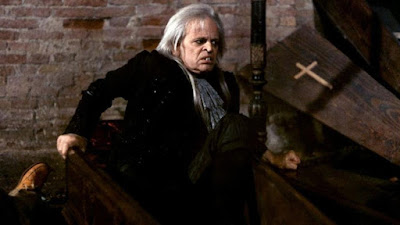
Suffice to say though, if Caminito didn’t exactly have his ducks in line here, it was blood and feathers as far as the eye could see as soon as Kinski made the scene. Tales of the actor’s outrageous conduct during the 1980s are, of course, legion, but, clearly aware that ‘Nosferatu in Venice’ lived or died on the basis of his participation, this particular shoot seems to have found the actor scaling ever greater heights of maniacal narcissism.

This was made immediately evident upon his arrival, when, infamously, he refused point blank refused to wear the Nosferatu make-up which had been prepared for him, declaring instead that he would play the vampire, sans prosthetics, as a more ‘romantic’ figure, complete with his own long, thinning blonde hair.

Not only did this make a mockery of evoking the Nosferatu name in the first place (and indeed of hiring Kinski specifically to reprise his role from Herzog’s film), but even more gallingly for the producers, the crew had already shot and edited twenty minutes of footage - filmed at great expense during Venice’s winter carnival - featuring a double wearing the full Nosferatu make-up.

Consulting the sketchy contract Kinski had signed for his appearance in the film, it was determined that there was nothing in place to actually compel him to wear the make-up… and woe-betide anyone who cared to try. With a substantial chunk of the budget already in the truculent star’s pocket, there was nothing to be done but surrender to his whims, ditch the pre-shot footage, re-jig the script and try to find something else to inexpensively fill all that empty screen time.

The next disaster was quick to arrive when the film’s third director, “safe pair of hands” industry veteran Mario Caiano (best known to horror fans for 1965’s Nightmare Castle) quit after less than a day on set, walking out after a violent altercation with Kinski. Thereafter, Caminito took the reins himself, with significant (uncredited) assistance from second unit director / special effects supervisor Luigi Cozzi [also see: Paganini Horror].

We could continue discussing the difficulty Kinski provoked on set at some length here, but one anecdote related by Cozzi will hopefully prove sufficient. At one point it seems, he and Caminito left the set for ten minutes, to make a phone call and buy some cigarettes. Returning, they found Kinski sitting alone in an empty room, the entire crew having apparently packed up their equipment and left with the intention of boarding the next plane back to Rome, so heinously had the star managed to offend them during the producer/director’s brief absence.

All of this though pales into insignificance compared to the rumours surrounding Kinski’s abuse of his female co-stars, which cast an ugly pall over whatever enjoyment may still be gleaned from ‘Nosferatu in Venice’. Again, we don’t need to labour the point here - the grisly details are easily google-able, and, if true, they’re pretty horrendous.

In summary though, it seems that actress Elvire Audray (who plays the wife of the movie’s supposedly heroic doctor character, woodenly played by Yorgo Voyagis) left the film with immediate effect when - as per Cozzi’s recollections once again - Kinski disregarded an instruction to bite her on the neck during filming, and instead subjected her to what can only be described as a violent and sustained sexual assault.

Even taking into account the progress which has been made on such matters since the dark days of the 1980s, it seems extraordinary to me that Kinski was not behind bars within hours of this incident, having apparently assaulted a woman in front of multiple witnesses and a rolling camera, but… who am I to speculate on the whys and wherefores of the situation?

Be that as it may, Kinski remained on the loose, and tried the same tactics on the film’s ostensible leading lady, Barbara De Rossi, allegedly molesting her off-camera whilst shooting close ups for a scene in which Nosferatu seduces her character in her bedroom. Reportedly, De Rossi only agreed to continue work on the film after receiving a promise that she would never again be placed in close proximity to Kinski… thus necessitating further rewrites. (1)

Meanwhile, the star seems to have found what we must assume was slightly more willing recipient of his attentions in the shape of a young woman named Anne Knecht, who apparently caught his eye when she visited the set as Voyagis’s girlfriend. Despite Knecht having no prior acting experience, Kinski insisted she was cast as a hastily-scripted new character. (No wonder the female characters in the finished film are so ill-defined and interchangeable.)

Presumably to the great relief of the other cast members, Knecht went on to dutifully provide the bulk of the film’s requisite nudity, most prominently during the lengthy ‘love scene’ (I use the term loosely) which comprises the film’s the finale. Therein, we see a shockingly haggard looking Kinski groping and clambering around on Knecht’s impassive naked body for what feels like hours, whilst, in a particularly grim irony, the footage is intercut with shots of her real life boyfriend Voyagis grumpily stomping about in ineffectual ‘vampire hunter’ mode.

And so the chaos went on, until - thankfully for all concerned, I can only imagine - Caminito called principal photography to a close after six weeks, despite having only acquired around two thirds of the footage he needed to complete the scripted film - in addition that is to ten solid hours of material ‘directed’ by Kinski himself, featuring his character stalking alone through Venice’s pre-dawn streets. (Ironically, these shots actually comprise some of the best stuff in the finished film.)
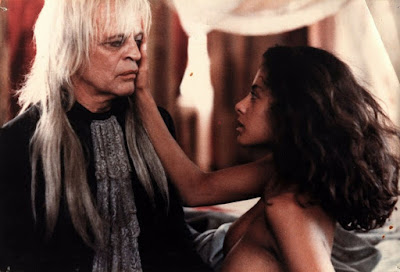
In view all the palaver outlined above, it’s hardly surprising that ‘Nosferatu in Venice’ emerged as an extraordinarily disjointed mess. Unreleased for several years after shooting was completed, the film’s editing (credited to Claudio Cutry) comprises the cutting room equivalent of a dazzling high wire act, splicing together pieces of mismatched, discontinuous footage into some semblance of narrative order, with… mixed results, in spite of what I take to have been herculean efforts on Cutry’s part.

The tragedy of it all is though, there are bits of the film - sequences of shots here and there, or even entire scenes during the first half - which are genuinely excellent. 

The deep shadows and subdued, Gordon Willis-esque lighting favoured by DP Tonino Nardi lend a pungent, foreboding atmosphere to the Venetian location footage, whilst interior scenes featuring the film’s better actors (Christopher Plummer, Donald Pleasence, and Maria Cumani Quasimodo as ‘the princess’), apparently filmed in a genuine, suitably palatial Venetian villa, achieve a sense of brooding menace, reminiscent of such art-house horror staples as Borowczyk’s ‘Docteur Jekyll et les Femmes’ or Tony Scott’s The Hunger. “Terrible things happened in these chambers two hundred years ago,” we are repeatedly told, and for a moment there, we can believe it.

Even the disjointed / discontinuous editing rhythms sometimes work in the film’s favour, bringing a murky, opiated haze to proceedings, suggestive of some incorporeal, space/time warping evil which feels entirely in keeping with the symbolic/metaphysical aspect of the Nosferatu character, whilst the thinly sketched, comic book weirdness of the, uh, ‘plot line’ invests everything with a haphazard surrealism which surpasses even the ‘80s output of directors like Cozzi or Lucio Fulci for sheer bewilderment.

So, speaking of the plot, let’s try to get this straight, shall we?

A perpetually silk-clad young woman, who lives alongside several other young women in a crumbling Venetian villa belonging to an elderly princess afflicted by a cursed bloodline, invites a Van Helsing surrogate vampire expert to come and see her, because she has found an iron-bound coffin in the villa’s basement which she believes, for some reason, must be the resting place of the dread Nosferatu, who (it is apparently well known) was last seen in Venice exactly two hundred years earlier.

But, this cannot be so, the vampire expert (Professor Catalano, played by Plummer) insists, because Nosferatu actually perished in a shipwreck somewhere far away, and now rests at the bottom of the ocean. But, everyone at the villa still feels some kind of psychic ‘connection’ to the bad ol’ vampire (reflecting both the cursed bloodline business, and the fact that he committed assorted atrocities in the villa back in 1786). So, what else do do but call in a medium and hold a séance with the intention of contacting the spirit of Nosferatu, thus prompting him to awaken from his slumber and bust out of his dusty coffin way over yonder in… some other place. (Not the bottom of the ocean, at any rate.)

After taking time out to engage in some lusty dancing with a group of gypsies who - in an interesting, if politically questionable, throwback to Stoker’s ‘Dracula’ - appear to hold him in high reverence, the revived Nosferatu employs a rather vague supernatural methodology to transport himself back to Venice, where, needless to say, he sets about biting necks, leching over ladies and indulging his inexplicable passion for throwing people out of windows.

Brilliant! All makes perfect sense, right? Italian horror movie logic, god how I love it.

Also hitting that late-era Italio-horror sweet-spot, consistently undermining the film’s intermittent attempts to achieve a more ‘classy’ feel, is Luigi Ceccarelli’s score, which - perhaps reflecting the lack of funds/enthusiasm which remained for this project during post-production - sounds as it was recorded on the cheapest synthesizer available, and transferred to the film via a warped cassette tape left for too long in direct sunlight. Whether the fact that I still enjoy the music speaks to Ceccarelli’s talents or just my personal fondness for such lo-fi aesthetics, I’ll leave readers to judge for themselves.

So, for my purposes at least, this is all pretty amazing as far as it goes - but, each time we’re ready to settle back and surrender to the intoxicating, oneiric groove of the whole thing, something completely stupid happens, crashing us straight back to reality. Again and again, the film catapults us from the sublime to the ridiculous in a matter of seconds, which proves a real buzz-kill.

Nosferatu’s aforementioned return to Venice proves a good case in point. A disconnected series of images sees him gliding across unguessed at landscapes before he is seen stalking recognisable Venetian landmarks in the eerie glow of the rising/setting sun, temporarily imbuing him with an ethereal, nameless menace matching the baleful rhetoric which has previously spouted about him in the film’s heavy-handed dialogue.

When he appears, silently, in the bedroom of the elderly princess, grinning like some imp of the perverse - or like Robert Blake’s white-faced man in Lynch’s ‘Lost Highway’ perhaps - the effect is truly horrific. Utterly malevolent, Kinski is all too convincing here as the personification of death, pestilence and misfortune, come to wreak cold, impersonal suffering upon all who cross his path.

We can only savour this exquisite dread for a few seconds though, because… then he jumps up and throws the old lady out of the window! An unconvincing dummy goes SPLAT on the inevitable spiked railings which surround a small patch if garden below, and we cut to an unedifying insert shot of the 78-year-old Maria Cumani Quasimodo - evidently not impaled upon the railings - with some stage blood dribbling down her chin.

Unbelievably, this exact same defenestration gag - a ridiculous way for a supposed master vampire to deal with his prey, aside from anything else - is repeated, equally unconvincingly, several more times during the film, as if someone on the production was convinced that a few good railing impalements was all it would take to win over a post-‘Omen’ horror crowd.

Even in terms of its gory horror business though, ‘Nosferatu in Venice’ is wildly inconsistent - consider for instance a frankly incredible shot elsewhere, when Nosferatu is hit point-blank in the chest by a shotgun blast. In what was apparently a green-screen effect orchestrated by Cozzi, we see Kinski raise his arms in a mocking, Christ-like posture, revealing a perfectly spherical hole in his chest, through which we can see traffic slowly passing on the canal behind him. It’s a pretty great moment.

Essentially anchoring the first half of the film, Christopher Plummer initially seems determined to bring his A game to a frankly dreadful script, lending an admirable amount of gravitas to the rambling passages of cod-vampiric lore he is called upon to recite. As the film goes on though, and the situations get sillier, we can almost see him disengaging, his patented “ah, I see now - this is a load of shit” expression becoming increasingly difficult to hide.

And indeed, his facial muscles have a point. Entirely dismissing the accepted ‘rules’ for vampirism, Caminito’s script instead opts to just, well… make up a bunch of random shit, as Plummer’s dulcet tones are employed to inform us that, amongst other things, the illegitimate children of illegitimate parents (and/or plague victims) will inevitably become vampires, that the only surefire way to destroy a vampire is to use bullets filled with liquid mercury, and that - rather like Waldemar Daninsky - a vampire’s spirit can only achieve true death after receiving the pure love of a virgin. (Boy, I bet Kinski must’ve loved that last one!) 

I wouldn’t mind so much, only… none of these novel innovations actually seem to have much of an impact on the film’s storyline?

Back in the real world meanwhile, I’m guessing that Plummer must have also left the production before shooting concluded - having presumably completed his contractually obligated number of days, or whatever - meaning that his all-too-noticeable absence from the film’s final act is rationalised by means of a hurriedly slapped together montage of unconnected shots, which attempt to visually convey the idea that, having despaired of his ability to defeat Nosferatu following a heated argument with Donald Pleasence’s priest character, Professor Catalano has committed suicide by jumping from a bridge into the canal!

Largely avoiding such indignities meanwhile, Pleasence (who seemed to have been specialising in bringing a touch of class to creaky gothic horror movies starring hell-raising sex-pests at this point in his career) here provides good value for money as usual, playing a weak-willed, gluttonous priest who attends the elderly princess.

As has been mentioned, Maria Cumani Quasimodo (who may be recognisiable to euro-cult fans for small roles in ‘Femina Ridens’ and ‘All The Colors of the Dark’), does fine work here too, as does Clara Colosimo (a wife, mother & maid specialist in Italian movies since the early ‘60s) as the medium. It’s interesting in fact to find two such strong roles for older women in a project which otherwise seems awash with misogyny on both sides of the camera. (One shot of Colosimo cruising through the canals in her private gondola, hair defying gravity, proves particularly memorable.)

So where, ultimately, does ‘Nosferatu in Venice’ sit within the cultural hinterlands of late ‘80s Italian horror? Even assuming we can temporarily put aside the legends arising its nightmarish production, is the weird, beached husk of a movie which remains ultimately worth our time?

Well, as difficult as it may be to defend from any objective standpoint, what can I say? We still watch ‘The Lady From Shanghai’ and ‘The Private Life of Sherlock Holmes’, don’t we? We still listen to Big Star’s ‘Third/Sister Lovers’ and The Beach Boys’ ‘Smiley Smile’. So why not ‘Nosferatu in Venice’?

The difference, I suppose, is that each of those works had the hand of a legitimate creative genius behind them, and seeing that hand slip or fail or tear itself apart carries a fascination which can sometimes even surpass that engendered by the greatest of artistic triumphs.

By contrast, ‘Nosferatu in Venice’ provides us with an equally fascinating example of a creative work which reached completion (in a manner of speaking) with no one at the wheel. Cruising into harbour like the empty, cursed ship which carries Nosferatu to shore in Murnau’s original film, there is a black hole at the centre of this movie - a void where the vision or direction provided by even a mediocre guiding light would normally be found.

Kinski may have established himself as the dominant presence on set through sheer force of will, but at the same time he was clearly happy to see the film crash and burn, interested solely in the opportunities it provided for him to pamper his ego and indulge his demonical lusts. Caminito meanwhile was obviously way out of his depth with regard to all aspects of on-set filmmaking, whilst everyone else simply kept their heads down and prayed for the damn thing to end.

Nardi’s lighting, Cutry’s editing, and the steadfast presence of Plummer, Pleasence and Quasimodo - these things came through to deliver 86 minutes of tangible celluloid which we can watch today without physical pain, but beyond that… the closest thing the movie gets to an auteur is probably Venice itself, the riches of its architecture and atmosphere infusing nearly every shot, pretty much cementing my long-held suspicion that literally anything shot in this extraordinary city will to some extent be worth watching.


--

(1) Widely repeated around the internet, the film’s Wikipedia page sources the accusations concerning Kinski’s abusive behaviour on set back to both Roberto Curti’s book ‘Italian Gothic Horror Films, 1980-1989’ (2019) and Matthew Edwards’ ‘Klaus Kinski: Beast of Cinema’ (2016), whilst the stories are also reiterated to some extent by both Cozzi and soundman Luciano Muratori in the excellent documentary ‘Creation is Violent: Anecdotes from Kinski’s Final Years’, which accompanies Severin’s recent blu-ray edition of ‘Nosferatu in Venice’. We here at BITR can of course make no claims either way regarding the accuracy of these tales, especially if there are any legal professionals in the room.