Showing posts with label London. Show all posts

Monday, 14 November 2022

Pan’s People:
Two Edgars
(1956/57)

Many of the cover illustrations used for Pan’s innumerable Edgar Wallace paperbacks are a bit dull, but these two are both absolutely terrific I think, highlighting the same lurid / fantastical aspect of Wallace’s work which was exploited so wonderfully by the German Krimi productions of the ‘50s and ‘60s.

This edition of ‘The India Rubber Men’ was published 1956 with art by Bruce C. Windo, whilst ‘The Ringer’ is 1957 (fifth printing), signed “Silk” (an artist whose full name and identity appears to be unknown, but as ever, please do drop me a line if you have any further info).

‘The Ringer’, of course, was the basis for Alfred Vohrer’s highly entertaining ‘Der Hexer’ (1964), which I reviewed here back in 2019.

Saturday, 6 November 2021

Pre-War Thrills:
Dark Eyes of London
(Walter Summers, 1939)

Until recently, I’d tended to accept the received wisdom that the few, scattered, horror films made in the UK during the 1930s were pretty creaky and timid affairs, their ambition stymied both by the era’s censorious climate and by the British film industry’s steadfast refusal to treat the nascent genre with anything approaching acknowledgement or respect.

Like viral infection or rock n’ roll though, horror will always find a way, and as such, I was pleasantly surprised to discover that, rather than the mere historical curiosity I was expecting, ‘Dark Eyes of London’, shot in the less than palatial surroundings of Welwyn Garden City over eleven days in April 1939, is actually pretty damned great.

Headlined by imported star Bela Lugosi - who seemingly undertook a journey across the Atlantic by ship solely to appear in the film - this adaptation of Edgar Wallace’s 1924 novel is in fact fairly strong stuff for its era, conveying a morbid, decidedly unsavoury atmosphere and including some moments of sadism grim enough to provoke comment even in the more open-minded United States (where the film played in 1940 as ‘The Human Monster’, having been picked up for distribution by Lugosi’s regular employers at Monogram).

Whilst the film’s violence never reaches a level which viewers alive today would deem ‘graphic’, there is a certain, base level nastiness to the depredations of Lugosi’s villainous Dr Orloff which remain disturbing. From the steel water tank in which it is implied the good doctor drowns his victims before dumping them, pre-deceased, into the Thames, to the scene in which he uses an electrical current to deafen a bed-ridden, blind-mute beggar, there is some nasty business going on here and no mistake.

In view of all this, it difficult to believe the film was produced at all, given that the UK’s censors had effectively banned all horror films just four years earlier, having thrown their toys out of the proverbial pram when confronted with the comic book excesses of Universal’s ‘The Raven’ (Lew Landers, 1935). I’d certainly be interested to learn how ‘Dark Eyes..’s domestic release played out under such circumstances, although it was, I note, the first film to be awarded the short-lived “H” (for “horror”) classification by the BBFC, meaning that persons under sixteen would theoretically be refused admittance.

It is telling that, between 1939 and 1950, when the ‘H’ certificate was more or less phased out in favour of the more iconic ‘X’, only one other domestic production achieved the dubious distinction of being “rated H” (Ivan Barnett’s little seen 1950 take on ‘The Fall of the House of Usher’). Instead, the dreaded ‘H’ was reserved exclusively for imported American horror pictures, leading me to surmise that its introduction in 1939 must have reflected the censor caving in to pressure from representatives of the American studios, particularly Universal, who had of course returned to making horror films in earnest at around the same time, and presumably needed a way to get their product onto UK screens. Beyond noting the unique position in which this leaves ‘Dark Eyes of London’ though, perhaps that’s a subject best left for another day.

It is possible, I suppose, that ‘Dark Eyes..’ journey to the screen may have been further aided by the fact that it sprung from the pen of a phenomenally popular, household name author, celebrated (if not exactly respected) for his mystery and crime - as opposed to horror - fiction.

Indeed, for all its unpleasantness, the movie is framed as a police procedural rather than a gothic horror, with the approach taken by director/co-screenwriter Walter Summers reminding me, not so much of the Universal-derived horror you might have expected from a production which went to trouble of luring Bela Lugosi across an ocean, but of Alfred Hitchcock’s then-recent series of ground-breaking contemporary thrillers.

In particular, 1934’s ‘The Man Who Knew Too Much’ shares this film’s down-at-heel East London setting, its diabolical Hungarian-accented villain, and even the idea of a charitable/religious institute being used as a front for criminal activity. More importantly though, ‘Dark Eyes..’, like Hitchcock’s British films, has the decency to remain fast-paced, modernistic and ingeniously plotted, imbuing its convoluted storyline with a strong, character-driven through-line to keep us hooked.

Along the way, Summers (along with co-writers Patrick Kirwen and producer John Argyle) give us plenty of interesting diversions, good-natured banter and running gags to break the tension / ghoulishness, and, whilst it’s probably fair to say that Summers lacks the touch of mastery we’d routinely assign to Hitch, the film is nonetheless very nicely done, with solid performances across the board and some impressively detailed production design, making for a rather charming, neatly turned out entertainment whose incongruously breezy tone must have further eased the censor’s worries.

For those who are neither keen readers of Edgar Wallace nor familiar with Alfred Vohrer’s excellent early ‘60s German quasi-remake of this film (of which more below), the plot of ‘Dark Eyes..’ concerns a number of suspicious corpses fished out of the Thames, all of whom turn out to have been customers of the Greenwich Insurance Company - a small-time outfit operated by one Dr Orloff, a seemingly kindly and well-meaning fellow with - AHEM - a murky past as a disgraced medical researcher, who also maintains close connections to The Dearborn Institute, a Limehouse-based home for the blind operated by his - AHEM - close personal friend, the sightless Rev John Dearborn.

As well he might, dashing young Inspector Holt of the Yard (a brisk and likeable Hugh Williams) smells a rat, and, given that Dr Orloff is clearly guilty as sin from the outset, the film’s subsequent ‘mystery’ largely consists of mapping out the precise size and shape of that rat. Less of a ‘whodunnit’ then, and more of a ‘what in god’s name is he doing!?’, if you will.

Of course, further complications arise across the film’s 76 minutes of densely-packed plottin’ and chattin’, not least the introduction of Norwegian actress Greta Gynt, providing a surprisingly strong and self-sufficient heroine as the daughter of one of Orloff’s earlier victims.

In this telling of the tale, Inspector Holt is also accompanied - presumably for reasons of transatlantic sales potential - by a hard-boiled, gun-toting Chicago cop - played for laughs by Edmun Brian - who is sticking around after delivering an extradited convict in order to learn something of Scotland Yard’s rather more genteel methods. It’s a testament to the film’s overall quality however that, rather than functioning as an insufferable comic relief goon, Brian is actually quite an appealing presence. Providing an effective foil for Holt, he even manages to achieve a few unforced laughs here and there, allowing the film to pioneer the ‘chills n’ chuckles’ formula which would later be repeatedly taken to the bank by Rialto Film’s post-war Wallace adaptations in West Germany. [Please consult the Krimi Casebook for further details.]

Jess Franco fans in the audience will no doubt be gesturing frantically and jumping up and down by this point, so yes, let’s briefly pause to acknowledge the fact that, given that the name ‘Orloff’ does not appear in Wallace’s source novel, Uncle Jess clearly must have been very fond of this movie, given the many and varied Dr Orloffs who abound throughout his mammoth filmography, beginning, of course, with Howard Vernon’s memorable portrayal in 1962’s The Awful Dr Orlof [sic].

Technically I suppose, this makes ‘Dark Eyes of London’ the inaugural entry in the Orloff saga, a loose accumulation of cinematic oddities which went on to include not only Franco’s numerous reiterations of the character, but also such mind-boggling spin-offs as Pierre Chevalier’s ‘Orloff Against The Invisible Man’ (1970) and Santos Alcocer’s ‘El Enigma del Ataúd’ aka ‘Les Orgies du Docteur Orloff’ (1967). (1)

As such, Euro-horror fans may wish to pause to consider the fact that the screen’s very first Dr Orloff was in fact embodied by no less a personage than Bela Lugosi - and a pretty bang up job he does of it too, I must say. Gifted with a more ambiguous and multi-faceted role than he was generally called upon to play in Hollywood, and with his confidence presumably buoyed by both his top-billed status and (we must assume) a level of respect and financial recompense commensurate with his talents, Lugosi actually delivers what I’m inclined to consider one of the very best performances of his career here.

Though Lugosi clearly makes little effort to try to convince the audience of the innocence his scripted character pleads during the film’s early scenes, he instead builds Orloff into an exquisitely loathsome, duplicitous, scene-stealing villain, the like of which old Bela was born to play, but so rarely actually did. The way he can switch from acting the soft-spoken philanthropist one moment to turning on his EVIL STARE and revealing himself as a diabolical mesmerist the next is truly remarkable.

Rivalling Lugosi’s hold over the imagination of the movie’s original viewers meanwhile is the more literally monstrous figure of ‘Jake’ (played here by Wilfrid Walter), the hulking, blind stooge whom Orloff uses to carry out his dirty work (somewhat pre-empting the character of Morpho in Franco’s Dr Orloff films).

Monogram’s publicity materials and re-titling certainly made Jake the star of the show upon the film’s American release, and, although the character was portrayed in more naturalistic, and more terrifying, fashion as ‘Blind Jack’ (Addy Berber) in Alfred Vohrer’s Die Toten Augen von London (‘The Dead Eyes of London’, 1961), Walter makes an impression here nonetheless; if not for his acting, then at least for the absolutely extraordinary make up job achieved by the film’s technicians.

Framing this unfortunate brute as a full-on monster, complete with pointed ears, protruding jaw and bulbous, orc-like fangs, Jake’s utterly fantastical visage provides another wonderfully diversion from the stultifying rules of ‘good taste’ which confined the ambition of so much British cinema in this era.

Speaking of Vohrer’s film meanwhile, that’s certainly another matter we’ve got to discuss here. Going into ‘Dark Eyes..’, I was worried that that it might pale in comparison to the more stylish, more sensational quasi-remake which hit screens over two decades later. And indeed, there is a lot of crossover between the two films, with at least some scenes and visual motifs in ‘Dead Eyes..’ appearing to directly recreate material first seen here. But, there are also enough differences between the two in terms of character and storytelling for them to avoid treading on each other’s toes too much, allowing them to co-exist as equally enjoyable alternate versions of the same tale.

As is extensively discussed by Kim Newman and Stephen Jones on the special features accompanying Network’s new blu-ray edition of the movie, ‘Dark Eyes of London’ feels in many ways like a bit of a cursed film; if not exactly an unheralded classic, then certainly a solid and historically significant effort which has never really gotten its due.

Being released in the UK six weeks after Britain’s declaration of war with Germany probably didn’t exactly help ‘Dark Eyes..’ prospects at the domestic box office - and, sadly, this same historical circumstance made the prospect of Lugosi returning to the country to promote the film, or to work again with the its producers, an impossibility. (2)

Slipped out with little fanfare by Monogram in the U.S. a year later amid a glut of creatively and financially impoverished Lugosi vehicles, it was all too easy for ‘The Human Monster’ to fall through the cracks, filed away between the likes of ‘The Devil Bat’ and ‘Spooks Run Wild’ in the memory of young audiences ill-equipped to appreciate the movie’s rather different cultural context.

With the majority of extant prints comprising blurry, severely degraded copies of this U.S. release version, the film has subsequently languished in Public Domain hell (see this version for a representative example). As a result, it has failed to gain much traction even amongst die-hard classic horror buffs, whilst Vohrer’s 1961 version has meanwhile been (justifiably) enshrined as something of a cult classic.

It is only really with this year’s pristine restoration (see link above) in fact that ‘Dark Eyes of London’ has finally, over eighty years later, been given another chance to find its audience. If you’re still reading this far down the screen, I’d bet that you’re a potential member of that audience, and as such, I’d urge you to take the plunge.

Ok, so the sight of Bela Lugosi lurching around claustrophobic faux-London sets menacing blind people whilst some bantering cops close in on his tail probably won't exactly change your life, but for fans of pulp mystery fiction or classic horror cinema alike, it will at least prove an absolute hoot, if not something of a minor revelation. It seems strange to retrospectively crown such a marginal and unbeloved production as probably THE best British horror film of the pre-war era, but, such is the dearth of competition that I’m damned if I can think of a better one.

----


 ----

(1)In the commentary track included on Network’s blu-ray, Kim Newman puts forward the theory that ‘The Dark Eyes of London’ influence on Jess Franco’s work goes far beyond merely repurposing the villain’s name for his own purposes. Newman suggests in fact that Franco scattered references and homages to the film throughout his filmography - an idea that, as a Franco fan, I find fascinating, but can’t immediately dredge up much evidence for. Certainly, there are similarities here to Franco’s script for ‘The Awful Dr Orloff’ (1962) - particularly re: cross-cutting between the villain’s crimes and the police investigation thereof - and Franco did indeed obsessively return to the same narrative framework across his subsequent career. But beyond that..? I’m not so sure. In an ideal world, I’d love to discuss this idea at length with the esteemed Mr Newman, perhaps over a few drinks and a slap-up supper, but I’d imagine he probably has more pressing matters to attend to (not least his new novel, which sounds great).

(2) As also observed by Newman & Jones, it is notable that ‘Dark Eyes..’ producer/co-writer John Argyle’s next project was another Wallace adaptation, ‘The Door With Seven Locks’ (aka ‘Chamber of Horrors’), which debuted in October 1940 with Leslie Banks, who had of course beautifully cribbed Lugosi’s style in ‘The Most Dangerous Game’ (1932), in the leading role. We may surmise therefore that that pesky war may perhaps have deprived us of the pleasures of an entire series of Lugosi-starring, UK-produced Wallace pictures.


Friday, 1 May 2020

Horror Express:
The Haunted House of Horror
(Michael Armstrong / Gerry Levy, 1969)

If you’ve read around the history of British horror a bit, chances are you’ll already be familiar with the convoluted background of this singularly ill-starred production, but nonetheless, it’s impossible to really put the contents of the film in their proper context without reference to behind-the-scenes shenanigans, so I’ll recount the tale for you in brief below.

So, basically – in 1967, ambitious young writer/director Michael Armstrong made a short film entitled ‘The Image’, starring an equally young and ambitious David Bowie. To follow up on the relative success of this venture, Armstrong put together a proposal for his debut feature – a violent psychological horror/thriller with a shocking-at-the-time homosexual twist, provisionally entitled ‘The Dark’, also starring Bowie. Tigon’s Tony Tenser was sold on the idea, and approached the British office of American International Pictures to sort out a co-production deal… which, by common consent, is where the trouble began.

To retrospective gasps from the world as it existed just a few short years later, AIP’s UK head honcho Louis M. ‘Deke’ Heywood nixed the casting of Bowie, insisting that fading ‘Beach Party’ heartthrob Frankie Avalon would prove a better box office draw, whilst also excising some of the more controversial elements from Armstrong’s script. The director, apparently grokking that compromise is the name of the game in commercial cinema, acquiesced, and set about shooting whatever was left of his masterpiece amid what seems to have been an atmosphere of persistent back office interference.

As Armstrong tells it, after principal photography was completed, he was told that Heyward didn’t think the footage was up to scratch, and had requested two weeks of re-shoots. Hastily throwing together ideas for a bunch of new and revised material he could use to beef things up, Armstrong anxiously prepared for the big production meeting – only to discover that it had taken place without him. He could collect his full fee, and would retain his director’s credit, but Heyward’s assigned director (Gerry Levy, who’d recently helmed the disastrous ‘The Body Stealers’ for Tigon/AIP) would handle the re-shoots, so, thanks for your hard work old chap, but best just go home and put your feet up, and we’ll sort everything out, alright?

Nine months later, something called ‘The Haunted House of Horror’ (we can blame Tenser for the title – not one of his best) made it to the screen, and is, to put it charitably, a complete dog’s breakfast.

It may be a cheap shot to observe that this back story is more interesting than anything that actually happens on-screen, but it’s unavoidable really. The fact is, most of the enjoyment which can be gleaned from this misbegotten cultural artefact comes from trying to keep track of whose footage we’re watching at any given moment, as fragments of Armstrong’s attempt to expose the venomous cynicism and psycho-sexual dysfunction of his swinging London contemporaries are interspersed – sometimes within the same scene, or exchange of dialogue – with redubbed material or new insert shots highlighting Heywood & Levy’s perverse determination to transform the project into some kind of outdated “teens in the haunted house” type drive-in caper.

As such, we’re never quite sure whether the mod-ish youngsters who initially assemble at a Central London house party are meant to be wolfish, psychedelic degenerates or gormless, Scooby-Doo-esque innocents. When they subsequently decamp to a derelict rural mansion for a phony séance (just for KICKS, y’know), the sudden lurches between teeth-grindingly witless dialogue of the “gosh, let’s get outta here before we see a ghost” variety and outbursts of shrieking, mean-spirited hysteria are jarring in the extreme… although the sad truth is that neither mode is really terribly engaging.

As presented here, the central conceit that, upon discovering that one of their friends has been brutally murdered, the party-goers decide to respond not by calling the police and/or leaving the dark old house to seek help, but instead by disposing of the body and instigating an extended private game of “one of us is the murderer, but who?”, just seems flat out ridiculous.

Perhaps if (as I suspect may originally have been the case), the script had established these guys as a bunch of sinister, ulterior motive-harbouring ne’erdowells with legitimate reasons to fear the fuzz, it might have worked. As is though, it feels as if Shaggy just got knifed, and Velma and Freddie are like, “shit man, we need to ditch the stiff”. We just can’t buy it, in order words – especially when it’s square-as-a-slide rule Frankie Avalon who’s trying to sell the others on this deeply questionable course of action.

Elsewhere, Heywood/Levy-mandated sub-plots involving veteran tough guy actor George Sewell as a spurned older lover of one of the girls, and a doddering Dennis Price as a police detective, prove almost unbelievably tedious, serving little purpose beyond padding out the run time – examples of the kind of cinematic ‘dead air’ which will sadly be all too familiar to devotees of Jess Franco and/or Harry Alan Towers. Even during the central ‘spooky house’ segments though, the pacing is often pretty slack and the action repetitious.

On the plus side, the pungent swinging ‘60s atmos of the film’s opening scenes will (as with just about anything filmed in this magic time and place) be worth the entry price alone to some viewers. The fuzzed up grooves which play during the house party scenes are pretty cool (it’s The Pretty Things, working once again under their ubiquitous ‘Electric Banana’ pseudonym, I believe), and the production design and set dressing - by future Norman J. Warren collaborator Hayden Pierce - is excellent too, during the Armstrong footage at least.

Some of the ‘tiptoeing around the dark house’ stuff is convincingly atmospheric, and, most memorably, the film’s two murder set pieces (both featuring male victims) are exceptionally gory for the period, edited together as sequences of ‘Psycho’-like shock cuts which I presume must remain largely true to the director’s original intent.

In places, we can also see that Armstrong had a pretty good knack for drawing strong performances from the film’s young cast (perhaps the fact he was around the same age himself helped in this regard), although the chopped and mangled nature of the footage prevents any of them from really establishing a consistent identity for themselves, whilst Avalon – whose be-cardiganed and be-quiffed character is ludicrously introduced as “..the epitome of Swinging London” – proves as wooden and out-of-place as you’d fear.

Likewise, we can just about see how the final reel revelation of the killer’s identity and motivation might potentially have provided a powerful and disturbing denouement, if the preceding seventy-five minutes had provided us with an appropriate frame of reference for it all, and if the pivotal scene had been performed by two actors who actually seem to have been in the same room with each other and understood the significance of the dialogue they were delivering – neither of which, sad to say, is the case here.

Whilst most of the blame for the sorry state in which ‘Haunted House of Horror’ reaches us must inevitably lie with Heywood & Levy though, it’s fair to say that there is likewise little left here to suggest that Armstrong’s original cut would have been a singular work of genius. Perhaps, as Heywood & co would no doubt have argued had posterity granted them the opportunity, he was simply too young and inexperienced to deliver a releasable, commercial feature? Perhaps, in tacking 30 or 40 minutes of hastily-shot filler onto the footage he delivered, they were simply trying to protect their investment and get the thing into cinemas?

Perhaps. But probably not. The cack-handedness of the producer’s insidious attempts to alter the tone and emphasis of the material, together with the remnants of a more coherent aesthetic vision which can be glimpsed in Armstrong’s footage, certainly lend credence to the director’s hard-luck story. Even if the film he delivered may have been a bit rough around the edges, Armstrong’s original cut would almost certainly have comprised a darker, more tonally consistent and more noteworthy contribution to the canon of British horror than the dispiriting hodge-podge of inconsequential guff AIP left us with.

It may not have established its director as a worthy successor to Polanski or Michael Reeves, but it would at least have given us a juicy chunk of sordid, late ‘60s gristle to chew on, prefiguring the grimy, proto-slasher tradition of Pete Walker’s ‘The Flesh & Blood Show’ and Richard Gordon’s ‘Tower of Evil’ by several years, or else mirroring the congealing counter-cultural ennui of Alan Gibson’s ‘Goodbye Gemini’ or Reeves’ ‘The Sorcerers’.

And, if we’d gotten his original wish and managed to cast Bowie, well… the sky’s the limit. Safe to say, we’d all have had umpteen releases of ‘The Dark’ sitting on our shelves by this point, and ‘Sight & Sound’ would have knocked out a cheery 50th anniversary piece a few months ago. Perhaps Armstrong might even have gone onto a longer and more rewarding directorial career, rather than packing the whole thing in after being shafted even more comprehensively by Adrian Hoven whilst trying to direct ‘Mark of the Devil’ in Germany a year or two later. Who knows. It’s a funny old game, this film industry lark.

We must, I suppose, at least admire Armstrong’s self-control in not attempting to recreate his film’s groin-stabbing finale in real life after seeing ‘Haunted House of Horror’ for the first time. He did get to enjoy at least some small quantity of revenge a few years later however, using ‘Deke’ Heywood as the basis for the pointedly named character of ‘Big Dick’ in what remains perhaps his most endearing contribution to British cinema, the semi-autobiographical sex film satire ‘Eskimo Nell’ (1975).

---

One of many things which is arguably more rewarding than watching ‘Haunted House of Horror’ is looking at some of the wonderful artwork which distributors around the world came up with to try to sell it. In particular, note the Italian poster, which tries to pass it off as a Poe adaptation!

Sunday, 28 October 2018

October Horrors # 13:
The Devil Within Her
(Peter Sasdy, 1975)


AKA ‘I Don’t Want To Be Born’, AKA ‘Sharon’s Baby’.

There is a lot to like about Peter Sasdy’s ‘I Don’t Want To Be Born’ / ‘The Devil Inside Her’ (I’m not sure which of those titles to go with really, either in terms of audience recognition, or my own personal preference).

For one thing, this is a quintessential “London in the ‘70s” film, with Kenneth Talbot’s nuanced and attractive photography and Sasdy’s confident direction helping to highlight all manner of glorious period detail, as the story veers uneasily between the gaudy middle class idyll of Joan Collins and Ralph Bates’ Chelsea townhouse and the seedy Soho strip club milieu within which Joan until recently made her living.

Like many New York films of the same era, it does a very good job of exploring the way in which the inhabitants of various, drastically different social strata (nuns and Harley Street doctors, high-flying young businessmen and ad executives, strippers and pornographers) must all find a way to co-exist within the same, imperfectly delineated urban landscape.

It’s all too easy to imagine the scummier worlds of ‘Death Line’ and Permissive living and breathing just around the corner, and the events of Sitting Target taking place just a short hop away on the tube.

The extravagant, almost barbaric period décor of the lead couple’s curtained living room is a thing of wonder to me – as is their none-more-70s approach to parenting, wherein the best solution to an infant’s violent behavioural problems is to lock him in his room and head downstairs for a stiff drink.
Indeed, these new parents spend so much of their time knocking back hard liquor that, to be frank, application of Occam’s razor might tend to suggest a simpler explanation for their troubles than demonic possession.

I was also delighted to see Bates visiting the same Italian food shop in Soho that I sometimes pop into to buy lasagne verdi sheets, and to discover that it looked exactly the same in 1975 as it does today.

And, I would also love to learn more about the place Collins goes to at one point for a tense meeting with John Steiner’s truly repulsive strip club owner. An indoor swimming pool – apparently also located in Soho – decorated with bright blue and green tiles, wherein visitors could apparently take a seat right at the edge of the pool and be served ham salad sandwiches and glasses of nut-brown ale by formally-attired waiters, whilst swimmers are splashing around right next to them. What a world of wonders this film is.

In terms of performances too, ‘The Devil..’ / ‘I Don’t Want..’ / whatever is great. Most notably, Donald Pleasence is on absolutely top form here as the family’s long-suffering paediatrician. He gets loads of screen-time, and does all that great Donald Pleasence stuff that we love so much. Along with ‘Death Line’ and ‘Wake in Fright’ in fact, I think this ranks as one of my all-time favourite ‘70s Pleasence performances.

Eileen Atkins, who plays a severe though enlightened Italian nun (Bates’ sister), also delivers an excellent performance, and her feisty academic discussions with Pleasance are one of the film’s highlights.

There is an extremely strange sub-plot about her continuing her program of scientific research whilst stationed in a London convent, which I’d imagine must have caused every single person who has ever watched this film to stop and ask themselves, “what the hell kind of Catholic Convent contains full laboratory facilities for carrying out animal experiments anyway…?!?”

No explanation is offered, and the film is all the better for such bizarre details, although I could have done without some brief footage of some bunny rabbits being given a hard time.

As mentioned, Steiner is great value here too, earning himself a prominent place in British cinema’s long lineage of vile, Soho sleaze-merchants – a more debased, crass and spiv-like successor to Christopher Lee in 1960’s ‘Beat Girl’, perhaps?

The sequences set in his club meanwhile are as lengthy, colourful, gratuitous and skeevy as furtive cinema-goers in 1975 may have demanded, representing perhaps ‘70s British horror’s most extended delve into this-sort-of-thing (although personally I still prefer the sheer, poverty-stricken weirdness of the equivalent scene in Norman J. Warren’s ‘Terror’ (1978), with Milton Reid as the doorman).

Oh yeah, and that reminds me! Caroline Munro is in this movie too, as Collins’ best friend and fellow stripper. Always nice to see her.

I’m not quite sure about the whole thing with Ralph Bates pretending to be Italian (did Franco Nero drop out at the last minute or something?), but again – his highly questionable accent is just another divertingly peculiar detail to throw on the pile.

Ron Grainer’s music is excellent too, particularly during the last few reels, when the movie spins way off into the realm of chaotic derangement in a manner I quite enjoyed.

So, yes – all of these things are good.

[Deep breath.]

I just really wish, in my heart of hearts, that these things hadn’t all been used to tell a story about Joan Collins giving birth to a demonically possessed baby after being cursed by an evil, strip club compere dwarf named Hercules.

I mean… I don’t know how best to break this down for those of you who have never seen this film but… we’re supposed to believe that the baby scratches people’s faces with his little baby fingernails, and pushes babysitters into lakes. Later, he makes a break for it out of upstairs windows, climbs trees, swings ropes around people's necks, and disposes of bodies.

Hercules meanwhile struts around the place leering and jeering and occasionally arranging for his face to be super-imposed over footage of the baby, as if daring the relevant campaign groups to instigate a lawsuit. I don’t think we ever get much of an explanation as to why he has evil, Satanic powers and can curse unborn children, except that, well, he’s a dwarf, and he goes around leering and jeering, and such.

It’s….. all just absolutely fucking ridiculous, to be honest.

Based on the information above, I think you can probably make an informed decision on whether or not this is a film you would like to watch. Rest assured, if you’re leaning toward the affirmative, the movie revels in its own bad taste to such an extent that it’s got longer legs than Joan Collins as a jaw-dropping camp / comedy item, if that’s your bag.

Perhaps it’s just my own fault that I’m sitting here wishing that, on some level, it could have been, y’know…. actually good?

Frankly, I think I would probably have been happier watching a movie in which Joan and Ralph just sit in their magnificent sitting room getting plastered, and invite Dr Donald, and the nun, and Caroline Munro, and the sleazy strip club guy (but maybe not Hercules) over for an impromptu cocktail party.

It probably would have ended up with just as many bodies hidden in the back garden, but it would have been a lot more fun.

Wednesday, 23 May 2018

Pan’s People:
Gideon’s Month
by J.J. Marric

(1960)


I’m afraid I’ll be heading off on holiday for a while through May and June (no prizes for guessing where). As such, I’ll be leaving you with a few pre-scheduled posts, offering up some recent additions to the various bits of my paperback collection I’ve been featuring here over the past few years. And, it seems weirdly appropriate that we should kick things off with a book seemingly set in London during a May heat-wave.

Like many of the British crime books published by Pan (see: The Little White God), there’s a heavy ‘Dixon of Dock Green’ feel to this one, although the sight of a lady in her night-gown being threatened by a knife-wielding ne’erdowell at least hints at the more lurid content that crime stories and thrillers were routinely dishing out by the dawn of the 1960s. Lovely artwork as always from BITR hero Sam ‘Peff’ Peffer.

J.J. Marric was of course a pseudonym for the impossibly prolific John Creasey – we covered another entry in his long-running Gideon series here a few years back.

Friday, 9 February 2018

Pan’s People:
The Little White God
by Edwin Brock

(1965)

After Paris and L.A., we move to the more familiar environs of South London, circa 1965.

I love the Times quote on the front. (For the uninitiated – Z Cars.)

Edwin Brock (1927-1997) was primarily known as a poet, and this seems to have been his only novel. Once again, it looks as if it might well be worth a read. And, yet again, beautiful cover art too – a quintessential example of 50s/60s Brit-crime imagery that, frustratingly, I can’t find an artist credit for online. Good ol’ Pan.

Thursday, 23 June 2016

Krimi Casebook:
Das Verrätertor / ‘Traitor’s Gate’
(Freddie Francis, 1964)


BLOGGER’S NOTE: It was actually a complete coincidence that I had this post, which discusses the intricacies of a curious Anglo-German co-production, scheduled to appear on the day of the UK referendum on membership of the European Union. As a strong believer in co-operation between nation states, open borders and the breaking down of cultural & economic boundaries, I’m unsure at the time of writing whether I’ll be weeping tomorrow morning or merely putting the whole sorry mess behind me and moving on, but – checks watch – I believe there’s still time to get to the polls today, so would urge all UK citizens reading to please consider rejecting petty nationalism and doing the decent thing. And hey, why not let this tale of zany Germans running around idyllic 1960s London waving guns about guide your hand..? (Ok, maybe not.)

[Political mithering ends. / Movie review begins.]

By late 1964, Copenhagen-based Rialto films had been churning out Edgar Wallace ‘krimis’ for the West German market for nearly five years, and had released no less than seventeen entries in the loosely connected series.

Given this level of productivity, and the creative burnout it must inevitably have incurred in the studio’s small stable of writers, directors and actors, it makes sense that someone in Rialto’s boardroom must have sat up one day and realised that the film industry in the UK – where all of these films were ostensibly set – also boasted its own, equally efficient, genre movie production line, as exemplified in particular by Hammer studios, whose unprecedented international success in the late ‘50s and early ‘60s could scarcely be ignored by other European producers.

Perhaps those fuzzy stock shots of Big Ben and Trafalgar Square were starting to get a bit ragged, or constantly redressing those ‘Scotland Yard office’ and ‘cobbled East End back street’ sets was getting a bit tedious - or perhaps Joachim Fuchsberger and Harald Reinl just REALLY needed a holiday - but whatever the reason, feelers were extended, hands shaken, and when ‘Das Verrätertor’, the 18th entry in Rialto’s Wallace series, went into production, it did so in actual, real life London, with Freddie Francis (fresh off ‘The Evil of Frankenstein’) in the director’s chair, and a script provided (under a pseudonym) by Hammer’s Jimmy Sangster.

Sadly, the eventual result of all this bold co-productionin’ sass is an odd mish-mash that basically plays out as if a few of the more distinctive faces from the ‘krimi gang’ (Klaus Kinski and Eddi Arent) had accidentally blundered into a mediocre British thriller in which everyone inexplicably speaks German - but nevertheless, it is not without its merits, and it remains vaguely interesting as a historical curio, at the very least. (1)

Things certainly get off to a good start, with an edgily shot prison break from a joint that I suppose is supposed to be Dartmoor (eventual destination of all krimi ne’erdowells). Bleak, wide angle overhead shots are here mixed with juddering, handheld footage and a tense, mod jazz soundtrack, as our protagonist (British actor Gary Raymond) scrabbles across scrubland with armed guards in close pursuit, only to find himself rescued by a Luger-toting Kinski, who ushers him into a waiting helicopter in which the pair make their getaway.

Back in London however, it soon becomes clear that this going to be another one of those creaky old “plan to steal The Crown Jewels” type heist capers, with all the discussions of alarm systems, guard duty rotas and unspeakably tedious footage of Beefeaters trooping about exchanging keys that that invariably entails.

Perhaps this might have all carried a bit more of a sense of novelty to German audiences than it does to us Brits, but it’s more likely that ‘Das Verrätertor’ simply suffers the kind of narrative structure that – much like that of the routine whodunit – has withered particularly badly under the glare of our somewhat different 21st century entertainment expectations.

I mean, first off, hands up who really gives two shits about the Crown Jewels? I suppose back in the ‘60s they probably still carried a certain mystique and cultural importance vis-à-vis British identity and so on, but now… well, you tell me when concern for their security last crossed your mind. And do any of us *really* care that much about the rather routine and unsurprising methods by which some fictional crooks might go about stealing them..?

No, what we really want to see in a story like this is the excitement that ensues during the after the heist, as things go wrong and people get hurt, as the perpetrators flee the law and double-cross each other, and so on. The jewels themselves should be little more than a McGuffin to set up the human drama. Unfortunately though, this is a point that Sangster and Francis (and perhaps Wallace, assuming anything in this yarn can actually be traced back to him) largely fail to appreciate, instead choosing to take us again and again through the not-terribly-riveting aspects of the gang’s planning whilst saving the big jewel-grab itself for the final reel.

Normally, Sangster was a writer who could be relied upon to put a cynical new twist on the formulaic genre material he was assigned to work on, but, perhaps playing it safe for a co-production aimed at an overseas audience, ‘Traitor’s Gate’ is an uncharacteristically bland effort, hitting the expected beats of its plotline with nary a trace of surprise or innovation. (A shame, as the twisted aesthetic of the krimis might in other circumstance have made for a perfect match with the black humour and imagination of Sangster’s better writing.)

Elsewhere in the film, Eddi Arent pops up as – I bet you never saw this one coming - a bungling German tourist, who gets inadvertently involved in the heist gang’s plans when, in the course of his day-to-day bungling, he accidentally visits a pleasantly authentic-looking Soho strip joint, the “Dandy Club”, wherein he witnesses triggerman Kinski doing away with a snitch – the gunshots muffled by the drummer in the house band playing a roll on the snare.

Slickly staged by Francis, this episode is just as much fun as it sounds, and indeed, there are some lovely bits of authentic London street footage to enjoy here too, largely shot around Piccadilly and Soho, all of which serves to make the corresponding passages of ‘changing of the guards’ / ‘buggering about with the beefeaters’ type material go down a little easier. (2)

In fact, Francis’ direction is probably the film’s strongest suit. He keeps things brisk and visually interesting through even the dullest stretches, occasionally experimenting with bold techniques and stylish moments which, it must be said, do not really equate to anything found in the British horror films he was directing at around the same time. This leads me to wonder whether he was in fact simply following the dictats of his producers in tailoring the look of the film to fit Rialto’s preferred “house style”, incorporating the kind of tricks (wide angle and deep focus shots, use of on-screen camera lens and mirrors, handheld shots and the like) that we have previously attributed to ‘krimi’ specialists like Reinl and Alfred Vohrer.

As you might have expected given the plot-line, ‘Traitor’s Gate’ features absolutely none of the macabre or fantastical elements that have livened up the others krimis we’ve thus far examined in this review strand, but as a straight-down-the-line crime caper, it is executed with what must have passed for a somewhat glamorous, high-tech sheen in 1964, exhibiting a particular fascination for camera lenses, telescopes, hidden tape recorders, clocks and so forth, verging momentarily into the realm of total ridiculousness for one particularly enjoyable moment in which the film’s heroine falls afoul of a specially modified taxi that fills the back-seat with knockout gas at a simple button push from the driver.

For the most part however, ‘Das Verrätertor’ is disappointingly down to earth. Presumably due to the fact that it was actually made in the UK with the participation of British personnel, the “bizarro world London” flavour that gave films like ‘Dark Eyes of London’ such a unique, out-of-time atmosphere is entirely lacking here, as the more buttoned down, English way of doing business vis-à-vis low budget thrillers leaves us instead with a far more quote-unquote “realistic” portrayal of London in 1964, completely devoid of psychotic masked villains, knife-wielding vagabonds, subterranean gangster hideouts, blood-thirsty fetishized murders and the like, although the presence of Kinski does at least bring a hint of this kind of thing to the table.

Spending much of his time obsessively licking his fingers and dispassionately threatening people with guns as only he can, one particularly surreal scene back-stage at the aforementioned strip joint sees Klaus lurking about near the head of a pantomime horse, whose teeth he at one point pretends to examine. In fact, I’d say that Kinski’s presence alone makes ‘Das Verrätertor’ worth seeking out, were it not for the fact that the unspeakable bastard made so many other films through the ‘60s in which he similarly delivers the goods, making such completism unnecessary for any but the most dedicated fans of his unique brand of strangely hilarious psychopathic menace.

Above and beyond the various drawbacks I have outlined above, there is one central fault that I feel stops ‘Traitor’s Gate’ from overcoming them and hitting home as a decent bit of entertainment, and that is the fact that no one else in the film is remotely interesting. With the exception of Kinski and Arent (who are both basically just goofing on their established screen personas), there is not a single character here who will stick in your mind after viewing – in fact I can barely remember a thing about any of them, and I watched this damn thing twice for review purposes.

A far cry from the sweaty-palmed blackmailers, seedy servants and playboy detectives we expect to find rounding out a krimi cast-list, in ‘Das Verrätertor’, the crooks, the innocent lead couple whom the persecute and the cops who peruse them barely have two character traits to rub together, and the blandly professional cast play out their assigned roles within the story as if they were simply experiencing a mildly stressful day working in an insurance office.

As a result, there is simply no suspense, and nothing beyond the occasional nice shot or visual flourish to even keep us awake. Will the heist succeed or not? Will the crooks be brought to justice? What do we even care, when we barely know enough about anyone concerned to decide who we should cheer or boo?

Though the film’s production values and technical credits are solid and the Rialto crew do their best to entertain, it is easy to conclude that ‘Traitor’s Gate’ – which remains one of the more obscure entries within the already obscure krimi canon - has been lost to history for good reason, relevant only to genre historians seeking an easy explanation for the reasons why the rich possibilities for Anglo-German krimi co-productions were never really followed up. (3)

------


(1) According to IMDB, Rialto’s only production partner on ‘Traitor’s Gate’ was an outfit named “Summit”, and my assumption is that this must be said company’s only known venture into the film industry, given that IMDB lumps them in with a US distributor of the same name who have no credits prior to 1983.  (Actually, it’s a fair bet that the IMDB page in question amalgamates the credits of at least three different companies, but it’s scarcely our business to complain about that here.)

(2) Outside of central London, one particularly lovely establishing shot captures the riverside beer garden of the London Apprentice pub in Ilseworth, Middlesex, which remains largely unchanged to this day.

(3) In so far as I can tell, only other Rialto krimi to feature significant UK input was 1966’s The Trygon Factor, which was directed by Cyril Frankel (‘The Witches’, ‘Never Take Sweets From A Stranger’) and starred Stewert Granger and Robert Morley. Again, no actual UK production partner is listed, and I’m not aware of the film being much of a hit on either side of the channel.

Monday, 14 December 2015

Random Paperbacks:
Gideon’s Ride
by John Creasey
(Coronet, 1972 / first published 1963)

The work of almost unbelievably prolific British crime writer John Creasey is not something I’ve ever taken a particular interest in, but when I spied this volume amid a stack of long discarded ex-pat poolside reads in a bookshop in Lagos, Portugal, something about the London-centric theme and the striking (unaccredited) cover illustration – featuring a (presumably murdered) black, female bus conductor - really grabbed me.

Also noteworthy is the somewhat edgy inside cover blurb reproduced above, which pulls a nice “oh yeah, that’s right, yeah, me too, yeah, I, uh… oh, wait, hang on a minute..” trick on the presumed heterosexual male readership.

Unfortunately, such risk-taking would not appear to have carried over into the book itself, which on a quick skim-read seems a rather quaint and old fashioned business, full of politely methodical police procedural stuff and no doubt achingly realistic details of the internal workings of London’s transport infrastructure circa 1963. Not that there’s anything wrong with that of course, but when you get to scenes such as the one in which two police officers earnestly discuss the possibility of “rounding up any young coloured men who have recently taken elocution lessons”, it becomes painfully obvious that the nine year gap between the book’s first publication and Coronet’s packaging of this edition had really taken its toll on the story's continued relevance.

Interestingly (well, to me at least), the 176 no longer goes anywhere near Willesden.

Friday, 21 February 2014

The Songs of Herman Cohen:
Horrors of the Black Museum
(Arthur Crabtree, 1959)


An outsider in the British film industry of the ‘60s and ‘70s, American ex-pat producer Herman Cohen masterminded a series of low budget horror & exploitation films that were, well… terrible, by and large. Thankfully for our purposes in beginning this new review strand though, Cohen’s productions went about being terrible in such a distinctively bizarre fashion that you’d be hard-pressed to find a fan of British horror cinema who doesn’t love them on some level.

Back in the ‘States, Cohen had enjoyed success through the ‘50s working with American International Pictures on the likes of ‘I Was a Teenage Werewolf’ and ‘I Was a Teenage Frankenstein’ (both 1957), taking the then largely moribund American horror genre (which was hardly that sophisticated as it stood at the dawn of the ‘50s, let’s face it), and further boiling it down into a bland, teen-orientated mush. His reputation for selling tickets as a cinema publicity man was already well-established even before that however; legend has it that when James H. Nicolson initially set out to find a partner with whom to establish the company that became AIP, Cohen was first on his list before Sam Arkoff got the call.

For reasons best known to himself, Cohen declined Nicolson’s offer, and, after spending a few years producing pictures for the fledging company on a freelance basis, exercised similarly mysterious logic in deciding to relocate to London. Whether his motivation was personal, financial, or just a wild “what the hell” kind of hunch, I’ve no idea, but following his arrival on British shores, Cohen seems to have picked up exactly where he left off, carving out a new niche for his particular brand of cheap, juvenile horror films in the land whose most recent exports in the genre had so recently started to rejuvenate gothic horror film-making around the world.
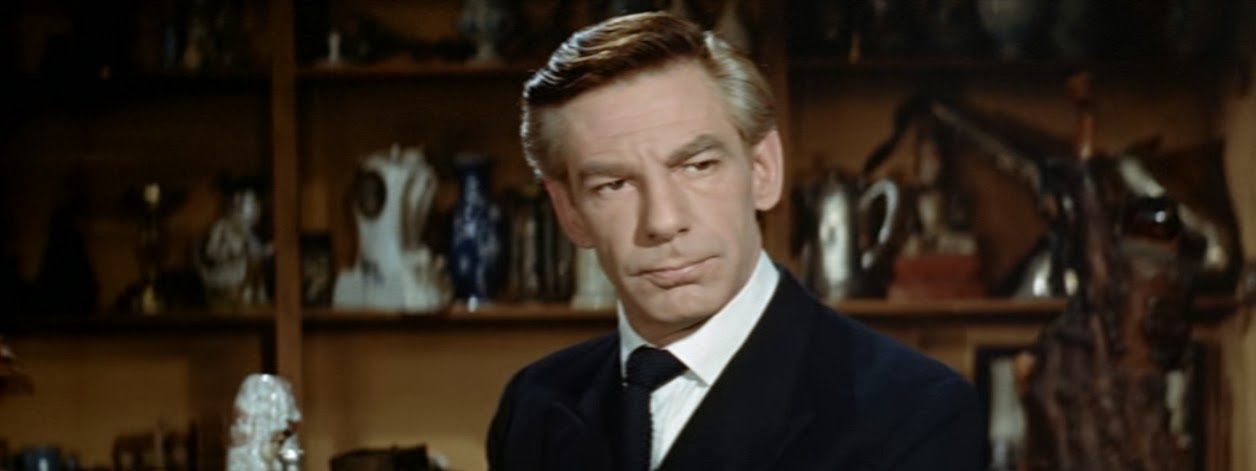
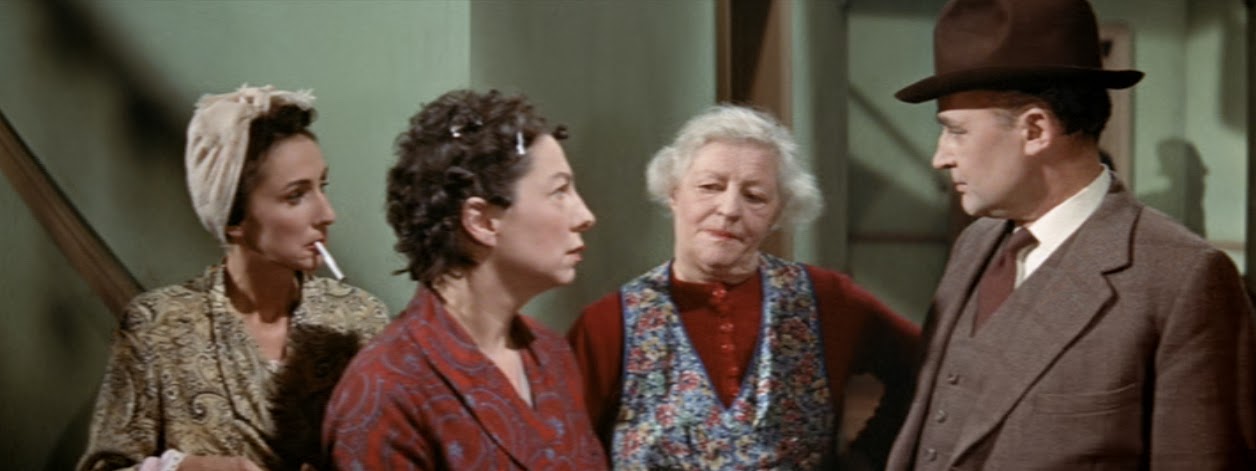
Which brings us, finally, to the opening salvo of Cohen’s British campaign, ‘Horrors of the Black-Museum’. Shot in a few weeks at the notoriously cramped Merton Park studios (British cinema’s own ‘poverty row’, more or less), this garish and implausible shocker certainly caused a few raised eye-brows and uncomfortable throat-clearings when it first appeared in 1959 – inspired as much by its sheer ineptitude as its shamelessly prurient approach to screen violence, one suspects.

Until I started watching these Herman Cohen productions, it had never before occurred to me that even the very cheapest British films from the black & white era tend to present a base level of professionalism and quote-unquote ‘quality’ that functions as something of a national trademark. That’s not to say that the resulting films are always worth watching - in fact, it’s that very veneer of ‘respectability’ that renders many of them so staggeringly boring. With a canny, low brow-centric American at the helm however, what’s most immediately notable about ‘..Black Museum’ is the way it completely ignores these expectations, instead veering so far in the opposite direction that it must have felt like a slap in the face for viewers raised on Britain’s more genteel approach to cinema.

The ‘Black Museum’ of the film’s title refers of course to the infamous archive of murder weapons and sundry paraphernalia apparently maintained, closed to the public, by Scotland Yard. Say what you like, but it’s a great title, and I’m sure there are a few good horror yarns that could be pulled out of such subject matter, although sad to say, this isn’t really one of them. Indeed, beyond a few lines of establishing dialogue, the nature of the titular museum never really comes into play at all.(1)


Instead, the film primarily concerns itself with the nefarious activities of one Edmund Bancroft (Michael Gough), an arrogant celebrity crime expert who seems to divide his ample free time between gloating over the souvenirs in his own private “black museum”, and swaggering over to Scotland Yard to taunt the officers of the law as they manfully go about the business of investigating as-yet unsolved crimes. (Quite why they continue to let him in is anyone’s guess, as he doesn’t seem to do anything during his visits except insult people and generally get in the way.)

And as it turns out, there quite a few unsolved crimes to command the Yard’s attention during the course of this picture, as London is rocked by a series of apparently motiveless murders, all of them carried out using a range of bizarre and unlikely antique implements. As Michael Gough continues to pranny about wasting police time before heading back to his basement to cackle amid his ghoulish waxworks, it doesn’t exactly take a genius to figure out what’s going on here, and, so, yeah… that’s your plot, more or less.

We should probably also mention that Bancroft commits his crimes with the help of a teenage assistant (Graham Curnow), whom he keeps in a state of hypnosis and routinely injects with some sort of inexplicable turn-into-a-monster serum, and that said assistant’s burgeoning romance with a young Shirley Anne Field (!) leads to the fiend’s eventual downfall, but that just about wraps things up, story-wise.(2)

Basically what little plot there is here simply acts as a wrap-around for a series of spectacularly silly murder scenes, the first and most notorious of which sees a curvaceous young lady meeting a sticky end via a set of binoculars fitted with retractable steel spikes. Splat. As with all of the subsequent ‘set-piece’ sequences in the film, there is an unearthly absurdity to these events that render them kinda wonderful, but… we’ll return to that in a minute.


First, let’s get it out of the way and simply state that, above all else, ‘Horrors of the Black Museum’ is a very poorly made film indeed. One of the cornerstones of the movie’s publicity campaign was the claim that it was shot in “widescreen hypnovista” or somesuch , an innovation that apparently boiled down to the use of Eastman Color and 2.35:1 Cinemascope ratio - still an extremely unusual choice for low budget films at the time, and a striking selling point even without the attendant hyperbole, one imagines.

Unfortunately however, credited director Arthur Crabtree and his crew clearly had no idea of how to effectively use the cinemascope frame. An industry veteran with credits stretching back to the early ‘30s, Crabtree had just finished work on the fantastic US-UK co-production ‘Fiend Without a Face’ (1958), which certainly proved his b-movie chops beyond question, but it’s also worth noting that the director was pushing sixty at the time, and that ‘..Black Museum’ proved to be his final film. Not that I wish to unduly denigrate anyone’s work in these pages, but, with retirement looming, maybe Crabtree simply didn’t give a shit?

‘Horrors of the Black Museum’ certainly gives that impression, relying as it does on dull, fixed camera long-shots that serve to immediately distance the viewer from the on-screen action, taking what could have been an effective shocker in the punchier old 4:3 ratio, and rendering it an instant bore, with actors forced to roam endlessly across a vast wilderness of shabby, poorly dressed sets (a drawback that earlier directors of cheap horror movies had often used the tighter aspect ratio to avoid).

The use of colour proves problematic too, with many scenes blandly overlit in uniform TV sit-com fashion, lacking any of the shadow or atmosphere you’d expect from a ‘50s / ‘60s horror film and instead presenting a world of gaudy puce and magnolia painted walls and rented furniture that helps create one of the ugliest pre-‘70s horror films on record. Oh, for a cobweb or two, or a chance to turn those bloody lights off for a minute…

To the production team’s credit, the set for a cluttered Portobello Road antique shop is very nicely done, some of the night-time interiors are lit in appropriately moody fashion, whilst the framing and general ‘look’ of the film improves dramatically for some (not all) of the scenes set in Bancroft’s museum. But for the most part, you know you’re in trouble when you watch a widescreen film in the correct ratio, and find yourself wishing it was a cropped TV version just so you wouldn’t have to keep looking at all that bloody crap in the corners. And sadly, the film’s problems don’t end there.


Long-time readers will know that I’m not usually one to take issue with, uh, ‘variable’ performances in movies, but seriously, the standard of acting here is simply appalling. Curnow is as wooden as you’d expect in his thankless teenage sidekick role,(3) but it is incredible to think that Field became one of Britain’s most acclaimed young actresses only a year or two after her sub-school play level stumble through this one.(4) Most of the supporting cast are just as rubbish too, often practically staring at the camera in search of direction that clearly wasn’t forthcoming, before shrugging and just setting the controls to “audition for amateur production of ‘The Hunchback of Notre Dame’” mode.

Under such circumstances, it’s hardly surprising that Michael Gough steals the show, but that doesn’t  mean we should hand him a medal just by default. Gough was a fine actor of course, and very much his own man in many of the better horror films he appeared in over the years, but here, as in his subsequent collaborations with Cohen, he seems dead set on simply trying to establish himself as Britain’s answer to Vincent Price - a notion that’s not quite as entertaining as it sounds, unfortunately.

Shamelessly appropriating the exaggerated mannerisms and camp demeanour of Price in his more light-hearted, ‘theatrical villain’ roles (cf: ‘House of Wax’, ‘The House of Haunted Hill’), Gough doles out the requisite ham with fearsome gusto, but fails to hit the crucial note of restraint and sympathy that Price lent to even his silliest villains, thus rendering Bancroft a thoroughly dislikeable individual, not only for his fellow characters on screen, but for the audience too.

More than any other ‘horror star’ I can think of, Gough always liked to play his villains as pure, black-hearted bastards – which works just fine when he’s a shadowy presence, pitted against some equally compelling good guys, but here, on-screen almost all the time as a Price-esque anti-hero, his constant, cringing bastard-ness basically just makes him a pain in the ass.


As Jonathan Rigby pointed out in his book ‘English Gothic’(5), Bancroft actually has the potential to become a pretty interesting character: a limping egomaniac with a mile-wide sadistic streak, it is implied that he is impotent in his relations with women, yet he uses drugs to keep a teenage boy under his control, then freaks out when said boy breaks up their S&M-inclined ‘private world’ by inviting a girl to visit..? It certainly would have been interesting to see where a director like Pete Walker might have taken such material a few years later, but anyone looking for any deeper psychological insight here will leave disappointed. In keeping with Cohen’s earlier AIP productions, both cast and script seem determined to keep things safely within the realms of conventional pantomime villainy.

And, maybe that’s just as well to be honest. After all, the future of British horror wasn’t exactly lacking in tormented psychopaths (Michael Powell’s ‘Peeping Tom’, released the following year from ‘..Black Museum’s UK distributors Allied-Amalgamated, marked a complete 180 degree reversal of Cohen’s approach to the genre), but rarely did it produce anything as deliciously goofy as this.

Because yes, in spite of all I’ve said above, ‘Horrors in the Black Museum’ remains an absolute hoot, if you’re in the right frame of mind. And, whilst I want to avoid going the “so bad it’s good” route, the film’s very ineptitude plays a big part in its weird appeal.

You know that particular feeling you get from a lot of cheaper American exploitation films, where it seems like no one on either side of the camera really knew what they were doing, and the script seems to have been written in some kind of stoned fugue, resulting in scenes that seem to have fallen out of a parallel universe where everything’s a bit ‘off’..? Well ‘..Black Museum’ is one of the few British films that captures that feel in spades. True, the dialogue scenes and expositional bits are a crushing bore, but when we hit the central murder sequences, and the set-ups that surround them, all bets are off as we lurch full-on into realms of delightfully unintentional surrealism.

The aforementioned binoculars scene is wacky enough – with the victim and her flatmate busy tottering about in high heels and tight-fitting dresses as the morning post arrives – but it’s merely a warm-up for some of the berserk wrong-headedness that follows.

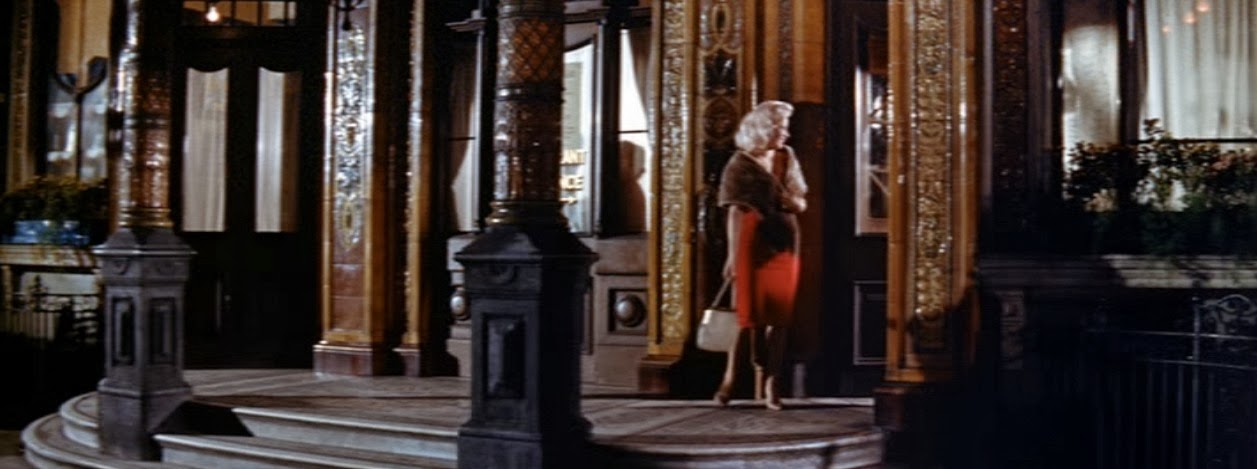

My favourite part of ‘..Black Museum’ is definitely the section of the film featuring pin-up model June Cunningham as Bancroft’s doomed mistress. Beginning with a hilariously camp, crockery-shattering shouting match between the pair (“Without your cane, you’re only half a man; and without your money, you’d be no man at all!”), the whole of the ten-minutes-or-so sequence that follows plays like a parody of a British film, as made by someone who’s never actually seen  one all the way through.

Determined to embark on a big night out in search of a new sugar-daddy, Cunningham (whose characterisation basically doesn’t extend much beyond a Diana Dors-esque caricature of a brainless-hussy-with-a-heart-of-gold) bravely sets sail for her local “pub” – an establishment whose location-shot exterior resembles a grand, Edwardian hotel, whilst the set-bound interior looks more like a windowless portacabin furnished with a bar-counter and a few tables. Here, she heads to the jukebox and puts on a swing record that sounds at least ten years older than this movie, then proceeds to perform a ludicrous, elephant-footed bump n’ grind dance routine in the middle of the floor, whilst the handful of down-at-heel extras lurking at the tables look on with what I can only read as either embarrassment or blank disinterest.

Somehow, the film fails to acknowledge the inherent comedy (and accompanying tragedy) of this Monroe-wannabe show-girl seeking romance and adventure in what appears to be the least glamorous drinking establishment on earth, and plays this scenario entirely straight, as if it were an everyday occurrence in the silent, bare-walled drinking halls of olde England.


After exchanging some toe-curling flirtatious ‘banter’ with the pub’s least mildewed looking inhabitant, and receiving a strangely touching tribute from the barman (“you really livened my place up tonight – you certainly made it a lot of fun”), June staggers off into the night after few too many flagons of Blue Nun (or whatever), and is escorted home by two courteous policemen who apparently have nothing better to do on a Saturday night than stroll around quiet residential streets, making idle conversation with passersby.

Fascinatingly off-key as all this is however, it’s basically just all padding leading up to what happens next, as Cunningham, safely back in her flat, strips down to her lacy underclothes (pretty saucy stuff for a 1959 British film), lies down drunk and happy on her bed, and….

- To be honest, I think we need a paragraph break / SPOILER WARNING to really prepare us for what happens next -

…screams, as she looks up and sees that a makeshift, portable guillotine has been attached to the top of her bed, apparently operated by a leering, oatmeal-faced zombie!

Before we can even begin to make sense of this insane turn of events, zombie-guy pulls the lever, off comes June’s noggin, and he picks up his guillotine and flees straight through the front door!

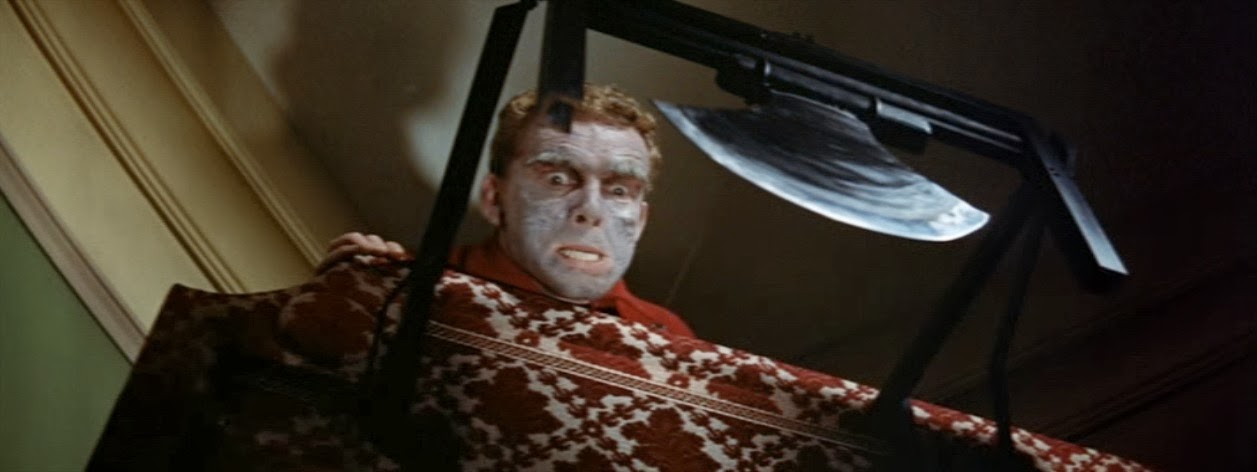

I mean… what can you possibly say to a film that suddenly throws something like that at you, in complete defiance of all notions of sanity, logic and physical possibility..? The whole guillotine bit probably doesn’t last much longer than twenty seconds, but the sheer, overwhelming joy of the “WHAT THE HELL?!” reaction it’s likely to inspire in every single conscious viewer makes sitting through the remaining hour or so of trudging, poorly shot rubbish that comprises the rest of ‘..Black Museum’ instantly worthwhile, at least according to my own strange system of values.

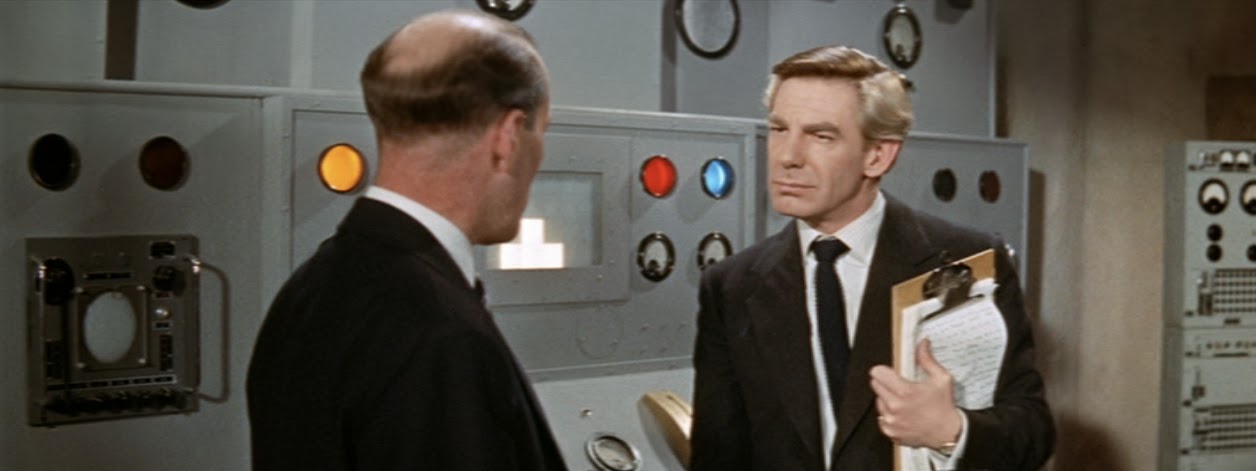
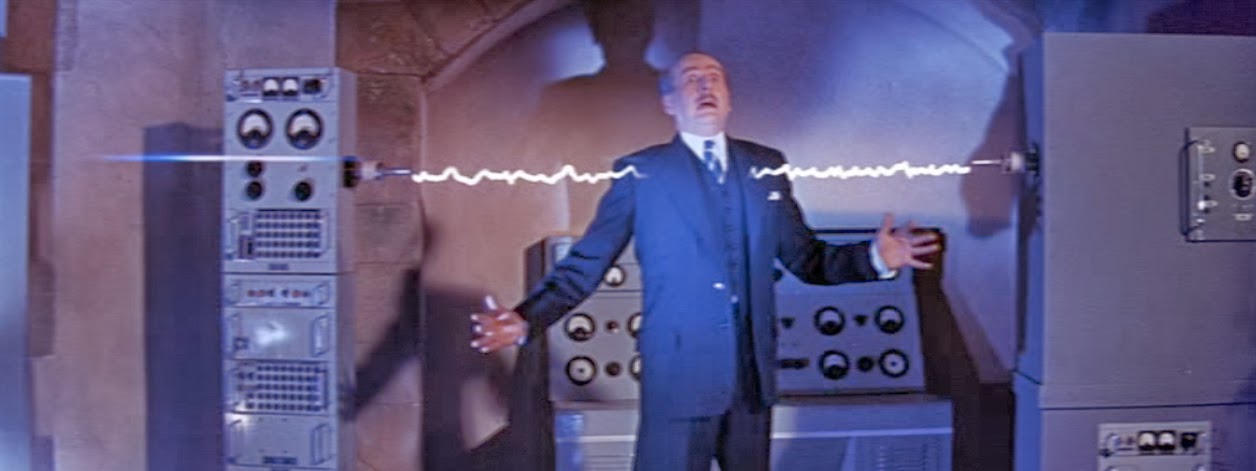
Those few seconds might represent my overall favourite moment of the film, but the remaining run-time has plenty of other lunatic fun to enjoy: from Bancroft’s unveiling of a room-sized 1950s computer system that seems to exist for the sole purpose of electrifying people, to his cackling removal of a fresh laboratory skeleton from a vat of acid, to the threadbare monster transformation / chase / shoot-out finale filmed on the cheap at Battersea funfair – it’s all the kind of wondrous, brain-damaged b-movie nonsense that later, more self-conscious practitioners of the form could never hope to rival, and, having rambled on here for long enough all ready, I’ll leave adventurous viewers to discover the rest of the film’s exquisite pleasures for themselves.
Whilst I certainly wouldn’t recommend Herman Cohen’s British films to casual viewers or well-adjusted human beings in general, what makes them so fascinating for weirdos like me is the shotgun wedding they represent between two otherwise incompatible modes of filmmaking.

If Cohen had continued to produce movies in the ‘States rather than moving to the UK, I think it’s likely that they would have been pretty unremarkable: more of the same sub-William Castle shenanigans and teens n’ hotrods double-bill fillers (not that there’s anything wrong with that, but y’know..). And conversely, if the mainstays of low budget British filmmaking in the late ‘50s had gone to work on the kind of material Cohen brought to the table, there’s a fair chance the results would have been equally forgettable: more dour and low-key quota-fillers, better written and performed perhaps, but too cowed by fear of negative press attention and the ever-present shadow of the censor to really go all-out with their grotesque or fantastical elements, and probably quite yawn-some as a result.

But somehow, when the oil of “make ‘em cheap, sell ‘em big” American drive-in hucksterism met the murky water of lower tier British exploitation, something extraordinary emerged. Certainly not something *good* by any stretch of the imagination, but then or now, the results remain a bit of an eye-opener.

And, believe it or not, ‘...Black Museum’ was just the beginning. Fuelled by the film’s modest success, Cohen and Gough were soon back at work, cooking a project that was in all senses bigger, stupider and even more astoundingly ridiculous than its predecessor. What are those booming footsteps we hear approaching..? Yes friends, KONGA was just around the corner. You have been warned.


---
(1)For anyone who’s interested, the Black Museum does indeed exist, and, whilst it is still not open to public, occasional one-off tours and open-days have taken place in recent years; further details to be found here.

(2)“I always try to put in the young teen, so the teenagers can identify with someone in the film”, Cohen helpfully explained to ‘Scarlet Street’ fanzine [#17-18, Winder/Spring 1995, as quoted in ‘English Gothic’ (see reference below)].

(3)According to a trivia entry on IMDB, Curnow was in a relationship with popular Welsh/Italian screen comic Victor Spinetti at the time, and used his fee from this film to buy a flat for the couple in Marylebone. So that’s nice, although to be honest I’m kind of astonished that the fee for appearing as the juvenile lead in ‘Horrors of the Black Museum’ was enough to put anyone on the property ladder, even in 1959.

(4)I can only assume that, like Crabtree perhaps, Field’s disdain for the project had her roboting through the role in pure “I don’t want to be here, and I hope everyone realises that” fashion. ‘Saturday Night and Sunday Morning’ put her on the map a year later of course, but we’ll always love her around her for appearing in ‘The Damned’.

(5)Jonhathan Rigby, ‘English Gothic: A Century of Horror Cinema’ (Reynolds & Hearn, 2000), pp. 58-59