HK and Cult Film News's Fan Box

Showing posts with label apes. Show all posts

Friday, May 23, 2025

Title Role Recast Mid-Scene in "Return of the Ape Man" (1944) (video)


Actor George Zucco, as "The Ape Man", received third billing after Bela Lugosi and John Carradine.

But a sudden illness (or, perhaps, second thoughts) made him drop out before a single scene was completed.

It begins with two brief shots of Zucco on the table. 

Then Zucco is replaced mid-scene by actor Frank Moran.  


Read our review of the film HERE.
I neither own nor claim any rights to this material.  Just having some fun with it.  Thanks for watching!


Share/Save/Bookmark

Thursday, May 22, 2025

Legendary "King Kong" Volkswagen Ad (1972): Stop-Motion Animation By Dave Allen (video)


(Originally posted on 10/6/18)


Dave Allen was one of film's leading stop-motion animators.

His work can be seen in such films as "The Crater Lake Monster", "Equinox", and "Honey, I Shrunk the Kids."

In 1972 Volkswagen hired him to recreate the classic King Kong for a TV commercial.

The woman is Fay Wray's daughter, Victoria Riskin.

The commercial was aired only once.

Volkswagen pulled it because viewers didn't remember the car...just Kong.
(I got to see it!) 


I neither own nor claim any rights to this material.  Just having some fun with it.  Thanks for watching!


Share/Save/Bookmark

Monday, February 17, 2025

THE BLOODY APE -- DVD Review by Porfle

Just so I don't give you the wrong impression, I want to say up front that this is a favorable review. I had loads of fun watching THE BLOODY APE, writer-director Keith J. Crocker's affectionate homage to the drive-in trash of yesteryear, and will enthusiastically recommend it to people who come knocking at my door trying to sell me a satellite dish or invite me to their church. 

Now that my disclaimer is out of the way and we can speak freely, I'll try to describe this surreal cinematic artifact to you. Imagine a cross between LITTLE SHOP OF HORRORS, BLOOD FEAST, and your dad's worst home movies. Whatever your mind comes up with, this is worse. Though filmed in 1997, it looks as though it were shot in 1967, buried, and then dug up by somebody's dog in 1997. It makes PINK FLAMINGOS look like it was directed by Terrence Malick. In fact, it makes almost literally every other movie ever made look good in comparison, unless, of course, Billy Crystal is in it. 

All of this, however, is simply part of THE BLOODY APE's makeshift charm. Crocker, a devoted grindhouse film aficionado who for several years published the popular fanzine "Exploitation Journal" with his pal George Reis, eschewed the "shot-on-video" look of much of today's indy titles and went instead for the more traditional look of actual film. Super 8mm film, that is--exactly the same stuff that all of us pre-home-video auteurs used in order to make our own geeky home monster movies back in high school. Except here, Crocker managed to shoot a feature film and get it released, so you gotta admire him for that. It's this homespun ingenuity and love for moviemaking that help make THE BLOODY APE such a strangely fascinating experience. 

The gleefully bizarre screenplay by Crocker and Reis is another factor. Loosely inspired by Edgar Allan Poe's "Murders in the Rue Morgue", it's the story of a carnival barker named Lampini (after George Zucco's character in HOUSE OF FRANKENSTEIN) and his beloved performing gorilla, Gordo. After being screwed over by an abusive garage mechanic and a crooked rabbi, and then rejected by his girlfriend Ginger while he's proposing to her, Lampini decides to use his ape as an instrument of revenge. Taking a cue from Bela Lugosi's diabolical aftershave murders in THE DEVIL BAT, Lampini mails Ginger some of his special homemade banana cream soap. This lures Gordo to Ginger's apartment, where he kills her roommates in a frenzy of fake blood and banana-scented soap suds. 

In one scene, we get to see what would've happened in PSYCHO if Janet Leigh's shower had been interrupted by a crazed gorilla instead of Norman Bates. Then Gordo chases another naked roommate around the livingroom couch a few times before squeezing the life out of her as she looks into the camera and laughs. Rabbi Rabinowitz and Vic White, the incredibly racist garage mechanic, are next on the list, having been given bunches of bananas by Lampini beforehand. I don't want to spoil too much of the intricate plot, but this is where Gordo rapes Rabbi Rabinowitz' wife and then disembowels her. Although this sounds horrible, the fact that the victim is giggling through the whole ordeal tends to soften the heinousness a bit. 

Gordo's reign of terror then goes on to include car theft--he drives around until stopped by a cop, whose head he pulls off--and the murder of an ill-mannered video store clerk, which is justifiable. Equally shocking is the scene in which a hippie is furtively taking a leak in some bushes when the confused ape mistakes part of his anatomy for a banana, and... During all of this, an incredibly racist police lieutenant named LoBianco (Reis, who also plays Gordo) is irrationally convinced that the whole killing spree is the work of an innocent black man named Duane Jones (after the lead actor in George Romero's NIGHT OF THE LIVING DEAD), which is a whole other subplot. With his ridiculous hair-helmet wig and fake goatee, Reis is as over-the-top hilarious as everything else about this movie. And as mechanic Vic White, Larry Koster is like a Jerky Boys character come to life. The early scene in which he browbeats the incredulous Duane (Chris Hoskins) out of the garage simply for wanting his car fixed sets the goofball tone for the rest of the film. 

Acting honors, however, must go to Paul Richichi as Lampini. With his dopey porkpie hat, cane, and Dracula cape, the ever-cheerful Lampini is a delightfully absurd character brimming with memorable quotes, as during his romantic dinner with Ginger: "The sky has never been bluer, the grass has never been greener, and Japanese sports cars have never been smaller, ever since I laid my head between your breasts," he gushes over a plate of Spaghetti-O's. "My love for you is as deep and as wide as the expanses of your vaginal cavity." To which the nonplussed Ginger responds: "What's the matter with you tonight? You're acting like a crackpot--like one of those self-proclaimed medicine men from the days of yore." Later, regretting his callous treatment of Gordo, he laments that he has become "so overwhelmed with repugnance for my enemies, that my love for my ape completely disappeared." 

Now, this is where I usually mention stuff like image and sound quality, but we'll skip that part and go on to the bonus features. The audio commentary is an entertaining gabfest with Crocker, Reis, Richichi, and Wild Eye DVD's Rob Hauschild, who directed the informative "making of" featurette, "Grindhouse Gorilla." Next is a Crocker short film, "One Grave Too Many", which boasts a crude sort of creepiness. Lots of other miscellaneous stuff is included: a gallery of covers from the "Exploitation Journal" 'zine, trailers for THE BLOODY APE and BLITZKRIEG: ESCAPE FROM STALAG 69, a pressbook, original VHS cover art, lobby cards, stills, and other related art. 

If you've read this far, you already know whether or not you should watch THE BLOODY APE as soon as possible or avoid it like the plague. It's loaded with exploitation goodies--nudity, violence, badly-done gore, bizarre situations, extreme characters, weird comedy--and done in such an unabashedly crude way that it radiates its own strange kind of fascination. As a Poe adaptation, George Reis accurately comments: "If you're running down the films based on Edgar Allan Poe, it's--one of them." As a study in miscommunication, as Crocker describes it, you couldn't find characters that are more miscommunicative. As cinema, it's like some kind of Super 8mm folk art whose worth can only be measured by each individual who watches it. As for me, I found it to be one of the funniest and most entertaining comedy-horror films that I watched yesterday.


Share/Save/Bookmark

Tuesday, January 14, 2025

The Burning Orphanage Scene From "MIGHTY JOE YOUNG" (1949) (video)


(spoilers)

Jill Young (Terry Moore) and her friend Gregg (Ben Johnson) are fleeing from the law...

...after a judge orders that her beloved pet gorilla Joe be shot to death.

But a burning orphanage causes them to cut short their escape.

Excellent stop-motion animation by Willis O'Brien and Ray Harryhausen...

...make this is one of the most thrilling sequences ever filmed.


I neither own nor claim any rights to this material.  Just having some fun with it.  Thanks for watching!


Share/Save/Bookmark

Saturday, January 11, 2025

Kong Undresses Ann in (Censored!) Scene From KING KONG (1933) (video)


When "King Kong" (1933) was re-released in 1938, several violent shots which violated the Production Code were removed.

Along with these went a scene considered much too risque' in which a curious Kong peels off some of Ann Darrow's clothing.

The new edit cut away just as Kong was getting started.

Here's the original, restored version...


I neither own nor claim any rights to this material.  Just having some fun with it.  Thanks for watching!


Share/Save/Bookmark

Friday, January 10, 2025

Extra Flips His Wig in "KING KONG" (RKO, 1933) (video)


When King Kong invades the native village looking for Ann Darrow, pandemonium ensues.

And for one unfortunate extra...it's truly a hair-raising experience.
 
Oh, well--hair today, gone tomorrow!


I neither own nor claim any rights to this material.  Just having some fun with it. Thanks for watching!


Share/Save/Bookmark

KING KONG (1933) -- DVD Review by Porfle


(NOTE: This review was written upon the DVD's initial release in 2005.)

Before CGI, before summer blockbuster films like JAWS, before "giant-monster-on-the-loose" movies of any kind, there was...KING KONG. Depression audiences who barely had two coins to scrape together jammed theaters in 1933 to witness this thrilling pinnacle of pure escapism and marvel at the sight of a giant gorilla battling dinosaurs, wrestling elevated trains, and swatting biplanes from his lofty perch atop the towering Empire State Building. Up to that time, KING KONG was the most spectacular, jaw-dropping adventure film ever made, and few films since, if any, have even come close to topping it.

The first forty minutes or so consist of careful, methodical build-up as flamboyant movie producer Carl Denham (Robert Armstrong) sets sail for Skull Island with the crew of a merchant ship called The Venture. He's heard stories of a giant monster called Kong who lives on the island, and plans to capture the beast on film. Along for the ride are the beautiful Ann Darrow (Fay Wray) to provide the "love interest" for his movie, and first mate Jack Driscoll (Bruce Cabot) to provide the love interest for Ann.

When they arrive, they witness a tribe of natives preparing to sacrifice a young girl to Kong. But one look at Ann, whom they call "the golden woman", convinces them that she would make a much more unique bride for the beast. ("Well, blondes are scarce around here," Denham notes.) They steal onto the ship that night and kidnap Ann, then open the massive doors of the huge protective wall that separates them from the rest of the island and bind her to an altar. As the crew of The Venture discover Ann's absence and race to the rescue, the natives wait atop the wall in awed silence for the arrival of the fearsome Kong. Suddenly there are loud, echoing footsteps...the trees are torn aside...and there stands King Kong, the greatest of all movie monsters.


All necessary exposition is laid out for us so that when Kong makes his appearance at this point, the rest of the film is a non-stop rollercoaster ride of action. Kong takes Ann in hand and disappears into the dense jungle, with Denham, Driscoll, and most of the Venture crew in hot pursuit. But it doesn't take long for these hunters to become the hunted, when they suddenly find themselves on the run from an array of ill-tempered prehistoric beasts ("from the dinosaur family!", Denham informs us). In one horrific scene, the sailors are trapped on a log over a deep chasm as the enraged Kong shakes them off into the pit below. Having dispatched his pursuers, Kong takes Ann to his lair at the top of Skull Mountain, engaging in awesome battles with various other giant creatures along the way.

But Driscoll, who managed to avoid plunging into the pit, rescues Ann and returns her to the native village. An angry Kong arrives moments later, pounds his way through the door of the great wall, and goes on a rampage in which he chews and stomps several unfortunate villagers. Denham, however, is prepared for such an eventuality, and hurls a gas bomb which knocks Kong unconscious. Realizing that the giant ape himself is worth more than any motion picture, Denham arranges to have a giant raft built to transport Kong back to New York, where he will be put on display for paying customers. "We're millionaires, boys!" he cries to the surviving sailors. "I'll share it with all of you!"

We all know, of course, that once Kong is taken to the Big Apple, he escapes and goes on a rampage of destruction that climaxes at the top of the Empire State Building, where he must fight off attacking biplanes amidst a hail of machine gun bullets -- one of the most enduring images in movie history and popular culture. 

KING KONG continues to astound all but the most jaded viewers even today, which is a tribute to the imagination and ingenuity of its makers. Special effects wizard Willis O'Brien laid the groundwork for all future effects-laden "event" movies as he created ways of bringing the most outrageous visions to the screen, many of which are still used today. His meticulous frame-by-frame stop-motion animation of Kong and the various dinosaurs never fails to impress, especially in the spectacular battle between Kong and the Tyrannosaurus Rex. 

Murray Spivack's sound design was an amazing feat considering that sound itself had only existed in movies for a few years before KING KONG. And the musical score by Max Steiner, with its beautiful descriptive passages and themes for various characters, is a masterpiece that showed all film composers to come how it should be done.

Upon its re-release in 1938, several of the more violent scenes were censored, including Kong popping various Skull Islanders and New Yorkers into his mouth and chewing on them, or stomping them underfoot. And the scene in which Kong curiously peels off bits of Fay Wray's clothing and sniffs them was deemed inappropriate as well, and out it went. The film was also darkened considerably to disguise much of the blood that flows during the battle scenes. For many years, this was the only version of the film available, until finally the excised scenes were rediscovered and restored in the early 70s.


Now, with Warner Brothers' current release of KING KONG on DVD, the film is restored, uncensored, and better-looking than ever before, with special features that will delight fans of the film. There is a commentary featuring stop-motion master Ray Harryhausen (SEVENTH VOYAGE OF SINBAD, JASON AND THE ARGONAUTS) and special-effects veteran Ken Ralston that is fun to listen to since the men are such devoted Kong fans. 

A documentary on the life of Kong producer Merian C. Cooper (upon whom the character of Carl Denham is based) is a fascinating look at a man whose exploits rival those of Indiana Jones. And the seven-part documentary "RKO Production 601:The Making Of Kong, Eighth Wonder Of The World" is packed with fascinating details about the film and comments from well-known filmmakers who have been influenced by it.

LORD OF THE RINGS director Peter Jackson, whose KONG remake hits theaters in December 2005, went to great lengths to help make this DVD a special event, including assembling his special-effects artists to recreate the legendary lost "Spider Pit Sequence" which was originally removed from the film due to its intensity ("It stopped the show!", as Merian C. Cooper put it). Jackson also created a new Kong scene using the same equipment and methods employed by Willis O'Brien, simply to give us an idea of how the effects for KONG were done since there is so little behind-the-scenes documentation of the original work. 

Also included are scenes from Willis O'Brien's aborted dinosaur project CREATION, which are so well-restored that they look as though they might have been filmed yesterday. And rounding out the special features on the disc are trailers from KING KONG, SON OF KONG, MIGHTY JOE YOUNG (Willis O'Brien's three great "Giant Ape" movies), and other Cooper productions.

If you're a fan of KING KONG, or you just want to see what all the fuss is about, there's never been a better time to watch this film in all its glory. The passage of time, and the advancement of special-effects technology, have not dimmed its power. It is still one of the greatest -- perhaps the greatest -- adventure films ever made.


Read our review of the 2005 Peter Jackson remake

Read our review of SON OF KONG


Share/Save/Bookmark

Wednesday, January 8, 2025

SON OF KONG -- Movie Review by Porfle


Originally posted on 10/25/15

(Caution: the last couple of paragraphs contain spoilers.)


I watched SON OF KONG (1933) again last night, and this toned-down sequel affected me just the same as ever. Most of the ingredients of KING KONG are there, but mixed together in such a different way as to explore whole new areas of cinematic enchantment.

The opening titles are reminiscent of KONG at first, but then they go into a cast montage and the music shifts dramatically to the jaunty but melancholy "Runaway Blues", and darned if that alone doesn't make me start to get misty-eyed. 

The stop-motion creatures are great as usual (although with little participation from special effects wizard Willis O'Brien, who was disillusioned with the project), and there's an exciting climax which anyone who saw this as a kid should vividly recall.


After the disaster of Kong's opening night in New York, showman Carl Denham (Robert Armstrong) is forced to flee lawsuits and creditors by going into the shipping business with Captain Englehorn (Frank Reicher) in the South Seas. 

Along the way he meets a sweet young down-on-her-luck woman named Hilda (Helen Mack), loses his ship to mutineers, and ends up back on Skull Island, where he and the rest encounter a baby Kong who protects them from danger as they search for a fabled island treasure. 

There's considerably less tension in this laidback sequel--the nightmare of KONG is over, and despite the hardships it caused this seems to have been cathartic for Denham as a person. He's no longer so manic and driven, content now to be Englehorn's business partner, and can enjoy little things in life like a two-bit tent show with dancing monkeys and an adorable young girl (Hilda) playing the ukelele.


The romance between Denham and Helen Mack's plucky, lovable Hilda is low-key and very sweet, more so because of the recurring "Runaway Blues" theme. The trip to the island and their adventures on it aren't dark and heavy as in the previous film, but KONG had already been done. Rather than trying to do it over again or continue its nightmarish tone, SON OF KONG gives us a fairytale ending.

It's not as much a sequel as it is a prolonged denouement--a long sigh of relief after the horrors that ended when Kong hit the pavement. All the sexual tension and Freudian complexities of KING KONG have been resolved, leaving Denham free to lead a simpler life with Hilda and, we assume, a happy ending. 

And then, of course there's little Kong (known by many as "Kiko") himself.  Some viewers fault the film for being too comedic, and indeed, this 12-foot albino ape is quite the clown.  Still, his interactions with Denham and Hilda are fascinating to watch, as are several furious battles between him and a variety of giant island creatures.  While rushed into production the same year as its predecessor, SON OF KONG still boasts some amazing special effects.


The grand finale is a terrifying earthquake which threatens to destroy the island, with Denham, Hilda, and Englehorn scrambling to escape in a rickety rowboat.  In the film's most heartbreaking moment, little Kong's foot is caught in a crevice as the island begins to sink beneath the waves, and as he wails in distress you can clearly make out the words: "Mom-my!  Mom-my!" 

Seeing Denham and Hilda at the rail of a rescue ship in their robes, as it begins to sink in that they're really in love and "Runaway Blues" creeps in one last time, still plucks the old heartstrings.  (It's here that Denham the "no funny business" mug finally cracks up and goes sappy.)  More than anything, SON OF KONG is, to me, a lovely fairytale adventure that gets a little more magical every time I see it.

Read our review of KING KONG

"The Runaway Blues" -- instrumental


Share/Save/Bookmark

Wednesday, October 23, 2024

KING KONG (2005) -- Movie Review by Porfle


(NOTE: I wrote this review in 2006 and posted it at the now-defunct Bumscorner.com.  My opinion of the film has soured considerably since this somewhat overly generous review--I can barely watch it now--but most of my reservations toward it are adequately expressed.)

Well, I never got around to seeing it in the theater, but thanks to the magic of DVD, I finally watched Peter Jackson's 2005 remake of KING KONG. If you're curious about my reaction to it, please keep reading. If not, here are some lovely pictures of giraffes.

(There are spoilers ahead, even if you're well familiar with the original film, since Jackson's version differs in several ways. So please proceed with caution if you haven't seen it yet.)

The story in a nutshell: flamboyant movie producer Carl Denham charters a merchant ship to take him and his leading lady, Ann Darrow, in search of the legendary Skull Island, where he hopes to capture such wonders on film that audiences will line up around the block to pay admission. But instead, he ends up capturing a fearsome 25-foot-tall gorilla named Kong -- who has left the safety of his jungle lair to pursue Miss Darrow, with whom he has become hopelessly smitten -- and then transports him back to New York to put him on display and make millions of dollars. Kong escapes, of course, and wreaks havoc in downtown NYC before recapturing Ann Darrow and climbing to the top of the Empire State Building, where he is picked off by machine gunners in biplanes.

The original 1933 version of this story by producer Merian C. Cooper and director Ernest B. Shoedsack is an undisputed classic. Okay, maybe it's disputed by some who now regard it as a creaky old black-and-white bore with crummy special effects. I feel that these people are missing out on one of the greatest cinematic experiences of all time -- a marvel of compact storytelling, pacing, and bravura filmmaking with a wonderful cast and groundbreaking special effects by master craftsman Willis O'Brien that are still astounding.
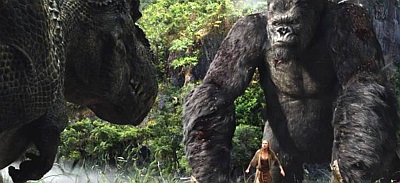

How does Jackson's film compare to the original? First of all, it looks absolutely beautiful. The first and last thirds of the movie display a dazzling recreation of Depression-era New York City that is rich in detail and utterly convincing. Jackson spends a lot more time here than Cooper and Shoedsack, who were more interested in setting up the story and getting us on our way to Skull Island as quickly as possible. In fact, Jackson spends a lot more time on everything in this version, making it twice as long as the original.

This time, we get Ann Darrow's (a radiant Naomi Watts) backstory in more detail -- she's a struggling vaudeville hoofer whose show just closed down, forcing her to consider the horrors of performing in burlesque rather than starving -- before her fateful meeting with Carl Denham, who in this version is a much more devious and manipulative, almost villainous character (although Jack Black somehow manages to make him mostly likable anyway).

Ann accepts Denham's offer of "money, adventure, and fame -- the thrill of a lifetime and a long sea voyage" after finding that a playwright she greatly admires, Adrien Brody's Jack Driscoll (who was the ship's first mate in the original version) is writing the screenplay to Denham's picture. So off they go, one step ahead of the police who have a warrant for Denham's arrest for bilking his previous film's investors.


The voyage to Skull Island gives Jackson a chance to introduce us to still more characters, subplots, etc., such as the close relationship between the first mate and a youngster named Jimmy (Jamie Bell, TURN: WASHINGTON'S SPIES) whom he once found stowed away in the cargo hold. This doesn't really go anywhere, except for the fact that Jimmy is reading Joseph Conrad's "Heart Of Darkness" and it's supposed to tie in with everything somehow. I never read "Heart Of Darkness" but I know APOCALYPSE NOW was based on it, so I guess Kong is Colonel Kurtz. Come to think of it, the later Marlon Brando would've made a pretty good Kong.

Anyway, Ann and Jack sorta fall in love, Denham and Captain Englehorn clash (Englehorn pretty much despises Denham in this version), the self-absorbed actor hired as Denham's leading man, Bruce Baxter, admires himself in the mirror, and when they finally get to Skull Island there's a thrilling sequence in which the ship is almost dashed against the rocks.

The island natives are a much more bizarre and murderous bunch this time, leading to some truly creepy moments, and when they kidnap Ann and offer her as a sacrifice to Kong by tying her to one end of a rickety drawbridge and then lowering it across a deep chasm on the jungle side of the great wall which separates them from the rest of the island, Jackson's staging and execution of the scene are impressive. All of which leads up to the big moment -- Kong's entrance -- which somehow just doesn't have the impact of the original. We only get to see fog-shrouded glimpses of him at first, and a close-up of his eyes, but never one definitive reveal, which I found disappointing.

Kong snatches Ann from her bonds (somehow managing not to rip her arms off in the process) and heads off into the jungle with her. This leads to a protracted series of fierce battles as Kong protects his golden-haired prize from a succession of prehistoric foes such as T-Rexes (three this time instead of the previous one) and giant bat-like creatures that infest the cave inside his mountaintop lair. Meanwhile, Driscoll, Denham, and a group of sailors who have set out to rescue Ann end up running for their lives from a herd of stampeding brontosauruses who are running from a group of hungry raptor-like creatures. This scene becomes almost cartoonish as the men skedaddle between the stomping brontosaurus feet and the huge beasts finally begin to pile up in a scene that resembles, as one message-board poster put it, the police car pile-up at the end of THE BLUES BROTHERS.
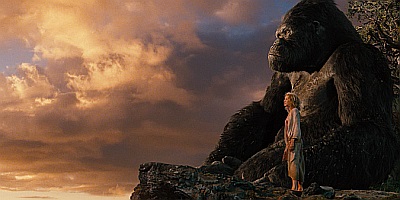

As if that weren't enough, their attempt to cross a gorge via a fallen log (which parallels the famous scene from the original) is foiled as an angry Kong shows up and starts to shake them off the log and into the pit below. Here, Jackson makes up for the excision of the fabled "Spider Pit Sequence" from the '33 version by having the hapless sailors attacked by the most nightmarish collection of giant insects, spiders, leeches, etc. that he and his SPFX crew could conceive of. I'm wondering how many walkouts there were when this was in theaters -- it's pretty horrifying. But it's also pretty cool.

Jack survives the pit, of course, and goes it alone as he makes his way up to Kong's lair. What he and the ragged remains of the rescue team don't know, however, is that while they were going through hell trying to rescue Ann, she was falling in love with Kong. And this is the element of Jackson's remake that I was dreading the most since advance word on the movie began to hint at it, and which serves as a giant stumbling block in my enjoyment of the film as a whole. I thought it was a dumb idea when it was injected into the stupendously awful 1976 remake, and I still do.

Let's face it -- if a giant rampaging gorilla grabbed me and carried me off into a jungle filled with prehistoric monsters, I'd be screaming my head off in mortal terror non-stop, just like Fay Wray's Ann Darrow did any time Kong came near her. I wouldn't be teaching the big, hairy ape sign language, nestling in his lap to watch the sunset, or making soulful googly eyes at him. I like the part where Ann attempts to calm the beast down by performing her vaudeville routine for him and eliciting a delighted reaction, but I just can't accept seeing the film turn into a love story that could almost pass for a Harlequin Romance novel with Kong taking Fabio's place on the cover.

At this point in the movie, it's almost as though Jackson had decided to remake TARZAN, THE APE MAN instead of KING KONG -- but when Tarzan carried Jane off into the jungle and she eventually came to love the untamed wild man, it was romantic. Here, it's just weird, and I found myself wondering at times if Ann wasn't a bit off in the head. And when Jack finally shows up and whispers for her to leave the sleeping Kong and come to him, for a moment there I thought she might actually refuse.


Perhaps recalling that she does have a prospective human lover and a life back in the real world, Ann manages to tear herself away from her beloved Kong and join Jack as they race back to the native village with Kong hot on their heels (a shot from the '33 version of them running through the jungle is beautifully duplicated here). When they arrive, Ann realizes with horror that Denham and Englehorn plan to capture Kong and take him back to New York as a big money-making attraction.

As Kong kills still more sailors left and right by smashing them, flinging them, and biting them in half, Ann can hardly contain her indignation and heartbreak at such a foul scheme. Although she must've come to know these hapless guys during the voyage -- we see her happily dancing for them at one point -- their violent deaths now seem to mean little or nothing to her, just as the deaths of several innocent New Yorkers and would-be rescuers in biplanes will later have no effect on her while she's in Kong's thrall. She's even furious at Jack for restraining her as Kong smashes his way through the door of the great wall, so I guess going through all kinds of hell to save her didn't keep her erstwhile human love interest out of the old debit column for long.

Kong, as everyone knows by now, does get captured and taken back to the big apple and made the star of the biggest show on Broadway. We discover that Jack and Ann have drifted apart in the interim, and he goes to the theater to try and win her back, not even knowing that she's left Denham and gotten a job in a chorus line somewhere else.


Kong's unveiling to a shocked audience is a grand affair which Jackson uses as one of the film's most blatant homages to the original, as Jack Black's Denham recites almost word for word the introductory speech Robert Armstrong gave back in '33 and the orchestra strikes up a stirring rendition of Max Steiner's famous score. The stage show also consists of a re-enactment of the native sacrificial ritual from the old version, but when the shackled Kong wakes up to find that the peroxide-blonde actress being offered to him as a bride isn't Ann Darrow, he goes ape and breaks loose. (I had to use the term "goes ape" somewhere.)

This is when the movie really starts getting good. Kong smashes his way through the front of the theater and goes on a destructive rampage through the icy streets of New York City, smashing vintage autos and trolley cars, snatching up any blonde he sees in search of the real Ann and tossing her aside when she turns out to be the wrong one. Jack jumps into an abandoned taxicab and tries to lure Kong away, but in the resulting chase Kong manages to cause even more destruction than before.

But just when he catches up to Jack and is about to smash him to a pulp, he senses something and looks around -- and there, gliding toward him out of the mist, is his beloved Ann. She leaps into his outstretched hand and off they go to Central Park for a romantic romp on a frozen lake (referred to by some as "the Thumper scene"), where they exchange more soulful gazes until the military arrives to break up their reverie. As the army guys blast away at everything in sight and terrified civilians run for their lives, Kong at last makes his way to the Empire State Building and begins his legendary climb.

All else aside -- and whatever gripes I may have, this is still an awesome film packed with one exhilarating scene after another -- Peter Jackson's staging of Kong's last stand atop the Empire State Building is a magnificent achievement. The attacking biplanes swoop down deliriously out of the sky toward Kong in several vertigo-inducing shots as he leaps around fighting them off amidst a hail of bullets. Every time I see this movie I have to go back and watch this part again, because it's simply one of the best action set-pieces ever filmed.
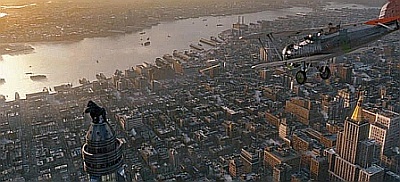

It's also one of those rare instances in which I'm glad they created CGI -- rarely has it ever been employed to such impressive effect (and when it is, come to think of it, it's usually in a Peter Jackson film). By this time, Kong has come into his own as a character that we can sympathize with (due to both the skill of the SPFX technicians and Andy "Gollum" Serkis' motion-captured performance), and his final emotional scene with Ann as he clings tenuously to the side of the building before finally slipping off and falling to the street far below is memorable. Even Jack Black's stiff repetition of the original film's final line somehow works as we reach the stirring fade-out at last.

So there you have it -- a rousing, gorgeously-photographed adventure story, a heartfelt tribute to the 1933 version by one of its most ardent fans, and a film that stands on its own and is definitely worth seeing and worth having. Which makes its one great, nagging flaw all the more bothersome to me. Maybe if Peter Jackson hadn't gone so overboard on the Ann-loves-Kong angle and used a bit more subtlety it would've worked, and might even have made Ann's offering herself to Kong in New York in an attempt to avoid further carnage seem like a more heroic act.

But as it is, she just seems abnormally and irrationally obsessed with this giant ape in a weirdly romantic way, as though he were the "man" of her dreams. Which makes her embrace with Jack at the end seem somewhat cursory. (There are, however, an awful lot of people who are utterly enamored with this aspect of the film, so -- as with any movie review -- take my opinion for what it is and decide for yourself.)

Anyway, that's the thing that really bugs me about the remake and prevents me from wholeheartedly embracing it; otherwise, I found the new KING KONG highly enjoyable on its own terms. Definitely a worthy effort, although, for me, it still doesn't quite live up to the first one.


Share/Save/Bookmark

Wednesday, October 16, 2024

Phantom Animation Devices Visible In "KING KONG" (1933) (video)


In the old days, stop-motion animators like KING KONG's Willis O'Brien and crew used a "surface gauge" to measure minute movements.

Sometimes they'd accidentally leave these devices in the shot. This happens at least twice in KING KONG. The first time isn't so noticeable. The second time is pretty obvious.

I neither own nor claim any rights to this material. Just having some fun with it. Hope you enjoy it!


Share/Save/Bookmark

Tuesday, December 26, 2023

Was The Beverly Hillbillies' "Granny" in "Mighty Joe Young"? (1949) (video)


Irene Ryan played crotchety old "Granny"...

...in the hit 1960s TV series "The Beverly Hillbillies."

But in her younger days, Ryan made a brief comedic appearance...

...in the SPFX-heavy monster thriller "Mighty Joe Young" (1949).


I neither own nor claim any rights to this material.  Just having some fun with it.  Thanks for watching!


Share/Save/Bookmark

Wednesday, March 29, 2023

THE MISADVENTURES OF MERLIN JONES (1964) -- Movie Review by Porfle


Originally posted on 7/11/21


Currently watching: THE MISADVENTURES OF MERLIN JONES (1964). I have a sneaking suspicion that I saw this at the theater or maybe on "The Wonderful World of Color" on TV as a kid but it has been lost in the hazy recesses of my memory.

All I remember is a fleeting image of Annette, and thinking that she must be just about the perfect girlfriend. Anyway, I'm counting this as a first watch.

This bright, colorful Disney comedy is the forerunner of a series of films about an egghead student at the fictional Medfield College whose wacky experiments end up giving him outrageous super-powers or otherwise causing comedic chaos in one way or another, often involving running afoul of rival students and/or gangster types.


The 1970s version would be Disney star Kurt Russell (yes, he used to be a chipper, clean-cut teen idol) as science major Dexter Riley, whose laboratory foul-ups would result in him gaining super strength, becoming invisible, and acquiring the brain of a human computer.

But in this mis-adventure that started it all, popular teen star Tommy Kirk plays science whiz Merlin Jones, resident genius who's only properly appreciated by his loyal girlfriend Annette (that isn't her name in the movie, but I don't care).

Merlin gets the plot ball rolling by accidentally short-circuiting himself into being able to read people's thoughts, which means trouble when he reads the mind of the judge (Leon Ames) who tried his traffic court case and finds out that the distinguished gentlemen is planning a nefarious diamond theft and a murder. 


This is enough to keep things hopping, and sorta amusing, for the first third or so of the movie, especially when Merlin ends up helping the police by using his mind-reading powers on a shifty suspect during a polygraph interrogation, and when he and Annette search the judge's home disguised as plumbers.

But then the whole mind-reading subplot is resolved and we discover that this is going to be a rather episodic story that will also find Merlin delving deeply into hypnotism, which he uses not only in an attempt to increase the intelligence of a lab chimp but also to find out if an honest man can be hypnotized into committing dishonest acts.

(During all of which he also has some ongoing problems with brawny campus bully Norman, as played by familiar character actor Norman Grabowski.)

To be honest, some of this overplotted stuff tends to get a tad tedious at times, especially since I have an aversion to chimps (the exception being "Lancelot Link, Secret Chimp" and Cheetah from the Johnny Weissmuller Tarzans). 


Fortunately, Tommy Kirk is at his awkward, boyishly likable best here, and Annette is just totally acing being Annette, which goes a long way toward increasing this film's watchability. No wonder American-International put them together in their teen "beach party" comedy PAJAMA PARTY the same year.

Director Robert Stevenson gives this enjoyable effort that same cheerful Disney quality which emanated from most of the studio's 1960s films, just as he did with the likes of MARY POPPINS, IN SEARCH OF THE CASTAWAYS, THAT DARN CAT!, THE LOVE BUG, this film's sequel THE MONKEY'S UNCLE, and many more. Stevenson works wonders with Disney's backlot in creating a pleasant smalltown atmosphere.

THE MISADVENTURES OF MERLIN JONES is hardly earthshaking, must-see entertainment, but for fans of early Disney, modest family comedies, and the two appealing stars, it's quite a pleasant way to pass some time. 
 

Share/Save/Bookmark

Friday, February 24, 2023

LANCELOT LINK: SECRET CHIMP -- DVD review by porfle


Originally posted on 6/10/12


Back when Saturday morning was just about the only time a kid could watch hours of wall-to-wall cartoons--along with live-action stuff like "Shazam!", "Banana Splits", and even "The Roy Rogers Show"--one of my favorite series was the simian spy spoof "Lancelot Link: Secret Chimp."  Now, Film Chest has collected all 17 episodes plus some nice extras in the 3-disc set LANCELOT LINK: SECRET CHIMP (1970), which the faithful and the simply curious alike should find both interesting and more than a little bizarre.

A takeoff of popular shows of the era such as "Get Smart" and "The Man from U.N.C.L.E.", with a little 007 thrown in, "Lancelot Link: Secret Chimp" boasted an all-chimp cast performing on scaled-down sets with all the appropriate costumes and props, and practical effects which allowed them to drive cars, motorcycles, speedboats, etc. (In a couple of western-themed segments they even ride Shetland ponies.) 

Dayton Allen provides the voice for Lance, who's sort of a cross between Humphrey Bogart and George Burns, while Joan Gerber channels Olive Oyl as the voice of Lance's partner and love interest, Mata Hairi.  The two agents work for a secret spy organization known as A.P.E. (Agency to Prevent Evil) and are forever foiling the evil schemes of C.H.U.M.P. (Criminal Headquarters for Underworld Master Plan).  A.P.E.'s leader is Commander Darwin ("What's your theory, Darwin?" Lance often asks), a character based on Leo G. Carroll's "Mr. Waverly" from "The Man from U.N.C.L.E." 


"Get Smart" regular Bernie Kopell is the voice of C.H.U.M.P. mastermind Baron von Butcher, a monocled megalomaniac whose associates include his chauffeur Creto, evil genius Dr. Strangemind (hilariously based on Bela Lugosi), Dragon Woman (who lives on an atomic-powered junk), her henchman Wang Fu, the Duchess, and Ali Assa Seen, who for some reason tends to burst into song after each sentence.

The stories (each episode contains two 15-minute segments) are very simple and serve mainly as an excuse for the chimps to perform funny bits of business that are often quite impressive.  With the perfect deadpan expressions, their simulated delivery of the show's droll dialogue can be priceless ("A thousand pardons, Dragon Woman.  A swarm of locusts attacked my moustache") as are the cleverly-edited reaction shots and slapstick performances. 

Lines were often improvised on the set to match the chimps' lip movements, yielding some delightful digressions and non-sequiturs as well as Ali Assa Seen's odd musical asides.  A typical "Get Smart"-style running gag is this exchange between Lance and Darwin:

"Give me one good reason why you should fire me."
"Because you're incompetent, an idiot, and a bumbler!"
"I only asked for ONE reason."


Some of my favorite scenes take place in Lance's apartment, which seems inspired by the ultra-modern bachelor digs of both Derek Flint and Matt Helm.  The apartment contains three secret exits ("It sounds like there's someone at the table," Lance observes in one episode) and a host of gadgets that don't always work as expected ("I need to get that button fixed"). 

So well executed is the illusion, it doesn't take long before one begins to think of these chimps as talented comic performers and grow fond of their characters.  Although a cool super-spy, Lance is also a lovable shlub.  Mata is the cutest and most appealing of the chimp cast, her expressions and demeanor matching perfectly with her Olive Oyl voice. 


One of her funniest moments is when she performs undercover as a blonde-wigged torch singer in a waterfront dive, belting out hilariously awful songs while bad guy Wang Fu cries in his beer.  Actor Malachi Throne ("It Takes a Thief") supplies the show's mock-serious narration: "Mata, fearing Lance was in danger, saw her chance to slip past the sleeping Wang Fu, who was emotionally exhausted from her singing."  Meanwhile, the chimps portraying Baron von Butcher and his cohorts seem to be reveling in their roles like a bunch of hammy human actors.

Since just about every Saturday morning show in those days had to feature a band a la "The Archies", Lance and Mata are members of an undercover rock group called "The Evolution Revolution" who in each episode perform a song which is introduced by an Ed Sullivan takeoff named "Ed Simian."  ("And now for you young youngsters out there...")  This is followed by a brief collection of "Laugh-In" inspired bits called "Chimpies." 

The DVD set from Film Chest comes with three slimline cases in a 60s-mod box that features Lance on the cover.  The episodes are 4:3 full screen with no subtitles.  Disc three contains bonuses including interviews with producer Allan Sandler and musical director Bob Emenegger and the short documentary "I Created Lancelot Link" featuring the late Stan Burns and Mike Marmer.  Sandler is shown being reunited with Lance, who now lives at the Wildlife Waystation in Los Angeles (to whom proceeds from the DVD sales will go).  Rounding out the extras is a slideshow and all of the "Evolution Revolution" songs and "Chimpies." 

A major concern which always arises regarding shows like this is the treatment of the animals involved during filming.  Producer Sandler never addresses this directly in his interview, but his recollections are of such a fond and seemingly benign nature that one gets the impression the chimps in this case were treated very well and, to a certain extent, even enjoyed performing.  At any rate, I thoroughly enjoy watching LANCELOT LINK: SECRET CHIMP and recommend it to anyone with a taste for entertainment that's not only funny but just plain wacky. 


Share/Save/Bookmark

Thursday, April 15, 2021

A Man Turns His Quarter-Life Crisis Into a Hunt for Bigfoot in "APE CANYON", on VOD April 16


Join the Hunt for Bigfoot in "APE CANYON" April 16

A Cryptozoological Dramedy Follows Two Siblings on the Trail of Sasquatch

A Quarter-Life Crisis Leads them Deep in the Woods to Find a Legend and Each Other

Available Nationwide on Cable VOD and Digital HD


Los Angeles, CA -- When your life is at an impasse, head to the woods and look for Bigfoot. Joshua Land's Ape Canyon follows Cal Piker, a commercial artist on the verge of an implosion. He won’t say why, but he needs to find Ape Canyon, and he needs his big sister Samantha to save him from the increasingly reckless things he will do to get there. 

Jackson Trent (Bad Witch) and Anna Fagan (I Like Me) headline the zoological cryptid dramedy as two siblings who join a motley crew on an expedition to find one of the hairiest myths. Indie Rights will release Ape Canyon April 16 on a number of digital and cable platforms.


WATCH THE TRAILER:


Ape Canyon premiered at Reading Film Fest, and went on to screen at a number of festivals, including the Roswell Film Festival, Orlando International Film Festival, Up Next Film Film Festival and the Fort Worth Indie Film Showcase, where the filmmakers took home the award for Best Non-Texas Feature Film. 

Cal Piker hasn’t seen his sister Samantha since their mother’s funeral. So she’s more than a little surprised when he interrupts her English lecture one morning with a bag of tacos and a proposal: a week out in the woods of Oregon, a week of looking for Bigfoot. And he already bought her ticket with her credit card.


So Samantha reluctantly joins Cal on an adventure he won’t fully explain, headed to Ape Canyon for no other reason than that “that’s where they are". But it’s a dangerous thing to be led around by Cal, the irresponsible, frustratingly likable kid brother, the one running always so hard and so far in the wrong direction.

For Cal’s part, he’s enthusiastic to the point of irrationalitydra to make his way to Ape Canyon and find Bigfoot for himself. He joins with a small group of adventurers and their guide from the Bigfoot Investigation Organization, and whatever obstacles they face—beginning, disconcertingly, with the guide absconding with money and valuables and leaving the group in the woods to die—he will not be turned away.

For whatever reason, for Cal, this is not a matter of legend. This is not just some adventure. If Samantha doesn’t stop him, Cal will either find Bigfoot or die trying.

Ape Canyon: 73 minutes / USA / English 


Share/Save/Bookmark

Monday, June 8, 2020

Thrilling Rescue Scene From "SON OF KONG" (Helen Mack, 1933) (video)


Before Carl Denham (Robert Armstrong) discovers Kong, Jr. on Skull Island...

...we discover the charming Hilda (Helen Mack) singing in a cheap sideshow act.

That night, her father is attacked and their tent set ablaze.

The rescue scene is a thrilling setpiece...

...highlighted by Max Steiner's musical score...

...and a brilliantly-staged lateral tracking shot.

Here, Helen Mack becomes one of fantasy cinema's most endearing heroines.


I neither own nor claim any rights to this material.  Just having some fun with it.  Thanks for watching!


Share/Save/Bookmark

Friday, January 10, 2020

"MAKING APES: THE ARTISTS WHO CHANGED FILM" On Demand 1/28 From Gravitas Ventures -- See Trailer HERE!


Gravitas Ventures Presents

"MAKING APES: THE ARTISTS WHO CHANGED FILM"

Available on VOD and Digital HD January 28, 2020


Fan of PLANET OF THE APES? Making Apes: The Artists Who Changed Film is a fascinating documentary about a group of ambitious makeup artists.

SYNOPSIS:

For over a century, make-up artists have dazzled audiences by creating extraordinary characters and creatures on screen.

50 years ago, a group of ambitious make-up artists led by John Chambers and Tom Burman ushered in a new era of cinema with their groundbreaking work on Planet of the Apes.

Featuring interviews with the original make-up team along with artists who were influenced by them, actors who wore the make-up, filmmakers, historians and more, Making Apes tells the emotional and thrilling story of how Hollywood was changed forever.

iTUNES PREORDER LINK:    https://apple.co/37KyUV2

WATCH THE TRAILER:


CAST:  Tom Burman, Guillermo del Toro, John Landis, Rick Baker, Leonard Maltin, and Matt Winston

DIRECTED BY: William Conlin
WRITTEN BY:  Thomas R. Burman, William Conlin
GENRE: Documentary, Independent
DISTRIBUTOR: Gravitas Ventures


Share/Save/Bookmark

Saturday, February 2, 2019

Does Kiko Cry "Mommy!" At The End Of SON OF KONG? (1933) (video)


"Son Of Kong" is a delightful, fairytale-tinged follow-up to "King Kong."

(You can read our review of it HERE.)

Kong's son "Kiko" is a likable character played for laughs and sympathy...
...with decidedly human-like qualities.

Kiko's life is threatened when the island begins to sink...
...and his foot gets caught in a crevice.

Does the poor little soul actually call for his Mommy?

What do you think?


I neither own nor claim any rights to this material.  Just having some fun with it.  Thanks for watching!


Share/Save/Bookmark

Monday, December 24, 2018

When King Kong Killed Gary Cooper's Wife! ("KING KONG", 1933) (video)


When KING KONG was re-released years after its initial run...

...several scenes were removed due to violence or sexual content.
These scenes would not be restored until the 1970s.

One of these censored scenes showed the demise of a sleeping woman...
...plucked from her bed and dropped to the street below.

The actress was billed as Sandra Shaw, otherwise known as Veronica Balfe...
...or, the future Mrs. Gary Cooper.

She and Gary were married in December of that year.

It's still a shocking scene.

I neither own nor claim any rights to this material.  Just having some fun with it.  Thanks for watching!


Share/Save/Bookmark

Saturday, June 16, 2018

Bizarre Comedy Relief Character in "The Ape Man" (Bela Lugosi, 1943) (video)


Besides the sight of a seemingly embarrassed Bela Lugosi reduced to acting like an ape...

...the weirdest thing about this film is a mysterious "comedy relief" character played by Ralph Littlefield.

Billed as "Zippo", he first sets up the story and provides exposition.

Then he keeps popping up at odd intervals for no apparent reason...

...until the strange "breaking the fourth wall" ending reveals his identity.


I neither own nor claim any rights to this material.  Just having some fun with it.  Thanks for watching!


Share/Save/Bookmark

Saturday, April 28, 2018

Phantom Paintbrush in "KING KONG" (1933) (video)


We've seen the "surface gauge" devices left by the animators in various frames of KING KONG.

Here's something not quite as noticeable--

--a paintbrush used to dab blood on the bullet-riddled Kong during his last stand against the biplanes.

An animator (Willis O'Brien, perhaps?) left it in the frame...
...but it disappears a split-second later.

Just one of those little details that make KING KONG such a fascinating movie.


I neither own nor claim any rights to this material.  Just having some fun with it.  Thanks for watching!


Share/Save/Bookmark