HK and Cult Film News's Fan Box

Showing posts with label bela lugosi. Show all posts

Thursday, April 30, 2026

What Kind Of Boots Did Frankenstein's Monster Wear? (video)


In "Frankenstein" (1931), Boris Karloff wore special boots for greater height.

They were a modified pair of knee-high "asphalt spreader" boots with the soles greatly enlarged.
Each boot is said to have weighed 13 pounds.  This added to the Monster's lumbering gait.

There have been conflicting accounts over the years...
...as to how the construction and weight of the boots vary in subsequent sequels.
They do seem smoother and more custom crafted in later films.

The Monster has been caught without his trademark boots only once...
...at the end of "Frankenstein Meets the Wolf Man" (1944).

I neither own nor claim any rights to this material. Just having some fun with it!

Thanks to Joro Gaming for the music.

Share/Save/Bookmark

Wednesday, April 22, 2026

ISLAND OF LOST SOULS (1932) -- Movie Review by Porfle


Originally posted on 4/10/21

 
Currently rewatching: ISLAND OF LOST SOULS (1932). One of the most grotesque and truly horrifying films of the Golden Age of Horror. 
 
Paramount set out to match Universal after that studio's previous year's successes with "Dracula" and "Frankenstein" by adapting another classic novel, H.G. Wells' "The Island of Dr. Moreau", and ended up creating a film so dark and so shocking that it has lost little if any of its power. 
 
Erle C. Kenton ("House of Frankenstein", "House of Dracula") proves once more that he was hardly just a hack director by making this a lavishly decadent, often nightmarish viewing experience.


Edward Parker (Richard Arlen) survives a shipwreck only to end up on the uncharted island of mad scientist Dr. Moreau (Charles Laughton at his best) who, through his techniques of accelerated evolution, transforms animals into tortured, pathetic animal/human hybrids.
 
These creatures are terrifying thanks to convincing performances (not the least of which being Bela Lugosi as a wolf man who acts as the keeper of the law taught to them by their cruel master Moreau (thou shalt not run on all fours, thou shalt not eat meat, thou shalt not spill blood, etc.) and a makeup department that had a field day creating a host of some of the screen's most frightening visages.
 
Things get even weirder when Moreau decides to test just how much of a woman his Panther Woman (the exotic Kathleen Burke) really is by introducing her to Arlen in a scene that practically oozes with pheromones. 


The film crackles with menace as the jungle surrounding Moreau's house is always crawling with the most wretched of creatures who are constantly on the verge of fully reverting to savagery and descending upon the island's human inhabitants.
 
When this finally occurs during the exciting finale, Moreau finds himself in danger of discovering why his "House of Pain" (the manimals' name for his laboratory) is a place of such terror and dread.
 
Leila Hyams and Paul Hurst also appear as Parker's bride-to-be and a captain who brings her to the island in search of her love. Arlen's a likable hero and Kathleen Burke both fascinating and heartbreaking in her character's yearning to be loved as a human female.


Laughton, of course, feasts upon the jungle scenery as a brazenly warped narcissist who revels in his own perversions and awaits the day he can return to shock the daylights out of those who have doubted and exiled him. 
 
As such, he shares a trait or two with ISLAND OF LOST SOULS itself, a film that shocks and horrifies its audience with giddy and almost human delight.
 
 
(NOTE: Thanks to Mark French for the heads up.) 


Share/Save/Bookmark

Friday, February 13, 2026

SUSPENSE: THE ULTIMATE COLLECTION -- DVD Review by Porfle


Originally posted on 5/7/09


I'm fascinated by the early days of television, and you can't get much earlier, or more fascinating, than SUSPENSE: THE ULTIMATE COLLECTION.  

This is Jurassic TV, a primitive-looking, melodramatic thriller anthology that premiered in 1949 and lasted for 260 live, half-hour episodes until 1954. Ninety of those episodes have been unearthed and are now available in this 12-disc set which spans the series' entire run. 

As in any anthology series, the quality of the writing varies--in fact, some of the stories are clunkers. But for the most part, these episodes are consistantly exciting and imaginative, and live up to the series' title with stories that quickly establish a suspenseful situation and then keep us on edge till the end. 

Several stories are adapted from the works of authors such as Robert Louis Stevenson and Edgar Allan Poe. Rod Serling's contribution, the eerie "Nightmare at Ground Zero", is a tense and unsettling atom-bomb tale that really stretches the limits of live television. 

Knowing that these teleplays were performed live gives them the immediacy of theater combined with the intimacy of television. You can imagine the actors and crew rushing into their next set-ups during a slow dissolve, and sometimes you can hear them doing it, too. 

Gaffes by these skilled actors are few, while the occasional technical blooper is unavoidable. In "The Comic Strip Murder", a piece of equipment can be seen moving past a high-rise balcony like a UFO. In "The Parcel", a stock clip of a crowd enjoying a ballgame runs out before the director can cut to Ray Walston, Royal Dano, and Conrad Janis sitting in a bleacher mock-up. Cues are missed, boom mike shadows flit across walls, focusing is done on the fly, and sometimes you can even spot an errant crew member where he shouldn't be. But mistakes like this are part of the appeal of watching live television, and the fact that there are so few of them in this smoothly produced and directed (mostly by Robert Stevens) series is impressive. 

Most of the stories are grounded in reality, with the occasional foray into the supernatural. The very first episode in this collection, "A Night at the Inn" with Boris Karloff, is an unabashedly nutball tale of a gang of thieves stalked by knife-wielding, turban-wearing Indians for stealing a sacred idol's jeweled eye, until the indignant idol itself shows up to reclaim it. Another episode, "Black Passage", features none other than Stella Adler as a hot-blooded Latin vampire and a very young William Prince as the unwary suitor of her equally bloodthirsty daughter. 

Hardboiled crime drama rubs shoulders with frequent doses of Hitchcock-style mystery and creepiness, along with the type of macabre irony often found in EC comics. Richard Boone gives a super cool performance as a homicide cop closing in on a medical examiner whose guilt has been inadvertently captured on film in "Photo Finish." In "My Old Man's Badge", Barry Nelson plays a beat cop who singlehandedly takes on a drug-smuggling ring to avenge his father's murder, and in "Dead Fall", he's framed for passing industrial secrets to the Commies. 

On the darker side, "Dr. Violet" gives us Hume Cronyn as the proprietor of a carnival murder museum who takes a chillingly active part in his exhibits, while "Dead Ernest" generates suspense by showing us a catatonic man mistakenly pronounced dead and lying on a morgue slab awaiting the embalmer. 

One of the main pleasures of watching this collection is its incredible array of familiar faces, from past, present and future stars to the great character actors, often doing brilliant work. Ray Walston (billed as "Wallston" in one episode) and Royal Dano appear several times. Leslie Nielsen, just beginning his career as a dramatic actor which would later give way to comedy, stars in "The Brush Off" with future "Superman" star George Reeves. Boris Karloff shows up more than once and Bela Lugosi gives a delightfully florid performance in an adaptation of Poe's "The Cask of Amantillado." 

Other notable names include Paul Newman, Otto Kruger, Kim Hunter, Anne Francis, Lee Marvin, Harold J. Stone, Conrad Janis, Eileen Heckart, Walter Matthau, Eddie Albert, Lloyd Bridges, Mike Kellin, Ward Bond, James Whitmore, Vic Morrow, Jackie Cooper, Brian Keith, Darren McGavin, Franchot Tone, Jack Klugman, Tom Drake, Gene Lyons, Cloris Leachman, Mildred Natwick, Lilli Palmer, Eva Marie Saint, Richard Kiley, Joan Blondell, Jack Palance, Eva Gabor, Peter Mark Richman, Jayne Meadows, Robert Webber, and many more. Several of them make multiple appearances. 

These episodes are kinescopes, meaning that a monitor was filmed during the live performances so that copies of each episode could be sent to various network affiliates (this was before videotape or cable). This gives the show a somewhat murky picture and sound quality that is unavoidable; otherwise, however, I think these DVDs look very good. 

The 12 discs are contained in six attractive slimline cases which were originally released in three seperate sets, and contain all 90 episodes of the show that are known to exist. The final episode, "The Funmaster" with Keenan Wynn, is the only non-live entry and was aired in 1958, four years after the show's demise, presumably in an effort to revive it. 

The musical score for "Suspense" is performed almost entirely on Hammond organ (with the occasional piano, tubular bells, etc.) in the style of the early soap operas, and sounds similar to the music in Herk Harvey's CARNIVAL OF SOULS. As a bonus, almost every episode contains the original commercials for the show's sponsor, Auto-Lite automotive products, featuring dulcet-toned announcer Rex Marshall and a delightfully corny assortment of cartoons and animated clips.

SUSPENSE: THE ULTIMATE COLLECTION is over 43 hours of pure, unadulterated nostalgia that I found irresistibly entertaining. Whether you're a fan of early TV, or simply curious about what the medium looked like before it began to earn nicknames like "vast wasteland" and "boob tube", this time capsule from television's infancy should give you just the sort of buzz you're looking for. Buy it at 


Share/Save/Bookmark

Monday, January 12, 2026

Porfle's Trivia Quiz: "ABBOTT & COSTELLO MEET FRANKENSTEIN" (1948) (video)


Here's one of the most popular horror-comedies of all time...

...which is beloved by fans of both Abbott & Costello and classic monsters.

How much do you remember about it?


Question: What does Lou swipe from Larry Talbot's hotel room?

A. Banana
B. Pillow
C. Apple
D. Book
E. Hat

Question: What does Bud go to the costume party dressed as?

A. Werewolf
B. Mummy
C. Frankenstein
D. Vampire
E. Ghoul

Question: Who does the Monster hurl through a window?

A. Bud
B. Lou
C. Sandra
D. Dracula
E. The Wolf Man

Question: What does Dracula throw at the Wolf Man?

A. Sword
B. Flowerpot
C. Lamp
D. Doorstop
E. Board

Question: What Universal "monster" makes a surprise appearance at the end?

A. Kharis (The Mummy)
B. Phantom of the Opera
C. Invisible Man
D. Hunchback
E. Son of Dracula


I neither own nor claim any rights to this material.  Just having some fun with it. Thanks for watching!


Share/Save/Bookmark

Sunday, January 11, 2026

Bela Lugosi At His Most Unhinged! "The Raven" (1935) (video)


In this bizarre thriller, Bela plays Poe-obsessed Dr. Vollin…

...the only surgeon who can save the life of Jean Thatcher (Irene Ware).

He also operates on an escaped convict named Bateman (Boris Karloff).

But instead of giving him a handsome new face, Bela makes him hideous.

Bela relishes gaining an advantage over others...
...and then torturing them mercilessly.

Bela's performance becomes more and more unhinged as the film progresses.

He pulls out all the stops in this one, and the result is glorious.


I neither own nor claim any rights to this material.  Just having some fun with it.  Thanks for watching!


Share/Save/Bookmark

Saturday, January 10, 2026

When Universal's "Dracula" Was Reflected In A Mirror (video)


A key element in Universal Pictures' "Dracula" lore is that the vampire's reflection can never be seen in a mirror...

...as in "Dracula" (1931) with Bela Lugosi...
...and "House of Dracula" (1945) with John Carradine.

But on at least two occasions, the filmmakers slipped up. 

In "Son of Dracula" (1943), Lon Chaney's vampire performs the screen's first bat-to-man transformation.

But in doing so, his image is captured in the hallway mirror.

In 1948's "Abbott & Costello Meet Frankenstein", Lugosi is once again in the role.

And once again, his image is reflected in a mirror.


I neither own nor claim any rights to this material.  Just having some fun with it.  Thanks for watching!


Share/Save/Bookmark

Thursday, January 8, 2026

The Three Undead Brides Of "Dracula" (Bela Lugosi, 1931) (video)


One of the eeriest aspects of the 1931 "Dracula"...

...is the sight of his three ghostly, cadaverous brides.

Dorothy Tree
Geraldine Dvorak
Cornelia Thaw 

And with the Spanish version of the film...

...comes yet another ghostly trio.


I neither own nor claim any rights to this material.  Just having some fun with it.  Thanks for watching!


Share/Save/Bookmark

Sunday, January 4, 2026

BELA LUGOSI AS THE FRANKENSTEIN MONSTER: "Frankenstein Meets the Wolf Man" (1943)


(Originally posted on 2/25/18)


Since the brain of Ygor (Bela Lugosi) was placed into the Monster's skull in GHOST OF FRANKENSTEIN(1942)...

...Lugosi was chosen to play the Monster in the follow-up, FRANKENSTEIN MEETS THE WOLF MAN (1943).

Thus, the Monster, now partially-blind, would speak with Ygor's voice.

But before the film's release, all references to the Monster's speech and blindness were removed.

The Monster's stiff, lurching walk is now unexplained...as are his silent mouth movements. 

At 60, Lugosi was in need of stand-ins for the more strenuous scenes.
Actor/stuntman Gil Perkins looked so good in the makeup, it is he whom we first see in close-up as the Monster.  Another actor/stuntman, Eddie Parker, also plays the Monster.

Perkins and Parker then take turns as Monster and Wolf Man during their climactic fight...with Bela appearing in the close-ups.


Mystery and confusion as to "who did what", compounded by extensive reshoots, continue to surround the production.

Fans of the film mourn the missing footage, which will most likely never be recovered.

And they imagine being able to watch the film, and Lugosi's performance, in their original form.


I neither own nor claim any rights to this material. Just having some fun with it!

Read our review of the movie HERE.


Share/Save/Bookmark

Friday, January 2, 2026

FRANKENSTEIN MEETS THE WOLF MAN (1943) -- Movie Review by Porfle


Originally posted on 1/5/22


I love FRANKENSTEIN MEETS THE WOLF MAN (Universal, 1943) because Lon Chaney, Jr.'s Wolf Man is my favorite monster, and this is the best Wolf Man movie ever, at least in that you get to see a lot of him, his story is interesting, and there are some great transformation scenes. Also because you get two awesome Frankenstein Monsters for the price of one--Bela Lugosi and Gil Perkins--combined to make one great tag-team performance that somehow comes together.

Bela, as many will know, was getting on in years when finally given the role of the Monster after famously refusing it in 1931.  To be fair, the part probably wasn't all that much as originally conceived, before director James Whale entered the picture with his imaginative revisions.

By the time Bela finally donned the makeup over a decade later, he had Karloff's definitive interpretation to live up to as well as the fact that his distinctive features seemed oddly ill-suited for the role.


Most damaging to his performance, however, was the fact that the script originally specified that the Monster be both blind and capable of speech, a result of Bela's "Ygor" character having his brain transplanted into the Monster's skull in the previous film, GHOST OF FRANKENSTEIN. 

While this would seem a logical development, the subsequent excision of all references in the film to the Monster's blindness rendered Lugosi's stumbling, groping movements extremely awkward-looking.  The missing dialogue (the story goes that Bela's voice coming out of the Monster sounded unintentionally funny) also resulted in shots in which the Monster's lips moved soundlessly.

By now pushing sixty, Bela was happy to turn over the role's more strenuous "acting" requirements to stuntman Gil Perkins, who not only went mano-a-mano with the Wolf Man in the final scenes but also withstood being packed into that wall of ice where he's first discovered and then freed by Lawrence Talbot (Chaney). 

Oddly, the burly Perkins looked so impressive in the Monster's makeup that it's a closeup of him we first see in the ice, and a stunning one at that.  So much so that one might wonder why he wasn't given the role in the subsequent films that featured fellow actor/stuntman Glenn Strange instead.


But aside from my affection for Bela and his ill-fated turn as the Monster, it's my love for the Wolf Man that most warms my heart toward this film.  For, indeed, FRANKENSTEIN MEETS THE WOLF MAN is more a sequel to the 1941 classic THE WOLF MAN than anything else, and a terrific one at that. 

It begins with that famous scene of two graverobbers invading Lawrence Talbot's crypt and getting much more than they bargained for, exposing his dormant body to the rays of the full moon and releasing the Wolf Man into the wild once again.

Talbot subsequently ends up in a hospital under the care of Dr. Mannering (Patrick Knowles, who played a different character in THE WOLF MAN), during which the full moon rises again and we get to see the first (and perhaps best) actual close-up transformation scene from man to wolf, done in a series of meticulous lap-dissolves featuring gradually increasing werewolf makeup in an exhaustive process that took all day and was an ordeal for all involved, especially Chaney.


Leaving the hospital--with a concerned Dr. Mannering on his heels--Talbot seeks help from the gypsy woman, Maleva (venerable actress Maria Ouspenskaya), who once cared for her own lycanthropic son Bela (played by Lugosi in THE WOLF MAN) before he passed his terrible curse on to Talbot and was then killed by him.  Together they travel to the village of Vasaria, where Maleva is sure Dr. Frankenstein (that is, the original Dr. Frankenstein's son Ludwig) will be able to help Talbot. 

When they arrive, they discover that Dr. Frankenstein is dead and his castle (into which the mental institution of the previous film seems to have morphed) is in ruins.  The full moon rises, and Talbot once again becomes the Wolf Man.  With a passel of torch-wielding villagers hot on his heels (including Lionel Atwill as mayor and Dwight Frye in a bit part), he darts into the ruins of Frankenstein's castle and falls through a hole into an underground ice cavern. 

There, after returning to human form, he discovers the Frankenstein Monster (Perkins) frozen in that wall of ice.  How did he get there, after last being seen burning alive in Dr. Frankenstein's laboratory?  Hmmm.  I guess he fell through the floor again like he did in the windmill at the end of the first movie. 


Talbot frees the Monster, hoping he can lead him to Dr. Frankenstein's diary and perhaps a way to end his own life of misery.  He then devises a plan to contact Frankenstein's daughter, Elsa (played by Evelyn Ankers in GHOST, but now embodied by bombshell Ilona Massey), to see if she knows the diary's whereabouts.  Talbot persuades Elsa to come to the castle with him, where she shows him a hidden compartment that contains the actual Frankenstein records.

Dr. Mannering shows up and inexplicably agrees to help Talbot in his suicidal endeavor (one of the troubled script's most puzzling elements), restoring Dr. Frankenstein's laboratory and using his records to come up with a way to drain off Talbot's life energies.  Elsa urges him to use the same technology to finish off the Monster as well, to which he agrees. 

Everything builds up to the film's highly-anticipated final confrontation.  As hotheaded villager Vaszec (Rex Evans) plots to blow up the dam overlooking the castle ruins and drown its inhabitants, both the Monster and Lawrence Talbot are strapped to lab tables, ostensibly so that Dr. Mannering can drain them both of their life energies and provide each a merciful death. 


Of course, it doesn't work that way--just at the point of throwing the proper switch, Mannering gets that old "mad doctor" gleam in his eyes (familiar to Universal monster movie fans) and suddenly decides he simply must see the Monster at his full power. 

Bela blinks his eyes as his sight returns, making the Monster more dangerous than he's been since the climax of GHOST OF FRANKENSTEIN.  The resulting surge of renewed energy gives us his finest closeup in the film, a crazed look of juiced-up triumph that turns into an evil sideways leer as he focuses his attention upon the lovely Elsa (apparently electricity acts as a sort of Viagra for monsters). 

Just at the point where the later films in the series began to fizzle out (Monster breaks straps, galumphs around for a while, blunders into quicksand or fire and conveniently expires), this one switches into high gear. When Elsa hits the wrong switch in an attempt to turn off the machine and the lab is shaken by explosions, with heavy wooden beams falling from the ceiling, a thrill of anticipation fills the air and we just know things are about to get really good.

The Monster bursts his straps and grabs Elsa--it's the only time in Universal's "Frankenstein" series when he'll do the traditional "monster carries girl" move--and the Wolf Man (for the full moon has just risen and Talbot has turned) follows suit soon after, attacking him from behind as Mannering whisks Elsa to safety. 

The fight itself isn't all that imaginatively staged, with the Wolf Man leaping on the Monster from various perches and the Monster throwing him around, with a little old-fashioned wrestling thrown in for good measure.  But it's still an exciting monster rumble designed to delight the fans. The dam blowing up and the raging waters surging downhill toward the castle add to the suspense.


Adding to the eternal confusion as to how many people played the Monster in this film, the shot of him bursting his straps and sullenly lumbering down off the lab table looks for all the world like an insert of actor/stuntman Eddie Parker (who reportedly doubled Chaney as the Wolf Man) in the makeup, as do some of the subsequent shots during the fight. 

This would attest to the notion of the film's final sequence being heavily redone to account for script changes, with the Monster's oversized boots being filled by whomever happened to be available that day.  In some shots he seems to be a poorly made-up Parker; in others, he's unmistakably Perkins.
 
The interspersed closeups of Bela--growling, sneering, wickedly gleeful--seem to be from the original version of the sequence which featured a talking Monster gloating over his renewed strength and power.  At one point right before the deluge he throws his arms up in a grin of triumph--is this a glimpse of the Monster right after electrical rejuvenation, when the original strap-bursting scene featured a talking, gloating Monster? I believe so, although we'll probably never know for sure.

One thing is sure, however--for pure all-around fun, the Universal horror pictures rarely, if ever, get any better than this.  While more serious critics ponder its many mysteries and hash over its faults, of which there are, admittedly, a few, fans revel in the undiluted monster goodness that is FRANKENSTEIN MEETS THE WOLF MAN.  It's a priceless example of richly-evocative vintage filmmaking that continues to fascinate and find renewed appreciation as time goes by.
  

Read the in-depth discussion of the film at Classic Horror Film Board

Getting the Story Straight: The Universal "Frankenstein" Series, Part One

Getting the Story Straight: The Universal "Frankenstein" Series, Part Two


Share/Save/Bookmark

Friday, October 24, 2025

THE RETURN OF THE VAMPIRE -- Movie Review by Porfle


Originally posted on 1/18/14


In THE RETURN OF THE VAMPIRE (1944), it's great to see Bela Lugosi playing Dracula again (his name,  technically, is Armand Tesla, but I choose to pretty much disregard that particular detail), and he obviously relishes the chance to don the old cape once more.

The wartime England setting is effective in this relatively fast-paced film, and there's a lot of spooky atmosphere. Frieda Inescort makes a strong impression as a female Van Helsing equivalent, doing her best to track down the vampire before he ruins the lives of her son and his fiancee, played by a cute young Nina Foch.  Matt Willis is Tesla's werewolf slave, Andreas, who gets a couple of cool Chaney-like transformation scenes.


[spoiler] It's a little strange to see Tesla knocked cold by a bomb blast in the final scenes, but when Andreas drags him out into the sunlight soon afterward he decomposes rather nicely. [/spoiler]

While Tesla no doubt lacks some of the class of the original Dracula character, I like to think of him as Dracula gone to seed, as though time and trevails have finally started wearing away his immortality and suave veneer, and made him a little more desperate -- not unlike the state of Lugosi's career at that point.

The story is dead serious (barring a strangely whimsical, fourth-wall-breaking ending) and filled with atmospheric sets (the cemetery is outstanding) and spooky situations.  A scene between Inescort and Lugosi's characters about midway through the film is one of the most startling and excitingly staged encounters in any classic vampire film.

THE RETURN OF THE VAMPIRE is also considered by many to be as close to a "Dracula vs. the Wolf Man" movie as we ever got except for the climax of "Abbott and Costello Meet Frankenstein" which briefly pits the two Universal monsters against each other.


Matt Willis' Andreas gains audience sympathy as the unwilling werewolf slave to Tesla, while the lovely Nina Foch is quite endearing as the object of the vampire's perverse lust.  A young Jeanne Bates is seen briefly as Tesla's first victim.

Although a comparatively minor production released by Columbia, THE RETURN OF THE VAMPIRE is a good companion to the Universal "Dracula" films and should prove to be a very satisfying viewing experience for any fan of classic horror.  What's more, it's really fun to see Lugosi hamming it up once again in a part that's as close to a genuine sequel to DRACULA as he was ever allowed to play.


Share/Save/Bookmark

Saturday, October 11, 2025

ABBOTT & COSTELLO MEET FRANKENSTEIN -- Movie Review by Porfle


Originally posted on 9/7/09


Old monsters never die, they just fade away... Unless, that is, they're given one last chance to shine, as Universal pictures did for their classic monsters Dracula, the Wolf Man, and Frankenstein (really Frankenstein's Monster, since it was the doctor who created him who was named Frankenstein -- but, let's face it, people were calling the Monster "Frankenstein" way back in the early thirties, including Universal's promotional department). 

By 1948, the various series starring these definitive movie monsters had wound down -- the scriptwriters were unable to think of new ways to rehash the same old formulas, the Gothic horror style that made these movies what they were had begun to diminish in the shadow of the Cold War and the Atomic Age, and new chapters in these sagas were beginning to end up at the bottom of double bills that drew increasingly smaller audiences. 

And so, as Universal became Universal-International and began to cut budgetary corners wherever possible, many of the men who played these monsters and the technicians responsible for bringing them to the screen were, one by one, given their pink slips and sent packing. 

However, two stars who were having no trouble getting people to buy movie tickets were the comedy team of Bud Abbott and Lou Costello. And since U-I had all these classic monster characters just sitting around collecting cobwebs, it was decided to team them with the two comics in an attempt to combine the last vestiges of the monsters' popularity with the ongoing success of Bud and Lou, and create what would become a unique and thoroughly entertaining comedy/horror experience. The result was ABBOTT AND COSTELLO MEET FRANKENSTEIN. 

Thankfully, the monsters were pretty much allowed to play it straight, without forcing them to perform a lot of pratfalls and silliness. In fact, the opening scene, which finds hapless lycanthrope Larry Talbot (Lon Chaney, Jr.) in a London hotel room fretfully awaiting the rising of the full moon, would have fit perfectly into any of the serious horror films of earlier years. Talbot, it seems, has been on the trail of Dracula, because he knows the infamous King of the Vampires is now in possession of the Frankenstein Monster and is trying to find a suitably compliant brain to surgically pop into his skull and transform the lumbering beast into a willing servant who will do his bidding. 


Having discovered that Dracula and the Monster have been transported to a "house of horrors" exhibit in Florida, Talbot is desperately trying to contact the shipping company by phone in order to intercept the crates before they're delivered. And who should answer the phone but Wilbur Grey (Lou Costello), who works there with his buddy Chick (Bud Abbott)? 

As Talbot tries to explain the situation to Wilbur, the full moon rises and he begins to sprout hair and fangs (in the first of two excellent transformation scenes). Wilbur hears growling on the other end of the line and thinks that, for some reason, the man has put his dog on the phone. But what he hears is the Wolf Man rampaging through the hotel room, savagely ripping the furniture to shreds in a scene that is every bit as chilling as any of the "official" Wolf Man movies. 

 After night descends on Florida, Wilbur and Chick deliver the crates containing Dracula and the Monster to McDougal's House Of Horrors. Wilbur, of course, discovers them and is suitably terrified, but a skeptical Chick will have none of it. 

Finally Dracula arises from his coffin and takes the Monster to a castle on a nearby island (I know, there aren't very many castles in Florida, but that's not important) where his accomplice, Dr. Sandra Mornay (Lenore Aubert), who possesses the actual diary of Dr. Frankenstein, will perform the brain transplant. Unfortunately, the brain she has chosen for its simplicity and compliance is none other than that of her "boyfriend", Wilbur! 

ABBOTT AND COSTELLO MEET FRANKENSTEIN is a dream-come-true for fans of both Bud and Lou and the classic Universal monsters. Although the humor is more situational, with less of the usual comedy "routines" that are found in most Abbott and Costello movies, it is one of their funniest efforts. And it's a real joy to see Bela Lugosi, Lon Chaney, Jr., and Glenn Strange performing their unforgettable characters one last time. 

Lugosi, denied by Universal the chance to portray his most famous character since 1931 (John Carradine assumed the role in HOUSE OF FRANKENSTEIN and HOUSE OF DRACULA; Lon Chaney, Jr. appeared as SON OF DRACULA around the same time), relishes the chance to don the famous cape again and gives a wonderfully sinister performance. 

 Chaney, of course, is great as Larry Talbot/the Wolf Man, and even though he wears a masklike appliance here (master make-up man Jack Pierce, who created the famous make-ups for the Monster, the Wolf Man, the Mummy, et al, had since been let go by the studio, and faster, more cost-efficient methods were now employed), thus making his face less mobile and expressive, still manages to convey the frightening viciousness of the Wolf Man, even in certain scenes in which he must clumsily fail in his attempts to sink his claws into an unsuspecting Lou Costello. 

And Glenn Strange, the former stunt man and bit actor who played the Monster in the last two serious entries in the Frankenstein series (HOUSE OF FRANKENSTEIN and HOUSE OF DRACULA) has more to do here than in either of the previous films in which he spent most of his screen time strapped to a laboratory table. 

The climax of the film takes place in the castle as Dracula and Dr. Mornay prepare to transfer Wilbur's brain into the skull of the Monster while Chick and Talbot come to his rescue. As fate would have it, the full moon rises yet again and Talbot undergoes his transformation, which leads to a rare battle between Dracula and the Wolf Man (just as Lugosi and Chaney, and their respective stunt doubles, fought in FRANKENSTEIN MEETS THE WOLF MAN five years earlier), while the newly-recharged Monster breaks free of his restraints and goes after Bud and Lou. This results in an extended free-for-all that will delight fans of both genres. 

Unfairly maligned by many critics as the final degradation of the classic Universal monsters, ABBOTT AND COSTELLO MEET FRANKENSTEIN is actually a wonderful tribute to them, and a fond way of bidding farewell to these familiar characters that provided so much entertainment to their many fans over the years. If you're one of those fans, and you also appreciate the comedy of Abbott and Costello, this is a film that you'll want to watch over and over again.


Share/Save/Bookmark

Friday, October 10, 2025

THE TRAIL OF DRACULA -- DVD Review by Porfle


Originally posted on 11/1/16
 
 
You know him...you love him...you want to know all about him.  And when we follow THE TRAIL OF DRACULA--a 2013 documentary now available on a brand-new DVD release from Intervision--we pretty much get the whole story, and more, about our favorite bloodsucking Transylvanian count, who just happens to be one of the most famous fictional characters of all time.

Writer-director David Mitchell has put together a history of the D-Man that's chock full of historical drawings, photographs, and film clips.  To augment the visual aspect of the story, we hear it told in exhaustive detail by a number of authors, historians, film critics, and other people who are both knowledgeable and enthusiastic about the subject.  

The story begins at the beginning, with the birth of vampire folklore in Middle Europe and tales of vile undead creatures who stalked the night feasting upon the blood of the living.  Then we trace the evolution and refinement of the vampire character into a more suave and sophisticated figure, thanks mainly to writer Bram Stoker and his novel "Dracula."


It's Stoker, we find, who is responsible for devising many of the modern variations of the ancient folklore as well as giving the character his birthplace (Transylvania would forever become known as Vampire Central).  The documentary also touches upon the influence upon the character of a certain Vlad "The Impaler" Tepes, or Vlad Dracul, a Romanian folk hero whose countrymen regarded his association with the evil Count to be rather less than flattering.

While the first half of THE TRAIL OF DRACULA is definitely interesting, it's a bit dry and "History Channel"-like compared to the second half when we finally delve into Dracula's many film incarnations.  That's where this documentary really comes to life for me, with a wealth of clips from early adaptations such as Murnau's incredible silent epic NOSFERATU starring Max Shreck, and of course arguably the greatest version of all, 1931's DRACULA with Bela Lugosi.

Many of the sequels and offshoots from the 30s to the 70s are covered, of which there are literally hundreds ranging from drama to Gothic horror to low comedy to, finally, pornography (DRACULA SUCKS, SEXCULA).  


Scenes from the original trailers are used whenever possible, giving us tantalizing glimpses of such films as DRACULA'S DAUGHTER with Gloria Holden, SON OF DRACULA with Lon Chaney, Jr., Bela Lugosi's Columbia outing RETURN OF THE VAMPIRE, Universal monster rallies HOUSE OF FRANKENSTEIN and HOUSE OF DRACULA with John Carradine as the Count, and Francis Lederer's excellent turn in the role in THE RETURN OF DRACULA. 

Lesser and sometimes obscure examples of the sub-genre include David Niven as OLD DRACULA, Andy Warhol's BLOOD FOR DRACULA, THE VAMPIRE LOVERS with Ingrid Pitt, ZOLTAN: HOUND OF DRACULA, Al Adamson's abominable (but fun) DRACULA VS. FRANKENSTEIN, drive-in favorite BLACULA, 7 BROTHERS MEET DRACULA, LADY DRACULA, Jess Franco's VAMPYROS LESBOS, and several more.

Special attention is paid, of course, to Hammer Studios' game-changing Dracula series starring Christopher Lee in what many feel rivals Lugosi's immortal interpretation of the character. 

Hammer's heavily atmospheric and relatively lavish 1958 adaptation of Stoker's novel, DRACULA (known in the U.S. as "Horror of Dracula") sparked a phenomenon that made a reluctant horror superstar out of Lee (as well as his frequent co-star Peter Cushing, already known as the new Dr. Frankenstein) and led to a lucrative, highly popular series.


Sequels would include BRIDES OF DRACULA (without Lee, but excellent nonetheless), DRACULA: PRINCE OF DARKNESS, TASTE THE BLOOD OF DRACULA, DRACULA HAS RISEN FROM THE GRAVE, SCARS OF DRACULA, THE SATANIC RITES OF DRACULA, and DRACULA A.D. 1972.  The films would gradually decline in quality with each installment until finally the cycle had played itself out. 

The DVD from Intervision is in widescreen with 2.0 sound. No subtitles.  Extras include audio interviews with Christopher Lee and Francis Lederer and video interviews with director Werner Herzog talking about his NOSFERATU remake with Klaus Kinski and BLOOD FOR DRACULA's ever-charming Udo Kier. 

My favorite bonus feature is a collection of all those wonderful trailers referred to in the documentary.  There are dozens of them--a full 94 minutes worth--ranging from DRACULA '31 and on into the 1970s.  Not just a bonus, this collection is equal to a full-length companion feature.

The uninitiated--those poor, mundane souls--may not get much out of THE TRAIL OF DRACULA.  But those of us who are devoted lifelong fans of the Count, no matter which incarnation of him may be our own personal favorite, will find plenty here to sink our fangs into.    


Share/Save/Bookmark

Tuesday, September 23, 2025

GETTING THE STORY STRAIGHT: THE UNIVERSAL "FRANKENSTEIN" SERIES (Part Two of Two) by Porfle


Here's the intro for Part One:

If you're just a casual viewer of the classic Universal horror films from the 30s and 40s, you might sometimes wonder exactly what's going on in a particular episode of the "Frankenstein" saga.  How come the Monster can talk in one movie, but is mute in the next?  How did he end up in that block of ice?  Why does he suddenly look like Bela Lugosi? 

Let's see if we can't get the story straight, and make as much sense out of things as possible, so that the next time you watch a "Frankenstein" movie, you'll know exactly where it fits in the continuing story of the Monster.  Although there's certainly more nitpicking that can be done with these films, such as various anachronisms, changing locations, and multiple spellings of certain names, we'll be dealing with the basic storylines and more fun-type details here.

And if you already know all of this stuff--well, what the heck, you can read it anyway.

And now, continuing with our recap of Universal's classic "Frankenstein" series with regard to its film-to-film continuity, we set our sights on the final four films...

(Warning: wall-to-wall spoilers ahead!)


FRANKENSTEIN MEETS THE WOLF MAN (1943)

In this installment, which is more a sequel to THE WOLF MAN than anything else, Larry Talbot (Lon Chaney, Jr.) once again finds himself roaming the earth waiting for those dreaded nights in which the full moon will transform him into a bloodthirsty beast.  He seeks help from the gypsy woman, Maleva (Maria Ouspenskaya), who once cared for her own lycanthropic son Bela before he passed his terrible curse on to Talbot and was then killed by him.  Together they travel to the village of Vasaria, where Maleva is sure Dr. Frankenstein will be able to help Talbot. 

When they arrive, they discover that Dr. Frankenstein is dead and his castle (into which the mental institution of the previous film seems to have morphed) is in ruins.  The full moon rises, and Talbot once again becomes the Wolf Man.  With a passel of torch-wielding villagers hot on his heels, he darts into the ruins of Frankenstein's castle and falls through a hole into an underground ice cavern.  There, after returning to his human form, he discovers the Frankenstein Monster frozen in a wall of ice (with stuntman Gil Perkins in full makeup providing the impressive first closeup).  How did he get there, after last being seen burning alive in Dr. Frankenstein's laboratory?  Hmmm.  I guess he fell through the floor again like he did in the windmill at the end of the first movie. 

Anyway, Talbot has the bright idea that the Monster might be able to lead him to Frankenstein's records, which contain the secrets of life and death and might show him a way to end his miserable existence.  The Monster, now played by Bela Lugosi (which is fitting, since Lugosi's "Ygor" donated his brain to the Monster in the last movie), obligingly leads Talbot to a hidden panel where he believes Frankenstein's diary resides.  But it is empty.  Talbot then devises a plan to contact Frankenstein's daughter, Elsa (played by Evelyn Ankers in GHOST, but now embodied by bombshell Ilona Massey), to see if she knows the diary's whereabouts.  Talbot persuades Elsa to come to the castle with him, where she shows him a hidden compartment that contains the actual Frankenstein records.
 

Dr. Mannering (Patrick Knowles), who treated an injured Talbot earlier in the film and believes him to be dangerously delusional, inexplicably agrees to help him in his self-destructive endeavors, restoring Dr. Frankenstein's laboratory and using his records to come up with a way to drain off Talbot's life energies.  Elsa urges him to use the same technology to finish off the Monster as well, to which he agrees.  But at the crucial moment, Mannering realizes that he can't destroy such a monumental scientific achievement as the Frankenstein Monster, and must see it at its full power. 

With Talbot and the Monster both strapped to tables in the laboratory, Mannering fires up the machinery and fills the Monster with life-giving electricity.  The Monster blinks his eyes--he can see again!  For indeed, in the original script he was blind just as he had been at the end of the previous film, and what's more, he spoke throughout the film in Ygor's voice.  But, as the story goes, the studio executives thought this sounded too gosh-darn funny (especially when they heard Lugosi speaking some of the really bad lines that Curt Siodmak had written for him), so they simply cut all of the Monster's speech, and references to his blindness as well, out of the finished film.  This explains why Lugosi plays the Monster with his arms stiffly outstretched, and why in some scenes his mouth moves even though there are no words coming out of it!  It's also one of the main reasons Lugosi's earnest performance as the Monster has been so unfairly maligned ever since this film premiered. 

But back to the story--the Monster can see again, and he feels unlimited power surging through his body as he breaks the straps and lumbers off of the table to grab the unwilling Elsa (apparently electricity works pretty much like Viagra).  Meanwhile, the full moon has risen again and Talbot has turned into the Wolf Man.  He also breaks free, then performs a flying tackle on the Monster. 

Elsa and Dr. Mannering hightail it out of the castle just as one of the villagers blows up the dam above, sending a raging wall of water down the mountainside while the Wolf Man and the Monster (with stuntmen Gil Perkins and Eddie Parker filling in for the aging Lugosi) take each other on in the monster rumble to end all monster rumbles.  The water hits the castle and destroys it, washing both monsters away as the villagers gape at each other in confusion.  Should they be happy?  Or should they run for their lives as the massive wall of water descends upon their village?


HOUSE OF FRANKENSTEIN (1944)

Karloff is back, but this time he plays the evil Dr. Niemann, a maniacal devotee of the late Dr. Frankenstein's scientific endeavors who has no qualms about applying this knowledge to such dubious efforts as transplanting the brain of a man into the head of a dog.  In the opening scenes, Niemann and his hunchbacked minion Daniel (J. Carrol Naish) escape from prison and kill the owner of a traveling horror show (George Zucco), assuming the identities of him and his driver. 

As this film is a multi-monster extravaganza (with the classic monster era fading, Universal was drawing audiences into theaters with the promise of more monsters for their money), they have a brief encounter with Dracula (John Carradine) before arriving at Frankenstein's castle to look for his records.  Venturing into the same underground ice cavern seen in the previous film, they discover the frozen bodies of both the Monster and the Wolf Man, apparently deposited there by the flood waters, and set about thawing them out.  Talbot comes to first, none the worse for wear but a bit cranky after his long nap ("Why have you freed me from the ice that imprisoned the beast that lives within me?" he asks). 

But the Monster is in bad shape and in need of rejuvenation again, which Dr. Niemann is quite willing to provide once they journey to his old laboratory with Talbot and the Monster in tow.  On the way there, they pick up a gypsy girl named Ilonka (Elena Verdugo), who turns the smitten Daniel into a palpitating bundle of jealousy when she promptly falls in love with Talbot.  Back at the lab, Niemann straps the Monster to a table (where Glenn Strange, the former stuntman and bit player who now plays the role, will spend most of his time in this movie and the next) to prepare him for his electrical "pepper-upper".


Talbot grows more and more agitated as the next full moon approaches, impatient for the doctor to help him instead of fiddling around with the Monster.  Ilonka takes pity on him, and plans to shoot him with a silver bullet ("fired by the hand...of one who loves him enough...to understand" she recites gravely) the next time he turns.  In one of the best transformation scenes in any of the Wolf Man films, Talbot once again becomes a hairy, fanged beast and rushes out into the night looking for a jugular vein to bite.  Ilonka follows him and is fatally wounded, but not before she can fire the crucial shot that will end Talbot's misery. 

Daniel is heartbroken when he finds her body, and blames Dr. Niemann for devoting all his attention to the Monster instead of fulfilling his promise to put Daniel's brain into Talbot's healthy body and turn him into a chick-magnet.  He attacks the doctor and breaks his back.  The Monster, grateful to the doctor for restoring his strength, breaks his straps and lunges off of the table, grabbing Daniel and heaving him through a window to his death.  At this point, the omnipresent torch-wielding villagers arrive right on schedule to herd the Monster, carrying the dying Niemann, into a nearby swamp where he stumbles into some quicksand and the two of them sink slowly into oblivion.


 HOUSE OF DRACULA (1945)

This is the last film in the series and is another monsterfest like the previous one, again featuring the Frankenstein Monster, the Wolf Man, and Dracula.  Also on hand to make it even more monster-packed are "The Mad Doctor" and "The Hunchback", although Jane Adams as a kindly hunchbacked nurse named Nina isn't exactly my idea of a monster. 

The "Mad Doctor" in question, Dr. Edelman (Onslow Stevens), is first seen as a respected physician and scientist who is currently working on the creation of a special technique that can heal all sorts of physical maladies without traditional surgery.  But progress is slow, and Nina longs for the day in which the doctor can finally work his magic on her. 

It isn't long before John Carradine's Dracula shows up at the doctor's seaside mansion, this time seeking a cure for his vampirism.  The doctor examines a sample of Dracula's blood under a microscope and discovers that it contains parasites that may cause his craving for blood.  He prescribes a series of transfusions which he hopes will solve the problem.  Of course, Dracula's ever-roving eye is drawn to Dr. Edelman's other nurse, the beautiful Miliza (Martha O'Driscoll), and before you know it he's forgotten that silly notion about being cured and is hard at work luring Miliza over to the dark side. 

Not only that, but during his next blood transfusion he proves what a real first-class jerk he is by reversing the flow and injecting his own blood into Dr. Edelman's veins, which will eventually turn the kindly doctor into a ravening madman (the "Mad Doctor" promised in the film's publicity).  But Dr. Edelman manages to thwart Dracula's plans by dragging his coffin into the light of the rising sun and opening the lid, thus reducing the vampire to skeletal form once again. 

Meanwhile, Larry Talbot (who somehow survived being shot with a silver bullet in the last movie) has also arrived at the mansion hoping for a cure for his particular problem, but he's come at a bad time--the doctor is busy, and it's almost full-moon time again.  He races into town and begs the local police to put him up for the night.  They call upon Dr. Edelman to come and take a look at the "madman" they've got locked up in their cell.  Edelman tries to convince Talbot that his problem is merely psychological, but Talbot effectively proves him wrong by promptly turning into the Wolf Man (in another excellent transformation scene). 

Edelman theorizes that Talbot is so convinced he's a werewolf that it affects him physically, and plans to use his new surgical techniques to attempt a cure.  But the next day a despairing Talbot hurls himself off a cliff next to the mansion and into the sea.  Edelman has himself lowered down the side of the cliff and discovers Talbot in a cave where the sea has deposited him, then almost dies at the Wolf Man's hands before Talbot returns to human form.  Also in the cave is the body of--wouldn't you know it--the Frankenstein Monster.  Somehow, after sinking into that quicksand back in the last movie, he has turned up buried in the muck in this cave beneath Dr. Edelman's house, along with Dr. Niemann's skeleton.  There's a brief line of dialogue that attempts to explain this, but I hardly find it worth repeating. 

Edelman does what anyone else in the circumstances would do--he straps the Monster to a table in his lab, snaps on the old jumper cables, and starts pumping electricity into him.  But Talbot and Nina use some really, really corny dialogue to talk him out of it, and he realizes that, sometimes, dormant monsters are better off left alone.  So he focuses his attention instead on performing Talbot's operation. 


That night, Talbot is sitting in his room recuperating, when he looks out the window and sees Dr. Edelman jumping onto a passing horse-drawn wagon.  Edelman, thanks to Dracula's blood, has begun to have spells in which he turns into a maniacal killer.  He murders the driver of the wagon and is chased by the villagers back to the mansion.  When the police arrive, he has reverted back to his normal self and persuades them to search elsewhere for the killer.  But Talbot later confronts him and finds out the truth.  Edelman pleads with Talbot to kill him if he becomes a danger to others again, and wishes only to remain lucid long enough to perform surgery on Nina.

The next night, the full moon rises once again and, after a tense few moments, Talbot realizes that his own operation was a success and he is no longer a werewolf.  But as he and Miliza celebrate, Edelman goes mad and starts recharging the Monster again.  Nina interrupts, so he strangles the poor girl as Talbot rushes in.  Edelman advances with murder in his eyes, and Talbot shoots him.  In a last moment of sanity, Edelman smiles gratefully and falls to the floor, dead. 

Suddenly realizing that all of the other monsters in the movie have either been killed or cured, the Frankenstein Monster breaks his straps and heaves himself wearily off of the table for one last final-reel stomp.  The police arrive and he manages to dispatch a couple of them before clumsily knocking over a tall shelf full of volatile chemicals that burst into flame, which, needless to say, he proceeds to wade around in like an idiot.  Talbot and Miliza escape to live happily ever after, while the last official chapter in the celebrated saga of the Frankenstein Monster concludes with stock footage of Lon Chaney, Jr. stumbling around during the fiery finale of GHOST OF FRANKENSTEIN.


ABBOTT AND COSTELLO MEET FRANKENSTEIN (1948)

I don't consider this to be an official part of the Frankenstein series, but it's worth mentioning just to note what our old friends are up to in this alternate comedy universe.  Somehow, Dracula has come into possession of the Monster (played for the third time by Glenn Strange) and is planning to transplant a different brain into his skull to make him more submissive (which would seem unnecessary, since the Monster follows all of Dracula's orders throughout the movie and calls him "Master"). 

As fate would have it, of course, the brain he plans to use belongs to Lou Costello as the not-so-bright "Wilbur."  Wilbur and his bossy companion, Chick (Bud Abbott), happen to work for the shipping company which receives the crates from Europe containing Dracula and the Monster.  Here, Dracula sets up shop in a castle (in Florida?) where, with the help of the evil Dr. Sandra Mornay (Lenore Aubert) posing as Wilbur's girlfriend, he plans to perform the brain transplant.

But Larry Talbot has discovered Dracula's plan and, for some reason, has taken it upon himself to thwart it.  The "cure" given him by Dr. Edelman seems to have worn off--he's still regularly wolfing out (in some fantastic transformation scenes).  Dracula and the Wolf Man finally do battle before the movie is over, and both end up falling from the balcony of the castle into the sea far below, which apparently kills them (not...bloody...likely!) 

After a prolonged slapstick finale--during which Strange racks up more screen time than in the previous two films combined--the Monster chases Bud and Lou onto a dock which is promptly set ablaze, and ends up being roasted alive--again.  But as I said before, as fun as this movie is, I regard it as a fanciful footnote in relation to the rest of the Frankenstein films.  (Read our full review here.)


And there you have it--the Frankenstein story from beginning to end, one film leading into the next (with varying degrees of continuity) in a saga that lasted for seventeen glorious years.  Some of them are among the greatest films ever made, while others are just above-average monster flicks.  But they are all endlessly entertaining classics, and all of them feature the most celebrated character in the history of horror movies--the Frankenstein Monster.


Share/Save/Bookmark

Monday, September 22, 2025

GETTING THE STORY STRAIGHT: THE UNIVERSAL "FRANKENSTEIN" SERIES (Part One of Two) by Porfle


If you're just a casual viewer of the classic Universal horror films from the 30s and 40s, you might sometimes wonder exactly what's going on in a particular episode of the "Frankenstein" saga.  How come the Monster can talk in one movie, but is mute in the next?  How did he end up in that block of ice?  Why does he suddenly look like Bela Lugosi? 

Let's see if we can't get the story straight, and make as much sense out of things as possible, so that the next time you watch a "Frankenstein" movie, you'll know exactly where it fits in the continuing story of the Monster.  Although there's certainly more nitpicking that can be done with these films, such as various anachronisms, changing locations, and multiple spellings of certain names, we'll be dealing with the basic storylines and more fun-type details here.

And if you already know all of this stuff--well, what the heck, you can read it anyway.

(Warning: wall-to-wall spoilers ahead!)


FRANKENSTEIN (1931)

This is the original, the one in which renegade scientist Henry Frankenstein (Colin Clive) first stitches together various parts of dead bodies to create a man, which he and his hunchbacked assistant Fritz (Dwight Frye) then bring to life via electricity.  (Note that the name "Frankenstein", despite popular misconception, refers to Clive's character and not to the Monster himself.)  While outdone in the sequel, the thunderous creation sequence is still a highlight of horror cinema, punctuated by Clive's frenzied declaration, "It's ALIVE!"

Boris Karloff rightfully became famous overnight for his portrayal of the Monster, a pitiful, confused creature (possessed of a criminal brain thanks to the bumbling Fritz) who longs for acceptance but is greeted only with fear and loathing.  To make matters worse for the poor soul, his fickle creator, despite all of his initial enthusiasm, seems to lose interest in his creation pretty quick when the pitiful brute shows his savage side due to the cruel taunting of a sadistic, torch-wielding Fritz. 

The Monster manages to kill his twisted tormentor, prompting Frankenstein's concerned mentor, Dr. Waldman (Edward van Sloan), to suggest dissection.  The exhausted Henry washes his hands of the whole matter and scampers back to town to marry his sweetheart, Elizabeth (Mae Clarke), leaving Dr. Waldman to perform the grisly task alone.  But as Waldman bends over the lab table with his scapel, the Monster wakes up from his anesthesia and does away with him. 

Free at last, the confused creature makes his way out the front door of the old watchtower laboratory and into the wild. He ends up accidentally drowning the one person who is nice to him, a little girl named Maria (Marilyn Harris), who shows him that flowers float just like boats, but little girls don't.  The Monster then terrorizes Frankenstein's bride Elizabeth on their wedding day, but, unlike what occurs in Mary Shelley's novel, lets her live. 

A hunting party comprised of enraged villagers tracks him down to an abandoned windmill, where the Monster and his creator have their final confrontation.  Henry Frankenstein survives being throttled and thrown from the mill (thanks to a happy ending tacked on by the studio), but the Monster meets a fiery death when the villagers set the building ablaze and gleefully watch it burn to the ground.  The poor Monster, who is deathly afraid of fire, screams in agony as a heavy beam breaks free and pins him to the floor while the raging flames close in around him.


BRIDE OF FRANKENSTEIN (1935)

Picking up where the first film left off, we find that the Monster (Karloff again) didn't die in the fire after all.  Instead, he plunged through the collapsing floor into the stream that flows beneath the windmill.  Maria's father, who must see the Monster's charred bones for himself in order to be able to sleep at night, ventures too close and falls in himself.  The Monster angrily drowns him, then kills the man's wife when she offers her hand thinking that it's her husband who is climbing out of the ruins.  Surprise!  It's the Monster, and he's loose upon the countryside once again. 

The villagers hunt him down as before, tying him to a pole like a wild animal and lifting it straight into the air before letting it fall into a hay wagon.  In this moment, as the Monster is suspended over the crowd upon the upraised pole, director James Whale creates an audacious crucifixion analogy featuring the Frankenstein Monster as a Christlike figure.  He escapes from captivity later on, of course, and finds his way to the isolated hut of a blind hermit, who takes him in and cares for him as a fellow outcast from society.  During their time together, the kindly hermit teaches him basic English ("Breeead!  Gooood!"), and introduces him to the dubious pleasures of smoking and drinking before a couple of passing hunters (including a young John Carradine) break up the party and send the Monster stumbling into the wilderness once again. 

Making his way into an underground crypt, he encounters a flamboyantly unbalanced individual named Dr. Pretorius (Ernest Theisiger), who seeks to collaborate with an unwilling Henry Frankenstein in the creation of life and considers the Monster to be the perfect means of persuading him to cooperate.  This persuasion will include the kidnapping of Frankenstein's bride Elizabeth (Valerie Hobson this time) as an additional incentive. 

The Monster is particularly interested when he discovers that Pretorius plans to create a woman as a fitting companion for him ("Wo-man...friend...wife..." he muses).  And in one of the most thrilling sequences ever filmed, full of crackling lightning, blazing showers of sparks, and generally bravura filmmaking, this is accomplished.  But the towering bride (Elsa Lanchester), a magnificent creation of perverse Gothic beauty, rejects him with the same fear and loathing with which he has been greeted by everyone else. 

In a fit of angst and despair, the Monster grabs a convenient lever ("Get away from that lever!  You'll blow us all to atoms!" Pretorius warns) and, after graciously allowing Henry and Elizabeth to escape unharmed, destroys the mountaintop laboratory in a spectacular explosion.  His last words to Pretorius and his erstwhile bride-to-be are:  "We belong dead."


SON OF FRANKENSTEIN (1939)

Traveling to the village of Frankenstein by train, Wolf von Frankenstein (Basil Rathbone), son of the infamous monster-maker, looks forward to moving into the house he has inherited from his father with his wife Elsa (Josephine Hutchinson) and their young son, Peter (Donnie Dunagan).  While the first film featured a roomy high-ceilinged mansion and the second an even larger and grander one, SON OF FRANKENSTEIN's oversized and stunningly Gothic castle is practically cavernous and designed in a style dripping with German expressionism.  The ruins of the once-remote watchtower laboratory are now situated directly behind it.

The Frankensteins receive a rather chilly reception from the villagers, and the local chief of constables, Inspector Krogh (Lionel Atwill), warns Wolf not to attempt to resume his father's work lest he risk their wrath. Krogh himself has an unfortunate history in this regard, the Monster having torn his arm from its roots when he was a child.  Before long, however, Wolf discovers the comatose Monster (who survived the explosion of the previous film, and is played by Karloff for the third and last time) beneath the ruins of the laboratory, tended by the faithful Ygor (Bela Lugosi in one of his finest performances). 

Ygor, a grotesque, broken-necked graverobber who was hanged for his crimes but survived, now lives in a cave beneath the laboratory with his friend, the Monster.  "He...does things for me," Ygor cryptically tells Wolf, alluding to the fact that, one by one, the Monster has been dispatching the members of the jury that sentenced Ygor to death before being immobilized by an errant bolt of lightning.  (Which is curious, as in other films lightning is the very thing which makes him stronger.)

Wolf is thrilled to discover the indisputable proof of his father's genius, and, even as Inspector Krogh and the volatile villagers become more and more suspicious of his actions, he quickly begins work on bringing the Monster back to full power.  But when this is accomplished, he finds the Monster (inexplicably mute once again) still in the vengeful thrall of the evil Ygor, who tasks him to finish off the rest of the jury that condemned him.  Realizing his mistake in reviving the Monster, Wolf attempts unsuccessfully to kill him, and later is forced to shoot Ygor in self-defense.  

Upon finding Ygor's body, the grief-stricken Monster strikes back by entering Peter's bedroom through a secret passage and kidnapping him.  In a climactic confrontation within the ruined laboratory, with the Monster holding both Wolf and the Inspector at bay with one foot on the little boy's neck, Wolf performs a swashbuckling rope swing and kicks the Monster head over heels into a boiling pit of sulpher, where he apparently meets his parboiled doom.  Wolf decides to take his family and leave the charming little village while the getting's good, and, for some inexplicable reason, the villagers give him a hero's send-off.
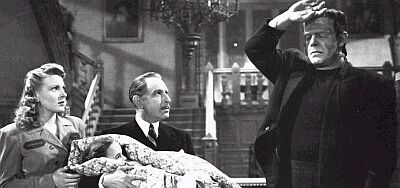

GHOST OF FRANKENSTEIN (1942)

As this story begins, the villagers are complaining to the mayor about what a dump their little burg has become due to the curse of Frankenstein.  One woman moans that her children cry themselves to sleep each night because "there is no bread."  What, did the Monster eat it all?  ("Breeead...goood.")  Did he knock down the bread factory?  Anyway, the mayor finally gives in and allows the villagers to blow up Frankenstein's castle, which prompts them to grab an armload of the nearest dynamite and gleefully scurry off to perform the impromptu demolition. 

Before you know it, the castle is a smoking, crumbling ruin, and Ygor, who somehow survived having several bullets pumped into his gut by Wolf von Frankenstein in the previous movie, is weaving his way through massive chunks of flying debris until he comes upon a startling sight--a wall has given way to reveal the solidified mass of sulphur which contains the body of the Monster (a stone-faced Lon Chaney, Jr. this time out), and he is still alive.  "The sulphur...was GOOD for you!" Ygor crows as he digs the Monster out.  Together they escape the destruction of the castle and, after the Monster is rejuvenated by an obliging bolt of lightning, make their way to the village of Vasaria, where yet another son of Frankenstein (Cedric Hardwicke as "Ludwig") presides over a mental institution while conducting his own advanced scientific research. 

Ygor is confident that this Dr. Frankenstein can restore the Monster to his full capacity, but his plan is sidetracked when the Monster breaks into the institution and murders an assistant, one Dr. Kettering.  Ludwig will have nothing of Ygor's dastardly plan, instead plotting to destroy the Monster by dissection, until the ghost of his father appears (also Hardwicke) and talks him out of doing away with his creation.  Ludwig decides instead to vindicate his father's genius by replacing the criminal brain within the Monster's skull with that of the murdered Dr. Kettering.

Taking advantage of this rare opportunity, the cunning Ygor persuades Ludwig's unscrupulous associate Dr. Bohmer (a leering Lionel Atwill) to make sure that his own brain is placed in the Monster's skull instead.  (The Monster's idea of having his brain replaced with that of a little girl he has befriended is vetoed.)  When the operation is over, Dr. Frankenstein is shocked to encounter a Monster that speaks not in Kettering's voice, but with the sinister tones of Bela Lugosi's Ygor, who schemes to take over the world now that his evil mind is housed in such a powerful body. 

But neither Ygor nor Bohmer foresaw a crucial element--while Kettering had the same blood type as the Monster, Ygor does not--and sudden blindness is the result.  As the ever-vigilant villagers once again take action and set fire to the institution, Ygorstein kills Dr. Frankenstein and then rampages blindly through the laboratory, knocking over several vials of flammable chemicals and turning the place into an inferno which, presumably, engulfs him.


That's it for part one!  Don't miss the thrill-packed conclusion, in which we'll take a close look at the final four films in the series: FRANKENSTEIN MEETS THE WOLF MAN, HOUSE OF FRANKENSTEIN, HOUSE OF DRACULA, and ABBOTT & COSTELLO MEET FRANKENSTEIN.  Coming soon to this theater!


Share/Save/Bookmark