HK and Cult Film News's Fan Box

Showing posts with label classic horror. Show all posts

Thursday, January 8, 2026

The Three Undead Brides Of "Dracula" (Bela Lugosi, 1931) (video)


One of the eeriest aspects of the 1931 "Dracula"...

...is the sight of his three ghostly, cadaverous brides.

Dorothy Tree
Geraldine Dvorak
Cornelia Thaw 

And with the Spanish version of the film...

...comes yet another ghostly trio.


I neither own nor claim any rights to this material.  Just having some fun with it.  Thanks for watching!


Share/Save/Bookmark

Wednesday, October 29, 2025

THE HILLS HAVE EYES (1977) -- DVD Review by Porfle


 Originally posted on 9/16/11


Back in the 80s when I was compulsively renting more videos than I would ever be able to remember, two of Wes Craven's more notorious horror classics passed through my VCR and then went swirling off into the recesses of my mental abyss.  A while back I revisited one of them, THE LAST HOUSE ON THE LEFT, and found it to be a disappointment.  Now comes the other one, THE HILLS HAVE EYES (1977), also enjoying a new DVD release, and this time the revisit is a welcome experience. 

Craven seems to have improved as a filmmaker between these two flicks, and so has his choice of actors.  The look of the film still betrays the low budget and Craven's inexperience, yet there is some style and he does a good job of staging scenes within cramped confines (car, camper trailer) while also taking good advantage of the Mojave desert's wide open spaces.  His cast is better here, too--while their thespian skills aren't always up to par, they handle the more hotly emotional material with abandon. 

Naturally, the older cast members are the most skilled.  Veteran actor John Steadman, best remembered by me as "Pop" in the original THE LONGEST YARD, plays Fred, proprietor of a "last chance" gas station in the middle of nowhere.  Russ Grieve and Virginia Vincent (I WANT TO LIVE!, THE RETURN OF DRACULA) are Bob and Ethel Carter, who stop by for a fill-up before taking their family into the desert while vacationing after Bob's retirement.


Old Fred tries to warn them to stay clear of the area, knowing that there's a family of vicious cannibals out there led by his own son, Jupiter (James Whitworth, TERMINAL ISLAND), a misshapen, split-nosed giant with a mean streak a mile wide.  The Carters, of course, disregard Fred's warnings and are subsequently terrorized by the murderous savages until forced to throw off their veneer of civilization and fight back in kind.

Craven takes his time introducing us to the family, gradually allowing a sense of dread to creep in after they break down in the desert.  While not entirely realistic, they're more three-dimensional and less cartoonish than most of the characters in LAST HOUSE, and the awful comic relief that marred the earlier film is mercifully lacking here. 

The hill people are barely glimpsed at first but their presence is felt as their actions become more overt.  When Bob takes a nocturnal hike to Fred's gas station for help, Jupiter's sudden entrance is a shocker that would be imitated in "Friday the 13th Part 2."  What happens after that is a starkly violent descent into nightmare that keeps the story gripping and fast-paced until the very end.

Future fan fave Dee Wallace makes her third film appearance as Lynne, whose husband Doug (Martin Speer, who resembles a "Simpsons" character) is along for the trip.  Robert Houston plays her brother Bobby Carter, an insecure teen trying to prove himself to a domineering father.  Susan Lanier doesn't make much of an impression at first as flighty younger sister Brenda, but when the action starts and she goes into screaming panic mode, her ability to totally freak out is striking. 

On the other side, James Whitworth is an imposing Jupiter, especially when he's berating a "civilized" captive while munching on his barbecued arm.  Legendary actor Michael Berryman, whose career has spanned everything from ONE FLEW OVER THE CUCKOO'S NEST and STAR TREK IV: THE VOYAGE HOME to the more recent THE DEVIL'S REJECTS, lends his eerie Boris Karloff-like countenance to the film and its poster as Pluto.


The attack on the Carters' camper by Pluto and his equally animalistic brother Mars (Lance Gordon) is one of the film's most harrowing setpieces and demonstrates to the viewer that no character is safe from brutal death.  The unnerving capper to the scene is the kidnapping of Lynne's infant daughter as a future feast for the cannibals.

HILLS kicks into high gear when the surviving Carters decide to fight such savagery with a little savagery of their own, proving surprisingly adept and creative at the task even as certain aspects of it are a terrible affront to their humanity.  They're aided in this by Jupiter's daughter, Ruby (Janus Blythe in a fine performance), who rebels against the brutality of her family and puts her own life in danger by helping the strangers. 

Jupiter's final assault on the campers is a thrilling sequence in which they counterattack with amazing ingenuity, but it's the grueling hand-to-hand fight between Doug and Mars which really punctuates all that's gone before (the very last shot is stunningly good).  Here, Craven gives the film one of the most effective abrupt endings I've seen, akin to a writer dotting his last sentence with a sharp jab of the pen.   

The DVD from Image Entertainment's "Midnight Madness" series is in 1.85:1 widescreen with both Dolby 5.1 and original mono sound, and the film looks pretty good for its age.  No subtitles.  Extras consist of a trailer and a chummy commentary with Craven and producer Peter Locke, which appears to be from an earlier release since they thank Anchor Bay at the end.  The two offer lots of good behind-the-scenes info including how difficult it was to secure an "R" rating due to the film's graphic violence and disturbing themes.

I was pleasantly surprised by how much I liked THE HILLS HAVE EYES upon seeing it again after so many years.  What Craven and Locke accomplished on this trip into the desert with their low budget, small crew, and limited resources remains an impressive achievement that rises above other films of its ilk to provide chilling, suspenseful, and freaky fun.


Share/Save/Bookmark

Tuesday, September 23, 2025

GETTING THE STORY STRAIGHT: THE UNIVERSAL "FRANKENSTEIN" SERIES (Part Two of Two) by Porfle


Here's the intro for Part One:

If you're just a casual viewer of the classic Universal horror films from the 30s and 40s, you might sometimes wonder exactly what's going on in a particular episode of the "Frankenstein" saga.  How come the Monster can talk in one movie, but is mute in the next?  How did he end up in that block of ice?  Why does he suddenly look like Bela Lugosi? 

Let's see if we can't get the story straight, and make as much sense out of things as possible, so that the next time you watch a "Frankenstein" movie, you'll know exactly where it fits in the continuing story of the Monster.  Although there's certainly more nitpicking that can be done with these films, such as various anachronisms, changing locations, and multiple spellings of certain names, we'll be dealing with the basic storylines and more fun-type details here.

And if you already know all of this stuff--well, what the heck, you can read it anyway.

And now, continuing with our recap of Universal's classic "Frankenstein" series with regard to its film-to-film continuity, we set our sights on the final four films...

(Warning: wall-to-wall spoilers ahead!)


FRANKENSTEIN MEETS THE WOLF MAN (1943)

In this installment, which is more a sequel to THE WOLF MAN than anything else, Larry Talbot (Lon Chaney, Jr.) once again finds himself roaming the earth waiting for those dreaded nights in which the full moon will transform him into a bloodthirsty beast.  He seeks help from the gypsy woman, Maleva (Maria Ouspenskaya), who once cared for her own lycanthropic son Bela before he passed his terrible curse on to Talbot and was then killed by him.  Together they travel to the village of Vasaria, where Maleva is sure Dr. Frankenstein will be able to help Talbot. 

When they arrive, they discover that Dr. Frankenstein is dead and his castle (into which the mental institution of the previous film seems to have morphed) is in ruins.  The full moon rises, and Talbot once again becomes the Wolf Man.  With a passel of torch-wielding villagers hot on his heels, he darts into the ruins of Frankenstein's castle and falls through a hole into an underground ice cavern.  There, after returning to his human form, he discovers the Frankenstein Monster frozen in a wall of ice (with stuntman Gil Perkins in full makeup providing the impressive first closeup).  How did he get there, after last being seen burning alive in Dr. Frankenstein's laboratory?  Hmmm.  I guess he fell through the floor again like he did in the windmill at the end of the first movie. 

Anyway, Talbot has the bright idea that the Monster might be able to lead him to Frankenstein's records, which contain the secrets of life and death and might show him a way to end his miserable existence.  The Monster, now played by Bela Lugosi (which is fitting, since Lugosi's "Ygor" donated his brain to the Monster in the last movie), obligingly leads Talbot to a hidden panel where he believes Frankenstein's diary resides.  But it is empty.  Talbot then devises a plan to contact Frankenstein's daughter, Elsa (played by Evelyn Ankers in GHOST, but now embodied by bombshell Ilona Massey), to see if she knows the diary's whereabouts.  Talbot persuades Elsa to come to the castle with him, where she shows him a hidden compartment that contains the actual Frankenstein records.
 

Dr. Mannering (Patrick Knowles), who treated an injured Talbot earlier in the film and believes him to be dangerously delusional, inexplicably agrees to help him in his self-destructive endeavors, restoring Dr. Frankenstein's laboratory and using his records to come up with a way to drain off Talbot's life energies.  Elsa urges him to use the same technology to finish off the Monster as well, to which he agrees.  But at the crucial moment, Mannering realizes that he can't destroy such a monumental scientific achievement as the Frankenstein Monster, and must see it at its full power. 

With Talbot and the Monster both strapped to tables in the laboratory, Mannering fires up the machinery and fills the Monster with life-giving electricity.  The Monster blinks his eyes--he can see again!  For indeed, in the original script he was blind just as he had been at the end of the previous film, and what's more, he spoke throughout the film in Ygor's voice.  But, as the story goes, the studio executives thought this sounded too gosh-darn funny (especially when they heard Lugosi speaking some of the really bad lines that Curt Siodmak had written for him), so they simply cut all of the Monster's speech, and references to his blindness as well, out of the finished film.  This explains why Lugosi plays the Monster with his arms stiffly outstretched, and why in some scenes his mouth moves even though there are no words coming out of it!  It's also one of the main reasons Lugosi's earnest performance as the Monster has been so unfairly maligned ever since this film premiered. 

But back to the story--the Monster can see again, and he feels unlimited power surging through his body as he breaks the straps and lumbers off of the table to grab the unwilling Elsa (apparently electricity works pretty much like Viagra).  Meanwhile, the full moon has risen again and Talbot has turned into the Wolf Man.  He also breaks free, then performs a flying tackle on the Monster. 

Elsa and Dr. Mannering hightail it out of the castle just as one of the villagers blows up the dam above, sending a raging wall of water down the mountainside while the Wolf Man and the Monster (with stuntmen Gil Perkins and Eddie Parker filling in for the aging Lugosi) take each other on in the monster rumble to end all monster rumbles.  The water hits the castle and destroys it, washing both monsters away as the villagers gape at each other in confusion.  Should they be happy?  Or should they run for their lives as the massive wall of water descends upon their village?


HOUSE OF FRANKENSTEIN (1944)

Karloff is back, but this time he plays the evil Dr. Niemann, a maniacal devotee of the late Dr. Frankenstein's scientific endeavors who has no qualms about applying this knowledge to such dubious efforts as transplanting the brain of a man into the head of a dog.  In the opening scenes, Niemann and his hunchbacked minion Daniel (J. Carrol Naish) escape from prison and kill the owner of a traveling horror show (George Zucco), assuming the identities of him and his driver. 

As this film is a multi-monster extravaganza (with the classic monster era fading, Universal was drawing audiences into theaters with the promise of more monsters for their money), they have a brief encounter with Dracula (John Carradine) before arriving at Frankenstein's castle to look for his records.  Venturing into the same underground ice cavern seen in the previous film, they discover the frozen bodies of both the Monster and the Wolf Man, apparently deposited there by the flood waters, and set about thawing them out.  Talbot comes to first, none the worse for wear but a bit cranky after his long nap ("Why have you freed me from the ice that imprisoned the beast that lives within me?" he asks). 

But the Monster is in bad shape and in need of rejuvenation again, which Dr. Niemann is quite willing to provide once they journey to his old laboratory with Talbot and the Monster in tow.  On the way there, they pick up a gypsy girl named Ilonka (Elena Verdugo), who turns the smitten Daniel into a palpitating bundle of jealousy when she promptly falls in love with Talbot.  Back at the lab, Niemann straps the Monster to a table (where Glenn Strange, the former stuntman and bit player who now plays the role, will spend most of his time in this movie and the next) to prepare him for his electrical "pepper-upper".


Talbot grows more and more agitated as the next full moon approaches, impatient for the doctor to help him instead of fiddling around with the Monster.  Ilonka takes pity on him, and plans to shoot him with a silver bullet ("fired by the hand...of one who loves him enough...to understand" she recites gravely) the next time he turns.  In one of the best transformation scenes in any of the Wolf Man films, Talbot once again becomes a hairy, fanged beast and rushes out into the night looking for a jugular vein to bite.  Ilonka follows him and is fatally wounded, but not before she can fire the crucial shot that will end Talbot's misery. 

Daniel is heartbroken when he finds her body, and blames Dr. Niemann for devoting all his attention to the Monster instead of fulfilling his promise to put Daniel's brain into Talbot's healthy body and turn him into a chick-magnet.  He attacks the doctor and breaks his back.  The Monster, grateful to the doctor for restoring his strength, breaks his straps and lunges off of the table, grabbing Daniel and heaving him through a window to his death.  At this point, the omnipresent torch-wielding villagers arrive right on schedule to herd the Monster, carrying the dying Niemann, into a nearby swamp where he stumbles into some quicksand and the two of them sink slowly into oblivion.


 HOUSE OF DRACULA (1945)

This is the last film in the series and is another monsterfest like the previous one, again featuring the Frankenstein Monster, the Wolf Man, and Dracula.  Also on hand to make it even more monster-packed are "The Mad Doctor" and "The Hunchback", although Jane Adams as a kindly hunchbacked nurse named Nina isn't exactly my idea of a monster. 

The "Mad Doctor" in question, Dr. Edelman (Onslow Stevens), is first seen as a respected physician and scientist who is currently working on the creation of a special technique that can heal all sorts of physical maladies without traditional surgery.  But progress is slow, and Nina longs for the day in which the doctor can finally work his magic on her. 

It isn't long before John Carradine's Dracula shows up at the doctor's seaside mansion, this time seeking a cure for his vampirism.  The doctor examines a sample of Dracula's blood under a microscope and discovers that it contains parasites that may cause his craving for blood.  He prescribes a series of transfusions which he hopes will solve the problem.  Of course, Dracula's ever-roving eye is drawn to Dr. Edelman's other nurse, the beautiful Miliza (Martha O'Driscoll), and before you know it he's forgotten that silly notion about being cured and is hard at work luring Miliza over to the dark side. 

Not only that, but during his next blood transfusion he proves what a real first-class jerk he is by reversing the flow and injecting his own blood into Dr. Edelman's veins, which will eventually turn the kindly doctor into a ravening madman (the "Mad Doctor" promised in the film's publicity).  But Dr. Edelman manages to thwart Dracula's plans by dragging his coffin into the light of the rising sun and opening the lid, thus reducing the vampire to skeletal form once again. 

Meanwhile, Larry Talbot (who somehow survived being shot with a silver bullet in the last movie) has also arrived at the mansion hoping for a cure for his particular problem, but he's come at a bad time--the doctor is busy, and it's almost full-moon time again.  He races into town and begs the local police to put him up for the night.  They call upon Dr. Edelman to come and take a look at the "madman" they've got locked up in their cell.  Edelman tries to convince Talbot that his problem is merely psychological, but Talbot effectively proves him wrong by promptly turning into the Wolf Man (in another excellent transformation scene). 

Edelman theorizes that Talbot is so convinced he's a werewolf that it affects him physically, and plans to use his new surgical techniques to attempt a cure.  But the next day a despairing Talbot hurls himself off a cliff next to the mansion and into the sea.  Edelman has himself lowered down the side of the cliff and discovers Talbot in a cave where the sea has deposited him, then almost dies at the Wolf Man's hands before Talbot returns to human form.  Also in the cave is the body of--wouldn't you know it--the Frankenstein Monster.  Somehow, after sinking into that quicksand back in the last movie, he has turned up buried in the muck in this cave beneath Dr. Edelman's house, along with Dr. Niemann's skeleton.  There's a brief line of dialogue that attempts to explain this, but I hardly find it worth repeating. 

Edelman does what anyone else in the circumstances would do--he straps the Monster to a table in his lab, snaps on the old jumper cables, and starts pumping electricity into him.  But Talbot and Nina use some really, really corny dialogue to talk him out of it, and he realizes that, sometimes, dormant monsters are better off left alone.  So he focuses his attention instead on performing Talbot's operation. 


That night, Talbot is sitting in his room recuperating, when he looks out the window and sees Dr. Edelman jumping onto a passing horse-drawn wagon.  Edelman, thanks to Dracula's blood, has begun to have spells in which he turns into a maniacal killer.  He murders the driver of the wagon and is chased by the villagers back to the mansion.  When the police arrive, he has reverted back to his normal self and persuades them to search elsewhere for the killer.  But Talbot later confronts him and finds out the truth.  Edelman pleads with Talbot to kill him if he becomes a danger to others again, and wishes only to remain lucid long enough to perform surgery on Nina.

The next night, the full moon rises once again and, after a tense few moments, Talbot realizes that his own operation was a success and he is no longer a werewolf.  But as he and Miliza celebrate, Edelman goes mad and starts recharging the Monster again.  Nina interrupts, so he strangles the poor girl as Talbot rushes in.  Edelman advances with murder in his eyes, and Talbot shoots him.  In a last moment of sanity, Edelman smiles gratefully and falls to the floor, dead. 

Suddenly realizing that all of the other monsters in the movie have either been killed or cured, the Frankenstein Monster breaks his straps and heaves himself wearily off of the table for one last final-reel stomp.  The police arrive and he manages to dispatch a couple of them before clumsily knocking over a tall shelf full of volatile chemicals that burst into flame, which, needless to say, he proceeds to wade around in like an idiot.  Talbot and Miliza escape to live happily ever after, while the last official chapter in the celebrated saga of the Frankenstein Monster concludes with stock footage of Lon Chaney, Jr. stumbling around during the fiery finale of GHOST OF FRANKENSTEIN.


ABBOTT AND COSTELLO MEET FRANKENSTEIN (1948)

I don't consider this to be an official part of the Frankenstein series, but it's worth mentioning just to note what our old friends are up to in this alternate comedy universe.  Somehow, Dracula has come into possession of the Monster (played for the third time by Glenn Strange) and is planning to transplant a different brain into his skull to make him more submissive (which would seem unnecessary, since the Monster follows all of Dracula's orders throughout the movie and calls him "Master"). 

As fate would have it, of course, the brain he plans to use belongs to Lou Costello as the not-so-bright "Wilbur."  Wilbur and his bossy companion, Chick (Bud Abbott), happen to work for the shipping company which receives the crates from Europe containing Dracula and the Monster.  Here, Dracula sets up shop in a castle (in Florida?) where, with the help of the evil Dr. Sandra Mornay (Lenore Aubert) posing as Wilbur's girlfriend, he plans to perform the brain transplant.

But Larry Talbot has discovered Dracula's plan and, for some reason, has taken it upon himself to thwart it.  The "cure" given him by Dr. Edelman seems to have worn off--he's still regularly wolfing out (in some fantastic transformation scenes).  Dracula and the Wolf Man finally do battle before the movie is over, and both end up falling from the balcony of the castle into the sea far below, which apparently kills them (not...bloody...likely!) 

After a prolonged slapstick finale--during which Strange racks up more screen time than in the previous two films combined--the Monster chases Bud and Lou onto a dock which is promptly set ablaze, and ends up being roasted alive--again.  But as I said before, as fun as this movie is, I regard it as a fanciful footnote in relation to the rest of the Frankenstein films.  (Read our full review here.)


And there you have it--the Frankenstein story from beginning to end, one film leading into the next (with varying degrees of continuity) in a saga that lasted for seventeen glorious years.  Some of them are among the greatest films ever made, while others are just above-average monster flicks.  But they are all endlessly entertaining classics, and all of them feature the most celebrated character in the history of horror movies--the Frankenstein Monster.


Share/Save/Bookmark

Monday, September 22, 2025

GETTING THE STORY STRAIGHT: THE UNIVERSAL "FRANKENSTEIN" SERIES (Part One of Two) by Porfle


If you're just a casual viewer of the classic Universal horror films from the 30s and 40s, you might sometimes wonder exactly what's going on in a particular episode of the "Frankenstein" saga.  How come the Monster can talk in one movie, but is mute in the next?  How did he end up in that block of ice?  Why does he suddenly look like Bela Lugosi? 

Let's see if we can't get the story straight, and make as much sense out of things as possible, so that the next time you watch a "Frankenstein" movie, you'll know exactly where it fits in the continuing story of the Monster.  Although there's certainly more nitpicking that can be done with these films, such as various anachronisms, changing locations, and multiple spellings of certain names, we'll be dealing with the basic storylines and more fun-type details here.

And if you already know all of this stuff--well, what the heck, you can read it anyway.

(Warning: wall-to-wall spoilers ahead!)


FRANKENSTEIN (1931)

This is the original, the one in which renegade scientist Henry Frankenstein (Colin Clive) first stitches together various parts of dead bodies to create a man, which he and his hunchbacked assistant Fritz (Dwight Frye) then bring to life via electricity.  (Note that the name "Frankenstein", despite popular misconception, refers to Clive's character and not to the Monster himself.)  While outdone in the sequel, the thunderous creation sequence is still a highlight of horror cinema, punctuated by Clive's frenzied declaration, "It's ALIVE!"

Boris Karloff rightfully became famous overnight for his portrayal of the Monster, a pitiful, confused creature (possessed of a criminal brain thanks to the bumbling Fritz) who longs for acceptance but is greeted only with fear and loathing.  To make matters worse for the poor soul, his fickle creator, despite all of his initial enthusiasm, seems to lose interest in his creation pretty quick when the pitiful brute shows his savage side due to the cruel taunting of a sadistic, torch-wielding Fritz. 

The Monster manages to kill his twisted tormentor, prompting Frankenstein's concerned mentor, Dr. Waldman (Edward van Sloan), to suggest dissection.  The exhausted Henry washes his hands of the whole matter and scampers back to town to marry his sweetheart, Elizabeth (Mae Clarke), leaving Dr. Waldman to perform the grisly task alone.  But as Waldman bends over the lab table with his scapel, the Monster wakes up from his anesthesia and does away with him. 

Free at last, the confused creature makes his way out the front door of the old watchtower laboratory and into the wild. He ends up accidentally drowning the one person who is nice to him, a little girl named Maria (Marilyn Harris), who shows him that flowers float just like boats, but little girls don't.  The Monster then terrorizes Frankenstein's bride Elizabeth on their wedding day, but, unlike what occurs in Mary Shelley's novel, lets her live. 

A hunting party comprised of enraged villagers tracks him down to an abandoned windmill, where the Monster and his creator have their final confrontation.  Henry Frankenstein survives being throttled and thrown from the mill (thanks to a happy ending tacked on by the studio), but the Monster meets a fiery death when the villagers set the building ablaze and gleefully watch it burn to the ground.  The poor Monster, who is deathly afraid of fire, screams in agony as a heavy beam breaks free and pins him to the floor while the raging flames close in around him.


BRIDE OF FRANKENSTEIN (1935)

Picking up where the first film left off, we find that the Monster (Karloff again) didn't die in the fire after all.  Instead, he plunged through the collapsing floor into the stream that flows beneath the windmill.  Maria's father, who must see the Monster's charred bones for himself in order to be able to sleep at night, ventures too close and falls in himself.  The Monster angrily drowns him, then kills the man's wife when she offers her hand thinking that it's her husband who is climbing out of the ruins.  Surprise!  It's the Monster, and he's loose upon the countryside once again. 

The villagers hunt him down as before, tying him to a pole like a wild animal and lifting it straight into the air before letting it fall into a hay wagon.  In this moment, as the Monster is suspended over the crowd upon the upraised pole, director James Whale creates an audacious crucifixion analogy featuring the Frankenstein Monster as a Christlike figure.  He escapes from captivity later on, of course, and finds his way to the isolated hut of a blind hermit, who takes him in and cares for him as a fellow outcast from society.  During their time together, the kindly hermit teaches him basic English ("Breeead!  Gooood!"), and introduces him to the dubious pleasures of smoking and drinking before a couple of passing hunters (including a young John Carradine) break up the party and send the Monster stumbling into the wilderness once again. 

Making his way into an underground crypt, he encounters a flamboyantly unbalanced individual named Dr. Pretorius (Ernest Theisiger), who seeks to collaborate with an unwilling Henry Frankenstein in the creation of life and considers the Monster to be the perfect means of persuading him to cooperate.  This persuasion will include the kidnapping of Frankenstein's bride Elizabeth (Valerie Hobson this time) as an additional incentive. 

The Monster is particularly interested when he discovers that Pretorius plans to create a woman as a fitting companion for him ("Wo-man...friend...wife..." he muses).  And in one of the most thrilling sequences ever filmed, full of crackling lightning, blazing showers of sparks, and generally bravura filmmaking, this is accomplished.  But the towering bride (Elsa Lanchester), a magnificent creation of perverse Gothic beauty, rejects him with the same fear and loathing with which he has been greeted by everyone else. 

In a fit of angst and despair, the Monster grabs a convenient lever ("Get away from that lever!  You'll blow us all to atoms!" Pretorius warns) and, after graciously allowing Henry and Elizabeth to escape unharmed, destroys the mountaintop laboratory in a spectacular explosion.  His last words to Pretorius and his erstwhile bride-to-be are:  "We belong dead."


SON OF FRANKENSTEIN (1939)

Traveling to the village of Frankenstein by train, Wolf von Frankenstein (Basil Rathbone), son of the infamous monster-maker, looks forward to moving into the house he has inherited from his father with his wife Elsa (Josephine Hutchinson) and their young son, Peter (Donnie Dunagan).  While the first film featured a roomy high-ceilinged mansion and the second an even larger and grander one, SON OF FRANKENSTEIN's oversized and stunningly Gothic castle is practically cavernous and designed in a style dripping with German expressionism.  The ruins of the once-remote watchtower laboratory are now situated directly behind it.

The Frankensteins receive a rather chilly reception from the villagers, and the local chief of constables, Inspector Krogh (Lionel Atwill), warns Wolf not to attempt to resume his father's work lest he risk their wrath. Krogh himself has an unfortunate history in this regard, the Monster having torn his arm from its roots when he was a child.  Before long, however, Wolf discovers the comatose Monster (who survived the explosion of the previous film, and is played by Karloff for the third and last time) beneath the ruins of the laboratory, tended by the faithful Ygor (Bela Lugosi in one of his finest performances). 

Ygor, a grotesque, broken-necked graverobber who was hanged for his crimes but survived, now lives in a cave beneath the laboratory with his friend, the Monster.  "He...does things for me," Ygor cryptically tells Wolf, alluding to the fact that, one by one, the Monster has been dispatching the members of the jury that sentenced Ygor to death before being immobilized by an errant bolt of lightning.  (Which is curious, as in other films lightning is the very thing which makes him stronger.)

Wolf is thrilled to discover the indisputable proof of his father's genius, and, even as Inspector Krogh and the volatile villagers become more and more suspicious of his actions, he quickly begins work on bringing the Monster back to full power.  But when this is accomplished, he finds the Monster (inexplicably mute once again) still in the vengeful thrall of the evil Ygor, who tasks him to finish off the rest of the jury that condemned him.  Realizing his mistake in reviving the Monster, Wolf attempts unsuccessfully to kill him, and later is forced to shoot Ygor in self-defense.  

Upon finding Ygor's body, the grief-stricken Monster strikes back by entering Peter's bedroom through a secret passage and kidnapping him.  In a climactic confrontation within the ruined laboratory, with the Monster holding both Wolf and the Inspector at bay with one foot on the little boy's neck, Wolf performs a swashbuckling rope swing and kicks the Monster head over heels into a boiling pit of sulpher, where he apparently meets his parboiled doom.  Wolf decides to take his family and leave the charming little village while the getting's good, and, for some inexplicable reason, the villagers give him a hero's send-off.
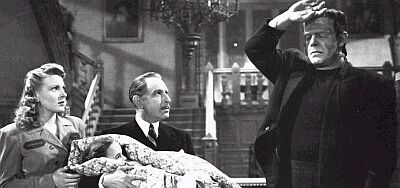

GHOST OF FRANKENSTEIN (1942)

As this story begins, the villagers are complaining to the mayor about what a dump their little burg has become due to the curse of Frankenstein.  One woman moans that her children cry themselves to sleep each night because "there is no bread."  What, did the Monster eat it all?  ("Breeead...goood.")  Did he knock down the bread factory?  Anyway, the mayor finally gives in and allows the villagers to blow up Frankenstein's castle, which prompts them to grab an armload of the nearest dynamite and gleefully scurry off to perform the impromptu demolition. 

Before you know it, the castle is a smoking, crumbling ruin, and Ygor, who somehow survived having several bullets pumped into his gut by Wolf von Frankenstein in the previous movie, is weaving his way through massive chunks of flying debris until he comes upon a startling sight--a wall has given way to reveal the solidified mass of sulphur which contains the body of the Monster (a stone-faced Lon Chaney, Jr. this time out), and he is still alive.  "The sulphur...was GOOD for you!" Ygor crows as he digs the Monster out.  Together they escape the destruction of the castle and, after the Monster is rejuvenated by an obliging bolt of lightning, make their way to the village of Vasaria, where yet another son of Frankenstein (Cedric Hardwicke as "Ludwig") presides over a mental institution while conducting his own advanced scientific research. 

Ygor is confident that this Dr. Frankenstein can restore the Monster to his full capacity, but his plan is sidetracked when the Monster breaks into the institution and murders an assistant, one Dr. Kettering.  Ludwig will have nothing of Ygor's dastardly plan, instead plotting to destroy the Monster by dissection, until the ghost of his father appears (also Hardwicke) and talks him out of doing away with his creation.  Ludwig decides instead to vindicate his father's genius by replacing the criminal brain within the Monster's skull with that of the murdered Dr. Kettering.

Taking advantage of this rare opportunity, the cunning Ygor persuades Ludwig's unscrupulous associate Dr. Bohmer (a leering Lionel Atwill) to make sure that his own brain is placed in the Monster's skull instead.  (The Monster's idea of having his brain replaced with that of a little girl he has befriended is vetoed.)  When the operation is over, Dr. Frankenstein is shocked to encounter a Monster that speaks not in Kettering's voice, but with the sinister tones of Bela Lugosi's Ygor, who schemes to take over the world now that his evil mind is housed in such a powerful body. 

But neither Ygor nor Bohmer foresaw a crucial element--while Kettering had the same blood type as the Monster, Ygor does not--and sudden blindness is the result.  As the ever-vigilant villagers once again take action and set fire to the institution, Ygorstein kills Dr. Frankenstein and then rampages blindly through the laboratory, knocking over several vials of flammable chemicals and turning the place into an inferno which, presumably, engulfs him.


That's it for part one!  Don't miss the thrill-packed conclusion, in which we'll take a close look at the final four films in the series: FRANKENSTEIN MEETS THE WOLF MAN, HOUSE OF FRANKENSTEIN, HOUSE OF DRACULA, and ABBOTT & COSTELLO MEET FRANKENSTEIN.  Coming soon to this theater!


Share/Save/Bookmark

Friday, April 5, 2024

SEASON OF THE WITCH -- DVD Review by Porfle


Originally posted on 6/10/11


The best way I can describe director Dominic Sena's SEASON OF THE WITCH (2011) is that it's too bad to be really good, but too good to be really bad.  It's the kind of movie I'd be tempted to give up on after about ten minutes if it weren't so much fun to watch.

Nicolas Cage, an actor I really like even though people seem to enjoy not liking him these days, is pretty much miscast as a badass Christian soldier during the Crusades.  But this is probably a good thing, because it wouldn't be quite as much fun watching a more appropriate actor in the part.  The closeup of him snapping into battle mode with that silly-looking helmet bobbling on his head is a priceless moment.

After a good old-fashioned witch-hangin' backfires on an unlucky priest, we switch to Cage as Behman and Ron Perlman as his rowdy sidekick Felson, kicking ass during an elaborate montage of battles a la Kurt Russell at the beginning of SOLDIER.  One passage resembles a 14th-century beer commercial as Felson, in the midst of carnage, bellows "I'm building up a powerful thirst, my friend!" and the next scene shows them in a pub wallowing in beer and babes.


This expensive-looking CGI kill-a-thon, done in the style of 300 and LORD OF THE RINGS, ends with Behman and Felson deserting after the slaughter of some women and children sours them on battle.  They return to England, engaging in some of this film's really bad dialogue along the way:

"We've been walking all day and haven't found a soul."
"Keep your souls.  Let me find a chicken."


--only to find the Black Plague in full swing.  Captured as deserters, Behman and Felson are offered freedom by a dying cardinal (Christopher Lee, unrecognizable under some heavy disfigurement makeup) if they'll transport a suspected witch to a distant monastery.  There, the monks are said to possess a book which can remove her powers and, hopefully, end the plague. 

Joining them on the trip are steadfast priest Debelzaq (Stephen Campbell Moore), brave knight Eckhart (Ulrich Thomsen), Hagamar, a comical con man paroled from the stocks to serve as their guide (Stephen Graham), and Kay (Robert Sheehan), an altar boy who wants to be a knight.  Their long, arduous journey is the best and least goofy section of the film, with some interesting dramatic moments arising from the question of whether or not the young woman in the cage is really a witch.  Indications are positive as Claire Foy deftly alternates between winsome innocence and witchlike malevolence.


The obligatory "crossing of the rickety rope-bridge over a vast gorge" scene is well-done with some really good SPFX.  Later, when a pack of ferocious wolves attack, we get our first taste of bad CGI as they magically morph into even fiercer beasts.  But it's when our heroes finally reach the mountaintop monastery and confront the greatest supernatural evil of all that SEASON OF THE WITCH begins to resemble an upscale SyFy Original Movie.  Even a rousing battle against a horde of wall-crawling zombie monks can't rescue the film's finale from the cringeworthy CGI used to render its main villain. 

Too bad that a fairly entertaining movie with such good production values should go so far off the rails at the end simply because of some hokey, cartoony CGI creature.  Especially since the ending as originally filmed (which is contained in the extras menu) was so much more effective before someone had the bright idea of digitally mucking it up.

The DVD from 20th-Century Fox Home Entertainment is in 1.78:1 widescreen with English 5.1 and French 2.0 Dolby Digital sound.  Subtitles are in English, French, and Spanish.  Extras include deleted scenes, two featurettes, the alternate ending (in which the zombie monks have a more EVIL DEAD quality that I like), and the film's trailer.

Despite the many good moments contained in SEASON OF THE WITCH, some of its dialogue and situations will no doubt provoke a lot of viewers to go into full-out MST3K mode.  But as far as I'm concerned, any 14-century action-horror flick with Nick Cage and Ron Perlman as manly knights slashing their way through a succession of witches, zombies, and Godless infidels can't be all bad.


Share/Save/Bookmark

Saturday, March 30, 2024

MY TOP 50 FAVORITE BAD MOVIES! by Porfle


If I don't mention one that you think is an extremely obvious choice, then I either don't like it or I haven't seen it yet.

(Click on the active links to read our reviews!)


1
Plan 9 From Outer Space (1959)

2
Village of the Giants (1965)

3
The Brain That Wouldn't Die (1962)

4
Frankenstein's Daughter (1958)

5
Jesse James Meets Frankenstein's Daughter (1966)

6
The Beast of Yucca Flats (1961)


7
Teenage Zombies (1959)

8
Playgirl Killer (1966)

9
Glen or Glenda (1953)

10
Attack of the 50 Foot Woman (1958)

11
The Killer Shrews (1959)

12
Manos: The Hands of Fate (1966)


13
If Ever I See You Again (1978)

14
Valentine Magic on Love Island (1980)

15
Blood Feast (1963)

16
The Giant Gila Monster (1959)

17
Bride of the Monster (1955)


18
Dracula vs. Frankenstein (1971)

19
Wild Guitar (1962)

20
The Cyclops (1957)

21
Teenagers From Outer Space (1959)

22
The Creeping Terror (1964)

23
Reefer Madness [Tell Your Children] (1936)

24
Zontar, The Thing from Venus (1966)


25
Curse of the Swamp Creature (1966)

26
Attack of the Giant Leeches [The Giant Leeches] (1959)

27

Orgy of the Dead (1965)

28
The Horror of Party Beach (1964)

29
Monstrosity [The Atomic Brain] (1964)

30
Battlefield Earth (2000)


31
Maniac (1934)

32
Monster From Green Hell (1957)

33
Bela Lugosi Meets a Brooklyn Gorilla (1952)

34
The Wild World of Batwoman (1966)

35
Robot Monster (1953)


36
Lisztomania (1975)

37
Mars Needs Women (1967)

38
The Doll Squad (1973)

39
The Crawling Hand (1963)

40
Killers From Space (1954)


41
The Neanderthal Man (1953)

42
Night of the Ghouls (1959)

43
Fire Maidens From Outer Space (1956)

44
Cat-Women of the Moon (1953)

45
Indestructible Man (1956)


46
Devil Girl From Mars (1954)

47
They Saved Hitler's Brain (1963)

48
The Wasp Woman (1959)

49
Armageddon (1998)

50
The Concorde - Airport '79 (1979)


Share/Save/Bookmark

Monday, July 31, 2023

THE MUMMY'S TOMB (1942) -- Movie Review by Porfle


Originally posted on 3/8/17


In 1942 came the second follow-up to Karloff's 1932 original film THE MUMMY. Unlike the first sequel, THE MUMMY'S TOMB brought a surprisingly downbeat and decidedly unsentimental aura to the series.

Gone was the comedy relief, along with the exotic Egyptian setting itself, and with it the security of knowing that certain characters were immune from the Mummy's wrath.

This is powerfully illustrated early on as the Steve Banning character from the previous film (Dick Foran in old age makeup), now thirty years older and living in peaceful retirement in the quiet New England town of Mapleton, is visited in his bedroom one night by a vengeful and somewhat singed Kharis and strangled to death.


The next night his elderly sister Jane, whose misfortune is to be of the same bloodline as a defiler of the Princess Ananka's tomb, meets the same fate (in a scene that must've been rather shocking for audiences at the time). 

Finally, Steve Banning's old partner Babe (Wallace Ford), whose last name has somehow changed from Jensen to Hanson, hears the news and comes to Mapleton to pay his respects.  Sure enough, the Mummy runs into him that very night, corners him in an alley, and gives him the old five-finger chokeroo.

Even when I saw this as a kid, I was aghast that these familiar characters from the previous film were getting killed off--this was eighteen years before Janet Leigh's fatal shower in PSYCHO proved that no one was safe.


Well, Steve Banning's goofball son John (John Hubbard) survives and goes skipping merrily through the woods with his fiancee' Isobel (the lovely Elyse Knox, who happens to be actor Mark Harmon's mom) while the new current High Priest of Karnak, Mehemet Bey (Turhan Bey) scarfs an eyeload of her and falls head-over-heels in puppy love just like his predecessor.

So, using Kharis as a sort of proactive go-between, Bey orders him to kidnap Isobel and bring her to the cemetary where he works as caretaker so they can share tana-leaf cocktails and go sailing off into eternity together. Which doesn't seem quite right to Kharis, but he does it anyway (in later films he'll get righteously fed up with such tomfoolery).

This eventually brings the usual gang of torch-wielding villagers down upon them and, in a fiery finale, John rescues Isobel while the Mummy is trapped on the balcony of the Banning home as it goes up in flames.


One odd aspect of the story is that nobody ever sees Kharis at first, but they do manage to see his shadow.  So often, in fact, that people start calling the town sheriff to report a strange shadow lurking around. 

Making a return here is the "greyish mark...like mold" that's found on the throats of the victims.  Babe is tipped off by this clue right away although the police, of course, scoff at the idea of a living mummy.  Kharis also seems to have an endless supply of loose wrappings to leave hanging from bushes to mark his passing.  

Most importantly, THE MUMMY'S TOMB establishes Universal's new horror star, Lon Chaney, Jr., as the Mummy for the remaining three films in the series, and the tall, beefy actor is definitely the most intimidating incarnation of Kharis.

He's big, mean, and vengeful, and somehow Chaney is able to convey this through the rubber mask now used by Jack Pierce to create the character, with a combination of body language and hand gestures along with his imposing physique. In short, he looks terrific in the role.


The film itself is a lean one hour long, with a full eleven minutes devoted to a recap of the previous film as recounted by the aging Steve Banning to his disbelieving houseguests right before his final encounter with Kharis, and there's also the traditional passing of the baton from one High Priest to another.

This time, it's George Zucco again, who somehow survived being shot two or three times by Babe in THE MUMMY'S HAND and managed to keep his job after having failed so miserably, handing things over to the young Turhan Bey, who proves to be a not-so-great choice himself.

But somehow, even with its brief running time and generous padding, THE MUMMY'S TOMB manages to generate a good deal of solid monster-type entertainment.

It also adds a curious element to the series' timeline.  If THE MUMMY'S HAND takes place in the forties, then how come THE MUMMY'S TOMB, which is supposed to be about thirty years later, also takes place in the forties? Hmm...


Read our overview of the entire original Universal Mummy series

THE MUMMY (1932)
http://hkfilmnews.blogspot.com/2017/03/the-mummy-1932-movie-review-by-porfle.html

THE MUMMY'S HAND (1940)
http://hkfilmnews.blogspot.com/2017/03/the-mummys-hand-1940-movie-review-by.html

THE MUMMY'S TOMB (1942)
http://hkfilmnews.blogspot.com/2017/03/the-mummys-tomb-1942-movie-review-by.html

THE MUMMY'S GHOST (1944)
http://hkfilmnews.blogspot.com/2017/03/the-mummys-ghost-1944-movie-review-by.html

THE MUMMY'S CURSE (1944)
http://hkfilmnews.blogspot.com/2017/03/the-mummys-curse-1944-movie-review-by.html


Share/Save/Bookmark

Sunday, July 30, 2023

THE MUMMY'S HAND (1940) -- Movie Review by Porfle


Originally posted on 3/17/17


Strangely enough, it took Universal eight whole years to get around to making a sequel to 1932's THE MUMMY with Boris Karloff. But in 1940, they finally came up with THE MUMMY'S HAND, which, as it turned out, had nothing to do with the original story.

This time, a couple of down-on-their-luck archeologists, the dashing Steve Banning (Dick Foran) and his pudgy comedy-relief sidekick "Babe" Jenson (Wallace Ford) are about ready to give up and leave Egypt when they stumble upon a clue that leads them to the ancient tomb of the Princess Ananka.

But the tomb is guarded by the undying mummy of Kharis, who, like Im-ho-tep, was mummified alive for sacrilege. In lieu of the Scroll of Thoth, however, Kharis is kept alive by the fluid of boiled tana leaves, given to him over the years by a succession of High Priests who are dedicated to preserving the sanctity of the princess' tomb.


The archeological expedition, which includes jovial financial-backer and stage magician The Great Solvani (the lovable Cecil Kelloway) and his no-nonsense daughter Marta (the even more lovable Peggy Moran), is menaced by the Mummy until Steve and Babe locate the High Priests' temple and, in the exciting finale, vanquish the evil Professor Andoheb, current High Priest of Karnak (George Zucco) and set fire to the Mummy.

By this time, Karloff had better things to do than shuffle around wrapped head-to-toe in gauze, so actor Tom Tyler took over the title role. Better known as the title character of one of the greatest serials ever made, 1941's THE ADVENTURES OF CAPTAIN MARVEL, as well as a prolific Western star, Tyler brought an eerie presence to the role of the homicidal Kharis.

In the movie's trailer and in some of the wider shots of the film itself, Tyler's eyes are menacing and expressive, yet in his close-ups they're masked to appear solid black. Some prefer this and consider it scarier-looking, but I think he looks much more impressive without the special effect.


The scene of the Mummy coming to life before the horrified eyes of expedition member Dr. Petrie (Charles Trowbridge) and strangling him as the gloating Andoheb leers on is one of the high points of the entire series. 

This time the Mummy remains mute and leaves his wrappings on, thank goodness--no fez for Kharis--as will also be the case in the subsequent sequels.  Tyler also sports actual Jack Pierce facial makeup in his closeups, whereas Tyler's successor Lon Chaney, Jr. would appear solely in rubber masks fashioned for him by Pierce.

Other precendents for the future films are set here as well. THE MUMMY'S HAND begins with an old priest handing down his knowledge and responsibilities to a successor, and relating the history of Kharis and Princess Ananka through flashbacks from the first film.


Here, scenes from THE MUMMY are combined with new shots of Tom Tyler replacing those of Karloff to depict Kharis defiling the tomb of Princess Ananka and being condemned to a living death. This is a scenario we'll see again. Another is the discovery of "a greyish mark...like mold" on the throats of the Mummy's victims.

And finally, there's the inherently lovelorn and amorous nature of these new-model High Priests of Karnak, who just can't seem to keep their hands off the leading ladies.

George Zucco sets this precedent in motion by developing a high-school crush on the captive Peggy Moran and planning to give her and himself the old "hot tana-leaf injection" in a lavish set left over from James Whale's GREEN HELL (which adds immeasurably to the film's production values.) Will Steve and Babe show up just in time to stick a fork in his scheme?


Actually, the fact that these ace archeologists have failed until the last minute to discover a huge Egyptian temple on the other side of the hill from where they're encamped doesn't speak much for their abilities. Even their discovery of Kharis' tomb is the result of a lucky accident after Andoheb tries to kill them with dynamite.

With THE MUMMY'S HAND, the series was already double-bill fodder with a running time of only 67 minutes. Even so, the expedition doesn't even reach the desert until the halfway point, and the Mummy makes his initial appearance several minutes after that.

But the comedy bits and character scenes leading up to this point are fun, and once the action gets started it never stops. The cast is fine and the film as a whole is a polished, competent effort that stands on its own as one of the most likable horror films of the forties.


Read our overview of the entire original Universal Mummy series

THE MUMMY (1932)
http://hkfilmnews.blogspot.com/2017/03/the-mummy-1932-movie-review-by-porfle.html

THE MUMMY'S HAND (1940)
http://hkfilmnews.blogspot.com/2017/03/the-mummys-hand-1940-movie-review-by.html

THE MUMMY'S TOMB (1942)
http://hkfilmnews.blogspot.com/2017/03/the-mummys-tomb-1942-movie-review-by.html

THE MUMMY'S GHOST (1944)
http://hkfilmnews.blogspot.com/2017/03/the-mummys-ghost-1944-movie-review-by.html

THE MUMMY'S CURSE (1944)
http://hkfilmnews.blogspot.com/2017/03/the-mummys-curse-1944-movie-review-by.html


Share/Save/Bookmark

Friday, June 2, 2023

THE CONOR TIMMIS INTERVIEW


(Note: This interview by porfle originally appeared online in December 2008.)

In 2006, actor and Boris Karloff fan CONOR TIMMIS got the idea to produce his own screen test for Universal Studios' biopic of the legendary horror star. The fact that no such picture is in the works was of little concern. Besides serving as a devoted fan's tribute to Boris, Timmis' screen test-slash-documentary KREATING KARLOFF was intended to give the studio that produced FRANKENSTEIN and THE MUMMY something to think about while giving us some interesting reenactments of certain scenes from those films.

Conor recently took a wrong turn and found himself in the spacious and elegantly-appointed HK and Cult Film News offices. Before he could make his escape, we blocked the door and promised to release him as soon as he answered a few questions for us. Here, then, are the results of that historic encounter...


When did the acting bug bite you?

I got the acting bug in my early 20's after watching Depp and Del Toro in Fear and Loathing and Karloff in The Mummy. Those performances made me notice great character acting and inspired me to follow in their footsteps. Around this time I took an intro acting class at my local community college after drifting through school not knowing what the hell I wanted to do with my life. Since it was the only class I enjoyed, attended regularly and excelled in, I figured acting was my life's calling.

How did you get into classic horror, and the work of Boris Karloff in particular?

When I was very young I remember my father renting "The Mummy" with Boris Karloff and telling me it was his favorite scary movie when he was little. Even at such a young age I remember enjoying "The Mummy", especially the spooky opening titles and the scene at the end when Ardath Bey is incinerated by the "living" statue of Isis and that wonderful shot of Karloff's face crumbling into dust. Indirectly, I was first exposed to Karloff by playground teasing. I was a shy, gawky, lanky kid growing up, with big hands, big feet, a pronounced brow and high forehead. So I was constantly called "Frankenstein" or "Karloff" when playground bullies wanted to hurt my feelings. Now I would take it as a compliment! When I rediscovered "The Mummy" and "Frankenstein" in my early 20's, I had an immediate empathy for the characters he played in those films. I guess cause I felt like a "little Frankenstein monster" growing up.

How did the concept for KREATING KARLOFF come about?

Inspiration came from many sources, but the initial idea, the earliest I can remember, started back in 2005 when I was working on a WWI short film. My character suffers horrific wounds in the film, so I underwent an extremely gory makeup application. It was my first time in the makeup chair, and I enjoyed it immensely. I kept pushing the makeup artist to make me look worse and worse. I found that I had a talent for happily enduring long hours of makeup-fx. Which I guess is a rare thing since most actors either detest heavy makeup or refuse to do it all together. When it comes to head and face casts and extreme creature/character makeup's alot of people panic and "lose it" in the make up chair.

It was during one of these makeup sessions that the idea for Kreating Karloff hit me like a bolt of lighting. I remember asking the makeup artist if he thought(based on my natural facial features)I could be transformed into a halfway decent Boris Karloff. He said that with prosthetics and a great makeup artist I could be made to look like almost anyone. After that conversation the project began to shape itself in my mind. Around this time I watched a clip of a screen test Jason Scott Lee underwent for the role of Bruce Lee in the film "Dragon". In order to pitch him as the best candidate for the role to Universal the director had made a cinematic looking screen test with costumes, set etc. I then thought I should do the same with my ambition to play Karloff someday by recreating scenes from his two greatest roles, "The Mummy" and "Frankenstein".

I had two major stumbling blocks from moving forward though, lack of money and not knowing a Hollywood quality makeup artist willing to take a chance on a complete unknown like me. So all this was just a day dream until I called Norman Bryn.

What was involved in organizing the whole thing and financing it yourself?

Organizing the project was simply a domino effect of exceedingly good fortune. Once I convinced makeup artist Norman Bryn to take on the project everyone else jumped on board. You get that one credible, professional person and it makes other talented professionals comfortable and willing to "throw in their lot" with you. Everything started and ended with the makeup artist. If Norm had said "NO" or hung up his phone, there would be no "Kreating Karloff". I knew starting off that the only way the project had a chance was IF I could somehow convince a Hollywood makeup artist with an extensive knowledge of Karloff's likeness to collaborate with me for very little money.

Through sheer luck this makeup artist lived only an hour away from me in Connecticut and believed in me and what I was trying to accomplish. Norm is also a good friend of Sara Karloff and one of her closest confidants...so that helped make the Karloff family comfortable with the project.The initial financing came from my jobs working at Starbucks and Ruby Tuesdays..I had very little money saved..once the budget skyrocketed over $20,000, I had to take on crushing unsecured personal loans to finish the film. I wasn't gonna let lack of money stop me. The film ruined my finances but gave me an amazing resume. I consider it my "college". I'd do it all over in a heart beat.

What was it like sitting through those complicated Norman Bryn makeup sessions?

Alot of fun. Absolutely fascinating because he was recreating the techniques Jack Pierce used on all his great classic monster makeups. Despite the long hours, it went by quickly because it was so damn interesting to watch. Norm's makeup talent is an awe inspiring thing to behold in person. The Mummy was 4 1/2 hrs and Frank was around 8 hours with 40-60 mins of "surgery" when my brow piece/head piece caved in from the hot lights.

Was it inspiring to see yourself in full costume and makeup as Frankenstein's Monster and the Mummy?

Yes, it gave me an appreciation for what Karloff endured on a daily basis with Jack Pierce. It's very easy to become your character when your covered in monster makeup. I'm an actor that works from the "outside in", meaning that the way I look effects the way I feel and helps shape my characterizations.

The lovely Liesl Ehardt plays Zita Johann as "Helen Grosvenor" in the MUMMY scenes. How familiar was she with the film at the outset?

Liesl had seen The Mummy many times and had done enormous research into the life of Zita Johann before I discovered her for my film. I mean she is Zita's cousin and "The Mummy" was Zita's biggest film role and what she is primarily remembered for.

How likely do you think it is that Universal will ever actually produce a Karloff biopic?

I think it's highly likely that someone will make either a Karloff bio pic or some kind of "Boris and Bela" film in the near future. Karloff's story would make an inspiring, heartwarming movie I think. His life was the personification of the "American Dream", coming to this country without having a pot to piss in, starving and struggling to become a working actor for more than 20 years to finally become a Hollywood Legend.

Watching KREATING KARLOFF now, are you satisfied that you achieved what you set out to do?

Yes. I did the best I could. That's all you can really ask of yourself. I'm very satisfied that the film has and will continue to expose new generations to Boris Karloff.

Have you found modern viewers able to relate to KREATING KARLOFF? What has the general response been?

Yes, absolutely. The best and most frequent compliment I get is when people say they want to go to Best Buy or Blockbuster and check out some Karloff films after watching my documentary. That's a great feeling, knowing that my film is exposing Karloff's work and achievements to a new generation of viewers and young people in particular. I didn't make this film for the fans, they already know everything about Boris. One of the main reasons I made Kreating Karloff was to reintroduce the life and work of Boris Karloff to the general public who have either forgotten about him or know him simply for Frankenstein.

How did Sara Karloff react to the project?

Sara enjoyed the film a great deal and was quite flattered by all the hard work that went into a project regarding her father. She's the nicest lady on the planet. I met her for the first time at Chiller Theater last year and spent the day at the "Karloff Table" with Sara and her husband Sparky. Makeup artist Norman Bryn showed up too, and we all had dinner at Ruth Chris after wards. Frank Stallone also joined us for dinner which was kind of funny. He's a friend of Sara's and a huge movie buff.

What's your favorite Karloff movie and/or performance, and why?

That's a really tough one to pick...obviously his performances as The Monster in the Frankenstein films are some of the greatest committed to film of any genre. There are so many excellent Karloff roles/films. I think his performance in "The Mummy" is his most underrated..I mean, how many great actors could make you BELIEVE 100% that they are truly a 2,700 dead Mummy brought back to life? I can't think of any actor that could approach what Boris did in "The Mummy". My favorite Karloff performance is probably his role as Hjalmar Polezig in the Black Cat. Even playing a character that is pure evil with no redeeming qualities, Kaloff makes Polezig so damn likeable. Karloff's great talent with playing monsters was injecting sympathy in them, making the audience root for them against "the good guys". "The Man Who Changed His Mind" is another favorite Karloff performance of mine, even though it's one of his lesser known films.

I loved the "Re-Animator: 1942" short in which you played a Nazi zombie, but at three minutes it was way too short. Any chance of Fierro Films doing a longer version of H.P. Lovecraft's "Herbert West:Re-Animator"? It seemed as though Derek Meinecke could really do some fun things with that role.

I'd love to do a longer version and I do think Derek Meinecke makes a wonderful Herbert West for someone who is not an actor. He had the perfect look for the role.

Was "Nazi Zombie" the most elaborate Norman Bryn makeup you've worn so far?

Yes, it was the most elaborate and uncomfortable makeup i've yet to experience. It really kicked my ass. I was buried alive, heavy foam rubber prostetics, painfully tight skull cap and "corpse gloves"...just covered in layers of tight fitting gore..it was worth it though, the makeup, the character that was created...really incredible to look at.

I still think Richard Upton Pickman of Lovecraft's "Pickman's Model" is your best character to date. You had some fun with that one, didn't you?

Richard Upton Pickman is my favorite role too. I am a HUGE H.P. Lovecraft geek. Getting to take on the role of Pickman was a dream come true even though the film itself was a micro budget, community college student film. Pickman is one of the central figures in Lovecraft's "Dream Cycle" stories and is his best known "human" character next to Randolph Carter. To put my personal stamp on a character that is a big part of the Mythos Lovecraft created is an honor.

Playing Pickman was my first and possibly only chance to play a true "classic horror villian". It gave me the oppertunity to channel some of my biggest acting influences: Karloff, Lugosi, Frye etc. I did alot of research for the role, traveling to Salem, Providence and the "Back Bay" area of Boston. The project was the first time I reunited with Kreating Karloff makeup artist Norman Bryn. My makeup was inspired by Chris Sarandon's sickly Curwen makeup in "The Resurrected"(One of my favorite movies) and Lovecraft's desription of Pickman as someone being on the "toboggan of reverse evolution".

Thanks for talking with us today. What's the very next acting-related thing you're going to do after we release you?

I have some very exciting and ambitious acting gigs lined up with producer/director Scott Essman, our first collaboration (on a feature film) lenses in early 2009. Unfortunately, i'm not allowed to say what those films are at this point in time. Aside from that, i'm talking with alot of indie filmmakers who are putting together films for 2009. With the worldwide release of Kreating Karloff on DVD this Nov.18th, i'm hoping the phone will ring with some acting work....we shall see!

Buy KREATING KARLOFF at Amazon.com
Share/Save/Bookmark