Featured Post

SIX KEYS TO A LITERARY GENETIC CODE

In essays on the subject of centricity, I've most often used the image of a geometrical circle, which, as I explained here,  owes someth...

Showing posts with label Greek deities. Show all posts

Monday, March 17, 2025

CROSSING GODS PT. 4

 I devoted one essay in this series to "external alignment," defined thusly: 'This form of crossover I will term an "external alignment" crossover, in that one icon with archaic myth-associations appears in a cosmos with which that icon is not aligned.' I then followed it up with another essay, which defined "internal alignment" as "substantive alterations of icon-arrangements in a single cosmos." However, in re-reading my other essays on the topic of "alignment," I see that the essay I wrote just before these two, COSMIC ALIGNMENT PT. 5, also dealt with two forms of alignment, both of which might subsume the external and internal formulations.                                       


  One example I gave of internal alignment was that of the 2014 film NOAH. I remarked that this film took place in the "Noah cosmos," but that it reached into some loosely allied Biblical narratives to flesh out the cinematic storyline: narratives such as the story of Tubal-Cain, which is not directly involved in the tale of Noah. I did not mention that the film also played off of alternate Noah-stories like the apocryphal Book of Enoch, which is probably the movie's source of its "rock-giants." These two borrowings bring me to explore my description of "static alignment" in Part Five of COSMIC ALIGNMENT. In that essay, I used the Joker as an element of the "Batman cosmos" that is always aligned with Batman, no matter how many other "other-universe" characters the Joker may encounter.                                                                                           
Now, there are various narratives, whether stand-alone or serial in nature, that relate fictional stories of archaic myth-characters meeting, even though they never met in archaic stories. The archaic Hercules never met a lot of the Greek figures encountered by, say, the televised Hercules of the LEGENDARY JOURNEYS teleseries, such as the above-seen monster Echidna. But in my view, even the modern-day version of Hercules remains in a static alignment with nearly all Greek mythology, just as the modern-day Noah is in a static alignment with all Biblical mythology. The only way in which the alignment is bent, though not broken, is when an element strongly aligned with another icon-cosmos is imported into a given narrative. The rock-giants of NOAH aren't in the Old Testament text, but they are in the Book of Enoch, so the two iterations of the Deluge Story can blend with no crossover-vibe. But Tubal-Cain, though he's a distant Hebrew ancestor like Noah, properly belongs to the narrative of Cain, and so a static type of crossover ensues.                                       


     The opposite of the "static alignment" was the "dynamic alignment." My main aim in forming this concept was to describe cases in which a particular "Sub" was not firmly bonded to the cosmos in which it first appeared, so that it could successfully migrate into other cosmoses. My examples there were super-villains like Thanos and the Cobra-Hyde team, which did not remain firmly associated with the hero-cosmos in which each originally appeared, to wit, Iron Man for Thanos, Thor for Cobra-Hyde. This also applies to the examples given in the "external alignment" argument: certain elements in a given culture's stories can be seen as dynamic in that they can and do move from one sub-cosmos to another. For example, one may posit that the Greek monsters called "Cyclopes" start out as smith-servants to Zeus, King of the Gods, crafting the heaven-lord's fatal thunderbolts. Arguably later, the poet Homer reworks these traditional figures into a race of cannibalistic giants who live apart from humankind and become menaces within the cosmos of the hero Odysseus.                                                                                                                         

                                                                             This transitive property of certain myth-figures transfers to their entirely fictional (and thus nominative) iterations. Thus Marvel Comics' Thor can meet pretty much any figure within Norse mythology-- say, the fire-god Surtur-- and it doesn't matter that Archaic Thor never crossed paths with Archaic Surtur.  This is the same intertextuality that keeps the NOAH movie's intermingling of elements from both Old Testament and apocryphal sources from meriting the crossover-vibe. The "static crossover" might still be possible if Marvel-Thor is constellated with another major figure of Nordic myth, like Roy Thomas' attempt to meld the legend of Marvel-Thor with that of Seigfried. But there's no intertextuality between Norse myth and Hindu myth, as per my example of Marvel-Thor meeting Marvel-Shiva. Thus, an encounter between any version of Thor and any version of Shiva is a dynamic one and parallels the sort of dynamic crossover one finds whenever a villan with a static default to a particular cosmos interacts with some other cosmos (The Joker hassles Superman, for example).                                                                                   


                                                                                      I felt I should be more specific on this subject also with reference to purely nominative fictional characters who are aligned with archaic mythologies, such as Wonder Woman. If Wonder Woman simply encounters a beast from Greek mythology without its "own story," such as the Chimera or the Hydra, then that's not a crossover. But if she meets a character from Greek myth that has been the "star" of his own narrative, such as Heracles, then that's a static crossover-- while if she meets myths or legends from outside the sphere of Greek myth, then that's a dynamic crossover.

Sunday, September 8, 2024

NEAR MYTHS: "THIS MORTAL COIL" (ALPHA FLIGHT #50, 1987)


Bill Mantlo's tenure on the original ALPHA FLIGHT series wasn't much more distinguished than that of the feature's creator John Byrne. Yet curiously, one of the few times Mantlo delves into the world of epistemological myth was a story in which he was clearly attempting to jettison a couple of characters he didn't like writing-- that is, Northstar and Aurora, whose history I briefly examined in TWINSANITY.

To the extent "Mortal Coil" is remembered at all, it's as the issue in which writer Mantlo made the big reveal that ambiguously gay superhero Northstar was actually a "fairy"-- but in the literal sense (though this didn't keep some commenters from assuming that this revised origin was meant as gay-bashing). Such invidious remarks didn't take into account (1) that Mantlo was also stating that Aurora, who was not gay/lesbian, shared the same human/fairy heritage, and (2) that Mantlo was a fairly conspicuous Liberal, who was unlikely to have been bashing even an implicit gay character.

Bill Mantlo took over writing the regular ALPHA FLIGHT title after John Byrne departed with issue #28, and he continued on the feature until issue #66. I would judge Byrne's stories to be no more than standard Marvel soap-operatics, in which a team of disparate individuals bounce off one another with lots of emoting and hand-wringing in place of substantial characterization. Mantlo's run was largely more of the same, and it can be argued that he made an honest attempt to follow through on most of the character-arcs Byrne had established. The two authors had roughly opposite strengths and weaknesses. Byrne could not plot an arc to save his life, but he was able to give his characters distinct voices. Mantlo was a better plotter, but all of his characters talk like they just graduated Exposition 101.

I glanced over the Mantlo issues prior to "Coil," and for the most part he keeps the Byrne status quo with respect to the mutant twins. Northstar is jealous of Aurora's dalliance with men in a way that would seem incestuous were he not supposed to be implicitly homosexual. As it is, Brother Northstar just comes off as judgmental for no particular reason. After the death of Aurora's former lover Sasquatch, she begins a love-affair with technician Roger Bochs, a legless paraplegic. Throughout these issues, Aurora's split personality remains unaltered, and her superhero persona is that of a flirt who has only light, insubstantial loves. Mantlo clearly had no interest in improving the fractious characters, and "Coil" is a story in which he sought to get rid of the twins-- and, for that matter, another Byrne original, the dwarf-hero Puck.


Since issue #44, Mantlo introduced the notion that Northstar had a "pre-existing disease" that made him cough in every succeeding issue. Unconfirmed rumors of the period asserted that Mantlo meant to imply that Northstar had contracted AIDS and to have the mutant hero perish of that disease. Allegedly, Marvel Editorial refused to let him make even indirect allusions to homosexuality, so Mantlo revised whatever plans he had to rid himself of the mutant siblings. Thus, Northstar's illness, as well as Aurora's mental instability, become serious enough that the team takes both of them to a potential place of healing, a mystical conduit that links to many of the Marvel magic-worlds.


Despite some nice art by June Brigman, most of the perils the Alphans face are standard and uninvolving. Thus there's some irony to my assertion Mantlo saved his creative energies to craft a new origin for the characters, just so that he could be rid of them. This new origin claims that the twins' mortal father, who died before either sibling could have met him, found his way into the Faerie World, and caught a female elf, Danae, who wanted to be caught by him. However, after the two were married and Danae conceived the twins, an Elf Purity Squad tracked the wayward fairy down. The twins' father expires in an accident and Danae, despite being immortal, perishes for some reason Mantlo does not bother to discuss.


This revelation by Loki, Norse God of Mischief, is taken at face value by both twins as they seek to survive in the darkness of the conduit. This situation engenders the closest thing the two characters have to a "mythic moment." John Byrne, during some of his last issues, had Aurora declare her independence from her snobby brother by altering her genetic makeup so that the two of them lost their powers when they made physical contact. Faced with the prospect of death in an otherworld, Aurora makes a sacrifice, radiating her store of light-energy-- which I guess is now mystical in nature-- into her brother's body. This depletes her so that Aurora is captured by some of the conduit's demonic denizens. 


Northstar locates the rest of Alpha Flight, but because their leader Vindicator is suddenly antsy about letting the demons out of the gate the heroes opened, she then seals it, with both Aurora and Puck inside. With two of the three characters Mantlo didn't want to write out of the way, he then came up with a way to usher Northstar into the Faerie-World of his mother's race-- though it's not clear why the elves suddenly welcomed a half-elf, half-human when twenty-something years ago they wanted to keep their bloodlines pure. 


The book's heroes have to slink away with their tails between their legs, but Mantlo makes certain that the readers don't condemn him for consigning two regular characters to horrible fates. I won't get into Puck's disposition, except to say that he's relieved of an ongoing curse. Loki then tells some irate deities that Aurora, by hurling all of her light-force into her brother, not only cured him but purged her own elf-nature as well. Loki claims he delivered her to some unspecified mortal custodians and that he supposedly cured her of her split personality.

I don't pretend that "Coil" is a good story, and as soon as Mantlo left the feature, the subsequent writer reversed the "half-elf" solution and both Northstar and Aurora came back, though I haven't re-visited at those stories for years. But I will give Mantlo some credit for coming up with a climax for the Northstar-Aurora sibling relationship, in marked contrast to the characters' creators John Byrne, who was content to have them simply snipe at one another endlessly. The idea of Aurora surrendering her essence to cure her ailing brother could even carry a loose clansgressive motif, which plugs in to Northstar's jealousy of his sister's sexual relationships-- though I won't claim that this was intentional on Mantlo's part. The name he gives to the twins' elfin mother also has an inverted connection to the use of "light" to signify "intercourse." In Greek mythology, the mortal maiden Danae begets Perseus after the hero's godly father Zeus appears to Danae as a "golden shower," usually translated as rain, though the shower's color has stronger associations with sunlight. And though I don't have reason to think Mantlo a "mythophile," it's interesting that the name Danae resembles a Celtic name for the faerie-folk: the "Tuatha de Danaan."


Monday, June 17, 2024

NEAR-MYTHS: "JIMMY'S INTER-DIMENSIONAL ROMANCE" (JIMMY OLSEN #73, 1963)

 In many ways "Romance" is just another of the many OLSEN stories in which Jimmy, after getting turned down by his fickle girlfriend Lucy Lane, gravitates toward another woman-- usually someone who ends up being a bad match for one reason or another. But this tale is a little more intriguing because of the way the writer-- whom I will assert to be Jerry Siegel though there's no absolute proof of this-- played with a couple of well-known mythic tales.


At the opening "Romance" makes a quick reference to Jimmy having proposed to Lucy on some previous occasion. Nothing daunted, not only does he buy an engagement ring for his next attempt, the young reporter rents a studio and plans to win Lucy over by immortalizing her in stone. There's a tossoff explanation as to how he picked up this rather demanding skill, but as he's working on the statue, a strange force takes over Jimmy's hands, so that he sculpts the image of a totally different woman. After an offended Lucy flounces off, the statue comes to life, claiming that she is Rona, inhabitant of the seventh dimension. She further claims that the stone from which Jimmy released her was a sort of an interdimensional vehicle.


Rona informs Jimmy that the two of them are now betrothed. But before the unusually dim youth even thinks to protest an engagement with a woman he doesn't know, Rona offers him the chance to compensate for his perceived lack of masculinity. She gives him a drug designed to make Jimmy as big and muscular as his idol Superman, and within about a day, it works. Lucy is terribly jealous, not just because she's losing Jimmy, but Jimmy-as-a-hunk. For his part, Jimmy's no better, rubbing salt in Lucy's wounds by asking the former girlfriend to pick out the new one's trousseau-- and he seems to be marrying Rona, whom he still barely knows, just to show off his ability to bag a hot chick.

The story then rushes to its foregone conclusion. The happy couple agree to be married before a "judge" (who wears a Catholic collar) and with only "best man" Superman in attendance. Again Rona gets Jimmy to drink some unknown potion, and again he obliges. Then cops from Rona's dimension show up, reveal that she's a female Bluebeard who kills her mates. (With possibly unintentional comedy, the cops prove what she is by showing that she has a blue tongue.) But Superman whips up a poison cure and talks the judge into keeping quiet. Jimmy reverts to his normal size but now enjoys being able to keep Lucy under his thumb-- at least until the next story reasserts the status quo.


The only thing that makes me think Jerry Siegel wrote this one is the risible term the writer gives to Rona's rocky prison: "the Stone Zone," an overt riff on The Phantom Zone. And as in some of Siegel's other stories, there's a very loose mythopoeic parallel here. This time the parallel is between how the tale begins with life arising from dead rock-- and ends with the villain's attempt to turn the rock's sculptor into lifeless matter.


Wednesday, March 10, 2021

MYTHCOMICS: “IXAR, SINISTER STATUE OF THE CYCLADES” (HOUSE OF MYSTERY #135, 1963)

All American comics-anthologies, or at least those within my not-inconsiderable experience, sell to their public by offering stories with “twist endings.” Because writers concentrate on coming up with fresh “gotchas” to impress readers, often they don’t manage to exercise their myth-making faculties as well. Of the stand-alone stories I’ve reviewed as fully concrescent mythcomics, Bruce Jones’ “The Maiden and the Dragon” stands as an exception to this tendency. Like other tales scripted by Jones during this period, this narrative relies upon a surprise at the end. However, the twist evolves from a synthesis of two disparate myth-tropes: that of a monarch dividing a bequest between several offspring, and that of a maiden being menaced by a ravening dragon—a synthesis not unlike the one in the story reviewed here.


The Silver Age anthologies of DC Comics, given the company’s editorial insistence upon delivering simple gimmick-tales, don’t furnish an inviting terrain for myth. Nevertheless, an exception to this tendency appears in an uncredited story in HOUSE OF MYSTERY #135. GCDB attributes the artwork to George Roussos but has no record of the author. I speculate that it may have been Arnold Drake, and so when speaking of the writer will term him “Maybe-Drake.”


The writer of the “Ixar” story certainly did a little more research than one sees in the average DC tale, both in terms of an accurate setting and of significant myth-tropes. I’ll descant on the tropes after summarizing the story. As for the details of verisimilitude, these relate to the author’s choice of the Greek Cyclades Islands as his setting. The most pertinent aspects of the Islands here are that (a) two of the isles are or were volcanic in nature, and (b) the area has a strong repute for exotic statuary, given that the islands were originally inhabited by a pre-Minoan culture.


Certainly Maybe-Drake starts the story by focusing on the volcanic nature of his unnamed island-setting in the Cyclades, stating that the “remote island” is occupied by “a village and a volcano.” The villagers believe that the volcano is held in check by Ixar, a giant green-skinned deity who “though blind, possessed amazing strength, and could easily hold back the volcano’s terrible fury.” (At present I’ve found no mythic correlations for the name Ixar, though it bears some resemblance to “Ixion,” the name of a Greek transgressor against the gods.)


Page two expands upon Ixar’s mythology by revealing that he’s a biune deity, for on his head stands a human-sized entity. This “lesser god” is named Optar, which is unquestionably derived from the Greek “optikos,” meaning roughly “that which sees or is seen.” Optar, Maybe-Drake tells us, possessed sight that “could peer beyond the stars,” though he “yearned for strength such as Ixar’s.” Thus, the two deities joined with one another: “Ixar became Optar’s strength, Optar became Ixar’s sight, and they served each other well.” Two thousand years prior to present time, the villagers honored the biune deity with the tallest statue on the island, roughly along the lines of the famed Colossus of Rhodes. However, a “new and jealous king decreed that his statue should stand above all others.” This proved an act of hubris comparable to the (non-canonical) fall of the Tower of Babel, for Ixar-Optar releases the volcano and buries the king’s city in ash and lava. In contemporary times, a humble village has taken the place of the impious city, and though the village is sustained by mining gold from the earth, the island’s greatest wealth is its history.


Three archaeologists—Stanton, Frazure and Duncan, all speaking in American speech patterns—have the luck to unearth a statue from the island’s earth, a statue which attentive readers will recognize as Optar. On the day when the scientists plan to subject Optar to carbon-dating, Stanton goes missing—and suddenly, mighty Ixar, with Optar still perched on his head, rises from the concealing earth. The hulking statue stalks toward the village, and the residents fear that he seeks to destroy everyone in response to the archaeological meddling. However, the blind green giant then saves some citizens from falling masonry.


Duncan and Frazure cannot reconcile the reality of the “incredible stone duo” in terms of science, and when the duo departs, Stanton suddenly shows up and asserts that everyone must have been the victim of mass hypnosis. Out of nowhere the two stone deities show up again, as if summoned by Stanton’s skepticism, and attack a local train that carries gold from the mine. Optar even reveals a new talent, blasting the train with a ray from his eyes. The deities stalk off again, and the villagers blame Stanton. Frazure absents himself during these goings-on but comes back to reveal the results of his own private research. He reveals the secret of Ixar-Optar: it’s a robot created by an alien race in order to gather data on the Earthlings of archaic times, apparently built to take the place of the colossal statue. The aliens died long ago in the same volcanic cataclysm supposedly unleashed by a king’s impiety, but the explorers left behind a laboratory filled with explanatory notes, conveniently written in ancient Aegean hieroglyphics. Frazure also deduces that Stanton found the lab first and acquired a device with which he controlled the robot and made it attack the train, so that he Stanton could later collect the gold. Stanton is implicitly arrested, and the islanders get a “tourist attraction” in the form of the deactivated robot.


The paltry detective plot is garbage and the three scientists are nothing characters, but Ixar-Optar is an engaging conflation of two intertwined traditions of archaic Greece. One tradition stems from the myth-corpus of Hephaestus the Blacksmith-God, not infrequently pictured as living inside volcanoes due to his association with fire. As for the other two major aspects of the artificial deity’s nature—his tremendous strength and his blindness—Maybe-Drake certainly borrowed these from the legend of Orion, who is connected to Hephaestus in this following myth:


According to the oldest version, he was the son of the god Poseidon and Euryale, daughter of King Minos of Crete. Thanks to his father, Orion had the ability to walk on water, which is how he reached the island of Chios. There, after drinking too much, he made sexual advances to Merope, the daughter of the local king. King Oenopion had him blinded and removed from the island. Blind Orion reached the island of Lemnos, which was the place where god Hephaestus had his forge. Helped by Hephaestus and his servant Cedalion, Orion reached the East where the sun god Helios restored his eyesight.


It would seem obvious that the forge-god’s apprentice Cedalion—who has no other associations beyond the Orion corpus—is the inspiration for Optar, a smaller being who provides the “eyes” for a blind giant. The writer of the story imagines the robot Optar as functioning atop Ixar’s head as an “aerial,” which in 1963 would probably have elicited mental comparisons to the “rabbit ears” of early televisions. One thing Maybe-Drake doesn’t trouble to explain is why this “aerial” has a destruct-beam built into his gaze. Weren’t the alien robot-builders supposed to be peaceful investigators? But the eye-beam elaboration—unnecessary in a plot-sense, given that giant Ixar could have just kicked the gold-train into the sea—suggests that the writer was having fun with the story to some extent, by imagining a deity with a thunderbolt gaze. (It’s of some relevance that in archaic times Zeus himself was sometimes pictured as casting lightning from his eyes, though I would not assert that Maybe-Drake must have known of this obscure tradition.) Hampered as “Ixar” is by DC editors’ affection for bland gimmickry, the story does show that a few rare flowers can grow even in the most unpromising soil.  


Thursday, September 14, 2017

MYTHCOMICS: "IN THE LAP OF THE GODS" (SUB-MARINER #57, 1973)


In my previous essay I noted how the design of Bill Everett’s Sub-Mariner showed considerable influence from Classical Greek iconography. The Golden Age stories featuring the character don’t evince much interest in Greek mythology as subject matter, however, and even Stan Lee’s reboot of the character in the 1960s barely touches on matters Hellenic, except for establishing at some point that Namor worships Neptune, the Greek god of the sea.

However, in the late 1940s, Everett produced a new character whose connections to Greek myth were more explicit, at least in terms of her origins. This was Venus, first seen in VENUS #1 (1948), and, as her name suggested, she was literally the Roman goddess of love, whose legend was at least partly patterned after that of Greece’s love-goddess Aphrodite. 

At present I've not yet read more than scattered reprints of Venus's adventures. My general impression is that most stories did not delve into her mythological background, and from what I've seen she seems to have chosen to live life on Earth as a mortal, since she doesn't display godly powers on a regular basis. The early stories seem to follow the pattern of supernatural comedies a la Thorne Smith, while the later period, concluding with VENUS #19, emphasized horror and science fiction thrills. With the termination of the magazine, the character disappeared from comics for over twenty years. However, in the early 1970s Marvel Comics reprinted a few of Venus’s adventures, which may have led to her brief revival in the pages of SUB-MARINER #57.

During this period, Bill Everett had been given the chance to essay the character he had originated, sometimes both writing and drawing Namor’s adventures, sometimes working in tandem with writers like Steve Gerber. “In the Lap of the Gods” is the best of Everett’s 1970s efforts, and may be his single most ambitious story. Not only did he bring together two of his creations for the first time, he used their “team-up” as a platform to address the subject of war.
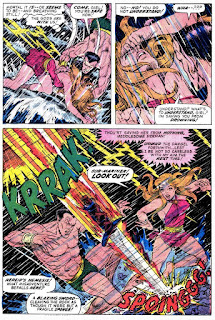


To be sure, the tale, like a lot of Golden Age stories, depends rather heavily on coincidence. In the midst of a stormy sea, Sub-Mariner beholds a “rocky pinnacle” rise from the ocean, complete with an Andromeda-like maiden atop it, waiting for rescue. The rescue is interrupted by a blazing sword from the heavens, which the reader—though not Namor—soon learns was thrown by none other than Ares, the God of War. Namor has more pressing problems. The rock-pillar starts sinking, and as he prepares to carry the unidentified woman to shore, she suddenly morphs into a different woman. Nevertheless, Namor takes her to safety ashore, and the woman, who calls herself “Vicky Starr,” takes her leave without so much as a thank-you.


The scene shifts to Namor’s then-current support-cast. One of them is Mrs. Prentice, who, in her youth during the 1940s, was Namor’s sometimes lover Betty Dean. The other is Namorita, the daughter of Namor’s cousin. In this story Namorita has become obsessed with campaigning against continued American involvement in Vietnam. In contrast, Mrs. Prentice represented the Older Generation that tends to trust in the government’s wisdom. During their exchange it comes out that Namorita’s teacher at college is one “Vicky Starr,” who is also an anti-war demonstrator. However, the morning paper alerts Namor’s cousin that Miss Starr’s car was wrecked near the ocean, so Namorita calls upon Namor to search for the missing teacher.
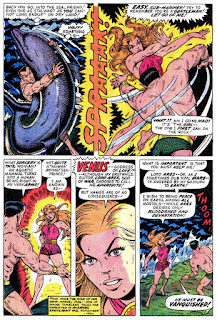

Namor, puzzled that the very woman he rescued has gone missing, searches the area. A mysterious dolphin shows up and encourages the Sub-Mariner to give chase. They end up at a “massive island” that has apparently appeared from nowhere, and the dolphin reveals itself to be the first woman Namor saw on the pillar. She reveals that she is Venus, Goddess of Love, and that the island was conjured into being by her eternal opponent, the God of War. Venus shows the Sub-Mariner how armed conflict has erupted upon the new island, and, though the island’s inhabitants are never seen, Venus asserts that if the island-war continues, “the pestilence of warfare will spread to all nations.”  Venus wants Namor’s help in defeating Ares, though she never troubles to explain why she didn’t identify herself to Namor the first time they met. Perhaps it would be charitable to assume that she waited until Ares launched his scheme, the better to overcome any doubts the sea-monarch might have.
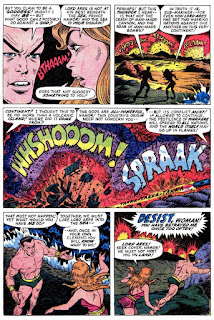

Ares shows up, and chases down Venus. He removes the girdle about her waist, which object gives Venus the power to encorcel others with love-spells. (Why she doesn't use the girdle on Ares the first time she sees him goes unexplained, except that it would have shortened the story a lot and left the main hero with nothing to do.) The Sub-Mariner joins the fight, and though Ares is said not to be at home in the sea, he gives Namor a pretty good battle by shifting his shape into various sea-creatures, more like the Greek Proteus than like the Hellenic war-god. Ares battles Namor to a standstill, but the key to Ares’ defeat proves to be the recovery of the love-girdle. Once Ares is exposed to its rays, he loses his resolve for battle, and obeys the goddess’s command to end the conflict on the island. In fact, the whole island disappears, and Venus once more morphs back into the identity of schoolteacher Vicky Starr.
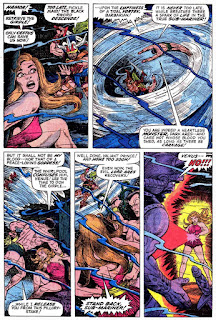

The final page, in which the name on Vicky's door is the same she used in her 1940s series, should probably be taken as a shout-out to the earlier series, rather than an attempt to launch the franchise again. As it happens, Everett died in February 1973, a.month after issue #57's January cover-date. Of course. the comic book probably appeared on newsstands two or three months earlier, and Everett had completed or semi-completed scripts and/or art that continued to appear in the title for a few months following his demise.


Now, the mere fact that Everett’s story conjures with archaic myth-figures does not make it “mythic” in my definition. The artist was probably aware of the story in which Ares and Aphrodite are shown as lovers, though he quite sensibly leaves out inconvenient details, like Aphrodite’s canonical marriage to Hephaestus, god of the forge. As William Moulton Marston did before him, Everett uses the war-god and the love-goddess to delineate opposing tendencies in the human soul. The Golden Age SUB-MARINER stories don’t delve into the depths that WONDER WOMAN did, but it should be noted that even though Sub-Mariner was a character formed in the crucible of war, one can find instances in which the character, or his author, comments upon the ultimiate foolishness of martial pursuits. HUMAN TORCH  #5, in which Namor becomes puffed-up with false glory and strives to conquer the globe, is probably the best example. In the Golden Age, there was no necessity to concoct an “island of war,” since war had already spread to almost every corner of the globe. Still, within the context of the 1970s, the martial island serves to concretize the fears that another World War might come into being, if humanity fails to “give peace a chance.”


A few other touches add to the story’s mythic density. I'm guessing that the 1948 Venus didn't have a love-inspiring girdle, but regardless of the item's provenance, it’s a patent vaginal symbol, and its victory over Ares’ very prominent sword may be seen as a renunciation of male bellicosity. I’ll also point out that although Namor was always rather bellicose in his own way, he, unlike a lot of Golden Age heroes, was frequently surrounded by female characters who often (though not always) sought to ameliorate his ferocity. The allusions to the continuing conflict in Vietnam could have dated the story, but Everett strikes the right touch of outrage in Namorita’s desire to see the madness end. There’s even a  loose imputation that American democracy is as vulnerable as any tyranny to letting war get out of control, for while Mrs. Prentice places her faith in the democratic way, Namorita puts her faith in her cousin, the monarch of a sub-sea kingdom. “I never noticed anything very ‘democratic’ about Namor,’ fumes the young mer-girl.  It wouldn’t be hard to see this story as Everett’s belated take on Marston’s love-war formula, in which women of good conscience ought to be making the decisions, and strong men are at their best when they serve as champions of peace.    

Monday, September 11, 2017

THE TOILS OF TROILUS

In MYTHOS AND MODE PT. 3, I spoke of three principal ways in which a given work failed to achieve the combative mode despite having some of the requisite elements, and I used one Shakespeare play as an example of each of the three. One way was exemplified by TITUS ANDRONICUS, which had both the necessary narrative and significant elements but simply chose not to resolve the conflict in a combative manner: I might call this the "diffuse type." Another path was exemplified by HAMLET, which had the narrative elements but not the significant ones relating to character-dynamicity, while the last was exemplified by CORIOLANUS, which had the significant elements but not the narrative ones. The third choice is one in which the main character and his enemy possess great dynamicity and seem to be building to a major combative resolution, but chose to frustrate that potential.

I recently reread TROILUS AND CRESSIDA, a play written about three to five years before CORIOLANUS. I remembered nothing about the play from whenever I last read it. Yet I decided, given my earlier statements on Shakespeare's proclivities for fictive violence, that I should re-read it, at least partly because the play's actions takes place during the action of the Trojan War. According to one source, the classic work most associated with that conflict, Homer's ILIAD, had not been fully translated into English when the Bard wrote his play. Thus it's hard to know if he knew more than generalities about parts of Homer's plot-action. Further, neither of the characters in the title-- two young Trojans in love (hmm, that sounds strange)-- appears in Homer. Both were born from medieval accretions to the main tale, accretions continued by authors ranging from Boccaccio to Chaucer, and since the story had proved popular in Shakespeare's time the Bard apparently chose to try his hand at the legend.

(Note: although Cressida does not appear in Homer, she's probably derived from the character Chryses, a prophet's daughter claimed by Agamemnon, leader of the Greek forces battling Troy. When circumstances make it necessary for Agamemnon to return Chryses to her father, he then swipes another "spoils of war" female from his subordinate warrior Achilles, and this leads to Achilles' famous reluctance to continue pressing the fight against the warriors of Troy.)

TROILUS has two plot-threads. One, dealing with the Trojan lovers, demonstrates no more narrative potential for the combative mode than does ROMEO AND JULIET. The other is nothing less than the quintessential combative moment of THE ILIAD: the duel between Achilles and Hector that, in Homer, marks the beginning of the end for Troy.  Toward the end of the play, main character Troilus does take the field and fights a warrior or two,  but he really has nothing to do with Shakespeare's (probable) attempt to one-up Homer by destroying the integrity of the Achilles-Hector battle. Here's a prose translation of the relevant scene from Homer:


Now, the fine bronze armour he stripped from mighty Patroclus when he killed him covered all Hector’s flesh except for one opening at the throat, where the collarbones knit neck and shoulders, and violent death may come most swiftly. There, as Hector charged at him, noble Achilles aimed his ash spear, and drove its heavy bronze blade clean through the tender neck, though without cutting the windpipe or robbing Hector of the power of speech. Hector fell in the dust and Achilles shouted out in triumph: ‘While you were despoiling Patroclus, no doubt, in your folly, you thought yourself quite safe, Hector, and forgot all about me in my absence. Far from him, by the hollow ships, was a mightier man, who should have been his helper but stayed behind, and that was I, who now have brought you low. The dogs and carrion birds will tear apart your flesh, but him the Achaeans will bury.’

And now here's Shakespeare's reworking:


ACT V SCENE VIII Another part of the plains.
[Enter HECTOR]
HECTORMost putrefied core, so fair without,
Thy goodly armour thus hath cost thy life.
Now is my day's work done; I'll take good breath:
Rest, sword; thou hast thy fill of blood and death.
[ Puts off his helmet and hangs his shield behind him ]
[Enter ACHILLES and Myrmidons]
ACHILLESLook, Hector, how the sun begins to set;5
How ugly night comes breathing at his heels:
Even with the vail and darking of the sun,
To close the day up, Hector's life is done.
HECTORI am unarm'd; forego this vantage, Greek.
ACHILLESStrike, fellows, strike; this is the man I seek.10
[HECTOR falls]
So, Ilion, fall thou next! now, Troy, sink down!
Here lies thy heart, thy sinews, and thy bone.
On, Myrmidons, and cry you all amain,
'Achilles hath the mighty Hector slain.'

So, in essence, Shakespeare undercuts all the glory and honor associated with the great duel-- though, to be sure, Homer seems quite aware of the innate brutality of the war itself-- and makes Achilles into a honorless dog who orders his personal guards, the Myrmidons, to chop down Hector when the latter has partly doffed his armor.

There's a lot of other support for the notion that Shakespeare meant to vilify the very idea of Classical Greece's idea of heroes and their heroic deeds, but I don't mean to explore that here. My main concern is to locate this Shakespeare play within the sphere of the playwright's handling of violent conflicts, and thus I find that TROILUS AND CRESSIDA follows the same pattern as CORIOLANUS, of which I wrote:

CORIOLANUS was my choice for a play that had the potential for the significant combative value, in that its opposed characters Coriolanus and Aufidius were both portrayed as exceptional warriors seen lusting to kill each other at the play's outset.  However, because the play's plot does not end with a combat between these two well-matched characters, CORIOLANUS is not combative in the narrative sense.
I'll forego further comment on the play, except to say that it strikes me as a play in which the writer's desire to satirize something he didn't like-- in this case, the general macho swaggering of the Greeks, and even Troilus's male chauvinism-- but without managing to bring any of his satirical characters to the semblance of life. By comparison, CORIOLANUS is much more successful on a roughly similar theme. The Roman general of the play's title is also something of an egotistical butthead, but he's a much more nuanced character than any of those in TROILUS AND CRESSIDA.

Thursday, February 21, 2008

DAUGHTER OF LOVE AND DEATH


In my previous post I stated that I could only evaluate the character of the Defenders character Valkyrie by exploring other narratives that contributed to her mythos. The first of these tales appears in the THOR story entitled “The Enchantress and the Executioner”, which appeared in JOURNEY INTO MYSTERY #103 (April, 1964). The story’s archetypal plot is that “the spurned and/or jealous goddess” that readers will know best from Greek myths, which is fitting since, despite sharing title-credit with her male partner, the Enchantress is the real star of the story. Arguably this witchy woman is also the first villainess of significant stature in the Marvel Universe, though this status didn’t keep her and her axe-wielding swain from enduring some distinctly un-mythic stories.

At the time of this story’s genesis, the continuity of the THOR feature still followed the founding premise that the character of Thor was no more than a superheroic identity assumed by Doctor Don Blake whenever he stamped his magically-endowed cane (which likewise transformed into Thor’s hammer). Creators Stan Lee and Jack Kirby probably derived their basic idea from Fawcett’s Captain Marvel, to whose 1940s saga Kirby briefly contributed. However, in CAPTAIN MARVEL Billy Batson, the alter ego to the Captain, was clearly the “true identity” of the two, complete with mortal relatives, while Marvel was in essence a magical idealization of Billy’s self-image. In THOR, however, Blake had no ties with mortal life save his romantic interest in his nurse Jane Foster, who was alternately attracted to both Blake and his thunder-god alter ego. But the character of Thor did have an identity separate from the moments when Blake summoned him into being. The otherworldly realm of Asgard wasn’t just a place where Thor could go to hang his winged helmet, but a place where he had familial connections, such as Loki, the brother who hated him, and Odin, the father who wasn’t crazy about his son potentially hooking up with a mortal woman. Given that Thor was more “real” than Blake in the ongoing narrative, in later years Don Blake was downgraded to being a vessel magicked up by Odin, in which Thor’s spirit could sojourn for a time in order to be humbled by mortal experiences. Jane Foster’s role in the series lasted even less long than the Blake persona, but at the time of JIM #103, both Blake and his romantic interest in Jane were ongoing concerns of the narrative—and of Odin, who wanted to break them up. To this end Loki encourages the father-god to send a “bad woman” to break up their romantic attachment; i.e., the Enchantress, sort of a faux-Norse version of love-goddesses like Aphrodite and Ishtar.

Curiously, though most of Lee and Kirby’s Asgardians have regular names, either drawn from Norse mythology or created to sound vaguely Nordic, the Enchantress and the Executioner are always referred to by what one might call their “supervillain names,” and don’t acquire personal cognomens until the 1990s. The text calls them “demi-gods,” which may have been Lee’s rationalization as to why his readers wouldn’t find the two of them listed in any Norse mythology books. In any case, the Enchantress happily accepts Odin’s mission, her demeanor making it clear that she looks forward to conquering Thor’s heart for the sheer sport of it. She’s also a sorceress, which gives her name a dual meaning that equates feminine attractions with literal witchery.

The demi-goddess’ mission to break up Blake and Jane proves indirectly successful. Posing as a mortal woman, the Enchantress visits Blake’s office and tries to work on him with her womanly wiles. But Blake, who apparently knows everything Thor knows, recognizes her as an Asgardian, and knows something’s up. However, Jane barges in on Enchantress trying to get Blake in a lip-lock, and then flees the office, having been (a caption helpfully tells us) “heartbroken.” Blake ignores the goddess and pursues his mortal love, leaving the goddess mightily insulted. She still wants to win Thor’s heart, but now decides that she can only do so by getting rid of Jane Foster, to which end she returns to Asgard to pay a call on one of her many frustrated suitors, the Executioner.

The title of this essay evoked the images of “love and death,” and if the Enchantress fills the bill for the first, clearly the name of her partner by itself evokes the opposite. However, unlike the demi-goddess the Executioner seems more of a blending of many mythic motifs. He is kin to various gods of death in that, when he finds Jane Foster, he consigns her to “limbo,” which is one of the abodes of afterlife spirits in Catholic theology. However, in terms of his character as the goddess’ subordinate servant, he reminds one more of Aphrodite’s ugly husband Hephaestus, and though the villain isn’t expressly a craftsman-god he does embody a sort of weapons-fetish, as later events in the story show. And lastly, the scene in which Enchantress sends her servitor to eliminate Jane has strong resonances with similar scenes in the folktale SNOW WHITE—a euhmerized version of the “jealous goddess” tale-type-- where the evil queen sends a huntsman to dispose of a younger competitor. Indeed, Lee’s script even specifies that the Executioner seeks out his victim with “the eyes of a hunting falcon,” though in no other way does he resemble mythic huntsman-figures (one of whom includes the archaic version of Odin).

After the Executioner descends to Earth and sends Jane Foster into limbo, Thor shows up and battles the villain, battering him to his knees. At this point the reader might rightfully expect the hero to use force to make the Executioner return the mortal girl to life, but this possibility never occurs to either hero or villain. Instead, the Executioner asserts that “Slaying me will avail you nothing,” but that Thor can recover Jane by giving up his hammer, which the villain says he desires “more than anything on Earth or Asgard.” This is a curious turn in the tale, in which the Executioner seems to have forgotten that his original motive for exiling Jane Foster was to win the heart of a certain sultry sorceress. There’s nothing in the text to explain such a change of heart, but I don’t regard it as a simple mistake.

On one level, the villain’s mid-stream motivational change serves a “furniture-moving” purpose in the tale. Because Thor does surrender his hammer to the villain, Thor’s nobility is emphasized, because losing his hammer means that when he next reverts to Don Blake, he will “remain so for all time.” Thus with this development Lee and Kirby create more suspense than they would have by simply having Thor beat the malefactor into compliance, and the suspense is furthered when the Executioner brings back Jane and then is frustrated by his inability to actually wield the hammer, which can only be lifted by one who is worthy.

Though as I said there’s no textual explanation of the villain’s motives beyond what he says about having always desired the weapon, it’s possible to see some deeper motives at work. The Executioner never asks his witchy woman why she wants some mortal removed, but one can imagine that he puts two and two together, and knows that he’s basically paving the way for the Enchantress to become romantically entwined with the thunder-god. By taking Thor’s hammer the villain hopes to both eliminate a rival and obtain his power—perhaps with the idea of conquering the Enchantress’ heart in future, or just for the gratification of power in itself, embodied in the aforementioned “weapons-fetish.”

In any case, his independent actions are a clear affront to the goddess he claimed to serve, and the Enchantress, watching from afar, takes vengeance by turning the axe-wielder’s limbs into tree-branches. Her intrusion inadvertently saves Thor, for the Executioner, desperate to save his life, gives the hero back his hammer so that Thor will combat the villainess (thus putting the formidable Executioner in the position of the “damsel in distress.”) The combat between Thor and the demi-goddess is short: she tries to change his hammer into a “deadly serpent,” but the hammer is proof against enchantments due to its being forged by the supreme father-god Odin (ironically enough, since the Enchantress is serving as Odin’s catspaw here). With male power reasserted over that of the jealous goddess, Thor returns both demi-gods to Asgard. Later Don Blake finds Jane and makes up with her, returning their relationship to square one and further aggravating all-father Odin.

As remarked earlier, most 1960s uses of the Enchantress and the Executioner did not attain this level of mythic complexity. Often the two were treated as little more than standard super-villains, whether separately or together, though a few stories have the Enchantress become infatuated with another archaic myth-hero, Hercules, making her the ironic victim of unrequited love. The main exception to this comedown appears in INCREDIBLE HULK #102 (April 1968). In this tale by Gary Friedrich and Marie Severin, the titular green-skinned star travels to Asgard, where he becomes embroiled in the attempt of the Executioner and Enchantress to become major players by leading a troll army against Odin and Asgard. In doing so they go from being minor incarnations of “love” and “death” to attempting their own Titanomachy. However, their failure returns them to something of the status of also-rans in the hierarchy of Marvel villains, and over the course of the next two decades their ambitions rarely attain the grandeur of attacking Asgard. However, the villains’ punishment by Odin for the attack on Asgard, as chronicled in AVENGERS #83 (December 1970) has the more far-reaching effect in beginning the first action that will lead to the birthing of their symbolic daughter, the Valkyrie—which will be further addressed next post.