In one reminiscence Roy Thomas recalled
that his one-time DC editor Mort Weisinger was the first person he
Thomas heard use the term “mythology” for a corpus of comic-book
stories, in particular the “Superman Family” titles over which
Weisinger held sway for the entirety of the Silver Age. I would guess
that this was just a convenient tag for the editor, that he probably
cared little or not at all about what comprised a genuine archaic
mythology, or what status if any modern-day stories might have as
“myths.” Still, in the late 1950s Weisinger made some concerted effort to have
his writers utilize far more fantasy/SF tropes in the Super-books
than had previously been the norm. Not all such metaphenomenal tropes
are automatically mythic in nature. Yet as it happened, many writers
in Weisinger’s stable—Otto Binder, Leo Dorfman and of course
Jerry Siegel—did manage to use these tropes to tell a handful of stories with a
high level of mythic concrescence.
However, Weisinger was edged out of DC
just in time for the debut of the Bronze Age in 1970, and the
Super-books were parceled out to assorted editors. Julie Schwartz
took custody of the two titles starring the Big Blue Cheese, SUPERMAN
and ACTION COMICS. But though Schwartz’s Silver Age writers had
also produced a respectable number of myth-stories, in the Bronze Age
the editor favored in large part two writers given to penning very
gimmicky, superficial tales: Cary Bates and Elliot Maggin. When three
of the ancillary Super-features—SUPERGIRL, JIMMY OLSEN and LOIS
LANE—failed to sell well, DC cancelled the individual titles and
transferred their features to a portmanteau book, THE SUPERMAN
FAMILY. As it happens, it was in this title that editor Schwartz and
writer Maggin produced one of the few stories that can stand
alongside the best myth-outings of Siegel, Binder and Dorfman.
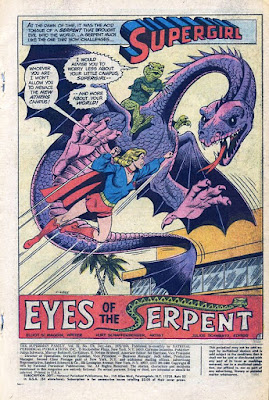
The first page of Kurt Schaffenberger’s
art for “Eyes of the Serpent” is a splash-page portraying a scene
that does not literally occur in the story: Supergirl flying into
combat against a giant winged dragon, while on the dragon’s back
rides a green-scaled humanoid. The humanoid looks a bit like a
frog-man, but Maggin’s caption makes clear that this fellow so viridian is also ophidian: “At the dawn of time, it was the acid tongue of a
serpent that brought evil into the world—a serpent much like the
one that now challenges Supergirl!” In this introductory sentence,
Maggin establishes that in this world, he validates as real the story
of the Garden of Eden, including Eve’s temptation by a serpent
later identified with Satan. However, the story Maggin tells is about
a serpent who is only “much like” the Biblical tempter, the
better to avoid any accusations of mixing serious religious figures
with the “let’s pretend” of a comic book.
As the story proper begins, the same
serpent-man from the splash, Lord Beriak, stands in an indeterminate
location (full of rocks and smoky vapors) along with other
serpent-men, who give Beriak his assignment. He must journey from
wherever the serpent-people make their home to a college in Florida,
where the Kryptonian heroine works as a guidance counselor in her
Linda Danvers identity. Beriak's purpose is that of “reasserting our
dominance over the human race.” (Some influence from Robert E.
Howard’s “serpent-men” stories seems likely, given that the
snake-people are never identified as either aliens or supernatural
demons.)
Once Beriak arrives in the fictitious
Florida town of New Athens—where, for once, the locale plays a role
in a Super-story—he takes on the appearance of a good-looking human
male and contrives to meet Linda Danvers. Linda/Supergirl is somewhat
attracted to the false flesh of Beriak, but she doesn’t immediately
agree to date him. Since Beriak’s as-yet-unrevealed master plan
requires him to gain mental dominance over Supergirl, he decides that
she may become more pliable if he wears her down a little. To that
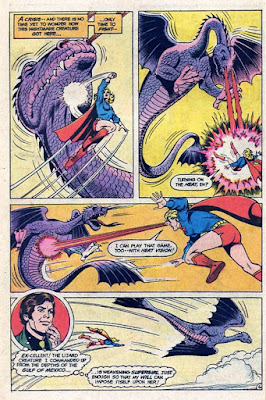
end he summons a dragon from the vasty deep of the neighboring ocean
and makes it run amuck in New Athens, so that the heroine will appear
and bring the beast to heel. (Though dragons have some status in
Bible lore, this critter is just another of DC’s countless
convenient prehistoric survivals.)
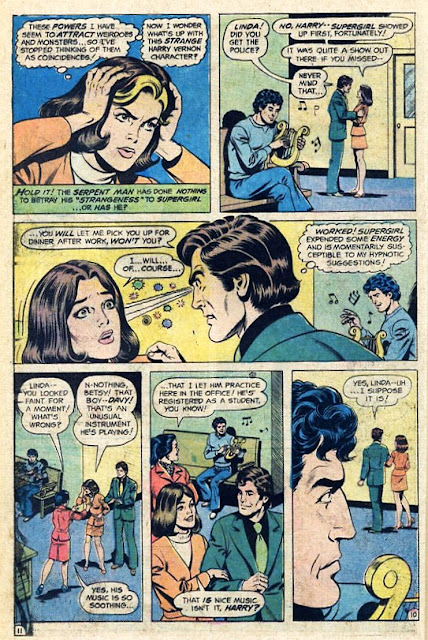
While all this is going on, a
mysterious young fellow named “Davy” appears at the college, and
he like the serpent-man shows some ability with exerting persuasive
mojo. The Davy character, created by Maggin for a three-part Green
Arrow story in ACTION COMICS, is given no precise origin, but he’s
clearly meant to be identified with the youthful David of the Bible,
since Davy carries a lyre on which he can play enchanting music, and
a sling with which he can cast stones, like the one David used to
defeat Goliath. Maggin does not ever say that Davy is identical with
Bible-David, who after all aged, sinned and died in the course of his
narrative. But since the House of David was associated (in a
roundabout way) with the lineage of Jesus of Nazareth, Davy is as
associated with the powers of Heaven as the serpent-men are with the
Devil.
In addition, in what may be the
shortest foreshadowing in a comic book, an orange-picker falls
unconscious after eating an orange in a local grove. The man is never
seen again, though by customary expectations the reader would assume
he’s okay once the threat of the serpent-men has been vanquished.
The disguised Beriak once more
encounters Linda Danvers after her heroic other-self has driven off
the winged dragon. This time, he places her under his mental thrall,
at least enough that she accepts a date with him. As Beriak leads his
victim to the slaughter, Davy follows along, sometimes playing the
music on his lyre, though for reasons undisclosed the serpent-man
can’t hear it. (Perhaps Maggin believed the legend that snakes
can’t hear or thought that his audience would believe as much.)
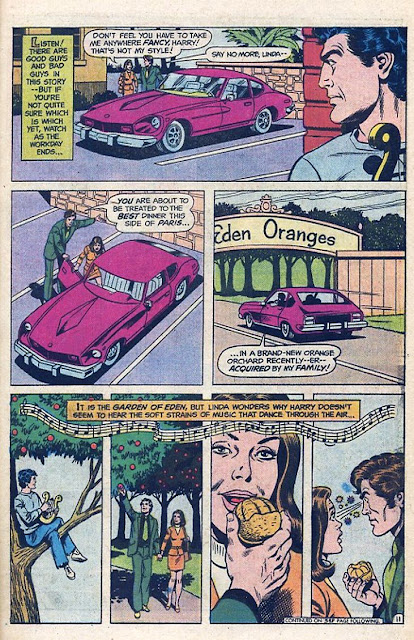
Beriak takes his date to an orange
orchard—possibly the same one where the unnamed man collapsed—and
ramps up the Eden-references by getting Linda to eat one of the
tree’s “forbidden fruits.” Whjen Linda eats the orange, it
apparently puts her under Beriak’s total control. Beriak then
reveals his scaly other self and makes the Girl of Steel perform a
few super-feats for his amusement. Then he finally reveals his master
plan. Beneath one of the orange-trees in the orchard—presumably the
one from which Linda ate, just to keep up the parallel with the
Biblical Tree of Knowledge—lies a “golden stone” called the
Eden Rock. Once Beriak compels Supergirl to surrender her life-energy
to the stone, this maneuver will give the serpent-race total dominion
over humanity and all of its superheroic defenders.
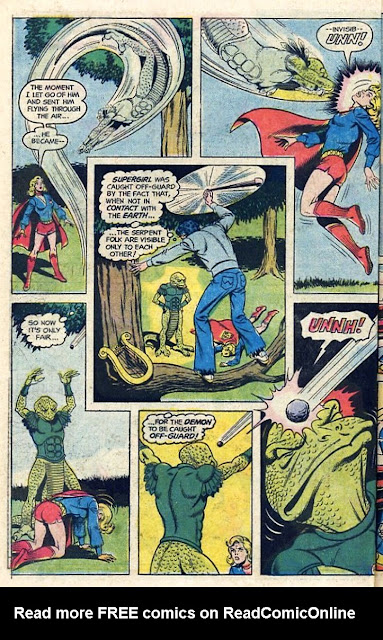
However, Supergirl has been shamming:
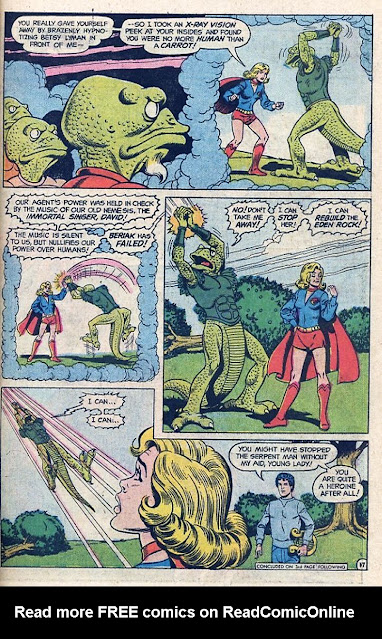
she caught on to his imposture early on. The two super-beings fight,
and though Beriak gets the upper hand once, Davy is on hand to
distract him with a handily-hurled sling-stone. Beriak finally
recognizes Davy as an old foe of his Satanic species, and Davy uses
his magic to keep Beriak restrained while Supergirl tunnels beneath
the earth and destroys the Eden Rock, so that no one can use it
again. Then, as the enemies square off again, Beriak’s fellow
serpents, who are watching from afar, decide to call back their
agent, commenting that he was stymied by “our old nemesis, the
immortal singer David.” Supergirl and Davy converse briefly and the
story ends with a minor coda at Linda’s workplace.
It would appear that the serial’s
Florida setting was the only reason for Maggin to substitute an
orange for the forbidden food, though to be sure some scholars don’t
believe the Biblical fruit was an apple, either. Maggin doesn’t say
why this particular delicacy is forbidden, or who forbade it, or why
eating it doesn’t really affect Supergirl at all. Presumably the
only parallel is an inverted one: unlike Eve, Supergirl resists the
blandishments of the serpent, and so preserves her world in contrast
to Eve losing Eden for herself and Adam.
As noted, since the Biblical David was
not “immortal” like Davy, there can only be a symbolic connection
between the two. Davy is what Carl Jung might have called a “puer
eternus,” an eternal child—which is, to an extent, an archetype
to which Youthful David subscribes as well. Bible-David has no
connection with the mythology of Eden except in the sense that David
provides a link between Adam and Jesus of Nazareth. In a larger
sense, of course, the expulsion of the first Man and Woman from Eden
leads to Christ’s sacrifice to redeem humanity, so the Fall
foreshadows the Redemption, and the general defeat of Satanic evil.
In addition, in Maggin’s scenario Davy is meant to be something of
a destined warrior like David: able to overcome evildoers who seem
far more powerful than he.
There is nothing paralleling the Eden
Rock in Genesis. However, there are a few foundation-stones in the
Bible and in later Judeo-Christian commentary. In the Zohar, God is
said to have unleashed the flood—the instrument by which the
Divinity eradicates almost all the sinning spawn of Adam and Eve—by
moving a foundation-stone called the Eben Shetiyah. There is no firm
evidence in the story that Maggin knew of this trope. But given that
he was already juggling the myths of Eden, it’s not improbable to
think he might work in one from the Flood-Myth, even if he does turn
it into a standard comic-book gimmick, “the thing that makes all
humanity bow down.”
Lastly and leastly, Beriak’s name
doesn’t seem to have any strong forbears, Biblical or otherwise.
There is a Canaanite deity named Berith or Baal-Berith, who later
becomes a Christian demon, but in this case it’s just as possible
that “Beriak” took no influence from this figure, that the
serpent-man just has a nonsense-name. It’s of passing interest that
“Berith” means “covenant,” which reference could take us back
to Flood-mythology—but that’s not a holy hill on which I’d
choose to make my stand.