Featured Post

SIX KEYS TO A LITERARY GENETIC CODE

In essays on the subject of centricity, I've most often used the image of a geometrical circle, which, as I explained here,  owes someth...

Showing posts with label justice league of america. Show all posts

Friday, October 17, 2025

NEAR-MYTHS: JUSTICE LEAGUE VS. GODZILLA VS. KONG (2023-24)


Now THIS is what JLA cluster-crossovers should be: valiant superheroes battling colossal monsters, and monsters battling other monsters, and villains trying to control the monsters before being taken down by the heroes. 

One thing I like about JL/G/K is that even though the DC-verse depicted here is not entirely congruent with the mainstream one-- for one thing, three regular villains and two regular heroes take the dirty nap-- there's no pretense by writer Brian Bucccelato that this is some amalgam universe where the Justice League and the Legion of Doom occupies the same world as the cinematic "Monsterverse." Buccelato possibly realized that it provided more opportunities for exposition if the Legion stumbled into the Monsterverse and brought back its progeny to menace this version of DC-Earth. 

The only icons directly imported from the Monsterverse are Godzilla, Kong, Mechagodzilla, and the Skull-Crawlers, though some new ones are invented to take the place of various Toho-titans. There were no such restrictions on the use of DC characters, so this is not a story for noobs, who really won't be able to tell the players without a scorecard. There's even a scene with some heroes breaking up a supervillain jailbreak in which I, expert though I usually am, strained to figure out some of the obscurities given a few panels here and there.

Characterization is understandably simple since the primary story is about stopping giant monsters, but Buccellato works in some pleasant dialogue nonetheless, and Christian Duce does a fine job of imparting the sense of monolithic hugeness to the big beasts. Sometimes there are continuity goofs because everything's so rushed. When in the story did someone bring the Teen Titans into the mix, and why is the Big S almost killed by Godzilla's atomic fire? If the Legion contacts Deathstroke to employ the League of Assassins, why does Ra's Al Ghul get into the thick of things? But since it's a one-off universe, the blips don't get in the way of all the looney hero/monster/villain fun.          


Wednesday, July 17, 2024

MYTHCOMICS: "TRIUMPH OF THE TORNADO TYRANT" (JUSTICE LEAGUE OF AMERICA #17, 1963)


This Gardner Fox JLA tale, while not as well-thought-out as the classic "Justice League's Impossible Adventure," nevertheless possesses a good myth-discourse which upgrades the standard "problem" of heroes overcoming villains to a "conundrum" about how that scenario can be validated.


The first page of the narrative proper begins with the heroes of the JLA celebrating their triumph over some stony-faced aliens. Batman opines that evildoers ought to realize that they have no chance against the forces of justice. J'onn J'onzz counters by saying that it's because such menaces exist that "they make us heroes." Just then, all of the heroes' bodies dissolve. An attack by one of those menaces?


No, all the heroes seen here are proxies for an alien being, the Tornado Champion-- who in some ways is using the Justice League of his comic-book universe much as the readers of the title do: to celebrate the virtues of goodness. The Champion had one exploit as "The Tornado Tyrant," menacing the planet Rann until being defeated by Adam Strange (also written by Fox in MYSTERY IN SPACE #61). He comes to admire the Justice League so much that he wants to emulate them exactly, and so he creates an exact duplicate of Planet Earth, except that he himself embodies the Justice Leaguers so that he can experience the inevitable triumph of good over evil.


However, Tornado-Fanboy doesn't overcome the evil in his own nature quite that easily. From "the ocean depths" (or maybe from the collective subconscious of the tornado-species), a duplicate Tornado-Being manifests, and this new Tyrant masters all of the Champion's ersatz Leaguers, mostly by either undermining their powers or turning them against one another. But before the Tyrant can eradicate the heroes, the Champion re-absorbs its component parts (using a "tornado-ship" like the one seen in the ADAM STRANGE story). He then decides that the only way he can formulate a counter strategy is by traveling to Earth to find out how the real heroes would cope. This means that he must, in essence, take the part of his villainous self, splitting off a part of his Champion-self to create a phony Tornado Tyrant to bedevil the real heroes.

Now, simplistic though all these complications may sound, Fox set himself a conundrum: to come up with a rationale as to WHY good should always be able to conquer evil. Six years later, a STAR TREK episode, "The Savage Curtain," tries to do something similar, though the conundrum there was to explain the difference between good and evil to an alien being. But how does one provide an answer for a foregone conclusion dictated by nothing but a literary trope?

And Fox's answer to his own conundrum-- is continuity.


So the Real Leaguers are defeated by the Fake Tyrant, just as the Fake heroes were defeated by the Real Tyrant. But unlike the imitation heroes, who only enjoy the simulacra of real lives, the real crusaders have gained a wealth of experience contending with menaces-- rather than, say, conjuring up faux enemies that can be vanquished easily. 

Thus, while the heroes collect their thoughts, they apply a certain amount of ratiocinative deduction. They debate as to whether the Tyrant's proxies might have been seeking to eradicate centers of atomic power to cover some vulnerability, but then dismiss the idea as untenable. However, the reason Author Fox included that blind alley-clue was to lead the heroes to a correct conclusion, even though only the real-world readers know why it's correct. The Tornado Being is not created by radiation, but it does have a dual personality-- and Green Lantern, drawing on one of his previous adventures (actually written by Fox's colleague John Broome), chooses to use "anti-energy" on the Tyrant as he did on a previous enemy that was a split-personality resulting from an atomic mishap. This strategy works for the Earth-heroes and destroys the Fake Tyrant. Yet the same process can't work for the observing Tornado Champion. If he tries to create anti-energy to destroy his evil self, he'll destroy himself as well.


But the Champion still prevails, by using another form of continuity. Since his proxies can't create anti-energy, they transport the Real Tyrant into the universe from which anti-energy came: "the anti-matter universe"-- which I assume is also a bit of continuity Fox also derived from Broome's GREEN LANTERN, though Fox doesn't explicitly reference Broome's "world of Qward."


If this was Fox's intention-- omitted to save space or reduce confusion in his young audience-- this would be doubly impressive, because in Broome the anti-matter world is also one dominated by evil-- and thus sending the Tyrant there is like consigning the "devil" in one's own nature back to perdition. 

I should note that in his Silver Age career Fox showed a penchant for stories in which he presented secondary scenarios in which characters "re-wrote" whatever initial scenarios Fox placed them in. I see this penchant as contributory to the way this Fox story solves the conundrum of "how can good always conquer evil:" by recognizing that this question itself is a literary trope, and that it can only be "solved" by invoking other tropes.

Monday, March 27, 2023

NEAR-MYTHS: THE TOWER OF BABEL:THE DELUXE EDITION (2021)


This is not my standard review of a "near myth" work, since I'm not going to dissect in detail the stories collected here, which appeared in a couple of JUSTICE LEAGUE titles in or around the period when Grant Morrison transformed the title. Most stories in the collection were written by Mark Waid, who in my view has always been a sort of dull version of whoever he chose to emulate, be it Kurt Busiek with KINGDOM COME or Morrison with his follow-up JLA stories. Thus Waid is significant only as a negative reflection of Morrison, and, for that matter, the JLA writer whom Morrison most challenged during his run: original Silver Age scribe Gardner Fox.

In this mythcomics post I recapitulated the history of the dominant writing-strategies of Silver Age DC Comics vs. Silver Age Marvel Comics thusly:

The JUSTICE LEAGUE comics title of the 1960s has never received a lot of respect even among Silver Age comics-fandom, and one reason may be that the early comic, for several years written by Gardner Fox and drawn by Mike Sekowsky, is perceived as being too "old school." Most team-features in both the Golden and the Silver Ages followed what I'll call a "plot-based model," in which "character moments" are kept to a minimum, as the author concentrates on the events of the plot, usually showing how the members of the team work to overcome some common enemy. The plot-model seems like an easy row to hoe, as indicated by countless spoofs of the model, but DC Comics pursued it almost exclusively, even when Marvel Comics in the 1960s advanced a "character-based model" that over time become the dominant paradigm.


Calling those strategies "the plot-based model" and "the character-based model" was a bit of an oversimplification, though many fans over the years have used similar terminology. Certainly the raconteurs who wrote superhero comics in the early Silver Age did not intend to follow such rigorous models; they were in large part "riffing," trying to find profitable ways to re-invent superheroes for a post-Comics Code readership. DC Comics started its efforts with re-imagined revivals of its most successful costumed characters from the 1940s. But Marvel, the rebranded version of the entity variously called "Timely" and "Atlas," had fewer such major successes, so that the key Marvel creative personnel had to create more original characters. DC initiated the Silver Age with single-character features like The Flash, Green Lantern, and (arguably) the Martian Manhunter, and then launched a team of said heroes in the Justice League. Marvel's superhero line was not initiated until roughly five years after DC's example, and it began with a quasi-emulation of JUSTICE LEAGUE, a team book made up of all-original characters, and only within the next year did the company launch such single-character superhero features as Hulk, Ant-Man and Thor. 

While no reader's experience of the elusive "sense of wonder" in SF/fantasy is paradigmatic, team-books arguably oblige the creators to increase the quantity of SF/fantasy concepts in order to provide multiple threats for multiple protagonists. Thus it's my experience that the first Silver Age team-books, the JUSTICE LEAGUE of Gardner Fox and Mike Sekowsky and the FANTASTIC FOUR of Stan Lee and Jack Kirby, offered the greatest opportunities for stimulating the readers' sense of wonder. Lee and Kirby certainly did not neglect the "plot-based model" of superhero scripting in conceiving of their menaces, whether they were strong concepts like Galactus or weak ones like the Enfant Terrible. Fox, for his part, concentrated on plot more when he conceived of foes for the Justice League, but there are interesting if minor character-moments even in the earliest JLA stories.                                 

I've sometimes expressed to other fans that in terms of raw creativity I deemed Fox's JUSTICE LEAGUE the equal of the Lee-Kirby FANTASTIC FOUR, and the reaction I got was usually a negative one. What I believe those fans were favoring in the Marvel team-title was the fact that Stan Lee perfected a strategy of building on his concepts so that they began to seem like part of a larger tapestry of interconnected wonders. Most of Fox's concepts were confined to whatever story they first appeared in, and so they had less cumulative effect than, say, the recurring concepts appearing in DC's single-character features (Green Lantern's "Guardians of the Universe," for example).

Raw creativity, of course, is just one element in communicating the sense of wonder from author to reader; an element that gives the reader the impression of "richness and profusion of images," as referenced in this essay. Based on my formulations there, said profusion provides the potential for the development of fantastic content into the even richer forms of myth, but the actuality of mythicity stems from articulating the raw material into organized patterns of conceptual thought. 

As noted above, Lee and Kirby had their share of so-so concepts, but FANTASTIC FOUR became a testing-ground for all of their best"sense of wonder" ideas. In contrast, what keeps Fox's JLA concepts from attaining their greatest possible development is the fact that each of them was largely isolated from all the others.

Grant Morrison's JUSTICE LEAGUE is a vision of what the Fox-cosmos might have looked like if many of the one-off concepts had been given the same inter-referentiality seen in the Lee-Kirby FANTASTIC FOUR comics. In contrast, Mark Waid's JLA feels like a regression to Fox's least inspired concepts. Waid trundles out abstruse concepts with potential, all right. In the titular story of the collection TOWER OF BABEL, the Leaguers are put through a series of transformations just as weird as any Fox ever devised. Said transformations are brought about when Batman's enemy Ra's Al Ghul implements strategies Batman himself devised to nullify the abilities of his fellow heroes in case any of them were suborned by evildoers. But even though Waid devotes considerable space to the character-conflicts that evolve as a result of this predicament, he doesn't really invest the proceedings with an independent "sense of wonder," as Morrison did with comparable concepts. In many ways Waid resembles Fox at his least inspired, when he simply churned out this or that concept to meet a deadline, and so failed to make those particular concepts emotionally resonant. Thus "Tower of Babel" is not much better, in terms of evoking the sense of wonder, than an inferior Fox-tale like the 1966 weird transformation tale "The Plague That Struck the Justice League."

Ironically, even though in his JUSTICE LEAGUE stories Morrison eschewed the soap opera dramatics that one often associated with the Lee-Kirby FANTASTIC FOUR, he came closer to the emotional resonance Gardner Fox successfully executed in stories like "The Justice league's Impossible Adventure." Thus Waid fails both the tests of good drama and sense-of-wonder in his lack of inspired work.


Sunday, February 12, 2023

NULL-MYTHS: INJUSTICE, GODS AMONG US YEAR FOUR (2018)


I don't know if I'll ever get around to reviewing the animated movie INJUSTICE, based on an alternate-world scenario for DC superheroes as propounded by both a licensed video game of that title and an extensive series of comics-prequels to the video-narrative. But having randomly sampled one such prequel, I think it's pretty unlikely I'll revisit the comics-franchise.

I won't spend a lot of time on YEAR FOUR. Like IDENTITY CRISIS and FLASHPOINT PARADOX, the series as a whole predicates one inciting incident that changes the status quo of the superhero setup. In this case, the incident is that the Joker kills a pregnant Lois Lane as well as all of Metropolis, and this tragedy causes Superman to end his never-ending struggle against evil by taking control of Planet Earth. In this endeavor he's aided by several of his fellow heroes-- some of whom are radically changed for whatever reasons, like "Yellow Lantern." However, other heroic types, notably a certain Cowled Crusader, don't like the Man of Steel becoming the Man In Charge. So it's Civil War All Over Again. But a few segments of Marvel's near-interminable hero-fracas touched on relevant moral issues, and here the writers are just pitting various characters against each other in a series of clumsy melodramatic conflicts.

The whole series is subtitled "Gods Among Us." I don't know how often the gods of the DC Mount Olympus figure into the grand scheme, but Part Four focuses on Batman involving the Olympians in the struggle for Earth's fate. The deities' motives for so doing are confused at best, though one cited motive is envy over being displaced in the eyes of mortals by costumed heroes, a premise that was much more concisely expressed in the 1967 Superman tale "Battle of the Gods." A lot of DC raconteurs portray the Greek deities as a bunch of pig-headed, quarrelsome oafs with super-powers, and the writers of INJUSTICE stick close to that superficial depiction.

While none of the melodramatic encounters of Part Four are insightful, I can damn the project with faint praise by saying that at least it wasn't as egregiously stupid as FLASHPOINT. And while the action set-pieces are undistinguished, I did notice that the artists produced some of the "punchiest" art I've seen in a DC multi-crossover. Superman and Wonder Woman punch each other several times, and they both punch Hercules. Shazam punches both Hercules and Apollo. Mera punches Poseidon. Damian Wayne punches Batman but Batman changes things up by hitting his son in the balls. At least no one could accuse the story of sanctimoniously avoiding the violence crucial to the superhero genre.

Wednesday, March 30, 2022

MYTHCOMICS: JUSTICE LEAGUE: THE DARKSEID WAR (2015-16)


In the thirty-something years since 1986’s CRISIS ON INFINITE EARTHS, DC Comics has published many similar multi-feature crossovers, few of which have possessed any mythic content. But the subject of this essay—henceforth WAR for short—not only achieves such symbolic amplitude but does so through some inventive riffing on many of the myth-tropes of CRISIS. (Note: I’m not reviewing here any tie-ins to this Justice League series.)


The purpose of the 1986 CRISIS was not purely artistic, for its purpose was to merge the many parallel worlds of the diverse DC universe into one cosmos, patently emulating the successful business model of Marvel Comics. As I observed in my CRISIS review, the authors did so by interweaving two loosely related concepts from DC’s Silver Age. The first was the idea of parallel Earths in which the archetypes of DC heroes took on somewhat different configurations—a Flash named Jay Garrick on one Earth but named Barry Allen on another, or a world where all the characters who were heroes in the Justice League became instead a group of criminals called “the Crime Syndicate.” The second was the notion of universes that were made either of “positive matter” or of “negative anti-matter.” The Earths of the Justice League and all their congeners fit into the positive universe, while the negative universe was represented only by the irredeemably warped world of Qward. In CRISIS, the positive universe gave birth to a protective super-being, the Monitor, while the negative continuum spawned the Anti-Monitor, an entity obsessed with annihilating all other realities (and thus serving the purpose of the authors). It’s interesting that DC’s way of getting rid of all the unmanageable doppelgangers from their company’s long history was to spawn a pair of cosmic twins, though both are dead by the end of the series like the other troublesome duplicates. The authors also threw in at least one other new doppelganger: a good version of Lex Luthor, who also gives rise to a son, Alexander Junior, who took on something of a “secular savior” role by story’s end. In addition, the reordering of the DC cosmos gave the company the chance to debut brand new versions of Superman, Wonder Woman and others.


WAR was not such a reboot, but it followed in the wake of a 2011 crossover event in which the DC cosmos was once more re-arranged, this time to allow for the return of many of the alternate worlds, including (most prominently) that of the “Crime Syndicate” Earth. During that reboot, familiar franchises were once more rebooted, but only two are relevant to the WAR storyline. First, Wonder Woman no longer enjoyed an immaculate conception via clay statue, but became the offspring of the deity Zeus with Amazon mother Hippolyta. Second, Cyborg’s artificial body, originally the invention of the hero’s scientist-father, became interfused with the technology of the New Gods from the classic Jack Kirby series. Both the good and bad gods of that franchise—respectively from the worlds of New Genesis and of Apokolips—sat out the events of 1986’s CRISIS. In contrast, the new origin for Cyborg insured that the revised 2011 Justice League would be strongly linked to the New Gods sub-cosmos. To be sure, the New Genesis gods barely figure into WAR, except that one of their kindred becomes the hero Mister Miracle. In WAR most of the authorial attention goes to the mythos of Apokolips, to whose activities Cyborg becomes attuned. Aside from the modifications to Wonder Woman and Cyborg, the rest of the starring characters—Superman, Batman, the Flash, the Hal Jordan Green Lantern, Shazam, and Lex Luthor—are broadly recognizable. The newbie in their ranks is one Jessica Cruz, who bears a complicated relationship to the evil Green Lantern from the Crime Syndicate cosmos, which I’ll forbear to discuss here.


Johns wastes no time in doubling down, so to speak, on the presence of doppelgangers. A flashback reveals that on the night that Hippolyta birthed Princess Diana on the island Themiscyra, another Amazon, Myrina, produced yet another female child, but her father was Darkseid, more or less the obverse of Zeus’s role in the Wonder Woman cosmos. Myrina names her child Grail, referencing the mystic Celtic vessel that restores life, because the Amazon mother believes that Grail will save the universe from the evil of Darkseid. (This idea may owe something to the mythology of Achilles, a child whom oracles claimed would overthrow his father— which prophecy restrained the usually randy Zeus from having sex with Achilles’ mother.)


Just as Grail is deeply implicated in the New Gods mythos, so too is the new version of the Anti-Monitor. In Kirby’s original series, he includes the character Metron, a relentless quester after knowledge, who moves about the cosmos in his “Mobius Chair.” Kirby never implied that anyone but Metron constructed the miraculous mobile throne. In Johns’ world, Mobius is the mortal inventor of the chair, as well as an inhabitant of the Qwardian anti-matter universe. In addition to gifting Metron with the chair, Mobius duplicates the function of the Guardian Krona in CRISIS, being a man obsessed with peering into forbidden secrets. As the result of Mobius’ prying, he beholds the “anti-life equation”—another NEW GODS concept, now tied to the “anti-matter universe”—and is thus transformed into the Anti-Monitor. Some story extrinsic to WAR causes the newborn fiend to annihilate the Crime Syndicate world, and this will eventually lead to the surviving super-criminals of that world making common cause with the Justice League. However, in the early chapters the cosmic colossus doesn’t immediately rush out looking for new worlds to destroy. Grail is the agent who calls him into conflict with both the Justice League and with Darkseid, the father whom Grail wants to murder.


To make things even more complicated, throughout the story most of the heroes undergo assorted transformations into god-like beings—a tacit response to the many superhero fans (like me) who view superheroes as recapitulations of archaic myth-figures. Some transformations are merely functional in nature. Batman becomes bonded to the Mobius Chair because Johns needs one of the good guys to tap into the chair’s ability to endow the sitter with copious knowledge. More promisingly, the Flash becomes bonded to the Black Racer, Kirby’s “New God of death,” which plays into the fact that Flash is one of the heroes who dies during CRISIS. Johns’ best scripting deals with the quarrelsome team of Superman and Lex Luthor, who get teleported to Apokolips and have to work together, but not with very positive results. 


On top of all that, the main subplot with the Crime Syndicate, out to avenge themselves on the Anti-Monitor, involves their one female member giving birth to a sort of anti-savior. Said female, Superwoman, is an alternate-world mashup of both Wonder Woman and Lois Lane, and the father of her demon-kid is a nasty version of Alexander Luthor, who was a good guy in CRISIS.

Whew.

I’ll forbear to discuss the very involved denouement here. I’ve long been aware that Geoff Johns knows his DC history inside and out, but this is the first time I’ve been strongly impressed by his artful repourings of old wine into new bottles. Not everything works, of course. Near the beginning Johns tosses in references to Brainiac and to Aquaman that may relate to some extrinsic stories, but which have nothing to do with WAR. Also, the deific names Johns gives to the transformed characters are lame. Shazam becomes “the God of Gods”—why exactly?


But I do like other playful recastings of continuity points. Luthor, abandoned on Apokolips by an evil-ized Superman, is taken in by a group of anti-Darkseid rebels, and they’re led by a woman named Ardora. In the Silver Age this was the name of an alien woman who fell in love with Luthor, and it’s through contact with the new Ardora that Luthor usurps the destiny of his enemy Superman and becomes the potential savior of Apokolips. Johns even has the Crime Syndicate version of Superman mention a woman named Luma Lynai, who in the Silver Age was a potential lover for Superman, for all that she looked like an age-appropriate version of Supergirl, as well as not being in any way related to the Man of Steel.


I freely admit that only a continuity-hound would get much mythic impact out of this highly referential opus. But for those so invested, the game is definitely worth the candle.

Sunday, September 13, 2020

MYTHCOMICS: DC: THE NEW FRONTIER (2004)


I’ve heard good press about the late Darwyn Cooke’s THE NEW FRONTIER ever since the series first appeared (in the abbreviated form of a six-issue periodical back in 2004. But though I knew that Cooke’s work dealt with one of the most important periods of American comic books—the beginnings of “Silver Age” comics in the mid-to-late fifties-- I didn’t rush to explore FRONTIER. Possibly I didn’t quickly warm to promos of Cooke’s art. More likely, though, I was just pessimistic that anyone could find a fresh take on yet another look back into that rather well traveled territory —the debut of Silver Age Flash, of Silver Age Green Lantern, of the Justice League. But I can now say without reticence that Cooke’s magnum opus succeeds—that of celebrating not only the gaudy costumed characters, but also the humbler-looking heroes of the DC Universe: the spies, the G.I. Joes, and, above all, the pilots..
Most multi-character crossover projects, both at DC and at Marvel Comics, tend to focus exclusively upon superheroes. There’s no intrinsic shame in this. For many decades superheroes comprised the only genre that sold decently in the direct market. Thus, when in 1986 Marv Wolfman and George Perez crafted CRISIS ON INFINITE EARTHS, they brought together dozens of characters from DC’s divergent realities with the idea of forging a new, more coordinated cosmos. Amid all of the spandex, Wolfman and Perez worked in a handful of non-superhero characters—largely stemming from war, western, and SF-genres—even though few if any of these characters were still being published in 1986. Characters like Sergeant Rock, Kamandi and the Nighthawk were probably included because the creators thought that the new cosmos would seem more cohesive if it also worked in the cowboys and soldiers. Nevertheless, in CRISIS the non-super-types contributed very little to all of the cosmic contortions.


In an afterword, Darwyn Cooke asserts that as a young fan that he preferred war and western comics to those of superheroes. Thus, his “fresh take” consists of approaching the seminal events of DC continuity largely from the POV of such characters as Rick Flagg, King Faraday and a quartet of mismatched military operatives known as “the Losers.” Further, Cooke culled the narrative’s central antagonist from one of DC’s most peculiar combinations of the war and science fiction genres: “The War That Time Forget.” In this series, based around a concept rather than a continuing hero, each story started with some unwitting soldiers—usually non-repeating characters—getting marooned on a strange island where prehistoric monsters still dwelled. As FRONTIER commences, the four commandos known as the Losers are sent to the island to pick up a stranded officer, Rick Flagg, and the scientific secrets in his custody. Though Flagg escapes the island with his intel, all of the Losers perish on DC’s version of The Lost World—though not before the soldiers uncover the hidden menace behind the mysterious isle.


Back in the real world, WWII ends, but anti-Communist hysteria begets the Cold War. None of this keeps a young Hal Jordan, years away from his power ring, from wanting to be a pilot like his late father—and though he does become Green Lantern in due time, Cooke is far more preoccupied with Jordan’s history as a pilot, as a hero who depends on a plane, not a ring, to fly. Jordan is one of FRONTIER’s more indispensable characters, and Cooke’s version makes him something of a pacifist type, butting heads with a more hawkish type like Rick Flagg, original commander of the Suicide Squad (whose adventures are retroactively connected to the War That Time Forgot).


Though the artist includes a handful of earthbound warriors, FRONTIER shows its creator’s abiding love for scenes of air action. Cooke also works in numerous other pilot-characters. Ace Morgan of the Challengers of the Unknown. Larry Trainor, later of the Doom Patrol. Nathaniel Adam, fated to become Captain Atom. I’m a little surprised the artist didn’t manage to work in sometimes pilot Rex “Metamorpho” Mason. Ironically, only one character in the story was designed to be a full-time aviation hero—namely, Johnny Cloud, “the Navajo Air Ace.” But after the Native American pilot’s feature was cancelled, he was assigned to the Losers, with the result that this hero’s final adventure takes place on earth rather than in the clouds for which he’s named.


Cooke’s focus upon the allure of aviation dovetails with another aspect of 1950s America: the space race, born out of American’s apprehensions about Communist incursions. This fear also gave shape to fantasies that “little green men” might choose to invade Earth, not to mention reinforcing native xenophobia toward what we now call “people of color.” All of this cultural disquiet leads to the banishment of the 1940s mystery men from the public eye, with the exception of major icons like Superman and Wonder Woman.


However, in the metaphorical wings wait a new breed of “mystery men,” and their appearance is foreshadowed by the advent of a not-so-little green man. In 1955, J’onn J’onzz, the Manhunter from Mars, subsisted in a minor back-up feature, dangling from the cape of Batman in DETECTIVE COMICS. But in the world of overall comics-history, Manhunter became the forerunner to DC’s renaissance of costumed heroes. Many modern comics-writers would rush to show J’onzz interacting with other costumed types right away, and in truth the Manhunter does “team up” briefly with Batman. However, Cooke grounds the character in the more mundane part of the DC Universe, teaming him up with detective-hero Slam Bradley and eventually having him captured by American intelligence agent King Faraday.

Numerous other characters prove central to the action—Superman’s cohorts Lois Lane and Jimmy Olsen, the Barry Allen Flash, all four of the Challengers of the Unknown (whose presence gives Cooke the chance to homage their creator Jack Kirby), and Rick Flagg and the other three members of his Squad. Numerous other DC figures make what are essentially cameos—the Blackhawks (who don’t get too much air action), Aquaman, Adam Strange, and even the Viking Prince. Even less central are a quintet of DC’s mystic heroes, who only appear to explain to readers their shaky reasons for not participating in the conflict, even though the island’s menace threatens the totality of the world.


Cooke gives a new name to the Island That Time Forgot, terming it “the Centre.” I suspect he came up with this name just so that he could work in Yeats’ famous line about how “the Centre cannot hold.” However, despite fomenting massive levels of destruction upon the modern world, the menace itself fails to impress. Cooke has various characters—including a clone of Doctor Seuss—experience psychic presentiments about the Centre’s catastrophic powers, all in the approved H.P. Lovecraft fashion. Yet somehow an intelligent, dinosaur-laden island proves a pale substitution for a narrative that desperately needs something on the level of Great Cthulhu. In the final analysis, the Centre is just a make-work menace, something cosmic enough to make squabbling Earthmen forget their fears and work together—thus making it possible for costumed heroes to regain the public favor they’d lost.


Cooke mentions in his afterword that some fans criticized him for overly liberal sentiments. My take is that when he focuses on real issues—relating the tragic tale of an early black vigilante-hero, John Henry—Cooke remains on solid philosophical ground. However, when the artist crafts a scene in which Hal Jordan’s Eskimo sidekick get mad when Jordan uses the name “Pieface”—so mad that said sidekick refers to Jordan by the anachronistic term “whitebread”—yeah, that’s Cooke practicing petty political correctness. He even attempts to have fun at the expense of reactionary fans in a silly six-page backup story, wherein Wonder Woman and Black Canary beat up a bunch of citizens for going to a Playboy Club. I suspect this sort of humor will only be funny to members of the choir. Within FRONTIER he does make some effort to justify the ways of hawks to doves, especially via an improbable friendship between J’onn J’onzz and his captor Faraday, so at least there are times when Cooke puts the brakes on some of his preachifyin’.


A proximate model for NEW FRONTIER might be the Busiek-Ross MARVELS, whose narrative concentrated upon an assortment of purely mundane characters, witnessing their sane world besieged by a flood of superheroic “marvels.” Yet Busiek doesn’t really transcend the standard Marvel narrative. Cooke, by forging a vital link between mundane and supramundane combatants, gives readers a solid vision of heroism as we know it through all manner of pop-culture fantasies. He concludes this vision by printing a famed John F, Kennedy speech regarding America’s need to find its “new frontier,” thus implicitly transferring the ideals of Kennedy to the second wave of superheroes spawned in the sixties. Possibly, one might extend this benison to all the better superhero comics that descended from those illustrious ancestors. But even though the superheroes forced most of the other adventure-genres out of commercial existence, at least here, in FRONTIER, earthbound grunts and air aces are remembered for their part in that evolution.

Sunday, April 12, 2020

MYSTERY OF THE MASTER THREAD PART 3

                             
The last comics-item I rated as an inconsummate null-myth was 1965’s “THE HAUNTED ISLAND” (CHALLENGERS OF THE UNKNOWN #43). It’s without question a story whose constituent parts don’t cohere into a pleasing whole, but it also illustrates my new distinction regarding concrescence, in that its parts don’t even relate to one another within the narrative.


For purposes of comparison with other narratives, I’ll identify ISLAND’s master thread as being that of “hero must confront evil counterpart.” To be sure, the story probably came about for extrinsic reasons of stoking the feature’s sales, in that editor Murray Boltinoff probably made the decision to give the heroes new uniforms, and assigned Bill Finger to come up with a rationale in story-form. Finger’s oddball solution was to have the “Challs” (as they were informally called) kidnapped by five mutated scientists, all of whom considered that they lived “on borrowed time”as did the quartet of adventurers. I mentioned that the imagery of ISLAND is all over the place, best exemplified by a mutant who looks like the Frankenstein Monster in a Beatle wig (the haircut even gets an explicit comment from one of the heroes). Yet even more damaging to the story as a whole is that the mutants initially want the heroes to subject themselves to mutation willingly—meaning that they’ll no longer be the heroic figures that the mutants found appealing. When the Challs decline, the mutants threaten to put them in suspended animation like the rest of their collection—though both scenarios would seem to render the idea of giving the heroes new costumes nugatory. Thus ISLAND demonstrates both a state of inconsummation and a poor level of mythopoeic concrescence.


To remain focused on the “evil counterpart” thread, a more effective example is 1969’s “AND SO MY WORLD ENDS” (JLA #71). Like the Challengers story, this one focuses upon an ensemble of heroes, though one among them, the Manhunter of Mars, receives “special guest star” billing. J’onn J’onzz convinces the heroes of Earth to follow him to Mars to prevent a Martian threat to Earth, but even the Martian doesn’t know that a civil war between Mars’ two races has decimated both sides, leaving only handsfuls of survivors on both sides. Green Martian J’onn meets his White Martian opposite number in battle, and though J’onn prevails, the victory is pyrrhic, since his civlization is all but perished. This is an entirely consummate story insofar as it gives the reader a feeling of completeness and satisfaction, even if it may incorporate one or two lapses in logic. But the master-thread of “hero’s evil counterpart” is only adequately explored, though a subordinate thread about the futility of war provides ample support, giving WORLD a fair level of mythopoeic concrescence.


   Finally, the 1947 story “THE INJUSTICE SOCIETY OF THE WORLD” provides an example of both consummate status and a high level of concrescence. In my review I wrote:

Other comics-features had played around with the idea of pitting heroes, whether in solo features or in groups, against teams of villains, so the basic idea of the Injustice Society was nothing new in 1947. What makes this story a "mythcomic," though, is Kanigher's attention to making the villain-group a formidable reflection of the good-guy group.
Much of the time, the JSA heroes won their battles a little too easily, partly because so many of their foes were just ordinary thugs and swindlers. I've argued elsewhere that one has to respect the gumption of commonplace crooks in challenging do-gooders who had godlike powers, but it still didn't usually give rise to many memorable battles.

I won’t repeat the various reasons I stated for validating the mythopoeic discourse of INJUSTICE, though, like the other two stories analyzed here, the tale’s not free of flaws and is not one of the more“sophisticated” even within the superhero genre. But it provides a good example of a story notable for just one strong master-thread, and nearly no subordinate threads in the mythopoeic vein.

Thursday, December 5, 2019

MYTHCOMICS: THE DARK KNIGHT, MASTER RACE (2015)

They'll kill us if they can, Bruce. Every year they grow smaller. Every year they hate us more. We must not remind them that giants walk the earth.-- Superman, Book 3, THE DARK KNIGHT RETURNS.

When Frank Miller wrote those words circa 1986 for THE DARK KNIGHT RETURNS-- his "brass band funeral" for superheroes-- he gave no indication that there was any real way to reconcile the domain of  the colossal super-crusaders and the domain of the Lilliputians whom the heroes are destined to save from peril.

(Sidebar: In THUS SPAKE ZARATHUSTRA Nietzsche often railed against mediocre people, for whom one of his many epithets was "the small men.")


Over rhirty years later, Miller and Brian Azzarello raise these same issues once more in THE DARK KNIGHT MASTER RACE. (To be sure, the progress from TDKR to TDKMR was interrupted in 2001 by a weird, carbuncle-like growth called TDKSA, but so far as I can see, this interruption plays no role in the progression between the 1986 work and the 2015 work.) Seven pages into Book One of MASTER RACE, Wonder Woman-- who has moved with her Amazon sisters to the Amazonian rainforest in South America-- saves a tribe of Indians from a rampaging minotaur. And as she vanquishes the monster, she thinks:

When they are threatened, we are there, and they name us saviors-- until they call us threats.

However, in contrast to Superman's frustrations in TDKR, the Amazon Princess seems to accept the absurdity of the sacrifice with samurai-like stolidity:

The same, a hundred times. A hundred hundred times. We know that, and we are still there for them. You taught us to be that way.


The "you" of which the Amazon thinks is Superman himself, the father of Diana's two children, an infant son named Jonathan and a teenaged daughter named Lara. Later the reader will learn that the Man of Steel has become a man of ice, retreating from his heroic duties into a frozen stasis due to his disappointment with the people he's served so long. The reader sees his self-exile through the eyes of his half-Kryptonian, half-Amazon daughter, who gets no answer when she asks her entombed father, "Why did you let the ants knock you from the sky?"


To be sure, Batman, the ostensible star of the show, has been gone for a while too, though a caped crusader makes the scene in Gotham City. However, it's not the aging and ailing Bruce Wayne, but his protege Carrie Kelley, formerly the first female Robin and now masquerading as her mentor for reasons that are never entirely clear. Really Old Batman doesn't make an on-panel appearance until Book 3, but he seems to have lost most of his zeal for crimefighting.


Though other superheroes are still around, DC's "Big Three" are largely removed from the current scene. Superman's hibernation in particular gives rise to his opposite number: a cult devoted not to the service and protection of humankind but to mastering all life. And his own daughter is the vehicle of the cult's rise, for while visiting her comatose father in his Fortress, she discovers the Bottle City of Kandor, and decides its inhabitants ought to "get big." And to accomplish this, she seeks DC's smallest hero, the Atom, who as it happens is just as given as Diana to waxing philosophical, though he's more scientist than samurai:

Everything-- for Stephen Hawking's brain to a molten flash of goo bubbling at the earth's core-- shared an undeniable commonality--


This belief in commonality, profound though it is, leads him to assist Lara and her Kandorian friend Baal (note the Old Testament cognomen) in enlarging a coterie of Kandorians to human-size. The Atom assumes he's going to get good men and true. What he gets a cult of Kandorians, led by a Manson-like old fellow named Quar, who believe that the ants ought to be worshiping them.

It's not clear how aware Lara is of the cult's purpose when she abets their ascension. However, she's a hot-headed teenager, who resents her father's absence and her mother's attempts to control/discipline her, and she doesn't exactly rush to combat Quar's cult. (It's strongly suggested that she's hormonally motivated, since she's a teenager who perhaps wants a boyfriend able to survive mating with her, though she ends up falling out with false-god Baal.)


 At any rate, the cult runs roughshod over humanity and neutralize most of the heroes, starting with Atom and moving on to Flash and Green Lantern, though Aquaman and the two offspring of Hawkman and Hawkgirl remain on the periphery. (This is perhaps the closest we'll ever get to seeing Frank Miller write a Justice League story.) Though the Kandorians can't rid themselves of Superman quite so easily, their real foe is Batman and his protege, who are able to combat the cult more with strategy than with brute force. Miller and Azzarello certainly make much more judicious use of DC continuity than Miller did in TDKSA, though only hardcore insiders will get the references to the Lazarus Pit, and even I, hardcore though I am, have no idea why Green Lantern conjures up the image of Bat-Mite in one panel. Yet, for all of the juicy superhero action and continuity, MASTER RACE's greatest accomplishment may be that of giving the lie to all the penny-ante intellectuals who dismissed THE DARK KNIGHT RETURNS as "fascist."


In my 1987 review of TDKR, I challenged this canard, though I qualified that view by suggesting that Miller might have "left himself open to such criticisms." But over the past thirty years, I've witnessed the irrational attachment that most psuedo-intellectual critics have to the "superheroes=fascism" meme, and now I believe that nothing Miller could have written then would have deflected that knee-jerk reaction.

Miller, as I said elsewhere, deals in visceral scenarios, not abstract propositions, so his answer to the fascist accusation appears in the form of the heroes having internal dialogues about heroism. The Atom's early musings about commonality prove central to Miller's response, and though the hero's meditations are qualified by some of his own experiences, he's certainly validated in that he ends up saving the day when the bigger heroes (yes, even Batman) fail. In Princess Diana's internal monologue provide a counter to Quar's ascension to godhood via the rays of a yellow sun, she argues that "specialness" must be cultivated as "something we can grow into, through curiosity, exercise, and discipline." And Superman, whose voice dominates the final coda, reverses his earlier animus to the incredibly shrinking mediocrity of humankind:

Ultimately, we understand how small our role really is-- that the lives we affect are potentially even greater than our own.

Superman also refutes the tendency of human beings to think of superheroes as gods, stating that "that's not even what we aspire to be." Miller and Azzarello are clearly not speaking only of four-color mystery-men, but of all human impulses toward heroism, however one may choose to define them. In a balanced viewpoint one could never be conflated with the ambitions of either historical fascists or super-villains like Quar, who sacrifices one of his own daughters as a "super-suicide bomber" whose exploding body annihilates Moscow-- though I feel relatively sure that some reviewer somewhere has complained about Miller and Azzarello having used Islamic motifs for his villains. (Quar has three Kandorian wives who wear veils. Oooooohhhh--)


In this post I've left out a lot of good stuff about TDKMR and some not so good stuff. Regardless, it's a given that, even if MASTER RACE's philosophy is more articulate this time round, this graphic novel can never surpass the place TDKR occupies in comics-history. But given that dopes like Frederic Wertham attacked superheroes by conflating Nietzsche and Nazism, it's fascinating to see these creators echo certain Nietzschean conceits that I identified in this meditation on the INCREDIBLES movie:

Nietzsche's ideal of his Ubermensch is not covalent with any version of the superhero, with one exception. the motivation of magnanimity. The Nietzschean "superman" is magnanimous because he has so much more "spirit" than common people. Superheroes generally don't show as much contempt for the rabble as Nietzsche did, but there's still a sense that superheroes are frequently magnanimous for similar reasons. But even here, there's a crucial difference. Mister Incredible enjoys getting praise and plaudits for his super-deeds, but his deeds primarily spring from empathy: from the realization that ordinary people need his help. 


Saturday, September 7, 2019

INDIVIDUAL VS. COLLECTIVE AMPLITUDE PT. 2

In my first essay on this subject, written three years ago, I pointed out the way a given group of characters might accue mythic amplitude even though said mythicity inhered only in the character's membership in the group, my first example being the Injustice Society of the World. Then I cited another example, the portrayal of the X-Men in the graphic novel GOD LOVES, MAN KILLS, and noted that all of the mutant heroes had a collective form of amplitude even though individually they were less than distinctive.

This week's mythcomic, "A Dream of Monsters," follows the latter pattern. Four of the six heroes-- Quantum Queen, Elvar, Dartalon, and Aviax-- have no mythic identities individually, but only collectively, insofar as they are part of Clonus's brood of mutated "children." Re-Animage has a little more individual mythicity, simply because his creators had to devote some cosmological thought to the process by which his body regenerates. The mental mistress Psyche, however, plays a more central role in the tale insofar as she is "the good mother" against Velissa's "bad mother," though even so, "Monsters" seems to be much more about the Frankensteinian story of Clonus-Prime, his wife Velissa, and the Hatchlings. Later stories in the short-lived WANDERERS series made some attempts to give the heroes some myth-status, as when Aviax, a fellow who can turn into various types of birds, fights an evil scheme that involves the extermination of birds, but all of these stories failed to imbue the sketchy characters with any symbolic stature.

In THE INJUSTICE SOCIETY OF THE WORLD, the starring heroes of the Justice Society don't have much mythicity compared to the villain-group. In the earlier tale A CURE FOR THE WORLD, the Society-members have more mythicity, but only in the collective sense. None of the heroes' particular skills or potentialities are emphasized, bur rather, all of them are made into vessels for the story's message regarding the liberating effects of democracy. If the same story had been told with six different DC heroes, it probably would have read about the same.

It is, however, not impossible for a narrative to sustain both individual and collective myth-amplitude, at least better than "Dream of Monsters" does. In THE JUSTICE LEAGUE'S IMPOSSIBLE ADVENTURE, five League-members are transported to an alien world by a group of judgmental beings named "the Impossibles."  The Impossibles remove the powers of Superman, the Flash, Wonder Woman, Aquaman and J'onn J'onzz simply because all five received their abilities without working to earn them. The powerless heroes are then obligated to defend the cosmic judges against a group of predacious aliens. During the battle, most of the heroes find that the removal of their powers turns out to be a Good Thing, because it either removes their weaknesses or prevents them from having their former powers turned against them. (For instance, Aquaman is attacked by mental waves from a brain-creature, but he realizes, somehow, that the waves could've slain him had he still had his telepathic powers.) So collectively, all the members share the amplitude of "earning what was not earned," but since the script exploits each of their individual myth-identities, each hero also has an individual myth-amplitude.


ADDENDA: Since, going by Google, I seem to be alone in appreciating JLA #59, I'll add that although Gardner Fox works into the story the weaknesses of Superman and J'onn J'onzz readily enough, he couldn't really do this with the other three. The Flash has no specific vulnerabilities, Aquaman's weakness of needing immersion in water only takes place after a full hour, and Fox probably didn't even know that the Amazon, as written by her creator, lost her strength (sometimes) if a man chained her-- or welded her bracelets together-- or whatever Marston wanted to write at the time. That's probably just as well, as we spared a scene in which Wonder Woman had to say, "The Crystal Man welded my bracelets together, but since I don't have my Amazon strength, I-- uh-- well, I'm still chained up!" (Oddly, the story does give Wonder Woman a psychological block, which is slightly appropriate, just because her creator was of the psychological profession.)

Thursday, November 30, 2017

MYTHCOMICS: "WORLD WAR III" (JLA #36-41, 1999-2000)

Last week I devoted a mythcomics essay to a THOR arc in order to purge the bad memory of THOR: RAGNAROK. In contrast, the JUSTICE LEAGUE film, released the week after the THOR flick, provided a much stronger translation of a comic-book concept, in this case of DC's most venerable team-feature. So this week's essay is more in the nature of celebration than of catharsis.
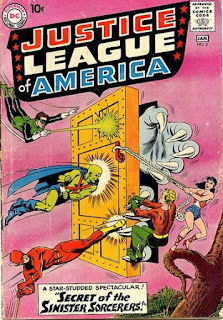


The JUSTICE LEAGUE comics title of the 1960s has never received a lot of respect even among Silver Age comics-fandom, and one reason may be that the early comic, for several years written by Gardner Fox and drawn by Mike Sekowsky, is perceived as being too "old school." Most team-features in both the Golden and the Silver Ages followed what I'll call a "plot-based model," in which "character moments" are kept to a minimum, as the author concentrates on the events of the plot, usually showing how the members of the team work to overcome some common enemy. The plot-model seems like an easy row to hoe, as indicated by countless spoofs of the model, but DC Comics pursued it almost exclusively, even when Marvel Comics in the 1960s advanced a "character-based model" that over time become the dominant paradigm.

Both models have their weaknesses. The character-model lends itself to bathetic soap-opera, which in modern comics has further degenerated into allegedly arty bathos. The plot-model often depended not on symbolically rigorous concepts but on weak contrivances. This vacuity dominates most of the Silver Age team-books-- BLACKHAWK, CHALLENGERS OF THE UNKNOWN, SEA DEVILS, and RIP HUNTER TIME MASTER  Fox's JUSTICE LEAGUE was one of the plot-modeled team-features of the Silver Age to overcome the model's limitations, for Fox was largely responsible for making the League's adventures all about the heroes' experience of "the sense of wonder." Only a few of the Fox-Sekowsky adventures are symbolically dense enough to qualify as mythcomics, as I've shown with "Secret of the Sinister Sorcerers" and "The Justice League's Impossible Adventure." But aside from a few clunking null-myths, such as "The Plague That Struck the Justice League," most of the Fox oeuvre offers at least strongly conceived "near myths." In fact, the current JUSTICE LEAGUE movie approaches its team-building story in much the same way that Fox launched the original series.

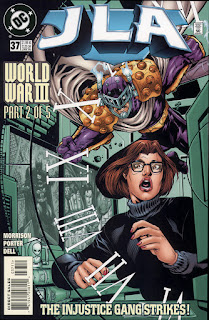
Prior to Grant Morrison's run on the JUSTICE LEAGUE title, few raconteurs on the book showed Fox's penchant for the sense of wonder. There were some uneasy attempts to shift the feature in the direction of the character-model-- "Justice League Detroit," anyone? But Morrison, aided by the pencil-work of Howard Porter, is the first author to exploit the original plot-model for all that it was worth, as well as providing enough "character-moments" to make his project palatable to Marvel-ized tastes.

Seventeen years before the JUSTICE LEAGUE movie, Grant Morrison also sought to devise a bridge between the wonder-scape of Fox's JLA and that of Jack Kirby's slightly later "Fourth World." Morrison was far from the first raconteur to provide a crossover between the superheroes and the "science fiction quasi-deities" of Kirby's universe, but he seems to be the first who understood how to get the best out of both worlds. Kirby's Fourth World cosmos is very different in tone than the Fox-scape, but the two are fundamentally both indebted to the "plot-model," and Morrison alone found a way to meld the two aesthetics. The current film only achieves this synthesis once or twice, but then, the filmmakers were primarily concerned with introducing the heroes, and the film's use of Fourth World characters and concepts is much more scattershot.

Morrison crossed over Kirby's "New Gods' and the JLA in his arc "Rock of Ages," but this, while a great deal of fun, wasn't nearly as mythically resonant as the author's final arc in his tenure, "World War III." Earlier issues also introduced the League to the champions of "Wonder-World," which in essence was a Mount Olympus for superheroes who had evolved to the level of gods. However, the gist of the story was to pit the League and some of Kirby's New Gods-- Orion, Metron, Mister Miracle and Big Barda-- against a seemingly unstoppable threat, the Wonder-World champions were primarily created to be the victims of the new menace.
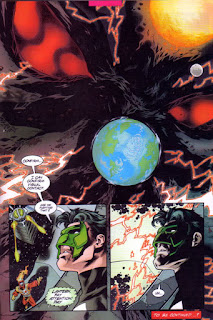


The menace is Maggedon, the Anti-Sun, a non-sentient weapon created by "the Old Gods" who, in Kirby's cosmology, preceded the newer super-deities. Mageddon escapes its exile at the end of space-time and destroys the Wonder-World heroes by emitting radiations that fill the heroes with rage and despair, so that they murder one another. That done, the super-weapon then makes a beeline for Earth. and as it approaches, the world undergoes the first symptoms of Maggedon's influence. Nations begin gearing up for a world war, and even the Justice League's regular villains become pawns of the extraterrestrial invader. Said villains include master planner Lex Luthor, who helmed an analogous bad guy-group in "Rock of Ages," and two old Fox-fiends, the Queen Bee and a substantially revamped Shaggy Man. For good measure, Morrison adds a villain he created in earlier issues of this tenure: Prometheus, a computer-nerd gone berserk.

Yet, although this is clearly a plot-heavy continuity, forcing the Leaguers and their allies to prevent a war opening up on multiple fronts, Morrison doesn't neglect the "character moments." The evildoer Prometheus plays the part of Faust to the League's long-crippled intelligence gatherer, Barbara "Oracle" Gordon, offering her the chance to walk again if she betrays the good guys. The then-current Green Lantern, Kyle Rayner, experiences a crisis of self-confidence, and the angel Zauriel-- allegedly Morrison's substitute for an unavailable Hawkman-- must remonstrate with his fellow angels to coax them to come to mankind's aid. Morrison gets a lot of humorous mileage out of the sometimes manic Plastic Man, but even characters who aren't overly funny get good lines. These include Kyle Rayner telling Luthor that he's being "outsmarted by a giant eyeball" and the brutal Shaggy Man referring to Orion as "Mr. 'Was-God-an-Astronaut.'" Morrison crafts strong moments for all of the heroes, and even strives, in his use of the New Gods, to pepper their dialogue with Kirby-ish touches, like calling Maggedon's interior "techno-active."


At the same time Morrison knows that the "friendly enemies" relationship of DC's most iconic characters, Superman and Batman, lies at the core of the modern JLA. The climax of WAR involves Superman trying to defeat Mageddon directly, with the result that the super-machine enslaves him. There's more than the suggestion of Biblical imagery here, in that Metron poetically describes Maggedon as "dragging its broken chains across the stars"-- and during Superman's captivity, he carries much of the resonance of Samson chained in the Temple of Dagon. One panel even makes Superman's eyes look overshadowed, as if he might be as blind as Samson, though this may have been no more than a fortuitous accident.
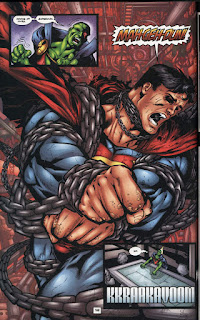

Maggedon enslaves Superman by filling him with a despair that plays on the hero's sense of "survivor guilt." Batman, speaking to the hero through a telepathic link, essentially "out-guilts" the machine, causing the Man of Steel to rally and to defeat the Anti-Sun with his own solar-based powers: the "positive sun" besting the "negative sun."


I should note in closing that though Morrison pays full respect to Kirby's Fourth World, the later author places a lot more emphasis on the idea of humankind's evolutionary destiny, which, in essence, argues that everyone can be a superhero. The author's meditations on metaphysical evolution are arguably better worked out in the later "Being Bizarro" sequence from ALL-STAR SUPERMAN. Nevertheless, I can find no substantive flaws in Morrison's homage to the wonder-working proclivities of the Silver Age JUSTICE LEAGUE, which, like all good homages, is as much about what the modern author likes as the thing being homaged.