Featured Post

SIX KEYS TO A LITERARY GENETIC CODE

In essays on the subject of centricity, I've most often used the image of a geometrical circle, which, as I explained here,  owes someth...

Showing posts with label star wars. Show all posts

Thursday, June 19, 2025

GIRLBOSS TROUBLE

 This CRITICAL DRINKER video was posted to YouTube in the last week. An "Open Bar" discussion followed but didn't add anything

 much.


I've followed Critical Drinker for some years now, and though I don't agree with him on various subjects, this was one of his better rants, even with the predictable, eyeball-grabbing title of "XXX IS DEAD." In many of his videos CD repeatedly complains about the offense to verisimilitude every time a female outfights a male in a way CD doesn't like. Yet until this "Female Action Movie was Killed by the Girlboss" thing, I didn't think he was very good on the history of femme-fight movies. 


Here, however, he contrasted a lot of the female action franchises of the 2000s and 2010s prior to the rise of the girlboss, such as Resident Evil, Underworld, Lara Croft, Hunger Games and (potentially) Kill Bill. He said they were accepted by mass audiences in part because none of them were trying to usurp the place of the male action movies, which is something we began seeing with increased frequency in the late 2010s. To those franchises one might also add some above-average one-shot films like Jolie's Salt and Theron's Atomic Blonde, though the latter showed up during the flood of the girlboss flicks. The Open Bar mentions how some of the nineties movies promoted actresses who clearly didn't have any command of fake-fighting, like Halle Berry and Pam Anderson. 


I hesitate to say that any particular moviemaking craze (talking here about the crazes of the moviemakers, not the viewers) kills things dead for all time. But he made a credible case for audiences avoiding reasonably competent flicks like BALLERINA and FURIOSA because audiences got burned so many times with crapfests like BIRDS OF PREY and THE MARVELS. Of course the Disney STAR WARS films were profitable even though they did what Drinker most hated-- slotting in girlbosses in place of established heroes-- but that was before we were drowned in all the MCU dreck, as well as some DC dreck as well. The new FANTASTIC FOUR movie sounds like its makers are still infected with the girlboss disease, so we'll see if it flops and validates CD's fatigue claims. 


Now I don't think this century is the first time filmmakers have overpowered female fighters. 1974's POLICEWOMEN, despite a scene in which Sondra Currie only beats Big Big Smith thanks to judo techniques, concludes with a scene where Currie vanquishes another male hulk with several straight punches and one kick. CD gives the Asian female action films a pass, but how often did chopsockies and "girls with guns" movies show women duking it out with men the same way, and not really getting thrown by a loop by superior strength blows? Only a couple hundred times, I'd say.        


Lastly, I am aware of one still successful girlboss franchise: HBO's HARLEY QUINN show, which enjoyed five seasons so far and is allegedly getting a sixth. I watched the first three seasons and thought they were all crap except for the general quality of the animation. HQ is entirely a girlboss, and the third season even has her replace Batman in the "Bat-family" of heroes. Granted, Harley earned a degree of spinoff success before HBO, and the character still seems wildly popular with cosplayers. And the HQ cartoon has an advantage over the BIRDS OF PREY movie, since the cartoon is sort of a Liberal version of SOUTH PARK, with loads of foul language and ultraviolence. So if HQ is the only current girlboss franchise that bucks the failures of MCU movies and of streaming shows based on the STAR WARS and STAR TREK properties, it could partly be due to other factors that the pure girlboss project lacks.

Friday, May 3, 2024

THE LATEST KATHLEEN KENNEDY WARS

While arguing the matter of STAR WARS politicization online, I had the notion, "wouldn't it be more interesting to cite recorded statements by a prominent Disney exec, say Kathleen Kennedy, and let her damn herself by her own statements?"  I preface this line of thought by noting that I have no personal opinions on the line of Disney streaming TV projects, since I've barely watched any of them. I don't have streaming Disney now and when I briefly had access, I only watched a handful of Mandalorian episodes and barely remember what I watched. My negative opinion toward Disney SW is taken largely from the movies I've seen.


That's not the case with the podcaster I'm citing, one Mike Zeroh, who appears to be conversant with the streaming projects whether or not one accepts his opinions. This podcast appeared a month ago, made in response to a press release by Kennedy about the impending (June of this year) ACOLYTE project, and Zeroh reads verbatim selections from the Kennedy press release. This I find valuable because it indicates whether or not the virtue signaling I've argued has been sustained over some years, rather than being just a momentary whim. (The "whim defense" is how Kennedy somewhat defended wearing the infamous NIKE "Force is Female" T-shirt, BTW.)


https://www.youtube.com/watch?v=cN5vRGEgZwM


Here are my takeaways from Zeroh's quotes.


(1) Kennedy claimed that only a "minority" of fans are opposed to the ACOLYTE project. In contrast, Zeroh claims that it has been the most heavily ratio'd SW project yet. One may argue that some fans may be producing more than one ratio-rating, though I don't think there's any way to prove that assertion.


(2) Kennedy denies at one point that she's promoting an "agenda," but celebrates that she's promoting not only DEI but the celebration of an all-female main cast with female show-runner Leslye Headland behind the camera. This would indicate, to me at least, that she was entirely serious about "the force is female" despite her denials.


(3) She says "George Lucas's treatments with his films" don't matter. She wants to "change the story" to reflect whatever Headland wants to champion. Wikipedia provides evidence of this, indicating that Headland wanted to attack the idea of the Jedi as fundamental good guys, which Headland claims (in separate statements, not in the video above) is right in line with Rian Johnson's positions in LAST JEDI.


The series questions the Jedi practice of training children,[ and also explores differing views on the Force and the amount of power and control that the Jedi have-- Wikipedia, THE ACOLYTE.


(4) She claimed that the sequel films had made money for the company. This avoids the question as to whether the streaming services have justified their expense, and it also does not show her taking responsibility for the box office bomb of SOLO, which barely made a million dollars past its estimated $300 million budget. Interestingly, Ron Howard blamed the failure on toxic fans, just as Headland claims such fans are responsibility for bad reactions to the ACOLYTE trailer.


In a larger sense, there have been times when Hollywood producers embraced this or that cause, and then backed off because the public did not prove receptive. But there's something weird about the Disney producers' utter, unshakable commitment to their ideological agenda. I assume that some of this attitude was brought into being by the political influence of asset manager Blackrock, but it may not be the only factor.


Wednesday, July 20, 2022

THE MASTER THREAD OF DISNEY'S "STAR WARS"


If one wanted a cogent, concise summation of the many failings of the Disney STAR WARS trilogy from 2015 to 2019, I for one would recommend this Youtube video by "So Civilized," entitled THE STAR WARS SEQUELS: DISNEY'S ANTI-TRILOGY. SC lays out the many missteps made by the creative teams, which I will abbreviate to the respective directors: J.J. Abrams for THE FORCE AWAKENS and THE RISE OF SKYWALKER, and Rian Johnson for THE LAST JEDI.

I fundamentally agree with SC on his essential thesis, which I'll boil down to "Abrams was too respectful of Lucas's NEW HOPE and EMPIRE; Johnson was too disrespectful of the whole mythos with nothing to put in its place." He doesn't elaborate what virtues of George Lucas these two latter-day creators fail to emulate, though a separate video, THE PERFECT STORYTELLING CLARITY OF STAR WARS, provides a good counterpoint to the ANTI-TRILOGY essay.

But, now that I've agreed with SC about all the storytelling flaws of both Abrams and Johnson, how do I make them line up with my own estimation of the three Disney flicks, since I rated the mythicity of LAST JEDI as "poor" while I deemed FORCE and RISE as "good."

Of course, I've championed a lot of works that have all sorts of surface flaws-- as seen recently in my reviews of grungy trash-films like BLOOD SABBATH and BLINDMAN-- because I consider that mythopoeic discourse can be formed even in the near-total absence of dramatic or didactic excellence. My criterion for mythopoeic discourse is that I have to be able to find a "master thread" around which the author(s) organize(s) his symbolic correlations, as explained in my essay series on the subject, starting here.

Interestingly enough, So Civilized has nearly nothing to say about the thread that most interested me, as I noted in my review of FORCE:

... it’s an interesting psychological touch that the script, by having Luke be Kylo’s teacher, makes him the symbolic offspring of the Luke-Leia-Han triangle

And this concatenation is echoed in Abrams' conception of Rey:

 ...Rey displays aspects of all of her parental influences, combining Han’s talents for piloting and scrounging, Leia’s feminine hauteur, and Luke’s instinctive connection with the Force.

I didn't comment in the FORCE review about the intimations of a romance-arc between Kylo and Rei. Yet this comes to fruition in JEDI, and I find it significant that even though Johnson downgrades almost every conceit Abrams raised-- Rei's mysterious parentage, the future significance of the Jedi, et al-- he never seeks in any way to tear down the blossoming quasi-romance between these two offspring, both literal and figurative, of the Luke-Leia-Han triangle.


 I failed to note this thread's development in my 2019 review. But in my recent re-screening, I must admit that Johnson seems fully aware that he cannot undo the growing "fellow feeling" between Rei and Kylo, even though she's seen him ruthlessly cut down a man who was Kylo's real father and Rei's wished-for surrogate parent. Johnson seems at least moderately aware that when he has Kylo betray and murder his mentor Snoke and invite Rei to join him in ruling the galaxy, he has fulfilled the intimations of a similar ambition voiced by Darth Vader to Luke in EMPIRE-- even though RETURN OF THE JEDI patently ignores Vader's earlier scheming against his mentor Palpatine.


In RISE, Abrams re-asserts his trope about Rei's special destiny, though in much the same way that Luke's destiny had dark roots. Just as Luke found out that he was the seed of an evil father, Rei learns that she's the granddaughter of the source of all Sith evil. I didn't feel that Abrams cared that much about that big revelation, and Palpatine's whole rap about "strike me down with your hate and I'll be reborn" fails to carry much resonance. But the repeated encounters of Rei and Kylo make up the trilogy's master thread, and Abrams puts far more effort bringing this trope to life than any of the pallid plotlines about Finn or Poe or even Threepio's supposedly comical loss of memory. In my review of RISE I noted:

As soon as renegade Kylo Ren encounters Rey, it's clear to every SW-savvy character that he's going to seek to convert her, as Palpatine successfully swayed Anakin Skywalker and as Anakin, in the guise of Darth Vader, failed to suborn Luke Skywalker. I suspect that Abrams may have formulated some specific ideas about Kylo's personal motives, and that Disney executives didn't want to delve into LOST-style psychodrama, so that in a psychological sense Kylo appears half-formed at best. However, Abrams does succeed in making Kylo a metaphysical complement to Rey, particularly when Kylo himself tells Rey that they comprise a "dyad," like the two sides of the Force. This yin-and-yang unity, though true to some of George Lucas's real world inspirations for the fictional Jedi, resembles nothing in the way Lucas treated the interactions of Palpatine-Anakin and of Vader-Luke, where it was clear that one character would dominate the other. Kylo, in his ceaseless attempts to draw Rey into his sphere, seems to be seeking some deeper consummation. To be sure, Abrams backs off on making the sexual aspects explicit, save for a suggestive final kiss between young Jedi and young Sith as the latter is about to perish.

I don't know how much of a Freudian J.J. Abrams may be now or has been in the past. He's written scripts that suggest Freudian content, particularly for LOST, but he's certainly done other scripts that don't pursue that sort of content. But it seems logical to me that either he or his collaborators on FORCE looked at the way Lucas had resolved the romantic angle of his original trilogy and wondered what might have happened had some of the offspring of both Light and Dark sides of the Force came together as Luke and Leia had not. I'm not saying that Abrams was engaging in nothing more than "shipping" forbidden romances, though there were be nothing wrong with it if he were. Rather, I think he had some notion of showing the dramatic costs of Rei's choice to pursue the rigorous destiny of a Jedi, which arguably put her apart from ordinary humankind. This gave Rei a kindred nature with the obsessed Kylo, who certainly had been all but overwhelmed by the weight of his heritage, and who may have chosen to imitate Darth Vader as an act of rebellion against his father, mother and uncle. I'm not saying Abrams totally succeeds in evoking all the dramatic potential of this psychology, but there's something more than mere imitativeness in his attempt to capture the complexities of Lucas's wonder child.


Tuesday, December 31, 2019

STAR WARS, NOTHING BUT STAR WARS

For my last ARCHIVE essay of the year, I thought I might put together something a little more accessible to the casual reader (if any) than the previous "Concrescence and the Kinetic Potentiality." And since this year I devoted several essays on my movie-blog to reviewing most of the as-yet-unreviewed-by-me live-action films in the STAR WARS series-- concluding with an analysis of the current RISE OF SKYWALKER-- I'll make the Lucasverse my last ARCHIVE subject for 2019.

In 1978, when Bill Murray sang the lyric in my title for an episode of SNL, he was playing the part of a lounge-singer making up lame lyrics to please an audience of barflies. The main focus of the schtick was to make fun of the way commercial performers tended to latch onto items of popular culture in order to sell themselves. In a different era, Murray might've constructed the same idea around, say, THE POSEIDON ADVENTURE.

And yet, though the comedian couldn't have known that the original 1977 film would be anything more than a flash in the pan, he could well have been aware that STAR WARS had garnered an adult audience far beyond anything seen in past SF-successes. I find it unlikely that the same schtick, done in 1968, could've sold the idea that a lounge-singer would've tried to appeal to a bunch of adult drinkers with insider references to any other fantasy-film, even a popular one like PLANET OF THE APES.

There had been a handful of fantasy-works in various media that somewhat escaped the "fantasy is for kids" cultural judgment. DUNE and THE LORD OF THE RINGS attracted an audience outside the world of hardcore SF-readers. The James Bond book-series and its attendant movie-adaptations trafficked in sci-fi gimmickery and villains that resembled the freakish fiends of the DICK TRACY comic strip. The fifties generated a handful of SF-films that enjoyed some qualified support from adult audiences, such as Howard Hawks' THE THING, and the late sixties mirrored that development with the first of the APES films (though later ones became more kiddified) and Kubrick's 2001: A SPACE ODYSSEY. Comic books remained a marginal medium despite adults' brief flirtation with the irony-drenched world of the 1966 BATMAN teleseries. Yet Marvel Comics changed up the game by introducing the formula of "heroes with problems," and while Marvel's penetration of "the real world" was minimal during its strongest creative era, its long-term influence on American culture would make possible the current hegemony of "superhero movies for all ages."

Yet, for all of these influences, the eventual validation of metaphenomenal entertainment for adults all comes down to "nothing but STAR WARS." In my review of the original film, I wrote:

...the religion of the Force works well in the first film because it's become the underdog in the galactic empire. Whenever the materialistic minions of the Empire mention the Jedi, it's only to sneer at the absurdities of their beliefs. To them Darth Vader's continued existence is little more than an indicator of the foolishness of having faith in anything but machines-- and the fact that Vader himself had taken on the semblance of a machine is merely a further confirmation of their world-view.
Luke Skywalker's existence defies the Empire's passion for "technological terrors," and whether or not Lucas meant him to be Vader's son at the time hardly matters. By inheriting Obi-Wan's mantle as the new embodiment of Jedi spirituality, he supplants Vader in the cosmos as Jacob supplanted Esau. This is the unlikely turnabout that Lucas teaches his audience to hunger for, and it plays as much a role in the franchise's success as the aforementioned love of pulpish extravagance. Indeed, without Lucas having crossbred the magic of fairy tales with the machines of SF, the furor over STAR WARS might have petered out over time like many other fannish enthusiasms, no matter how hard big corporations labored to keep them stoked.

George Lucas's scattershot research into fairy tales, archaic shamanism, and mythology clearly touched a cord in the American psyche, not mention the psyches of a great many other world cultures. And its popularity with adults was reflected in one of America's earliest instances of "political correctness," on which I reflected in my essay TRIBAL IN PARADISE:

STAR WARS was the test-case for racial representation. Not long after the film came out, I recall hearing a black comedian say something like, "Tell the truth, white people; you like STAR WARS because it means ya'll gonna leave alla us behind!" There may be more truth than humor in that statement, and Lucasfilms was quick to remedy the lack of POC in the SW universe by introducing Lando Calrissian in the second movie.

This wasn't pure tokenism, though. The Lucasverse as we now know it recapitulated a number of political attitudes, not least Lucas's favored trope of "lots of little good guys can beat a big bad guy." This is best illustrated in the first film in the Rebels' triumph over the Death Star. In addition, an early draft for STAR WARS would've also included a primitive tribe of Wookies beating a contingent of Storm Troopers, even though the story-idea didn't show up on celluloid until Lucas reworked the Wookies into RETURN OF THE JEDI's Ewoks. Reportedly Lucas was not entirely pleased that the only well-known black actor in the cast was "off-camera" in the form of Darth Vader's voice, but the appeal of James Earl Jones' baritone overcame those reservations. Thus I would surmise that Lucas probably didn't engineer the role of Lando Calrissian merely to profit from tokenism. He probably sincerely believed in a judicious forms of racial representation, much like that similarly-liberal toiler-in-fantasy-fields Gene Roddenberry. However, Lucas he didn't virtue-signal quite enough to head off his critics in 1999, when the buffoonish Jar Jar Binks was assailed for being a modern reincarnation of Stepin Fetchit.

The prequel series displeased a lot of viewers for a lot of reasons, but on the whole the series proved a success-- not just in terms of box office, but also in showing how thoroughly the viewing public had become enthralled with the Lucasverse cosmology. That said, even in the sixteen years between RETURN OF THE JEDI and THE PHANTOM MENACE, countless film producers sought to pursue the grail of the "Big Lucas Pay-Off," seeking to subject the once marginal genres of science fiction, magical fantasy and superheroes to the big-budget treatment. Television showed a similar transformation, though obviously Hollywood's Veblen-esque investment in conspicuous consumption didn't play so well on the small screen. Still, serials like XENA, HERCULES and BUFFY THE VAMPIRE SLAYER demonstrated methods of bringing in big ratings on a small budget. For all anyone knows, the increasing profitability of sci-fi and superheroes may have played a role in encouraging George Lucas to return to his long-neglected franchise.

There's not much doubt that the "Rise of the Box-Office Profits" motivated Disney to purchase the Lucasverse, but here too, it's hard to say if pure profiteering explained the whole megilla. In my essay FREEDOM VS. FREEDOM PART 4, I called attention to the way Disney strategists re-wrote Lucas's "Clonetroopers" scenario from the prequels in order to start off the new series with an appeal to racial priorities. Thus the first promo for FORCE AWAKENS opens with the sight of a Storm Ttrooper unmasking and revealing the face of a black man (or at least, a face whose ethnicity is less ambiguous than that of actor Temeura Morrison, who played the mercenary from whose cells all Storm Troopers were supposedly derived).
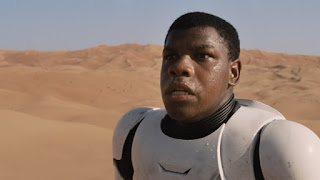


Now, with the Disney trilogy is complete, it's possible to state categorically that the company's vaunted commitment to diversity did not extend to making Finn a halfway interesting character. In my review of FORCE AWAKENS, I pointed out that this revelation could be seen as a war to replay what I called "the African Diaspora," insofar as Disney's white-clad troopers were abducted from their worlds and forced to serve the Empire/First Order. However, even if the persons responsible for crafting the Finn character had some such intention-- and the idea is re-emphasized anew in RISE OF SKYWALKER-- the producers failed utterly at making Finn even as compelling as a Lucas toss-off like Boba Fett. That said, other new characters in the Disneyverse-- Poe, Rose Tiko, Holdo-- were no better characterized, so Finn certainly wasn't singled out for half-assed treatment. The one decent new character, Rey, got most of her mojo from being tied to one of Lucas's legacy characters in a literal sense, and with others in a more symbolic sense.

It may be a measure of Disney's perceptions about the adult audience's investment in the Lucasverse that the company chose to virtue-signal the company's commitment to diversity. However, it should be noted that, even if Lucas and his collaborators might have been influenced by tokenism in crafting Lando Calrissian, they still managed to make Lando an interesting character despite the creators' possibly-monetary motivations.

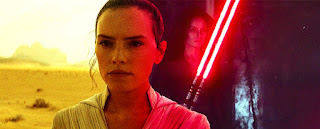
Even before SKYWALKER appeared in theaters, the first two films in the Disney trilogy were excoriated for their virtue signaling, though this criticism tended to focus less on people-of-color than on a perceived overemphasis of female characters. I feel that this criticism is partly justified in the cases of Holdo and Rose Tiko, who were such ciphers that I find them unlikely vessels of female empowerment. However, I will defend Rey against that charge. I don't think that Lucas's STAR WARS cosmos was ever directed exclusively to the male gender, and I think that Princess Leia stands as a major femme formidable, even if it's true that Carrie Fisher was less than entranced with her role. Rey has been accused by some critics of being a "Mary Sue" in terms of how easily she attains power and formidability. But while I might share some critics' concerns about the depiction of her path to power, I felt all three Disneyverse films succeeded in making her a vital character, one not defined by the gender wars. Thus, when Rey takes the name "Skywalker" at the end of SKYWALKER, I for one embraced that conceit. For me, the gesture demonstrated that, even when the new-verse was compromised by venal virtue-signaling, and dull diversity-concerns, it still was possible for people who weren't George Lucas to create at least one character that escaped such banal politicization.

Monday, September 23, 2019

QUICK THOUGHTS ON STAR WARS FILMS

I posted this on a BOUNDING INTO COMICS thread--

_______

I don't dismiss the idea that [the STAR WARS producers] may've come out with "too much, too fast," but that wouldn't have been a problem if the people in charge of STAR WARS had taken as much care to keep their content (rather than just the actors) truly "diverse."

IMO a better comparison than Pixar would be the MCU, because Pixar's releases aren't part of a shared universe. I have a lot of problems with assorted MCU movies, and with Kevin Feige's take on the Marvel Universe. But I would never deny that Feige is a canny producer. He knows how to come out with three-four movies a year and not have them step on one another. Some are big and cosmic, some are smaller and more comical than cosmic. But the tone of NEW STAR WARS is all one big brown blur. I think the producers of the SW universe all trying too hard to keep the brand looking the same, and that results in a tiresome sameness.

Saturday, April 1, 2017

MYTHCOMICS: [THE NAGAI INVASION], STAR WARS #94-107 (1984-86)

My essay XX MARKING THE SPOT works as something of a preface to this week’s mythcomic. Only in the last week of March, publicly allotted as “Women”s History Month,” did it occur to me devote at least one entry to a mythcomic relevant to this topic. I’ve often covered the mythic incarnations of women in fiction throughout the "1001 myths" project, but very few of the female characters I surveyed were actually created by female authors. To be sure, even had I thought about what month it was earlier, I’m not sure that I could isolated three more female-authored mythcomics. Whether the lack of such creations is the fault of nature or culture is a matter for each individual to decide. But I have found one for this week, and from a rather unlikely source.


Marvel’s licensed STAR WARS comic book began in the same year that the original Lucas film debuted and ended about three years following RETURN OF THE JEDI, the final installment of the original film-trilogy. While the earlier SF-series STAR TREK became well-known for having inculcated a strong and lasting female fandom, STAR WARS has not been quite as well celebrated for its female adherents.  On one hand, Lucas’ space-opera concept has been viewed by many as a quintessential form of “boys’ enterainment,” which some critics, notably Ursula LeGuin, have considered irrelevant to female interests. On the other hand, the sheer kinetic and emotive appeal of the original trilogy crossed barriers of both age and gender to become a genuine American myth purely in terms of mainstream popularity. That said, I don't know that any of the various iterations of the franchise  in other media enjoyed the same degree of mainstream approval.

Marvel’s STAR WARS title was not in any sense of “fan-favorite” during its nine years of publication. Thanks to the popularity of the film, the comic sold extremely well, so much so that in more than one interview Marvel editor Roy Thomas credited the franchise with having saved the company from economiccatastrophe. For most of the title’s history, one would be accurate to assume that the majority of its stories were at best good formula space-opera, devoted to depicting the main characters of the franchise—Luke, Leia, Han, Chewbacca, and the droids—having assorted non-canonical adventures. Along the way, raconteurs created their own characters, whose character-arcs could be much more elastic than the ones licensed from Lucasfilms. In the long sequence I’m examining, which I’ve entitled “The Nagai Invasion,” one particular character, created by writer Jo Duffy, becomes the central mythic persona in a continuity that, in some ways, put the “war” back in STAR WARS.


For most of the comic’s history, Jo Duffy contributed formula stories largely indistinguishable from those of male writers like Archie Goodwin and David Micheline. Not surprisingly, male artists illustrated all of her stories prior to issue #84. With this issue, Cynthia Martin then took over penciling duties for almost every subsequent issue, and arguably she added a grimmer, more restrained aesthetic, rooted in the use of fined-lined artwork and generous use of white space. Presumably, her main influenced were from manga artists: I note the use of the surname of manga-artist “Go Nagai” being used as the name for a new breed of aliens menacing Luke Skywalker’s Rebel Alliance. In addition, the physical model of the Nagai resembles that a body-type often seen in manga, one in which the men are all lean, epicene, and pale-skinned.


I won’t dwell overlong on the main plot of the long sequence, except that the incursion of the Nagai—and their team-up with assorted leftover stormtroopers—forces the STAR WARS characters to go to war once more. During this continuity, Duffy’s original character Dani—a humanoid woman belonging to a red-skinned race called “Zeltrons”—becomes a sort of “walking wounded” that I've never found in any George Lucas narrative.

In the critical subplot of “Invasion,” the Nagai—led by military officer Den Siva—are curious about the battle-abilities of the Zeltrons. Den’s forces capture Dani, and he personally suhjects her to a process designed to analyze her biological nature. It also causes the young woman—typically portrayed as something of a “fun-time girl,” despite being a warrior—to intense pain. The structure of scenario is almost identical to scenarios in which a captive soldier is tortured for information by his captors, though in this case the torture itself supplies the Nagai with the information they want, irrespective of the victim’s suffering. While watching the torment Den informs an aide that the process often kills its subjects. 


Dani survives an experience that may he compared to that of rape—the machine penetrates her body with assorted light-beams, though none strike the most obvious area—and in consequence, she becomes highly traumatized. Den, however, becomes fascinated with the Zeltron’s strength of character. When she is liberated from imprisonment by her ongoing boyfriend Kiro, Den personally tracks the two of them down, engages Kiro in a knife-duel, and apparently kills him. A later issue, #102, gives Kiro an ambiguous revival, though he never returns to Dani’s side and thus leaves her doubly traumatized.

However, Duffy and Martin handle the trauma in a manner more in line with Japanese samurai-dramas than with American Lifetime movies. Dani’e experiences cause her to focus upon Den Siva as the incarnation of her nightmares, and he for his part goes to great lengths to track her down and possess her. 


However, in a twist one won’t find in the average melodrama, Den becomes so besotted with the Zeltron that he betrays his own people to save her life, and eventually becomes an ally to the Alliance. 


Dani, despite her consuming hatred of the Nagai general, eventually becomes reconciled to this particular fortune of war. There is no attempt to mitigate Den’s “mental rape” of his prisoner, though Duffy may have intended to comment on the way real war usually treats its combatants. In the final issue, Den and Dani are last seen in one another’s company, even though the most she can say of him is, “I don’t love him, or even like him-- but at least we understand each other.”


George Lucas’s unique take on American action-serials and space-opera has many virtues that go overlooked by elitist critics, and the Duffy-Martin work on the STAR WARS comic does, to be sure, include many of the aspects that made the original film-trilogy popular, such as light humor and non-stop action. But I would imagine that the type of trauma depicted in Dani's character-arc would have been beyond Lucas's skill-set. Dani's degradation might be said to place her within the sphere of "the abject" as the concept was formulated by Julia Kristaeva. I touched upon said concept in this essay, though probably not in total agreement with Kristaeva. For instance, I would view Den Siva, the source of Dani's degradation, to have also entered a state of abjection simply because he has become infatuated with her, thereby causing him to betray his own people. In my view this is the only common ground that the characters share-- certainly Duffy and Martin never suggest that Dani and Den can lose themselves with the bounties of romantic love-- as well as the only reason Dani could say that the two of them "understand each other."

As a coda, I chose not to research any statements made online by Duffy or Martin before finishing my essay. That done, I was not surprised to learn that from this 2011 interview that the STAR WARS comic was cancelled while Duffy had yet to complete her long-term narrative, and that she was forced to condense her conflict as rapioly as possible in order to give her sequence an effective conclusion. While as a reader I would have liked to have seen her continuity played out to its full effect, I can't say that I am enamored of Duffy's plans to conclude Dani's character-arc by having her sacrifice her life in battle. Perhaps it would have been an impressive sequence. Yet I confess that the ending as it stands-- in which Dani and Den remain together, bound in a non-romantic alliance-- seems far more original, and more evocative of the mythology of wartime alliances.   

Wednesday, December 14, 2016

ANCESTORS OF FEAR AND DREAD

C.S. Lewis's analysis from AN EXPERIMENT IN CRITICISM remains my touchstone for the distinction between fear and dread:

Suppose you were told there was a tiger in the next room: you would know that you were in danger and would probably feel fear. But if you were told ‘There is a ghost in the next room’, and believed it, you would feel, indeed, what is often called fear, but of a different kind. It would not be based on the knowledge of danger, for no one is primarily afraid of what a ghost may do to him, but of the mere fact that it is a ghost.

Lewis formulated this opposition by drawing on Rudolf Otto's 1917 THE IDEA OF THE HOLY. However, a much earlier distinction appeared in a 1826 analysis by Gothicist Ann Radcliffe, where she distinguished between "terror" and "horror." This analysis, later given the title "On the Supernatural in Poetry" by an editor, isn't particularly well-organized. In essence, Radcliffe-- whose Gothic novels depended on suggestion rather than explicit gore and gruesomeness-- has her principal character argue that "terror" is a much subtler and finer emotion than "horror," which is all about the explicitness. Here's her most definite statement on the difference:

Terror and horror are so far opposite, that the first expands the soul, and awakens the faculties to a high degree of life; the other contracts, freezes, and nearly annihilates them.

This doesn't really clarify the matter all that much, but a later section makes clear that Radcliffe equates the sublimity of terror with that of the merely suggested, the merely imagined. When an interlocutor asks the speaker what he thinks about Milton's line, "On his brow sat horror plumed," the speaker essentially co-opts MIlton's use of the word "horror" for the speaker's (and Radcliffe's) idea of "terror:"

As an image, it certainly is sublime; it fills the mind with an idea of power, but it does not follow that Milton intended to declare the feeling of horror to be sublime; and after all, his image imparts more of terror than of horror; for it is not distinctly pictured forth, but is seen in glimpses through obscuring shades, the great outlines only appearing, which excite the imagination to complete the rest; he only says, ‘sat horror plumed ;' you will observe, that the look of horror and the other characteristics are left to the imagination of the reader; and according to the strength of that, he will feel Milton's image to be either sublime or otherwise. 

According to this site, Radcliffe was not a fan of explicit gore, and wrote her book THE ITALIAN (which I have not read) as a pointed response to the excesses of Matthew Lewis's 1796 Gothic novel THE MONK. I have read the Lewis book, and I can confirm that it does not hold back in "distinctly picturing forth" its ghastlier scenes).

If there are any significant parallels between the formulations of Ann Radcliffe and of C.S. Lewis (by way of Otto), it would seem to be the mutual attempt to define the nature of fear based in purely physical causes. Lewis' tiger can only inspire fear because there's no deeper concept to be understood about it, save that it's an animal capable of killing a human being. This is only a partial parallel to Radcliffe's use of "horror," which "contracts, freezes, and nearly annihilates" both the soul and the faculties. But her contrast to "terror," like Lewis' contrast to the "uncanny" feeling of seeing a "ghost," is pretty clearly based upon the familiar body/mind duality, which poet Octavio Paz more aptly rendered into a duality between "body" and "non-body" (or as I once called them, "corporeal" and "non-corporeal.")

To further complicate the matter, although Lewis is to some extent addressing the question of different phenomenal presences in different situations, Radcliffe apparently has no interest at all in aligning either "terror" or "horror" with any type of phenomena. Though she doesn't mention THE MONK in the above essay, it's plain that she would class it as a work of "horror" simply because it "distinctly pictures forth" all of the unseemly situations it includes-- ranging from the monk Ambrosio's (naturalistic) incestuous union with his own sister, to his (marvelous) doom at the hands of a demon, who flings Ambrosio's body from a great height and allows the monk to perish in agony. If anything, Radcliffe's distinction of "distinct" and "indistinct" is closer to my distinction between "clean" and "dirty violence" in this essay:

I said in an earlier essay that I would address the differing "intensities" of violence in fiction, by which I meant what I called "clean violence" vs. "dirty violence." These are NOT meant to be covalent with my versions of Twitchell's preposterous violence and its unnamed opposite. I refer to the "intensities" of clean and dirty because they are determined purely by how intensely the work does or does not present scenes of violence. As I see it preposterous violence and its opposite are not determined by intensity of effect but by narrative function.

Again, the parallel is still not exact. Still, just as the proponent of "suggestive terror" does not want to "freeze the soul/faculties" of the reader by bringing in gross effects, the proponent of "clean violence"-- my principal example being the 1977 STAR WARS-- is also seeking to avoid grossing out the audience, albeit for a very different aesthetic purpose.

Now, my own definition of "dread" moves away from Lewis's example of a "ghost:" to anything covered by my Ten Tropes, which occur in both naturalistic and uncanny forms-- the first forms inspiring only "fear," while the second may inspire fear but more importantly inspires "dread" as well. The latter comes about because even though both forms obey the laws of causal coherence, the uncanny forms violate the law of intelligibility. In the interest of further defining the process through which intelligibility is violated, I'll devote the upcoming essay JUDGING DREAD PART 2.

Tuesday, May 10, 2016

TRIBAL IN PARADISE

As a quick follow-up to my last essay, I'll expand upon some of the reasons that I don't think it would be a big crisis if all the Amazons of Paradise Island were white, or why previous depictions of this status, whether in comic books or the 1970s teleseries, are not implicated in some sort of racist conspiracy.

In my refutation of Berlatsky, I mentioned that even if WW's creator Marston had wanted to do a liberation-fantasy directed at "the women of either local minorities or of Third World countries," no comics-publisher would have touched it. That calls for two different expansions:

(1) Some ideologues have criticized the early feminist movement for being too centered on the plight of white women, and not of their darker-skinned sisters. This is clearly putting the cart before the horse, in that there was no practical way that the women who had been marginalized by majority culture could have assumed a dominant role in the framing of feminism-- not for lack of ability, but for lack of resources. Simply put, 'POC women" of the 1940s had far less leisure time to spend on politics. I strongly doubt that even progressive males of the period. whether white or non-white, would have agreed to raise the children while their wives went out to raise their consciousness a la bell hooks. The greatest gains of Black Americans in the 1940s related almost entirely to the liberation of black men in the workplace, as seen with 1941's establishment of the Fair Employment Practices Committee.

(2) I characterized DC Comics-- and by extension, all of the comic-book publishers of the period-- as businessmen who "played to the prejudices of the dominant white majority most of the time, while allowing for occasional breakthroughs with particular characters." This means that just as there were vaguely pro-imperialist fantasies circling around, like Marston's African tale in WW #19, there were also a fair number of progressive stories, such as a couple of postwar GREEN LAMA stories that critiqued the poison of racism. But both the progressive and regressive stories were occasional in nature; they existed to entertain the readers of the white majority in one way or the other, not to reform society as such.

No blogpost of mine (and certainly not of Berlatsky's) can do justice to the complex social and economic history that led to the marginalization of POC in the United States, in contrast to the avowed ideals by which many white Americans believed that they lived. Nevertheless, while the tastes of the white majority determined that early comics focused almost on Caucasian protagonists, it's still arguable as to whether a given work, be it a comic book or a movie based on one, is implicated in historical racism simply for the crime of omitting POC characters from its narrative.


STAR WARS was the test-case for racial representation. Not long after the film came out, I recall hearing a black comedian say something like, "Tell the truth, white people; you like STAR WARS because it means ya'll gonna leave alla us behind!" There may be more truth than humor in that statement, and Lucasfilms was quick to remedy the lack of POC in the SW universe by introducing Lando Calrissian in the second movie.

And this was the right decision. In the case of STAR WARS, there was no reason not to have all sorts of POC human beings represented, since it was a fantasy of humans and aliens existing in a universe devoid of any connection to the history of Earth-humans.

Fast-forward 36 years, though, and we have Noah Berlatsky foaming at the mouth because he thinks all of the Amazons of Paradise Island will be white. In contrast to STAR WARS, his righteous resolution does present some narrative problems with the 2017 WONDER WOMAN film, depending on how the Amazons come into existence.

Putting aside the question as to whether all Greeks of the Classical period were "white" as we now understand the denotation-- a discussion best fitted to the adherents and detractors of BLACK ATHENA-- Marston's original idea is that all of the Amazons who come to Paradise Island are descended from Greeks. Quite probably Marston would never have cared to depict any Classical Greeks as non-white, even if he had been apprised of alternative interpretations. But was he racist to default to the common idea that all Greeks were white?

In a word, no. The Greeks of Classical times were, by my reading, an extremely xenophobic race. I'm sure that they, like every other culture on the planet, mingled with other human *clines* when they were so "in-clined." But that likelihood doesn't mean that there wasn't a dominant phenotype in Greek culture-- and that was the logic that Marston and other contributors to the Wonder Woman mythos have followed. It's an ineluctable part of history, as I detailed in this essay, that the people of any given tribe become psychologically attuned to the dominant phenotype, and it becomes an expression of their social identity-- not, as the ideologues would have it, as a means of exerting social control. It can *become* a means of social control, as it was in 20th-century America, but there too it started as an expression of social identity.

The reader should note that when George Perez introduces Philippus to the Amazon mythology, he does through a *deus ex machina,* according to Wikipedia:

3,000 years ago a select few of the Olympian gods, which included ArtemisAthenaHestiaDemeter andAphrodite, took the souls of women slain throughout time by the hands of men and sent them to the bottom of theAegean Sea. The souls then began to form bodies with the clay on the sea bed. Once they reached the surface the clay bodies became living flesh and blood Amazons. Philippus was one of these new race of women.

I suspect that the makers of the 2017 film will probably find some way to inject "diverse" Amazons. Certainly they would be ill-advised to follow Perez's creation-story, which is well suited to an ongoing comic book but not to a stand-alone movie. The interpolation of, say, Middle Eastern Amazons would make a great deal more sense than a character from Black Africa, since the historical Greeks had a lot more contact with the former than with the latter.

But should the filmmakers have to do so? Is it moral to insist that some POC character be injected into every narrative, just so that the filmmakers can avoid the taint of being called racist? I know that the Social Justice Warriors like to think of this sort of kibitzing as righting the wrongs of history. Yet if this passionate call for justice depends so substantially on fear-mongering, then it's not different from the tyranny of the old white majority-- except in terms of whose ox is gored.

Friday, March 20, 2015

FREEDOM VS. FREEDOM PT. 4

Though in Part 3 I was basically in agreement with the 3-19-15 broadcast of Jon Stewart's DAILY SHOW, my opinion of the same-day airing of Larry Wilmore's show (found here) is like-- well, daily and nightly.

On this show, Larry Wilmore chose to examine the protests of nerds against supposed racial diversity. Both he and his panel-- made up, in part, of comics-pros Sana Amanat and Phil Jimenez-- chose to view the syndrome under one narrative: "Nerds Hate Change."

I wouldn't deny that this may be one reason for protests against diversity, and of course, the ultraliberal fallback, institutionalized racism, may also be a factor. But some of the things mentioned on the show fall more in line with "playing the game by established rules."

That sounds like a paean to conservatism, but it's not. It's the nature of all games that they function by somewhat arbitrary rules, which only have a nodding resemblance to reality. The game LIFE is not about life; it's about creating situations that approximate real-life scenarios.

One of the minor firestorms of the previous year was fannish opposition to the idea of a "black stormtrooper" when Disney previewed a clip showing what appeared to be such a character. Wilmore said:

“Nerds don’t have a problem with women; they have a problem with change. I’ll give you an example: Nerds are upset at black stormtroopers in the new Star Wars movie. Do they have a problem with stormtroopers being black? No. They have a problem with you changing their definition of a stormtrooper. I’ll be a little clearer: If the first time you introduce oatmeal to a nerd it has maple syrup in it, it better have maple syrup every fucking time, or it’s not oatmeal.”

This was at best an oversimplification. The basis of the fans' objection was not purely that every stormtrooper had to be white because other past stormtroopers had been coded as white. The objection was grounded in a misapprehension, to the effect that all stormtroopers were clones of one persona, who at least appeared to be white-- and that therefore it should have been impossible for any viable clones to suddenly look like black people.

Happily, there have been some good reasoned responses online as to why it's entirely feasible to have black stormtroopers in STAR WARS, as explained in part by a quote from this site:


It's only in the prequels that all the Stormtroopers (called Clonetroopers) are clones. It was established in the Expanded Universe that the Emperor started replacing clones with regular people through recruiting and conscription. This is pretty obvious when you watch the original trilogy. Stormtroopers are all different sizes, shapes and have different voices. So, no, the Stormtroopers in Star Wars Episode VII aren't clones. 

Wilmore, had he possessed any genuine interest in the topic, might have at least have referenced the notion, however false, that black stormtroopers created a continuity issue.  He chose, sadly, to focus only on the narrative of "resistance to change." If one views STAR WARS as a game which its audience agrees to play on its own terms, then Wilmore is the equivalent of the fellow who tells all the players that the game is stupid and he refuses to play it.

Of course, this would be unobjectionable, if the declaration was made as a matter of personal taste, rather than in terms of political advantage. In Wilmore's world, "black stormtrooper" is good in the same way that "black Spider-Man" is, because both promote visions of purported diversity. This causes him to overlook that there may be scenarios in which "black fill-in-the-blank character" may not be always be the ideal concept.


Take for example the 1999 WILD WILD WEST film, in which Will Smith essayed the part of Old West secret agent James West, a part originated by Robert Conrad in the 1965-69 teleseries. I objected to this film not simply because a black actor played a part associated with a white one, but because Smith was playing a part that created extreme "continuity issues" due to the social mores of that time and place.

Do my reservations mean that it was impossible for such a role to be attempted? Not necessarily. With a little intelligent tinkering, the scriptwriters might have come up with an alternate-world scenario in which it would have been more probable for a black secret agent to exist. Maybe the world of this WILD WILD WEST could have been one in which Lincoln was never assassinated; where he was somehow able to succeed in a partial reform of Southern social priorities. But given that the WILD WILD WEST we got showed no interest in political subtleties-- being, after all, nothing more than a Big Dumb Summer Movie-- I would have to say that the concept was at best difficult to pull off credibly, though not intrinsically impossible.

The ideological mind, though, only sees that not enough black actors have had starring roles, be it as superheroes, superspies or anything else, and so any work that promotes "more starring black actors"is perforce "good." And this ideology is just as simplistic as the message Wilmore promotes in his comedic admonitions against nerds.


Friday, May 3, 2013

SUBLIMITY VS. MYTHICITY PART 3

Though it may not be evident from the argument in Part 2, I am oriented on finding a rapprochement between my earlier statements, to the effect that "mythicity" and what I now call "dynamic sublimity" were independent of the phenomenality involved, and my current statement here, where I've said that the nature of the phenomenality does make a difference to the "combinatory sublime."

My solution, then, is that the earlier statements were not adequately worked out with regard to the "narrative value-significant value" schism.

Both "mythicity" and "dynamicity," to the extent that they have particular functions in making a narrative work, comprise "narrative values."

The sublime affects associated with them, "the combinatory sublime" and the "dynamic sublime," are inevitably "significant values."

Nevertheless, there is a slight skewing in purpose between each of the two interrelated categories.

I conjure forth once more the three pop-fiction films I used to illustrate "violent sublimity," aka "dynamic sublimity."

Within each of these worlds, the phenomenality makes no difference to the narrative function of the "focal presence" involved.  As far as the film DIRTY HARRY is concerned, there is no being more powerful than Harry Callahan, though some of his foes, particularly Scorpio, are capable of challenging the hero.  The same holds true for Lee and his foe Han in ENTER THE DRAGON, and for Luke Skywalker and his opponent Darth Vader in the first three STAR WARS films. 

These diegetic dynamicities inevitably call forth significant values, of course.  But viewers do not often think of the "dancers" of violent conflict-- the presences of the narrative-- as being separate from the energy of their "dance," which is the significant value experienced by those who watch.  Thus the narrative value of *dynamicity* often takes precedence over the significant value of the *dynamic sublime* evoked by it.

Mythicity, however, is much more referential in nature.  As soon as one descries the presence of symbolic discourse, one tends to think less of its function within the story and more about what it means to the person experiencing the story.  Say, for sake of argument, that the symbolic discourse in all three of the cited films is equally complex.

DIRTY HARRY-- symbolizes the psychology of the (fictional) Old West, reborn in a modern urban environment
ENTER THE DRAGON-- symbolizes the psychology of the peerless martial artist, whose power lies not only in physical strength but also in his ability to "see" the weaknesses of his enemies
STAR WARS-- symbolizes the psychology of the archetypal orphan-hero, seeking to prove himself in a cruel world and finding his strength in opposition to a father (and a grandfather) archetype

On the level of the narrative value, all of these myth-functions are equal.  HOWEVER-- the potential of myth-combination is inevitably limited in Dirty Harry's world, since a naturalistic world always values verisimilitude over myth's improbabilities.  Works in an uncanny world have more leeway to be improbable, and thus greater combinatory power-- while marvelous works, able to present various levels of "the impossible," can present more combinations of elements than either.  Thus it seems demonstrable that because mythic/symbolic aspects are so highly referential in nature, this principle skews more toward the significant value of the "combinatory sublime," toward calling attention to the difference between the dancers and the dance.

On a somewhat conclusive note, I probably will not attempt to introduce the term "dynamic-sublime" into my tags.  Since as I explained in Part 1, almost all of my references to "sublimity" have been predicated on the Kantian concept of might.  So for the future I will continue to use "sublimity" as a tag to denote only "dynamic sublimity."


Saturday, March 30, 2013

THE THREE-PART HARMONY OF SUBLIMITY

For others, the advent of spring means cleaning out the house.  For me, it means yet more terminological revisions to my previously advanced terms regarding the experience of sublimity.

First, prior to any such revisions, a quick revisit to the cognitive and affective conditions that describe my trinity of phenomenalities.  In NOTES ON NORTHROP FRYE AND THE NUM-THEORY I defined the three phenomenalities in terms of their relationship to "causality," insightfully defined by Roger Caillois as "the changeless everyday reality."

“the marvelous”— cognitive and affective aspects of phenomena both exceed causality
“the uncanny”—causality cognitively preserved, but affectivity exceeds causality
“the naturalistic”—cognitive and affective aspects are both contained by causality


In ODDLY OR STRANGELY SUBLIME, I advanced these terms for the differing operations of the sublime within these phenomenalities.

Since works of an entirely naturalistic phenomenality are always defined by limitations, in which it is deemed impossible to transcend the cause-and-effect universe, such works do not evoke "arresting strangeness" in Tolkein's sense. They do, however, depict worlds in which "the typical" is frequently superseded by "the atypical." This may include anything from an anomalous event, such as a bank robbery, to a personal epiphany, such as Conrad's narrator describes by catching a ship at sea in a mood of sublime repose.

This kind of sublimity/sense of wonder, which does not break with the order of causality, I term the "odd-sublime," in that whatever takes place in the naturalistic world does not transcend either the cognitive or affective aspects of that orderliness.

Works in the sphere of the uncanny and the marvelous, however, fall into a category best termed the "strange-sublime." Marvelous works break with both the cognitive and affective aspects of normative order, while uncanny works break with the affective aspect appropriate to causal relations but largely stay within the cognitive sphere of causality.
I later decided that I didn't think "oddity" worked as well as "atypicality," and without otherwise revising this aspect of my system made a one-on-one substitution in NUM-INOUS CONFRONTATIONS, VIOLENT SUBLIMITY, the first essay in which I applied my evolving concept of "the sublime" to three phenomenologically-distinct works.  Of my naturalistic example, the character of "Dirty Harry" from the film of the same name, I wrote of this form of naturalistic sublimity:


At this point, if no other, Dirty Harry takes on a transcendent quality. I would call this particular quality (revised since I last wrote of it here) as the "atypical-sublime." In a naturalistic world, even the most extreme actions by hero and villain can never be more than atypical occurences in a world dominated by typical events.
 
I undertake the revisions of the currently reigning terms-- "atypical-sublime" and "strange-sublime"-- because I've decided that my terms ought to be able to reflect the phenomenological difference between the types of "strange-sublime" in the uncanny and the marvelous.  I've protested Tzvetan Todorov's totalizing tendencies, wherein he views an "uncanny" story as one subsumed by Freud's "reality principle:"


Todorov thinks that the rational order, Freud’s “reality principle,” has won out in the Poe tale because Poe does not literally have the house smitten by the hand of God, after the fashion of more marvelously-oriented Gothics like THE CASTLE OF OTRANTO. But I believe Poe only includes these realistic devices as a means of showing that even with those sops to rationality, the affect of sublime terror remains undiminished.
Nevertheless, though a work like HOUSE OF USHER is not subsumed by causality and the reality principle, unlike (say) Poe's PURLOINED LETTER, it also does not share the exact same relationship to causality as that of Walpole's CASTLE OF OTRANTO.  In order to keep the distinctions of that relationship to "the real," I've devised three terms to reflect the causality-relationship of each phenomenality.

In NUMINOUS CONFRONTATIONS, I used the heroes of three adventure-films to contrast the different phenomenalities of each film.  These respective heroes can also be used to define the relationship of the sublime in each film to the causal order.


Again, 1971's DIRTY HARRY is entirely defined by a naturalistic phenomenality.  This phenomenality is not "real," any more than any other fictional production.  However, because all the forces and presences within DIRTY HARRY attempt to be identical with the causal order that we perceive in our shared cultural existence, any sublimity generated by the film-- in particular, by the conflict between the hero and his opponent-- must be termed an "iso-real" sublimity; that is, one limited to the forces and presences that are "the same" as what we know in "the changeless everyday reality."


1973's ENTER THE DRAGON breaks with this "everyday reality" not in terms of the cognitive aspects of causality, but with the affectivity appropriate to a purely naturalistic universe.  Of one metaphenomenal detail of DRAGON I wrote:


A hall of mirrors certainly does not violate our ideas of causality, so it is not metaphenomenal in any cognitive sense, but because it does suggest the metaphenomenal in an affective sense-- pushing [the villain] Han more toward the domain of the supervillain proper-- this scene in particular captures violent sublimity in one of its two metaphenomenal modes, both of which I still designate as "the strange-sublime."
 

All of the tropes I've designated in my critical writings on film *can* be expressed within a purely naturalistic phenomenality, where both the cognitive and affective aspects are "iso-real."  But uncanny works always push beyond the boundaries of the naturalistic in an affective sense.  This more exaggerated, perhaps more improbable form of affectivity generates a different manifestation of sublimity, one that is rooted in "the real" but transcends it partially.  For this reason I term this manifestation a "supra-real" sublimity.


Finally, with 1977's STAR WARS audiences manage to combine the two most famed genres of the marvelous: "science fiction" and "fantasy."  There are significant phenomenological differences between the two genres, which come down to a different approach to the nature of reality.  In science fiction an apparent "marvel" results from some discovery of a hitherto-unrecognized principle or application of science, while in fantasy,, the "marvel" results from some transcendence of all principles of reality.  Thus most of the characters in STAR WARS use "marvelous" devices like droids and ray-guns without regarding the devices as marvelous, though of course they remain so for the audience.  In contrast, the Jedi powers of Luke Skywalker and his fellow Jedi, though given a smattering of science-fictional rationalization through the concept of the Midi-chlorians, has far more in common with ideas of magic as promoted in otherworldly magical fantasy-fiction. 

Despite all the quarrels between exclusivist fantasy-fans and SF-fans of the same stripe, in a narrative sense the marvels of science fiction and fantasy work the same way: they invoke forces that are not commonly explicable within the domain of "the real."  For that reason, the type of sublimity I discern within the marvelous-metaphenomenal I'll term an "anti-real" sublimity.


Saturday, November 3, 2012

MONSTERS, DEMIHEROES, AND OTHER WILLING BEASTS

In this essay I said:


In WORLD AS WILL AND REPRESENTATION, Schopenhauer distinguishes between "intuitive" and "abstract" representations: humans share "intuitive representations" with other animals, in that they are based in the body's "percepts." But humans alone have the power to conceive "abstract representations," for humans alone can base representations in "concepts." I will use this basic opposition here, though I'll substitute "intellectual" for "abstract" purely for euphony.


A little later "instinctual" took the place of "intuitive," but I don't think I adequately explained that these representations are not inherent in the hearts and minds of the characters themselves, which is a mistake I find in the opinions of other genre-sussers cited in that essay, such as Jeff Rovin and S.C. Butler.  Rather, these Schopenhaurean representations are narrative patterns imposed upon those characters by their respective authors, irrespective of how "intellectual" or "instinctive" the characters themselves may be.


So I am not claiming that the character denoted as a hero must be intellectual, nor that the character denoted as a demihero must function by instinct alone.  The willing aspects of the characters are to be found in the narrative functions given the characters by their authors, not in the personalities of characters themselves. 


In this essay I defined Vincent Price’s character Dr. Craven as a demihero, saying that he was defined by "instinctive will."  This doesn't mean that instinct alone rules the character; rather, it rules the pattern of his narrative.  Craven is certainly more intellectual than many of the characters that qualify as heroes.  Craven is governed by “instinctive will” because even though he makes a heroic effort to oppose the villain of the story, he doesn’t become a hero.  He remains defined by his own personal goals alone, without any hint of a transcending altruism.


I’ve defined the persona of the “monster” as the generally negative counterpart of the demihero.  Usually the monster is also defined principally by self-preservation, whether the creature is destructive on a large scale (Godzilla) or covets some forbidden prize (King Kong).  Self-preservation and endurance also typify even benign monsters, like Man-Thing, of whom I said in D IS FOR DEMIHERO PT 3: 

A comics-series like MAN-THING portrays its monstrous protagonist doing good not as a conscious act but in response to instinctive tendencies. 
 

And yet there are monsters who do good as a conscious act.  A prominent example is the Incredible Hulk.  In Peter Coogan’s 2006 SUPERHERO: THE SECRET ORIGIN OF A GENRE—referenced here—he denies that Buffy the Vampire Slayer can be a superhero due to his method of “genre exclusion.”  Yet he doesn’t disallow the Incredible Hulk from superherodom despite that character’s clear alliances to the horror-genre.  And he’s correct in the latter instance.  The Hulk, though a character with no more than a brutish intelligence, exemplifies the same “intellectual will” in his narrative function, in that his authors emphasize that he makes conscious choices to battle evil.  While there are various stories in which the Hulk himself proves an unwitting menace to humanity, it’s far more typical to see him engaged in combat with outright villain-antagonists. The Hulk even has a "rogues' gallery," which is atypical for the majority of monsters of purely kenotic orientation.


The greatest exception are those serials in which a monster is drafted to become a hero in terms of plot-function, even though the monster retains the kenotic *character* of a monster.
Some examples include the 1966 KING KONG kid-cartoon:
Not to be outdone, several of Japan's Godzilla films from Toho Studios also cast the Big G in the unlikely role of Earth's protector.  In GODZILLA VS. MEGALON the Zillinator even allies himself with Jet Jaguar, one of the many progeny of UltraMan, in the battle to save Earth.

Toho's competitor Daiei Studios went even further in "super-heroizing" their monster Gamera.  After just one film in which the giant super-turtle proved a menace to mankind, every other film cast him as a heroic monster who acquired a "rogues' gallery" of mostly one-shot menaces.  A later revival even gave Gamera a backstory to explain why he was so darn beneficial.


Hanna-Barbera revisited the "hero-monster" idea in the 1978 GODZILLA TV-cartoon.  To be sure, though every episode Godzilla had to pit his reptillian righteousness against the Monster of the Week, at least the writers kept the sense that Godzilla was a big irritable beastie rather than a crusading hero.  He only protected the show's human regulars inadvertently, because his son "Godzooky" hung out with these mediocrities and the Big G had to put the welfare of his family above any possible preferences to fry the humans like so many ants beneath a magnifying glass.


So are of these permutations of respectable monster-personas "heroes?"  Only if one prioritizes the *dynamis* of plot over the *dynamis* of character.  I first established the separability of plot-dynamis from character-dynamis in KNOWING THE DYNAMIS FROM THE DYNAMIC, but my fullest examination as to this sort of division appeared in RISING AND FALLING STARS.  Examples here focused purely on the opposition of the "adventure mythos" to the "drama mythos," so that:

Observations include:

STAR WARS serves as an unreserved example of the "pure adventure," in which both plot and characters evoke the dynamis of adventure.
...in STARGATE the mythos of drama pervades the plotting of the series, overshadowing characters who would otherwise fit adventure-archetypes.
Another negative example, but one in which the mythos of drama dominates the characters rather than the plot, would be the 1978-80 versions of BATTLESTAR: GALACTICA. The plot, in which noble humans repeatedly faced the menace of Cylon invaders, clearly takes inspiration from STAR WARS, but the characters lack the *dynamis* of the adventure-mythos, tending toward drama in its manifestation of "melodrama." 
DC Comics' STARMAN, in most of the iterations of the franchise, has usually been a "pure adventure." However, the Starman introduced by James Robinson, whose continuing series ran from 1994-2001, exemplifies the type in which the plot is the main source of the adventure-dynamis.
My final example must be one in which characters with the adventure-*dynamis* override a plot with a dramatic emphasis. My choice here is the 1978 American STAR BLAZERS, adapted from the Japanese anime TV-series SPACE BATTLESHIP YAMATO (which I have not seen in its original form). 
I didn't give an example in which both plot-dynamis and character-dynamis were both aligned to the drama.  But in other essays I have mentioned Classic STAR TREK as one such, so I include it to fill in that space for symmetry's sake.

I mention all these mythoi-examples because I propose the same ambivalence applies to the narrative "persona-patterns."  King Kong, Gamera and Godzilla may follow the plots of heroes in these assorted works, but I assert that in terms of fundamental character they still represent "instinctive will," while the not much more intelligent Hulk represents "intellectual will."  So the Hulk does make that hypothetical "wiki-list of all superhero works that fall into the adventure mythos," mentioned in RISING, while the three big honking monsters cited would still fit the persona of the "monster" rather than that of the "hero."