Featured Post

SIX KEYS TO A LITERARY GENETIC CODE

In essays on the subject of centricity, I've most often used the image of a geometrical circle, which, as I explained here,  owes someth...

Showing posts with label bill everett. Show all posts

Tuesday, November 5, 2024

MORE MORE NAMOR

 I've been having a good conversation with Sub-Mariner fan "John" in the comments for this 2017 post, so I thought I'd dish out a few more observations on Marvel's waterlogged warrior.

One thing I didn't mention in my 2017 essay is that from time to time I go searching through the SUB-MARINER comics of the forties and fifties, looking for stories that fit my specialized category of "mythcomics." What I've found so far as mostly decent formula stories with really fine Bill Everett art. This isn't a knock against the Golden Age version of the character. Dozens of long-lived characters were better served by their art than by their plots or characterization. Everett's SUB-MARINER is in my view on the same level as Jack Cole's PLASTIC MAN; great to look at, but not that much story-wise.


Still, there were some interesting twists here and there. In issue #38 of the second SUB-MARINER series (February 1955), Everett apparently felt that other people's stories had taken his once-popular character and powered him down too much. So his solution in "The Sub-Mariner Strikes" was to "re-power" Namor with the idea of restoring his superman-status. After he's restored to his former status, the Emperor announces that he wants to launch a new war of conquest against the surface-dwellers-- a war that never gets off the ground, aside from the one task he gives Namor: to dispose of an air-breather ship. Namor ends up sparing the humans' lives, though not without regrets, since they act like assholes to him. No further suggestions of aggression by Namor's people take place in the ensuing stories, so perhaps the editors decided that they wanted Everett to confine himself to done-in-one tales.

Then in issue #40-- three issues away from the title's cancellation-- Everett wrote and drew "The Sub-Mariner and the Icebergs," a tale which might have provided some tropes that Stan Lee used in his 1960s revision of Namor's origin.


An American fleet of ships intrudes upon the arctic oceans where Namor's sub-mariners live. Namor immediately believes the flotilla is an invasion force and uses his people's tech to surround the ships with icebergs. In self-defense the ships' leader orders the icebergs dynamited, which causes some destruction of the sea-dwellers' nearby city-- which recalls the mission of Captain McKenzie in the Marvel Origin. Everett then has the Emperor send Namora to sabotage the ships, which resembles the way Namor's mother Princess Fen infiltrates McKenzie's ship with some idea of spying on the humans. (How she was going to spy with her blue skin hanging out was never explained.) 


Namora is captured and held hostage, which forces Namor to talk turkey with the captain of the flotilla. He claims to be the head of a scientific expedition looking for uranium-- and though this isn't necessarily a venture without ANY military applications, it proves true that the humans aren't intentionally encroaching on the sub-mariners. 


Namor accepts the humans' pledge of peace, but his evil cousin Byrrah tries to re-incite hostilities. However, before he can do so, the humans inform Namor that his own interference with the icebergs has triggered an unstoppable seismic reaction that will destroy the sub-mariners' city. Over Byrrah's protests, Namor evacuates his people-- and sure enough, the city is destroyed by a seaquake. The story ends with a plea for peace and a touch of tragedy as the subsea people seek to rebuild "their shattered empire." In FANTASTIC FOUR #4, Stan Lee may have remembered "Icebergs" when he had Atlantis destroyed by nuclear tests and its people scattered, though only a few more Sub-Mariner stories transpired before Namor was reunited with his people once again.

Saturday, December 14, 2019

NEAR MYTHS: "THE SON OF SATAN" (VENUS #10, 1950)

Thanks to the site READ COMICS ONLINE I've now read the entirety of Timely Comics' 1948-52 series VENUS, which devoted itself to the travails of the Graeco-Roman love goddess while she abode on the planet Earth.

GCD has no speculations about who wrote the first issue or most of the rest of them, though Wiki alleges that Stan Lee had some credits on the love-goddess. I frankly don't remember if I noticed Lee's name on any of the stories, but all of the stories are so dull that if Lee wasn't the originator he must've decided to follow the basic template in very sedulous fashion. For most of the run, prior to the attempt to inject a horror-story vibe, most of the issues read pretty much the same. Venus, who came to Earth to learn about love, falls head over heels with a fellow who publishes a magazine about pretty girls, or something like that. Because he's in love with her he makes her the magazine's editor, and most of the goddess's adventures concern her either fending off the backbiting attacks of an envious secretary or being courted by other-worldly swains. For instance, in issue #10, she's pursued by "the Son of Satan"-- no relation to the later Daimon Hellstrom-- and she almost gives up her precious womanhood to him, until her ally Apollo sends down a sun-disc to sweep the satanic spawn away. Of all the stories, this is the only one with halfway inventive myth-content, since by accident or design the story replicates a visual aspect of the Greek story of Ixion.


Beyond the possible Ixion reference, the closest thing that this odd title had to a running myth-theme was the idea that Venus was frequently called upon to surrender to the fate worse than death, only to be saved at the last minute. Then she would return to the side of her publisher-boyfriend, though at no time do the couple make noises about getting engaged. I would surmise that this theme of female sacrifice was one that the creators-- probably, but not definitely, all male-- was one that they thought a romance-reading female audience might relate to. I don't know how VENUS compares to other Timely romance-comics of the period, but in the early issues there's so much concentration on the visual elements of feminine glamour that the series seems to have more in common with Timely's line of "pretty girl" books, which were more oriented upon pleasing that fiendish "male gaze."

The series is on the whole less interesting than debating what might've made the publishers give it the green light. The first issue appeared with a cover-date of August 1948, which means that issues were actually on the stands roughly two or three months previous. And in that same August, Universal Studios released ONE TOUCH OF VENUS. Aside from the basic idea of the goddess Venus coming to Earth and falling for a mortal, the movie doesn't have much in common with the comics-series. However, it does seem possible that Lee or someone at Timely was aware of the property, which debuted on stage in 1943 and had been floated for a possible movie adaptation in 1945. (For that matter, the play was loosely based on a prose novel dating back to 1885.)

Another small point in common is that the comic-book Venus, like the one in the Ava Gardner movie, possesses no powers while on Earth. Indeed, she isn't seen wielding any power but her basic authority while on Olympus, so one might guess that the creators were trying to steer the character's adventures away from male-oriented fight-scenes. On occasion, as in the "Son of Satan" tale, Venus calls upon other gods to help her, which might be deemed a "super-power" of sorts. But in the Golden Age series she doesn't even have the ability to compel people to fall in love with her, which was evidently an invention of Bill Everett when he briefly revived the character in a 1973 Sub-Mariner story. Everett was not involved in the series' romantic arc, but only contributed to the horror-stories of the title's final phase, when the editorship was evidently trying anything to keep the series afloat. Nor surprisingly, the Evreett-drawn stories were the only reprints Marvel published prior to collecting the whole series in archive form.  Possibly Everett, who gave his revised version of the goddess a new secret identity, had some thoughts of floating a new series with the character, but we'll probably never know.

Monday, April 29, 2019

CRAFTING WALL STONES PT. 2

Assuming that one validates my equation between artistic creativity and Mary Wollstonecraft's concept of "virtue" as it is determined by the sexual division of labor-- what then?

Well, if everyone viewed such discrepancies in virtue as the result of a long-standing biological process, we wouldn't get things like THE OBITUARY MARIE SEVERIN SHOULD HAVE RECEIVED, in which we learn, according to author Alex Dueben, that it represents "the career she could have had, had she been born a man."

Not since the days of "Spiderbuttgate" have I seen such a display of blithering ressentiment, in which the shortcomings of any person who fits an intersectional profile can be excused by references to "endemic sexism."

Now, I wrote my own obit for Marie Severin, combined with one for Gary Friedrich, who coincidentally passed on the same day. Mine was not a general assessment of either comics pro, aside from crediting them both with "better-than-average formula entertainment," which assessment I would apply to both pros separately.

What we have here is sheer revisionism, an attempt to build Marie Severin up to a major figure in comic books. In the comments-section, Heidi McDonald avers:


Looking at the work here, Severin should always be mentioned in the same breath as Wood and Kurtzman.

To say the least, I do not agree. Severin simply was not that imaginative. Forget comparisons to Wood and Kurtzman; Severin was not even as accomplished as a contemporaneous "Marvel Bullpen" artist like Bill Everett. Everett is of course most famed as the creator of the Sub-Mariner, but even if one compared Everett's accomplishments in the Silver and Bronze Ages to those of Severin in the same period, there's nothing on Severin's resume that even rates with Everett's co-creation of Daredevil. Indeed, Everett even created one of Marvel's most prominent sixties villainesses, Umar the Unrelenting--


--whom Severin also drew a few issues later.


Now, if one agrees with my proposition that, based only on their Silver-and-Bronze Age contributions Everett was superior to Severin, is there a biological explanation for this opinion? Certainly I would not advocate Camille Paglia's explanation, as discussed in Part 1, to the effect that Everett's abilities in male projection-- and being able to write his own name in the snow-- had anything to do with it.

But Everett may have been a better creator simply because, being a man, he was more invested in excelling in a largely male arena, while Severin was not so invested.

Granted, one can certainly find male practitioners who weren't even as good at formulaic entertainment as was Severin. But on the whole, there were simply more good male creators than there were female ones, and no revisionism can change that.

I assert, further, that there are a fair number of female comics-pros who not only show exceptional creativity, but who arguably can excel their male contemporaries. An example would be Rumiko Takahashi, one of the foremost manga-artists, who IMO easily outpaced her former manga-teacher, the recently departed Kazuo Koike. I admire Koike's writing on such properties as LONE WOLF AND CUB and LADY SNOWBLOOD. But even allowing for the manga-works I have not read, I would say that Takahashi displays a far greater profusion of disparate characters and concepts. And she did so, even though it seems likely that Japan had its own tradition of "endemic sexism."


Thursday, September 14, 2017

MYTHCOMICS: "IN THE LAP OF THE GODS" (SUB-MARINER #57, 1973)


In my previous essay I noted how the design of Bill Everett’s Sub-Mariner showed considerable influence from Classical Greek iconography. The Golden Age stories featuring the character don’t evince much interest in Greek mythology as subject matter, however, and even Stan Lee’s reboot of the character in the 1960s barely touches on matters Hellenic, except for establishing at some point that Namor worships Neptune, the Greek god of the sea.

However, in the late 1940s, Everett produced a new character whose connections to Greek myth were more explicit, at least in terms of her origins. This was Venus, first seen in VENUS #1 (1948), and, as her name suggested, she was literally the Roman goddess of love, whose legend was at least partly patterned after that of Greece’s love-goddess Aphrodite. 

At present I've not yet read more than scattered reprints of Venus's adventures. My general impression is that most stories did not delve into her mythological background, and from what I've seen she seems to have chosen to live life on Earth as a mortal, since she doesn't display godly powers on a regular basis. The early stories seem to follow the pattern of supernatural comedies a la Thorne Smith, while the later period, concluding with VENUS #19, emphasized horror and science fiction thrills. With the termination of the magazine, the character disappeared from comics for over twenty years. However, in the early 1970s Marvel Comics reprinted a few of Venus’s adventures, which may have led to her brief revival in the pages of SUB-MARINER #57.

During this period, Bill Everett had been given the chance to essay the character he had originated, sometimes both writing and drawing Namor’s adventures, sometimes working in tandem with writers like Steve Gerber. “In the Lap of the Gods” is the best of Everett’s 1970s efforts, and may be his single most ambitious story. Not only did he bring together two of his creations for the first time, he used their “team-up” as a platform to address the subject of war.
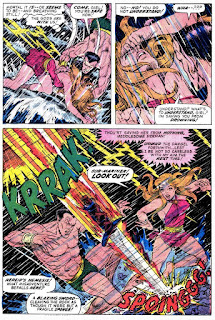


To be sure, the tale, like a lot of Golden Age stories, depends rather heavily on coincidence. In the midst of a stormy sea, Sub-Mariner beholds a “rocky pinnacle” rise from the ocean, complete with an Andromeda-like maiden atop it, waiting for rescue. The rescue is interrupted by a blazing sword from the heavens, which the reader—though not Namor—soon learns was thrown by none other than Ares, the God of War. Namor has more pressing problems. The rock-pillar starts sinking, and as he prepares to carry the unidentified woman to shore, she suddenly morphs into a different woman. Nevertheless, Namor takes her to safety ashore, and the woman, who calls herself “Vicky Starr,” takes her leave without so much as a thank-you.


The scene shifts to Namor’s then-current support-cast. One of them is Mrs. Prentice, who, in her youth during the 1940s, was Namor’s sometimes lover Betty Dean. The other is Namorita, the daughter of Namor’s cousin. In this story Namorita has become obsessed with campaigning against continued American involvement in Vietnam. In contrast, Mrs. Prentice represented the Older Generation that tends to trust in the government’s wisdom. During their exchange it comes out that Namorita’s teacher at college is one “Vicky Starr,” who is also an anti-war demonstrator. However, the morning paper alerts Namor’s cousin that Miss Starr’s car was wrecked near the ocean, so Namorita calls upon Namor to search for the missing teacher.
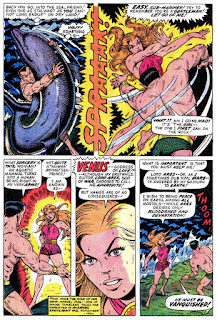

Namor, puzzled that the very woman he rescued has gone missing, searches the area. A mysterious dolphin shows up and encourages the Sub-Mariner to give chase. They end up at a “massive island” that has apparently appeared from nowhere, and the dolphin reveals itself to be the first woman Namor saw on the pillar. She reveals that she is Venus, Goddess of Love, and that the island was conjured into being by her eternal opponent, the God of War. Venus shows the Sub-Mariner how armed conflict has erupted upon the new island, and, though the island’s inhabitants are never seen, Venus asserts that if the island-war continues, “the pestilence of warfare will spread to all nations.”  Venus wants Namor’s help in defeating Ares, though she never troubles to explain why she didn’t identify herself to Namor the first time they met. Perhaps it would be charitable to assume that she waited until Ares launched his scheme, the better to overcome any doubts the sea-monarch might have.
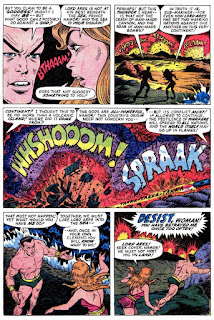

Ares shows up, and chases down Venus. He removes the girdle about her waist, which object gives Venus the power to encorcel others with love-spells. (Why she doesn't use the girdle on Ares the first time she sees him goes unexplained, except that it would have shortened the story a lot and left the main hero with nothing to do.) The Sub-Mariner joins the fight, and though Ares is said not to be at home in the sea, he gives Namor a pretty good battle by shifting his shape into various sea-creatures, more like the Greek Proteus than like the Hellenic war-god. Ares battles Namor to a standstill, but the key to Ares’ defeat proves to be the recovery of the love-girdle. Once Ares is exposed to its rays, he loses his resolve for battle, and obeys the goddess’s command to end the conflict on the island. In fact, the whole island disappears, and Venus once more morphs back into the identity of schoolteacher Vicky Starr.
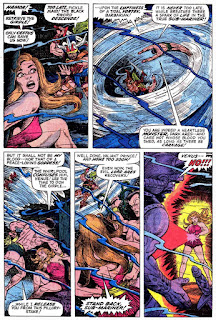

The final page, in which the name on Vicky's door is the same she used in her 1940s series, should probably be taken as a shout-out to the earlier series, rather than an attempt to launch the franchise again. As it happens, Everett died in February 1973, a.month after issue #57's January cover-date. Of course. the comic book probably appeared on newsstands two or three months earlier, and Everett had completed or semi-completed scripts and/or art that continued to appear in the title for a few months following his demise.


Now, the mere fact that Everett’s story conjures with archaic myth-figures does not make it “mythic” in my definition. The artist was probably aware of the story in which Ares and Aphrodite are shown as lovers, though he quite sensibly leaves out inconvenient details, like Aphrodite’s canonical marriage to Hephaestus, god of the forge. As William Moulton Marston did before him, Everett uses the war-god and the love-goddess to delineate opposing tendencies in the human soul. The Golden Age SUB-MARINER stories don’t delve into the depths that WONDER WOMAN did, but it should be noted that even though Sub-Mariner was a character formed in the crucible of war, one can find instances in which the character, or his author, comments upon the ultimiate foolishness of martial pursuits. HUMAN TORCH  #5, in which Namor becomes puffed-up with false glory and strives to conquer the globe, is probably the best example. In the Golden Age, there was no necessity to concoct an “island of war,” since war had already spread to almost every corner of the globe. Still, within the context of the 1970s, the martial island serves to concretize the fears that another World War might come into being, if humanity fails to “give peace a chance.”


A few other touches add to the story’s mythic density. I'm guessing that the 1948 Venus didn't have a love-inspiring girdle, but regardless of the item's provenance, it’s a patent vaginal symbol, and its victory over Ares’ very prominent sword may be seen as a renunciation of male bellicosity. I’ll also point out that although Namor was always rather bellicose in his own way, he, unlike a lot of Golden Age heroes, was frequently surrounded by female characters who often (though not always) sought to ameliorate his ferocity. The allusions to the continuing conflict in Vietnam could have dated the story, but Everett strikes the right touch of outrage in Namorita’s desire to see the madness end. There’s even a  loose imputation that American democracy is as vulnerable as any tyranny to letting war get out of control, for while Mrs. Prentice places her faith in the democratic way, Namorita puts her faith in her cousin, the monarch of a sub-sea kingdom. “I never noticed anything very ‘democratic’ about Namor,’ fumes the young mer-girl.  It wouldn’t be hard to see this story as Everett’s belated take on Marston’s love-war formula, in which women of good conscience ought to be making the decisions, and strong men are at their best when they serve as champions of peace.    

Tuesday, September 12, 2017

NEAR-MYTHS: ASSORTED SUB-MARINER STORIES

Several months back, I complained about the lack of mythicity in the origin of the Golden Age Human Torch.  I must admit, however, that I don't think Carl Burgos' creation ever had great potential, since the conception of the Torch always seemed fairly gimmick-oriented.

In contrast, Bill Everett's Sub-Mariner-- who debuted alongside the Torch in the same 1939 issue of MARVEL COMICS-- always seemed to have a lot of unused potential, whether the character was handled by his creator or by latter-day talents. 

For one thing, the Sub-Mariner (a,k.a. "Prince Namor") has a great visual design. With his triangularar head and pointed ears, he seems to me like a less hirsute version of the Greek god Pan.


And that's not even taking into account the ingenious (if improbable) attribution of his power of flight to the tiny wings on his heels, obviously derivative from Hermes/Mercury's winged sandals.


The Sub-Mariner's origin-story is extremely promising, pitting the youthful hero against the surface world due to an attack on his people, also called "sub-mariners" (and not called "Atlanteans" until the 1960s reboot). 


However, with a real World War threatening to engulf America, there was no possibility that the Sub-Mariner's storyline could have continued to focus on a war between sub-mariners and surface dwellers. Namor quickly dropped his grievances against Americans and became a crusader against the Nazi menace for most of his Golden Age career. Yet his best-remembered stories are those when he was still somewhat on the side of the devils, as when he battled the not-so-human protector of surface dwellers, the Human Torch.


Indeed, one of these encounters even involved Namor hurling a tidal wave against New York City, though he repented of his warlike acts and went back to being a good guy, without anyone raising a stink about the death and destruction he had caused.


The 1960s reboot heightened Namor's role as a decent guy embittered by the way nuclear testing had dispersed the people of his Atlantean empire. (Later continuity rewrote this story to exculpate Americans once again.) Namor was most frequently opposed to the Fantastic Four, though he was made more sympathetic due to his rather goatish lust for Sue "Invisible Girl" Storm. The character didn't get his own series until 1965, in TALES TO ASTONISH #70. Unfortunately, Stan Lee and Gene Colan got off to a poor start with a soggy quest-story that couldn't compete with similar tales from Lee and Kirby in the THOR title. 


Things looked up somewhat when Sub-Mariner got his own title, written for several years by Roy Thomas.For a time, artist John Buscema also gave the series an epic feel somewhat reminiscent of Hal Foster's PRINCE VALIANT. However, no single story or set of stories used the hero to best effect. The closest Namor came to glory during his own magazine's run was when Thomas and Buscema had him encounter the denizens of another sunken city, Lemuria. This was the most ambitious serial in the history of the Silver Age comic, but though it introduced the artifact known as "the Serpent Crown"-- a major trinket in Marvel continuity-- the Lemurian tale lacked cohesion. The character's mythos also suffered from a mediocre set of  villains who failed to challenge the hero on a deeper conceptual level, as the Fantastic Four's foes did for that group. 


For the most part, later series starring Namor also failed to use his mythic potential. However, I finally re-read one particular stand-alone story that meets my mythcomic criteria-- and interestingly enough, it's by Namor's creator Bill Everett, who was allowed to write and draw several issues of the Silver Age title the artist passed away. The story even manages to play into the element usually neglected in Namor stories: i.e., his relationship to the Greek deities, as well as commenting on the character's intrinsic connection to humankind's practice of the art of war. More on this story anon.


CORRECTION (8/29/18): I credited the Lemuria sequence (SUB-MARINER #9-13) to artist John Busceme. Evidently I was only remembering the big Sub-Mariner/Thing battle that precedes the sequence proper, in issue #8, for the artists in #9-13 are Marie Severin (issues 9, 12 and 13) and Gene Colan (issues 10 and 11).