It's now a week and a day since the assassination of Charlie Kirk. I'd heard his name off and on but only had become aware of him in the last month, thanks in large part to SOUTH PARK. I don't regularly watch the show but some podcast on YT featured Kirk reacting to a 2025 SP episode. From the clips shown, the show spoofed Kirk by having Cartman give extremely racist speeches, supposedly modeled on those of Kirk. The real Kirk was highly amused by SP's hyperbolic satire, and he stated something to the effect that he felt he'd "arrived" by getting lambasted by the famous teleseries.
The SP episode may have been clever or stupid, but it falls within the realm of art, and so it can't be judged as pure political discourse. Not so, the dozens of contemptible reactions on the Left to the murder, in which people felt it more important to virtue signal about Kirk's alleged racism than to show common respect for a man shot down for his words. Even worse were the bottom-feeders who tried to make a hero of the left-leaning assassin, or to romanticize him, or to make him part of some convoluted conspiracy on the Right.

But this is a philosophy-blog, not a political rant blog, so I do have some thoughts about what I consider the "two ethical systems" that underlie all forms of political endeavor-- the Ethos of Keeping and the Ethos of Sharing. They are the two sides of human nature, which have taken many forms in history. In this century we know the Keeping-Ethos as "conservatism," which connotation is baked into the very word "to conserve." Now, the word from which "liberalism" descends means "to free," not "to share." But no actual liberal in modern times advocates simply "freeing" marginalized people without also letting those people "share" in whatever rights or privileges have supposedly been denied them-- ergo, liberalism is predicated on an Ethos of Sharing. The two words are even traced back to the same century, the 14th, while in another century, the 19th, they became rhetorically linked to the two dominant U.S. political parties.
Within the liberal view, conservatism is evil, the domain of money-hoarding tyrants, but this is false logic, and not only because there are a lot of rich liberals too. From the tribal level up, every organized society depends upon an Ethos of Keeping, particularly with respect to resources. If Tribe A has control of the headwaters of a river, then Tribe B will not be allowed to Share in this bounty, for that would mean less for every member of Tribe A. Tribe B can only access the river only through (1) reciprocal trade, which exchanges goods from B to A, which is still the opposite of Sharing since each party Keeps the fruits of the exchange, or (2) killing off Tribe A or somehow managing to merge with the other tribe consensually. Obviously small societies often merged to make larger ones, but often this strategy, like trade, was executed for mutual advantage, such as defense against a common enemy, Tribe C. The primary mode of non-reciprocal Sharing appears within families, where parents share with children and may get nothing out of the bargain except a sense of familial immortality. One may assume that some tribes extended familial charity to tribe-members who were injured or indigent, and that this eventually led to a sense of philanthropy toward the poor as tribes coalesced into city-states. But this still constitutes Sharing within a particular ingroup.
The Ethos of Keeping also applies equally to the ethos behind slavery, which is in modern times supplies both sides of the political spectrum with a source of conflict. In archaic times no citizen would have thought that any society was obligated to free slaves. Slaves were often taken during wars with other nations, along with other plunder. The idea of simply letting enemy slaves go free would not have made any more sense than a request for the return of any other sort of plunder. Ancient citizens might have understood a slave wanting to be free, but that would not mean that the slaveholder had any moral duty to free him. The closest thing ancient societies had to the modern idea of liberation would be related to Nietzsche's concept of the largesse of the nobility. Nobles might choose to free slaves-- say, during the Hebrew festival of the Jubilee-- as a gesture of generosity. Something similar may inform the story of Cyrus the Great releasing Jewish slaves in Babylon from captivity once the Persian ruler took over the country. One does not need to believe the Old Testament's account of the event, and one may fairly speculate that Cyrus may have liberated the Jews with the notion of being able to garner a return favor from Israel down the line. But since the Jews did not to our knowledge render Cyrus any goods in exchange for freedom, his gesture is still defined as a gesture of magnanimity.
Though one can find evidence of the Ethos of Sharing in early societies, its manifestation in the form of charity became arguably more cental to what some have called the "pietistic religions"-- Judaism, Christianity, Islam, Buddhism. With the rise of these beliefs, the Ethos of Sharing became a general commandment. It's also during this period that two of the greatest empires of the Old World, Imperial Rome and Imperial China, had their Keeping-systems of empire-building interfused with the Sharing-oriented systems of Christianity and Buddhism. Granted, Imperial Rome had to take a "fall" before it rose again in a more religiously oriented form, while Buddhism had to share China with Taoism and the secular "faith" of Confucianism. In both domains, strong limitations remained upon the Ethos of Sharing, for the institution of slavery continued in both empires. More egregiously, the later Empire of Islam turned the practice of slavery, which had most often been the consequence of warring tribes and nations, into a transnational moneymaking business.
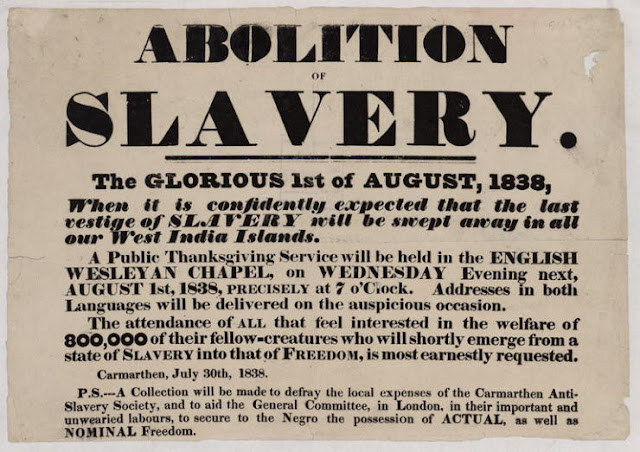
So when I write something about the American Confederacy and don't react with a knee-jerk excoriation of the evils of slavery, it's because I recognize that slaveholders in all of the twelve original slaveholding states were governed by the same Ethos of Keeping that applies to any other form of property. American slaveholders in the North and the South didn't bring Africans to the States for any other reason but to be slaves, the same way the captive Africans would have remained slaves had they been sold anywhere else, in Persia or Turkey or China. But in the United States, there had arisen a secular "ethic of emancipation" due to the American Revolution. This combined with the Sharing-ethos of mainstream Christianity-- as well as offshoots like Quakerism-- and so produced abolitionism. The abolitionists were far too few to have influenced the nation's course, but their aims happened to coincide with (1) Great Britain's early-19th century ban on slave-trading, and with (2) the desire of Northern politicians to nullify the congressional power of the Southern states. The "liberals" of this period were no less devoted to their Ethos of Keeping than were the "conservatives." Aside from real abolitionists, who often sacrificed life and property campaigning for slaves' rights, most Northerners had only one real goal: to bend the Southern states to their will. These early "liberals" sometimes wrapped their quest for power in an alleged Ethos of Sharing. But they often expected the South to do all the sharing of resources, by enforcing codes that kept even free Blacks from emigrating into certain states, such as Illinois.
And now, about a hundred and fifty years after the close of the Civil War, modern liberals are still telling conservatives that they Must Share whatever liberals think ought to be shared. To that imperious command, conservatives reply that they Must Keep what they hold rather than becoming de facto slaves to the Left. While there are real racist movements within the Far Right, and while there are reactionary elements within the "Center-Right" that I don't always countenance, the anti-racist screed of modern Liberals has become removed from all practical considerations. Thus, they only command others to Share on their own terms-- yet they cannot share condemnation of the political murder of a man who only contended against them with words. Thus the Left's alleged narrative of Sharing becomes that of Keeping one's political stance in place, no matter what. I'll add that I imagine a lot of Righties want to keep the controversy boiling too. But the Left missed a real chance to participate in a Sharing that would have made them look a lot better than they do now.