Featured Post

SIX KEYS TO A LITERARY GENETIC CODE

In essays on the subject of centricity, I've most often used the image of a geometrical circle, which, as I explained here,  owes someth...

Showing posts with label alex raymond. Show all posts

Saturday, October 25, 2025

INFLUENCE OF ANXIETY

 Response designed for a forum-post, context implicit.

____________

Because you and another poster raised the spectre of influence between the daughter of Sax Rohmer"s Fu Manchu (1912) and the daughter of Ming in FLASH GORDON of Alex Raymond (and all uncredited collaborators), here are my hot takes.


First off, there's no doubt in my mind that Ming derives from Fu Manchu, even though their specific characters are not very similar. The fact that both have disobedient daughters is one big factor, though surprisingly the big thing everyone knows about Princess Aura-- that she falls big-time for studly Flash Gordon-- is not initially a feature of Fu's daughter Fah Lo Suee.   


Now, the element of a female ally of Fu Manchu falling for one of the heroes is a big part of the first two books, published respectively in 1912 and 1916. Fu's beautiful slave-girl Karameneh inexplicably becomes enamored of Doctor Petrie, and thus helps Petrie and his cop-friend Smith out of some jams. In the second book Karameneh even shoots her master to save Petrie, and the only thing that saves her from the devil-doctor's vengeance is that Fu uses his former servant as a bargaining chip to compel Petrie's aid in the third book.

This book, HAND OF FU MANCHU (1917) also introduces Fu's daughter, though she's not given a proper name and is never disobedient to her father's will. Then there's a lacunae of about fourteen years, during which there are no official Fu Manchu novels (though the doctor kind of "guest-stars" in THE GOLDEN SCORPION). DAUGHTER OF FU MANCHU debuts in 1931, and here Fah Suee does get a name, and she does seek to wrest control of the Si-Fan from her father. However, she doesn't ally herself to any Englishman. In this and in the subsequent book, she implicitly uses drugs to make a young guy her lover, though there's no sense that she's in love with him.         

The sixth book, BRIDE OF FU MANCHU, again portrays conflict between father and daughter, though not over any romantic alliance of hers. Then finally, in April 1934, Rohmer starts serializing, in Collier's, THE TRAIL OF FU MANCHU, Fah stuns her dad by claiming that she's fallen in love with Fu's worst enemy, Smith. In two or three later books, this romance is mentioned, and at least once Fah helps the heroes out of a fix, but the plot is left hanging by the end of the series.


However, FLASH GORDON debuts in January 1934 and its first arc, in which Aura meets and desires Flash Gordon (even as Ming desires Dale Arden) finishes up in April-- which as noted is pretty much when TRAIL got started.

Of course, Raymond et al could have taken the element of the romantically traitorous daughter from a lot of places other than Rohmer. But Rohmer did use that element, albeit with a slave-girl rather than a literal relation, for whatever that might be worth.  


Wednesday, November 14, 2018

MYTHCOMICS: THE WITCH QUEEN OF MONGO (1935)

"Witch Queen of Mongo" marks the first sequence in which Alex Raymond seeks to expand on the formulaic characters of FLASH GORDON. But it's not the central character who gets the attention, but his faithful inamorata Dale Arden.

As I pointed out in my previous Raymond essay, Dale Arden's role in the series is one of the strongest deviations from the strip's putative inspiration, Edgar Rice Burroughs' JOHN CARTER series. It may be that Raymond chose to give his hero a female "comrade-in-arms" in imitation of the science-fiction strip with which FLASH was competing, BUCK ROGERS. Dale Arden is, admittedly, not an experienced warrior-woman like BUCK's Wilma Deering. Yet Dale is much more gutsy than any of Burroughs' Martian princesses.


For example, in the second FLASH strip, Zarkov, having built a spaceship to combat the onrushing world of Mongo, forces Flash and Dale  to board the ship, after which he sends them all speeding toward the enemy planet. Flash fights with Zarkov, and though the hero slugs the older man unconscious in the next panel, Dale is seen grabbing a lug-wrench so as to crown Zarkov if necessary. And while Flash is always the main hero in the ensuing sequences, Dale frequently shows more than a little initiative. When Flash and Dale are held prisoner by the Hawkmen's king Vultan, Dale pretends to make up to the monarch in order to protect her beloved. Early in the "Witch Queen" sequence, Dale is seen ray-blasing Mongo-monsters as ably as her boyfriend could. However, since she is a woman, her priorities are not quite the same as the hero's, and on that the main plot of "Queen" hinges.
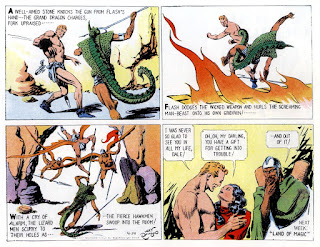


At the end of the sequence I termed "Tournament of Death," Ming awards Flash his own kingdom, but the hero has to tame it for himself. Flash, Dale and several Hawkmen provided by Vultan infiltrate this new domain, name of Kira. The first ten strips depict Flash's first efforts to extend his rule, in particular defeating a tribe of cannibalistic lizard-men. But at the end of the tenth strip, Dale takes issue with the male mode of continual conquest:

But Flash, if you keep finding new enemies, when can we hold our wedding?

This can't be dismissed as mere feminine pique, given that Dale was key to rescuing Flash from the lizard-men. Flash, being a man, gives Dale a sweetly reasonable answer that doesn't acknowledge her concerns (I suppose some today would call it "mansplaining"). Dale blows up: "I won't marry you now til you beg me to!"


As if summoned into being by this disavowal, Dale's next major romantic competitor, Azura the Witch Queen, enters the fray. Despite the slight similarity between the name of the queen and that of Ming's daughter, Princess Aura comes off as a poor second to Azura, an independent ruler with her own array of arcane weapons-that-look-like-magic. Azura appears before Flash's entourage, seeming to be such a "spectral figure" that the armed men are briefly cowed. Flash orders them to attack, but Azura has the situation in complete control. She uses explosives to trigger an avalanche, burying many though not all of the Hawkmen, while the queen uses sleep gas to take prisoner Flash, Dale and a Hawkman captain named Khan.

With the help of her soldiers, usually called "magic men" despite the fact that they too only use super-science weapons, Azura transports her captives to Syk, her "flame-guarded stronghold" (perhaps modeled on the folk-story of Venusberg). She seems to be unaware of Flash's intention to invade her territory, and is only interested in seducing him. Apparently her only reason for keeping Dale and Khan alive is to use them to keep Flash in line when he wakes up-- although it doesn't take long for Azura to take the next step: drugging the hero with a forgetfulness potion called "Lethium.."  Flash easily buys into the notion that this sexy witch-woman is his queen and lover.


Ar this point, Azura really has no reason to keep Dale and Khan alive, and Raymond doesn't even resort to the most logical excuse: that Azura takes sadistic glee in seeing Dale suffer when Flash no longer knows her. Both Dale and Khan are given servile jobs as servants, but aside from a scene in which a female servant lets Dale see Flash kissing Azura, there's no direct attempt to humiliate. However, though Flash doesn't know Dale as anything but a serving-girl, he objects to seeing a member of the weaker sex whipped for a minor infraction. This illustrates Flash's innate gallantry, given that he remembers nothing of his previous life.


Meanwhile, some of the Hawkmen under Flash's command weren't killed by the avalanche, and have sent for military aid to Vultan. Soon a small army of Hawkmen, accompanied by the peripatetic Doctor Zarkov, assault Azura's "magic-men."


The Hawkmen lose the contest, but Flash takes Zarkov prisoner and brings him into Syk. This proves costly for Azura, for with his super-science Zarkov slays several magic-men and cures Flash's amnesia. Flash feeds Azura her own potion, so that she forgets her evil ways-- temporarily at least-- and aligns herself with his rulership.


However, just to keep the pot boiling a little longer, Azura's generals stage a coup. Flash, Dale and Zarkov are forced to flee Syk, somehow leaving the Hawkman Khan behind in prison, and in the absence of the heroes, Azura's old identity returns. Zarkov then uses his science to give Flash a "super-power," turning him temporarily into an invisible man, even though Raymond draws him as a shadowy figure. Thus Flash invades Syk again, launching a "one-man war" on Azura and freeing Khan. However, Flash's invisibility begins to wear off. He takes Azura hostage and drags her into "the Tnnnel of Terror" to escape. This proves a mistake, for the tunnel is inhabited by "death dwarves."


Just as Flash and Azura stand on the edge of being overwhelmed by the dwarves, Dale and Zarkov show up in the Tunnel and drive away the nasty fiends. However, because Flash and Azura thought themselves on the verge of death, the queen begged the hero for a last kiss, and he obliged, just as Dale showed up. Thus the story comes full-circle, for although Dale has reclaimed her lover, he's displayed a certain amount of sexual infidelity before her eyes. At last Flash is able to smooth over the troubled waters by relating his transgression to his Manifest Destiny. When Dale asks Flash if he liked the kiss, "I liked it because it meant her friendship-- it meant that this bloody business was at an end-- that I had won my kingdom and the right to marry you."

However, Flash manages to find another new war that keeps him from getting married, which also brings the story back to Dale's original protest. When Flash announces the taming of his kingdom to Ming via radio, the Mongo emperor refuses to acknowledge Flash. In the following sequence, this begins Flash's first major martial assault on the empire of Ming, but "Witch Queen" in essence sets a pattern that would mitigate against marriage for the rest of the comic strip's history. In other words, Flash and Dale would perpetually have their virtue attempted by this or that powerful figure of Mongo. It's a virtual certainty that male readers enjoyed it whenever some beauteous ruler tried to seduce Flash, while female readers didn't get nearly the same vibe from Dale having to fend off unattractive seducers like Ming and Vultan. Still, there may have been some pleasure for women readers in seeing Flash prove his faithfulness again and again in spite of massive temptation, for, to my knowledge, Flash always remains devoted to one woman, despite not ever quite finding time to marry her.


Monday, November 12, 2018

NEAR MYTHS: "MAROONED ON MONGO," "TOURNAMENT OF DEATH" (1934-35)

In THE PLANET MONGO, Nostalgia Press's 1974 collection of the first two years of Alex Raymond's FLASH GORDON strip, the editors assigned titles to five sections of Raymond's work. I disagree with these assignments, for as I see it, these three years break down into three definable installments. I'm keeping their title, "The Witch Queen of Mongo," for the forthcoming essay, but the other two I've designated as "Marooned on Mongo," a title borrowed from the otherwise unmemorable 1996 TV-show, and "Tournament of Death," a title borrowed from one of the episodes of the 1936 serial. In all of the Raymond works I analyze here, I give Raymond sole credit for sake of brevity, though some if not all of the work was co-written by Don Moore.

_________

The comic strip adaptations of two prose creations-- Edgar Rice Burroughs' TARZAN and Philip Francis Nowlan's BUCK ROGERS-- launched what many have called "the Golden Age of Adventure Comic Strips." The two strips even debuted in American newspapers on the same day in 1929.  About five years later, King Features Syndicate invited artist Alex Raymond to create two ongoing strips, often if not always appearing together on Sunday pages, and both seemed to be biting the style of Edgar Rice Burroughs. JUNGLE JIM, though it concerned a white hunter rather than a ape-man, at least sought to compete with Tarzan's jungle thrills, though at no point was the former capable of eclipsing the latter. However, if it's true that King originally thought of doing an adaptation of Burroughs' John Carter of Mars, then there's not much question that Raymond'FLASH GORDON did indeed surpass the reputation of the Burroughs creation. (Additionally, King was possibly seeking to compete with the popularity of BUCK ROGERS, whom FLASH also excelled in popularity and repute.)


The sequence I've dubbed "Marooned on Mongo" is a long picatesque adventure that acquaints Raymond's readers with many of the colorful races of Mongo, and in this Raymond follows the lead of Burroughs's Mars books for the most part. Burroughs' Carter was an Earthman transported to a savage Mars inhabited by humanoids, one of whom, the "incomparable Dejah Thoris," eventually becomes Carter's wife. Mars's humanoids were largely characterized by skin-color-- red, white, black, and yellow-- though there were two quasi-humanoid races, the Tharks and the Warhoons, who were four-armed green monsters. In contrast, Raymond's Flash Gordon and his love-interest Dale Arden are both abducted to Mongo by crazed Doctor Zarkov when the scientist takes the two youths aboard his ship and tries to ram the hurtling planet Mongo to keep it from crashing into Earth. (The peril of colliding worlds is summarily dismissed and nothing more is said about the havoc Mongo's presence might be wreaking on Earth's solar system.) Mongo has a few humanoid races characterized by color alone, though the strips are inconsistent about depicting Ming, Aura and their congeners as "yellow," while Ming is the only one given a "Chinese Mandarin" image. However, Raymond was far more interested in creating humanoids with overt or implied animal natures: lion-men, hawk-men, and shark-men. Mongo is also, like Mars, rife with both primitive sword-battles and advanced technical gadgetry, underscored by sneaky court intrigues and romantic entanglements.


In contrast to John Carter's wooing of Dejah Thoris, the romance of Flash and Dale takes place somewhat on the fly, and is swiftly challenged by the ardor of Aura, daughter of Ming. In the "Marooned" sequence none of these four characters are very strongly characterized, and the attitudes of Ming and Aura toward the two Earthpeople reverse one another: Ming desires Dale and wishes to kill Flash; Aura desires Flash and wishes to kill Dale. In an early essay here, I discerned this as a "racial myth," but today I tend to think that this was just a surface imitation of the BUCK ROGERS strip, and that Raymond had little real interest in such matters. "Marooned" is largely a Cook's Tour of Mongo. There's nearly no social commentary on the various exotic tribes met by the humans, except insofar as many of them have grievances against Emperor Ming, who implicitly rules the planet with an iron hand.


"Tournament of Death," however, marks a transition in Raymond's work. Toward the end of "Marooned," King Vultan of the Hawkmen has been trying to make Dale his bride, and even comes to blows with Flash. However, when the floating city of the Hawks is imperiled, Doctor Zarkov saves the city with his scientific knowledge, and so Vultan befriends the three Earth-people. Ming and Aura then show up with their troops to seize the humans. So Vultan invokes "the ancient laws of Mongo," calling for a "tournament of death," in which Flash can compete to rise to the rank of rulership-- but only if Flash is the "last man standing" in the midst of dozens of ambitious warlords from all over the planet. It's with "Tournament" that Raymond abandons most of the storytelling tropes favored by Burroughs. Palace intrigue and romantic complications remained, but "Tournament" begins to portray Mongo with a sense of the pagantry emblematic of photorealistic book illustrations. In addition, Raymond advances Barin-- one of the rebel warlords seen in "Marooned"-- as a consolation prize for Aura. Though Aura makes one attempt to kill Dale during this sequence, she's overcome by Barin's charm and for the most part forgets her ardor for Flash, as well as deserting the cause of her father.


Though Aura's character diminishes in this sequence, Ming becomes a more majestic figure of evil here. He allows the tournament because he hopes to see Flash humbled before all Mongo. Instead, Flash wins in such a way that he allows his fiercest competitor Barin to live. But even though Ming is forced to assign kingdoms to both Flash and Barin, the wily emperor gives both of them wild, untamed domains, so that the two warriors will have to exert themselves mightily in order to attain their goals. It's at this point that Flash goes forth to conquer the lands under the sway of Queen Azura, "the Witch Queen of Mongo"-- which I'll consider in the next essay.


Tuesday, April 29, 2008

RAYMOND'S RACIAL MYTHOS

As was the case with TERRY AND THE PIRATES, most of the material in Checker Books' 2003 collection of early FLASH GORDON (Jan '34 to Apr '35) is stuff I've read before in other editions. This early work is sometimes critically derided in favor of the more monumentalist-looking art produced by Alex Raymond in later years, but it's doubtful that the strip would have survived in its early stages without its rapid-fire offerings of serial-style danger and sexual titillation.

One thing that becomes clear from reading the early work of Raymond and writer-collaborator Don Moore is how much it stands in the shadow of Hal Foster's TARZAN. It wouldn't be impossible to view the early months as a sort of dumbed-down Tarzan, in which wild animals frequently pop up in the most absurd places (and with the most absurd anatomies, as per the "Tigrons," tigers with unicorn-horns). Now, without making a side-by-side comparison I can't say how well Foster's did in HIS first year as far as realizing the mythic quality of the Tarzan books, but he admittedly he had more to work with. Even though Edgar Rice Burroughs produced many a potboiler with both Tarzan and his own otherworldly superman John Carter, the early adventures of both prose-heroes start off with a high degree of symbolic complexity (in addition to also having lots of serial-style dangers and sexual titillations).

But FLASH GORDON doesn't come off as having much complexity in its early year. The strip's closest claim to any complexity comes out of what modern readers would find its most egregious absurdity: transplanting Earth's concept of "the Yellow Peril" to Mongo, the alien planet visited by Flash and his two-person chorus, ingenue Dale Arden and mad scientist Zarkov.

Raymond and Moore may have borrowed this notion from Burroughs, who had his John Carter butting heads with various adversaries, all pretty much humanoid but with yellow, white or black skins (though the black Martians are literally black, not just dark-brown). Another possible influence might be either the original novellas or the comic strip that gave readers Buck Rogers (1928 for the novellas, 1929 for the strip). The action of the novellas takes place entirely on a future-Earth conquered by the descendants of the "Mongolian" race, and the strip begins the same way. Toward the end of the second novella there appears a backtracking rationalization to the effect that the rapacious "Mongols" may have actually been alien-human hybrids, which serves to distance them from the ranks of real-life Asians. The strip takes a similar tack around 1930 or so, replacing the Mongolian opponents with clearly-alien "tiger-men." (This idea is tossed into the 1979 BUCK ROGERS teleseries, where an Asian-looking henchman named "Tiger-Man" serves the needs of villainous invader Princess Ardala.)

However, FG contains a Yellow Peril motif more typical of Burroughs than BUCK ROGERS: the motif of the tyrant who desires the white hero's woman (who, as in JOHN CARTER, may not actually be white herself) and the tyrant's sexy daughter who desires the white hero. This is a racial myth unquestionably directed at flattering the egos of a mostly-white American readership. Emperor Ming wants Dale, but she doesn't want him, only Flash. Flash fights Ming to save Dale, and usually rejects Ming's daughter Aura, though given her general sexiness there are naturally moments where the hero seems a trifle more conflicted in his refusal than Dale does. The manhood of the yellow-skinned Mongo-men is somewhat propped up when Aura is given a consolation prize in the form of Barin, a man of her own race, leaving old Ming odd man out.

However, despite the great fame of FLASH GORDON and the admirable skill with which it's drawn, on the basis of this first year I would not find the strip to have much mythic complexity compared to either the early Burroughs books or even the BUCK ROGERS novellas. Most of the "alien races," whether they look like humans or human-animal hybrids (Lionmen, Hawkmen), are much flatter than Burroughs' peculiar cultures, and even Buck's quasi-Mongols occasionally have something like a culture, however wrongheaded it may be. Thun, the Lionman who becomes Flash's first real alien buddy (making him a stand-in for JOHN CARTER's Tars Tarkas) actually befriends Flash after Flash shoots him down. But it's okay with Thun, 'cause Flash did it to protect Dale Arden. ????

Going by this estimation, FLASH GORDON may not be as low on the scale of complexity as, say, the original VALKYRIE tale in AVENGERS (which see), but it's pretty close.