In the response-thread for EYES OF THESERPENT, reader AT-AT Pilot brought up the topic of mythic content
with respect to comics using cheesecake art. After making my response
there, I decided to build on it with respect to the overall topic of
art with a “sexploitation” angle and its possible relation to
myth-content.
To define the second term first,
“myth-content” arises in fiction when its authors produce what I
term “epistemological patterns” in their work. These patterns are
drawn from real-world observations about the way things work in
different aspects of reality: patterns of the physical and
metaphysical properties of the cosmos, or patterns of human beings in
both their individual and social matrices. These patterns, when
transmuted into literature, should not be valued in the same fashion
that scientific data is valued: as reproductions of how those factors
function in reality. Rather, the patterns serve to deepen the
symbolic universe of each myth-narrative, thus allowing readers to
reflect upon all the different factors that make up experience, when
seen through the free play of imaginative fantasy.
The first term, “sexploitation,”
also requires some analysis. The term seems to have sprung into being
as a tag for works that sold themselves to the public by focusing
upon spectacular versions of sexual depiction and/or activity. This
view assumes a sort of baseline for normative sexual depiction, which
might extend even to those works that seek to avoid sex as much as
possible, like Stevenson’s TREASURE ISLAND. Starting from this
supposition, one must assume ever-increasing levels of sexual
depiction, and for convenience I tallied three such levels in this essay. More on the levels of spectacular depiction later.
While a number of critics have sneered
at sexual depiction as taking audiences’ minds away from “better
things,” sex and myth are certainly not in conflict in my
system—not least because sex is an important aspect of archaic
religious mythologies. Since I’ve continually favored the analysis
of literary works through the heuristic tool of Joseph Campbell’s
four functions, I thought it would prove stimulating to look at four
sexploitation works I’ve already reviewed, each from the viewpoint
of a particular function.
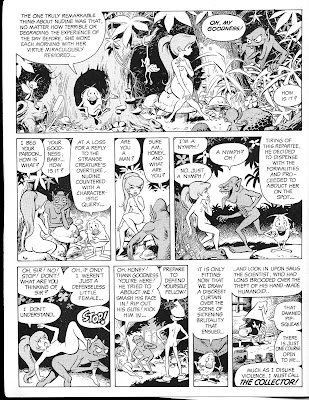
THE PSYCHOLOGICAL FUNCTION arises most
often in literary myths involving sexuality, probably because each
individual’s sexual nature is as a bedrock of that individual’s
personality. In my review of Wally Wood’s PIPSQUEAK PAPERS, I
noted that he encoded his fairly misogynistic feelings about women
into a short series of riffs taking place in a burlesque (in more
than one sense) fantasy-verse. Perhaps the most revealing projection
in PIPSQUEAK is the way he undermines the sex-fantasies of main
character Pip toward his perpetually nude mate, the nymph Nudina. Pip
starts the story as an undersized sprite whose dinky wang can’t
possibly satisfy Nudina. He acquires a “second body” that allows
him to enjoy the naughty nymph, but soon finds that it’s a drag to
always be defending her from rapacious villains. At the end his
reward for remaining true to Nudina is that he loses his alternate
body and falls into slavery alongside her, in a situation where he
can no longer satisfy her and must also put up with the child he
sired by her. Whatever psycho-demons Wood sought to lay to rest via
this satire, he nevertheless gave them much more complexity than he
did in a romp like SALLY FORTH.
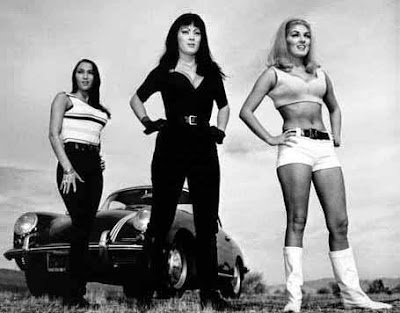
THE SOCIOLOGICAL FUNCTION looms forth
wherever a given work seeks to show how human society is affected by
the disparate natures of men and women. Thus, Russ Meyer’s FASTERPUSSYCAT KILL KILL, which starts out by welcoming the audience to
“violence,” shows male and female social roles breaking down by
the new breed of the Sixties Women. Three go-go dancers, less
criminals than lovers of life in the fast lane, become involved in
murder, mostly because of their bad-tempered, karate-chopping leader
Varla. Instead of butting heads with the patriarchal order in the
form of lawmen, the trio of hot babes—who have abducted a young,
naïve woman who witnessed the murder-- comes into conflict with a
trio of men living in a remote desert-cabin. Both the three men and
the three women have various dark secrets, but none of the characters
have “psychologies” as such. The Old Man, father to a normal
young man and to a mentally impaired hulk, represents not so much
abstract patriarchy as a male sexual desire to prey on women. Varla,
hoping to rob the old hermit, pits both her feminine wiles and her
penchant for violence against this male prerogative, but her victory
proves pyrrhic. She sacrifices both of her female followers to her
greed and almost destroys all three men, only to be ignominiously
defeated by the girl hostage.
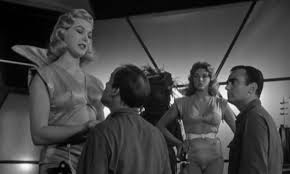
THE COSMOLOGICAL FUNCTION perks up with
some loony effects in the 1961 film INVASION OF THE STAR CREATURES. Though the viewpoint characters are Penn and Philbrick, a pair of
goofy army privates, the real stars are the titular stellar villains,
the risibly named “Doctor Puna” and “Professor Tanga.”
CREATURES was almost certainly conceived by writer Bruno VeSota as a
baggy-pants reaction to a spate of “space Amazon” films seen
during American cinema’s sci-fi boom of the 1950s. As one sees in
most space-babe films, Puna and Tanga are designed to provide
cheesecake-fantasies for the two homely schmucks. Both alien babes
are tall and stacked, and though they’ve supposedly been hidden on
Earth for ten years, both have coiffed hairdos and walk around in
high heels while wearing outfits that look like swimsuits with flared
collars attached. They came to Earth to scout the planet for possible
conquest by their people, and they’ve just managed to get their
damaged ship ready to return to “the black voids of space” when
the army-ants come knocking. Yet the big girls are not only spies,
but also scientists, and they maintain a small standing army of
“vegetable men” as guards (a conceit probably swiped from 1951’s
THE THING). Unlike most space Amazons, the two women are both
physically and mentally superior to the male leads, and they display
impressive mastery of sciences far beyond the Earthmen. Still, the
alien ladies are defeated by their biology. Tanga tells Puna that the
sympathy she feels toward the puny Earthlings is the stimulation of
her “maternal nature.” Nevertheless, after ten years of raising
little vege-men in incubators, Puna is hard up enough that even
Philbrick’s dubious charms can persuade her to “sleep with the
enemy.” Tanga also falls for Penn without putting up that much
resistance. Science gives you weapons and technology, but sex, even
with shrimpy guys, keeps you warm at night.
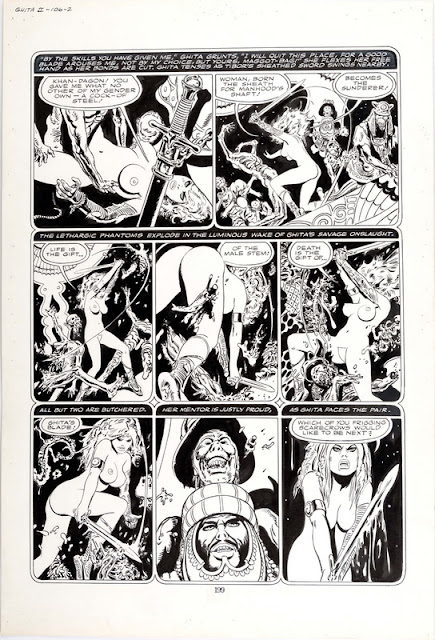
THE METAPHYSICAL FUNCTION culminates
with in Frank Thorne’s first graphic novel featuring GHITA OFALIZARR. Ghita, a cheerful prostitute who seems willing to have sex
with nearly anyone, has her receptive feminine nature (as a
metaphysician might see it) invaded by a masculine propensity
for violence. Necromantic transference is at the root of it, in that Ghita gets raped by an undead king, one significantly named for a
Philistine fertility-god. From then on, Ghita is a reluctant badass,
able to slaughter opponents with a sword rather than inviting them to
her bed. Late in the story it’s revealed that her transformation
was somehow stage-managed by one of her world’s gods: Tammuz, a
female deity using the name of a male Sumerian myth-figure. In this
raucous ode to conjoined sex and violence, Thorne suggests that both
male and female natures proceed from mirroring forces in heaven,
which means that Ghita is pretty much stuck between the rock of
masculinity and the soft place of femininity for the remainder of her
career.
Returning quickly to the topic of the
levels, I would judge that the first three of these sexploitation
examples fall into the category I term “titillation.” Only GHITA
falls into the most overtly spectacular category, “pornification,”
insofar as Thorne is evoking the fantasy of endless, cost-free sex
and violence, paralleling, though not indebted to, the dominant
associations of sexual pornography.
I chose works that fit these more
extreme categories since they’re the sort of thing most readers
envision when they think “sexploitation.” But to be sure,
sexploitation also appears in what I termed the least spectacular
category, “glamor.” Examples of glamor-sexploitation might have
included such works as the 1966 BATMAN—which repeatedly appealed to
older male viewers with sumptuous female eye-candy—and also
Akamatsu’s LOVE HINA, which I also attribute to the glamor
category despite the series’ frequent use of female nudity. I may
devote a future essay to discussing the aesthetic that separates the
three levels, but for now, that’s all folks.