(NOTE: In
my essay on one of Kanigher's WONDER WOMAN "null-mythic" stories, I mentioned that the author occasionally managed to put together some decent myth-tales in the pages of a title of his own creation, METAL MEN. I anticipate getting to one of these in the future. But if I had to name the Kanigher story that possesses the strongest mythicity, it would be the story in which he introduced Poison Ivy to the Batman mythos-- though it's been said that the new villainess was created in part because allegedly the producers of the ABC Bat-teleseries requested more female characters in the comics franchise, and that both editor Julie Scwhartz and artist Carmine Infantino were involved in Ivy's conception.)
SUMMARY: As the story opens, there are three
super-villainesses—Dragon Fly, Silken Spider, and Tiger Moth; none of whom had appeared before this story—on the loose
in Gotham City. At a museum gathering
attended by Bruce Wayne and Dick Grayson, a fourth villainess, Poison Ivy,
appears and claims to be greater than the other three curvaceous crooks. Ivy flirts with Wayne before she flees the museum in the company of a cadre of henchmen. Wayne and Grayson don their crusader-guises and battle the henchmen while Ivy meditates about whether Wayne or Batman ought to be her next beloved. Ivy, having made her escape, sends out messages to both Batman and Wayne, inviting them to show up at a prearranged
location and battle one another for her favor. At the same
time Ivy also sends false messages to the other three super-villainesses,
causing them to assemble at the same location with their gangs, in order to
fight for the right to be called “Queen of Crime.” Bruce Wayne doesn’t attend the gathering,
but Batman and Robin arrive and began thrashing thugs,. Meanwhile Ivy puts her three
rivals out of commission. Ivy tries to
conquer Batman’s crimefighting resolve with drugged lipstick, but his willpower
proves greater, and Ivy also ends up in jail.
Since the “real world” we live in generally produces more male criminals than females of the species, it's perhaps inevitable than most if not all fictional serial-heroes also have more males than females in their "rogues' galleries."
That said, it still seems
odd that Batman, a serial hero whose adventures were published continuously since 1939, should endure for his first twenty-five years with only one
significant female opponent in his mythos. Admittedly the Catwoman is
probably the most famous lady lawbreaker to have been birthed from the
comic-book medium. Still, twenty-five
years is a long time, and one might conjecture that Catwoman cast such a long
shadow over the Bat-mythos that the raconteurs of that mythos could not even
contemplate breaking the Feline Felon's monopoly.
Only in 1966 did writer Robert Kanigher introduce the first challenge to
that monopoly: Poison Ivy, who would remain a major player in Batman’s cosmos,
thanks in large part to the way Kanigher’s original story celebrated the
felicities of feminine feloniousness.
“Beware,” aside from introducing Poison Ivy,
also makes evident how little the costumed criminals of Batman’s world function
like real-world criminals, and how much more they resemble the deities of Greek
myth: eager to show off their divine attributes before astounded mortals, and
quick to take offense at any perceived slight. In keeping with this attitude, Kanigher may have borrowed, consciously or not, certain elements from the Greek myth of the Apple of Discord. This myth explained the origins of the
Trojan War as stemming from the mischief of Eris, Goddess of Discord. She fomented strife amidst the female
Olympians—Hera, Athena, and Aphrodite—by hurling into their midst a golden
apple inscribed, “To the prettiest one,” which prize each of the goddesses
claimed. Zeus passed the decision on
this “beauty contest” to Paris of Troy, and when each goddess in turn gave
Paris a bribe, he chose the bribe proffered by Aphrodite, which was Helen, wife of Agamemnon, whose abduction led to the war
against Troy—a fitting piece of mischief from the Goddess of Discord.
Kanigher’s tale is not quite this ambitious, but there are
a number of similarities between the archaic and modern tales. In the archaic tale, all the strife of the Trojan War takes place due to the squabbling of
goddesses, while all of the conflict in the Bat-tale proceeds out of Poison Ivy's schemes against her female
rivals. Ivy’s plan is on one level more
audacious than that of Eris, for while Eris merely wants general strife, Ivy
wishes to totally unseat the ruling “goddesses” of Gotham’s crime-world.
Discounting a “teaser”
panel that depicts an event from a later part of the tale, the first panel of "Beware" literally frames
the story's three goddesses for the delectation of all onlookers, both inside and
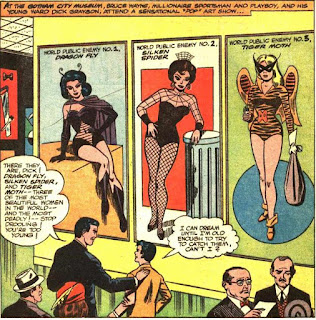
outside the story. The tale begins in a Gotham museum, which has on display huge
pictures of three at-large villainesses: Dragon Fly, Silken Spider, and Tiger Moth. These pictures are closer to being a combination of wanted posters and girly-art, though Kanigher explains them in terms of contemporaneous art-movements by calling the display a “pop art show.” Since
in 1966 even Catwoman had not appeared in a Batman comic for over ten years,
this sudden profusion of felonious femininity—consisting of three bad girls who had never
appeared in comics before—seems grounded in the desire to put some lustiness
back into Batman’s somewhat chaste mythos.
Both Bruce Wayne and Dick Grayson show their appreciation for these
gigantic images of femininity, and Wayne even tells Grayson, “Stop
drooling! You’re too young!” For his part, Grayson imagines being someday old enough to “catch” the illegal ladies.
Poison Ivy then appears, and observes that
though the three insect-named villains may be judged as numbers 1, 2, and 3 on
the scale of “World Public Enemies,” only Ivy is really no. 1. She's not only better looking, she argues, but she's managed to commit crimes without having them detected. Having made
this statement, she bows out, frustrating attempts by both Bruce Wayne and his
alter ego to “catch” her. In truth, Ivy's the one who plans to catch both Wayne and Batman.
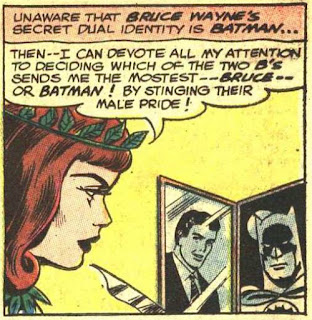
Ivy projects the aura of a pagan goddess in her
utter confidence in her attractiveness, and Kanigher frequently uses metaphors
about the infectiousness of real poison ivy to describe the way her beauty
dazzles Batman. The other three
crime-queens are never given as much personality, yet because all three share
the same insect-motif, one may wonder if Kanigher meant them to
suggest the rapacity of certain females of the insect/arachnid kingdoms that
consume their male counterparts.
Strangely, Kanigher never makes any comparisons to the natural world’s
frequent antipathies between insects and plants, though if he had, one assumes
he would’ve been drawn to yet another plant with feminine symbolism:
Ivy-as-Venus-flytrap.
At any rate, now that Batman is smitten, it’s Robin who
must play the part of Jiminy Cricket-- and sort of a roundabout daddy-figure-- by trying to keep Batman’s mind off the verdant vixen. Strangely, though the story starts out with Robin showing off his adolescent lusts, he's immune to Ivy's charms.
Ivy then sends out certain “poison pen” letters, which cause the three insect-girls to meet
and fight it out, for the honor of being the prettiest crime-queen. Oddly enough, her messages to Batman and
Wayne are without guile, but this is her own feminine ego at work: she assumes
that as both have seen her, both will want her. Thus the second and final act of the tale
turns upon her double play: to overcome the rival females and co-opt the most
powerful male.
Of the two actions, Ivy’s device to usurp her rivals is
the most telling: again pursuing the “beauty contest” comparisons, Ivy presents
the three female felons with a “priceless crown.” As with Eris’ golden apple, the three females
all try to possess the prize, but with more harmful results, since Ivy rigs the
crown to shock them all into unconsciousness.
Ivy then takes possession of her second objective, as she beguiles Batman into kissing her, over the futile protests of Jiminy Robin. It should be noted that although Ivy does use drugged lipstick on the senior hero, the drug doesn't have anything to do with him allowing her access to his lips in the first place.
Ivy then attempts a rather unlikely form of escape—“climbing straight up
that wall, like she was Ivy,” Robin exclaims. She confidently proclaims
that Batman won’t stop her-- her kiss essentially having “unmanned” him. But since it's Batman’s book, he recovers his huevos and brings her to justice.
In conclusion, I should note that despite the plant-motif
of her costume, the original Poison Ivy has nothing to do with using exotic
plants: the Ivy that uses plant-weapons is a later revision, followed by the current version that's a plant-human hybrid. Kanigher’s Ivy uses weapons modeled on
aspects of femininity. In the next (and last) Batman story Kanigher
wrote with her, Ivy uses weapons like a hypnotic face-mirror and explosive
“hairs” concealed in her own hair.
Kanigher clearly meant her to be the epitome of feminine evil. And though Catwoman still outshines her in many departments, at least Kanigher might be pleased that she remains an unrepentant villain for most of her career.