Featured Post

SIX KEYS TO A LITERARY GENETIC CODE

In essays on the subject of centricity, I've most often used the image of a geometrical circle, which, as I explained here,  owes someth...

Showing posts with label ideas and concepts. Show all posts

Sunday, February 27, 2022

CORRELATIONS AND COGITATIONS

 My attempt to distinguish between ideas and concepts in terms of narrative tropes isn't even four months old, and I've already decided to jettison those terms for another pair.

Though I labored with might and main to find a logical way to distinguish between ideas and concepts-- with the former leaning toward the mythopoeic potentiality, and the latter toward the didactic one-- the fact is that the two words have been used interchangeably for so long that nothing short of a major revision of all future dictionaries could dis-entangle them. This was borne out to me recently in a conversation with a friend who referred to science fiction as a "literature of ideas." I'd heard the phrase many other times, but hearing it once more convinced me that the word "idea" is conflated with "didactic utilitarian construct" as much or more than is "concept."

So I'm now using the words "correlation" and "cogitation." In keeping with my various observations on the combinatory mode, the mythopoeic is dominated by the process of correlation,  of bringing together disparate phenomena for the sheer pleasure of forging interesting combinations. Cogitation, however, is guided by a rational desire to suss out the imaginary relations of the phenomena in order to make some didactic point. 

I could cite examples of each mode, as I've done in other essays, but I've already cited various opposed examples of the didactic and mythopoeic potentialities in earlier essays, so there's no pressing need at this time. The point is merely to distinguish the different ways in which the tropes are formed as well as how they are used in fictional narrative. Didactic cogitations may be profitably aligned with Jung's concept of "directed thinking," while mythopoeic correlations are more in line with the psychologist's concept of "fantasy thinking." Somewhat more abstrusely, a similar dichotomy obtains with regard to Whitehead's distinction between "prehensions" and "apprehensions," an observation I reprinted in this essay:

Of central importance is Whitehead's idea of "prehension," which is dramatically defined, following Whitehead's specifications, "as that act of the soul, reaching out like an octopus to digest its experience." Fixing on "prehension" as the basic act in existentialism, an act carefully to be distinguished from "apprehension," which is based on intellectual rather than soulful understanding, Wilson rests his own case.

For that matter, though I've not written about Kant for some time, I might also align the pure pleasure of correlation-activity with the philosopher's notion of "the free play of the imagination," whose freedom stands in contrast to the restraints upon that imagination by what Kant calls cognitive understanding. But for now, I've probably put forth plenty of correlations for cogitation.


ADDENDUM: I haven't finished listening to this podcast in which Jordan Peterson hosts a discussion with Richard Dawkins. However, at one point, after listening to Peterson's Jungian rap for a while, Dawkins asks Peterson if he thinks more "in symbols or in ideas." Peterson says "symbols," and when he turns the question back on Dawkins, the latter says that he tends to think more in "ideas." 

Wednesday, November 17, 2021

HALF-TRUTHS AND CONUNDRUMS PT. 1

So if philosophical epistemology is concerned with the nature of absolute truth-- even if it might be, as in William James, to disprove its existence-- then mythico-literary epistemology is concerned only with "half-truths," with exposing its audience to pure possibilities.-- AND THE HALF-TRUTH SHALL SET YOU FREE.

Given this statement of the nature of "truth" in myth and literature, I want to bring it into line with my newly formed dichotomy between "problems" and "conundrums" as delineated in this recent essay. 

Though I didn't make any comment on the four potentialities in the first HALF-TRUTH essay, the subject did come up in the second essay. 

As I reconsidered this in greater depth, I feel it necessary to explain that though the kinetic and the dramatic potentialities certainly do draw upon "patterns" derived from sense experience, those two potentialities don't make substantial use of what I've called "epistemological patterns." I suppose I might term the first type of patterns "existential," since these two potentialities are more concerned with translating existence as the fictional characters *seem* to experience it. The other two potentialities, however, are rooted in a fictional form of epistemology, because the forms they deal with depend on abstract constructions. 

My more recent formulation was an attempt to identify the types of propositions involved with each potentiality, after making the determination that the "existential" types of propositions were short-range in nature and followed the paradigm of the idea of the "problem that can solved" (even if said solution is a negative one, as one often sees in horror stories), while the "epistemological" types were long-range and followed the paradigm of the "conundrum that may not be entirely soluble." From this line of thought I formulated this schema:

KINETIC PROBLEM-- how a protagonist solves a short-range problem with the use of kinetic applications, usually in the forms of "sex and violence." Aligned with Jung's "sensation function."

DRAMATIC PROBLEMS-- how a protagonist solves a short-range problem with the use of dramatic interactions with other characters. Aligned with Jung's "feeling function."

DIDACTIC CONUNDRUM-- how a protagonist reacts to a long-range conundrum through didactic assessments. Aligned  with Jung's "thinking function."

MYTHOPOEIC CONUNDRUM-- how a protagonist reacts to a long-range conundrum through symbolic embodiments. Aligned with Jung's "intuition function."

On a side note, in keeping with my observations in KNOWING THE IDEA FROM THE CONCEPT, from now on I'll attempt to term all "symbolic embodiments" as either "ideas" or "idea-tropes," while "didactic assessments" will be termed either "concepts" or 'concept-tropes."

Now, as I've conceived the relationship of problems and conundrums, they exist to complement one another. A reader doesn't necessarily find both a problem and a conundrum in every narrative, but the potential is always there, in keeping with Northrop Frye's observations about the distinction between narrative and significant values  (a set of paired terms that I used for some time before gravitating to others.) But since I stated at the outset that the purpose of mythico-literary epistemology was to create "half-truths," the following question arises, at least for me: "What is the half of the narrative that is MORE true than the other?"

And my answer is, inevitably, "the conundrum, not the problem." The PROBLEM is rooted in the existential nature of entities who never truly existed, even when an author has scrupulously sought to base a given fictional entity on a real person, as William Styron did in his CONFESSIONS OF NAT TURNER. The CONUNDRUM, because it is based in an epistemological idea or concept, has a degree of truth-value, even if the idea or concept is itself untenable as a source of philosophical epistemology. (One earlier example of such an untenable concept was that of Freudian psychology.) Again, the main purpose of narrative epistemology is to "expose... audiences to pure possibilities," which in turn can be aligned with Cassirer's notion of "a free selection of causes."

ADDENDUM: The above terms "ideas" and "concepts" have been replaced by the more arcane "correlations" and "cogitations."


Wednesday, November 10, 2021

KNOWING THE IDEA FROM THE CONCEPT

I am as guilty as anyone of having used the two terms almost interchangeably-- and by "anyone," I mean a number of philosophers, ranging from Hume to Cassirer, who use either one or both terms inconsistently. Yet, the root associations for each word still continue in demotic usage. The archaic Greek etymology stresses that an "idea" is something one sees, and in demotic use this is reflected by the proverbial trope of a "light bulb" blinking on when one gets a new idea. Indeed, comics-creator Carl Barks played with this common visual trope by giving his genius-inventor character Gyro Gearloose a little robot "helper" who had a light-bulb for a head.
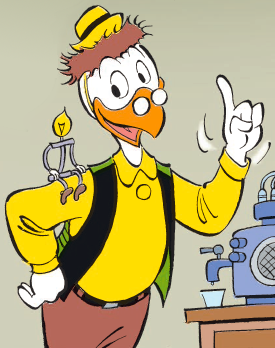


In contrast, though there's no standard sensory trope associated with "concept," said word does trace its lineage back to Latin, where the word connoted the physical conception of every human being within the womb. And for human beings, the birth of a new living thing is by no means as quick a thing as the act of seeing, so I tend to think of "ideas" as simple notions that may or may not prove useful, while "concepts" are ideas that have been worked out more thoroughly in terms of real-world applications. I would not be surprised to find that this or that philosopher has used these two terms in ways opposed to the way I choose to use them, but that's my choice nonetheless. At least part of my preference stems from my readings of Cassirer. particularly the frequently raised topic of how "theoretical thought" descends from the earlier and more expressive form of "mythical thought." The Stanford Encyclopedia of Philosophy provides this handy summation:

Characteristic of the philosophy of symbolic forms is a concern for the more “primitive” forms of world-presentation underlying the “higher” and more sophisticated cultural forms – a concern for the ordinary perceptual awareness of the world expressed primarily in natural language, and, above all, for the mythical view of the world lying at the most primitive level of all. For Cassirer, these more primitive manifestations of “symbolic meaning” now have an independent status and foundational role that is quite incompatible with both Marburg neo-Kantianism and Kant’s original philosophical conception. In particular, they lie at a deeper, autonomous level of spiritual life which then gives rise to the more sophisticated forms by a dialectical developmental process. From mythical thought, religion and art develop; from natural language, theoretical science develops. It is precisely here that Cassirer appeals to “romantic” philosophical tendencies lying outside the Kantian and neo-Kantian tradition, deploys an historical dialectic self-consciously derived from Hegel, and comes to terms with the contemporary Lebensphilosophie of Wilhelm Dilthey, Henri Bergson, Max Scheler, and Georg Simmel – as well as with the closely related philosophy of Martin Heidegger.

As an example of my own imperfect use of at least the term "idea," in one April 2021 essay I attempted to identify the different types of tropes underlying the two abstractive potentialities:

In literature as in other cultural forms, all potentialities express themselves through processes of discourse. The discourses of “lateral meanings” deal with concrete subject matter—that of what sensations the subject experiences, and of the subject’s emotional reactions to those sensations. In contrast, the discourses of “vertical meanings” concern themselves with abstractions, with the didactic making use of “ideas” while the mythopoeic makes use of “symbols.” For the sake of argument, I will treat both ideas and symbols as if they existed as discrete monads, which is not the way either are experienced. Both ideas and symbols are best expressed in the form of typical story-tropes. Levi-Strauss was pleased to term these tropes “mythemes,” conveniently ignoring how such monadic forms were dispersed throughout all forms of human communication, not just myth.

Whenever I thought about the matter, I wasn't entirely comfortable with my opposition between mythopoeic "symbols" and didactic "ideas," particularly when I'd specified that neither of them were experienced as any sort of monadic entities. I'm now specifying that any "idea," as I use the term, is primarily a symbolic construct, given that it functions to describe a base relation between one or more symbols. In contrast, a "concept" is primarily a didactic construct, since the one who conceives it is attempting to give it a more developed form, with one's own mind providing the analogue to fetal development within the womb. So in future, whenever I refer to the types of tropes favored by either the mythopoeic or the didactic potentiality, I will speak of the former as "idea-tropes" and the latter as "concept-tropes."

I can't over-stress the importance of "the idea" as a mental construct that is first and foremost expressive rather than rigorously logical. Some ideas, as noted above, form the basis of developed conceptual systems, a familiar example being the mutation of the Judeo-Christian "idea" of "the believing elect" into a more didactic form, such as the socialist "concept" of the rise of the proletariat, which is, at least in theory, more responsive to real-world considerations.

I will conclude with an example of the sort of impractical symbol-play one encounters with pure ideas taken from my recent review of SUPERMAN IV: THE QUEST FOR PEACE. I wrote:


As poor as the script is, I can see some potential in the basic imagery here, which is the only reason I gave QUEST a "fair" mythicity rating. Superman attempts to get rid of Earth's nuclear weapons by tossing them into the sun. In rude poetic terms, the weapons "get even" by spawning their own champion who journeys to Earth and almost kills the hero. 

I assumed that I should credit writers Konnor and Rosenthal for the final form of the script, and that Chris Reeve was only responsible for the base idea of tossing nuclear weapons into the sun. Reeve's initial notion would be a fragmentary idea-trope by itself, probably derived from the opinion that a hero from a destroyed world might be proactive about preventing the destruction of his adopted world. Konnor and Rosenthal may have been given the basic idea of providing a framework for an "imperfect duplicate" of Superman by someone else, but I speculate that they would have elaborated Reeve's one-note idea into a slightly more elaborate framework of idea-tropes. It's not a didactic concept, given that at no point do the writers claim that the weapons are "angry" at Superman for "killing" them, and since they cannot act, the villain Luthor must be responsible for spawning Nuclear Man. Another didactic development of the idea-framework might have also intimated that the sun was pissed off at the hero from dumping all of these weapons in its maw, and thus the solar body is also complicit in spawning Superman's nemesis-- though once again, Luthor has to provide all the heavy lifting for any inanimate objects. Even Luthor's mode of creating Nuclear Man, that of using a hair from the hero's head to make the duplicate, embodies a symbolic idea, though as I recall Konnor and Rosenthal don't even attempt to invoke the still-nascent science of cloning to make the genesis of Nuclear Man more "logical." Frankly, the original comics-method by which Luthor birthed Bizarro was more forthright. But I can't claim that the method itself displayed any mythic idea-tropes, even though Bizarro himself did, as discussed here.

I will probably explore the process of concept-formation, as opposed to idea-formation, in a future post.

ADDENDUM 1-28-2022: Roughly six years prior to this essay I addressed some similar developmental formulations in A PAUSE FOR POTENTIALITIES, where I said:

Now, I agree with Jung's comment that "ideas" are developed out of what might as well be called "images" (Kant called these lesser elements "notions.")