Featured Post

SIX KEYS TO A LITERARY GENETIC CODE

In essays on the subject of centricity, I've most often used the image of a geometrical circle, which, as I explained here,  owes someth...

Showing posts with label man-thing. Show all posts

Monday, September 16, 2019

MYTHCOMICS: NEVADA 1-6 (1998)

In general I didn't like a lot of Steve Gerber's post-Bronze Age work. The antic creativity present in such 1970s features as THE DEFENDERS, MAN-THING and HOWARD THE DUCK faded in favor of an often nihilistic sourness. Possibly this feeling caused me to quickly pass over NEVADA, a six-issue 1998 Vertigo series by Gerber and artist Phil Winslade. But now it seems to me one of Gerber's best accomplishments from the latter part of his career.


In a roundabout way, NEVADA arose from one of the author's more bizarre inspirations. The story goes that in 1977 Gerber missed his deadline for HOWARD THE DUCK #16, and that, rather than simply reprinting an earlier HOWARD story, he and some artists whipped together a series of illustrated meditations on life, the universe, and everything, sometimes through the eyes of the acerbic duck, sometimes from Gerber himself. One two-page piece allowed Gerber to express his absurdist take on the then-prevalent "obligatory fight scene," in which a Las Vegas chorus girl and her pet ostrich battled an animated lamp. Many fans didn't care for the stratagem-- one reader wrote simply "Next time go reprint"-- but supposedly Neil Gaiman opined that he'd actually like to see such a story. Twenty years later, Gerber and Winslade produced NEVADA, though not from Marvel, the publisher of HOWARD, but under DC's Vertigo imprint.


Like many Gerber protagonists, the Vegas showgirl Nevada, whose birth-name is not disclosed, would have no luck if not for the bad kind. She dances for her living at the tacky "Nile Hotel and Casino," has an assortment of cool, trippy friends, and shows her essential kind-heartedness by rescuing her pet Bolero (named for the Ravel ballet composition) from an ostrich farm. Though she has some ongoing hassles, like a rejected boyfriend who won't take "no" for an answer, she came to Vegas to start a new life. To be sure, we learn nothing about the old life except that at nine years she auditioned for a Christmas church play by portraying the Virgin Mary with a pillow that realistically showed the icon as "great with child," thus evoking the ire of Christians who didn't like too much reality in their religion. As if to satirize religion in general, her featured dance at the Nile is a re-enactment of the Egyptian story of Osiris' dismemberment, but given a snarky feminist denouement.


However, soon Nevada has bigger problems than a stalker (who, by the way, gets totally trounced by one of Bolero's deadly kicks). Some innocent tourists at the Nile get literally dismembered by an alien visitor from another realm, and Nevada finds herself the victim of time-slips, causing her to encounter cavemen or to witness a guillotine-execution during the Reign of Terror. Who's responsible? Is it Mister DeVesuvio, a mysterious crime-boss who has a glass tube in place of his head? (A similar character, Ruby Thursday, appeared in Gerber's DEFENDERS.) Or is it the drunken sot Odgen Locke, who once taught theoretical physics but now seems to be able to transform himself into an angel-winged warrior? But no, the real culprit is a cosmic event breaking down the boundaries between worlds, which incidentally makes possible the invasion of the aforementioned killer alien. Nevada actually meets and kills the alien, but there's an unnamed higher power who wants her special talents to be a "Rift Warrior," a defender of the cosmic order.


There have been dozens if not hundreds of reluctant heroes since the debut of Marvel Comics, but Gerber isn't interested in characters who make token protestations before easily acceding to the call of destiny. Through the author's Bronze Age work alone it's clear that Gerber enjoyed the allure of combative heroes while still feeling a lot of ambivalence about the use of violence, particularly sanitized violence, as a means of escape. Thus when Nevada's abducted by the "higher power" to put her through an ordeal called "the Hammer," we're not talking a few strenuous training-sessions with Master Yoda. Instead, Nevada goes through tons and tons of patented Gerber mindfuckery, leaving the reader wondering if her cosmic perceptor is on the side of the angels or not. But Gerber does make Nameless Higher Power the vessel of one essential nugget of wisdom: that most of sentient suffering arises from a hunger so great that it rises to the level of universal decay, not unlike the principle of entropy expoused by the villains in the Man-Thing tale "How Will We Keep Warm When the Last Flame Dies."  Nevada, despite her distrust of her perceptor, Nevada does have the stuff to fight back a downfall that could be brought about not by an evil overlord, but rather by "some moronic soul whose ego cannot endure being second in line." And thus Nevada does become a Rift Warrior and forces back a greater invasion of alien dipsticks bent on destroying the fabric of space-time


After this, the dancer returns to reality, though not without more attendant troubles. Clearly, the author left the door open for more stories with Nevada, Bolero and their quirky pals, but since it was a creator-owned project, this was the last show for the Vegas showgirl. Perhaps it's just as well that she went out on a high note. Nevada sums up her situation and her mordant but courageous philosophy in a letter, ending in part with the words:

"So what do you do when reality bites back and the new life falls apart. I can only speak for myself. Fuck it raw and keep dancing."

Wednesday, August 15, 2018

MYTHCOMICS: "HOW WILL WE KEEP WARM WHEN THE LAST FLAME DIES?" (G-S MAN-THING #1, 1974)

In my mythcomics-review of a HOWARD THE DUCK issue, I commented: "While Gerber's preoccupations on the Man-Thing-- one story analyzed here-- tend toward the kinetic and the mythopoeic, most of the HOWARD stories focus on elements of the dramatic and the didactic."

I've always thought that MAN-THING was a much more mythopoeic series than its contemporaneous competitor, DC's SWAMP THING. Nevertheless, after doing a quick re-read of Gerber's tenure on the feature, I must admit that Gerber may have been a little too preoccupied with making rational "overthoughts" than with giving free reign to his mythical "underthoughts." That's not to say that Gerber wasn't an imaginative writer. Indeed, back in The Day he was probably esteemed for his ability to spin wild fantasy-sequences not only in "edgy" books like MAN-THING and HOWARD but also in "mainstream" titles like THE DEFENDERS and MARVEL TWO-IN-ONE. Regrettably, though, even though MAN-THING might have held the greatest potential capacity for the mythopoeic, too often Gerber seems concerned with making moral statements. "Decay and the Mad Viking" (MT #16) arranges a promising *enantiodromia* between the Viking's murderous masculinity and the implied quasi-femininity of his degenerate victims, but the story doesn't quite make either side come alive in a mythic sense. "Song-Cry of the Living Dead Man" (MT #12) records the mental breakdown of an ad-agency writer besieged by the phantoms of everyone who ever wanted a piece of him, but the focus only upon financial threats to the "dead man's" peace of mind keeps the story from delving into the essence of the Buberian "I-it" relationship.


"How Will We Keep Warm," which sounds a little like the title of a MOD SQUAD episode, enhances some of the ongoing environmental tropes of the feature. Often Man-Thing, a man transformed into a swamp-monster, mindlessly defends his domain against intruders, but most stories failed to realize the tragic disconnect between nature and culture. "Warm," however, dovetails the Man-Thing concept with the prevailing American fears of survival brought on by the 1973 fuel crisis.

As in most stories, the mindless swamp creature simply wanders about until he encounters the more active characters in his story, composed here of two factions. One faction is a group of scientists who have decided that the Florida swamp is the best possible place to build a self-sustaining alternative-power community, given the rather downbeat name of Omegaville, because it's "man's last chance." ("Alphaville" would have been more upbeat, but it had already been used.) The other faction is a group of modern cultists called "Entropists," since they worship the concept that the universe is governed by entropy, the tendency toward decay. The Entropists want to prevent Omegaville from re-igniting human possibilities, so one of the cultists unleashes the power of the Golden Brain. This disembodied organ projects an energy-demon that looks suspiciously like an old monster-enemy of Marvel's Hulk-- though Man-Thing is provoked enough to destroy the energy-creature.


The violence causes the lead cultist to lose his grip on the brain, which falls into the swamp. The scientists get clear and the cultists return to their base, allowing for Gerber to relate the history of the brain. Thus he recapitulates the last two appearances of "the Glob," a man who got turned into a muck-thing years before Man-Thing came into being. During the creature's second encounter with the Incredible Hulk, the Glob's muck-body was destroyed, except for its brain. (Gerber gives no reason for the brain to be gold-hued, though personally it reminded me of the so-called "golden egg" of Hindu theology.) The brain is picked up by a fellow named Yagzan, the leader of the Entropy Cult, and he's first seen killing off the cultist who bungled the attack on the Omegaville scientists.

While Yagzan-- drawn by Mike Ploog to look much like Richard Nixon-- lays plans for another attack on Omegaville, the Glob-brain doesn't just sit on the bog's bottom. Though not precisely sentient, the brain assembles a new body for itself out of the swamp's elements, though as a Gerber caption comments, the brain's new body doesn't look like the original body of its owner, but looks as if "sculptured by Michelangelo." However, the new body is also a tabula rasa, in that its owner no longer remembers its previous existence, or even how to speak. Naked as Adam-- to whom he's later compared-- the former monster wanders into the haven of Omegaville, where the scientists take him in and name him Joe, calling him "Omegaville's first native-- Adam created from clay to live in the garden, and all that." Joe takes basic pleasure in serving the community, while the mindless Man-Thing looks on from the sidelines, anticipating trouble.


The Entropists show up, and Yagzan recognizes his former pawn in the speechless Joe. Yagzan tries to force the brain to devolve, but it can only go so far, at which point the cult-leader orders the reborn Glob to attack "man's last hope." The Glob manages to destroy most of the community until Man-Thing intrudes, eventuating in what may be the world's first "battle of the muck-monsters."


Since it's Man-Thing's book, he manages to vanquish the Glob, who takes cult-leader Yagzan down with him. Despite this triumph, the story ends on a note of pessimism, since Omegaville has been destroyed, and never again shows up in the Marvel Universe, to my knowledge. True, American fears about the fuel crisis waned once the country made trade concessions. But Gerber delivers a vision of doom that goes beyond newspaper headlines, with his Entropists incarnating the human tendency to lust after ultimate destruction.

Monday, July 20, 2015

MYTHCOMICS: "TOWER OF THE SATYR" (MAN-THING #13-14, 1975)

In my essay PERFECT STORMS OF SEX AND VIOLENCE I asserted that, contrary to the opinion of my sometime opponent Noah Berlatsky, I did not automatically validate every manifestation of the kinetic effects in fiction, a.k.a. "fictional sex and violence." My validation of these, I stated, depends on the way in which they are used. Any ideological critic might make the same claim, of course. However, an ideological critic would assign merit only when the use of the kinetic effect reaffirmed some aspect of said critic's ideology-- an example being Berlatsky's validation of violence in the Marston WONDER WOMAN comic because he believes that these stories supports his ideology, while denying any such validation to the contemporaneous adventures of Superman and Batman.

In contrast, a pluralistic myth-critic validates inventiveness in any fictional cosmos, whether or not he agrees with the ideology of the author or not. Rather than expecting every creative artist to be a source of moral pronouncements that encourage the audience to "go thou and do likewise," the pluralist can also value the author taking a "vacation from morals," and indulging in outbursts of fictional sex and violence for purely expressive ends.
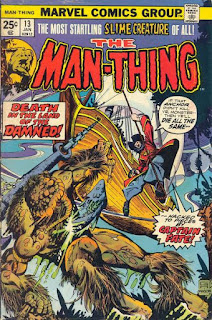


In comics-circles, Steve Gerber's initial tenure on the Marvel Comics feature MAN-THING-- a tenure extending across various titles from roughly 1972 to 1975-- remains one of the premiere works of the so-called "Bronze Age of Comics." The feature-- not originated by Gerber-- concerned the events in the life of a scientist who becomes transformed into the Man-Thing, a near-mindless monster made of mud and swamp-plants. The Man-Thing wandered the Florida swamps getting into various forms of trouble, and was particularly celebrated by fans when Gerber used him to reflect on the evils of human society. I enjoyed these stories as much as any Gerber fan, but most of them don't speak to the mythopoeic potentiality. One of the few Gerber MAN-THING stories that does possess a significant mythopoeic density is a two-part story in issues #13 and 14, which I'll denote using the title of its second part, "Tower of the Satyr"-- but for reasons of perhaps misplaced moralism, this story occasioned a hostile reaction from many fans.

Issue #18's letter column printed some of the responses to the second part of "Satyr." One letter expressed disapporval of "the breakdown in Steve's even-handed approach to male-female situations," and the author boiled down the story to a dicey theme statement: "Give a old goat a young woman and see a miraculous change of life and restored magical power." The Marvel employee answering the letters asserted that "several readers wrote to chastise us about the male-chauvinist elements" of the story and assured the readership that Gerber would not in future "let his baser instincts get the best of him." Like the uncredited respondent, I don't deny the presence of "male-chauvinist elements." But I do think that they are mitigated by their context.

In summarizing the story as simply as is possible, I'll state that the monstrous star of the feature takes something of a back seat to the "guest stars" of the tale. Principally, he serves two functions: that of catalyst or catspaw (occasionally both). The Man-Thing is accidentally taken aboard a cargo ship, and when the ship departs on a scientific expedition, the monster goes along for the ride. The ship has been hired by a lady scientist, Doctor Maura Spinner, a somewhat prickly lady who professes a strange attraction for the area she's going to investigate' the legendary Bermuda Triangle.


After this initial set-up-- which includes the crew's discovery of the muck-monster's presence aboard ship-- the narrative of the story's first half shifts into overdrive. A magical biigantine appears in the skies above the cargo vessel, and from it descend 18th-century pirates, who proceed to abduct both Doctor Spinner and the Man-Thing. (The ship's captain and crew continue to appear in the story's second half as well, but play such minor roles that I'm leaving them out of this summary.)


The minor conflict of male and female in the first half is also amplified in Part Two. Doctor Spinner meets the leader of the pirates, who styles himself "Captain Fate." Fate tells her that she is the modern reincarnation of Maura, the Pirate Queen, who was formerly the captain of a pirate ship, and commanded both Fate and the rest of the crew. Back in the 18th century, the original Maura commanded her minions to help her investigate a small island in the Bermuda Triangle, to search for treasure in its only man-made structure, a single tower with neither doors nor windows. Given the structure's phallic shape, it's significant that Maura is the only one who can break into the tower, making it possible for her rowdy crewmates to follow her in.

They find a treasure, all right, but they also find the tower's sole occupant: Khordes, a master sorcerer who is also one of the last satyrs of the ancient world. Satyrs, as the story acknowledges, are almost always symbols of unrestrained lust, but Khordes has become a withered old goat-man over the centuries. He proposes a bargain: he'll allow the pirates to take his treasure, if they will leave him Maura: "a woman with whom to mate-- one whose charms will replenish my youth and virility."

The pirates accept the bargain and leave Maura behind. Gerber's captions are a little ambivalent about how much of a victim she is, suggesting that she anticipates killing the satyr-- which she does-- and rejoining her men, However, by the time she manages to get out of the tower, the ship has departed the island, leaving her behind for real. Maura curses the pirates to never enjoy their booty, and the dying satyr reinforces her curse with his own power. The pirates and their ship are thrown into a limbo, where they remain for the next 180 years. The tower does what its organic model does when in danger: it retreats-- specifically, sinking beneath the ocean-waves. Presumably the treacherous Maura drowns when the tower and its magical island sink, though Gerber does not say so. Before Khordes dies he specifies that Maura's spirit will live through three generations "e're you return to the sea-- three lives to learn the meaning of love-- e're we meet again."

After Fate has detailed this story to Doctor Spinner, she pretty much seems to lose all connection with her modern-day self, and her scientist persona fades into the persona of a piratical hellion for the rest of the story. Fate, having awakened her old self, commands his magical ship to descend once more to the waters of the Triangle. Obligingly, the tower-island of Khordes rises from the sea to meet the pirates, who want Maura to persuade the satyr to remove the limbo-curse. Khordes too has returned to life, still frail and wrinkled, and he still wants Maura to accept "the love you callously destroyed three lifetimes ago." Maura sics her piratical catspaws on the satyr, but Khordes sics his own catspaw, the Man-Thing, on them. The outcome doesn't go well for the buccaneers, thus clearing the decks, so to speak, for a talk-fest between the satyr and the pirate queen.


In SACRED AND PROFANE VIOLENCE, PART 3 I described some of the ways in which the dominant gender-roles of men and women might undergo a *bouleversement,* resulting in male characters who were predominatly lovers and female characters who were predominantly fighters. Khordes and Maura are both examples of these reverse-archetypes. Khordes now claims that he didn't just want Maura for her body, but because he loved her "spirit." Being a wizard, he foresaw that the other pirates, who were entirely dominated by standard male aggression, planned to kill her at some future time anyway. Maura, though still less than admiring of male attributes, is somewhat impressed by the satyr's chivalry and decides to stay with him in his tower. The cargo ship leaves, the magical tower sinks beneath the waves, and eventually the Man-Thing makes his way back to his swampy home.

Some of the reaction against "Tower" is understandable: certainly there's a power discrepancy between Khordes and Maura that inevitably reminds one of real-world parallels between "old goats" and "sweet young things." That said, Maura isn't really all that sweet, her central persona is a murderous, plundering pirate, and Gerber suggests that she even co-operates with Khordes' bargain with the idea of betraying him later. One may be fairly skeptical about Gerber's other formula: the "female who's so competitive with men that she's closed herself off to love." Certainly he doesn't manage to make either of Maura's personas come alive; she remains symbol first and person second. Nevertheless, what Gerber does with the symbols is still interesting. Richard Wagner formulated the mythic idea of the "love-death," in which a man and woman were united either in death or after death. "Satyr" has it both ways: Khordes and Maura die together when the tower first descends into the waves, but on the second descent, it's suggested that they will enjoy some immortal life together-- which might have some appeal for Maura, if the magical satyr literally recovers a youthful body thanks to the pirate-lady's "charms." It's not likely a coincidence that the first name of the doctor-turned-pirate resembles the Latin "mare," meaning "sea," so the tower's descent into the ocean is patently a sexual action. There's no strong connection between the surname "Spinner" and any action the character takes in either persona, though Gerber may have been thinking of "spinster," since this is the fate often assigned to man-haters in fiction. Even so, the "spinster" persona is the one that essentially disappears, in favor of a persona that becomes "married" after a fashion, though without losing all agency, as some irate Marvel readers claimed that she did.

As I've noted here, the confounding of boundaries between the relatively young and the relatively old can lead to a sense of transgression that forms parallels with, but is not identical to, the transgression of incest. It's understandable that the confounding of boundaries makes some readers squeamish, but that in itself is not any sort of barrier to the realm of the mythopoeic.


Monday, October 8, 2012

DIAL D FOR DEMIHERO PT. 3


Returning now to the hitherto-sketchy idea of “intellectual will” vs. “instinctive will” expressed in this essay.

 
I’ll reiterate that of the four persona-types outlined in HERO VS. VILLAIN, MONSTER VS. VICTIM PART 1, any of them can be “protagonist” or “antagonist” as delineated in AGAIN SUPERHEROIC IDIOMS PART 4. 
 
As a general rule two of the four, the “hero” and the newly christened “demihero,” are the life-affirming forces, while the “villain” and the “monster” exist to thwart the forces of life.  However, experienced readers will be familiar with other permutations. 
 
 
A comics-series like MAN-THING portrays its monstrous protagonist doing good not as a conscious act but in response to instinctive tendencies. 


In the short-lived JOKER series of the 1970s, the titular villain still performed many of the same evil deeds he performed as a Batman antagonist, but in the majority of Joker-stories his efforts had the effect of putting other felons back in the pokey.


For simplicity’s sake I choose to define the story’s protagonist not as the person or presence most emphasized in the story—“the focal presence,” the “imaginative center”—but as the character with whom the audience principally identifies, while the antagonist represents whatever forces the protagonist struggles against.  Yet identification and imaginative focus are not the same.  I’ve frequently cited Lewis Carroll here.  One identifies with Alice, but Wonderland provides the audience’s imaginative focal point.


Admittedly, the focus is not always so easy to sort out.  In most Batman-Joker stories, it’s a given that Batman is both the identificatory character and the imaginative center.  The Moore-Bolland KILLING JOKE provides a rare exception in that the narrative shifts the imaginative focus to the Joker as it relates a possible origin for the Clown Prince of Crime.  Batman is still predominantly the identificatory character through whom the reader is lessoned in lunacy.  Arguably the hero loses some of his heroic status as he becomes the “Alice” lost in the demented “Wonderland” of the Joker’s madness.


I’m aware of a slight tendency on my part to categorize characters as “victims/demiheroes” if they are lacking in dynamicity (Carl Kolchak, Doctor Who) or centricity (Jonathan Harker of the DRACULA novel).
 

Yet that’s not what I meant to communicate when I formulated this schema.  The demihero can be resourceful, can be powerful, can be central to the narrative.  But he must embody “instinctive will” in its life-affirming guise, even as the monster does in its (generally) life-denying guise.


In my current analysis, both Doctor Who and Kolchak are heroes of the subcombative type.  Though they lack the *dynamicity* that would make them combative heroes, they do exercise “intellectual will” in order to stymie the forces of disorder.  Bram Stoker’s Jonathan Harker, on the other hand, is a *mesodynamic* type of protagonist who nevertheless ups his game enough to become a key player in the fight against the monstrous focal presence/antagonist Dracula.  Yet I judge that his type of heroism is governed less by a heroic ideal than by the instinct to protect himself, his home and his ingroup against all aggressors.  Thus, he provides a mirror to Dracula, the monster whose main focus is also self-preservation.


The instinct of self-preservation, though, does not rule either Batman or the Joker.  Their respective devotions to “order” and to “chaos” are often—though not invariably—framed as intellectual propositions.  The Moore-Bolland KILLING JOKE devotes its narrative to the Gospel According to the Joker, depicting the Joker’s madness as an insight into the true nature of the world.  Frank Miller’s DARK KNIGHT RETURNS, in contrast, depicts the Batman’s vigilante quest as one in which the protagonist breaks man’s law in order to protect a higher law—admittedly one perceived through Batman’s particular blend of ruthlessness and compassion.


By chance I stumbled across a quote that may illuminate some of the differences between these different yet complementary forms of human will.  Following the spinal trauma Christopher Reeve suffered in 1995, the actor wrote in his autobiography STILL ME:


“What is a hero?  I remember how easily I’d talk about it, the glib response I repeated so many times.  My answer was that a hero is someone who commits a courageous act without considering the consequences… Now my definition is completely different.  I think a hero is an ordinary individual who finds the strength to perservere and endure in spite of overwhelming obstacles.”


Reeve, though he was an actor whose job was to play fictional characters, speaks here of normative, real-world definitions of heroism, making no comment upon the depictions of heroes in fiction.  But his remarks do have application to the archetypes of heroes as we find them expressed in fiction.  Endurance, more than courage, is the hallmark of demiheroes like Alice and Jonathan Harker.  It also underlies the “raison d’etre” for the majority of monsters, though one cannot generally call their acts “heroic.”  Dracula seeks to survive by finding new feeding-grounds. The Man-Thing is psychically sensitive to the emotion of fear, and attacks anyone who broadcasts that emotion in his presence, which may include innocents as readily as malefactors.


Heroes and villains are more focused on “grand gestures,” made in defiance of consequences.  Not all villains are larger-than-life like the Joker: Batman often fights criminals who are no more than *mesodynamic,* though on occasion a sufficient number of ordinary crooks present an extraordinary threat. 


 Even the mundane crooks as portrayed in these stories want more than simple survivial.  Typically they desire wealth, which may be seen as establishing a form of willed control over their environment.  This will to control often manifests in the crooks forming their own society counter to that of honest citizens.  Unlike monsters, who are most often seen as forces gone out of control, villains seek to exercise total control, be it of city-neighborhoods or the entire world.  The hero responds in turn with his own counter-efforts to control the pernicious counter-society of crime.  Those efforts—whether they stem from a vigilante like Batman or a constituted legal authority like Judge Dredd—also go beyond the criteria of simple survival, emphasizing the power of the law to curtail the will of the lawbreakers.