It’s interesting to reflect on what
factors might have led Robert E. Howard, fairly early in his
writing-career, to pastiche the Fu Manchu stories of Sax Rohmer.
WEIRD TALES printed the first story in Howard’s series,
“Skull-Face” in 1929, but Rohmer had not written a new Fu Manchu
story since 1917. Despite the early popularity of the Fu books in the
nineteen-teens, Rohmer reputedly wanted to end the series, but later
decided to return to his most famous character. Possibly some
silent-film adaptations of the Fu stories, appearing in 1923 and
1924, helped revive general interest in the character, and it’s
been theorized that the announcement of a pending sound-film
adaptation in 1930 may have persuaded the writer to pen DAUGHTER OFFU MANCHU, which appeared in that same year. Robert Ervin Howard may
have heard about these revival rumblings in advance of DAUGHTER’s
publication, and if so maybe he sought to steal some of the older
author’s thunder.
Of course, it’s also possible that
Howard had simply enjoyed the earlier Fu-novels, particularly because
they addressed contemporary concerns about the relationship of white
people toward people of color. Rohmer was not given to theorizing
about any proposed hierarchy of various races, but even by 1929, a
few years before Howard birthed Conan, such theories were clearly a
big part of Howard’s intellectual makeup. In fact, the British
Rohmer is more concerned with the theme of Europe vs. Asia than he is
with inherited racial nature. Indeed, Fu Manchu stands as a
refutation of the notion of racial limitations, since he is a master
of all sciences from both the modern and ancient worlds.
The four tales I term “the Skull-Face
stories” are something of an anomaly, because Richard A. Lupoff,
the editor of the 1978 Berkley paperback collection SKULL-FACE,
didn’t just include the two extant stories featuring the titular
villain—one of which was an unfinished Howard effort, which Lupoff
finished. The editor also included two stories, one unpublished in
Howard’s lifetimes, both of which featured a villain named Erlik
Khan. This later creation did resemble Skull-Face in terms of modus
operandi: that of enslaving his henchmen with opiates so that someday
the dark races might rise up to conquer the light-skinned ones. I’m
glad that Lupoff bracketed the four stories together, for the sake of
Howardian scholarship. Nevertheless, the two villains are not
identical, any more than are their respective heroic enemies, even
though these heroes both share the first name “Steve.”
The three later stories — “Lord of
the Dead,” “Taveral Manor,” and “Names in the Black Book”—are
passable timekillers, but I have little to say about them.
“Skull-Face,” however, is a more delirious exercise, for all that
its villain is not the main character, as is the case with the Fu
Manchu stories. The central figure of “Skull-Face” is Steve
Costigan, a veteran of World War One. For years he’s suffered from
what our age calls PTSD, and he’s ended up finding surcease from
sorrow in a Limehouse hashish-den. At the story’s opening, Costigan
has run out of money and is on the verge of becoming an utter
wastrel.
However, the operator of the
hashish-den—initially called the Master, and appearing to be a
living skeleton—decides to make Costigan his henchman, asking him,
“You who are a swine, would you like to be a man again?” Howard
never fully justifies the reason why this villain—whose other
enforcers are non-whites, ranging from Chinese to Arab to Black
African—chooses to employ this one white man as a pawn, even giving
Costigan a serum that gives him temporary super-strength. However, at
one point, Costigan saves the Master’s life and Costigan considers
them even. The evildoer still seeks to make Costigan his slave.
Luckily the hero, being a typical Howardian he-man, breaks free,
thanks in part to help from Skull-Face’s only other white servant,
a beautiful maiden named Zuleika, and from a redoubtable English cop
modeled on Rohmer’s Nayland Smith.
Howard’s story, originally serialized
in three parts, rambles quite a bit, just as the early Fu stories
did. During the episodic chapters, Skull-Face takes on at least two
other names, “Kathulos of Egypt” and “the Scorpion.” (The
former name is probably an in-joke on H.P. Lovecraft’s demon-god
Cthulhu, while the latter might be a reference to the villain in
Rohmer’s 1919 novel THE GOLDEN SCORPION.) Unlike Rohmer, Howard has
no interest in “the romance of the Orient.” And whereas Fu Manchu
is served by henchmen with no thoughts or personality, all of
Skull-Face’s minions are major assholes, so that the reader can
look forward to the many scenes in which the mighty white hero beats
them all to butter.
I certainly cannot claim that there’s
no racist content here, not when Howard claims that Skull-Face’s
avowed people, the Egyptians, are a people “more despised than the
Jews.” Howard apparently based this absurd assertion on the same
sort of racial theories that informed the Conan stories, which often
posited the idea that certain races, be they Egyptian or Chinese,
were not fully human like Caucasians. Howard goes a step further
here, in that he eventually reveals that Kathulos is actually a
revenant from ancient Atlantis, revived into a mummy-like state by
arcane magic/science. For all of Skull-Face’s resources, though,
he’s largely a cardboard fiend, with none of the perspicacity of
Rohmer’s devil-doctor.
I don’t imagine that a story like
“Skull-Face” promoted racism in anyone who wasn’t already
racist. It does reject people of color from the table of privilege,
and flatters the status quo, but both the good guys and bad guys are
so broadly drawn that few would deem them any more than overheated
entertainments. Further, though I’ve established in other essays
that the mythopoeic impulse can appear in any authors despite their
holding offensive beliefs, “Skull-Face” doesn’t really offer
any memorable mythic images. Even Howard’s playing to White
Americans’ fears of a Black Uprising—a thing readers would never
find in Rohmer—lacks any sort of imaginative conviction. (That
said, Howard does have Skull-Face mention that he has no intention of
liberating Blacks, since he believes they should be his slaves as
they were for the Atlanteans.)
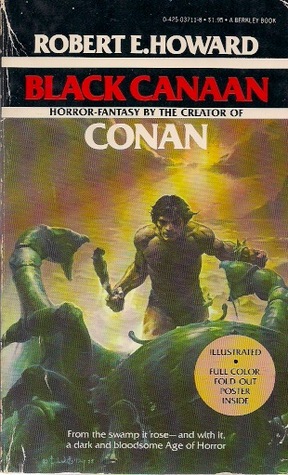
Coming from deeper recesses of the
mythopoeic mind is Howard’s 1936 short story “Black Canaan.”
Here too we encounter the notion that a non-white people,
specifically American Blacks descended from Deep South slaves, are
not fully human. However, here Howard grounds his fantasy in the
notion that because Black Africans predate Caucasians as a culture,
the former’s ancestors conferred on all their descendants an
inhumanity stemming from their interactions with monstrous
demon-gods.
“Canaan,” which takes its title
from a real-life Arkansas city, takes place in the 1870s and is told
from the viewpoint of heroic white local Kirby Bruckner. The earlier
Union victory over the Confederacy has made no difference in the
wilds of this domain. Here, white people call the shots while blacks
brood in “the jungle-deeps of the swamplands,” which are patently
a displacement for the real jungles of Black Africa. Neither Kirby
nor any other white character acknowledges any inequity in the
hegemony: Howard wants to portray the enmity of whites and blacks for
one another to be an inevitable clash of civilizations, not anything
founded in social injustice.
Oddly, the individual who warns Kirby
that the blacks may be rising against their masters is an old black
woman, who enjoys an “Ides of March” moment at the story’s
beginning and then disappears. Kirby, being a doughty hero, braves
Goshen, the swampy recesses near Canaan, to investigate the rumor. He
learns that there is a “conjure-man” named Saul Stark who is
stoking the Black folk to rise up against the whites (Howard
purportedly based the character on a real-life personality from the
period, albeit not one involved in fomenting race wars.) But Kirby
meets an even more insidious threat in a young “quadroon” woman
who beguiles him in the forests, summons Black henchmen to attack
him, and ultimately masters him with what may be either hypnotism or
real magic. The mysterious woman, given no name and addressed just
once as “the Bride of Damballah,” is a source of endless allure
for Kirby. This white hero is clearly capable of lusting for
forbidden fruit, a vice one would never find in a genuine
frontier-hero of the the 1800s hero, such as Fenimore Cooper’s
Natty Bummpo.
Saul Stark and the Bride are two of
Howard’s best villains. They make no complaints about white
people’s injustice; they’re both willing to bring about chaos for
the sake of sheer power. And in “Canaan” Howard also makes a much
more substantive reference to Lovecraft than anything one sees in
“Skull-Face,” for by some magic Stark can transform his hapless
worshipers into fish-like monsters a la the piscine predators of
HPL’s Innsmouth.
Howard’s use of Biblical lore also
enhances the mythicity of the story. The Biblical Saul, of course,
embodies the trope of the illegitimate king, and Stark seeks to carve
out his own kingdom in an illegitimate manner, though the latter-day
Saul does have the blessings of the only “gods” that have
objective reality in the story. It’s of even more interest that
while Canaan is the name of the town inhabited by the whites, Goshen
was the name of the land where Pharaoh sent the Jewish slaves prior
to the Exodus. It’s patently absurd to imagine that Howard was not
aware of the extent to which American Blacks identified with the Jews
of the Exodus through the common theme of slavery, and that if Goshen
was the place to which Stark’s minions were confined, even as the
Jews were confined, Canaan was the land of plenty that both Jews and
Blacks aspired to conquer. It goes without saying that Howard’s
tale upholds the status quo both in the historical era and in
Howard’s own environment. Nevertheless, Kirby’s partial
attraction to the deep truth of humanity’s savage origins ensures
that the whites’ triumph is at best a temporary one.