Featured Post

SIX KEYS TO A LITERARY GENETIC CODE

In essays on the subject of centricity, I've most often used the image of a geometrical circle, which, as I explained here,  owes someth...

Showing posts with label swamp thing. Show all posts

Saturday, February 22, 2025

MYTHCOMICS" "THE ANATOMY LESSON" (SWAMP THING #21-24, 1984)


In 1984 Alan Moore and Steve Bissette had only barely started working on DC's SWAMP THING comic, which wasn't precisely setting sales records. With issue #21, they began a four-part story which I've given the collective title of "The Anatomy Lesson," after the first installment. I won't comment on any of the ongoing subplots that had been set up in earlier issues and that would bear fruit (so to speak) in future issues, but will concentrate on the main plot, involving the character of Jason Woodrue, first introduced in a 1962 ATOM story, reviewed here.   


To be sure, this was not the Woodrue of the 1960s, an unremarkable-looking scientist in a lab coat. In the 1970s Woodrue became something of a forerunner of the "eco-terrorist" trope, transforming himself into a plant-human hybrid who called himself The Floronic Man. In this guise he championed the cause of the plant world against that of humanity, so that he came into conflict with heroes like the Justice League. In this story, Woodrue has been liberated from prison by General Sunderland, head of your basic evil corporation. Sunderland's forces had captured their frequent nemesis the Swamp Thing, and so the economical overlord wants Woodrue to suss out the swamp-monster's nature, to learn if there's any way the company can profit from the "bio-restorative formula" that made scientist Alec Holland into a muck-encrusted creature. Woodrue subjects the swamp monster's body to various anatomical analyses, and soon reveals the payoff that would change the course of the SWAMP THING series from then on. Swamp Thing is not a human being transformed into a humanoid made of plant matter, but an actual plant that consumed the dead body of Alec Holland, preserving his memories in a new organic form. When Sunderland dispenses with Woodrue's services, implying the scientist will be sent back to the jug, Woodrue releases Swamp Thing from captivity, and also makes sure the creature learns his true nature-- which does not result in happy times for Sunderland.         


Somehow Swamp Thing manages to make his way back to his de facto home in the Florida swamps, and Woodrue follows. Swampy's friends Abigail and Matt find their old ally when he's succumbed to existential despair, losing the will to think himself human, so that his body begins merging with the vegetable growths of the swampland. But Woodrue has not followed out of mere curiosity.


Because the former Alec Holland's confused mind wanders in a limbo between plant and animal life, Woodrue somehow taps into Swampy's mind and uses it as a gateway into "The Green," a sort of collective unconscious for plant life (and one of those expansive concepts that I imagine Alan Moore regrets selling to DC Comics). Once there, Woodrue experiences a vast communion with many if not all of the plants on Earth. He becomes convinced that they are telling him to avenge their mistreatment by eradicating all animal life.                                                                                                            


Whereas the old Woodrue tried to conquer the Earth with a bunch of gimcrack plant-weapons, the Floronic Man comes up with a new tactic (which is not to say that he doesn't still take control of vegetable life and make it do things that real plants cannot do). He causes the plants to flood the Earth's atmosphere with oyxgen, which will eventually bring about the destruction of all animal life. Woodrue's old foes the Justice League can't figure out what to do. Luckily for them, the creature that thought it was Alec Holland has also been in communion with The Green, and he arises from his torpor to intervene.                                                                                                        

 
Although the two chlorophyll-critters exchange a few blows, Swamp Thing conquers The Floronic Man with simple logic regarding the ecocystem: get rid of all the animals, and where do plants get their carbon dioxide? Woodrue loses contact with The Green and suffers from what Swampy tellingly calls a "fall from grace." The Justice League find Woodrue as a babbling idiot and take him into custody, having no idea of what forces saved their (literal) bacon. Thirty years later, I'm still impressed with the power of this denouement, and how subtly the plants' oxygen threat foreshadowed the peril plants would then suffer from the ruined ecosystem.                                                 

   
As for Swamp Thing, he gets a new lease on life, learning that it is much easier being green than moping around for decades about a human identity that he was never going to recover (without ending the franchise, that is). Not every story in the Moore-Bissette SWAMP THING run possesses the quality of ANATOMY LESSON. But LESSON isn't just a good story. It's also one of the few "origin-revisions" in comic books that doesn't just content itself with the brash statement that "everything you knew is wrong," but taps a deep well of emotion and mythopoetic imagery to make the new dispensation thoroughly compelling. 

Sunday, April 14, 2024

MYTHCOMICS: [THE LORDS OF ORDER] JUSTICE LEAGUE DARK (2018)


The story-line I've designated as THE LORDS OF ORDER appears within two TPB collections, respectively subtitled "The Last Age of Magic" and "The Lords of Order." I've chosen to designate all pertinent material under the umbrella-title LORDS OF ORDER because said characters constitute the primary menace. Not all of the material collected in these two compilations is relevant to the main plot, which appears principally in issues #1-3, 5-6, and 8-12. Cutoff points for the narrative are problematic, and without reading the entire 29 issues of this JLD incarnation-- the second to focus on a "Justice League of Weirdies"-- I would not be surprised to learn that one or more raconteurs kept some of the subplots going to the bitter end. But issue #12 at least supplies some conditional closure, supplied dominantly (though perhaps not exclusively) by writer James Tynion IV and artists Alvaro Bueno and Daniel Sampere.

I'll explain my highly complex term of "weirdies" in a subsequent post. I have read a few of the issues of the 2011 JUSTICE LEAGUE DARK series and I found them unremarkable. Tynion, however, did show a greater facility for exploring aspects of DC's "weirdoverse" (a term DC itself advanced for a quartet of inter-related "supernatural" titles during the late nineties).


Taking place following the so-called "DC Rebirth," ORDER builds upon a relatively-new rethinking of the DC multiverse, to the effect that it's mirrored by a "dark multiverse," possibly inspired by the so-called "Dark Web of the Internet." I believe that Tynion is the first to claim that all of the magic in Regular Multiverse has been stolen, a la the Fire of Prometheus, from the Dark Multiverse, but he may have had inspirations from previous works. 


The DC Universe, like its One True Business Rival, is and always has been something of a never-ending palimpsest. For instance, the character of Nabu, perceptor of the hero Doctor Fate, appears with little backstory in the character's 1940s origin tale. But not until the 1970s is Nabu said to be a member of "the Lords of Order," the opposites of their eternal foes "the Lords of Chaos," both of whom were probably borrowed from the early 1960s prose stories of Elric by author Michael Moorcock. In general Nabu and his fellow Lords were depicted as positive forces in comparison to their antagonists. However, even as early as a 1987 AMETHYST min-series, the Order-Lords sometimes came off cold and unfeeling,


Tynion posits that in the earliest phases of DC prehistory, the Lords were responsible for codifying all the rules and rituals surrounding the magic called up from the Dark Multiverse. But now the denizens of that domain are coming to reclaim their stolen powers, though the Dark Multiversals are something of a side-threat in ORDER. The Lords have decided to cut their losses and eradicate magic from the non-dark multiverse, and that forces Justice League Dark to get involved.


As with Geoff Jones' cosmic restructuring from a couple of years earlier, "the plot is not the thing" here. Tynion uses some of the same team-members seen in the earlier series, particularly Swamp Thing and Zatanna, but other members are de-emphasized, such as the popular mage John Constantine. Wonder Woman, a heroine with a foot in both magical and scientific worlds, becomes the leader of the 2018 group. The new lineup includes BATMAN's monstrous foe Man-Bat and Detective Chimp, a DC character from the late Golden Age who was reworked into something of a supernatural sleuth, as well as being tied to marginal sword-and-sorcery crusader Nightmaster. Tynion throws out a lot of subplots for the various characters, but none of them are extraordinarily consequential for the Lords of Order narrative. And only one Lord of Chaos, the LEGION OF SUPER-HEROES villain Mordru, becomes tangentially involved as well.


The most visionary aspect of ORDER is the way Tynion depicts the passing of the old order. The denizens of DC-Earth did not beseech the Lords of Order to give them magic, but once many of those denizens built their lives around the existence of things mystical, the Lords seem a bit like Promethean Indian Givers. To his credit, Tynion does not simply dodge the problem he's created with a wave of his hand. Magic does get eradicated, but the heroes are able to bring it back by what one might call "returning to the factory default," which means that all the old rules have to be rewritten. The ORDER narrative concludes while this reboot is still in progress, but it's a more effective conclusion to yet another multiversal reshuffling.


Bueno and Sampere provide better than average design elements that put across the mood of the eldritch, particularly in the image of the Wonder Tree (though this creation was the result of a yet earlier Tynion narrative).

Saturday, August 27, 2022

PERSONA-TO-PERSONA CALLINGS

 In ONCE AND FUTURE STATURE (AND CHARISMA), published on 7-27-22 I made the following inexact statement: 

Lee had Foswell return to crime as an ally to the newly minted Kingpin-- only to be killed by the Kingpin's thugs for trying to protect Jameson. This might be deemed a demi-crossover of the charismatic kind, since Foswell had some escalation-charisma even as a support-figure, and the Kingpin had none until he appeared often enough to become a familiar figure.

I added a note to the blogpost to the effect that I would trash this opinion in another essay, and this is it.

The problem with my previous formulation is related to my ongoing theory of personas, given its final form in 2012's DIAL D FOR DEMIHERO PART 1. I feel as if I've implied, though never stated outright, this necessary rule:

"When dealing with icons who originate within the cosmos of a given series, there can be no charisma-crossovers except between icons belonging to the same persona."

An example: within the Batman series, Commissioner Gordon and the Joker have existed almost the same number of years, and have frequently appeared in the same stories. Both characters are Subordinate Icons to Batman, but there's no charisma-crossover between the two Subs as there is when the Joker appears in a story alongside another villain, such as the Penguin or Two-Face.


To return to the Spider-Man cosmos once more, Fred Foswell may have started out as a super-villain, but he spends the majority of his career as a demihero in the Lee-Ditko stories, wherein he's reformed and become a crusading reporter, generally being of aid to Spider-Man or the police but only with the limited actions of a demihero. Lee and Romita change him back to a villain who conspires with the Kingpin, probably because neither creator cared anything about Foswell and simply wanted to be rid of him. Nevertheless, Foswell's gratitude toward J. Jonah Jameson causes him to betray the Kingpin to save Jameson, which means that his brief conversion back to villainy was less than consequential in summing up his character arc. So Foswell dies, according to my system, a demihero.

So by my newly stated rule, Foswell might in theory interact with another demihero in the SPIDER-MAN cosmos, and that might be a charisma-crossover. Nevertheless, such a crossover would have to have something unusual about it, rather than just Fred Foswell bumping into Betty Brant or Jonah Jameson in the news room. For that matter, Foswell bumping into any of Peter Parker's college-chums-- which I don't believe ever happened-- would also prove inadequate to sustain any charisma. Now, if Stan Lee had written a bizarre story in which Fred Foswell was revealed to be the real father of Flash Thompson, then THAT might be a charisma-crossover, but even then it would be largely because the two characters had spent a long time in the Spider-cosmos acting independently of one another. 

In some of my earliest writings on crossovers, I distinguished between "static crossovers" and "dynamic crossovers." I won't repeat those particular observations, but the salient aspect of that theory was that the static crossovers were those that were fairly regularized, like Donald Duck appearing in Uncle Scrooge's feature, while dynamic crossovers were those that spotlighted a more unusual meeting, say, of Spider-Man and Daredevil. I would now tend to state that, in contrast to the crossovers of the other three persona-types-- of heroes, villains, or monsters-- demiheroes only sustain crossovers of a dynamic kind, because most of them function as support-characters. Returning to the Batman cosmos, a story in which Alfred simply met police detective Harvey Bullock would not be a dynamic crossover. But if the two of them joined forces to accomplish some mission, as the characters did in an episode of "Gotham," I would consider that a charisma-crossover. This principle builds on what I said here about viewing the meeting of two URUSEI YATSURA support-types as a charisma-crossover, because they immediately challenge one another.


Now crossovers of demiheroes from different universes are a different matter, since those are dynamic by definition. On my blog OUROBOROS DREAMS I devoted a post to a multi-demihero crossover, a TV-cartoon entitled POPEYE MEETS THE MAN WHO HATED LAUGHTER. Although the humorous hero Popeye is the star of the show, he's conned into bringing together a few dozen characters from funny comic strips, all under the aegis of King Features Syndicate, and including both famous types like Blondie and Dagwood and near-forgotten types like Snuffy Smith. Some "serious" heroes are mixed in as well, but almost all of the crossover-characters are of the demiheroic persona.

Similarly, there's no problem crossing over demiheroes with other persona who originate in separate conceptual universes. When DC Comics finally brought back their late sixties character Brother Power, who belongs to the "monster" persona, they did so in 1989's SWAMP THING ANNUAL #5. But the Brother didn't cross paths with the monster-protagonist of the feature, but with two of Swamp Thing's support-characters, Abby Arcane and Chester Williams. A crossover with Swamp Thing would have been a stature-crossover, but Brother Power meeting Swamp Thing's friends only works on the level of cosmic charisma.


Sunday, May 9, 2021

COMBATIVELY YOURS


In the three-part LOVE OVER WILL (FOR NOW) series, starting here, I listed five of the mythcomics I’d reviewed here because I deemed that they all rated as “accommodation narratives” rather than “confrontation narratives.” In my many observations on the combative mode in confrontation narratives, I’ve continually sought to make clear that although many narratives resolve conflict through violence, said narratives are only combative if the violence has a particular level of organization. I further observed that many other narratives of the accommodation type resolve conflict through romance and/or sexual activity, and that they would follow the same dichotomy. The stories would only be “combative,” so to speak, if two or more characters with *megadynamic * wills are brought into conflict, with that conflict resolved by their romantic interaction. 


That essay-series didn’t look at any of the accommodation narratives through the lens of the four mythoi, as I did with four confrontation narratives in STATURE REQUIREMENTS. I’ve now improved my interpretation of the mythoi through the metaphors of “the four ages of man” in the DYNAMIS essays, starting here, and so I’ll use that approach in comparing and contrasting four accommodation stories, one for each of the four mythoi.


Again, for an accommodation narrative to register as combative, the contending wills must have a high level of dynamicity, expressed in terms of sexual rather than martial conflict. If the tropes of combative energies in battle are embodied by famous myth-stories like Odysseus slaying the suitors (“extroversive”), the tropes of energetic sexual cooperation are embodied by a model like the one in Yeats’ “Solomon and the Witch,” wherein Solomon and Sheba have such great sex together that it seems as if the whole word has been temporarily annihilated (“introversive”). This would be the kind of interaction that Hollywood advertising calls “tempestuous,” so that’s what I sought in the four examples I’ll examine. Three of the examples are taken from the LOVE OVER WILL series, while the fourth is new to these considerations.


In the DYNAMIS essays, I’ve allotted the mythos of comedy to the first age of man, in which the main character, regardless of how old he may be, is placed in the situation of a child seeking to negotiate his way through the arbitrary, often ludicrous rules of society and/or nature. In “She Tried Her Own On,” a self-contained story from the series DOMINA NO DO, the humor proceeds out of nature. Lead female Hikari has been keeping her supposed boyfriend Takeshi in her mansion for some time, subjecting him to her confused sadomasochistic attentions. Then, like the Melancholy Dane, she begins to have “bad dreams.” She imagines that Takeshi menaces her with a titanic phallus, despite the fact that she’s seen his actual joystick and wasn’t consciously impressed. But Hikari begins to feel guilty about having abused Takeshi, so she decides to “walk a mile in his wang” by having her sorcerous grandma give Hikari a temporary penis. The experience doesn’t fill the young woman with anything akin to “penis envy,” but the ordeal does solve Hikari’s nightmare-problem, because now she can imagine “dueling” Takeshi in her dreams.       


Next of the four ages is that of adolescence, when the thoughts of young men and women turn to goals of heroic accomplishment. In the NEW MUTANTS story “To Build a Fire,” one of the titular heroes, Magma, finds herself stranded in the Amazonian rainforest with Empath, a member of the Hellions. Though the New Mutants and the Hellions belong to rival mutant schools, the ongoing continuity had Magma leave her team to sojourn with the “bad” mutants. The reasoning for the “school transfer” always remained murky, but the author’s main purpose was probably just to get Magma and Empath together. As her name suggests, Magma can call streams of lava from the vasty depths of the Earth. In contrast, Empath’s mutant power is entirely mental: he can persuade almost any woman to fall in love with him. When the two teens are stranded in the forest, they quarrel about whether Magma should use her power to call attention to their plight. The young woman gives evidence that she’s attracted to the rather skeevy Hellion even when he’s not using his power on her, and the mere fact that he might try to master her—albeit only mentally—may have a lot to do with her refusal to “give it up.” The story concludes with an accommodation between the two, in that Magma does use her power the way Empath wants, but only after both belting him and kissing him, leaving him confused about whether he influenced her at all.


Like “To Build a Fire,” “Rite of Spring” is a nonviolent story within a series that is dominantly violent (and within the combative mode as well). Like most stories centered upon a monster-protagonist, the SWAMP THING series falls into the dramatic mythos, particularly because Swamp Thing’s experiences as a monster don’t emphasize thrilling physical triumph (as with say, the Thing of the FANTASTIC FOUR), but the tragic dimensions of life, of the limitations that dog every mortal’s tracks when he transitions into the third age of man. The swampy protagonist, however, gets a bit of a new lease on life, when his female companion Abby, after having followed him around for years as a friend-in-need, suddenly confesses feelings of love for the plant-monster. He for his part reciprocates. Since the Swamp Thing is a mass of plant-growths in humanoid form, he doesn’t have the equipment to consummate a romantic relationship after the human fashion. So instead he encourages Abby to “eat of his flesh,” a specific tuber growing from his body. Not only is the tuber psychotropic, it apparently enhances Abby’s psychic senses so that she can behold the spirit-energies of living things that Swamp Thing can normally see. Swamp Thing and Abby then link minds and experience an ecstatic communion with all the surrounding life-forms of the swamp—which is portrayed as being both as intense and as intimate as any human coitus. Yet the advancement of their relationship into a sort of sexual congress signals that they've moved outside the sphere of triumphant adventure; that they've entered the sphere in which men and women have congress in order to create their replacements when they pass on-- even if the exigencies of comic book ensure that neither Abby nor Swamp Thing shall perish from their earth.


The hero of RAT GOD is actually more of a demihero, an upright New England man who finds himself entrapped in a Lovecraftian cosmos, including a degenerate town that I called “an Innsmouth for rats.” Clark Elwood, like many protagonists of such stories, finds himself forced to fend off a cult that worships the titular rat god. But whereas H.P. Lovecraft would have emphasized the brooding terror of the rat god and his followers, Richard Corben focuses on Elwood’s overly flattering view of his own racial heritage, as against, say, the local Indians. The only reason Elwood gets embroiled with the rat-worshippers is out of sexual passion, as he pursues his love-interest Kito. The real cosmic joke on Elwood is that he doesn’t realize that Kito is an Indian girl, meaning that cohabitation with her ought to be verboten for an upright Caucasian. This sort of a joke, in which the protagonist is caught in some ludicrous situation that he has no power to meliorate, is characteristic of the final age of man, as a person loses his health and faculties with increasing age. To Elwood’s credit, he does overcome his prejudices on a basic “but I really want her” level, and though Elwood’s not a real fighter he does show enough determination to outwit the rat-worshippers. Afterward, Elwood settles down to some sort of romantic accomodation with not only Kito, but also with a rather degenerate looking white woman named Gharlena. This is about as close to a happy ending as one ever gets from a predominantly ironic narrative. As seen in the conclusion of Voltaire’s Candide, the protagonist does not so much triumph as escape from the craziness of the madding world.


I mentioned in QUANTUMS OF SOLIPSISM PT. 2 that the master tropes governing the organization of the violent combative mode were either “univectoral” or “multivectoral.” The first three of these “combative love-attacks” emphasize the back-and-forth exchanges of Hikari and Takeshi, of Swamp Thing and Abby, and of Empath and Magma, so all three would be multivectoral in nature. Only RAT GOD would be univectoral, since the story’s main emphasis is upon Elwood, with Kito, despite her erotic charms, taking the position of a support character.  


Monday, September 24, 2018

LOVE OVER WAR (FOR NOW) PT. 3

In this essay I'll explore the application of my concept of megadynamicity to a selection of comics-narratives that I've more fully analyzed in my mythcomics essays. The common ground for all five stories is that they are all "love-narratives." As I noted in ACCOMODATING ACCOMODATION, such narratives are a subset of the total set of "accomodation narratives," so I've already specified that I'm not claiming that these are the only form in which the accomodation patterns appears. However, since I've put forth the proposal that "love-narratives" are "female" while "war-narratives" are male, this point will be brought forth better by focusing only on examples that concern the theme of heterosexual love (and not, say, homosocial affection, as one can find in Dave Sim's "Guys" arc.)

To reframe my question: my first premise is that in real life, sex, like violence, is an activity that often (though not always) involves at least two subjects. In literature both activities can be portrayed as being exactly as the reader perceives them in real life, or they can be exaggerated or enhanced by tropes of what the reader considers "fantasy." I've stipulated in previous essays, such as SUBLIMITY VS. MYTHICITY PART 3,  that phenomenality makes no difference to dynamicity. In that essay all of my examples were "confrontation narratives," but the principle holds true for "accomodation narratives" as well, as well as for any potential portmanteau combinations of the two patterns (such as one might find in an anthology-film).

Here are my examples of accomodation-narratives with a theme of heterosexual love:


At the end of Part 2 of LOVE OVER WILL (FOR NOW),  I remarked that the end of Yeats's poem "Solomon and the Witch," it is suggested-- though not made definite-- that Solomon and Sheba have such great sex that the world seems to have come to an end. Even if this is just Solomon's metaphorical reading, this is still a representation of sex that goes beyond the limits of what real-life sex can do, and thus aligns itself with metaphenomenal narratives. Isophenomenal narratives can only portray the real base action of sexual activity, and so it follows that all such narratives can only be "sexually megadynamic" if they portray two or more sexual participants who are really, really good at shtupping, even though they can't cause the world to end. 


This is certainly not the case with the ambivalent romantic pair of THE FALL, Kirk and June. In a probable emulation of a "film noir" trope, June plays the femme fatale and manipulates good-hearted schmuck Kirk, not for any grand design but just to enjoy a sense of power. They don't ever get it on within the space of the narrative, though the possibility of romance is suggested at the conclusion. Thus they provide a sort of "negative example," in that one has no reason to think that the universe would have stopped, even if they had made it.


SHE TRIED HER OWN ON (with the words "Balls and All" in a subtitle), is my best illustration of a nearly naturalistic situation, although the particular story has metaphenomenal content. The basic situation is certainly bizarre even for a comedy: high-school boy Takeshi is more or less forced to live in the home of an eccentric Japanese family, the Dominas, because their daughter Hikari lied to her parents and claimed that Takeshi was her boyfriend. Hikari only did so to get out of an arranged marriage, but the longer she's forced to remain in Takeshi's company, the more she becomes intrigued with him as a potential consort. The self-contained story deals with Hikari dreaming an erotic fantasy about Takeshi's balls, imagining them as enormous, even though her waking mind knows better. Hikari's witchy grandmother enspells her so that the girl temporarily obtains male equipment, enabling Hikari to see how the other half lives. After this trial ends and the young girl goes back to normal, she apologizes to Takeshi for having injured him in his sensitive spot. But her dreams still play havoc with her conceptions of human genitalia, for her next dream is an absurd megadynamic exaggeration of real sex, as Hikari imagines that she again meets Takeshi and engages in a contest of "dueling phalluses." Though the magic spell is real within the story's confines, the overall implication is one that could have been enacted within an entirely naturalistic phenomenality, using dreams to portray Hikari's weird projections about sex.

(Note: though Takeshi's prowess in this particular story is only imagined, some of the DOMINA stories suggest that he forms an uncanny erotic devotion to Hikari, and to Hikari alone, so that the entire corpus of stories implies an eventual sexy culmination for their wack-a-doodle romance.)


RITE OF SPRING is a more explicit exaggeration of sex, given that the act is dominantly mental, taking place between human woman Abigail Arcane and the penis-less Swamp Thing. Alan Moore's script and Steve Bissette's art are at their best, as Swamp Thing gives Abigail a unique form of communion, by having her devour one of the hallucinogenic tubers growing from his body. Their shared mental experience has megadynamic potential, but I hesitate to include this one, simply because the idea of the combative focuses on two extraordinary willing subjects joining together, either in combat or in cooperation, and unfortunately, there's nothing extraordinary about the human participant in this "hieros swampos."


RITE is an accomodaton narrative within a series that is dominantly confrontational, and the same is true for TO BUILD A FIRE. Amara, one of the New Mutants, is stranded in the Amazon jungle with a sometime enemy, Manuel. As they forge through the jungle, trying to reach civilization, the two of them never precisely fight, but they are in conflict due to their mutual attraction-- though some of Amara's erotic feeling toward Manuel may stem from his mind-control powers. As I point out in the main essay, Amara, who knows the jungle better than city-boy Manuel, often assumes the "male" role in their travails, and Manuel is relegated to "feminine persuasion," as he argues that she should use her mutant fire-powers to signal a rescue-party. Ironically, the moment when Amara more or less gives in to Manuel's demand may or may not be a response he has coerced-- even Manuel is not sure-- and yet Amara's surrender is marked by a note of defiance rather than acquiescence.


SISTER SYNDROME is a few chapters away from the romantic finale of the LOVE HINA series, but the arc is crucial to the accomodation of main characters Keitaro and Naru. For many stories previous, the most-reused joke in the series is one in which (1) Keitaro somehow offends Naru, usually by catching her half-naked, and (2) Naru punches him. Though technically neither one is "super-powered," comic exaggeration allows Naru to hit Keitaro so hard that he flies into the air, and also allows Keitaro to survive incredible falls and huge objects striking him. Though there are minor metaphenomenal entities in the stories, Naru and Keitaro are only supernormal in being "slapstick gods." SISTER SYNDROME has a confrontation-element, in that Keitaro's adoptive sister Kanako arrives and nearly undermines Naru's relationship with Keitaro. However, toward the end, even Kanako gives way to their romantic mystique, which culminates in the elusive Naru finally deciding to commit to her persistent boyfriend. The coda implies that the violence between them has become eroticized, and that their eventual nuptials will be preceded by a bout of erotic violence-- with the female on top, of course.


The three narratives that qualify as examples of megadynamic sex-- the ones in DOMINA NO DO, NEW MUTANTS, and LOVE HINA-- all depend on channeling the sexual nature of their principal characters through exaggerations of real human abilities, iu much the same way that examples of megadynamic combat deal with powers not commonly within the sphere of human ability.

Section Four will focus more on the question raised in Part One. 


Thursday, December 28, 2017

MYTHCOMICS: "RITE OF SPRING" (SWAMP THING #34, 1985)

When holiday-seasons roll around, I sometimes give thought to the idea of organizing these essays on a holiday theme. However, it's not often that comics-makers have succeeded in coming up with symbolic discourses about seasonal events. One exception, perhaps more appropriate for Easter than for the current season, is the Moore-Bissette "Rite of Spring." Indeed, the magazine, released in March 1985, may be the only example of a 'springtime comic book." If there are others, this is still probably the best.


I used "Rite" earlier in the essay LEAD US NOW INTO TRANSGRESSION as an example of  a sexual activity free of any aspect of physical violence, summing up the action thusly:

SWAMP THING #34's story "Rites of Spring" (Moore/Bissette/Totelbein) features about the most non-violent sexual encounter one can imagine, since the sex act is abstracted into an interweaving of minds rather than bodies. The narrative concept is that because Swamp Thing doesn't have a penis, he uses one of the hallucinogenic fruits growing on his vegetable body to give his human love Abby an ecstatic ride into his enhanced consciousness. Thus the mind-sex scenes in ST #34 bear kinship with those Hollywood sex-scenes which depict the literal sex-act as a flurry of abstract movements, with lots of touching but no hint of one body actually entering another body. I imagine that a simplistic Freudian would read the significant value of this story as an instance of "castration anxiety." But since the sex-scene takes place in a story that hypothesizes that all living things possess energy-fields to which Swamp Thing and Abby are both attuned, it's more accurate to the narrative to see "Rites of Spring" as a celebration of Jungian energy/libido in all things. In addition, to the extent that Swampy does "put" his consciousness "into" Abby, he doesn't function as a castrated male in narrative or significant valuations.
The "mind-sex scenes" in "Rite" would be enough to make it a mythcomic, but it also belongs to a much more prevalent myth-image, that of "the woman and her demon/monster lover." Prior to this issue, the characters of Matt Cable and Abigail Arcane, who functioned as support-cast for many of the early Wein-Wrightson stories, had been married for some time. However, the marriage was on the rocks even before Abby's evil uncle Anton possessed Matt's body and used it to have indirect sex with his niece, before he was defeated by both the swamp monster and Cable herself.


Prior to Alan Moore's tenure on the feature, I don't believe other writers had even entertained the notion that Abby Arcane could entertain any feelings for Swamp Thing beyond a certain distanced respect. But Moore was in those days the guy who went the extra distance.


To be sure, though Matt Cable's body is still alive, there's not much chance of his recovery. and it's clear that, in keeping with the changing of winter to spring in the story proper, Abby's feelings have also undergone a seasonal shift, so that she's fallen in love with the monster. In turn, Moore reveals that Swamp Thing, even though he no longer thinks himself to be a human transformed into a plant-creature, has been in love with Abby for a long time. Since the two of them can't have sex, Swamp Thing suggests a communion of spirits, which can be obtained when Abby eats one of the tubers growing on the plant-man's body.


Abby then gets to see that the world of animal life and death is suffused with interweaving energy-fields, merging the cosmological world of life-processes with the metaphysical world of spirit.


This "good trip" lasts for eight pages, most of which must be read vertically rather than horizontally, which is one of the few truly artful uses a comics-artist has made of said arrangement. The trip then culminates in a figurative orgasm, an experience beyond words.


In contrast to the many interactions of woman and monster that are predicated on violation-- not least that of the vampiric intruder-- Moore and Bissette are clearly seeking to break down the barriers between the human world and the world of "the other," at least insofar as it makes for a better story. This storyline led to other developments, such as a hybrid spawn from Abby and Swamp Thing, but the narrative of issue #34 never feels like a set-up for future events, and can be read with only minimal acquaintance of preceding continuity. To my knowledge Bissette's designs here constitute one of his highest achievements, while Moore-- whose command of poetic elements in his prose hasn't always proved sure-- never hits a false note with his visual accompaniments. Even when Abby sees visions of rodents fucking and fighting in their holes, Moore's images of "small hearts spilling poppies of blood on  black earth scented with urine" causes even the images of violence to become subsumed by those of sex.

I'll add that the subsumption of violence applies to the story as a whole, for though the tale follows the violent encounter with Abby's uncle, here there is no villain to be defeated, no cataclysm to be averted. Of course even 1985 readers knew that this was an idyll at best, that by the next issue Swamp Thing would again be battling gruesome entities. Still, like the story I discussed in THE BASE LEVEL OF CONFLICT,  this one is more about overturning expectations than about fighting opponents. In an addendum to the original essay on said story, I fleshed out my original view:

I still assert that the predominant appeal of "The Last Night of the World" is its defiance of audience-expectations re: the equanimity with which the viewpoint-characters-- and implicitly, all other people in the world except the children-- meet the world's irrevocable end. But this conflict arises from the combination of a dire situation with reactions which do not seem to fit that situation...
"Rite of Spring" is, like the Bradbury story previously discussed, devoted to presenting an ordinary person, in this case, Abby, and presenting her with new insight into the familiar world she knows, thus transforming her perceptions. If there is a conflict, it's one appropriate to the theme of springtime, in which the old expectations of winter gives way to the rebirth of vernal possibilities.

Tuesday, March 21, 2017

MYTHCOMICS: "THE MAN WHO WOULD NOT DIE" (SWAMP THING #10, 1974)

This week artist Bernie Wrightson, best known as the co-creator (with writer Len Wein) of DC's Swamp Thing, passed away. This prompted me to re-read the first ten issues of the comic, to see if any of those issues had a strong enough symbolic discourse to merit the label of "mythcomic."

I wasn't optimistic in my search. Though Wrightson's masterful draftmanship was evident in every issue, and though the Swamp Thing is one of DC's better-known horror-heroes thanks to his media-exposure, most of the Wein-Wrightson stories are enjoyable "near myths," but not quite complex enough.

Except, happily, the last such collaboration.


In contrast to many of the writer-artist collaborations at DC in the 1970s, I imagine Wrightson exerted considerable influence over what went into the issues. In one old interview. for example, he mentioned that the magazine gave him the chance to draw all or most of his favorite movie-monsters. That said, "The Man Who Would Not Die" is the only story in which Wrightson is credited with the plot. So it may be that, as he was perhaps winding down his association with the series, Wrightson may have tried to do something a little more ambitious than "monster of the month."

Some backstory: in issue #1, we see how scientist Alec Holland becomes transformed into a monstrous swamp-creature, and how he yearns for the chance to reverse the transformation. In issue #2 he gets the chance at a Faustian bargain when he meets another scientist, Anton Arcane. Arcane  offers the muck-monster a chance at liberation: using a special device, Arcane can separate the "Swamp Thing body" from that of the man it transformed, by transferring the former to himself, which transformation Arcane welcomes, in order to escape his status as a decrepit old man, doomed to die soon. Swamp Thing accepts and becomes Alec Holland once more. However, he learns that Arcane hopes to use the near-invulnerable plant-body to wreak havoc on innocent people. Thus Alec does the right thing, reversing the transformation and re-assuming his monstrous nature. Arcane dies and Swamp Thing goes on to other adventures. However, Arcane is "the man who would not die"-- or at any rate, one of them.

In the previous issue, Swamp Thing managed to make his way back to the Louisiana swampland where (in this iteration) he was "born." While wandering in the fens, he comes across an escaped convict about to kill an old black woman:


The convict, who goes by the punny name "Hunk" Dorry, squares off against the monster as Swamp Thing comes toward him-- but all is not hunky-dory for Hunk, for he topples over dead, having taken several bullets during his escape. The old woman, not the least bit frightened by the swamp creature, introduces herself with a no less punning name.


Though "Auntie De Luvian" would make a great name for a horror-story hostess, I assume that whoever coined this name was making a veiled reference to the woman's age-- although one has to wonder about said age, since she soon starts relating a story from Louisiana's slavery years, apparently prior to the Civil War, as if she witnessed it all.

Auntie tells Swamp Thing that a great cotton plantation once abided on or near the swamplands, and that even for a slave life there might have been pleasant-- except that the slave-owner, Samson Parminter, was exceptionally sadistic. Parminter seems to have a liking for the European custom of "drawing and quartering:" when a young slave-woman named Elsbeth resists Parminter's overtures, he commands for her to be torn apart. A burly male slave named "Black Jubal." protests, because Elsbeth is his promised bride. A dry caption tells the reader that since Parimnter had already removed one of Jubal's arms long ago, so instead of having him quartered, Jubal meets a fate explicitly compared to that of a Christian martyr.
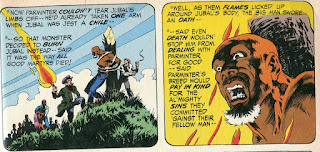


However, despite being one-armed, Jubal manages to reach his enemy from beyond the grave, for at some later point-- presumably after Elsbeth too has been murdered-- Parminter is "torn limb-from-limb" and his remains scattered throughout the manor. Auntie De Luvian then concludes the story, saying that the slaves "run away" that the plantation fell into ruin, and that she, Auntie, stayed in the swamp because she had nowhere else to go. At that point, she then warns Swamp Thing about the presence of "unholy things."


The "things" happen to be Arcane and his synthetic monsters, his "un-men." It seems that though Arcane's original body did perish, the un-men managed to resurrect him in a synthetic body-- albeit one not very well constructed. Arcane and his servants have tracked the monster-hero to these lands, and the villain still has his same agenda in mind: to take over the Swamp Thing body while expunging the persona of Alec Holland. So they fight--


Then the fight-- which Swamp Thing is losing-- is interrupted by some unquiet spirits. It seems that during the battle Arcane makes several verbal references to making modern humans his "slaves"-- and this is enough to offend the ghosts of the slaves who died in the swamp.


Swamp Thing does not witness what the ghosts do to Arcane and his minions, for Black Jubal himself bids the swamp-monster to fall asleep. When he awakens, he finds that in the graveyard dedicated to the deceased slaves, some new gravestones have been erected for the evildoers. In addition, when the hero goes looking for Auntie, he finds only another gravestone, proving that the woman to whom he spoke was also a ghost-- specifically, that of "Elsbeth de Luvian."

While this can be seen as a fairly traditional horror-story in which the dead come back to avenge past crimes, I find that there's a little more attention to detail than in the average ghost-story. Samson Parimnter of course has no resemblance to the Biblical Samson, though the first name is similar to that of literature's archetypal evil slaver, Simon Legree. Similarly, the Biblical character of Jubal from Genesis bears no resemblance to the hulking, one-armed slave-- but the name sounds not dissimilar from the Hebrew festival of Jubilee in which, Wikipedia relates, "slaves and prisoners would be freed, debts would be forgiven, and the mercies of God would be particularly manifest."

In conclusion I can't resist observing that an ideological critic would probably be offended by the story's association between a "real-world" evil like American slavery and a "made-up" evil like a mad scientist. However, it's clear to me that even if Arcane is a fantasy-figure, he's a more than accurate analogue to the evil of world conquerors generally-- and thus, the ghosts have ample reason to despise anyone who proclaims a desire to bring back slavery of any kind.


Thursday, February 9, 2017

ONE NULL, ONE NEAR: SWAMP THING ANNUAL #5 (1989)


Since Neil Gaiman was never the regular writer on the SWAMP THING title, it may be that his stories for 1989’s SWAMP THING ANNUAL #5 were just fill-in works, or possibly audition-tales. Though I’ve labeled one story a “null-myth” and the other a “near myth,” both languish under the long shadow of Alan Moore’s tenure on the feature.

“Brothers” is the null-myth here: a good idea that never quite works, despite Neil Gaiman’s considerable talents. The living dummy known as Brother Power the Geek has remained out in space for roughly twenty years, only to suddenly crash to Earth. Brother Power not only survives, he has no understanding that any time has passed, and still speaks in hippie-talk. He has apparently gained a new power, though, in that he can now assemble new bodies for himself out of random junk, and expand said bodies to giant-size, so that he becomes an unwitting peril to the citizens of Tampa, Florida.

The “monster-menacing-city” structure of the story is strongly indebted to a two-part Alan Moore story in SWAMP THING #52-53, and Gaiman more or less admits the indebtedness by having two of Swamp Thing’s support-characters called in to consult on the matter of "The Flower-Child That Time Forgot." Swamp Thing himself is not present in either of the annual’s stories, due to events in the regular title. Still, Gaiman picks up on the character’s basic concept—at least as it was re-imagined by Moore, that of making the muck-monster into a plant-elemental—and declares that Brother Power was created by a process analogous to the one that created Swamp Thing. Abby Arcane, the Swamp Thing’s wife, receives an oracle that says Brother Power is “a doll god—a puppet elemental—like others before it.”


Gaiman does not choose to say more than this, however, and so the idea of what a “puppet elemental” might be is dropped. (Was Pinocchio one of the “Parliament of Puppets?”) Eventually the problem is solved when the other support-character, belated hippie Chester, gets Brother Power’s attention, talks with him a little, and then sends him on his way. Given that most of Gaiman’s observations on the generation of the Flower People are trite, it may be that the story’s main point was to bring Joe Simon’s most peculiar creation out of mothballs—though Gaiman does a decent job with his characterizations of Chester and Abby.


“Shaggy God Stories” might sound like a myth-nerd’s dream, though the tale fails to be more than the sum of its parts. The story focuses upon a character whom Moore adapted early in his run: Jason Woodrue, a super-villain so obsessed with plants that he mutated himself into a plant-human hybrid. Woodrue, more than a little crazy, wanders into the domain of the Parliament of Trees, the largely immobile plant-elementals who preceded Swamp Thing. For most of the tale, Woodrue meditates on the many ways in which trees and other plants have been intertwined with the lives of holy men and deities. He seeks out the Parliament, rambling about gods and trees, and finally reveals that, “I want to be a god too.” The representative of the Parliament gives Woodrue no satisfaction, though he gives the former super-villain a warning about a future danger. The deranged plant-man pays no attention and wanders away, and the story ends on the suggestion of a future menace, which eventually manifests in the Doug Wheeler SWAMP THING run.

Still, limited as the story’s scope is, it does toss out a few good myth-kernels, particularly at the opening, when Woodrue mediates on the “two trees” of the Bible’s Eden narrative. I find it particularly interesting that Gaiman has Woodrue harp on the existence of the “two trees” at the story’s  opening, because “two trees” also figure in the next and last major appearance (as of this writing) of Brother Power, the Geek.   

ADDENDA: On this forum a poster shared a part of a Gaiman interview from an online source that no longer seems extant. In the spirit of knowledge I share Gaiman's statement on the Annual here:

"I was going to bring [Woodrue] back as a villain. He was getting back to being Woodrue, the Rue of the Wood, and probably on a much bigger scale, a much nastier scale. It would have been fun, but again it didn't happen.
I probably would have brought back Black Orchid in there. I don't know, because as I said, it never got that far. Rick still had a few issues. I talked to Rick, we sort of co-plotted Rick's last few episodes, which never saw print."