Featured Post

SIX KEYS TO A LITERARY GENETIC CODE

In essays on the subject of centricity, I've most often used the image of a geometrical circle, which, as I explained here,  owes someth...

Showing posts with label exothelic and endothelic. Show all posts

Monday, July 28, 2025

EMINENT ICONS AND PROPOSITIONS

 A random thought struck me the other day: that, if I was trying to convey what distinguished a story's centric icon (assuming there's just one) from all the other icons in the story, I might have said that all centric icons were "organizational matrices." As soon as I thought this thought, I realized that even to most literary pundits the phrase would be about as clear as the view from beneath the La Brea tar pits.

The thought did take me back to some of the various ways I'd attempted to think about centricity in terms of categorical abstractions, at least going back to this key essay, 2018's KNIGHTS OF COMBAT AND CENTRICITY, PT. 1. In that essay, I cited a remark by author Nancy Springer about her conviction that the true hero of Scott's IVANHOE was not Ivanhoe:

Who is the real hero of Ivanhoe? Certainly not Wilfred of Ivanhoe himself, for never was a title character more palely drawn. Even though he is the common thread that strings the novel together, he is all but invisible... He is a pawn, exercising no control of the events around him, a piece of plastic with almost no personality...

 I refuted this in part by comparing Ivanhoe, a monadic centric icon, with the example of The Spirit, a serial centric icon:

From all my statements on centricity, it should be plain that I have no problem with a main character having little color-- or mythicity-- of his own. For me Ivanhoe is as much the star of Scott's only story with the character as the Spirit is of his long-running serial adventures. Springer's metaphor of a "common thread" catches some of the sense of Ivanhoe's role in the narrative, but she apparently does not realize how often famous works may be organized around an essentially unremarkable character. The Spirit is not really any better-characterized than Ivanhoe-- Eisner tended to refer to his hero as something along the lines of a "big dumb Irishman"-- and as I mentioned above, most of the mythicity of the Spirit's serial adventures inhere in his supporting characters, just as figures like Rebecca, Richard and Robin Hood are more mythic than Ivanhoe himself. In both cases the under-characterized, under-mythicized character functions as an organizing factor.   

Later in the same essay, I admitted that there were times in which a viewpoint icon might be very dull and NOT be the center of the story, using the example of Lemuel Gulliver. But Gulliver does not provide an "organizing factor" as do Ivanhoe and The Spirit. That's because GULLIVER'S TRAVELS is not about Gulliver, but about the exotic places to which he travels, making it *exothelic* rather than *endothelic." I've discoursed about these structural distinctions elsewhere, but they're not germane to the problem under discussion here, which concerns defining the nature of centricity.

However I may choose to define centricity in light of the "organizing factor" thesis, this line of thought puts paid to my brief consideration of centricity as a form of resonance, which I advanced in this 2023 essay, and then barely used thereafter. The metaphor of resonance, as I expressed it there, was something like whatever voice in a narrative happened to be the loudest-- which is not unlike the poor logic I critiqued Nancy Springer for. In future, if I use resonance at all, I'll try to keep it closer to the cited definition by Northrop Frye, where resonance connotes a reader's ability to see the universal in the particular.  

So if centric icons within a narrative are "organizational matrices," is there a better term to assign to the organizing principle? Astute readers of this blog (are there any other kind?) will guess that the previously unused term of "eminence" will now assume that position, but the rationale must wait until Part 2.  


Monday, September 2, 2024

COSMIC ALIGNMENT PT. 7

Most support-characters, like most the subordinate villains discussed in Part 5, default to "static alignment" with whoever or whatever is the "Prime" icon of the story. In the vernacular, they continue to dance with whoever brung them. But there are examples of subordinate characters who shift their alignment into a dynamic form.

In contrast to the interlocutor-types discussed in Part 6, here I will discuss the sort of figures usually described as "viewpoint characters." In my essay OUT WITH THE BAD WILL, IN WITH THE GOOD, I distinguished two narrative approaches to viewpoint characters, who usually (though not always) merge with the viewpoints of the readers:

In place of "ego-oriented," I'll speak of the *endothelic,* meaning that the narrative is focused upon the will of the viewpoint character or of someone or something that shares that character's interests.

In place of "object-oriented," I'll speak of the *exothelic,* meaning that the narrative is focused upon the will of "the other," something outside the interests of the viewpoint character, though not necessarily opposed to them.

I'll mostly focus here on exothelic stories, but just for more context, two instructive examples would be Conan Doyle's novel THE LOST WORLD and the 1933 film KING KONG. Both are stories involving intrepid adventurers voyaging to obscure parts of the Earth in order to uncover rare phenomena. But in LOST WORLD, Challenger's merry band of explorers are the focal icons of the story, despite the copious detail author Doyle provides on the phenomena of The Lost World. Therefore, LOST WORLD is endothelic. However, in KING KONG, the phenomenon is Kong, and Kong is the star. The ensemble of explorers-- Carl Denham, Ann Darrow, and Jack Driscoll-- are all vividly sketched, but they're all support-characters in an exothelic film.

Neither Kong, Darrow nor Driscoll made an encore performance in any film from the original KONG production company-- but Carl Denham did, rearing his head for one more official appearance in THE SON OF KONG that same year. While the junior giant ape never assumed the mythic resonance of his theoretical "old man," there's no question that he is the star of this exothelic show. Denham and one or two other crewmembers are the only icons linking the two films, but because they shift their support-duties from one Prime to another, they're my examples of "dynamic alignment" as it relates to support-characters.


A parallel example appeared first in THE MOON POOL, which began in a short story with viewpoint character Walter Godwin, who has a close encounter with an eldritch alien being. Author Abraham Merritt then incorporated this tale into the context of a full novel, in which Godwin and an ensemble of other characters find their way to the hidden city where the bizarre entity, The Shining One, dwells. Despite the heroic activity of some of the explorers-- not including Godwin, who's essentially a "floating eyeball"-- the author emphasizes the exothelic presence of the Shining One. The novel ends much as the short story did, with Godwin excluded from the fantasy-world and consigned to mundane reality.

That, however, doesn't keep Godwin from going on the hunt for more supernormal phenomena, and he comes across a totally different lost world in 1920's THE METAL MONSTER. I frankly don't remember what happens to Godwin at the end of that novel, but MONSTER too is exothelic, focusing upon Norhala, a young human woman who has become the thrall of an inorganic metal-intelligence. So Godwin shifts his alignment from The Shining One to Norhala, who aren't even as interrelated as the two Kongs of Skull Island.

My tentative judgment, then, is that just as I've said that there's a "crossover-vibe" when a villain introduced in one feature makes an appearance in another-- even if that villain's alignment is not static in nature-- there's also a crossover-vibe, albeit minor, in both SON OF KONG and METAL MONSTER,

Wrapping up, I should note that even though THE LOST WORLD is definitely endothelic, I'm not sure all of Doyle's other Professor Challenger stories also qualify, not having read them in some time. It's possible that in some of those, Challenger takes a back seat to whatever phenomenon he's expounding upon. But that's a question for another day.

ADDENDUM: For all Sub characters, they can only generate a crossover vibe once when first "jumping" into another cosmos. Going back to my hoary Cobra-Hyde example, their first encounter with Daredevil, after having been foes of Thor, is a crossover-- but not their second, third, or fourth encounters with Daredevil. The same rule applies to their first appearance in a Captain America feature, and so on. This concept parallels my observation about the transition of subordinate characters into Primes starring in a given feature; only the first appearance counts as a crossover.

Sunday, January 7, 2024

REPETITION AND PROLONGATION PT. 1

The main reason I devoted time to sussing out "the two escalations" was because the earlier-conceived term bears on my also sussing out the quantitative form of "conflict-escalation" with respect to the long neglected topic of fictional sadism. To be sure, this line of thought was generated when I began thinking about how the quantitative form of "stature-escalation" depended on duration, and this led me to think about duration's influence upon a particular type of conflict-escalation.

My most concentrated observations on sadism were made in essays like POP GOES THE PSYCHOLOGY, aimed at disproving the simplistic attempts of Frederic Wertham and Gershon Legman to define all forms of fictional violence as "sadism." In the same month I also observed, in SADISM OF THE CASUAL KIND, that the majority of audience-members are not vulnerable to becoming syndromic sadists just because they get a little jazzed reading about some criminal going on a crime-spree, which was another piece of nonsense from Wertham and Legman.

But while all forms of violence are not reducible to sadism, sadism and its "opposite number" masochism (which will have to wait for later discussion) have their own respective dynamics. 

Sadism, as previously related, is the ethical opposite of combat. Combat almost always involves two or more subjects in contention, where all have some ability for self-defense. Sadism depends upon one subject wielding control over the other subject and imparting physical (and sometimes emotional) violence upon the latter. I distinguish four patterns of fictional sadism. Two categories are the newly minted "prolongation" and "repetition," which are further subdivided (at the risk of inducing terminological overload) by my earlier categories of "the exothelic and the endothelic."


ENDOTHELIC PROLONGATION-- This type of scenario largely focuses upon one sadism-victim, or a group of victims, suffering prolonged acts of sadism, whether it's just one repeated scenario or an assortment of assaults. In fiction one of the most famous scenarios is that of Edgar Allan Poe's "Pit and the Pendulum," in which an unnamed prisoner must endure the agonies of the titular horrors, without his even interacting with the sadistic authors of his predicament.


ENDOTHELIC REPETITION-- Repetition, in contrast to prolongation, often depicts several independent scenarios separated by assorted time-frames. One of the most famous victims of repeated sadism appears in Sade's JUSTINE. Toward the end of the book the afflicted heroine provides a long chronicle of the many persons who have tormented her just for the hell of it, a list which apparently includes whatever God rules her world. Just a partial list:

During my childhood I meet a usurer; he seeks to induce me to commit a theft, I refuse, he becomes rich. I fall amongst a band of thieves, I escape from -hem with a man whose life I save; by way of thanks, he rapes me. I reach the property of an aristocratic debauchee who has me set upon and devoured by his dogs for not having wanted to poison his aunt. From there I go to the home of a murderous and incestuous surgeon whom I strive to spare from doing a horrible deed: the butcher brands me for a criminal; he doubtless consummates his atrocities, makes his fortune, whilst I am obliged to beg for my bread. I wish to have the sacraments made available to me, I wish fervently to implore the Supreme Being whence howbeit I receive so many ills, and the august tribunal, at which I hope to find purification in our most holy mysteries, becomes the blcody theater of my ignominy: the monster who abuses and pluncers me is elevated to his order’s highest honors and I fall back into the appalling abyss of misery.


As "endothelic" describes centric icons with whose will the reader is expected to sympathize, "exothelic" describes centric icons who ought to inspire antipathy.


EXOTHELIC PROLONGATION-- Whereas the unnamed narrator of "Pit" is the sufferer, the narrator of Poe's "The Cask of Amontilado," one Montresor, shows the slow and careful progress of Montresor's plan to trap his perceived enemy Fortunato into a death-trap; that of being confined behind a wall of bricks in a catacombs, where Fortunato will, and does, suffer a lingering demise.


EXOTHELIC REPETITION-- And, to maintain parallelism, my selection here also comes from Sade, who followed up JUSTINE with JULIETTE. The latter book takes the point of Justine's sister Juliette, who prospers despite visiting pain and death on innumerable victims, the most notable of which I discussed in this essay

More variations to come in Part 2.

Sunday, May 14, 2023

CENTRICITY AND RESONANCE

On this blog I've devoted thousands of words attempting to imagine the diffuse operations of literary endeavor into more specified categories, but I don't feel I've managed to do so with the concept of centricity. A little while back, I played around with the idea that centricity might subsumed by the agency of a given narrative's superordinate icon or icons. But the word "agency" is too easy to confound with other principles, so I'll probably confine its use to all matters related to interordination comparisons, as laid out in GOLDEN AGENCY PT. 1.

It sometimes helps, though, to imagine what abstract principles would act like if they were incarnate entities, and one day I was trying to imagine "centricity" as if the icon in it were "doing something" in order to express, as mentioned earlier, the author's priorities. And the image that came to me was that of the icon as a human singer, projecting his/her voice outward so that it enveloped all the subordinate icons within his/her span.

Since I've also specified that icons don't have to be human or even humanoid beings, another possible metaphor would be that of the tuning fork, that, when struck, sets up a resonance that affects its surroundings. 


By extension, an ensemble of superordinate icons would be like a set of tuning forks, some of which might be struck at different times in order to produce their effects.


One reason I like the resonance metaphor is that it's a means of describing how authorial will spreads out from different types of icons in similar forms of narrative.

For instance, in the 2012 essay DIAL D FOR DEMIHERO PART 2, I compared two television shows in the "occult crusader" subgenre, the 1974 KOLCHAK: THE NIGHT STALKER and the 1987 FRIDAY THE 13TH--THE SERIES. I can express the opinion that the former is centered on Kolchak, the endotheric identification-figure, or that the latter is centered on the Curious Goods shop, the exothelic source of evils for the continuing characters to thwart. But the argument, as I've previously framed it, is perhaps easier to picture (though it may not compel any greater agreement) with one's experience of the way everything in the KOLCHAK series is permeated by the resonance of the hero, while everything in the FRIDAY series is permeated by the resonance of the malefic shop of evil wonders.

A similar example can be made with respect to a type of icon that would seem to have the least possible "agency:" the dead-person-who-tells-a-story." In the 1950 film SUNSET BOULEVARD, the story is related by murder victim Joe Gillis, but the audience is barely made to care about the provenance of this character. The character with the greatest resonance is clearly Norma Desmond, the faded silent-film star who pulls Gillis into her world and ends up killing him.

So Desmond has both the greatest agency and resonance. However, in 1947's SCARED TO DEATH, I think it's arguable that Laura, the murdered narrator of the movie, has greater resonance than any of the usual "old dark house" support-characters, or even than the green-masked villain who kills said narrator. Like most of the victims in the old PERRY MASON TV show, it's the murdered person who's the center of the mystery, but what little authorial will exists in SCARED stems from Laura, whose malevolence makes the plot go. 

It's interesting that Northrop Frye made use of the term "resonance" in his book THE EDUCATED IMAGINATION, where he said that resonance was the process by which "a particular statement in a particular context acquires a universal significance." Frye was not talking about centricity as such, more about the general function of narrative. But since I've defined narrative here in terms that focus upon the interaction of what I now call superordinate and subordinate icons, the coincidence seems felicitous.


Friday, August 28, 2020

EQUAL AND UNEQUAL VECTORS OF AUTHORIAL WILL, PART 1

Though my rough reading of Whitehead’s PROCESS AND REALITY did not convert me to process philosophy, I profited once again through my exposure to his gift for terminology—with the usual caveat that my use of a Whiteheadian term will not necessarily agree with Whitehead's use of it.

In assorted sections, Whitehead speaks of what he calls “primary feelings” as “vectors.” The Merriam-Webster definition of the word is as follows:

A quantity that has magnitude and direction and that is commonly represented by a directional line segment whose length represents the magnitude and whose orientation in space represents the direction.

So in physics, a vector indicates a magnitude of physical force oriented in a particular direction. How could this concept apply to the discipline of literary studies?

I return to one of the bedrock formulations of this blog, from the essay SEVEN WAYS FROM SCHOPENHAUER:

Was Schopenhauer right about “Will” inhering in every aspect of our reality? We do not know. However, we CAN be sure that “Will” inheres in every aspect of the various LITERARY realities we humans create, since we KNOW for a fact that they are all “willed” into existence by their creators (and sometimes, however indirectly, by audiences as well).

In this essay I applied this concept of will to literary conflict. Yet all aspects of art—characters, settings, plot-tropes—derive from authorial will. Similarly, all of the multifarious literary categories I’ve introduced on this blog—dynamicity, mythicity, the combinatory-sublime and so on—are the prisms I use to view patterns of authorial will, patterns formed by the unceasing interactions of authors swiping from each other, competing with each other, and writing love letters to each other.

In other essays I may choose to investigate the vectors to be found in other domains. Here, though, I’ll address only the domain of centricity.

In STATURE REQUIREMENTS PT. 5, I utilized the term “charisma” to indicate the way the author dispersed his will to characters or phenomena in the narrative, asserting that the centric presence was the one that had received the greatest amount of charisma. The concept of vectors does not invalidate any of these formulations, but the vector-metaphor proves more useful, particularly since, in mathematics, one can speak of both equal and unequal vectors.

The most typical situation in narrative usually presents one protagonist in a particular situation. In most such narratives, the protagonist embodies the greatest magnitude of authorial will; whether he prospers or perishes, he’s the character on whom the reader most focuses. This is also the usual model of the endothelic mode, in that the protagonist, no matter how flawed, is the one with whom the reader identifies. However, there’s also a counter-tradition, that of the exothelic mode/ In this mode, the reader identifies less with the protagonist than with the situation enfolding the protagonist, be it a confrontation with a menace, like Dracula, or with an environment, like Wonderland. In INVESTMENT VS. FASCINATION PT. 2, I illustrated these opposed modes. H.G. Wells’ book THE TIME MACHINE proved exothelic, concerned largely with showing the reader the entropic worlds of the future. In contrast, the 1960 film-adaptation was endothelic, focusing less attention on the worlds visited by the Time-Traveler than on the deeds of the Time Traveler, WHICH in essence signified his ability to transcend entropy. To employ the new terminology, Wells’ Future-Earth possessed a centricity vector exceeding that of the main character or anything else in the novel, while in the movie the Time Traveler possessed that superior and unequal vector.

In essence, once one has identified the superior unequal vector, it doesn’t especially matter as to the magnitude of the other vectors. Some of the subordinate vectors may be equal to one another, and certainly this would be the case of all the supporting characters in the 1960 TIME MACHINE film. But none of the subordinate characters play a role in determining centricity, except in terms of sheer contrast to the dominant vector.

Now, I said that the one-protagonist schema was the most frequently used one. Still, the idea of the ensemble-schema—wherein two or more characters “share the spotlight,” so to speak—is at least as archaic as the other schema. In STATURE REQUIREMENTS PT. 6, I observed that I thought the ARGONAUTICA of Apollonius should be judged an ensemble-narrative. Obviously the same schema applies to most “team” narratives. At the same time, though, serial narratives can change their stance in this regard. In STATURE REQUIREMENTS PT. 3 I contrasted two TV-serials, ANGEL and BUFFY THE VAMPIRE SLAYER. BUFFY, in my current terms, would be a series built around one starring protagonist from start to finish, meaning that Buffy Summers always embodied an unequal vector of authorial will, while her helpers were all inferior to her but roughly equal to one another. However, I observed that ANGEL started out much as BUFFY did, focused largely upon the titular protagonist. Yet by the series’ second season, I noted a shift in which Angel’s associates became increasingly important to the ongoing narrative, so that by the series’ conclusion Angel and his associates shared equal vectors of authorial will.


Even some stand-alone narratives require close attention. For the first twenty minutes of the schlock-film SHE DEMONS, the film looks like it’s going to center around the adventures of its lead male and female characters, a no-nonsense he-man and a shrewish rich bitch. It would have been easy to arrange their island-encounter with a mad scientist in such a way that their triumph over him reinforced their characters. But the script for SHE DEMONS suggests that the author was more invested in his mad-scientist character. Once the Nazi madman comes on stage, the romance of the lead male and female takes second place, as the writer places far more emphasis on the evil Nazi’s inventiveness and his wavering attachment to his mutilated wife. The titular “she demons,” in addition, are nothing more than the scientist’s creations, and thus are not superior in centricity to him—though arguably their centricity-vector might be unequal to that of the romantic duo.

Friday, May 8, 2020

CHALLENGER AND DEFENDER PT. 1


Over a year ago I formulated two terms, “investment” and “fascination” in this essay. According to my system, these are the affects inspired by the two respective modes, the “endothelic” and the “exothelic,” which apply to a given literary work’s focal presence. Now I’ve formulated broad terms for each type of focal presence, to better illustrate the multifarious ways in which investment and fascination manifest.

Though Aristotle’s POETICS is the earliest extant work to speak of conflict as necessary to all narrative, not until the 19th century did ArthurQuiller-Couch distinguish particular dominant tropes by which conflict was organized. To this day, people who don’t know Aristotle, much less Quiller-Couch, should recognize these tropes-- “man vs. man,” “man vs. nature,” and “man vs. society”—from their use in middle school lit classes. Quiller-Couch’s formulation seems to follow the basic structure handed down from archaic Greece, in which a “protagonist” was the star of the show and an “antagonist” challenged him. But in the twentieth century, sometimes the antagonist proved the more fascinating narrative presence, even if a protagonist-like figure might be around to give the reader some investment. H.P Lovecraft’s 1927 SUPERNATURAL HORROR IN LITERATURE boldly stated that in supernatural fiction the “phenomenon” was the star, while in 1982 Frank Cioffi stated that narrative conflict came about when some “anomaly” interfered with the status quo.

Without a doubt, the trope “sympathetic protagonist vs. antipathetic antagonist” is the dominant mode in the whole of literature. Thus most works are concerned with showing the reader how a character in which the reader has invested positive emotions defends himself against a given challenge. The opposite trope, however, puts an antagonist—be he real or perceived—in the driver’s seat,, so the reader’s dominant response is that of fascination with “the other” (little as I like invoking Sartre’s tired concept). Contrary to Cioffi's somewhat Marxist tendency to extol the anomaly—what I am calling “the challenger”—as a positive force that breaks down the status quo, many challenger-focused narratives end up validating the “status quo” viewpoint of the figure I call “the defender.” As I type these words, I’m half-watching a film that’s yet another take on Richard Condon’s famous short story, “The Most Dangerous Game.” There’s no question that Condon’s narrative focus is entirely upon the corrupt Count Zaroff, the man who decides to start hunting his fellow human beings. Yet this narrative strategy in no way compromises the POV of the defending protagonist, which maintains that Hunting Humans is Not a Good Thing. The same principle obtains with the various film-serials that focus less on the heroes than on the villains. The villains of THE PHANTOM CREEPS, THE WHISPERING SHADOW, and THE BLACK WIDOW are more interesting than the phlegmatic heroes, but the heroes still represent the right moral orientation.

As I discussed in INVESTMENT ANDFASCINATION PT. 3, sometimes the position of “challenger” can be an entire environment, often combining two Quiller-Couchisms: “man vs. nature” and “man vs. society.” In H.G. Wells’ TIME MACHINE, the nameless viewpoint character is essentially a rather passive defender of his time’s values. Those values are challenged and conquered when his time-machine reveals the horror at the heart of reality, summed up by the predacious relationship of the Morlocks to the Eloi. In the 1960 film-adaptation, Rod Taylor’s two-fisted scientist successfully defends his time’s ethics so strongly that he may be able to reverse the future world’s fall into entropy. Thus the original novel and its film-version evince the investment and fascination strategies respectively. However, the triumph or failure of the viewpoint-character is not the determining factor. WORLD WITHOUT END presages George Pal’s 1960 film by showing another corrupted future that can be saved. However, the titular world, the challenger, is the star even though its monstrous aspects are overthrown and tamed by the film’s dull defenders of the eternal verities.

Next up: curse-challenger and cursed defender.

ADDENDA: Just to line up all the categories, any work centered on a "challenger" would be exothelic, while any work centered on a defender would be endothelic.

Monday, May 6, 2019

INVESTMENT VS. FASCINATION PT. 3

I don't consider "the Time Traveler" to be the star of Wells' TIME MACHINE, and from one standpoint I might teem "time itself" to be the star. However, the bulk of the narrative does center itself upon the Eloi/Morlocks period of future-history, and so it's possible to see that one period as the focal presence of the Wells narrative.-- TREES, MEET FOREST (GOD).
 The true "hero" of a marvel tale is not any human being, but simply a set of phenomena.-- H.P. Lovecraft.

Since I've recently reviewed both H.G. Wells' TIME MACHINE and the 1960 George Pal adaptation, I decided to analyse both these works and those works most probably influenced by Wells' "Eloi-Morlocks" trope in terms of the "investment/fascination" concepts.

The fact that H.G. Wells chose not to give his focal character a name would seem to underscore Lovecraft's observation that "the phenomenon" is the star of the novel. Since an abstraction like time can't really be the "star of the show," I've determined that "Morlock-Earth" is the exothelic center of the Wells narrative, since it's the "entity" through which Wells expresses his beliefs about the ultimate degeneration of Earth and/or the universe. Thus Wells' work functions by concentrating the reader's emotions on fascination with the phenomenon of the decay of Earth and its inhabitants.


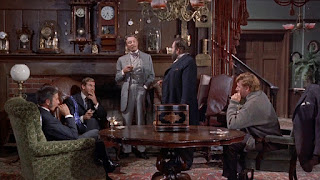
In contrast, though the 1960 movie starts off almost identically to the novel in terms of plot, the David Duncan script gives the traveler (Rod Taylor) the name of George (with other elements in the script implying that he's actually "H. George Wells"). Further, Duncan builds up George's relationship to his Victorian contemporaries, particularly with David Filby (Alan Young), so that George seems like a much more well-defined character, and so indicates that the scripter's strategy is to create the viewer's emotions on investment in George's fate.


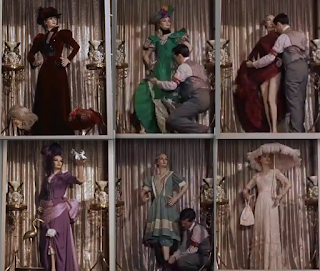
The scenes of George's first time-ventures reinforce this strategy, for in contrast to the novel, George travels to the near future and meets James Dilby, grown son of George's now-deceased friend David. George's moments of grieving for his friend give him greater dimension, as do his humorous moments observing the changes in a dress-shop opposite his own domicile, allowing him some very mild "voyeurism" as he watches a dress-dummy continually undressed and re-dressed. This plays into George's later romance with Weena, in contrast to the Time Traveler's largely paternal relationship to the (much younger) Weena of the novel


Duncan's main purpose in having George visit the 20th century is to make Wells' vision of cosmic degeneracy more relatable to 20th-century audiences, by grounding the events of "Morlock-Earth"  in the development of nuclear-war and America's use of bomb shelters. Of course, given that Morlock-Earth is many thousands of years in the future, Duncan's future only works if one assumes that the pattern of aerial bombing and human retreat into bunkers kept happening over centuries-- though, to be sure, Wells' SHAPE OF THINGS TO COME does describe a situation in which aerial bombing gets lost and has to be rediscovered over the eons.
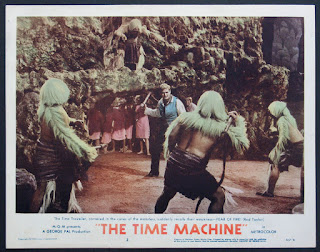


Finally, as I noted in the film review, Rod Taylor's George is much more proactive than the Time Traveler. The Time Traveler, even though he has some affection with the child-like Weena, never raises the possibility of educating the Eloi to advance themselves. Every contact he has with them suggests that they've descended too far into imbecility for that. In contrast, George's efforts to get the Eloi to think and fight for themselves bear fruit: not only does Weena start wondering about how the women of George's time wear their hair, one of the male Eloi comes to George's defense during the big fight-scene, actually striking a Morlock in emulation of George's fisticuffs. This revelation, that the Eloi are not beyond saving, telegraphs Duncan's ending to the film. In the book, the reader doesn't know just why the Traveler, having returned to Victorian London to relate his story, gets back in the machine and leaves, never to be seen again. But the film makes it indisputable that George is returning to bring 19th-century enlightenment to the Eloi and to defeat the savage Morlocks, more or less following the pattern of 19th-ceutury concepts of imperialistic noblesse oblige.


Having described George's impact as a culture hero, though, I have to remark that a protagonist's act of playing "culture hero" doesn't always lead to the pattern of investment. I remarked in my review of the TIME MACHINE film that four years earlier, the studio Allied Artists produced a B-film, WORLD WITHOUT END which anticipated the quasi-imperialistic developments of David Duncan's adaptation of the Wells work. In fact, the estate of Wells allegedly filed a lawsuit against the company for copying the author's book, even though the film's writer-director Edward Byrnes reversed the basic setup of the Eloi and the Morlock, though it's not impossible that he also borrowed from other SF-works for his scenario. In WORLD, four modern astronauts accidentally time-travel to a post-apocalyptic future, where they find savage "mutates" on the surface and an effete, though technologically gifted, civilization dwelling beneath the Earth.

Now, though Bernds' four protagonists have a few distinguishing characteristics, I stated that I found them "exceedingly dull," which didn't help me invest any emotions in their project to restore the ravaged Earth (anticipating Duncan's concept by four years). There is, as I discussed in the review, a concluding battle in which an astronaut named Borden (Hugh Marlowe) fights and kills a mutate in single combat, but Bernds underplays this potentially exciting scene, as if it's no more than a necessary evil. With neither strong characterizations nor physical vitality to enliven the astronauts, they seem to play a role not unlike Wells's Time Traveler: they're just there to illustrate a theme. The true star of the show is the fallen Earth that is to be redeemed, what I tend to call "Mutate-Earth" even though the mutates are destined to pass away. Even the film's title, apparently derived either from a passage in King James or some secondary use of said passage, affirms the idea that humanity, though bifurcated into savages and decadents, will be brought together, and that even the brave astronauts who accomplish this are merely part of some cosmic scheme.
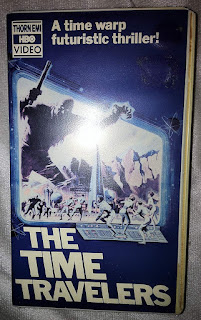


Four years after the debut of Pal's TIME MACHINE, the idea of bifurcation is again used in Ib Melchior's THE TIME TRAVELERS. A group of scientists, all pretty unmemorable, accidentally travel to the far future, to 2071 A.D. Once there, they find the world rendered uninhabitable from nuclear radiation, and haunted by deformed mutants above-ground, just as in WORLD WITHOUT END. And there's also, as in WORLD, just one enclave of technologically-advanced humanity left, though TRAVELERS' script does not in any way portray the future-people as decadent. Their only fault is that the future-humans are devoting all of their efforts into escaping Earth for greener pastures in Alpha Centauri. However, at the climax the mutants invade the enclave and destroy the Alpha Centauri rocket. Humankind is only redeemed because the time-travelers are able to access their temporal portal once more, and to transport themselves and some of the future-humans into an even more distant future-- one in which, in contrast to Wells' novel, Earth has become a virtual Eden once more. And just as I considered Wells' "Morlock-Earth" to be central to the novel, even though the hero also travels to the time of Earth's ending, "Earth 2071" is also central to THE TIME TRAVELERS, even though that fallen world, like that of WORLD WITHOUT END, implicitly leads to the rebirth of humankind with a tone of Judeo-Christian transcendence.

Monday, March 18, 2019

INVESTMENT VS. FASCINATION PT. 2

At the end of PART 1,  I asserted that the dominion of the process of fascination over that of investment came about when "the other" received more narrative charisma than "the familiar." The former category doesn't have to be evil as such-- the Japanese "Mothra" films are a case in point-- but in some way the incarnation of the other cannot be subsumed within the audience's concept of what is familiar.

Today I finished a review of the 2005 film DOOM, in which I compared the movie to its video game iterations and to its supposed filmic influence, the 1986 ALIENS. DOOM, unlike ALIENS, presents a rather complicated dynamic of centric will, so I'll begin my analysis with the simpler dynamic of ALIENS. As I stated in the review, I view all works in the ALIEN franchise to be "exothelic," in that they depend more on fascinating the audience with the bizarre nature of the killer aliens than on building up the audience's investment in the human heroes, primarily Ellen Ripley. That's not to say that such investment does not exist. Obviously, no other hero to be found in the subgenre of "killer alien movies" has been more important to audiences than Ripley. But the ALIEN films emphasize the fascinations of the exothelic over the familiarity of the endothelic.

Now, rather than addressing DOOM as yet, I'll segue to a film-franchise that resembles the ALIEN franchise in having a simple dynamic: the live-action STARSHIP TROOPERS serial, whose films I reviewed here and here. The first film is, like the source novel, centered upon the activities of the various Earth-soldiers who go to war against a race of alien "Bugs," and the next two films in the series more or less follow the same formula. I confess that in the original review I regarded STARSHIP TROOPERS 2 to be something in the nature of an ALIEN-clone, which meant that within my system the centric will would be represented by the Bugs. Further, this determination caused me to determine that the film fell within the mythos of the drama rather than the irony seen in the other two films. However, upon re-viewing TROOPERS 2, I've decided that the Bugs still weren't emphasized as much as the humans. Indeed, Captain Dax, the soldier who perceives the insanity of the Earth's military fascism, is the most important character in that film, just as John Rico is for the first film and Lola Beck in the third one. Further, the fact that Dax perishes and fails to change the destructive course of his people makes the film cohere with the mythos of irony (I've added a correction to the original review).

Now I mentioned that the process of investment did not necessarily mean that the audience endorsed everything that a centric character said or did; it only means that the audience feels able to understand where that character comes from. Thus, even if a character like John Rico has been effectively brainwashed by his culture, the audience still feels in him a familiarity about the nature of his fictional will; how he lives and what he desires. So, now that I've revised my view to state that Rico, Dax and Beck are all investment-type centric characters, I can state my determination that the franchise as a whole (including the somewhat marginal animated video) is endothelic.

So, with these examples in mind, is DOOM endothelic (investment-centered) or exothelic (fascination-centered)? I stated that I felt that none of the starring human characters incarnated the narrative charisma, even though the character of Reaper is the nominal "hero," even as Ripley is the nominal "hero" of the first four ALIEN films. More precisely, I said:

Whereas ALIENS is a film in which the titular extraterrestrials are on center stage, dwarfing the importance of the space-marines fighting them, determining the "main characters" of DOOM becomes a little more dicey, given that the actual Martians are all dead. However, their genetic legacy-- that of passing on the mutagen  that can enhance either "good" or "evil"-- has more central importance to the narrative than any of the three human characters. A quick check of Wikis about the video game suggests that there's no generic name for the "Doom Monsters," probably because they are largely supposed to be either Hell-demons or humans possessed by demons. So for my own satisfaction, I'll state that the stars of DOOM are indeed the Doom Monsters-- and, since both Sarge and Reaper become affected by the mutagen, they become reflections of the mutagen's potential to create both monsters and monster-fighting heroes.
So in DOOM, neither Sarge nor Reaper is really "the hero," but both together can be subsumed by the ensemble-concept of "the Doom Monsters," since both are infected by the mutagen, which makes it possible for them to re-play the catastrophe that destroyed the Martians. The mutagen furnishes the connective tissue between the "good guy" and the "bad guy" so that they're both part of the same ensemble. I observed the same dynamic prevailing with the two opposed monsters of THE WAR OF THE GARGANTUAS and the two opposed psychics of John Farris' THE FURY. Of course the ensemble "Doom Monsters" also includes the long-vanished Martians and the humans who become mutated menaces-- though not any of the "victim" characters who don't become transformed.

Saturday, February 9, 2019

INVESTMENT VS. FASCINATION PT. 1

In my 2011 essay NEGATIVE I.D, I cited some comments by Curt Purcell on the topic of reader identification with fictional characters, or other entities/presences:

 I certainly wouldn't say there's any encouragement to identify with the villains in the movies I discussed, if only because they tended to be repellently nonhuman--sometimes little more than a writhing mass of tentacles. How does one identify with that?

One of my responses went as follows:

 Identification need not always connote one's sense of participation in a given character's bodily reality, although when speaking of erotica, that would be the natural assumption.  It's equally possible to identify with a nonhuman creature, or even an inanimate phenomenon, by identifying it as an expression of a particular will to do something within the sphere of a narrative.

Most of my response in the essay dealt with the reader's potential for identification with various negative narrative presences, ranging from tentacled demons to dead girlfriends to "phenomena that don't really have benign or malign intent." Their effects within a narrative are all different from one another, but they would seem to share one factor: that it's difficult to imagine the reader investing any personal emotion in them-- which seems to have been Curt Purcell's yardstick for identification.

My current insights regarding identification, as well its consequences for gauging a narrative's centric will, don't invalidate anything I've written on these subjects to date. However, the revelation that identification has two distinct and often complementary aspects may serve to clarify the gulf between what Curt thinks (or thought) about identification and what I think about it.

The two complementary aspects I'll now label *investment* and *fascination.*

In a sense I've indirectly addressed these aspects of identification when I began writing about the centric will in two manifestaitons: the exothelic and the endothelic:


...I defined the philosopher's idea of "Will" as "the radical root of all literary activity." This means that, no matter what sort of viewpoint character the author may choose, he may focus as easily upon the "will" within the viewpoint character (or on some figure allied to him, or an ensemble of such characters), OR upon things, people, or phenomena that are perceived as "the other" to the viewpoint character's will.
*Investment* is the form of identification that the reader experiences when the author has organized his narrative around some focal presence that the intended reader can engage with in a generally sympathetic manner. This does not necessarily mean that the reader endorses everything that the focal presence may think or do-- Humbert Humbert comes to mind here-- but nevertheless, the reader invests himself by participating in the focal presence's way of relating to the world.

*Fascination* better describes the form of identification the reader experiences when the focal presence is perceived as "the other" to the viewpoint character's will. This narrative strategy-- for which I cited EVIL DEAD as an example-- does not ask the viweer to invest any sympathies, critical or otherwise, with the entity that embodies the centric will of the film. Indeed, the film's demonic entities evoke fear because the viewer does not what to make of them or what they will do next. However, as the film progresses, and the viewer gets scraps of new information about the Evil Dead, the viewer becomes somewhat more fascinated with their alien nature, for all that he never really participates in it. This process of fascination becomes so pronounced that the characters in whom the viewer can invest sympathetic emotion, the victims of the Evil Dead, are soon subordinated to the film's monstrous entities. Patently, this is the reverse of what happens in many "investment' narratives, where the reader rejects everything about the protagonist's enemies and their will proves subordinate to that of the main focal presence or presences.

However, a crucial further insight is that investment and fascination can work together in coordinated harmony. In my review of EVIL DEAD II, I noted how Ash Williams, who in the first film is the  last human survivor of the Deadites, becomes a force to be reckoned with:

EVIL DEAD 2 is certainly a much better film than its precursor, and a lot of that can be credited to Raimi's decision to give Ash a more slapsticky vibe, up to and including quotes from Three Stooges routines. Still, the improvement in Ash didn't extend to any of the other characters, who were just as much throwaway cannon-fodder... The film's highlight is Ash's decision to fit a chainsaw onto his missing hand, which is almost as much of a grabber as his final confrontation with the main demon. 
The viewer hypothetically starts out the film investing some emotion in Ash as a sympathetic character, who seems to have no advantages that will keep him from becoming "cannon fodder." However, his maniacally comical struggle against his own demon-possessed hand-- which he lops off to keep it from infecting his whole body-- moves the viewer's identification in another direction. Suddenly, it is Ash, not the malignant demons, who takes center stage, and his later feat of suturing a chainsaw to his arm makes his will even more fascinating. Thus the process of fascination becomes coordinated with the process of identification, so that Ash becomes the embodiment of the film's centric will and the Deadites become subordinate presences.

 To be sure, most serial narratives don't change their centric will so suddenly from one installment to the next. Superman and Batman inspire both investment and fascination from their first adventures to their last. Fu Manchu never allows for full sympathy but the fascination of his character overrides the investment process represented by his goodguy enemies. And, as I've often noted on this blog, Frankenstein and his creation sometimes coordinate with one another in terms of the level of fascination they inspire, and sometimes one is subordinate to the other, usually in the same pattern as Fu Manchu: where "the other" proves more interesting that the familiar.

Tuesday, December 4, 2018

ENVIRONMENTAL CONCERNS PT. 4

Here I'll cite a couple more categorizations with respect to classifying environments as potential focal presences. In ENVIRONMENTAL CONCERNS PT. 2 I wrote:

...though much of LOVE IN HELL's narrative is devoted to describing the infernal domain, I would not go so far as to say that Hell is the"main character" of the story, in the manner that I've said that Wonderland is the "main character" of Carroll's Alice books. In this essay I said that the Alice books were *exothelic,* meaning that 'the narrative is focused upon the will of "the other," something outside the interests of the viewpoint character, though not necessarily opposed to them.' LOVE IN HELL comes very close to this, but in the final analysis it's still more focused upon the evolving relationship of Rintaro and Koyori as they interact both with each other and the strange requirements of their domain-- so that LOVE IN HELL is as *endothelic,* wherein "the narrative is focused upon the will of the viewpoint character or of someone or something that shares that character's interests."

The same designation applies to last week's mythcomic, LUCIFER RISING. In this 1985 manga story, the mysterious tenth planet Lucifer is a phenomenon that the two main characters, Father Chavez and Doctor Cleaver, must investigate in order to learn its nature, both in its cosmological and metaphysical. There are any number of science fiction stories in which the narrative focuses upon the viewpoint characters sussing out the nature of a star or planet, so that in effect the phenomenon is "the star." However, LUCIFER RISING is endothelic, since the story focuses on the human conflict of faith and science, as represented by the initial outlooks of, respectively, Father Chavez and Doctor Cleaver.

A narrative may also focus upon an environment as the concatenation of the sentient culture. This is the case with the Byrne-Mignola WORLD OF KRYPTON. In my review I noted that writer Byrne had failed to invest his characters with much in the way of "dramatic heft:"

Given Byrne's tendency to rewrite earlier stories. it's not hard for me to believe that he caught onto the way Jerry Siegel concealed the quasi-incestuous theme of his story by giving Superman's Kryptonian lover the name "Lyla Lerrol," a shuffling of the name "Lara," Byrne thus creates both a bad mother and a not-so-good girlfriend, Nyra and Vara, before introducing the "good mother" who will make possible the birth of a "savior" of sorts. Byrne doesn't devote nearly as much attention to the two main male characters, dramatically or symbolically. Van-L's name doesn't seem to hold any strong associations, though an old SUPERBOY story does state that one of Superboy's ancestors is named "Val-El." As for "Kan-Z," I can't help but note that his name resembles that of the American heartland where the infant Kal-El ends up; i.e., "Kansas." But the latter confluence may not have been consciously intended.

Yet none of these characters looms larger than the world they inhabit, although the perverse mother Nyra, a sort of "anti-Lara," has the greatest mythicity. Rather, Krypton is the exothelic focus of the narrative, as I showed in this passage:

 I will give props to the schematic sociological myth he devises for Krypton: first too sensuous, then too abstemious. This stratagem succeeds in characterizing the homeworld of DC:s pre-eminent hero in terms of unpleasant extremes, as against the "divine middle" embodied by the Planet Earth.


Saturday, September 16, 2017

FINAGLING THE FOCAL PRESENCE PT. 4

In the previous incarnations of this line of thought, I've been writing about the many ways in which authors might "finagle" the "focal presence" of their works, so as to leave critics like myself (all right, just me alone) puzzled about what object or character serves as the expression of the authorial "will" behind the work. Over the years I've honed my skill at trying to suss which object or character is most important to the author of a given work. However, some recent meditations revealed to me that I went in the wrong direction concerning the 1964 historical-horror film, THE BLACK TORMENT, reviewed back in 2012.

I revisited the film's narrative again in 2015 for FINAGLING THE FOCAL PRESENCE PT. 2. The common theme in this essay was about works that focused upon "phantasmal figurations," wherein some eerie figure is revealed to be the creation of a living person's imposture for one reason or another. In this essay I wanted to make the point that, although the weird phantasm wasn't what it appeared to be, the idea of the phantasm was still the expression of the author's will; the axis around which the narrative revolved.

In THE BLACK TORMENT, Richard Fordyke, a nobleman living in 17th-century England, remarries after the death of his first wife, and brings Wife Number Two back to his castle as its new mistress. I generally praised the film, though not without pointing out the script's immediate indebtedness to Daphne Du Maurier's 1938 novel REBECCA and its film adaptation, which were both in their turn indebted to Chartlotte Bronte's 1847 JANE EYRE.

All three works shared one basic narrative concern: that of a female character trying to make herself fit into an estate owned by an eccentric man. In the case of JANE EYRE, the title character's relation to the estate's owner Rochester is at first professional-- she's been hired as a governess-- but the two of them develop a romantic entanglement. This relationship is complicated by the fact that Rochester is actually still married, though his wife has gone insane and has to be confined to an attic-room, thus giving rise to the story-trope of "the madwoman in the attic." Eventually the first wife perishes and Jane takes her place.

In REBECCA, Du Maurier's feminine protagonist-- deliberately given no name by the author-- becomes the second wife of wealthy Maxim de Winter. However, as she comes to his estate of Manderley to take her position as Maxim's wife, she finds that everywhere she looks, she finds evidence that her husband's deceased first wife Rebecca still rules the house, kept "alive" by both Maxim and Manderley's dictatorial housekeeper.

BLACK TORMENT, as I noted, takes from both sources and possibly Stevenson's DOCTOR JEKYLL AND MISTER HYDE as well. Lord Fordyke is accused of living a double life as a serial murderer. In FINAGLING PT. 2 I argued that, even though this was proven not to be true, and that the murderer was part of a scheme to destroy Fordyke's new bride, the "phantasm" of Fordyke's "evil twin" provided TORMENT's focal presence.

But recently I found myself meditating on how much TORMENT has in common with the works that most probably influenced it. Elizabeth Fordyke, a.k.a. Wife Number Two, is more than a little unsettled by the accusations of her husband's insanity. However, in the final analysis, she's not a spineless weeper like Du Maurier's Rebecca, but is closer in spirit to Bronte's Jane Eyre. Elizabeth, not Richard, uncovers the scheme to frame her husband, and even shoots Richard's "mad twin brother," who is the culprit in the slayings. Her action, not those of frenzied Richard, expose the plot, much as Jane Eyre's determination serves her in uncovering the mystery of the attic-madwoman.

None of the characters in BLACK TORMENT are as well-developed as those of Bronte, admittedly. Still, simple though Lady Elizabeth is, she is more significant to the story than the phantasm whose existence she disproves. So she, the phantasm's potential victim, is the star of the show, much in the way that Sherlock Holmes is always the focus on THE HOUND OF THE BASKERVILLES, no matter how much time is devoted to the Hound's mystery.

Ironically, a few months before I wrote FINAGLING PT. 2, I testified to my own tendency to consider the "monster-figure" of any horror-film to be the focal presence, in my April essay
SON OF THE BRIDE OF THE NON-MONSTROUS DEMIHERO. I wrote this to report my finding that the closest thing to a "monster" in 1944's THE CLIMAX was not the star of that particular show:

In horror-films that are centered-- as most are-- upon the figure of the monster, the monster's victims-- almost always demiheroes-- are usually not given much depth. But THE CLIMAX is interesting for inverting the pattern, though there isn't much of an increase in character-depth. That is, the real star is not top-billed Boris Karloff as the malefic Doctor Hohner, but singer Susanna Foster's character Angela..

That said, Elizabeth's actions only signal her status as a focal presence if they prove to be an expression of the authorial will, which as I wrote here, is either endothelic or exothelic. In BLACK TORMENT, the most important "will" is that of the woman who solves the mystery, rather than the mysterious presence threatening her, so it is endothelic. However, it's easy to imagine a narrative that showed some viewpoint-character doing almost the same type of investigatory actions-- and monster-slaying-- that Elizabeth performs, but that narrative would still have its imaginative center in the monster being destroyed. A fitting parallel would be the character of Frank in 1943's SON OF DRACULA. Frank is forced to destroy the two monsters in his life, both the reborn Count Dracula and his former fiancee-turned-vampire. But this story is exothelic, because it's more concerned with what the monsters do than how a hard-pressed demihero manages to thwart them.


.


Thursday, March 16, 2017

THE COMPLICATIONS OF COMEDY PT. 3

In this essay I summed up the "theme statement" from one of my key essays on "focal presences," ENSEMBLES ASSEMBLE:


ENSEMBLES ASSEMBLE established simply that it is possible for a work to possess two or more "focal presences," who may work as a team (the two alleged vampires in 1935's MARK OF THE VAMPIRE, various superhero groups) or may be utterly opposed (1934's THE BLACK CAT, 1968's WAR OF THE GARGANTUAS).  The latter is an important point in that the concept of "mortal enemies" pervades most if not all literary genres in one way or another. Usually either a "hero" or a "villain" alone is the focal presence, just as one sees with the examples from Haggard: the "heroic" Allen Quatermain and the "villainous" She-Who-Must-Be-Obeyed. 
On some occasions, the "centric will" may seem to emphasize the protagonist's opponent more than the protagonist-- as with the Batman tale "Laugh, Town, Laugh"-- and yet, in terms of the way the story is presented, it's still a Batman story, not a Joker story. But then, most if not all Batman stories follow the exothelic pattern. while all three of the horror-movies referenced above are endothelic: they seek to represent the nature of willing subjects that seem to be partly or fully negative with respect to the community within each narrative. All of the focal characters in these movies are "monsters," even though the "two alleged vampires" of MARK OF THE VAMPIRE are at the film's end revealed to be actors in costume, hired to embody the dark fantasies of the story's actual villain.

Such last-minute transitions of the main character's persona are usually not the case. but there are some famous examples. Katniss Everdeen is in essence a demihero who finds herself forced to take the role of a hero, but by the end of the book-trilogy, she essentially reverts to the status of the demihero. However, I recently reviewed here a work of far less consequence than any iteration of THE HUNGER GAMES. It's interesting only in that it offers a more radical transition than one usually sees in works relating to the "superspy" genre, even in the subgenre of the "spy spoof."

The 2004 film D.E.B.S. is, as I said in the review, essentially "the glorification of the film's amour fou," which happens to be a lesbian hookup between Amy, a woman who initially dedicates her life to the persona of a hero, and Lucy, who has for some time prior to meeting Amy accepted the destiny of a villain-persona. By the end of the film, though, both women have decided that "Love is All There Is," and they flee the roles of both heroism and villainy. The lightweight tone and content of D.E.B.S. implies that they will live lesbianically ever after-- which is interesting to me, in my study of personas and focal presences, because it's more typical to see demiheroes transform into heroes, villains, or monsters-- but not the other way round. It's also more frequent to see demiheroes remain demiheroes from start to finish, particularly when they are found in ensembles, as I argued in THE COMPLICATIONS OF COMEDY PART 2, with the focal characters of TOPPER and I MARRIED A WITCH as my main examples.

IRRELEVANT ASIDE: I've argued that one can find "glory" as the essential-- if not overtly expressed-- motivation of most villains. I found this opinion echoed when I re-screened Michael Cimino's 1974 ironic heist-film THUNDERBOLT AND LIGHTFOOT. Wounded unto death, the character of Lightfoot sums up his criminal career with Thunderbolt with these dying words:

You know... you know somethin'? I don't think of us as criminals, you know? I feel we accomplished something. A good job. I feel proud of myself, man. I feel like a hero.


Saturday, May 21, 2016

ENVIRONMENTAL CONCERNS PT. 2

This is not so much a follow-up to the first ENVIRONMENTAL CONCERNS essay as to my recent myth-analysis of LOVE IN HELL-- reason being that this is the first mythcomic I've examined in which one might argue that the locale is just as important to the story as the two principal characters.

Environment varies in its amplitude throughout the mythcomics, just as that of any presence, even a focal character. In one of my earliest essays on focal presences, I mentioned that in Arthur Conan Doyle's original novel THE LOST WORLD, Doyle's heroes were the focal presences, but that the Lost World itself became the focus in the 1925 film.

There's great precedence for this sort of "man vs. nature" opposition, but this formula has never been nearly as popular as "man vs. man." It's not uncommon, even in the most strongly mythic narratives, for the environment to fade into the background, even if that environment is sometimes a major generator of mythic content. Thus, even though many THOR stories describe the power of the Lee-Kirby Asgard to generate all manner of Nordic strangeness, in "The Mangog Saga" Asgard might as well be the Pyrenees for all the impact that the locale has upon the struggle between main character Thor, his various allies, and the seemingly invulnerable Mangog.

In some situations, the environment retains its mythic nature within a given narrative, but its myth-power stems from a particular character. In the SON OF SATAN story "Dance with the Devil, My Red-Eyed Son," the soul of Daimon Hellstrom is apparently drawn down into Hell, with whose denizens he must battle. Only by story's end does the reader learn that this particular version of Hell is not one that exists independently of its satanic master, for it's actually Satan's own dream.

In a less direct manner, some environments can be seen as being more metaphorical expressions of a character's good or evil: thus in Kirby's NEW GODS saga, New Genesis embodies the creative empathy of its patriarch Highfather and Apokolips is the expression of the corruption of its master Darkseid-- though admittedly both worlds already show those predilections, long before either of the respective "New Gods" comes into existence.

 There's also a sort of ambiguous middle ground. as seen with"the Palace of Ice," In this extended dream, Nemo experiences what I termed "a child's version of the metaphysics of ice and snow, taking in from juvenile pleasures like toboggan-riding and snowball-fights as well as the more profound wonders of the Northern Lights and the mysterious North Pole." McCay probably does not mean to assert that either Jack Frost or his realm possess any reality independent of Little Nemo's imagination. Nevertheless, this ice-world possesses far more amplitude than most real dreams.

In contrast, the Hell of LOVE IN HELL does not seem to be an expression of any character's imagination or personality. Hell does have its ruler, Japan's traditional hell-lord King Enma (who according to some references is actually female), but Enma only makes one appearance in the narrative, and then only toward the very end, where the ruler's gigantic foot intrudes upon the inferno to mete out justice. Rintaro, the "new fish-soul" in Hell, is not especially mythic in himself, any more than any other "everyman" character, given that most such characters are meant to heighten the significance of other characters by their ordinariness. The demoness Koyori serves to explain the ways of Hell to Rintaro, but she's new to the job of being a soul-torturing demon, so she's not a pure representative of Hell, in the same way Darkseid is a pure representative of the ethos of Apokolips.

All this said, though much of LOVE IN HELL's narrative is devoted to describing the infernal domain, I would not go so far as to say that Hell is the"main character" of the story, in the manner that I've said that Wonderland is the "main character" of Carroll's Alice books. In this essay I said that the Alice books were *exothelic,* meaning that 'the narrative is focused upon the will of "the other," something outside the interests of the viewpoint character, though not necessarily opposed to them.' LOVE IN HELL comes very close to this, but in the final analysis it's still more focused upon the evolving relationship of Rintaro and Koyori as they interact both with each other and the strange requirements of their domain-- so that LOVE IN HELL is as *endothelic,* wherein "the narrative is focused upon the will of the viewpoint character or of someone or something that shares that character's interests."


Note: since writing the above I've changed my mind: Rintaro and his sins comprise the series' focal presence, with Koyori qualifying only as a support character.

Thursday, January 21, 2016

OUT WITH THE BAD WILL, IN WITH THE GOOD PT. 2

A few refinements to what I wrote in Part 1:

I stated that "...no matter what sort of viewpoint character the author may choose, he may focus as easily upon the "will" within the viewpoint character (or on some figure allied to him, or an ensemble of such characters), OR upon things, people, or phenomena that are perceived as "the other" to the viewpoint character's will." I should have noted, however, that the will of the viewpoint character is a construction of the author, since no fictional character is a willing entity. Thus the viewpoint character's will-construct may subsume even things that seem opposed to that character's personal interests.

In CREATOR AND CREATOR ENSEMBLED HE THEM, I stated that I considered that both Victor Frankenstein and his monster constituted an "ensemble," in that both characters were central to the concerns of Shelley's novel. Some iterations of the Frankenstein concept have chosen to center upon just one of the two. The 1931 FRANKENSTEIN film is *exothelic,* in that it emphasizes the monstrous "other" of the Monster, but the 1957 CURSE OF FRANKENSTEIN centers upon the megalomaniacal monster-maker, and is thus *endothelic.*

The novel FRANKENSTEIN is told from the POV of Victor Frankenstein, but this in itself does not make it *endothelic,* given that the 1931 film also follows Frankenstein's POV. But unlike either of the films, the Shelley novel explores the psyche of Frankenstein as a divided will. I'm far from the first to suggest that Shelley's work owes something to the German folklore of the doppelganger. The Monster is certainly not Victor's physical double in accordance to most folklore and literature about doppelgangers (notably Poe's WILLIAM WILSON). However, the Monster stalks Victor relentlessly after the former's unfortunate creation, and, more importantly, the creature may be acting upon Victor's suppressed desires and hostilities, visiting horrible deaths upon people Victor supposedly cares about. Thus, even though Victor and the Monster are opposed on the literal, "lateral" level of the novel's action, in terms of the story's *underthought* the two are one.

However, it's not impossible for characters linked via some sort of shared psyche to become distinct. In the ENSEMBLED essay, I argued that even though Robert Louis Stevenson's Jekyll and Hyde were literally two sides of the same man, Stevenson devotes far more attention to Hyde than to Jekyll, so that Hyde is the focal presence of the story-- as he is in most adaptations-- while Jekyll is reduced to something of a "supporting character" to Hyde, much as the beast-men of Wells' DOCTOR MOREAU are subsidiary to the titular scientist. Of course, both the Stevenson and Wells novels are told from the POV of a largely uninteresting narrator, so there's no question that both of these are *exothelic.* The matter becomes a little more complicated in that most Jekyll-and-Hyde film adaptations take Jekyll's POV, but these tend to be *exothelic* as well, like the 1931 FRANKENSTEIN film. In many respects "Jekyll the support guy" conjures forth a more dynamic "alter ego" a la both Clark Kent and Billy Batson-- and so all three would be examples of the theory of exteriorization discussed here, though the latter two examples are *endothelic* in that the alter ego is not an "other" to the viewpoint "support-character."

In (temporary) conclusion, I'm meditating on also devising adjectivial forms for "the idealizing will" and "the existential will." The appropriate Greek words would seem to yield *ideothelic* and *physiothelic,* but I'm not in love with these terms at present.


Tuesday, January 19, 2016

OUT WITH THE BAD WILL, IN WITH THE GOOD

On this blog I've written a good deal about the theories of "will" expoused by Nietzsche and Schopenhauer, and have formulated a literary "theory of two wills," influenced by Schopenhauer, in which literary characters are dominated either by the "idealizing will" or the "existential will." However, the English word "will" doesn't adapt well to the adjectival form, which is what I need in reconsidering the arguments stated in 2014's EGO, MEET OBJECT.

In that essay, I meditated on Jung's distinctions between "extrovert and introvert" in his book PSYCHOLOGICAL TYPES, also classified as "object-oriented" and "ego-oriented." I've sometimes considered applying the former set of terms to the two different ways focal presences resolve themselves in fiction. However, the informal meanings of "extrovert and introvert" are far too limiting, while the terms "ego-oriented" and "object-oriented," while closer to my needs, are cumbersome.

Now, in 2009's SEVEN WAYS FROM SCHOPENHAUER, I defined the philosopher's idea of "Will" as "the radical root of all literary activity." This means that, no matter what sort of viewpoint character the author may choose, he may focus as easily upon the "will" within the viewpoint character (or on some figure allied to him, or an ensemble of such characters), OR upon things, people, or phenomena that are perceived as "the other" to the viewpoint character's will.

The Greek word for will is (more or less) *thel.* Thanks to the wonders of search-engines, I've discovered that one author has coined the term "thelic" as an adjective for will, and also that he's using that term for a purpose quite unlike my own. Therefore I will appropriate the term for fiction only, and apply it only to the orientation of the focal presence in narrative.

In place of "ego-oriented," I'll speak of the *endothelic,* meaning that the narrative is focused upon the will of the viewpoint character or of someone or something that shares that character's interests.

In place of "object-oriented," I'll speak of the *exothelic,* meaning that the narrative is focused upon the will of "the other," something outside the interests of the viewpoint character, though not necessarily opposed to them.

This adjectival terminology solves the clumsiness I mentioned in EGO, MEET OBJECT in that a term like "exothelic" applies as well to a place like Wonderland or a character like Dracula. In addition, since I allow for the association between the ego of the viewpoint character and any representative affiliated figure within the same "endothelic" constellation, that not only subsumes narratives like Doyle's "Sherlock Holmes" prose tales-- where the star of the show only rarely becomes the viewpoint character-- but also for examples of *exteriorization,* as seen in the essay DJINN WITH SUMMONER. By this logic, the non-sentient Gigantor-- the star of the teleseries and of (presumably) the manga series as well-- is *endothelic* even though he has no diegetic "will" of his own, because Gigantor is associated with a sentient will through his controller Jimmy Sparks. In contrast, a cognate robot-hero like Astro Boy displays sentience, and therefore does not actually need an interaction with humans to be his "summoners," although the associations don't hurt the robot-boy's claims to human sympathy.

I mentioned Wonderland above, which is clearly the focus of Lewis Carroll's books, which would be *exothelic,* as are most film-adaptations, with the exception of the 2010 Tim Burton film, which becomes *endothelic* by virtue of emphasizing the will of Alice rather than of Wonderland.

Keeping to the context of environments, in OBJECTS GIVEN LUSTER. I used the example of the 1950 WEIRD SCIENCE story "The Destruction of the Earth" in order to demonstrate that the narrative's focus was not upon any of the niggling human characters, but upon the Destroyed Earth itself, whose death-throes are given the most attention. I called it "object-oriented" before, but now it is *exothelic.*

In contrast, there are hundreds of stories dealing with the world's destruction that focus upon the aggrieved reactions of the viewpoint characters, all of which would be *endothelic.* Yet aggrieved reactions are not necessary, as I noted in my examinations of Ray Bradbury's short story "The Last Night of the World." In my first consideration of the story, I averred that the viewpoint characters' sanguinity about the world's end might be viewed as a form of negative will, akin to Nietzsche's "will to nothingness." But in my revised outlook here, I decided that even though the nameless viewpoint characters do nothing to bring about the cataclysm, they are stand-ins for the author's POV.

Thus Bradbury's strategy for giving "new life and force" to the overly familiar threat of nuclear war was to undercut its power by invoking a greater power, one that simply chooses to end the story of mankind in the manner of "the closing of a book"-- an apt metaphor for a writer frustrated with the follies of mankind.
Therefore in this case, although the narrative still concerns the world's end, the focal presences are the two nearly anonymous "husband and wife" who calmly observe that ending with a dignity that the author finds appropriate-- while the nature of the world's end is at best a subsidiary phenomenon.