Showing posts with label Book Review. Show all posts
Showing posts with label Book Review. Show all posts
Monday, December 11, 2023
Sean Gill's "Classic Florida Literature: On the Novelization of Porky's II: The Next Day" in Evergreen Review
Sunday, September 25, 2022
Only now does it occur to me... ALIENS: GENOCIDE (1992)
Only now does it occur to me... that ranking the best ALIEN-related media goes something like this:
#1. ALIEN (1979)
#2. ALIENS (1986)
#3. That ALIEN comic book where a space marine throws a saxophone at a Xenomorph
and after the space marines leave, said Xenomorph thinks about learning to play it. Objectively, this rules.
[For the curious, the comic in question is Dark Horse's ALIENS: GENOCIDE (1991-1992). I've only read the first two of six ALIEN omnibuses and they are extremely hit or miss. Some are excellent and carry novel concepts into the ALIEN universe (humans worshipping Xenomorphs in a death cult) or offer closure that ALIEN 3 denied us (the continued adventures of Newt and Hicks––renamed "Billie and Wilks" so as not to bruise the egos of the makers of ALIEN 3?). Others are hot garbage, basically deadline slapdash. Your mileage may vary!]
Wednesday, October 23, 2019
"The Abyss Munches Back: On Martin Amis' INVASION OF THE SPACE INVADERS" in Epiphany
Friday, March 15, 2019
"A Fine Green Thread" in The Los Angeles Review of Books
Monday, October 23, 2017
My analysis of "Freddy Vs. Jason: The Novelization" in Barrelhouse
Wednesday, September 28, 2016
Only now does it occur to me... AMERICAN PSYCHO: THE NOVEL (1991)
10. "...best of all, The Patty Winters Show this morning was in two parts. The first was an exclusive interview with Donald Trump, the second was a report on women who've been tortured." (p. 256)
9. "I pause, unsure of what to say, and come up with 'Futility... is hard to deal with.'
I am thinking about nothing. It's silent in the office. To break it, I point out the book on top of the desk, next to the San Pellegrino bottle. The Art of the Deal, by Donald Trump.
'Have you read it?' I ask Kimball.
'No,' he sighs, but politely asks, 'Is it any good?'
'It's very good,' I say, nodding. (p. 276)
8. "'We're going to a party Donald Trump's having,' I lie.
'Big fun. Very big fun.'
'Donald's a nice guy. You should meet him,' I say. 'I'll... introduce you to him.'
'Really?' Sean asks, maybe hopefully, maybe not. (p. 229)
7. "'Thirty bucks at the door apiece is not exactly slumming, Evelyn.' Then I ask, suspiciously, 'Why wasn't Donald Trump invited to your party?'
'Not Donald Trump again,' Evelyn moans. 'Oh god. Is that why you were acting like such a buffoon? This obsession has got to end!' she practically shouts. (p. 194)
6. "'Is that Donald Trump's car?' I ask, looking over at the limousine stuck next to us in gridlock.
'Oh god, Patrick. Shut up,' she says, her voice thick and drugged." (p. 93)
5. "'Listen,' she says. 'The Young Republican bash at the Pla...' She stops herself as if remembering something, then continues, 'at the Trump Plaza is next Thursday.'"
4. "'Here.' He reaches into his pocket and hands me a Xeroxed article. 'I just wanted to prove you wrong. Read this.'
'What is it,' I ask, opening the folded page.
'It's an article on your hero, Donald Trump.' McDermott grins.
'It sure is,' I say apprehensively. 'Why didn't I ever see this, I wonder.'" (p. 109)
3. "I look up, admiringly, at Trump Tower, tall, proudly gleaming in the late afternoon sunlight. In front of it two smart-ass n****r teenagers are ripping off tourists at three-card monte and I have to fight the impulse to blow them away." (p. 385)
2. "Faded posters of Donald Trump on the cover of Time magazine cover the windows of another abandoned restaurant, what used to be Palaze, and this fills me with a newfound confidence." (p. 163)
1. "Everyone is very uptight at the concert Carruthers drags us to in New Jersey this evening, an Irish band called U2 who were on the cover of Time magazine last week... Carruthers keeps trying to placate everyone by telling us that Donald Trump is a a big U2 fan..." (p. 142)
Monday, December 29, 2014
Book Review: SPLINTER OF THE MIND'S EYE (1978, Alan Dean Foster)
Length: 199 pages.
Publisher: Del Rey/Ballantine, NY.
Tag-line: "Stranded on a jungle planet, Luke Skywalker and Princess Leia found themselves desperately racing Imperial stormtroopers to claim a gem that had mysterious powers over THE FORCE"
Now this is a true curiosity. A quickie paperback sequel to STAR WARS that used inside info of George Lucas' original drafts of the script (with his blessing) to build a smaller, more intimate storyline that might have been the actual movie sequel to STAR WARS had the first film not been such a resounding success.
The plot follows Luke, Leia, C-3PO, and R2-D2 as they travel to the Circarpous system to spread the Rebellion and recover a mysterious force-focusing crystal on the planet Mimban. Darth Vader makes a brief appearance at the end, also hunting for the crystal. Ben Kenobi is mentioned a few times, though Han and Chewbacca are nowhere to be found (Han warrants one mention only, on the penultimate page, when Luke argues in passing, "I know another man, a smuggler and a pirate, who once thought the same way as you.").
It's a strange, quick read (it's one of those books you can finish in an hour and a half) that feels sort of quaint (droids are persistently called 'droids throughout, for instance) in light of the actual STAR WARS sequels, and any die hard fan will find much amusement in its pages. Therefore, without further ado, here are my ten strangest/most hideous/favorite things about SPLINTER OF THE MIND'S EYE:
#10. The level of self-seriousness. First off, the title: SPLINTER OF THE MIND'S EYE. It's already striving for something greater than "STAR WARS." STAR WARS gets straight to the point: you got yer stars, you got yer wars, and there you go. "SPLINTER OF THE MIND'S EYE" sounds partway between a Tennessee Williams play and a Daphne Du Maurier short story and a Philip K. Dick novel. This seriousness sometimes extends to the prose. For instance, the opening line had me chuckling out loud:
"How beautiful was the universe, Luke thought. How beautifully flowing, glorious, and aglow like the robe of a queen."
Now, in context, the first movie began with pew-pew laser-blastin' spacecraft screaming across a field of stars... that I've always considered to be much like like the robe of a queen.
Pictured: the robe of a queen.
#9. The names. Alan Dean Foster definitely nails Lucas' (more recent) propensity for unwieldy names: Circarpousians, Kaiburr Crystals, The Temple of Pomojema, Captain-Supervisor Grammel... er– Captain-Supervisor Grammel? Seriously? There is no precedent in the first film for the rank of Captain-Supervisor. That's unwieldiness for unwieldiness' sake. And I kinda like that.
#8. So much Luke and Leia romance. SO MUCH LUKE AND LEIA ROMANCE.
This was more than enough already.
I realize that they peck in STAR WARS and kiss in THE EMPIRE STRIKES BACK and that we don't know their actual sibling relationship until halfway through RETURN OF THE JEDI, but in retrospect this stuff is extraordinarily awkward, and most of it feels culled from a trashy Harlequin paperback:
"The other [Leia]... whenever he looked at her, the other caused emotions to boil within him like soup too long on the fire, no matter if she was separated from him by near vacuum as at present or by only an arm's length in a conference room."
"Awkwardly pressed up against him, the Princess seemed to take no notice of their proximity. In the dampness, though, her body heat was near palpable to Luke and he had to force himself to keep his attention on what he was doing."
"Disheveled and caked with mud from the waist down, she was still beautiful."
Luke does some sleeper creepin':
"It was not the face of a Princess and a Senator or a leader of the Rebel Alliance, but instead that of a chilled child. Moistly parted in sleep, her lips seemed to beckon to him. He leaned closer, seeking refuge from the damp green and brown of the swamp in the hypnotic redness."
At one point Luke and Leia must (?!) undress in front of each other:
"She put her hands on seal-curve hips, cocked her head to one side and stared meaningfully at him. 'Oh,' he murmured, half-smiling. He turned away and continued undressing."
At another point, in a great leap forward for gender relations, Leia must role-play as Luke's servant-girl in order to fool the local authorites:
"He thought furiously. 'No, she's... uh, I bought her.' Leia twitched, stared at him a moment before returning resolutely to her food. 'Yes, she's a servant of mine. Spent all my earnings on her.' ... Her shoulders shook. 'But she was the best I could afford. And she's kind of amusing to have around, though she tends to get out of line at times and I have to slap her down.'
#7. As a writer myself, I'm always on the lookout for bad sentences, the sort that jut out of the page and fall straight on their faces. Usually, they are ambitious sentences; a simple sentence has fewer ways in which it can go wrong. In any event, bad sentences can happen to good writers, and Alan Dean Foster is no exception:
"While most of it tasted like reprocessed X-Wing fuselage insulation, a couple of the subterranean gourmet delights were downright flavorful."
"We could find ourselves marooned forever on this empty world, without companionship, without knowledge tapes, without... without lubricants!"
"She did as she was told, the motion generating squelching sounds from the bog."
"Air! Most delicious of gases, it filled his starved lungs, those weakened bellows pumping harder with every fresh breath."
"Swear it!" She [Leia] demanded, her voice that of a steel kitten."
#6. Pre-Yoda speak. At one point, Luke pontificates, "Survive we will, if the Force is with us." The man hasn't even met Yoda yet!
#5. Lovecraft references. At one point, beloved Lovecraft descriptors like "eldritch," "stygian," "abyssal," and "sepulchral" appear within the same paragraph. The only one missing is "Cyclopean." As they say, everybody loves Lovecraft.
#4. Brief social commentary. On the planet Mimban, the underclass' plight is addressed:
"She gestured, and they saw the degraded, crawling beggars pleading with patrons for a chance to perform the most servile acts in return for a sip of alcohol."Holy shit– Imperial policies have created a society of deviant hobo drunks!
The STAR WARS universe and this guy seem like they'd be a good fit.
#3. After cutting off a ruffian's hand with his lightsaber, the Mimban locals give Luke the nickname "Saberman." Boy, I wish that name would've stuck!
"Use the force, Saberman."
#2. Foster is forced to expand on little throwaway bits from the first movie because at this point, it represents the entirety of his source text. Some of these are actually well-developed.
For instance, Leia is basically suffering PTSD from her encounter with the interrogation droid in the first STAR WARS movie. ("Small black worms crawled through her brain...the machine drifting into her holding cell. The remorseless black machine, illegal, concocted by twisted Imperial scientists in defiance of every code, legal and moral... Screaming, screaming, screaming never to stop she was...").
Later, she makes Luke promise to murder her ("put that saber at your hip to my throat") if she's captured by Vader, because she won't be taken alive again.
Grand Moff Tarkin (Peter Cushing) mentions the Emperor disbanding the Imperial Senate in the first STAR WARS. In SPLINTER OF THE MIND'S EYE, Foster tries to address how this is putting undue pressure on the local system Governors, who no longer have Senate infrastructure and don't always have access to Imperial military. While it's kind of bureaucratic in a PHANTOM MENACE kind of way, I appreciate the effort.
#2. Darth Vader is a total perv. I guess the dudes's always been into leather and bondage and asphyxiation and could definitely fit in with the gas mask fetishists.
I would never say that his cape reminded me of the robe of a queen, however.
Maybe this whole time his cape has really been just one big handkerchief indicating what sorts of scenes he's into.
Would you say, "leather daddy?"
Anywho, in SPLINTER OF THE MIND'S EYE, while fighting Princess Leia Vader says the following:
"'Foolish infant. The Force is with me, not you.' But, he [Vader] shrugged amiably, "we will see." He assumed a position of readiness. 'Come, girl-woman... amuse me.'"Er– did you really just say that?
"Yes," Vader observed, perverse amusement in his voice, "I can see that you do. I am truly sorry I have nothing as elaborate to treat you to at this time. 'However,' he added, swinging his weapon lightly, 'one can do some interesting things with a saber, you know. I'll do my best to show you all of them if you'll cooperate by not passing out.'WHAT!?!
In lieu of comment, I will simply remind you that we never really knew what went on inside that chamber.
#1. Okay, so we seem to have a mix of progressive and backward thinking running throughout this book. It takes a hardline stance on torture and Imperial hobo policy, but on servant-girl fantasy and daddy-daughter-dance protocol, it's a tad sexist.
Let me back that up: it becomes a plot element that Princess Leia can't swim. And Luke can. Luke, who spent the entirety of his life thus far on a desert planet. As in, "lacking in bodies of water whatsoever." From our brief glimpse of Leia's planet Alderaan before it's destroyed,
we can see that it's at least 75% water. Plus, Leia clearly had Alderaanian dressage tauntauns and palace diving pools and water polo lessons and lakeshore property and sailing lessons and summer homes and all that jazz, and you don't experience all that without learning how to swim.
In SPLINTER OF THE MIND'S EYE, Luke demonstrates his lifeguarding skills on Leia and she says, "I'm sorry I was so much trouble. I'm sorry I did so much screaming. I... usually have better control of myself than that." In the first STAR WARS movie we saw Leia survive torture, murder a stormtrooper at point-blank range while his blaster was set to 'stun,' and coordinate a war room. She's a two-fisted Hawksian heroine, for sure, and she doesn't need a farm boy to fish her out of a swamp.
At least she gets to take on Darth Vader with Luke's– I mean Saberman's– lightsaber at the end, but she only holds him to a draw till Luke can extract himself from the rock that has pinned him. Luke finishes the battle but cutting off Vader's arm and knocking him down a mineshaft, which is a pretty stock ending, but what are you gonna do.
Three stars.
–Sean Gill
Thursday, October 31, 2013
Book Review: HALLOWEEN III SEASON OF THE WITCH: THE NOVELIZATION (1982, Dennis Etchison)
Length: 228 pages.
Publisher: Jove Publications, NY.
Tag-line: "The night no one comes home. The new screen shocker by Jack Martin based on a screenplay by Tommy Lee Wallace– a John Carpenter /Debra Hill production."
Back cover blurb: "Do you know where your kids are tonight? The streets are quiet. Dead quiet as the shadows lengthen and night falls. It's Halloween. Blood-chilling screams pierce the air. Grinning skulls and grotesque shapes lurk in the gathering darkness. It's Halloween. The streets are filling with small cloaked figures. They're just kids, right? The doorbell rings and your flesh creeps. But it's all in fun, isn't it? No. This Halloween is different. It's the last one."
Happy Halloween, everyone– Poor Man's Carpy continues!
Using the pseudonym of "Jack Martin," Dennis Etchison brings us another John Carpenter-related movie novelization (he also did THE FOG and HALLOWEEN II) that's better than it needs to be. In lieu of retreading old ground, if you need a little background on Etchison and his other Carpy-related work, see my review of THE FOG: THE NOVELIZATION. Also, if you're somehow unfamiliar with HALLOWEEN III: SEASON OF THE WITCH, allow me to fill you in:
After HALLOWEEN II, John Carpenter was getting sick of this Michael Myers guy, and envisioned the HALLOWEEN series as becoming a series of spooky flicks that merely shared the common holiday setting. Therefore, he, HALLOWEEN co-creator Debra Hill, and crony Tommy Lee Wallace (who designed the original look for Michael Myers) teamed up to unfold the saga of an evil cult of killer-robot-manufacturing Irish people living in a small town in California who are hell-bent (literally!) on killing the children of America by way of rigged masks that will turn them into rotting piles of snakes and spiders. They are doing this so that people will take Halloween seriously again. It leads to an absurdist, apocalyptic, INVASION OF THE BODY SNATCHERS-by-way-of-James Bond conclusion, and in its own way is one of the great, underrated horror films of the 1980s.
So what does HALLOWEEN III: THE NOVELIZATION bring to the table? The language isn't quite as florid as in THE FOG, but it's a decently written palimpsest of the screenplay. Let me give you the rundown– my ten favorite things about HALLOWEEN III: THE NOVELIZATION:
#1. It begins with a Thomas Hardy quote.
Remember him, possibly from English Lit? JUDE THE OBSCURE, THE MAYOR OF CASTERBRIDGE, THE RETURN OF THE NATIVE, TESS OF THE D'URBERVILLES, etc., etc.? So let me say that again: the HALLOWEEN III: SEASON OF THE WITCH novelization begins with a quote by Thomas Hardy.
"If a way to the better there be, it lies in taking a full look at the worst."Is that a prediction of HALLOWEEN: RESURRECTION? Nyuck, nyuck, nyuck. (Also, I'd like to see Carpy do "TESS OF THE COUPE DE VILLES!)
–Thomas Hardy
#2. Attempts to recreate how annoying the "Halloween Countdown song" is.
Anyone who's seen HALLOWEEN III will never forget the "Eight more days to Halloween, Halloween, Halloween... eight more days to Halloween..." Silver Shamrock song, set to the theme of "London Bridge is Falling Down." Etchison, obviously, makes it an integral part of the novel.
"The insistent refrain, chanted inanely to the tune of 'London Bridge is Falling Down,' was for a few moments everywhere, even cutting into speakers which were set to carry only a steady drone of Muzak around the clock throughout the hospital and, it had seemed to Challis lately, the entire world. But tonight he was feeling no pain. '...SIL-VER SHAMROCK!' At last the advertising jingle wound down, followed immediately by Madison Avenue's idea of an Irish jig."#3. Michael Myers fake-out.
Etchison knows that some readers of HALLOWEEN III: THE NOVELIZATION (specifically those who haven't seen the film yet) are going to expect to read about Michael Myers. Instead of being up front with his audience about Myers' exclusion, he tries to fake them out for the first fifty or so pages. I find this to be hilarious.
In a marked reference to "The Shape" being Myers' name from the credits to the first film, Etchison tries to fool us while he describes one of the Irish robots:
"It was not a bush that was moving. It was the shape of a man. ...He veered to the curb and cut his lights. The shape was no longer there."
Furthermore, he specifically references the tag-line of the first film by naming the first section "The Night He Came Home Again." As you read on, you realize that this actually refers to "Challis" (the Tom Atkins character). Additionally, the opening murder (which takes place less than five minutes into the movie) doesn't occur until 53 pages in to this thing! It almost seems designed to piss people off. I heartily approve, and find it well-deserving of a slow clap.
#4. Challis' (Tom Atkins') alcoholism.
In THE FOG: THE NOVELIZATION, Etchison fills in a few gaps in regard to character development, particularly with Father Malone (Hal Holbrook), the tortured whisky priest. Here, since Challis is the clear protagonist, Etchison's focus is not divided (THE FOG has an array of protagonists– you could even make the argument that the fog itself is the main character!) and he's free to explore his brooding and alcoholism in great detail. We see a fair amount of it in the movie, but in the novelization, Etchison describes it quite well, alternating between grotesque Bukowskian flourish, Raymond Carver-ish straightforwardness, and Amis-style panache.
"'Agnes, tell me you've got a beer stashed somewhere with my name on it. You were just about to say that, weren't you? I can tell. My mouth feels like a bedpan.'"
"He was strangling the glass neck through the twisted brown paper."
"The day after the funeral he had bourbon for breakfast."
"He poured beer down his throat. It tasted bitter, but he knew it would make him feel better in a few minutes."
"Beneath the wide brimmed hat was an old face, covered with stubble and deeply creased from too many years out of doors and out of luck. The expression in the eyes was rat-shrewd. It was a look Challis had seen all his life, in bus depots and skid-row clinics in every city he had worked. The face was no more than forty years old by the calendar. But they had been forty long, hard years."And perhaps one of my all-time favorite sleazy 1982 sentences:
"Ellie's maroon Cutlass was waiting at the curb in front of the liquor store."
#5. These sentiments extend to Challis' brooding, which is wonderfully bitter and even more enjoyable if you properly imagine it as Tom Atkins' internal monologue.
"Kids, he thought. They don't forget– they're too young– and so they don't forgive. They're the only truly uncivilized beings left on earth, a race apart, a primitive tribe and a law unto themselves."
"The evasions are over. I thought I could get away. But I couldn't. Happy Halloween, he told himself, gunning the motor and roaring away from the house, his house, the house he had built and would continue to maintain forever, undoubtedly even unto death and beyond the grave, if his ex-wife and the lawyers had their way. Trick or treat? ...He knew the answer, and would never ask the question again."
#6. Big Ideas.
Etchison tries to work some Big Ideas into this mass market paperback... and sort of succeeds! He hammers the point home that men are becoming like machines, that our humanity is being lost as our society becomes increasingly mechanized and detached. These have become stock ideas and it's nearly impossible to express them without hammering the reader over the head, but dammit– Etchison hammers 'em well:
"They survive, he thought, the slow and the stubborn, the old individualist misfit sons of pioneers who won't allow themselves to be folded, stapled, or spindled. The revolutions come and go, nations are torn apart and rebuilt, the climate changes to make way for the next millennium; the snow on the wheel turns and the century ices. Men like machines walk on the moon and machines like men remake the world in their own image; the iron dream rears its head again in a new age; the old tribes fade from sight in the long night of the human soul."I never thought I would read about "the long night of the human soul" in any movie novelization, much less that of a much-loathed horror sequel written under a pseudonym. Will wonders never cease?
#7. A FOG reference?
Apparently Father Malone survived THE FOG and relocated to Santa Mira?
"A signboard reading 'Church of St. Patrick/Rev. Father Tom Malone' was hanging peeled and broken from one upright."
#8. A Jamie Lee Curtis reference.
The robotic, Big Brother-ish voice which lords over the evil Irish town of Santa Mira is played in the movie by an uncredited Jamie Lee Curtis. She even gets a shout-out in the novelization:
"'Going down,' said a sensuous female voice."
#9. The book can also function as a robot-killing manual.
"The graysuit outside her room went into a sputtering death-dance at the first surprising thrust to its soft spot. The same spot, where the diaphragm would be in a human being, an inch or two below the center of the ribcage. Challis remembered well his latest anatomy lesson."
#10. The closing lines of apocalyptic brilliance:
"'STOP IT! STOP IT! STOP...' Then there was only the sound of the rain outside in the endless blackness of the long night and, presently, the rising tones of a pitiful wailing within and without, spreading across the station, the town, and the land without end."Simply fantastic. That about wraps it up, ladies and gentlemen. Again, Happy Halloween– and stay tuned: Poor Man's Carpy shall continue through November!
–Sean Gill
Tuesday, October 15, 2013
Book Review: THE FOG: THE NOVELIZATION (1980, Dennis Etchison)
Length: 180 pages.
Publisher: Bantam Books, NY.
Tag-line: "The terror filled novel– based on a motion picture written by John Carpenter and Debra Hill."
Back cover blurb: "Before the light of dawn, you will know the vengeful fury of the dead. Tonight the fog that rises off the California coast is different. And deadly. A writhing icy mist pulsing with terror. It is too late to escape. Even now the people of Antonio Bay are cut off, engulfed. Along darkened streets, death searches them out. There is no sanctuary for the living. Those who are doomed will die horribly. Those who are spared will suffer the endless fear of a soul-chilling night when the dead, finally, return for revenge. THE FOG: NOW A MAJOR RELEASE FROM AVCO EMBASSY PICTURES."
Now here's some real Carpy marginalia– the novelization of THE FOG! Longtime readers will note that THE FOG is one my all-time favorite horror movies, and I did a write-up about it a few years back which you can read here. (Others will note that I was even so moved by THE FOG that I wrote a three-part series of John Carpenter fanfiction entitled "Carpy & the Cap'n" which chronicles the fictitious attempts to combine a CAPTAIN RON sequel with a spin-off of THE FOG.)
Anyway, as to the novelization: surprise, surprise– it's basically the movie. But amid its cheap and yellowed pages there's some nice ghostly atmosphere, the clear influence of writers like Ray Bradbury and M.R. James, and some fine horror nostalgia for fans of Young Adult lit in the 1980s.
A little background: from page one, you can tell that Dennis Etchison is a higher caliber of writer than those who usually pen these sorts of trashy mass-market rush-jobs. His C.V. is of interest, too: he was the President of the American Horror Writers' association in the early 90s, wrote an un-produced adaptation of THE MIST in the early 80s, was Stephen King's film consultant on the nonfiction DANSE MACABRE, and was a staff writer on TV's THE HITCHHIKER (you can read a rundown of my love/hate relationship with that particular series here). Later, under the pseudonym of Jack Martin, he wrote the novelizations for HALLOWEEN II, HALLOWEEN III: SEASON OF THE WITCH, and VIDEODROME, one of which will be the subject of a forthcoming review.
Now, without further ado, my Top Six favorite moments from the paperback novelization of THE FOG:
#1. The opening lines:
"The moon rose over the bay, round and burnished as a golden doubloon. It hung there high above the black waters, breaking the even waves with yellow tips and tinting the flat sand and the beach houses and the jagged trees behind them with a faint, ghostly pallor, a reflection of its polished, uneven face."Etchison really sets the stage– evocative, ornate, maybe even a little overblown. But that's good. He's not a hack, and this isn't simply a paycheck for him. Right off the bat, he's letting us know that he intends to take the novelization of THE FOG very, very seriously. And I wouldn't have it any other way.
#2. Father Malone (Hal Holbrook in the movie)'s alcoholism:
"Ought to put the wine away, he supposed. But why bother? The boy had smelled it on his breath enough times. ...He turned slowly and gave the boy a sleepy smile, rotating the stem of the crystal wine glass in his fingers."and his self-condemnation:
"His robes flowed open, rustling over the uneven stones as the material filled with dank air and blossomed around his thin body. From time to time his bare heels caught and tripped on the hem, but he took no notice of the tearing of the vestment as he drifted on, circling the pews beneath darkling stained glass, doomed to visit, again and again, without end, the stations of his dispensation."Malone's soul, racked with guilt over the misdeeds of his ancestors, has become that classical archetype of the "whisky priest." This is what movie novelizations are all about– the writer has to fill his paragraphs with something extra– so why not explore in depth what is mostly alluded to in the movie?
#3. Evocative prose.
"He marched across the sand, packed smooth again during the night, the red float at the end of his fishing line swinging in the sky in front of him like a brave winking eye, leading the way. ... Already his cheeks were burning as the breeze combed his hair back with a fine spray from the riptide. Far down the beach at the cusp of the bay, a big dog, an Irish setter or golden retriever, pawed for sand crabs and then broke into a loping run at the gulls that were sunning themselves at the waterline, kicking up a muddy trail and then dashing for safety, his legs splaying wildly and his pink tongue flying, as the water washed in to fill his footprints with clear bubbles."The seaside has always impelled writers to employ poetic language, and Dennis Etchison is no exception. And though it's not quite worthy of William Faulkner, that closing sentence up there is pretty damn lengthy for a movie-based paperback, intended to be disposable reading for people on summer vacation!
#4. That stomach-pounder reference!
As I explained in-depth in my review of HALLOWEEN 6, a throwaway line in THE FOG has led to much debate about what, exactly, a "stomach-pounder" is.
Here, is that section from the novel, replicated in all of it's glory:
"'Mom, can I go get a Stomach Pounder and a Coke?'Well, now it certainly looks like the person who theorized it meant "Quarter Pounder from McDonald's" was right, given the reference to the "Golden Arches." But again this raises the question– why would he get a Quarter Pounder after lunch? Perhaps we will never know.
How quickly they change gears, she thought. Exit the wood to the junk pile, enter the Golden Arches. 'After lunch. Did you eat your breakfast?'
"Yeah. I'm gonna go look for another one [piece of driftwood -SG]. Maybe this time I can get the gold coin!'
He jumped off the bed and raced out of the bedroom."
#5. Added material.
There's not a whole lot here that's not in the movie, but, for example, Stevie (Adrienne Barbeau) notices a crucified starfish on her property; we spend a lot more time with Dan O'Bannon (Charles Cyphers) and his daily routine, which involves a daredevil coastal drive to the weather station; and Andy (Ty Mitchell, who plays Adrienne Barbeau's son) has an extended dream sequence with evil pirates, Davy Jones, and a giant manta ray ("...the remains of the great pirate Davy Jones himself. An electric eel was slithering alive inside the empty skull, lighting the eyesockets with a blinding florescence. A host of plankton jetted by, tinging the water around Andy with a glow like Greek fire.")
#6. Like the movie, it leaves plenty to the imagination.
The violence is muted and atmospheric, remaining true to Carpenter's vision. From the death of Mrs. Kobritz:
"Had he looked back over his shoulder one last time to argue, he would have seen a tall shape solidifying behind Mrs. Kobritz, a stringy black hand reaching around her head from the outside, closing at her chin, covering her mouth so that she could not scream, and lifting her as if she were a rag doll straight up into the air, leaving her empty shoes toppling on the welcome mat."And so there you have it. THE FOG: THE NOVELIZATION. Not an essential work of literature by any means, but far better than it needed to be!
–Sean Gill
Monday, May 27, 2013
Book Review: THREE BAD MEN: JOHN FORD, JOHN WAYNE, WARD BOND (2013, Scott Allen Nollen)
I'm a longtime fan of John Ford (who isn't, really?), the patron-saint of Monument Valley, born-again Irishman, and director of some of the best-constructed, most thoughtful films to come out of Hollywood, from THE INFORMER to THE MAN WHO SHOT LIBERTY VALANCE to THE QUIET MAN to THE GRAPES OF WRATH.
John Wayne is, so to speak, John Wayne, though his work frequently transcends the "movie star" mold with a dancer's grace and a touch of madness like in Ford's THE SEARCHERS, Hawks' RED RIVER, and Siegel's THE SHOOTIST.
Then, there's Ward Bond: a character actor extraordinaire who played brutes and cowpokes and priests and boxers across more than two hundred films. Though his supporting work with Ford and Wayne is why he's included in this trio, my soft spot for him will always be his one and only shot at top-billing in 1942's HITLER: DEAD OR ALIVE, a film that clearly inspired INGLOURIOUS BASTERDS and contains the fabulous spectacle of Ward slapping the shit out of Hitler himself ...before proceeding to force-shave off his mustache!
Anyway, I just finished reading Scott Allen Nollen's in-depth examination of the lives and work of these three cinematic giants, and I highly recommend it as a fascinating study for burgeoning old-Hollywood aficionados and serious fans of cinema alike. Chronologically tracing the intertwining lives of these three "good-bad men" who were not unlike the characters in their films (Ford directed Bond and Wayne in nearly thirty pictures each), Nollen is at once objective and affectionate in his analysis, and there's a wealth of source material including documents, letters, telegrams, and plenty of rare photographs. There are riveting anecdotes (I may now actually be inspired to read Harry Carey, Jr.'s autobiography), some great yarn-spinning (including tales of Ward Bond's brutish, high-flying, indecent-exposing, Wile E. Coyote-style antics and his ruining of a key scene in THE SEARCHERS when he unplugged the camera to plug in his electric razor!), and the work definitely touches on their peccadillos and absurdities, though never salaciously.
It's deftly written and never dry; while many books of this kind become bogged down by academic posturing, Nollen remains true to the spirit of his subjects and opts for a two-fisted, no bullshit approach. I really appreciate how deeply he throws himself into the work, freely admitting "a meaningful (though a bit one-sided) conversation with a tombstone or two." He's as a film writer should be– intense, obsessive, and highly-focused; reverent without succumbing to hollow adulation.
The main drive of the work is the examination of the complex personal and working relationship between the three (though large swaths of the book are dedicated to advancing the underrated Ward Bond to his rightful place in the pantheon). None of these men could really be pinned down or branded with a particular stereotype– each had a volatile mix of id and ego (often sprinkled heavily with alcohol) that fused together to create a kind of perfect storm of filmic art.
The complex psychology of Ford's relationships with the two men is indeed worthy of an entire volume– you see a strange kind of ownership emerge, resulting from Ford's "discovering" of the two actors. This ownership was generally expressed in verbal (and often physical) sadism as Ford became master of his "whipping boys," something which may have even tied into his potential bisexuality:
"Ford loved John Wayne and Ward Bond, but his true sexual orientation wasn't something he would have discussed with them, or anyone else. When it came to his own life and psyche, Pappy [Ford] avoided the truth, exaggerated, lied, or just didn't 'have any goddamn idea.' The positive emotions he felt for his two favorite actors and whipping boys may have been the underlying cause of his negative, sadistic treatment of them (and himself); but even a lifetime of psychoanalysis may not have 'proved' anything."Vindictive and controlling, Ford "froze out" Wayne for eight years when he appeared in a rival director's Western (Raoul Walsh's THE BIG TRAIL) and later, when Bond made serious forays into television (WAGON TRAIN) and Wayne tried to direct a picture of his own (THE ALAMO), Ford would sometimes install himself as a presence on set and attempt to undermine/co-opt the work therein. These behaviors even extended beyond the trio– he punched out Henry Fonda (!) on MISTER ROBERTS and made cruel, deliberate use of alcohol to wring earth-shattering, hungover performances out of the likes of Victor McLaglen in THE INFORMER and Woody Strode in SERGEANT RUTLEDGE.
Though he reveals these men "warts and all," Nollen also paints a portrait of devoted friends and masterful artists whose lives and creative outlets meshed almost completely. (For instance, despite the abuse, Ford chose Bond to play his own alter-ego in the deeply personal THE WINGS OF EAGLES.)
Nollen takes on the accusations of racism in Ford's films, and reveals his struggle to show all sides despite the constraints of the system– especially evident in films like THE SEARCHERS, SERGEANT RUTLEDGE, and CHEYENNE AUTUMN. He tackles the strange political spectrum of the men, too, with John Ford's patriotic progressivism, Wayne's conservatism, and Ward Bond's ultraconservatism (and yet it was Ford who took his camera overseas into the crucible of World War II while Wayne and Bond remained in Hollywood). He doesn't shy away from Ward Bond's shameful behavior in the McCarthy era as a supporter of the blacklist:
"The social climbing Bond's ultimate political affront to Ford involved an invitation to a party he was throwing for Senator Joseph McCarthy. His great mentor [Ford] simply answered, 'You can take your party and shove it. I wouldn't meet that guy in a whorehouse. He's a disgrace and a danger to our country.'"Bond's involvement with the blacklist feels like a moral counterpoint to Ford's extensive work with the U.S. armed forces in World War II and beyond, and much attention here is paid to his military career (I learned that in North Africa a Nazi actually surrendered himself to John Ford!)
Along the way, Nollen delves into a vast spectrum of material including Ford's relationship with his older brother Francis (mentor, actor, and silent film director), Ford's gleeful propensity for Chaucer/Shakespearean-style low comedy and his hilariously bizarre obsession with highlighting Ward Bond's "horse's ass" in shot compositions ("Although FORT APACHE is a serious examination of the mythology of the American West, it humorously can be branded Ford's 'ass-travaganza'"). Of particular interest to me were Ford's work with Victor McLaglen (whose performance in THE INFORMER is one of the greatest in filmdom), his direction of genius child actor and later genre-movie legend Roddy McDowall in HOW GREEN WAS MY VALLEY, Bond's artistic process as unofficial show-runner on WAGON TRAIN, and the compelling, touching latter-day friendship between Ford and Woody Strode– and the book certainly has some genuinely emotional, poignant moments as the three "good-bad" men's lives dwindle to a close.
In the end, it definitely gets you amped up to watch some John Ford films– I've probably seen at least two dozen or so at this point, but there's still scores more I need to get my hands on, and there's obviously some big gaps in my knowledge. For instance, since I've read THREE BAD MEN, MISTER ROBERTS, THEY WERE EXPENDABLE, 3 GODFATHERS, and WAGON MASTER have now leapt to the forefront of my queue.
THREE BAD MEN is published by McFarland (Order line: 800-253-2187), ISBN 978-0-7864-5854-7
Thursday, July 22, 2010
Book Review: THE GHOST MAKER: A HALLOWEEN TALE (1988, John Carpenter)
In continuing John Carpenter week, here's a little oddity- originally published in the New York Times on October 31, 1988, this short story is extremely derivative of H.P. Lovecraft, but is certainly enjoyable enough as a miniature horror yarn designed to complement your bowl of Count Chocula or what-have-you on a Halloween morning. It recalls most readily Lovecraft's "The Outsider," one of his most famous short stories (which in turn, is rather indebted to Poe).
Carpenter additionally injects the theory of Schrodinger's Cat into the narrative, which imbues it with a touch of Science Fiction. He peppers the story with references to Lovecraft, from "Dr. Necron," to the asylum frame story, to simply the language itself- and, as such, it feels more like a mere pastiche than, say, Carpenter's Lovecraft-inspired films like IN THE MOUTH OF MADNESS or PRINCE OF DARKNESS (or to some extent, THE THING), which take on distinct lives of their own. In short, it's not a piece of any literary significance, but an interesting curiousity for the Carpenter (or Lovecraft) fan. The original story appears below:
The Ghost Maker: A Halloween Tale
© 1988, John Carpenter and The New York Times.
I live my days in silence, behind the barred in windows of this asylum, in a cell of shadows. Until this moment I have spoken to no living person of the events of that Halloween night five years ago - because I could neither ask for nor expect belief.
But today, my doctor has given me paper and a pen, as he hopes I shall be compelled to write out my tale of horror and madness - once and for all expelling the demons that hold me in their catatonic embrace. I know this horror shall never leave me. So my purpose, Dear Reader, is to finally put before the world the events of Oct. 31, five years past, as I experienced them, that no man may follow me to this hideous darkness in which I dwell, awaiting the only mercy I shall ever know - my release - the moment of death.
It was a bitterly cold night and I welcomed the warmth of the hearth in Howard Necron's study that All Hallow's Eve five years ago. I settled myself comfortably into an armchair by the crackling fireplace and waited as Necron poured two large snifters of brandy. He then turned to me with the oddest smile...
"I suppose, William, that you wonder why I have asked you here this evening," Necron said as he poured the amber liquid.
I admitted that I had been somewhat curious, as for the last 15 years we had been bitter professional rivals. We had once been partners in science and the closest of friends as well, but a dark schism had developed over our opposing research ethics. Necron had always wanted to prove that which should have, to my mind at least, remained in the ephemeral world of mathematics and theory. Disagreement had turned to debate, which in turn had become cold enmity.
"What would you say, William, if I told you that using universally accepted scientific principles, I could create a ghost?"
"I would say, Necron, that you were as mad as a March hare." My smile of derision must have been obvious, for he turned quickly away, pausing for a moment with his back to me before he slowly crossed the study to hand me the brandy snifter.
"To science, eh, William?" As he raised his glass to mine, his gaze seemed to burn into me, as if a shrewd smokey secret passed behind his eyes. I nodded and took a sip of the brandy. It had a sharp undertaste, and as I started to mention something about it, Necron settled himself closer to me on the ottoman at my feet.
"What is Schrodinger's cat?" he asked in a whisper.
"There's no need for this. We both know what it is." I suddenly felt unfocused. Drowsy. Probably the heat from the fire, making me sleepy. "It is a... a... thought experiment used to demonstrate the paradox of observer-created reality," I answered.
Necron seemed unbearably close to me now, his face but inches from my own.
"Yes," he said, "Nothing is real until you observe it."
Necron now stood, staring down at me with triumph and ice, the fire flickering on his face, shadows squirming like mad, devouring insects. A wave of dizziness washed through me.
Necron continued: "Imagine a box. The size of a coffin. Inside it is a radioactive particle with a 50-50 chance of decaying in, say, one minute. Also in the box is a glass bottle containing cyanide gas, and a Geiger counter. And, finally, into the box, is placed - an unconscious man."
"A cat, wasn't it?" I broke in. I was having a difficult time maintaining any line of reasoning, but there was a chill to his words.
His eyes began to drift strangely above me, as I sipped once again from my drink. That metallic undertaste assaulted me again. What had he put in my brandy? Could Necron be that insane? I tried to focus on his face. His features seemed to melt in the heat of the fire.
"If the radioactive particle decays, the Geiger counter so records it, trips a hammer, smashes the glass bottle, thus allowing the cyanide gas to escape and kill the man."
Necron's words were running all together.
"You mean... the cat," I mumbled weakly.
"Or," he said, "if the particle does not decay, the Geiger counter is silent, the hammer not tripped, the man allowed to live."
The room was spinning like a child's music box. The heat from the fireplace... Necron looming above me... My eyes bobbed open, closed. "What did you put... in my drink?"
But Necron ignored my slurred question.
"Don't you see, William? I could be either a murderer or a savior, because until human eyes see inside the box, the man inside is both dead and alive at the same time - a complex, linear combination of the two. The man in the box is a ghost of all possibilities of dead and alive, condemned to live in a limbo until the box is opened and he is observed by human eyes." His voice had dropped to a sibilant rasp, eyes glowing with a fury.
The snifter of brandy suddenly fell from my fingers. As I lost consciousness Necron's face was the last thing I saw.
"I am the ghost maker," he said, grinning. Then there was nothing. Blackness. Silence.
I awoke. I was lying down. Enclosed. Trapped. I couldn't move. Listening. Trying to breath. Then suddenly I threw up my arms. Touched a solid surface above me, no more than a foot away from my face. A lid. I was buried. In a coffin. A box.
I pushed up the lid a fraction of an inch.
A sliver of morning sunlight appeared as the lid opened, illuminating the inside of the box.
I suddenly saw the thing above me. It was hovering, just a foot away. Its body prone, it was staring down at me. Fuzzy. Indistinct. Its arms reached for me and at the same time another pair of arms lay at its side.
It was a blurred composite. A living transition. A contradiction. All possibilities, dead and alive. It undulated. Gazing eyes. Dead eyes. Living eyes. Blue decaying flesh.
In the fraction of a second before it disappeared I saw the creature's shape crawling, diffracting - indefinite, exploding anew out of rippling flesh.
A leering death's head began to scream down at me, disintegrating, crumbling and decomposing, growing and rejuvenating, humanity degraded and corrupted, dead and alive, revealed in an instant.
And then it was over. The thing disappeared. Its features settled, collapsed into definition. I looked around - the glass bottle at my feet was unbroken, the cyanide gas contained. The Geiger counter at my side was silent.
My mind raced frantically. Dead plus alive. Alive minus dead. Dead plus the square root of minus alive.
And then, as I continued to push upward, the impact of Necron's experiment hit me. As my fingers lifted the underside of the lid, the thing made man stared back at me in horror, screaming a long, sustained shriek of utter annihilation. Touching the unfeeling surface of a mirror - I realized the hideous image had been a reflection - it was I.
-John Carpenter
Carpenter additionally injects the theory of Schrodinger's Cat into the narrative, which imbues it with a touch of Science Fiction. He peppers the story with references to Lovecraft, from "Dr. Necron," to the asylum frame story, to simply the language itself- and, as such, it feels more like a mere pastiche than, say, Carpenter's Lovecraft-inspired films like IN THE MOUTH OF MADNESS or PRINCE OF DARKNESS (or to some extent, THE THING), which take on distinct lives of their own. In short, it's not a piece of any literary significance, but an interesting curiousity for the Carpenter (or Lovecraft) fan. The original story appears below:
The Ghost Maker: A Halloween Tale
© 1988, John Carpenter and The New York Times.
I live my days in silence, behind the barred in windows of this asylum, in a cell of shadows. Until this moment I have spoken to no living person of the events of that Halloween night five years ago - because I could neither ask for nor expect belief.
But today, my doctor has given me paper and a pen, as he hopes I shall be compelled to write out my tale of horror and madness - once and for all expelling the demons that hold me in their catatonic embrace. I know this horror shall never leave me. So my purpose, Dear Reader, is to finally put before the world the events of Oct. 31, five years past, as I experienced them, that no man may follow me to this hideous darkness in which I dwell, awaiting the only mercy I shall ever know - my release - the moment of death.
It was a bitterly cold night and I welcomed the warmth of the hearth in Howard Necron's study that All Hallow's Eve five years ago. I settled myself comfortably into an armchair by the crackling fireplace and waited as Necron poured two large snifters of brandy. He then turned to me with the oddest smile...
"I suppose, William, that you wonder why I have asked you here this evening," Necron said as he poured the amber liquid.
I admitted that I had been somewhat curious, as for the last 15 years we had been bitter professional rivals. We had once been partners in science and the closest of friends as well, but a dark schism had developed over our opposing research ethics. Necron had always wanted to prove that which should have, to my mind at least, remained in the ephemeral world of mathematics and theory. Disagreement had turned to debate, which in turn had become cold enmity.
"What would you say, William, if I told you that using universally accepted scientific principles, I could create a ghost?"
"I would say, Necron, that you were as mad as a March hare." My smile of derision must have been obvious, for he turned quickly away, pausing for a moment with his back to me before he slowly crossed the study to hand me the brandy snifter.
"To science, eh, William?" As he raised his glass to mine, his gaze seemed to burn into me, as if a shrewd smokey secret passed behind his eyes. I nodded and took a sip of the brandy. It had a sharp undertaste, and as I started to mention something about it, Necron settled himself closer to me on the ottoman at my feet.
"What is Schrodinger's cat?" he asked in a whisper.
"There's no need for this. We both know what it is." I suddenly felt unfocused. Drowsy. Probably the heat from the fire, making me sleepy. "It is a... a... thought experiment used to demonstrate the paradox of observer-created reality," I answered.
Necron seemed unbearably close to me now, his face but inches from my own.
"Yes," he said, "Nothing is real until you observe it."
Necron now stood, staring down at me with triumph and ice, the fire flickering on his face, shadows squirming like mad, devouring insects. A wave of dizziness washed through me.
Necron continued: "Imagine a box. The size of a coffin. Inside it is a radioactive particle with a 50-50 chance of decaying in, say, one minute. Also in the box is a glass bottle containing cyanide gas, and a Geiger counter. And, finally, into the box, is placed - an unconscious man."
"A cat, wasn't it?" I broke in. I was having a difficult time maintaining any line of reasoning, but there was a chill to his words.
His eyes began to drift strangely above me, as I sipped once again from my drink. That metallic undertaste assaulted me again. What had he put in my brandy? Could Necron be that insane? I tried to focus on his face. His features seemed to melt in the heat of the fire.
"If the radioactive particle decays, the Geiger counter so records it, trips a hammer, smashes the glass bottle, thus allowing the cyanide gas to escape and kill the man."
Necron's words were running all together.
"You mean... the cat," I mumbled weakly.
"Or," he said, "if the particle does not decay, the Geiger counter is silent, the hammer not tripped, the man allowed to live."
The room was spinning like a child's music box. The heat from the fireplace... Necron looming above me... My eyes bobbed open, closed. "What did you put... in my drink?"
But Necron ignored my slurred question.
"Don't you see, William? I could be either a murderer or a savior, because until human eyes see inside the box, the man inside is both dead and alive at the same time - a complex, linear combination of the two. The man in the box is a ghost of all possibilities of dead and alive, condemned to live in a limbo until the box is opened and he is observed by human eyes." His voice had dropped to a sibilant rasp, eyes glowing with a fury.
The snifter of brandy suddenly fell from my fingers. As I lost consciousness Necron's face was the last thing I saw.
"I am the ghost maker," he said, grinning. Then there was nothing. Blackness. Silence.
I awoke. I was lying down. Enclosed. Trapped. I couldn't move. Listening. Trying to breath. Then suddenly I threw up my arms. Touched a solid surface above me, no more than a foot away from my face. A lid. I was buried. In a coffin. A box.
I pushed up the lid a fraction of an inch.
A sliver of morning sunlight appeared as the lid opened, illuminating the inside of the box.
I suddenly saw the thing above me. It was hovering, just a foot away. Its body prone, it was staring down at me. Fuzzy. Indistinct. Its arms reached for me and at the same time another pair of arms lay at its side.
It was a blurred composite. A living transition. A contradiction. All possibilities, dead and alive. It undulated. Gazing eyes. Dead eyes. Living eyes. Blue decaying flesh.
In the fraction of a second before it disappeared I saw the creature's shape crawling, diffracting - indefinite, exploding anew out of rippling flesh.
A leering death's head began to scream down at me, disintegrating, crumbling and decomposing, growing and rejuvenating, humanity degraded and corrupted, dead and alive, revealed in an instant.
And then it was over. The thing disappeared. Its features settled, collapsed into definition. I looked around - the glass bottle at my feet was unbroken, the cyanide gas contained. The Geiger counter at my side was silent.
My mind raced frantically. Dead plus alive. Alive minus dead. Dead plus the square root of minus alive.
And then, as I continued to push upward, the impact of Necron's experiment hit me. As my fingers lifted the underside of the lid, the thing made man stared back at me in horror, screaming a long, sustained shriek of utter annihilation. Touching the unfeeling surface of a mirror - I realized the hideous image had been a reflection - it was I.
-John Carpenter
Saturday, October 31, 2009
Book Review: CHOOSE YOUR OWN ADVENTURE #84: YOU ARE A MONSTER (1988, Edward Packard)
Pages: 116.
Endings: 13.
Illustrations: Judith Mitchell.
A lot of works of art think that they're special merely because they address the audience directly. They like to call it "breaking the fourth wall." Well, I got a little something here that breaks the- are you ready for this?...– breaks the fifth wall.
'How does it do that?,' you ask. Well, I'll tell you– instead of just watching or reading or listening to the work of art, you ARE the work of art. It's YOUR story, and you'd better hang on for dear life, cause things are liable to get real freaky, real fast. It's called Choose Your Own Adventure- maybe you've heard of it already. You're the star of the story- you make the decisions- you are personally responsible for your successes, failures, and gory, gory deaths!
Anyway, this title is not one of my absolute favorite Choose Your Own Adventure titles, but it still felt appropriate. In a month devoted to enjoying monster movies, I thought I'd turn the tables a little bit. Spin the telescope around. Scrutinize you a little bit. See how you like being the monster for a change. Everybody running from you and screaming at you and laughing at your expense. It doesn't feel very good, does it? I guess that's the point of this book. It's probably the best 'You are a Monster' style book since Kafka's METAMORPHOSIS.
Written by Edward Packard (creator of the Choose Your Own Adventure series and author of some its most popular titles, including THE CAVE OF TIME, INSIDE UFO 54-40, HYPERSPACE, and THE WORST DAY OF YOUR LIFE), YOU ARE A MONSTER is a pretty standard example of the YOU ARE A... subgenre that emerged within the larger Choose Your Own Adventure franchise (i.e., YOU ARE A... GENIUS, SHARK, SUPERSTAR, etc., etc.). The problem here, though, is that there is just too much linear story, and not enough choices. And to cover this up, there's a shit-ton of needless page-flipping. It gives you the illusion you're reading a Choose Your Own Adventure novel when you've flipped pages like sixteen times but haven't yet made a choice.
Regardless, I'm not here today to indulge in literary criticism. I'll save that for HYPERSPACE and HOUSE OF DANGER. No, today, I'm here to show you stuff like this:
Don't worry, it makes sense in context– post monstrous transformation, you shack up with some nonjudgmental blue bloods and play soccer on their estate with their friendly German Shepherds.
Anyway, the plot is this– you're kidnapped from school by the fiendish Dr. Nair, who wants kiddies for his evil experiments. He injects you with gorilla/bear serums, and
"you slap at the bathroom door. It flies off the hinges. The mirror shatters. You roar in agony and rage. There is no doubt what's happened: You are no longer the person you were–– YOU ARE A MONSTER!!!"
This scene is also depicted on the front cover of the book, but note that the monster on the front cover bears little resemblance to the monster which you are on the book's pages. If you go a certain route, once you escape, you're captured by the cops. You have to relearn how to speak because your vocal chords have been stretched, but once you do, you carefully explain everything that happened, and the feds still won't let you out of jail:
'What about my civil rights?,' you say. 'You have no right to keep me locked up!' The police commissioner shakes his head. 'The fact is, you have no civil rights,' he says brusquely. 'They only apply to people–– and you're not a person anymore-- you're a monster!'
Wow, this book's dolin' out some harsh truths– I sure hope no kids on the cusp mistook this for a puberty metaphor.
Allow me to entreat you to a few random moments:
'ARRRRAGH!' Now you're mad. You kick the bear's shins with such force, the animal bellows in pain. ... You have not only been accepted by the bears as one of them, but you've been acknowledged as their leader! '
You're not a monster,' the chief tells you as he reaches up to pat your shaggy shoulder. 'You're a hero!' 'ARRRRAGH! I mean, thanks,' you say humbly. You know you'll always have some problems as long as you remain a monster. But at least now you have proven that you are not a threat to society. THE END
[a phone conversation]
'Well then, please hurry home-- and we'll talk about it.'
'Just one last thing I want to tell you before I get there, Mom.'
'What's that, darling?'
'I've become a monster.'
Meyerstraum is the biggest crime boss in the Caribbean--maybe the world!
There's multiple scenarios where you get shot, and many where you adapt to being a monster (book deals, circus, etc.), but one of the most whacked-out is when a failed operation turns you into a little monkey (with possibly a monkey's mental faculties?).
'I'm glad to see you looking so healthy, and, in your own way, normal,' says Mrs. Vandergraft. 'Yes, you do look fine-- and so agile,' her husband adds with a smile. 'Chh, chh, cheeeeeek,' you respond. But when Dr. Firenze looks at you, his face is grave. 'Now I'm afraid you only have two choices left,' he says. 'The jungle–– or the zoo.' THE END
So wait, why are those your only two choices? Couldn't a family take care of you?
It's interesting that after the operation, Packard allows you no more insight into (your) monkey's mind- are you a vegetable now that can only say 'chh, chh, cheeeeek?,' or is it like before, when you possess your own mind and a monster's body? Existential stuff, there, Mr. Packard.
But probably my favorite ending is when the FBI (!) arranges for you to go to France, where you're going to be paid twenty million francs to star in an arthouse remake of Cocteau's BEAUTY AND THE BEAST.
In all, this is far from being the best Choose Your Own Adventure. There is some ridiculous shit happening here, to be sure, but there's nothing like in THE TRUMPET OF TERROR where you have to decide whether to remove your own eye or like in HYPERSPACE where you meet Edward Packard himself and discuss the literary process or like in THE HORROR OF HIGH RIDGE where you're entreated to ghastly, graphic scalpings. Anyway, I guess there's an anti-eugenics–– well, maybe just anti-science in general- message wafting around in there somewhere, and I guess we can all get on board with that. In fact, anti-science has been a recurring theme this Halloween countdown from Chuck Norris in SILENT RAGE to THE ABOMINABLE DR. PHIBES to GEEK MAGGOT BINGO, so, to quote Gary Busey, I'll ask you to hold that in your heart.
Anyway, there were about 10 billion movies and books and beverages and songs that I didn't quite get around to this Halloween countdown, and while I'll save many for later, expect a lot to spill over into November, including TERRORVISION, THE LEOPARD MAN, HELLRAISER 2, and HUNTER'S BLOOD. As far as I'm concerned, it's still Halloween until Thanksgiving.
Happy Halloween!
-Sean Gill
2009 Halloween Countdown
31. PROM NIGHT (1980, Paul Lynch)
30. PHENOMENA (1985, Dario Argento)
29. HOUSE OF WAX (1953, André de Toth)
28. SILENT RAGE (1982, Michael Miller)
27. BASKET CASE (1982, Frank Henenlotter)
26. THE DEADLY SPAWN (1983, Douglas McKeown)
25. PELTS (2006, Dario Argento)
24. ANGEL HEART (1987, Alan Parker)
23. KILLER WORKOUT (1986, David A. Prior)
22. FREDDY'S DEAD: THE FINAL NIGHTMARE (1991, Rachel Talalay)
21. THE ABOMINABLE DR. PHIBES (1971, Robert Fuest)
20. FRANKENHOOKER (1990, Frank Henenlotter)
19. HELLRAISER (1987, Clive Barker)
18. GEEK MAGGOT BINGO (1983, Nick Zedd)
17. ALLIGATOR (1980, Lewis Teague)
16. LIZARD IN A WOMAN'S SKIN (1971, Lucio Fulci)
15. THE CARD PLAYER (2004, Dario Argento)
14. SPASMO (1974, Umberto Lenzi)
13. C.H.U.D. (1984, Douglas Cheek)
12. FRIDAY THE 13TH PART III (1982, Steve Miner)
11. SWAMP THING (1982, Wes Craven)
10. DIARY OF THE DEAD (2008, George A. Romero)
9. THE LAIR OF THE WHITE WORM (1988, Ken Russell)
8. PIECES (1982, Juan Piquer Simón)
7. THE NEW YORK RIPPER (1982, Lucio Fulci)
6. MOTHER OF TEARS (2008, Dario Argento)
5. THE CHANGELING (1980, Peter Medak)
4. FREDDY'S GREATEST HITS (1987, The Elm Street Group): PART 1
3. FREDDY'S GREATEST HITS (1987, The Elm Street Group): PART 2
2. THEY LIVE (1988, John Carpenter)
1. CHOOSE YOUR OWN ADVENTURE #84: YOU ARE A MONSTER (1988, Edward Packard)
Thursday, January 22, 2009
Book Procurement Review: ENCYCLOPEDIA BRITANNICA
I was doing research for my forthcoming film, BLACK HOLE ADVENTURE, which I've already begun to shoot in earnest (a trailer for it will be posted on this site shortly), and I was scouring books, old and new, for information that would make my film scientifically accurate. Then I remembered someone who might be able to help, might provide a unique window into the answers to the questions I'd been asking.
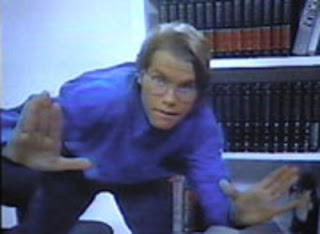
Remember him? He had a report due on space. Then he found himself swimming in a veritable font of information. Almost too much. So much, that if you'll recall, he actually received a B+ on that famous report on space. It was too long, too professional, too above and beyond the call of duty, that his teachers couldn't even handle it. I, however, had need for all the help I could get. So, while a couple of friends were visiting, I popped in the old VHS I keep all of my Encyclopedia Britannica commercials on, and gave it a whirl.
I had forgotten about the meta-commentaries provided by the omniscient voice. It's interesting, almost as if the producers had such a lack of faith in The Encyclopedia Britannica Kid's (to be subsequently referred to as 'The Kid') abilities to carry the commercial on his own, that they created this meta-narrative to showcase their own insecurities. It was common practice in the 1980's, as my forthcoming review of the MR. AND MS. PACMAN STORYBOOK ALBUM shall illustrate.
In any event, the producers of the commercial created 'The Kid.' Child voice actor Donavan Freberg breathed life into him, gave him flesh. Yet then they insert this omniscient voice to deride The Kid, to tear him down, to dismiss him. Not completely, but overtly enough. They have the voice insert bored, condescending responses ("Uh-huhhh...," "Um...yes," "Uh...good," "Hmm," "Mm-hmm") as if the voice simply can't wait for The Kid to stop talking so that he can take over. I'll tell you what was happening: the producers were afraid. They were afraid viewers would disrespect The Kid. Tear him down themselves. So they acted preemptively. If we tear The Kid down first, we'll take all the fun out of it for them. In fact, they might even start sympathizing with The Kid, and then we'll sell more encyclopedias. It's basic psychology, and it's clever psychology. Let's say that it worked on me. Alright, so let's have that 800 number. And there it is:
And, shit the bed! Just for previewing Britannica, they'll send me, for free, a three-volume desk reference set of $14.40 value.

It's been a number of years since this commercial aired. I'm excited right now, but I'm probably just setting myself up for disappointment. It's late, too. It's almost three A.M...maybe I should try tomorrow...no! A helpful, visiting friend-of-a-friend from Buffalo makes up my mind for me, ends the paralysis that grips the room. He takes his phone, dials the number, and it begins to ring. Everyone in the room awaits the pick-up with baited breath. It feels as if the phone rings ten or twelve times.
Suddenly, a female voice:
"Hello?" She fails to immediately identify herself.
"Hello, I'm calling about the Encyclopedia Britannica, about the free three-volume set, of $14.40 value being offered right now."
"One moment, please."
Our minds would be racing if they hadn't just been blown. Have we wandered into some Twilight Zone time loop? Is it possible to go back? Is it truly possible to go home again? Can we find ourselves in a world where one can eat Dunkaroos and wash them down with Coke II and Ecto Cooler and then brush our teeth with toothpaste that comes out of the tube in the shape of a multi-colored star? Does time have no dominion over the promises made by 80's television? Can we indeed get our free books of $14.40 value?
The passing of time seems interminable. The phone's on speaker, and we can all hear clinking and clacking, office noises. It's real. This is really happening.
"I'm sorry, we don't carry that product, sir."
The inevitable disappointment. The patchwork dreamworld shattered by a dose of reality.
"No, I'm telling you, I'm looking at the TV right now- looking at this phone number-"
"I'm sorry-"
"No, there's this kid. I'm watching it right now! He's got a mullet, this red shirt, black pants–"
"We carry no such product, sir."
"Well, what products do you carry?!"
"Golf Digest magazine, sir."
This continued only a little longer. After a brief discussion involving the merits of golf, the beleaguered operator woman decided to let him go, probably figuring we were a couple of smarmy kids having a laugh at her expense. She couldn't have been more wrong. Now I find myself on the other end of the ouroboros. I've been spat out by the beast and swallowed once more. Now I'm the kid who has a report due on space. Only there's no due date, and I no longer can claim to be a 'kid.' It's all a big mess with the wreckage piled atop itself into infinity. And somehow I get the feeling the answers were all floating out there on the frigid, hazy January night we tried to meld past and present...
Remember me? ...I'm the kid that had a report due on space...
-Sean Gill
Remember him? He had a report due on space. Then he found himself swimming in a veritable font of information. Almost too much. So much, that if you'll recall, he actually received a B+ on that famous report on space. It was too long, too professional, too above and beyond the call of duty, that his teachers couldn't even handle it. I, however, had need for all the help I could get. So, while a couple of friends were visiting, I popped in the old VHS I keep all of my Encyclopedia Britannica commercials on, and gave it a whirl.
I had forgotten about the meta-commentaries provided by the omniscient voice. It's interesting, almost as if the producers had such a lack of faith in The Encyclopedia Britannica Kid's (to be subsequently referred to as 'The Kid') abilities to carry the commercial on his own, that they created this meta-narrative to showcase their own insecurities. It was common practice in the 1980's, as my forthcoming review of the MR. AND MS. PACMAN STORYBOOK ALBUM shall illustrate.
In any event, the producers of the commercial created 'The Kid.' Child voice actor Donavan Freberg breathed life into him, gave him flesh. Yet then they insert this omniscient voice to deride The Kid, to tear him down, to dismiss him. Not completely, but overtly enough. They have the voice insert bored, condescending responses ("Uh-huhhh...," "Um...yes," "Uh...good," "Hmm," "Mm-hmm") as if the voice simply can't wait for The Kid to stop talking so that he can take over. I'll tell you what was happening: the producers were afraid. They were afraid viewers would disrespect The Kid. Tear him down themselves. So they acted preemptively. If we tear The Kid down first, we'll take all the fun out of it for them. In fact, they might even start sympathizing with The Kid, and then we'll sell more encyclopedias. It's basic psychology, and it's clever psychology. Let's say that it worked on me. Alright, so let's have that 800 number. And there it is:
And, shit the bed! Just for previewing Britannica, they'll send me, for free, a three-volume desk reference set of $14.40 value.
It's been a number of years since this commercial aired. I'm excited right now, but I'm probably just setting myself up for disappointment. It's late, too. It's almost three A.M...maybe I should try tomorrow...no! A helpful, visiting friend-of-a-friend from Buffalo makes up my mind for me, ends the paralysis that grips the room. He takes his phone, dials the number, and it begins to ring. Everyone in the room awaits the pick-up with baited breath. It feels as if the phone rings ten or twelve times.
Suddenly, a female voice:
"Hello?" She fails to immediately identify herself.
"Hello, I'm calling about the Encyclopedia Britannica, about the free three-volume set, of $14.40 value being offered right now."
"One moment, please."
Our minds would be racing if they hadn't just been blown. Have we wandered into some Twilight Zone time loop? Is it possible to go back? Is it truly possible to go home again? Can we find ourselves in a world where one can eat Dunkaroos and wash them down with Coke II and Ecto Cooler and then brush our teeth with toothpaste that comes out of the tube in the shape of a multi-colored star? Does time have no dominion over the promises made by 80's television? Can we indeed get our free books of $14.40 value?
The passing of time seems interminable. The phone's on speaker, and we can all hear clinking and clacking, office noises. It's real. This is really happening.
"I'm sorry, we don't carry that product, sir."
The inevitable disappointment. The patchwork dreamworld shattered by a dose of reality.
"No, I'm telling you, I'm looking at the TV right now- looking at this phone number-"
"I'm sorry-"
"No, there's this kid. I'm watching it right now! He's got a mullet, this red shirt, black pants–"
"We carry no such product, sir."
"Well, what products do you carry?!"
"Golf Digest magazine, sir."
This continued only a little longer. After a brief discussion involving the merits of golf, the beleaguered operator woman decided to let him go, probably figuring we were a couple of smarmy kids having a laugh at her expense. She couldn't have been more wrong. Now I find myself on the other end of the ouroboros. I've been spat out by the beast and swallowed once more. Now I'm the kid who has a report due on space. Only there's no due date, and I no longer can claim to be a 'kid.' It's all a big mess with the wreckage piled atop itself into infinity. And somehow I get the feeling the answers were all floating out there on the frigid, hazy January night we tried to meld past and present...
Remember me? ...I'm the kid that had a report due on space...
-Sean Gill
Subscribe to:
Posts (Atom)