Stars: 4 of 5.
Running Time: 95 minutes.
Notable Cast or Crew: Charles Bronson, Martin Balsam (PSYCHO, DEATH WISH 3), Paul Koslo (ROBOT JOX, MR. MAJESTYK), Norman Fell (THE GRADUATE, THE KILLERS, BULLITT), Jack Colvin (CHILD'S PLAY, ROOSTER COGBURN), David Sheiner (BLUE THUNDER, THE ODD COUPLE), John Ritter. Music by Roy Budd (Don Siegel's THE BLACK WINDMILL, GET CARTER). Presented by Dino de Laurentiis.
Tag-line: "Take away his badge and he'd top the Ten Most Wanted list!"
Best one-liner: Cop #1: "What hit him?!" Bronson: "A complete state of death."
Now I can't say that THE STONE KILLER is top-shelf Bronson, but there's enough kickass action and total bizarre-itude to make it more than worthy of an intense discussion. Now this was the third of six collaborations between Bronson and English director Michael Winner (CHATO'S LAND, THE MECHANIC, DEATH WISH 1, 2, & 3), and at this point, it's fascinating to examine the recurring tropes that would typify their work. More on that later. Here, Bronson plays Detective Lou Torrey, an Italian-American crime-stomper. I love that his name is Lou. He's supposed to be Italian, but he mispronounces "Guido" as "Gee-do" at least a dozen times.
Cop #1: "He's got a big gun."
Bronson: "....And a small future."
THE STONE KILLER begins with a scene that feels very DIRTY HARRY-inspired, down to Roy Budd's rip-off Lalo Schifrin score. In fact, let's talk about the score for a second. It's full of schweet grooves and mewing keyboards that recall Schifrin, but then it occasionally is full of despondent Euro-Crime melancholy (at the request of Dino de Laurentiis?). And every once in a while, some
serious horn sections come out of nowhere to have out their say. These trumpets are quite literally blurting out interjections that are so sudden, you may find yourself enjoying a spit-take. It's quite an experience. Anyway, back to the opening scene. Bronson is pursuing an underage suspect up a stairwell (there are a lot of stairwells in this movie). He follows him onto a fire escape, where the kid pulls a gun and Bronson blows him away. The kid flies back and awkwardly lands, hanging by his legs, on the fire escape.
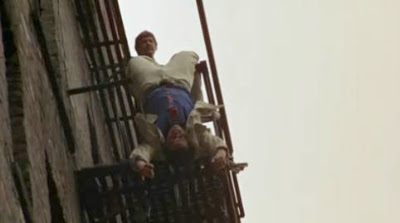
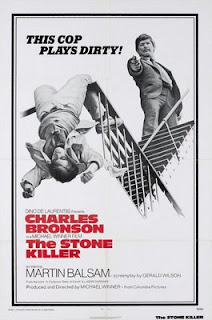
For whatever reason, the producing/marketing team thought that this was the film's most evocative image, and centered their ad campaign around it. (See poster.) Anyway, Bronson has to turn in his NYPD badge (the kid pulled a gun on him in front of witnesses, so I'm not sure why), and he hightails it to the west coast where he quickly becomes a member of the LAPD. [And as with most 70's L.A. crime movies, it's all about cars as big as battleships and tuff lookin' dudes in wool suits walking around on sun-beaten pavement.] Bronson's new boss is perennial TV actor Norman Fell,
 Fell.
Fell.
and he's paired with an incompetent racist partner who seems to exist only to show what Bronson's
not. Bronson possesses equal disdain for all peoples, all ethnicities, all religions, and all sexual orientations– not just for black people. He even goes one step further and reveals complete disdain for
racists in particular (he calls one "Cracker!"). Attaboy, Bronson.
 Disdain for the legal system.
 Disdain for all peoples.
 Bored disdain for all peoples.
 Disdain for the blood he's beaten out of a suspect.
 Disdain for a cop enjoying a Miller on duty.
 Somewhere below, there's disdain for the stunt double used in this sequence.
The key word for Bronson's performance here is "apathy." He doesn't have a sense of humor about anything, even his one-liners, which are frequent. When he heads back to NYC later in the film, he asks a cabbie to drop him off at the 4th precinct. "What's a nice guy like you want with the 4th Precinct house?," says the cabbie. "They give a good massage and a quick piece of ass," says Bronson- without a shred of levity. And he pronounces the first part of "massage" like "MASSachusetts." There's something about Bronson delivering a sexualized zinger with such by-the-numbers impassivity: it's definitely unclear if he knew he was delivering a joke. It's so matter-of-fact, you briefly wonder- maybe the 4th precinct
does give a good massage and a quick piece of ass? But this actually
adds to the character.
Similarly: "You wop bastard, how the hell are you? You like L.A.?" says an old buddy. "It's better than a sharp stick in the eye," responds Bronson, and you genuinely believe that he has weighed the pros and cons of 'L.A.' and 'a sharp stick in the eye,' and after careful deliberation, has determined that L.A.
is, in fact, better than a sharp stick in the eye. Thus, he's not making a joke, or a smart-alecky remark, he's merely imparting a nugget of information to his friend.
But Bronson is not just some one-dimensional tough guy. Winner includes a few 'deeper' characterizations. As in
THE MECHANIC, Bronson has a disturbing work of art in his apartment (here, it's Francisco Goya's "Saturn Devouring His Son"– before, it was Bosch's "The Garden of Earthly Delights") which provides a glimpse of the tortured interior, and there's an odd scene of avant-garde self-reflection where Bronson stares into a mirror (which shatters and crosscuts with John Boorman-style edits to previous scenes of violence).
The plot concerns a forty year-old vendetta between mobster Martin Balsam and some other Eye-talians. Balsam's raising an army of "stone killers" (assassins with whom he has no connection) to take out his enemies on the anniversary of a historical mob massacre. Most of these stone killers happen to be Vietnam vets, which I'm sure intended some political statement, but in Winner's films, political statements are usually confined to just the mention of "Vietnam" or "hippies" or "racism." That's fine, though– none of us came here with a thirst for thoughtful social commentary.
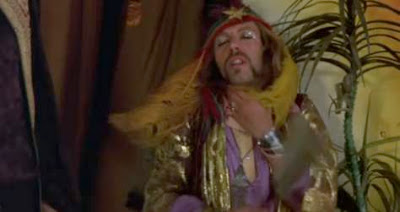
On the side of the baddies is psychotic bisexual trombone-playing assassin Paul Koslo (the over-the-top villain in ROBOT JOX and a frequent Bronson collaborator– MR. MAJESTYK & LOVE AND BULLETS. He also collaborated with Eastwood on JOE KIDD- hmm...).
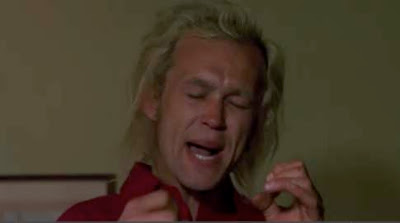
Koslo plays his role with such ratty-haired, delicious pizazz, you know that somewhere, even Michael Moriarty is getting jealous. When Bronson's on his trail, he questions a woman who reveals that "Sometimes he's with a chick– he's a switcher." Bronson then mutters something about "...the best of both worlds."
WHUTTT!?
Now, there's two things that Bronson and Winner frequently return to: hippies and ice cream. (See my reviews of
THE MECHANIC,
DEATH WISH II, and
DEATH WISH 3 for added insight):
 Look at him– Bronson is so single-mindedly devoted to the case that he has NO IDEA that the promise of "frosty shakes" lies a mere 20 feet behind him.
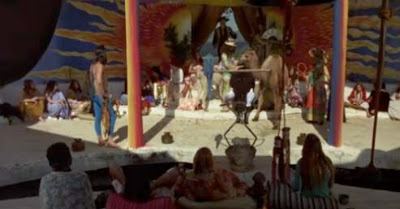
Shortly thereafter, Bronson shows up at this hippie commune that basically looks like a scene from an Alejandro Jodorowsky film.
As Bronson questions a woman, he remains blasé and willfully unaware of the
TOTALLY INSANE tambourine-infused, wild hippie dance orgy going on right behind him:

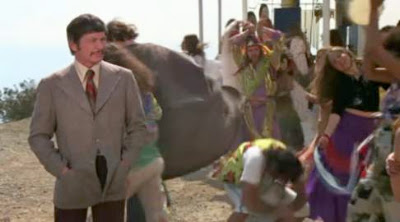
Yeah, this is pretty great. There's also a recurring theme in Winner's films of the hero interrupting mid-coitus couples during chase scenes, but that seems to be a further-reaching cliché than these previous examples, so I shan't discuss it in detail.
All of this leads up to the finale we've all been waiting for: the actual massacre of mobsters.
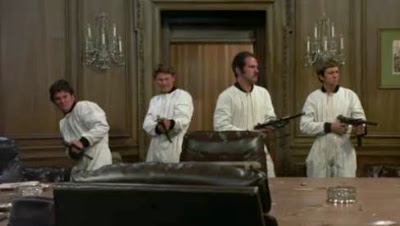
Dudes wearing YOU ONLY LIVE TWICE-henchmen costumes burst in and gun down a ton of cigar-smoking Sicilians. I don't know if they ran out of extras, but we get to see a couple of guys bite the dust twice.
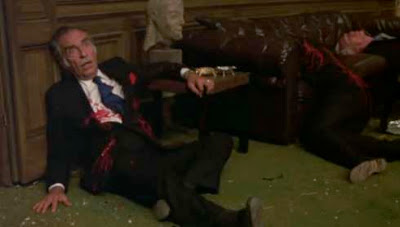
Then, the
piéce de résistance:
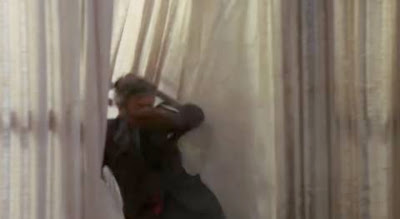
A mobster gets shot through a window, plummeting to his extraordinary death below...
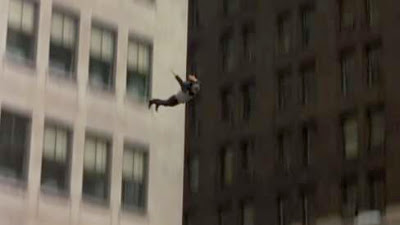
This again makes me wonder; as nearly every single Bronson movie- Cannon, De Laurentiis, or otherwise– has at least one scene where a dummy plummets to its doom. I think Bronson must have gotten a secret kick out it and confidentially demanded that it be written into his contract. Here, there's even
two: when Bronson shoots one of the assassins in the stairwell, he flips over the railing, and there you go.
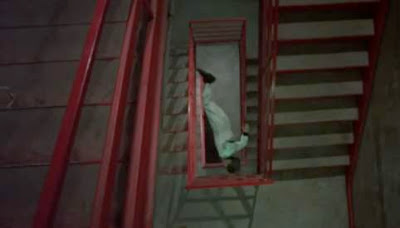
William Lustig (director of MANIAC COP, VIGILANTE) has praised the film for having some of the best uses of plummeting dummies in a studio picture.
Then there's the final, head-scratching scene. It's so bizarre that I don't even think that discussing it could constitute a spoiler.
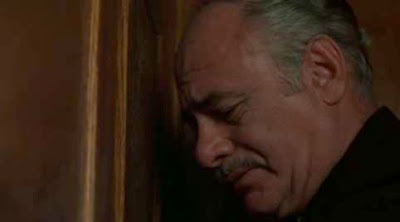
Balsam goes to confession, and Bronson and another cop watch the church from a car.
 With disdain, I might add.
Bronson makes a speech:
"We're chest deep in water. Screaming against the rushing tide. You know, last three weeks, in New York City alone, there were 159 homicides? 3,000 criminal assaults, 6,000 robberies. You multiply that by Chicago, Boston, Philadelphia, Los Angeles... You remember that cartoon of an old Roman Circus, where all the lions are roaring, and the page boy yells down the corridor...
 ...YOU'VE GOT FIVE MINUTES, CHRISTIANS!"
Now, I guess one could see this as a direct transition from THE STONE KILLER to the first DEATH WISH (made by the same team the next year), but I'm not sure exactly who the Christians are in the metaphor here. I guess
we're the Christians, cause the criminals are all coming for us, and he's kind of addressing the camera. But then again, it's kind of like a
threat- maybe the criminals are the Christians, and Bronson is coming after them in five minutes? Or perhaps
Bronson and the other cops are the Christians, and they've got five minutes before the criminals start coming after them? Well, regardless, it's a credit to the complexity of the line reading and the pensive screenwriting that we're able to have discussions like this thirty-six years after the fact. And, Charles, by the way– No, I do not remember that cartoon.
-Sean Gill