"What would you do if I bit your face now... suddenly?" Gotta love MR. JEALOUSY. It offers astute, biting commentary on romantic relationships, daring to go to places of jealousy, resentment, and self-hatred where even dramatic films (much less comedies!) fear to tread. It offers bold 1930's-style screwball, mistaken identities, a ludicrous bit part by Peter Bogdanovich as Dr. Poke, the finest ever use of Harry Chapin's "Cat's in the Cradle," and tackles OCD, substitute teaching, Gustav Flaubert, and the eternal question of "Do people really spit in the communal coffee creamer?" It's well-populated by genius performances from the likes of Baumbach standbys like Eric Stoltz, Chris Eigeman, Annabella Sciorra, Carlos Jacott, and John Lehr, (and a great one from Baumbach newcomer Marianne Jean-Baptiste, fresh off of Mike Leigh's SECRETS AND LIES). Noah Baumbach himself even gets to prove that he was born to do voice-over narrations. And, of course, the excess budget brought us little-known gem that is HIGHBALL. In all, one of the best-written movies of the 90's, and a film so good that naturally Armond White's response was to call for Baumbach's retroactive abortion. If that doesn't prove you've made a great film, I don't know what does.
64. KNIGHTRIDERS (1982, George A. Romero)
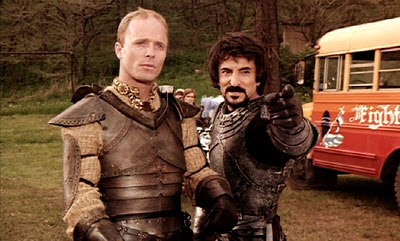
"I'M FIGHTING THE DRAGON!" Yes, you certainly are, Ed Harris. You are, too, Mr. Romero. You have to fight the dragon, gentlemen, for you feel the moral imperative to do so. You live in a world of insanity, your options limited to being crushed beneath it's bootheel, lashing out madly, or retreating into oneself. In a way, this is the definitive counter-culture film. It unfolds with an ensemble-based subtlety that recalls the best Renoir and Altman. It reveals an ensemble of fully-developed, REAL characters trying to deal with existential confusion and a world gone mad, NOT, as the cover art might suggest, a group of medieval-themed bikers pillaging the countryside. Romero has taken timeless messages on brotherhood and sisterhood from the tales of King Arthur and languidly, thoughtfully, applied them to the modern era. George Romero is not merely a horror filmmaker, nor is he, in fact, merely a filmmaker. He is a philosopher, a poet, a sociologist and a true citizen of the world. I salute you, Mr. Romero, a man who unfailingly depicts the true heights and depths of humanity, whether it be in the midst of a zombie holocaust or while good friends bond over a quiet campfire. May you continue to grace us with such compassionate, thoughtful works. Also: Stephen King's cameo as a local yokel and Tom Savini's amazing "80's sell-out" costume receive my highest commendations.
"I'M FIGHTING THE DRAGON!" Yes, you certainly are, Ed Harris. You are, too, Mr. Romero. You have to fight the dragon, gentlemen, for you feel the moral imperative to do so. You live in a world of insanity, your options limited to being crushed beneath it's bootheel, lashing out madly, or retreating into oneself. In a way, this is the definitive counter-culture film. It unfolds with an ensemble-based subtlety that recalls the best Renoir and Altman. It reveals an ensemble of fully-developed, REAL characters trying to deal with existential confusion and a world gone mad, NOT, as the cover art might suggest, a group of medieval-themed bikers pillaging the countryside. Romero has taken timeless messages on brotherhood and sisterhood from the tales of King Arthur and languidly, thoughtfully, applied them to the modern era. George Romero is not merely a horror filmmaker, nor is he, in fact, merely a filmmaker. He is a philosopher, a poet, a sociologist and a true citizen of the world. I salute you, Mr. Romero, a man who unfailingly depicts the true heights and depths of humanity, whether it be in the midst of a zombie holocaust or while good friends bond over a quiet campfire. May you continue to grace us with such compassionate, thoughtful works. Also: Stephen King's cameo as a local yokel and Tom Savini's amazing "80's sell-out" costume receive my highest commendations.
63. THE CHANGELING (1980, Peter Medak)
I wrote previously that:
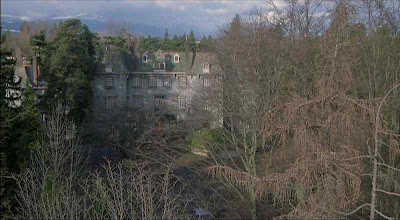
For the uninitiated, it must be said that the less you know about THE CHANGELING, the better, so I'll avoid revealing anything about the plot. Somehow the median point between Nicolas Roeg's DON'T LOOK NOW and the turn-of-the-century ghost stories of M.R. James, THE CHANGELING is a sheer force of atmospheric dread. Director Peter Medak is a master of effectively using space, foreboding architecture, and ornate interior design– as well as the roaming camera which captures them. In THE RULING CLASS (1972), he nearly turned the expansive Gurney estate into a character- an object of desire for some, and a turgid reminder of a centuries-old oligarchy to others. While it was not a 'horror' film in the purest sense, I feel as if Medak learned much back then, and merely had to subtly tweak his techniques in order to create a seriously sinister mood. The score, by Rick Wilkins, is hauntingly evocative, consisting of ever-flowing, swirling piano, surging and eddying like sudden rushes of air or a gentle, ghostly breaths. The cast is phenomenal: George C. Scott's stoic melancholy, Melvyn Douglas' tortured countenance, and Trish Van Devere's harried energy go a long way toward establishing the atmosphere. THE CHANGELING belongs to the genre which I call 'melancholy horror,' consisting of films like CASTLE FREAK or DEAD & BURIED. It's almost as if a shroud lies draped upon the film- a defeated sigh, a pensive look, a sense of loss. But make no mistake, this film is SCARY. Medak portrays the supernatural in a manner that, for me, is unmatched: to feel the otherworldly as an ominous presence that lingers just outside the frame- Kubrick does it in THE SHINING, Alan Parker does it in ANGEL HEART, Lynch does it in TWIN PEAKS, and Medak does it here. He doesn't have to rely on cheap 'sudden loud noise' scares, he builds a genuine sense of foreboding from the ground up, and takes the material very seriously. Without this film, there would be no RINGU (or, consequently, THE RING), THE OTHERS, or even THE DEVIL'S BACKBONE. It's one of the great ghost stories, unsullied by time, and as long as we fear the unknown, this film will continue to resonate.
I wrote previously that:
For the uninitiated, it must be said that the less you know about THE CHANGELING, the better, so I'll avoid revealing anything about the plot. Somehow the median point between Nicolas Roeg's DON'T LOOK NOW and the turn-of-the-century ghost stories of M.R. James, THE CHANGELING is a sheer force of atmospheric dread. Director Peter Medak is a master of effectively using space, foreboding architecture, and ornate interior design– as well as the roaming camera which captures them. In THE RULING CLASS (1972), he nearly turned the expansive Gurney estate into a character- an object of desire for some, and a turgid reminder of a centuries-old oligarchy to others. While it was not a 'horror' film in the purest sense, I feel as if Medak learned much back then, and merely had to subtly tweak his techniques in order to create a seriously sinister mood. The score, by Rick Wilkins, is hauntingly evocative, consisting of ever-flowing, swirling piano, surging and eddying like sudden rushes of air or a gentle, ghostly breaths. The cast is phenomenal: George C. Scott's stoic melancholy, Melvyn Douglas' tortured countenance, and Trish Van Devere's harried energy go a long way toward establishing the atmosphere. THE CHANGELING belongs to the genre which I call 'melancholy horror,' consisting of films like CASTLE FREAK or DEAD & BURIED. It's almost as if a shroud lies draped upon the film- a defeated sigh, a pensive look, a sense of loss. But make no mistake, this film is SCARY. Medak portrays the supernatural in a manner that, for me, is unmatched: to feel the otherworldly as an ominous presence that lingers just outside the frame- Kubrick does it in THE SHINING, Alan Parker does it in ANGEL HEART, Lynch does it in TWIN PEAKS, and Medak does it here. He doesn't have to rely on cheap 'sudden loud noise' scares, he builds a genuine sense of foreboding from the ground up, and takes the material very seriously. Without this film, there would be no RINGU (or, consequently, THE RING), THE OTHERS, or even THE DEVIL'S BACKBONE. It's one of the great ghost stories, unsullied by time, and as long as we fear the unknown, this film will continue to resonate.
62. KOYAANISQATSI (1983, Godfrey Reggio)

The hypnotically transcendent imagery of Godfrey Reggio (and DP Ron Fricke) and the transcendentally hypnotic music of Philip Glass are perhaps the perfect fusion of sound and image in film. Eschewing mere 'words' in favor of a view of the world from perhaps the omniscient vantage point of the "angel of history," Reggio brilliantly illustrates the process by which we are subverting– no, perverting the concept of a genuine, harmonious existence through almost every aspect of our modern society. It's a humbling film, one that places one's own insignificance into an even wider context; it makes our personal time and our personal space seem so very, very painfully small. When the bulldozers first appear after a series of idyllic landscapes, you want to cry "INTRUDER!," you want to destroy them and their faceless mechanical obscenity! It says more by saying less than FERNGULLY, AN INCONVENIENT TRUTH, AVATAR, CAPTAIN PLANET, and every other well-meaning environmental film combined, because it's intent is not to "recycle more" or "save the whales" or "prevent oil spills," its intent is to show us, quite graphically, how, for most of us, our entire lifestyles, from when we wake in the morning till when we go to sleep at night, from cradle to the grave, are (to use some of Hemingway's favorite terminology) inauthentic. It's not a problem that'll be solved through sorting the glass bottles from the plastic ones, nor from turning the A/C unit from high to low; it's a call to reinvent ourselves, to recreate what it means to be a human being in a society that has only been in existence for as long as a blink of the cosmic eye. It's a powerful film, and one of only a chosen few that dares show how irrevocably fucked and how painfully trivial we really are.
61. THE RED SHOES (1948, Michael Powell & Emeric Pressburger)

Astonishing spectacle and tempestuous melodrama in a ferocious blaze of wondrous Technicolor. I've sung the praises of Powell & Pressburger earlier in this countdown, but words cannot do this film justice. It's a true pleasure to the point of pain, and if you haven't seen it– goddammit, just see it. Here's a taste for the uninitiated.
Coming up next: Gutter poetry, drug addiction, and James Woods... And no– not all three at the same time!
Previously on the countdown:
#70-66
#75-71
#80-76
#85-81
#90-86
#95-91
#100-96
Runners-up Part 1
Runners-up Part 2
Previously on the countdown:
#70-66
#75-71
#80-76
#85-81
#90-86
#95-91
#100-96
Runners-up Part 1
Runners-up Part 2