Showing posts with label Michael Winner. Show all posts

Monday, January 21, 2013

RIP, Michael Winner

Michael Winner, a much beloved director here at Junta Juleil, passed away this morning.  
His best-crafted films include the original DEATH WISH, THE SENTINEL, and THE MECHANIC, but I think he'll be most remembered for DEATH WISH 3, the outrageous, incredible Cannon film that reigns over action movie sequels like a benevolent, chicken-loving monarch.  And his legendary multi-film partnerships with giants of cinema Charles Bronson and Oliver Reed shall not be forgotten.  Here's to you, Mr. Winner, here's to exploding juke boxes, mail-order rocket launchers, and dummies plummeting to their doom– your films have made this viewer very happy.  R.I.P.

Thursday, August 25, 2011

Bronson in THE STONE KILLER finally coming to DVD

[stone7.jpg]
It's not the greatest Bronson flick there ever was, but for those desiring cheap thrills and 70's Bronson crime-stomping, THE STONE KILLER sure fits the bill. I wrote a semi-lengthy review of it HERE some time ago, and now it's time to retire the VHS, cause you can get it on DVD-R from the Warner Archive HERE.

Friday, June 3, 2011

The Runners-Up to Junta Juleil's Top 100, Part 2

Ah, more spillover. But next, we'll be cracking the Top 100 for real.

DRACULA (1931, Tod Browning)
https://blogger.googleusercontent.com/img/b/R29vZ2xl/AVvXsEizFFZqunv3mgz7_L3Kf6p3SUp59wtnffpJJiI2sfBSkKRQ_mX_IWNd8s69HG-tjNACCHWZS42A2G0aSWk2YHxymyERLLKJbSucnvpEISbcGe13OmJKGWHqXvNlHSRPvOOdy7PUNi_VG1qc/s1600/screenshot436.jpg
I've said before that "DRACULA is a monster classic, full of fleeting, mystical moments and ethereal majesties. Exceedingly atmospheric and possessing one of the most iconic leading performances in film history, DRACULA is a Halloween fixture and a classic of early sound cinema; it's mandatory viewing not only for horror fans, but for cineastes in general." The maniac élan of Dwight Frye; the ineffable, funereal poetry of Lugosi's performance; the weight and the torment of centuries... while it may not be an objectively perfect film, dammit, it's close enough for me.

STROZEK (1978, Werner Herzog)
http://doctordocumentary.files.wordpress.com/2010/03/stroszek-dancing-chicken-e1277851693909.jpg
"No one kicks you here, Bruno." –"Not physically...here they do it spiritually." So Herzog tackles the American Dream, er, let's make that the American Nightmare. How do we get from a point where the emotionally and institutionally damaged German street performer Bruno S. (played by the emotionally and institutionally damaged real-life German street performer, Bruno S.) is escaping thugs in Germany to find a better life in America, to the point where a cop is screaming "WE CAN'T STOP THE DANCING CHICKENS! WE CAN'T STOP THE DANCING CHICKENS, SEND AN ELECTRICIAN!?" Well, I'm not going to tell you how. See the film for yourself. But be prepared for more humanity in non-actor Bruno S.'s little finger than in the entirety of your average, unfortunate member of that species we call Homo sapiens.

THE MECHANIC (1972, Michael Winner)
[screenshot29584+copy.jpg]
A Michael Winner movie permitted to even bask in the presence of the top 100?! Yeah, you heard me right. While this might not be the best movie that Bronson was ever in, this is probably the best "Bronson movie." I've written of my love for this flick before: It's a detached, melancholy thriller with crisp, artistic cinematography; a dissonant, unnerving Jerry Fielding score; and perhaps Bronson's most complex, compelling performance. And, boy, has it got a doozy of an ending. Highest marks. (Plus, this might mark the beginning of Bronson's love affair with ice cream– not to be confused with his love affairs with chicken or bananas.)

THE LIMEY (1999, Steven Soderbergh)
http://i52.tinypic.com/21nqwpx.jpg
The style of swingin' 60's Godard, but without all the pompous, pseudo-revolutionary hogwash and self-congratulatory pretension that've infected his films sometime since 1965 or so, THE LIMEY has what every movie should have: an aged, blood-spattered Terence Stamp screaming at the top of his Cockney lungs, "Tell him I'm fucking comingggg!" The brutality of a POINT BLANK or an OUTFIT combined with the thoughtfulness of a Jean-Pierre Melville or an Antonioni, THE LIMEY is, hands-down, Soderbergh's masterpiece. Cliff Martinez's somber, furtive score; the use of counter-culture icons like Peter Fonda, Barry Newman, and Joe Dallesandro; the lunatic improvisations of a pony-tail'd Nicky Katt; brilliant, deadpan sidekickery by Luis Guzman; and the ethereal cinematography of Edward Lachmann all revolve around the furious, uncompromising, force-of-nature lead portrayal by Terence Stamp. It's THE REMEMBRANCE OF THINGS PAST for the Sons of Lee Marvin.

EXTREME PREJUDICE (1987, Walter Hill)
[screenshot9915.jpg]
Because I can't really think of any way to put it better than I already did, I'll say this: "Before you stick this thing in your player, I want you to mark out an 8 foot radius around your TV set. Then I want you to make sure there's nothing in that zone that you wouldn't mind having 40 gallons of testosterone poured over. EXTREME PREJUDICE has been proven to make wombs shrivel and has turned the frilliest of ladies quite husky; it makes men stumble, confused, into the street with a mysterious desire to chomp on cigars and arm wrestle. It's robust, potent, severe, and is completely safe when used as directed." It's the ultimate manly man's 'manly man' movie, and just about the most fun you can have indoors on a hot summer's day. And I'll leave you with two words that you should always remember: "Michael," and "Ironside."

THE SADDEST MUSIC IN THE WORLD (2003, Guy Maddin)

http://www.joshuaavram.com/includes/img/filmreviews/XA%20The%20Saddest%20Music%20in%20the%20World.jpg
"If you're sad, and like beer, I'm your lady." To that, I answer "why, I'm all of the above, but I thought Isabella Rossellini was already my lady." Guy Maddin, George Toles, and Kazuo Ishiguro put their heads together for a completely deranged, nostalgia-soaked, impeccably-desinged paean to silent and early sound cinema, a film so utterly bizarre and completely sincere that it avoids the typical pitfalls of pastiche. And even though the ending is borrowed from HANGOVER SQUARE, by God, it still takes the guts outta ya. (Also: Isabella Rossellini has prosthetic legs filled with beer, which might be enough to get this near the Top 100 alone.)

DOWN BY LAW (1986, Jim Jarmusch)
http://blog.lib.umn.edu/clyne003/1601fall2008/18847649.jpg
Picking a favorite Jarmusch film is a lofty task; I've got major soft spots in my heart for STRANGER THAN PARADISE, DEAD MAN, GHOST DOG, and MYSTERY TRAIN, to name a few. But nothing can match what Tom Waits called "a Russian neo-fugitive episode of THE HONEYMOONERS," the dingy-bayou prison-break (that doesn't actually show the prison-break) classic, DOWN BY LAW. You can almost touch the peeling paint, feel the haze of everpresent New Awlins humidity, smell the stench and stagnancy of the swamps... And that's not the half of it- there's the inscrutable John Lurie, the drunken Tom Waits, and the never-better zany Eye-talian, Roberto Begnini!

LE TROU (1960, Jacques Becker)
http://hopeliesat24framespersecond.files.wordpress.com/2011/03/le-trou-becker-criterion-pdvd_009001.jpg
Speaking of prison breaks, this one's all about the logistics, the timeframe, and the little details that make it feel real. Jacques Becker's observational style is applied to a group of desperate, jailed men, and the results are astounding. He documented the behavior of criminals before in TOUCHEZ PAS AU GRISBI, but these men are anguished, doomed souls, yearning for freedom– they aren't zoot suit-wearing bon vivant gangsters; they're working-class buddies who had to push the acceptable limits of human behavior to survive in the free world (until they got busted), and now they have to push the limits of their own ingenuity if they want to survive a caged world. Often, in a film of this type, we'll see a man digging with a spoon or a toothbrush or a what-have-you, and then, via montage, we see the completed tunnel. There's an economy of storytelling in that, but it occasionally feels staged, contrived, or worse. In LE TROU, some men in real-time pass around a steel bar, taken from a bed, and smash at the concrete. When one man tires, he passes the bar to the next, and then to the next. Finally, with nary an edit, they break through, creating a hole. We've just seen the process and the effort which went into making the hole, and that is strangely satisfying. No smoke and mirrors here; it's real men doing real things. Strange that a genuine moment as simple as this should stick out to me in a life-time of film watching. Of course, it's not as simple as pointing a camera at someone doing something real and recording it– but I suppose therein lies Becker's genius.


BLOODSPORT (1988, Newt Arnold)
https://blogger.googleusercontent.com/img/b/R29vZ2xl/AVvXsEjQAPJWYqetYPPGXwWrTBWK3oNEoBJPIFuigQJZhAx1zTZxXH_jqu5KHW98MIMBUEpkfLV_qov7YDAlmBvBjhEgCcbbSTH_Zj4XbNCLuTkEz2HkVUvVwGyNn_Ljv0b4As9lH2Rwt2Ykd8o/s1600/screenshot9965.jpg
"What?!," I see you saying, way in the back, lurking in the darkness. "Who the hell lets BLOODSPORT within 30 miles of a Top 100 list?!" Well, 'Mr. Too-Fancy-to-Appreciate-Van-Damme's-Mastery-of-Splits-and-Full-Contact-Martial-Arts,' I do. Because there's something to be said for a movie (even if it's a big, dumb, fun movie) that can be watched again and again and again and again, forever. Cannon Films churned out some silly content and some serious content, but it was always audacious– ballsy, even- brimming with a genuine joie-de-vivre that was infectious then, and it's infectious now. Golan and Globus were producers who allowed their directors artistic control, who refused to stomp upon their creativity, and infused their production company with the sense that something new and exciting was happening– yeah, what were they thinking, right?! "Golan and Globus used to be big," says the naysayer in the rear. "No," I say, "they ARE big– it's the pictures that got small! KUMI-TE! KUMI-TE! KUMI-TE! KUMI-TE!"

THE MAN WHO WOULD BE KING (1975, John Huston)
https://blogger.googleusercontent.com/img/b/R29vZ2xl/AVvXsEjspIUhydX_sIhbjL0RKoHhi2LcLiwyvTNsL0IvliUBHI8e8XM7Y2SinjtALH8fOx03YtqSTPr__zb6_uJdUL5NMuwWpkcr3VCd3i-4Ic2K_9r5EaXyGSFq_dyuo92-ToqF96P-Tqs0thGM/s1600/Man+Who+Would+Be+King.jpg
A grand adventure film from a time when that didn't mean a CGI fuckfest with a heavily airbrushed poster, a $200 million budget, a cast of brain-dead fluffballs for the younger demographic and "wait, do we have a script yet?– here, let's assign these eight guys to it, each of whom has a notable credit from a high-profile reboot." Rudyard Kipling's tale of fortune and glory and deification has been laid out on the screen here by John Huston, perhaps the best-suited man for the job from Kipling's time to ours. Somehow, all at once, he captures rollicking fun, the absurdities of imperialism, the outrageous hubris of man, and the pathos which often swells beneath it. And rarely have two lead actors (here, Sean Connery and Michael Caine) been so perfectly cast, so full of life, so connected to material that flits to and fro from the light-hearted to the downbeat like the oscillations of a river's current, flowing through a dramatic, uncharted slit of a canyon, somewhere on the other side of the world...

HIGHBALL (1997, Noah Baumbach)
https://blogger.googleusercontent.com/img/b/R29vZ2xl/AVvXsEhjrjfF61BX_ebLfxSYSJfWmaPmZ8FoH8qeLI5XxGrs7o3Bq8xzs_pN8jDL_nuGqMEvxWzFydhess5A4zBSBKhf_CY0zvtOpexfwx9mlJTS3rRbt8f4b_uEWcXP8iBO9M1c4ZTOVfRL5GI/s1600/screenshot11809.jpg
Though this film's cult following outside of my apartment is likely pretty slim; I will say, that inside my apartment, said cult following is rather extensive and rather rabid. I've spoken of my love for this film before, and I have to say "it's the ultimate party movie for people who generally dislike party movies." Rae Dawn Chong as herself, Chris Eigeman, Carlos Jacott, John Lehr, Peter Bogdanovich... it's fantastic. Acerbic wit, low-budge' moxie, and an incredible re-watchability factor.

THE SCARLET EMPRESS (1934, Josef von Sternberg)

http://www.filmreference.com/images/sjff_03_img1057.jpg
Holy shit– let von Sternberg do whatever he wants, and this is the result: a cast of thousands; imposing, grotesque statuary and sets that spiral toward the heavens; intertitles and silent film techniques in the midst of sound film; Sam Jaffe leering with half-witted insanity (he gives Dwight Frye a run for his money); and Marlene Dietrich in opulent period costume pieces and shot with starry-eyed closeups. Some have described it as "kitsch," and maybe it is, but it's really a weighty examination of the nature of power: we only see Dietrich become the "Scarlet Empress" at the film's close, in fact, we spend the majority of our time with her as a frightened young woman spirited away to a foreign land, yanked to and fro by forces beyond her control. Ultimately, she embarks on an inevitable, fascinating journey towards becoming the sort of deadened, manipulating individual capable of wielding absolute power. It's pretty damned spectacular.

THE GARBAGE PAIL KIDS MOVIE (1987, Rod Amateau)
http://www.brightlightsfilm.com/53/53_images/53garbagedolls.jpg
Now I've done it– I've put Josef von Sternberg and John Huston in the same room as the Garbage Pail Kids, and I'll defend that decision to the death. Rarely does a movie achieve such a perfection of badness; not even TROLL 2 can quite compete with this schizophrenic tale of one-dimensional misfits. Take Ali Gator, for example. His dogged, single-minded quest to eat people's toes quickly vaults him onto the shortlist of my favorite characters in all of cinema. Seriously, his only character trait is that he longs, unswervingly, to hasten the union between your toes and his teeth. We've got little people in hideous, quasi-animatronic costumes. We've got "Captain Manzini," a sort of gutter-Shakespeare stock player. We've got bodily functions. Vomit. Farting. Musical numbers. We got a plot that revolves, entirely, around a fashion show. There's underage romance. Genuine rage. Powerlessness. Cries unto the night. Biker gangs. Toxic sewer sludge. Is it burlesque? Is it grotesque? The modern-day GARGANTUA AND PANTAGRUEL? WHAT THE HELL IS THIS THING?! All I do know is that it's truly something special, and if you'd caught me on a different day, hell, this thing could've cracked the Top 100 proper. So consider yourselves lucky. For now.

-Sean Gill

Monday, November 9, 2009

Film Review: THE STONE KILLER (1973, Michael Winner)

Stars: 4 of 5.
Running Time: 95 minutes.
Notable Cast or Crew: Charles Bronson, Martin Balsam (PSYCHO, DEATH WISH 3), Paul Koslo (ROBOT JOX, MR. MAJESTYK), Norman Fell (THE GRADUATE, THE KILLERS, BULLITT), Jack Colvin (CHILD'S PLAY, ROOSTER COGBURN), David Sheiner (BLUE THUNDER, THE ODD COUPLE), John Ritter. Music by Roy Budd (Don Siegel's THE BLACK WINDMILL, GET CARTER). Presented by Dino de Laurentiis.
Tag-line: "Take away his badge and he'd top the Ten Most Wanted list!"
Best one-liner: Cop #1: "What hit him?!" Bronson: "A complete state of death."

Now I can't say that THE STONE KILLER is top-shelf Bronson, but there's enough kickass action and total bizarre-itude to make it more than worthy of an intense discussion. Now this was the third of six collaborations between Bronson and English director Michael Winner (CHATO'S LAND, THE MECHANIC, DEATH WISH 1, 2, & 3), and at this point, it's fascinating to examine the recurring tropes that would typify their work. More on that later. Here, Bronson plays Detective Lou Torrey, an Italian-American crime-stomper. I love that his name is Lou. He's supposed to be Italian, but he mispronounces "Guido" as "Gee-do" at least a dozen times.

Cop #1: "He's got a big gun."
Bronson: "....And a small future."

THE STONE KILLER begins with a scene that feels very DIRTY HARRY-inspired, down to Roy Budd's rip-off Lalo Schifrin score. In fact, let's talk about the score for a second. It's full of schweet grooves and mewing keyboards that recall Schifrin, but then it occasionally is full of despondent Euro-Crime melancholy (at the request of Dino de Laurentiis?). And every once in a while, some serious horn sections come out of nowhere to have out their say. These trumpets are quite literally blurting out interjections that are so sudden, you may find yourself enjoying a spit-take. It's quite an experience. Anyway, back to the opening scene. Bronson is pursuing an underage suspect up a stairwell (there are a lot of stairwells in this movie). He follows him onto a fire escape, where the kid pulls a gun and Bronson blows him away. The kid flies back and awkwardly lands, hanging by his legs, on the fire escape.
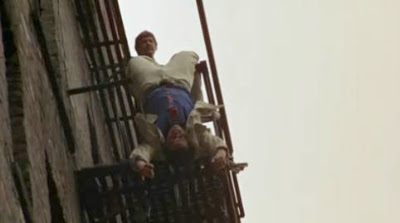
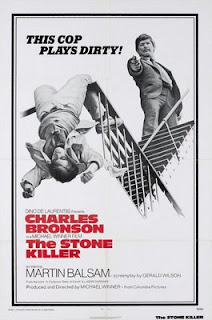
For whatever reason, the producing/marketing team thought that this was the film's most evocative image, and centered their ad campaign around it. (See poster.) Anyway, Bronson has to turn in his NYPD badge (the kid pulled a gun on him in front of witnesses, so I'm not sure why), and he hightails it to the west coast where he quickly becomes a member of the LAPD. [And as with most 70's L.A. crime movies, it's all about cars as big as battleships and tuff lookin' dudes in wool suits walking around on sun-beaten pavement.] Bronson's new boss is perennial TV actor Norman Fell,

Fell.
and he's paired with an incompetent racist partner who seems to exist only to show what Bronson's not. Bronson possesses equal disdain for all peoples, all ethnicities, all religions, and all sexual orientations– not just for black people. He even goes one step further and reveals complete disdain for racists in particular (he calls one "Cracker!"). Attaboy, Bronson.

Disdain for the legal system.


Disdain for all peoples.


Bored disdain for all peoples.


Disdain for the blood he's beaten out of a suspect.


Disdain for a cop enjoying a Miller on duty.


Somewhere below, there's disdain for the stunt double used in this sequence.

The key word for Bronson's performance here is "apathy." He doesn't have a sense of humor about anything, even his one-liners, which are frequent. When he heads back to NYC later in the film, he asks a cabbie to drop him off at the 4th precinct. "What's a nice guy like you want with the 4th Precinct house?," says the cabbie. "They give a good massage and a quick piece of ass," says Bronson- without a shred of levity. And he pronounces the first part of "massage" like "MASSachusetts." There's something about Bronson delivering a sexualized zinger with such by-the-numbers impassivity: it's definitely unclear if he knew he was delivering a joke. It's so matter-of-fact, you briefly wonder- maybe the 4th precinct does give a good massage and a quick piece of ass? But this actually adds to the character.

Similarly: "You wop bastard, how the hell are you? You like L.A.?" says an old buddy. "It's better than a sharp stick in the eye," responds Bronson, and you genuinely believe that he has weighed the pros and cons of 'L.A.' and 'a sharp stick in the eye,' and after careful deliberation, has determined that L.A. is, in fact, better than a sharp stick in the eye. Thus, he's not making a joke, or a smart-alecky remark, he's merely imparting a nugget of information to his friend.

But Bronson is not just some one-dimensional tough guy. Winner includes a few 'deeper' characterizations. As in THE MECHANIC, Bronson has a disturbing work of art in his apartment (here, it's Francisco Goya's "Saturn Devouring His Son"– before, it was Bosch's "The Garden of Earthly Delights") which provides a glimpse of the tortured interior, and there's an odd scene of avant-garde self-reflection where Bronson stares into a mirror (which shatters and crosscuts with John Boorman-style edits to previous scenes of violence).

The plot concerns a forty year-old vendetta between mobster Martin Balsam and some other Eye-talians. Balsam's raising an army of "stone killers" (assassins with whom he has no connection) to take out his enemies on the anniversary of a historical mob massacre. Most of these stone killers happen to be Vietnam vets, which I'm sure intended some political statement, but in Winner's films, political statements are usually confined to just the mention of "Vietnam" or "hippies" or "racism." That's fine, though– none of us came here with a thirst for thoughtful social commentary.

On the side of the baddies is psychotic bisexual trombone-playing assassin Paul Koslo (the over-the-top villain in ROBOT JOX and a frequent Bronson collaborator– MR. MAJESTYK & LOVE AND BULLETS. He also collaborated with Eastwood on JOE KIDD- hmm...).
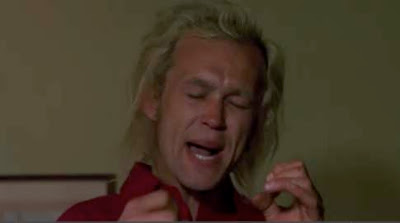
Koslo plays his role with such ratty-haired, delicious pizazz, you know that somewhere, even Michael Moriarty is getting jealous. When Bronson's on his trail, he questions a woman who reveals that "Sometimes he's with a chick– he's a switcher." Bronson then mutters something about "...the best of both worlds." WHUTTT!?


Now, there's two things that Bronson and Winner frequently return to: hippies and ice cream. (See my reviews of THE MECHANIC, DEATH WISH II, and DEATH WISH 3 for added insight):


Look at him– Bronson is so single-mindedly devoted to the case that he has NO IDEA that the promise of "frosty shakes" lies a mere 20 feet behind him.
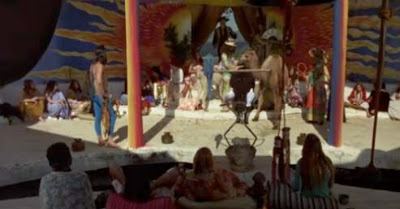

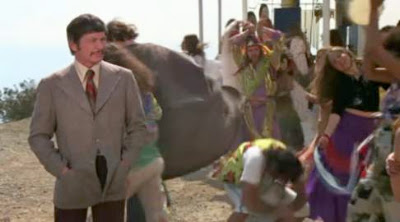
Shortly thereafter, Bronson shows up at this hippie commune that basically looks like a scene from an Alejandro Jodorowsky film.
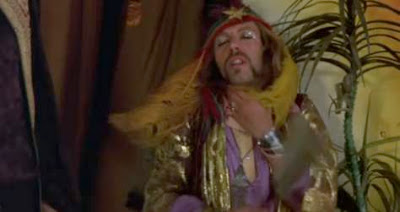
As Bronson questions a woman, he remains blasé and willfully unaware of the TOTALLY INSANE tambourine-infused, wild hippie dance orgy going on right behind him:


Yeah, this is pretty great. There's also a recurring theme in Winner's films of the hero interrupting mid-coitus couples during chase scenes, but that seems to be a further-reaching cliché than these previous examples, so I shan't discuss it in detail.

All of this leads up to the finale we've all been waiting for: the actual massacre of mobsters.
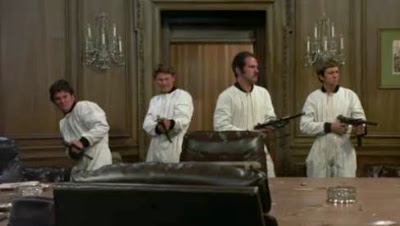
Dudes wearing YOU ONLY LIVE TWICE-henchmen costumes burst in and gun down a ton of cigar-smoking Sicilians. I don't know if they ran out of extras, but we get to see a couple of guys bite the dust twice.
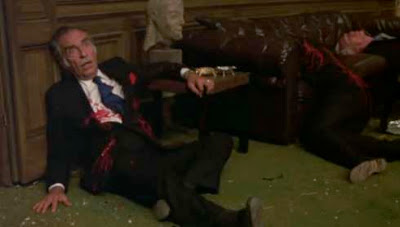
Then, the piéce de résistance:
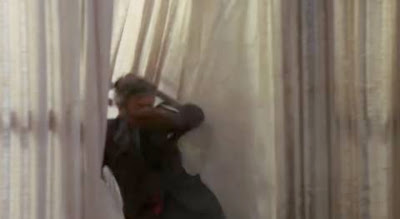
A mobster gets shot through a window, plummeting to his extraordinary death below...
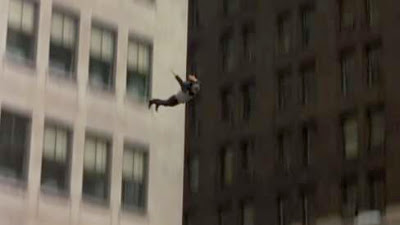
This again makes me wonder; as nearly every single Bronson movie- Cannon, De Laurentiis, or otherwise– has at least one scene where a dummy plummets to its doom. I think Bronson must have gotten a secret kick out it and confidentially demanded that it be written into his contract. Here, there's even two: when Bronson shoots one of the assassins in the stairwell, he flips over the railing, and there you go.
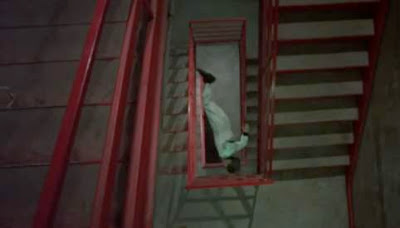
William Lustig (director of MANIAC COP, VIGILANTE) has praised the film for having some of the best uses of plummeting dummies in a studio picture.

Then there's the final, head-scratching scene. It's so bizarre that I don't even think that discussing it could constitute a spoiler.
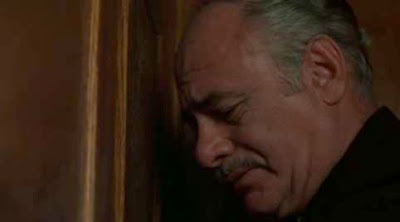
Balsam goes to confession, and Bronson and another cop watch the church from a car.

With disdain, I might add.

Bronson makes a speech:

"We're chest deep in water. Screaming against the rushing tide. You know, last three weeks, in New York City alone, there were 159 homicides? 3,000 criminal assaults, 6,000 robberies. You multiply that by Chicago, Boston, Philadelphia, Los Angeles... You remember that cartoon of an old Roman Circus, where all the lions are roaring, and the page boy yells down the corridor...

...YOU'VE GOT FIVE MINUTES, CHRISTIANS!"

Now, I guess one could see this as a direct transition from THE STONE KILLER to the first DEATH WISH (made by the same team the next year), but I'm not sure exactly who the Christians are in the metaphor here. I guess we're the Christians, cause the criminals are all coming for us, and he's kind of addressing the camera. But then again, it's kind of like a threat- maybe the criminals are the Christians, and Bronson is coming after them in five minutes? Or perhaps Bronson and the other cops are the Christians, and they've got five minutes before the criminals start coming after them? Well, regardless, it's a credit to the complexity of the line reading and the pensive screenwriting that we're able to have discussions like this thirty-six years after the fact. And, Charles, by the way– No, I do not remember that cartoon.

-Sean Gill

Saturday, August 29, 2009

Film Review: THE MECHANIC (1972, Michael Winner)


Stars: 5 of 5.
Running Time: 100 minutes.
Tag-line: "HE HAS MORE THAN A DOZEN WAYS TO KILL AND THEY ALL WORK." Damn!
Notable Cast or Crew: Charles Bronson, Keenan Wynn, Jill Ireland, Jan-Michael Vincent. Written by Lewis John Carlino (writer/director of THE GREAT SANTINI and director of CLASS).
Best one-liner: Bronson: "You always have to be dead sure. Dead sure, or DEAD."

A taut, stylish Bronson potboiler that I would place at the forefront of his oeuvre (along with ONCE UPON A TIME IN THE WEST, RIDER ON THE RAIN, and the original DEATH WISH). Known primarily as THE MECHANIC, and sometimes as KILLER OF KILLERS, it could very well be titled DIARY OF A SOCIOPATH.

It's by far Michael Winner's greatest film: here, he reminds me much more of John Boorman or Nic Roeg at their best than, say, the director of WON TON TON- THE DOG WHO SAVED HOLLYWOOD (yeahhh, Winner did that one). It's a detached, melancholy thriller with crisp, artistic cinematography;

Shades of M (1931)?

a wonderful Jerry Fielding score comprised of dissonant piano and strings; and perhaps Bronson's most complex, compelling performance.

The opening sequence (which observes Bronson planning a hit from bureaucratic start to grisly finish) is filmed entirely without dialogue, and, if separated from the film, would surely qualify as one of the greatest shorts of all time. It's not a pretentious film, however: Winner still possesses his old bag of tricks, which includes laughable depictions of hippies (see: THE STONE KILLER),


I think Winner had been reading a lot of cautionary National Review clippings.

people knocked into a swimming pool by a motorcycle, and Bronson indulging in his love for ice cream (see: DEATH WISH 2 and 3).

Damn, he loves it!


Now here's something you don't get to see every day.

In his hits, Bronson employs deceit, genius planning, ruthless cunning, and a lot of sport coat/turtleneck combos.

He's not merely a disconnected killer, however, and we catch glimpses of his fascinating, tortured psyche: an obsession with Bosch's "Garden of Earthly Delights," stories of an abusive father, a strange dynamic with a bizarre role-playing prostitute (Jill Ireland), and his body's subconscious revulsion at his sociopathic persona.

He plays his cards close to his chest, and to the other characters [like Jan-Michael Vincent (the snotty up-and-comer) and Keenan Wynn (as Jan's gangster dad)] he remains a wax ball-squeezing, squinty, brutal enigma. The end result is something action-packed, unexpected, and extremely satisfying. Five stars.

-Sean Gill

Monday, July 27, 2009

Film Review: DEATH WISH 3 (1985, Michael Winner)

Stars: 5 of 5.
Running Time: 92 minutes.
Notable Cast or Crew: Charles Bronson, Martin Balsam (PSYCHO, TWO EVIL EYES), Alex Winter (BILL & TED'S EXCELLENT ADVENTURE), Kirk Taylor (THE LAST DRAGON, FULL METAL JACKET), Gaven O'Herlihy (WILLOW, SUPERMAN III), Ed Lauter (TRUE ROMANCE, FAMILY PLOT), Deborah Raffin (GOD TOLD ME TO, SCANNERS II), music by Jimmy Page.
Tag-lines: "He's back in New York bringing justice to the streets..."
Best one-liner: "WE know that you did it! YOU know that WE know that you did it! WE know that you know that we know that you did it!"

ER doc: "Mrs. Rodriguez has expired." A concerned, brow-furrowing Bronson: "But you told me over the phone she only had a broken arm?" DEATH WISH 3 is golden 80's trash, bedazzled with that sparkling magic wand known as Golan-Globus.

The problem: out in Cypress Hills, Brooklyn, (filmed on location!) a poor man's Klaus Kinski and a bunch of face-painted background dancers from BREAKIN' have declared war on the elderly.

Their heinous acts are accompanied by Jimmy Page's rootin' tootin' burlesque synths, slap-happy bass (imagine SEINFELD times one thousand), and a general easy listening jazzy funkitude that words can't quite describe.

The solution: send in Bronson, make 'im mad, and turn 'im loose.

Now here's 15 reasons why DEATH WISH 3 may be the greatest movie Cannon ever made:

1. A bored Bill S. Preston, Esq. being told to "Stay awake while we're killin' this guy."

Each DEATH WISH film has an unlikely, famous- or pseudo-famous- henchman. In 1, it's Jeff Goldblum. In 2, it's Laurence Fishburne. In 3, it's Alex Winter. Hell, ST. IVES has even got Goldblum AND Robert "Freddy Krueger" Englund.

2. “Chicken’s good. I like chicken.” Yeah, Bronson’s easy to please. As long as you've got chicken.


3. The Hispanic family has a giant sombrero hanging on their wall.

Similarly, the Jewish family has an enormous Menorah. Golan-Globus films take place in a kind of post-racial universe where sterotypes abound, but complete racial harmony can proceed as soon as the [land developers, evil gangs, rich kid's dance team] is defeated. See also: RAPPIN', LAMBADA, etc.

4. The jarring, semi-frequent roach squishing. The pacing in a Cannon film seems completely designed to illicit spit-takes. The whackiest moments come out of nowhere- just as you're taking that sip of Coke II...

5. The little zoom in on the portrait of the Rough Riders as the music noodles out a little martial flair (for no reason). See #4's note on spit-takes, and previous notations on Jimmy Page.

6. Bronson's disquieting smile and his ill-considered, matter-of-fact one-liner delivery: "It's MY CAR!"


"It's MY CAR!"

7. Four words: Mail, Order, Rocket, Launcher.

Not to mention the legal improbabilities of Bronson setting up a P.O. Box and immediately having truckloads of illegal weaponry shipped to him.

8. Bronson's continued love for ice cream (see DEATH WISH 2).


9. The purse-snatching 'Giggler.' "He laughs as he runs."

And that he does.

10. "Believe it or not, this used to be a great neighborhood." Ummm…WHAT?

11. Bronson shooting an unarmed man in the back, prompting the ghetto to erupt in a chorus of 'Right-ons' set to ROCKY-esque MIDI music.


12. When Bronson punches a dude out and he goes into an artful jazz-dance fall.


13. The fact that, without exaggeration, nearly EVERY single car seen in this movie ends up EXPLODING.

Car explosions would probably make a good starting point for a drinking game if you're so inclined.

14. The Commodore 64 adaptation with the tag-line: "You ARE Bronson."


15. And because the Italian marketing was so memorable.


I could easily come up with fifteen more. Probably even a thousand more. And maybe I will, someday. In the meantime, Charlie, here’s five mind-blowing, chicken-flavored stars. You earned ‘em. Eat up. Maybe we'll get some ice cream in here for dessert.

-Sean Gill