Only now does it occur to me... that in Junta Juleil's proud tradition of presenting awkward dance sequences involving our favorite actors, from Ed Harris in CREEPSHOW to James Remar in RENT-A-COP to Jean-Claude Van Damme in KICKBOXER to Linda Hamilton in CHILDREN OF THE CORN to Michael Moriarty in TROLL to Lorenzo Lamas in BODY ROCK... we can now throw the hat of a new contender to the ring. May I proudly present Robin Wright in Sean Penn's THE CROSSING GUARD (in a scene that exudes 1995 from every pore):
Showing posts with label Jack Nicholson. Show all posts
Showing posts with label Jack Nicholson. Show all posts
Wednesday, September 20, 2017
Monday, January 30, 2012
Only now does it occur to me... THE PHANTOM CARRIAGE!
Only now does it occur to me... that the "father breaking down door with an axe to get at his cowering family" is an established genre.
Wednesday, June 22, 2011
Junta Juleil's Top 100: #80-76
80. THE LAST DAYS OF DISCO (1997, Whit Stillman)
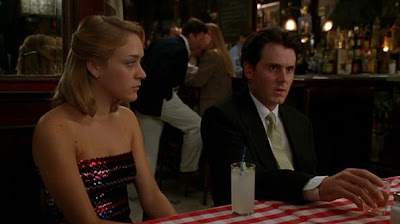
"You know that Shakespearean admonition, 'To thine own self be true?' It's premised on the idea that 'thine own self' is something pretty good, being true to which is commendable. But what if 'thine own self' is not so good? What if it's pretty bad? Would it be better, in that case, NOT to be true to thine own self?" Welcome to Jane Austen's SATURDAY NIGHT PYREXIA, a world where the silver-tongued parry, slash, and down vodka tonics (and whisky sours) deep into an endless night of excess, crippling malaise, and the sweet, sweet disco beat. The most clever, nuanced work of art ever written with "Disco" in the title, I've said before that it "follows a circle of UHBs (Urban Haute Bourgeoisie) as they simultaneously wrestle with preconceived notions of failure AND try to get the most out of their nightlife. If you prefer your comedy subtle, intricate, and full of stinging wordplay, then LAST DAYS OF DISCO will likely rank among your all-time favorites. Stillman's characters are at once extremely lovable and hateable; they either possess no sense of propriety or far too much, they won't take 'no' for an answer, or will, cheerfully." Also, we've got Chris Eigeman as, uh, well, Chris Eigeman. And make no mistake, that's one of the best things a movie can have. One of the great comedies.
"You know that Shakespearean admonition, 'To thine own self be true?' It's premised on the idea that 'thine own self' is something pretty good, being true to which is commendable. But what if 'thine own self' is not so good? What if it's pretty bad? Would it be better, in that case, NOT to be true to thine own self?" Welcome to Jane Austen's SATURDAY NIGHT PYREXIA, a world where the silver-tongued parry, slash, and down vodka tonics (and whisky sours) deep into an endless night of excess, crippling malaise, and the sweet, sweet disco beat. The most clever, nuanced work of art ever written with "Disco" in the title, I've said before that it "follows a circle of UHBs (Urban Haute Bourgeoisie) as they simultaneously wrestle with preconceived notions of failure AND try to get the most out of their nightlife. If you prefer your comedy subtle, intricate, and full of stinging wordplay, then LAST DAYS OF DISCO will likely rank among your all-time favorites. Stillman's characters are at once extremely lovable and hateable; they either possess no sense of propriety or far too much, they won't take 'no' for an answer, or will, cheerfully." Also, we've got Chris Eigeman as, uh, well, Chris Eigeman. And make no mistake, that's one of the best things a movie can have. One of the great comedies.
79. NAKED (1993, Mike Leigh)
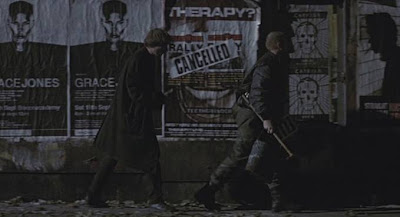
Ah, NAKED. A misanthropic cry unto the night. It's like FIVE EASY PIECES meets STREET TRASH. If ever there was an actor's director, it's Mike Leigh, whose rigorous rehearsal process and proclivity toward improvisation have allowed some of the finest performances of the last thirty years to flourish. David Thewlis is "Johnny," an on-the-dole-off-the-dole miscreant with scraggly beard, a bad attitude, horrifically misogynistic tendencies, and constant commentary about your "diminishing pachyderm collection" or "the 'ole Highland fling" or this or that or the other. He gravitates toward people to whom he can feel superior; it's important for him to continue believing that he's 'above it all,' and that no one is capable of understanding his suffering. His nocturnal journey takes him past a security guard who protects empty space; a sad sack waitress who sits at home and does nothing; a man who pastes retraction posters over posters for concerts that have been cancelled; and all manner of fascinating, disturbing, and well-written characters and vignettes. And who can forget Greg Cruttwell's insane, ever-snickering evil yuppie, who seemingly exists only to show that there are indeed even worse people than Johnny? Lesley Sharp is genius as the perpetual doormat, who possesses a certain command over her life despite a gullible streak, and Katrin Cartlidge plays the "wicky wacky friend Sophie" with strung-out, wounded aplomb– a truly connected performance. And yet for the hideous way the film makes you feel, it's endlessly quotable ("Ya big girl's blouse!," or "Jane...Austen...by...Emma"), and offers even greater rewards on subsequent viewings. Also: a fantastic, billowing harp and string score by Andrew Dickson and sordidly beautiful visuals courtesy of Dick Pope.
78. THE SHINING (1980, Stanley Kubrick)
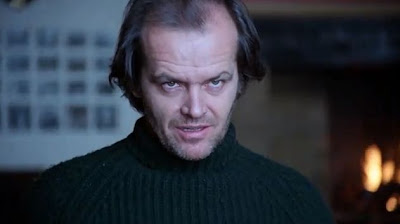
Looking at this list in its entirety, it's sort of hard to believe that this is my highest-ranked Kubrick, but here it is, so I guess it must be true. It could have easily been eclipsed by A CLOCKWORK ORANGE (#88), or by 2001: A SPACE ODYSSEY, PATHS OF GLORY, or even THE KILLING. So there must be a logic behind it. Maybe it's because, in a way, it's his most focused film. He zeroes in, amidst the vast, solemn expanse of the Rockies (set to the sounds of another "fantastique" Wendy Carlos reimagining), into the phantasmagorically deteriorating psyche of one man, and the effect that it has on the family around him. Rarely has such an exquisite sense of foreboding, of pure, tangible dread, been built by a film, between the architecture, the empty spaces, the sounds, the explosive imagery, the sense of being watched. And, of course, there's Nicholson's terrifying, deadened stare, which is perhaps even more frightening than his notorious deranged leering! Also: the insanity of Kubrick forcing Scatman Crothers to explain "the shining" for 148 takes, or him calling up King at 3:00 AM and asking if he believes in God– yep, Kubrick's nuttiness goes a long way, too. See ya in Room 237!
77. THE PIANO (1993, Jane Campion)

I mean it's not often that a face-tattoed quasi-Maori Harvey Keitel squaring off against an axe-wielding, stuffed shirt Sam Neill over the love of a mute, piano-playin' Holly Hunter, but here we are, so I guess it happened. Years before THE LORD OF THE RINGS introduced your average joe to the natural beauty of New Zealand, Keitel lorded over the majesty of its landscapes, and he was naked at the time, too. In all seriousness, though, this film is fantastic: the swirling through-line of Michael Nyman's masterful score and the intense, committed performances preside over disparate ideas on colonialism, ownership, emancipation, nature, gender, art... People occasionally try to pin down THE PIANO, either insisting that it beautifully depicts a woman's struggle for independence, or, on the other side of the coin, saying that it shows a woman traded from one brute to another ("I want to lie together without clothes on"), but it's not a film that trades in moral absolutes; it's just a tale of love and abuse and defiance and music and fleeting moments of joy and tenderness in one of the furthest corners of the world..
76. BAD LIEUTENANT (1992, Abel Ferrara)
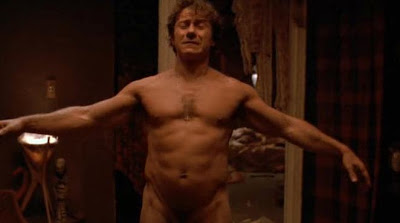
Keitel, passed out on a couch, suffering the ill effects of crack, meth, coke, heroin, and God knows what else; a child, a niece or nephew of some kind, clambers over his prostrate body as a vintage cartoon depicting hardworking mice blares in the background: "WE'VE DONE IT BEFORE, AND WE CAN DO IT AGAIN, ANNNND WE CAN DO IT AGAIN!!..." Just another day in the life of Harvey Keit– I mean, the "Bad Lieutenant."
This nameless "bad" lieutenant (Harvey Keitel in perhaps his most crazed and convincing portrayal yet) wanders through his waking life with the sole intent of pleasuring himself (something shown quite literally in one notorious scene involving the Lieutenant and some teenage girls which probably gave it its NC-17). As the Lieutenant investigates the rape of a nun and his gambling debts continue to escalate, he begins a simultaneous downward spiral of depravity and an upward surge toward the divine. As with almost every Abel Ferrara film, plot and coherence take a back seat to character study and a twisted look at spirituality. The Lieutenant's overindulgence in drugs, sex, gambling, petty theft, and poor parenting (amongst many other vices) leads many viewers to take an unsympathetic stance; as the film progresses, however, we see that the Lieutenant is something between wounded animal and man-child, wavering between cruel intensity and pathetic innocence as he forever nears the bottom of a barrel that never quite comes into focus. He steals food from the store in which he is investigating a robbery. Is this the bottom? He does coke off of his children's photos. Is this the bottom? Perhaps a scene between the Lieutenant and a junkie (played by Ms.45 herself, Zoe Lund, also a co-writer for the script) puts it best as she says, "Vampires are lucky, they can feed on others. We gotta eat away at ourselves." We've seen stories like this before, but Ferrara and Keitel create such a raw, low budget (under $2 million) atmosphere of existential doom that it makes MEAN STREETS look like a walk in the park.
Coming up next... Maggots and Jimmy Stewart!!!
Previously on the countdown:
#85-81
#90-86
#95-91
#100-96
Runners-up Part 1
Runners-up Part 2
Ah, NAKED. A misanthropic cry unto the night. It's like FIVE EASY PIECES meets STREET TRASH. If ever there was an actor's director, it's Mike Leigh, whose rigorous rehearsal process and proclivity toward improvisation have allowed some of the finest performances of the last thirty years to flourish. David Thewlis is "Johnny," an on-the-dole-off-the-dole miscreant with scraggly beard, a bad attitude, horrifically misogynistic tendencies, and constant commentary about your "diminishing pachyderm collection" or "the 'ole Highland fling" or this or that or the other. He gravitates toward people to whom he can feel superior; it's important for him to continue believing that he's 'above it all,' and that no one is capable of understanding his suffering. His nocturnal journey takes him past a security guard who protects empty space; a sad sack waitress who sits at home and does nothing; a man who pastes retraction posters over posters for concerts that have been cancelled; and all manner of fascinating, disturbing, and well-written characters and vignettes. And who can forget Greg Cruttwell's insane, ever-snickering evil yuppie, who seemingly exists only to show that there are indeed even worse people than Johnny? Lesley Sharp is genius as the perpetual doormat, who possesses a certain command over her life despite a gullible streak, and Katrin Cartlidge plays the "wicky wacky friend Sophie" with strung-out, wounded aplomb– a truly connected performance. And yet for the hideous way the film makes you feel, it's endlessly quotable ("Ya big girl's blouse!," or "Jane...Austen...by...Emma"), and offers even greater rewards on subsequent viewings. Also: a fantastic, billowing harp and string score by Andrew Dickson and sordidly beautiful visuals courtesy of Dick Pope.
78. THE SHINING (1980, Stanley Kubrick)
Looking at this list in its entirety, it's sort of hard to believe that this is my highest-ranked Kubrick, but here it is, so I guess it must be true. It could have easily been eclipsed by A CLOCKWORK ORANGE (#88), or by 2001: A SPACE ODYSSEY, PATHS OF GLORY, or even THE KILLING. So there must be a logic behind it. Maybe it's because, in a way, it's his most focused film. He zeroes in, amidst the vast, solemn expanse of the Rockies (set to the sounds of another "fantastique" Wendy Carlos reimagining), into the phantasmagorically deteriorating psyche of one man, and the effect that it has on the family around him. Rarely has such an exquisite sense of foreboding, of pure, tangible dread, been built by a film, between the architecture, the empty spaces, the sounds, the explosive imagery, the sense of being watched. And, of course, there's Nicholson's terrifying, deadened stare, which is perhaps even more frightening than his notorious deranged leering! Also: the insanity of Kubrick forcing Scatman Crothers to explain "the shining" for 148 takes, or him calling up King at 3:00 AM and asking if he believes in God– yep, Kubrick's nuttiness goes a long way, too. See ya in Room 237!
77. THE PIANO (1993, Jane Campion)
I mean it's not often that a face-tattoed quasi-Maori Harvey Keitel squaring off against an axe-wielding, stuffed shirt Sam Neill over the love of a mute, piano-playin' Holly Hunter, but here we are, so I guess it happened. Years before THE LORD OF THE RINGS introduced your average joe to the natural beauty of New Zealand, Keitel lorded over the majesty of its landscapes, and he was naked at the time, too. In all seriousness, though, this film is fantastic: the swirling through-line of Michael Nyman's masterful score and the intense, committed performances preside over disparate ideas on colonialism, ownership, emancipation, nature, gender, art... People occasionally try to pin down THE PIANO, either insisting that it beautifully depicts a woman's struggle for independence, or, on the other side of the coin, saying that it shows a woman traded from one brute to another ("I want to lie together without clothes on"), but it's not a film that trades in moral absolutes; it's just a tale of love and abuse and defiance and music and fleeting moments of joy and tenderness in one of the furthest corners of the world..
76. BAD LIEUTENANT (1992, Abel Ferrara)
Keitel, passed out on a couch, suffering the ill effects of crack, meth, coke, heroin, and God knows what else; a child, a niece or nephew of some kind, clambers over his prostrate body as a vintage cartoon depicting hardworking mice blares in the background: "WE'VE DONE IT BEFORE, AND WE CAN DO IT AGAIN, ANNNND WE CAN DO IT AGAIN!!..." Just another day in the life of Harvey Keit– I mean, the "Bad Lieutenant."
This nameless "bad" lieutenant (Harvey Keitel in perhaps his most crazed and convincing portrayal yet) wanders through his waking life with the sole intent of pleasuring himself (something shown quite literally in one notorious scene involving the Lieutenant and some teenage girls which probably gave it its NC-17). As the Lieutenant investigates the rape of a nun and his gambling debts continue to escalate, he begins a simultaneous downward spiral of depravity and an upward surge toward the divine. As with almost every Abel Ferrara film, plot and coherence take a back seat to character study and a twisted look at spirituality. The Lieutenant's overindulgence in drugs, sex, gambling, petty theft, and poor parenting (amongst many other vices) leads many viewers to take an unsympathetic stance; as the film progresses, however, we see that the Lieutenant is something between wounded animal and man-child, wavering between cruel intensity and pathetic innocence as he forever nears the bottom of a barrel that never quite comes into focus. He steals food from the store in which he is investigating a robbery. Is this the bottom? He does coke off of his children's photos. Is this the bottom? Perhaps a scene between the Lieutenant and a junkie (played by Ms.45 herself, Zoe Lund, also a co-writer for the script) puts it best as she says, "Vampires are lucky, they can feed on others. We gotta eat away at ourselves." We've seen stories like this before, but Ferrara and Keitel create such a raw, low budget (under $2 million) atmosphere of existential doom that it makes MEAN STREETS look like a walk in the park.
Coming up next... Maggots and Jimmy Stewart!!!
Previously on the countdown:
#85-81
#90-86
#95-91
#100-96
Runners-up Part 1
Runners-up Part 2
Monday, May 11, 2009
Film Review: THE LAST DETAIL (1973, Hal Ashby)
Running Time: 103 minutes.
Notable Cast or Crew: Jack Nicholson, Randy Quaid (MIDNIGHT EXPRESS, MAJOR LEAGUE II), Michael Moriarty (TROLL, THE STUFF, IT'S ALIVE III: ISLAND OF THE ALIVE), Otis Young (BLOOD BEACH, THE HOLLYWOOD KNIGHTS), Carol Kane (LICENSE TO DRIVE, THE PRINCESS BRIDE), Gilda Radner, Nancy Allen (ROBOCOP, BLOW OUT), writer Robert Towne.
Tag-lines: "No *#@!!* Navy's going to give some poor **!!@* kid eight years in the #@!* brig without me taking him out for the time of his *#@!!* life. "
Best one-liner: "I am the motherfucking shore patrol, motherfucker! I am the motherfucking shore patrol! Give this man a beer!"
Scripted by Robert Towne (CHINATOWN, SHAMPOO), directed by Hal Ashby (BEING THERE, HAROLD AND MAUDE), and based on the novel by Darryl Ponicsan, THE LAST DETAIL is a grand rumination on injustice, indoctrination, the privileged, and the complex dynamics that bind them together, and it's a film that's as prone to hilarity as it is to soul-crushing angst. It's a film of train stations and travel lockers, of Schlitz and Pabst and shitty hotel rooms; of fear and regret and bravado and rage.
It's about that class of people (which is comprised of nearly every one of us) who are instruments in a flawed system and powerless to do anything but bitch, bitch, bitch. And we're really good at that. Really good at expending all of our righteous indignation at the wrong people, at putting more energy into bitching instead of taking action.
But what can we do? Suppress our emotions until they explode (invariably, at the wrong time)? Maybe we should just stick to that. Do the job. Deliver the man. Listen to your handlers. Just keep moving so nothing sinks in. Drink your drink and mouth off; take out your frustrations on the wrong people, the other cogs like you. Maybe crack a joke or two to make yourself feel like more of a man and less like a lackey. Repeat.
Nicholson lives up to the hype: highly volatile and extremely complex. Otis Young is fantastic as well, and truly holds his own against Nicholson. (Young really should have had the chance to work more.) Youthful Randy Quaid is bumbling and extremely sympathetic. Brief appearances by Gilda Radner, Nancy Allen, and Carol Kane add feminine flavor amidst the masculinity, and the icing on the cake is Michael Moriarty, popping up in the final act as one of those asshole 'handlers' I was talking about. Excellent, excellent, excellent film, and one of those perfect, iconic fusions of script, direction, and acting that seemed to flow so effortlessly out of the 1970's. Five stars.
-Sean Gill
Subscribe to:
Posts (Atom)