Showing posts with label tippi hedren. Show all posts

Monday, November 16, 2009

Hitchcock Blonde!

Consider...a succession of beautiful blonde actresses...the first few of whom naturally exuded a quality of feminine refinement that appealed to director Alfred Hitchcock and which he incorporated into a character type that he used repeatedly in his films. Ultimately, Hitchcock took possession of and honed this persona to a fine point. His final blonde stars were scrupulously stylized to fit his very specific image.

Joan Barry (Emily Hill in Rich and Strange, 1931)...London-born Barry first worked with Hitchcock when she dubbed Anny Ondra's voice for the sound version of Blackmail. She later starred in another of the director's early sound films, Rich and Strange. In addition to being a blonde, Barry possessed a delicate beauty that Hitchcock would seek again. (Note: This British actress should not be confused with the American actress Joan Barry who was legally entangled with Charlie Chaplin)

Madeleine Carroll (Pamela in The 39 Steps, 1935, and Elsa Carrington in Secret Agent, 1936) Often referred to as the first of Hitchcock's "ice cool" blondes, Carroll bore a striking resemblence to Joan Barry. Her career skyrocketed with the success of The 39 Steps and, following Secret Agent, she signed with Paramount and made several films in the U.S.

Carole Lombard (Ann Smith in Mr. & Mrs. Smith, 1941) Hitchcock's only screwball comedy, Mr. & Mrs. Smith starred one Hollywood's great Golden Age comediennes, the lovely Lombard. She sparkled as the stubborn, beautiful and well-heeled Mrs. Smith; not exactly aloof, she was certainly intelligent and fashionable. Hitchcock directed at Lombard's request and it was the last of her films released during her lifetime.
(Note: Mr. & Mrs. Smith airs today, 11/16, on TCM at 4:15 pm Eastern/1:15 pm Pacific)
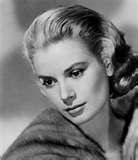
Grace Kelly (Margot Wendice in Dial M for Murder, 1954, Lisa Fremont in Rear Window, 1954, and Frances Stevens in To Catch a Thief, 1955) The quintessential "snow covered volcano" that all others are measured against. Kelly, one of the definitive beauties of the 1950s, naturally possessed elegance and refinement - she was also able to effortlessly portray the chilly allure that so appealed to Hitchcock.

Kim Novak ("Madeleine Elster"/Judy Barton in Vertigo, 1958) Novak was a very popular movie star of the 1950s and a departure from the type Hitchcock had previously cast as his blonde love objects. Among other things, she was more voluptuous than those before her. Her sultry allure was toned down with a chic and often subdued wardrobe as well as the application of quiet but precise makeup. In a new "twist," Novak wore her hair in a stylized up-do throughout most of the film - this was the memorable "French Twist" Hitchcock liked to explore with his camera. Novak's enigmatic performance much enhanced the mysteries of Vertigo.

Eva Marie Saint (Eve Kendall in North by Northwest, 1959) Though not a sex symbol like Novak, Saint was also a departure from the actresses Hitchcock had cast before her. A dedicated dramatic actress, she was known for starring in films like On the Waterfront and A Hatful of Rain as well as live TV dramas - what Hitchcock called "kitchen sink" roles. However, she got the full treatment once chosen to play Eve and was transformed into a cool glamour girl whose urbane artifice belies her vulnerability. Saint was coiffed, costumed and made up to seductive, slightly brittle perfection. Being a solid actress, she was able to carry off with ease the role of a government operative while encased in fullblown Hitchcock Blonde regalia.

Tippi Hedren (Melanie Daniels in The Birds, 1963, and Marnie Edgar in Marnie, 1964) Hitchcock's final pale-haired icon, Hedren's was the most controlled expression of Hitchcock's archetype. More model than actress at the time, Hedren's mannequin-like qualities seem emphasized by heavily sprayed bouffant hairstyles, a sophisticated and strictly coordinated wardrobe and fastidious makeup. Hitchcock coached Hedren closely and constantly, intensely involved in her every move. Her career faltered when she bought out her contract with Hitchcock following Marnie.

Footnote:
Truffaut and Hitchcock discuss "the Hitchcock Blonde"

Hitchcock: You know why I favor sophisticated blondes in my films? We're after the drawing-room type, the real ladies, who become whores once they're in the bedroom.
Truffaut: What intrigues you is the paradox between the inner fire and the cool surface.
Hitchcock: Definitely...Do you know why? Because sex should not be advertised...because without the element of surprise the scenes become meaningless. There's no possibility to discover sex.

Friday, September 18, 2009

In Defense of Hitch's The Birds (and the birds)

My blog One Fan's List of the Best Hitchcock Films has generated a lot of comments both here and when originally posted in the CFU. I'd like to think it's because people like me (shades of Sally Field), but, alas, the blog's popularity is strictly due to Mr. Hitchcock's many fans. Reader comments often focus on the fact that I relegated Notorious to honorable mention, while ranking Marnie and The Birds among the top four spots. I've devoted a blog to Marnie...and now The Birds gets its time in the spotlight.

I first saw The Birds on NBC’s Saturday Night at the Movies with my sister in the late 1960s. I remember liking it well enough, though the film just seemed to end with no satisfactory resolution. Over the next two decades, I may have watched The Birds three or four times. But I never developed an affection for it until the early 1990s when, on a whim, I decided to view it again while my wife was out-of-town.

For the first time, I realized that the film functions on two levels for me. It is, of course, a well-done thriller about unexplained bird attacks in a small California seaside community. But it’s also a well-acted 1960s drama about three women and their relationships with the bland, but likable, Mitch Brenner (Rod Taylor). Mitch’s mother (wonderfully played by Jessica Tandy) fears losing her son to another woman—not because of jealousy, but because she can’t stand the thought of being abandoned. Young socialite Melanie Daniels (Hedren) views Mitch as a stable love interest, something she needs as she strives to live a more meaningful life. And Annie Hayworth (Pleshette) is the spinster schoolteacher, willing to waste her life to be near Mitch after failing to pry him from his mother.

In the midst of this soap-like plot, Hitchcock injects a series of escalating bird attacks, ranging from a gull that nips Melanie to a explosive strike at a gas station. His direction of these sequences is flawless, as evidenced by two textbook examples of creating suspense. Early in the film, there’s a cute scene in which Melanie (in a boat) races Mitch (in a car) to the other side of the bay. Hitchcock waits patiently until the viewer is involved in the race, then a gull suddenly swoops down to bite Melanie. This abrupt assault results in a sense of uneasiness that permeates the rest of the film.

Knowing that the viewer will now be prepared for more surprise attacks, Hitchcock shifts his strategy with a classic scene outside the schoolhouse. As Melanie waits for Annie and listens to the children singing, the viewer sees a flock of birds filling up the playground bars behind her. Melanie is oblivious to the impending danger until she catches sight of a single bird in flight and watches as it joins the others. It’s a brilliant example of the visual power of cinema.

Now, let's talk about the birds. Are they truly villains? I think not. Miss Bundy, the ornithologist, states in the restaurant after the attack on the children: "Birds are not aggressive creatures...it is mankind that insists in making it difficult for life to exist on this planet." I'm not suggesting that The Birds is an eco-horror film like John Frankenheimer's Prophecy (which I think is pretty entertaining, by the way). Rather, the scene with Miss Bundy is intended to soften our perception of the birds as terrifying creatures.

And why is that? Because Hitchcock doesn't want us to focus too much on the birds. The movie is about the Mitch-Melanie-Mitch's mother triangle. The birds are just catalysts. I still know people who hate the ending. If it frustrates you, think of the film as a drama in which all the conflicts between characters have been resolved. In that sense, The Birds ends when it should.

I realize that Notorious fans can argue the complexities of that Hitchcock classic just as well. But the purpose of this blog is not to explain why Notorious didn't make my top 10 (and, yes, I need to see it again). Rather, my goal is to point out that The Birds is more than just a suspense film and its ability to function effectively on two different levels (thriller and relationship drama) is why I love it.

Saturday, September 5, 2009

Marnie--The Second Time Around

Has a subsequent viewing—at a later point in life--ever drastically altered the way you felt about a movie? Once Upon a Time in the West made little impression on me when I first saw it. But, as I watched it again at various points in my life, it gradually became one of my favorite films. However, no movie has made as long a journey for me as Alfred Hitchcock’s Marnie.

I recently found a film journal I’d kept back in 1986 and my assessment of Marnie was a “disappointment that oddly lacked suspense.” I went on to blame Tippi Hedren’s “detached performance” and complain about Hitch’s use of a “shoddy rear screen.”


Today…and for many years now…Marnie has ranked as one of my favorite movies. There is much to admire in this underrated, multi-layered picture, from Hitch’s rich use of color to the progressively complex relationship between Marnie (Hedren) and Mark (Sean Connery). I’m always intrigued by the way Mark watches Marnie, hoping to catch her in a lie that will lead to a better understanding of this unusual woman he has blackmailed into marriage. Mark becomes the predator, observing his quarry intently and sometimes playing with it cruelly. Surprisingly, Marnie—in its own quiet way—generates suspense worthy of Hitch’s best man-on-the-run films.

As for Hedren’s performance, it’s her very detachment that makes Marnie such a vulnerable, intriguing character. I’ve read where Hitch originally acquired Winston Graham’s novel as a comeback vehicle for Grace Kelly. But I can’t imagine Princess Grace, with her warmth and classic beauty, in the role. It’s really Hedren’s film and easily surpasses anything else she’s done.

But my younger self was right about one thing: the rear screen shots are awful. Hitch hated to film outdoors, where he couldn’t control the lighting, but the scenes of Tippi on her horse and the closing shot are embarrassing.

Forget this minor complaint, though. If you haven’t seen Marnie in a few years, please give it another chance. You may be surprised. And if you’ve come to admire another movie the second time around—as I did Marnie—I’d love to hear about it.