 |
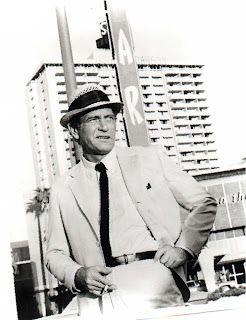
| Darren McGavin as Kolchak |
Certainly one of my favorite TV memories,
Kolchak: The Night Stalker (hereafter
Kolchak) is one of television’s best-remembered and influential detective series. However, it lasted only 20 episodes. Based on a novel by Jeff Rice titled
The Kolchak Papers, the TV rights to the story were acquired by ABC before the book was even published. A pilot special was adapted from the novel by Richard Matheson, a marvelous writer of science fiction and thriller stories, as well as one of
The Twilight Zone’s most prolific writers. The pilot was released in 1972 as
The Night Stalker, and garnered good ratings. In 1973, a second pilot was written by Matheson,
The Night Strangler, also well-received by TV audiences. So in 1974, ABC put
Kolchak in its Friday night lineup in the 10:00 slot.
 |
| Simon Oakland as Vincenzo |
Produced by Dan Curtis (of soap opera
Dark Shadows fame),
Kolchak was considered a risk, certainly completely different than detective stories before it. Carl Kolchak was played by Darren McGavin, best known now as everybody’s favorite holiday Dad in
A Christmas Story. Kolchak was not actually a detective, but a newspaperman who worked for Chicago’s Independent News Service. Kolchak would
have to work for an independent service because he was anything but a company man. Aggressive, fast-talking, dark-humored, ready with an insult and intolerant of stupidity, Kolchak was the perfect reporter. He drove a yellow mustang convertible (which today would be a coveted item!), and always dressed in a rumpled light blue suit, battered hat and well-worn tennis shoes. And to boot, when Kolchak ran down a story, it always turned out to be something supernatural, from werewolves to vampires, from aliens to the subject of this article, Jack the Ripper. His long-suffering and frustrated boss Tony Vincenzo (Simon Oakland) gave Kolchak rather free rein for his eccentric behavior and wild ideas, but Vincenzo did a lot of shouting when his star reporter ignored his orders and finagled his way out of the office on a chase for the story.
 |
| Jack Grinnage as "Uptight" |
Other members of the staff included Ron Updyke (Jack Grinnage), not Kolchak’s favorite co-worker. Updyke’s newspaper experience consisted of writing for financial pages, and Kolchak never passed up an opportunity to show his disdain for the nervous little guy, usually referring to him as “Uptight.” Another staff member was sweet, elderly Miss Emily Cowles (Ruth McDevitt) who answered letters for the advice for the lovelorn column. Other regular characters were introduced in later shows: Captain “Mad Dog” Siska (Keenan Wynn); the “Ghoul”, a helpful morgue attendant (John Fiedler Gordy); and rich intern Monique (Carol Ann Susi). Regular appearances were made by Carol Lynley, Ralph Meeker, Claude Akins, Elisha Cook, Jr., Margaret Hamilton and John Carradine. Quite an impressive list of actors.
Kolchak was the success of the season, and a great many popular actors appeared in roles or cameos, including Phil Silvers, Scatman Crothers, Hans Conreid, Mary Wickes, Dwayne Hickman and Jim Backus.
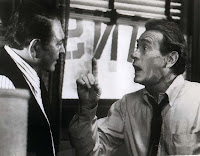 |
| Kolchak and Vincenzo as usual |
The introductory episode of
Kolchak is also my favorite –
The Ripper. Only Vincenzo and Updyke were in evidence as INS staff. Actually, Miss Emily did appear, but at this point was not yet a regular. Narrated by McGavin in a style of which Mickey Spillane would be proud, the story begins as Kolchak is being punished by Vincenzo for a previous assignment in which he angered the police commissioner. He is being forced to answer the letters for Miss Emily’s column while she is on vacation. You can probably imagine his reaction to the letters from the lovelorn and his abrupt answers, to say the least. However, women are being murdered and mutilated, and Kolchak is not about to let that kind of a story get by him. He manages to go out on the prowl, putting himself in all kinds of dangerous situations, including a funny scene in a massage parlor. After one murder, the killer is seen on a rooftop and police are chasing and shooting at him. Kolchak arrives in time to see the killer leap from the tall building, land without a scratch, and fight his way through the tactical force in a hail of bullets, escaping into the darkness. As he discovers more about the killer, Kolchak becomes convinced that he is not just a Ripper copycat, but the actual Jack the Ripper who killed 5 women in 1888 London.
 |
| Ruth McDevitt |
 |
| Beatrice Colen as Jane Plumb |
One of Kolchak’s eyewitnesses, at least to the Ripper’s appearance and possible residence, turns out to be one of the the letter-writers to Miss Emily’s column. The lady is played by Ruth McDevitt, a wonderful character actress who must have made such an impression she was hired to be a regular. A reporter from a competing newspaper, Jane Plumb (Beatrice Colen), is also out for the story. She is a sweet, naïve lady who has received a letter from the Ripper, and believes she can meet with him for an exclusive. Kolchak does not find out until too late about her plan to meet the Ripper. Not only is it sad, but also a lost opportunity for an interesting regular on the show. Colen would have been the perfect foil for Kolchak's curmudgeonly character. He then goes to the house reported by the elderly lady as the home of the killer, and comes face to face with the Ripper.
 |
Mickey Gilbert as the Ripper
Mute but menacing |
The opening music and credits for
Kolchak were memorable. Composer Gil Melle, also responsible for the music of
Night Gallery, wrote the theme. Kolchak enters the empty office at night, whistles a tune (which he also does through the show), the music begins as a pleasant little tune, then turns darker. Kolchak seats himself at his typewriter, begins to write, the music becomes more sinister, the room darkens, he looks to the side anxiously, and the frame freezes. I found the opening on Youtube, and present it for you here.
Many factors combined to make
Kolchak a short-lived series. The main problems were office politics, behind the scenes squabbling over production credits, and McGavin’s increasing disappointment with the progress of the series. He called it “Monster of the Week”, and when the ratings finally dipped, he was able to be released from his contract. I think McGavin had a good point. There is only so much you can do with a limited story type until it gets repetitive and loses the element of surprise. (A current television series,
House, has been called “Disease of the Week”, but it has managed to stay interesting because of great ensemble acting and several side-stories unrelated to the medical issues.) It is really a shame that Kolchak could not be developed further. The character was unique, the writing excellent, and it would have been just as good without monsters. Unfortunately, once it started out that way, there was no turning back.
Despite its short run,
Kolchak is well-remembered by many viewers. It was even the major inspiration for
X-Files creator Chris Carter. He stated that besides his own creative ideas, it was not Spielberg’s movies or
The Twilight Zone that inspired him, but
Kolchak, particularly because he admired Richard Matheson's work on the show. Not a bad legacy for a brief but unique television series.