Showing posts with label charles laughton. Show all posts

Sunday, April 14, 2019

An Interview with Ruta Lee: A Lively Conversation about Seven Brides, Marlene Dietrich, Perry Mason, Khrushchev...and More!

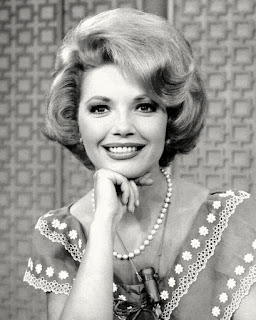
Ruta Lee made her big screen acting debut in Seven Brides for Seven Brothers in 1953 at the age of eighteen. She has been performing ever since! Her film roles have run the gamut from portraying Tyrone Power's girlfriend in Witness for the Prosecution (1957) to starring opposite the whole Rat Pack in Sergeants 3 (1962). She has guest-starred in dozens of television shows, including multiple appearances in classics such as Perry Mason, Gunsmoke, and The Andy Griffith Show. She has also gained acclaim as a stage actress with credits ranging from Hello, Dolly to Steel Magnolias.  Ruta Lee is a great believer in volunteerism and serves as the Chairman of the Board Emeritus for The Thalians, a non-profit organization that "raises funds to educate and enlighten the world about mental illness." She recently returned from Lithuania where she was the keynote speaker at a women's conference.

Café:  Your first movie role was as one of the brides in Seven Brides for Seven Brothers. What are some of your memories from making that classic musical?

Ruta Lee:  There are so many memories that it would probably take four weeks of us sitting down and talking about them. I think the best part was my mother, who took me to the audition, going into the church across from casting at MGM and getting on her knees and praying. I, on the other hand, went into the audition in my little ballet tights and shoes and danced for the choreographer. He told me to do a little ballet and do a little a jazz. Then, he said: "How about a little something folksy?" Well, I'm of Lithuanian descent and if there's one thing I know, it's a good Lithuanian polka. So, I did my polka for him. I'm not sure if it was my polka or my mother's prayers, but I got the job.

Café:  In Billy Wilder's Witness for the Prosecution, you played Tyrone Power's girlfriend. What was it like working with Wilder, Power, Charles Laughton, and Marlene Dietrich?

Ruta, as a brunette, and Tyrone Power.
Ruta Lee:  First of all, Billy Wilder was probably one of the most innately funny people that God put on this Earth. He has a wonderfully wild sense of humor. It showed up in a great deal of his work, like Some Like It Hot. When I first came into Witness for the Prosecution, it was several weeks after production had started. The studio had taken two huge sound stages and built a replica of the Old Bailey courtroom to three-quarters scale, which was incredible. I had been warned by the make-up department, who said: "Listen, Ruta, Charles Laughton is sometimes a nasty old gay who doesn't like young girls, so just do your work, know your lines, and everything will be fine." So, I came onto the set, in my little tight dress and perky hat, and everyone is sitting around in British tea circles. No one is saying hello to me or welcome. For the first time in my life, I wished the floor would open up and swallow me--that kind of a feeling. And, as I'm standing there, somebody walks up behind me, smacks me on my butt, and sends me flying across the stage. I turn around and it's Charles Laughton. He says: "That's the best damn ass I've seen in a long time." And I became his baby doll. He would sulk if I didn't come in to say good morning to him before anybody else. He taught me to play all kinds of games like Perquackey and Scrabble; he was quite the game player. He and his wife Elsa (Lanchester) would sometimes invite me to lunch in their dressing room. She was trying to watch his weight...ha, ha! They helped me with my middle British accent. High English and Cockney are rather easy, but that middle English was tougher. They were the dearest, most wonderful people and I will love Charles Laughton until the day I die. As for handsome Ty Power, I adored him. He was a lovely, lovely man and very sweet. I will never forget telling him that I hadn't seen Blood and Sand, which was a terribly important movie in his career. He arranged a screening of it for me. Then, of course, there was Marlene Dietrich. Marlene is one of the most professional people that I've ever known, but she was not exactly thrilled with young girls. When she saw my screen test for Witness of the Prosecution, she said "nein" when she saw the blonde hair and I was a brunette overnight. She was very cool and had little to do with me. She was a little bit warmer when I saw her in later years. Boy, though, I learned a lot from her. All you had to do was watch her. She knew about cinematography and lighting and what worked for her and what didn't. She'd say to our cinematographer: "I believe I'd like that inky under my chin here because I could use a little more light." He'd say: "Oh, Marlene, you don't need it. You're well lit. I'm taking care of you. We don't even have an inky." And she'd say "I do" and she'd open up a big trunk and there was the inky she needed for a light. I wish all of us had taken lessons from her because she really knew what she was doing.
(Note: An inky, or inky dink, is a small light of 100-250 watts.)

Café:  You were the female lead in Sergeants 3 (1962), which starred Frank Sinatra and the whole Rat Pack. How would you describe that experience?
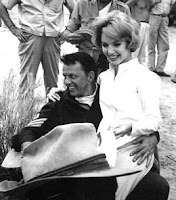
On the set with Frank Sinatra.
Ruta Lee:  The most fun of my life. We laughed all the way through making that film. Poor (director) John Sturges kept trying to get our attention. I tried to do all my work properly, but you could not help but laugh because Dean Martin is a truly funny man. Frank is a funny guy, Joey Bishop was a funny guy, and Sammy is one of the most delicious people ever. It was one big lark. And, of course, they all treated me like their little, baby sister that had to be taken care of. I thought, oh hell, I could have had an affair with all of them and written books...but I didn't.

Café:  You guest starred in almost every classic TV series in the 1960s (and many beyond that). What were some of your favorite guest star roles?
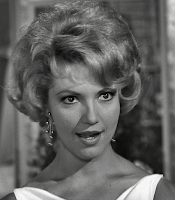
As a "bad girl" in Twilight Zone.
Ruta Lee:  I think that playing a bitchy, little tramp in The Twilight Zone ("A Short Drink from a Certain Fountain") was one of my favorites. When I got through doing a scene, there came a big round of applause from the crew members up on the catwalk. Later, when I finished work that day, they said the applause was because I was good and reminded the crew of their favorite: Carole Lombard. I thought, wow, what a compliment! I also believe I did a good job in a Bonanza episode ("A Woman Lost"), but it was before everyone's agent nominated them for an Emmy. I could have won one with the right publicity. One of the great learning experiences for me was the stuff I did on Perry Mason. Gail Patrick was a beautiful star from the 1930s and into the 1940s, who became a producer. She would hire me a lot. It was always very interesting to me that there was this exquisitely beautiful woman who was not afraid of young girls and not afraid of the competition. I did at least five Perry Mason episodes and that was almost like going to acting school. Working with that cast was absolutely wonderful. I could also say that about the work I did at Warner Bros. One of the mistakes that I made back then was that I said no when Warner Bros. wanted to put me under contract. The contract would have paid me $300 a week whereas I was doing one to two shows a month for $750 a week. But when you go under contract to a studio, you have a powerful machine behind you. You get lessons in whatever you need. You get a publicity department behind you. You get put into roles without having to audition for them. Still, I was very grateful, because I got to do shows like Cheyenne, Maverick, 77 Sunset Strip, and Hawaiian Eye. I was a fixture at Warner Bros. The house that I'm sitting in now I call the "House that Jack (Warner) Built" because my Warner Bros. salaries and residuals helped make the payments.

Café:  When we interviewed Julie Adams in 2013, she also said how much she enjoyed guest starring on Perry Mason.

Ruta Lee:  I don't know if this happened with Julie, but I would get invited as a guest to dinner parties, not every week, but maybe twice a year at Gail Patrick's home. She was married to a man named Cornwell, or Corny, Jackson. I just felt so honored to be among the elite of Hollywood and listen to their stories. It was a great honor and I will never forget Gail Patrick for that.

Café:  Were there any actors that you particularly enjoyed working with?

Ruta Lee:  I loved working with everybody. I am a very easy person to get along with and I enjoy people and their stories. Needless to say, Frank, Dean, and the boys were just the best. Jimmy Garner was great fun to work with on Maverick.

Café:  You have also appeared in a number of stage plays. What were some of your favorite stage roles and why?
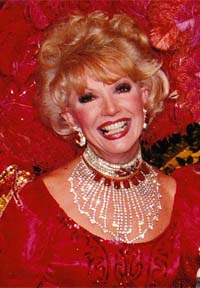
Ruta Lee in Hello, Dolly.
Ruta Lee:  My altogether favorite is one of the hardest roles to play and that's The Unsinkable Molly Brown. I played that role for the first time in Fort Worth, Texas, where I went on to perform it for 40 years. Because of Molly Brown, I became the darling of Fort Worth. The press would write that summer is here and Ruta is here, so everyone can enjoy their summer! It was a great role for me and the best part was the composer of the show, Meredith Wilson, came to see Molly Brown with his wife on opening night. When Meredith was interviewed by the press, he said: "Ruta is the best Molly of them all. If she had played it on Broadway, it would still be running." I also love Anne Get Your Gun, Bells Are RingingHello, Dolly, and The Best Little Whorehouse in Texas, which is the easiest and still a great role in which to strut your stuff.

Café:  You and your husband, business executive Webb Lowe, Jr., celebrated your 43rd wedding anniversary in February. How did you meet and what is the secret to your long marriage?
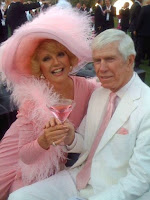
Ruta and her husband Webb.
Ruta Lee:  I'll answer the second question first. The secret to our long marriage is having a great sense of humor. My husband taught me something the first year we were married. As a new young bride, I'd get upset and distressed if he didn't hear what I had to say or didn't bring flowers on an occasion. He said to me: "Let me ask you something. At the end of the day, will this be important? At the end of the week? At the end of the month? At the end of the year, will this still be important and will you still be thinking about it?" I realized that nothing in life is worth stressing over. I'm not talking about serious tragedies, but the usual daily routine. If you can't just laugh it off, then you don't need to be married. Now, as to how I met him, that's a fun story. I had promised the Ladies Professional Golf Association (LPGA) that I'd be its guest star at an event in Naples, Florida. At the time, I was doing a show in Dallas, which was supposed to close on Sunday and then I'd go to Naples on Monday. The theater owners came to me and asked if I could play another week since my shows were selling out. I agreed to do two shows on Sunday, go to Naples, and return to Dallas. I hadn't been feeling well, but I threw myself together, flew to Miami, and ran across the tarmac to a small plane which took me to Naples. I put on the feather boas and long eyelashes and made my big appearance at the LPGA. The next day, of course, I had to return to Dallas for a show and I had a fluey thing going on. So, I put a babushka on my head, big sunglasses, and not a stitch of make-up. It's hot in Florida, so I carried my fur coat as I ran across the tarmac. I go over to American Airlines and they tell me it's a turnaround flight and that they'll pre-board me as soon as it gets cleaned up. So, I was leaning against the counter, my head in my hands, and looking down at the floor. I see a great pair of Gucci loafers coming towards me. And I look up a little further and see nice slacks with a crease on them. I look up a little higher to see a double-breasted blazer with gold buttons. A little further, there's a great tie. And then I see a shock of silver hair and a face that's a cross between Lee Marvin and Clint Eastwood. I said: "Be still my heart!" And he kept walking towards me...and then right past my counter and down the hall. I thought, oh shoot, we're just ships that pass in the night. So, the airline pre-boards me and I'm piling all my stuff under my seat and on the seat next to me. And all of a sudden, I look down and the same pair of shoes are standing there. And he said: "Is this seat taken?" And I said--for the last time in my life--no. And he leaned over and said: "Hello, my name is Webb Lowe." And I said: "Hello, my name is Ruta Lee. And we should be married, because then my name would be Ruta Lee Lowe and we could open a Chinese laundry."

Café:  That's a charming story! Now, I've read where you personally contacted Nikita Khrushchev in 1964, when he was the Premier of the Soviet Union, to secure the release of your grandmother from an internment camp. Can you provide the fascinating details?
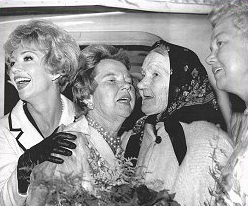
Ruta and family reunited.
Ruta Lee:  I had been trying for years to get my grandmother out of Siberia where she had been deported. She spent fifteen years there. Most of my family was deported to Siberia. No one knows why. We're not talking about brilliant, educated teachers and writers. These were peasant folk who tilled the land and grew their own vegetables to eat. My grandmother was finally permitted to go back to Lithuania with some of the family and we received word that she was dying. We tried to keep them alive by sending packages. You could only send forty-pound packages and the contents were dictated by the Communists...one pound of coffee, one pound of lard, one pair of socks...that kind  of thing. I came home from work one day and my mother was in a state of tears. We had received a letter, though much of it was blacked out, and my grandmother was thanking us for sending clothes for her to be buried in. She had been to a doctor and was told she was going to die. I was so distressed. She was my one remaining grandparent and I had never met any of them. I went out with friends that night and the more wine they poured, the more obvious it became that I should pick up the phone and call Khrushchev--so I did. In those days, there was person-to-person calling and you didn't pay for the call if you didn't get your party. If you got your party, you paid maybe twice as much. I kept calling and calling and the American operator would talk to the Russian operator who would talk with the Kremlin operator, who would get back to me and say: "Nyet, nyet, nyet." In the meantime, I called the Russian Embassy in Washington to get permission to go to Lithuania and I'd get "nyet" there, too. Finally, the Kremlin operator called back and said: "Mr. Khrushchev doesn't speak English. You speak to interpreter to Mr. Khrushchev." I remembered a good-looking young man who traveled with Khrushchev when he was here and had translated for him. Anyway, I spoke with the interpreter and he said: "Miss Lee, we would be very happy to have you travel to the Soviet Union. We know you here. We see your films here. Why don't you speak to your congressman about it?" And I said: "Excuse me, sir. What the hell does my congressman have to do with my traveling to your country? This is not a political matter. It is a matter of the heart. What are you going to do about it?" And he said: "In half an hour, present yourself again to the Soviet Embassy in Washington." I thought, oh no, here we go again! I hung up and a half-hour later I called the embassy. This time, I was connected immediately to the first secretary, who was Lithuanian. Of course, he knew me because I was the one doing the Voice of America broadcasts against Communism. It's an absolute miracle that within 48 hours, my parents and I were on a plane headed to Moscow and then to Lithuania. They took us to my grandmother and six months later, I was given permission to bring her and an aunt back to the United States. She lived for two years, two months, and two days.

Café:  That's an amazing story.

Ruta Lee:  I've been writing a book for the last ten years. One of these days, I'll hopefully get it together and finish it. Maybe you'll help me out by telling all your readers to go buy Ruta's book!

Café:  I will certainly do that. Now, I know you're passionate about volunteerism. You, along with other stars such as Debbie Reynolds, have been deeply involved with a charity called The Thalians for many years. Can you tell about its mission and about how others can help?
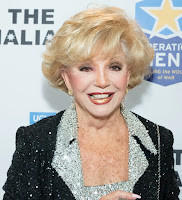
Ruta at a Thalians event.
Ruta Lee:  First of all, everyone can go online to thalians.org and read about us there. It all started in 1955 with a group of young actors who got tired of being called hard-drinking idiots who had nothing to contribute. We'd get together to laugh and play at parties, so we decided we should sell tickets and make a few dollars for a charity. So, we sent Jayne Mansfield and Mamie Van Doren to find out what charities were available. They came back a few months later and said that all the big charities were taken. But they had found a doctor who worked with emotionally-disturbed children at Mount Sinai Hospital. At first, we raised funds for the children and then, eighteen years later, we built a clinic and went from pediatric to geriatric care. We were very proud that this small group of Hollywood performers had shone a spotlight down into that dark pit, which is mental illness, and tried to bring it into the light of healing. Many years later, we changed our focus to returning veterans, who came back scarred not only physically but mentally. We joined up with a group at UCLA called Operation Mend. It deals with the broken arms and faces and we deal with the broken spirits through The Thalians. We ask everybody who has $5, $50, or $5 million to please contribute to The Thalians. We have raised millions of dollars by doing huge shows starring the stars of all-stars and they all did it gratis.

Café:  Do you have any upcoming events that you'd like to tell our readers about?

Ruta Lee:  Yes, The Thalians has an event at the Music Center in Los Angeles on the 18th of May. It's a wonderful luncheon and not a terribly expensive one. If you go to our website, you can read about it and call our office for more information.

Café:  Ruta, you've been a highly entertaining and informative interview subject. Thank you for all of your charity work and for all you've brought to classic movie and TV fans throughout the world.

Ruta Lee:  That's very kind of you. Thank you and all of your readers, Rick. God bless you all.

Thursday, September 8, 2016

Love Fights Hate in "The Night of the Hunter"

In addition to a gallery of memorable performances, actor Charles Laughton’s cinematic legacy includes one fling with directing—but oh what a fling it is! The Night of the Hunter is a haunting, poetic film that explores themes ranging from the battle between good and evil to the propensity of Nature to protect the innocent. The film also provides Robert Mitchum with his best role as Harry Powell, evil incarnate disguised as a preacher (what makes the character even more chilling is that Harry believes he has a special relationship with the Almighty).

Harry's hand of hate.
The film’s opening is pure Hitchcock, with a group of frolicking kids discovering a corpse in a cellar. In the next scene, we see Harry Powell driving down the countryside, talking to himself about the “six…twelve widows” he has murdered. When Harry is arrested—for car theft—he becomes the cell mate of Ben Harper (Peter Graves). Harper stole $10,000 and accidentally killed a man. However, before he was arrested, he disposed of the money with his two children, John (who’s about 11) and his younger sister Pearl. Harper makes his children swear to never divulge the hidden location of the money, not even to their mother (“You’ve got common sense; she ain’t.”).

Harry confronts young John.
The lure of $10,000 (a lot of money during the Depression) appeals greatly to Harry. Upon his release from prison, he looks up the pretty young widow Willa Harper (Shelley Winters). But young John (Billy Chapin) takes an instant dislike to the new preacher wooing the mother; it’s as if only the innocence of childhood can recognize the true nature of evil. John tries to protect his family, but when tragedy strikes, he and Pearl flee with Harry in pursuit.

The Night of the Hunter is a virtual textbook on filmmaking, with sound and image blended effortlessly to create mood. Harry’s entrances in the film are accompanied by a jarring, foreboding piece of music. Even more disturbing is when we hear Harry before we see him. In one scene, his singing filters into the children’s bedroom as he waits patiently outside the front gate (almost like a predator lurking for its prey).

Laughton’s striking use of shadows and silhouettes recall the Expressionistic German films of the 1920s (e.g., The Cabinet of Dr. Caligari). I suspect much of the credit for the brilliant lighting belongs to cinematographer Stanley Cortez, a skilled craftsman who labored in routine films except for this one and Orson Welles’ The Magnificent Ambersons.

One of Stanley Cortez's haunting images.

Billy Chapin with Lillian Gish.
As Harry Powell, Mitchum gives the performance of a lifetime. With “love” tattooed on one hand and “hate” on the other, he describes the struggle between them in one of the famous scenes in film history. To complement Mitchum’s performance, Lillian Gish brings quiet strength to her role as his eventual adversary. Just as the animals watch over the children as they drift down the river in a boat, Gish’s Mrs. Cooper guards the children (almost as if she personifies Mother Nature). At one point in the film, she even says: “I’m a strong tree with many branches for many birds.”

Since Charles Laughton never directed another picture, it’s hard to gauge how much of Night of the Hunter was his vision. Screenwriter James Agee, already a renowned film critic, went on to win a Pulitzer Prize for fiction. But for all their talent, neither Agee, Cortez, nor Mitchum made another movie to rival this one. So either it was sheer luck that all the talents gelled so wonderfully on The Night of the Hunter or Laughton provided the guidance to make it work. I tend to believe the credit belongs to Mr. Laughton.

Wednesday, August 17, 2016

The Big Clock: Man Against Time

What would you do if you were asked to track down a suspected murderer and your quarry was...you?

That's the dandy premise behind The Big Clock, a smart 1948 suspense film sometimes misclassified as a film noir. Ray Milland stars as the protagonist, who explains his predicament via voiceover in the opening scene and then flashes back to 36 hours earlier.

Ray Milland as George Stroud.
George Stroud (Milland) works at Crimeways, one of many magazines published by ruthless media magnate Earl Janoth (Charles Laughton). Stroud, who specializes in finding criminals on the run, is looking forward to his honeymoon. It's a bit overdue considering he and his wife (Maureen O'Sullivan) have a five-year-old son. When Janoth directs him to cancel his vacation plans and personally cover a story, Stroud quits his high-pressure job. That evening he meets Pauline, a pretty blonde (Rita Johnson) who turns out to be one of Janoth's disenchanted mistresses.

Instead of meeting his family at the train depot, Stroud commiserates with Pauline. They visit several bars, stop at an antique shop, and wind up at her apartment. She nudges a tipsy Stroud out the side door when Janoth arrives unexpectedly. When Pauline berates Janoth during an argument, he flies into a rage and kills her.

Janoth turns to Steve Hagen (George Macready), his second-in-command, who covers up the crime. The only problem is that Janoth saw a man standing in the shadows outside Pauline's apartment door. He and Macready decide to pin the murder on the mysterious stranger...assuming they can find him. And who better to track down a suspected killer than George Stroud?

Laughton and mustache.
While there is much to like in The Big Clock, uneven performances and a lack of attention to detail hamper it to some extent. Charles Laughton, who can be a very fine actor, makes Janoth into a one-dimensional monster. When he strokes his mustache with one finger, it's oddly reminiscent of an intentionally overplayed vaudeville villain. Ray Milland fares better as the hero, but I'd expect a crime journalist to show more intelligence when it comes to investigating a murder scene. When Stroud returns to Pauline's apartment, he picks up a clock--thereby marking it with his fingerprints (and yes, fingerprints were admissible as evidence in U.S. courts as early as 1911).

The standouts in the cast are Rita Johnson as Janoth's mistress and Harry Morgan as a masseuse who doubles as a killer. Morgan doesn't have a line of dialogue, but lurks creepily in the background as Stroud and his team conduct inquiries. I was expecting an exciting confrontation when he encounters Stroud inside the "clock room" of the Janoth building. Alas, one punch knocks Morgan's character down some stairs and he never appears again.
Note Harry Morgan lurking between Macready and Milland.

Ray Milland and Rita Johnson.
As for Rita Johnson, she appeared in many classic films (Here Comes Mr. Jordan, The Major and the Minor), but usually in secondary roles. She turns Pauline into a bright, likable character who flirts sweetly with Stroud and then verbally attacks Janoth aggressively. In real life, Rita Johnson suffered a brain injury in 1948 that caused lapses of memory and partial paralysis. The official story was that a large hair dryer had fallen on her in her apartment. However, she had other bruises on her body that led to speculation that she may have been beaten. After her brain surgery, she only appeared in a handful of films. She died in 1965 at age 52. Click here to read an article about her alleged accident.

Milland inside the big clock.
Director John Farrow, husband of Maureen O'Sullivan, directs with a sure hand and emphasizes the importance of time, but he adds little stylistically. His opening tracking shot from the outside to the inside of the Janoth building recalls Roy William Neill's earlier Black Angel (1946). The interior of the big clock, the film's most interesting set, is barely used. John Seitz's black-and-white cinematography is crisp as always. He worked on several famous noirs (e.g., Double Indemnity, This Gun for Hire), which I assume is why some critics consider The Big Clock to be a film noir. Thematically, though, it doesn't fit in that genre (now it might be different if Stroud had been unfaithful to his wife).

Sean Young and Kevin Costner.
Kevin Costner and Gene Hackman starred in an above-average 1987 remake called No Way Out. Costner played an unmarried Naval officer who began an affair with an attractive young woman (Sean Young), who was also mistress to the Secretary of Defense (Hackman). After Hackman's politician murders his mistress, he accuses her "other lover" and recruits Costner to find the alleged killer.

Monday, November 17, 2014

Witness for the Prosecution: It's Billy Wilder--Not Hitch!

A dear friend of mine has referred to Witness for the Prosecution as an Alfred Hitchcock movie on more than one occasion. That's understandable--it looks, smells, and feels like a Hitch pic. The fact that it was directed by Billy Wilder is a testament to Mr. Wilder's versatility as a filmmaker. The Austrian-born writer-director was adept at making screwball comedies (One, Two, Three), film noir (Double Indemnity), satire (The Apartment), sophisticated comedy (Sabrina), drama (The Lost Weekend), and romance (Avanti!). In Witness for the Prosecution, he expertly blends courtroom drama and humor--in the best Hitchcockian tradition.

Tyrone Power as the defendant.
Charles Laughton stars as Sir Wilfred Robarts, a grumpy but shrewd London barrister who was recently released from the hospital after suffering a heart attack. Against the advice of his physicians, Sir Wilfred takes on a murder case (his specialty). His client is an affable chap named Leonard Vole (Tyrone Power) accused of killing an elderly lady. Vole's alleged motive is that the murder victim left him a substantial amount of money in her will. His alibi rests on the testimony of his German wife Christine (Marlene Dietrich), who leaves a decidedly cold impression with Sir Wilfred.

Based on a short story and stage play by Agatha Christie, Witness for the Prosecution is justly famous for its twist ending--which is flawlessly executed. It was probably one of the first films that marketed its climatic twist. Indeed, a voiceover prior to the closing credits asked moviegoers not to reveal the ending to their friends. However, like Hitchcock's Psycho, Witness is a strong film that's enhanced by its famous plot device. It certainly doesn't rely on a clever trick to be entertaining.

The film's success can be attributed to those old basics of good acting and good script writing. Laughton, who had a tendency to ham up some of his later roles, finds the perfect blend of seriousness and humor. He is matched by Dietrich and his wife Elsa Lanchester as Miss Plimsoll, a nurse charged with the unenviable task of caring for Sir Wilfred. Lanchester and Laughton make a delightful comic team, one savvy enough to generate laughs out of the contents of a thermos. Dietrich has a more difficult role, especially since her character is a conundrum for much of the film. However, when it comes to her big scenes, she exceeds all expectations.

Nurse Plimsoll and Sir Wilfred.
There was a time when I considered Tyrone Power to be the film's weak link. I still don't believe his performance ranks with the ones delivered by his co-stars. However, I have gradually come to the realization that Power is portraying a character playing a character. That's got to be a challenge, so, on that level, he does a solid job as the smarmy Vole.

Marlene Dietrich in the witness box.
In adapting Christie's play, Wilder and co-writers Larry Marcus and Harry Kurnitz made two significant additions. First, they added scenes showing how Leonard met Christine and later befriended the murder victim. The latter doesn't add much to the plot, but the scenes of Christine soften her character and help justify actions taken later in the film. Dietrich's nightclub number was reportedly based on a scene cut from Wilder's A Foreign Affair (1948), which starred Dietrich, Jean Arthur, and John Lund. The cabaret set cost over $75,000 to build.

Still, Wilder's most significant contribution to the script was the creation of the delightful Nurse Plimsoll. Many of the film's best lines are delivered by her or directed at her by the gruff barrister (Miss Plimsoll: "Sir Wilfred, we mustn't forget that we've had a teeny weeny heart attack."). Plus, Wilder gets a lot of mileage out of Sir Wilfred's amusing attempts to hide his vices (e.g., cigars and brandy) from Miss Plimsoll's watchful eyes.

Witness for the Prosecution earned six Academy Award nominations, including Best Director for Wilder, Best Actor for Laughton, and Best Supporting Actress for Lanchester. It was remade for television in 1982 with another impressive cast: Ralph Richardson as Sir Wilfred, Deborah Kerr as Miss Plimsoll, and Diana Rigg as Christine. I haven't seen that version since it's original broadcast, but recall it being very well done.

Friday, November 15, 2013

Short Takes with Charles Laughton, Cowboys & Dinosaurs, and Neil Simon

This Land Is Mine - When the Nazis invaded France during World War II, acclaimed filmmaker Jean Renoir relocated to the United States. Renoir, son of the Impressionist painter Auguste Renoir, had already completed what would become his masterpiece, 1939's Rules of the Game. Unlike fellow refugee director Fritz Lang, Renoir never found his groove in Hollywood. Still, his first English-language film, This Land Is Mind, is a heartfelt, patriotic story of a timid schoolteacher (Charles Laughton) in a small European village occupied by Nazis. Maureen O'Hara, George Sanders, and Una O'Connor lead a strong supporting cast.

The Valley of Gwangi - Ray Harryhausen's imaginative mix of Western and fantasy overcomes a leisurely first half en route to 45 minutes of almost non-stop cowboys vs. dinosaurs action. While it can't stand alongside Harryhausen classics like Jason and the Argonauts, the special effects in 1969's Gwangi are excellent--especially the climatic T-Rex rampage. The scene where the cowboys lasso the T-Rex took stop-motion animator Harryhausen five months to film. Willis O'Brien, King Kong's creator and Harryhausen's mentor, conceived Gwangi in 1942, but RKO abandoned the production.

The Goodbye Girl - Playwright Neil Simon penned this winning romantic comedy as a vehicle for his then-wife Marsha Mason. She plays the title character, a single mother recently jilted by her latest lover. To make matters worse, she learns that her NYC apartment has been subleased to Dreyfuss, a struggling actor. Simon wisely keeps sentiment to a minimum, while allowing his outwardly brash characters to reveal their inner insecurities. Mason is good, if a bit too theatrical, but Dreyfuss hits all the right notes in his Oscar-winning performance. Quinn Cummings, as Mason’s wise-beyond-her-years daughter, delivers most of Simon’s trademark zingers. She, Mason, Simon, and the film all earned Oscar nominations. David Gates, formerly of the rock group Bread, wrote and performed the memorable title tune, which peaked at #15 on the Billboard chart.

Thursday, February 2, 2012

Preminger Takes an Insider's Look at Politics in Advise & Consent

Like The Day the Earth Stood Still, Advise & Consent is one of those rare films whose themes never seem to age. Even its plot has held up remarkably well. When I watched it a few years ago, President George W. Bush was encountering opposition from the Senate—and his own party—on the appointment of Robert Bolton as United Nations ambassador. In Advise & Consent, the President (his name is never given) clashes with the Senate and his own party on his nomination of a liberal academic to become Secretary of State.

Fonda as the President's pick.
His nominee Robert Leffingwell (Henry Fonda) isn’t even sure he wants the job at first. But the President (Franchot Tone), whose ailing health threatens the future of his policies, remains steadfast in his choice. Even a potentially scandalous secret from Leffington’s past can’t convince the Commander in Chief to alter his position. The President’s unyielding stance sets into motion a political chess match in which Senators take sides and people become pawns. (The chess analogy is an interesting one: Walter Pidgeon, who fights for Leffingwell, wears a dark suit; Charles Laughton, who opposes him, wears white).

Laughton on the Senate's floor.
The characters come alive courtesy of an exceptional cast: Laughton as the curmudgeonly senior senator from South Carolina; Pidgeon as the President’s right-hand man; Don Murray as a bright well-intentioned junior senator with his own secret; George Grizzard as an overly ambitious right-winger; Peter Lawford as a team player who finally sees through the hypocrisy; and Lew Ayres as an ignored vice president who may be stronger than people think.

My favorite aspect of the film, though, is its “behind the scenes” look at Washington politics. A powerful senator, not selected for a subcommittee, pulls strings so he can influence a hearing as an “observer.” Strategists project votes to determine when they think they have enough to make their move. An ambitious junior senator campaigns to be selected as a committee chair. There are subtle threats of blackmail and not-so-subtle ones. Allen Drury, who wrote the Pulitzer Prize-winning bestseller on which the film was based, spent several years as a political reporter. His insider look is revealing and engrossing.

Pidgeon and Gene Tierney,
Preminger's Laura.
I'm often surprised that director Otto Preminger is mentioned so rarely in conversations about great directors. It may have to do with his versatility. Many of the great filmmakers are associated with certain types of films, such as Hitchcock and suspense, Ford and Westerns, and Lubitsch and comedy. But Preminger, like Billy Wilder, could make a movie about anything: film noir (Laura); comedy (The Moon Is Blue); social drama (The Man With the Golden Arm); courtroom drama (Anatomy of a Murder); or suspense (Bunny Lake Is Missing). His direction is subtle and flawless in Advise & Consent, inconspicuously moving along the dialogue-driven plot.

The 1960s were a banner decade for political dramas. The Best Man (1964), about two men seeking their party’s presidential nomination, is a fine companion piece to Advise & Consent (interestingly, it also shares a key subplot and also stars Henry Fonda). And though it’s more of a thriller, Seven Days in May (1964) provides a sharp portrait of a president facing a leadership crisis. All three films hold up amazingly well today and come highly recommended.

Tuesday, November 16, 2010

The 1935 “Mutiny on the Bounty” Gets the Blu-ray Treatment

Frank Lloyd’s 1935 adventure-at-sea, Mutiny on the Bounty, starring Charles Laughton, Clark Gable and Franchot Tone, arrives on Warner Bros. Blu-ray today. Inspired by historical events, the movie details a mutiny led by Fletcher Christian (Gable) against the captain of the Bounty, William Bligh (Laughton).

Winner of an Academy Award for Best Picture (the category officially deemed Best Outstanding Production), Mutiny on the Bounty was also nominated for Best Director, Best Film Editing, Best Music (score), and Best Writing, as well as nods for the three leading men (all nominated for Best Actor in a Leading Role, as the Academy would not have a Supporting Actor/Actress category until the following year).

The film was based on a 1932 novel by Charles Nordhoff and James Norman Hall, and was remade in 1962, directed by Lewis Milestone (who also helmed 1960’s Ocean’s 11) and starring Marlon Brando as Fletcher Christian and Trevor Howard as Capt. Bligh. Preceding Lloyd’s movie, there were two Australian films produced based on the incident on the Bounty: a 1916 silent film, The Mutiny of the Bounty, that reportedly has no existing prints; and 1933’s In the Wake of the Bounty, which features Errol Flynn in his screen debut as Fletcher Christian. In 1984, The Bounty was released with Anthony Hopkins as Bligh, Mel Gibson as Christian, Laurence Olivier as Admiral Hood, and early performances from Daniel Day-Lewis and Liam Neeson.

The Mutiny on the Bounty Blu-ray displays sharp, sublime black and white cinematography and an impressive hi-def soundtrack. Considering the film’s age, the images and audio are worthy of praise, and the entire presentation looks and sounds admirable. The single-disc release is packaged in a handsome book format, loaded with publicity stills and trivia. Extra features include an MGM short, “Pitcairn Island Today”, 1936 newsreel of Frank Capra presenting the Oscar to producer Irving Thalberg (who gives a brief word of thanks), and trailers for the film and the 1962 remake. Mutiny on the Bounty in hi-def would make a great gift for the upcoming holidays!

For details on the movie and its production, check out Kims Cafe write-up here. For more information on the new release, you can visit the Warner Bros. Blu-ray site.

Warner Bros. provided a copy of this Blu-ray to Classic Film & TV Cafe. Photo stills courtesy of Warner Bros.

Sunday, July 4, 2010

Ruggles of Red Gap: What Price Freedom?

Freedom isn’t free. There is always a price that must be paid.

An excellent example of this is on display in this lesser-seen gem starring the phenomenally talented Charles Laughton as Ruggles of Red Gap. Ruggles is a very proper manservant to Lord Burnstead in England. His employer, however, offers him as chattel as part of a bet that he loses in a poker game to some unusual Americans, Egbert and Effie Floud (Charles Ruggles and Mary Boland). Effie is thrilled beyond belief that this valet will be able to influence her wealthy, but decidedly uncultured, husband. But Egbert has other ideas. He is glad to have a new buddy and introduces Ruggles as “the Colonel” to the townsfolk back home in the U.S.

Ruggles is like a fish out of water. He doesn’t quite know what to make of this situation. He is an excellent servant but confused as to what his responsibilities are supposed to be in this household that is so decidedly different from the one he has known in England. Still, he is impressed with something he never quite grasped before. There are opportunities in this new country for everyone who is willing to work hard.

Ruggles befriends Mrs. Judson (ZaSu Pitts) and demonstrates his remarkable cooking abilities. Soon, the man who was displaced from his comfortable employment into a brand new environment is learning what it means to be a free man.

In the most touching scene of a movie that is mostly filled with humor, Egbert attempts to quote Lincoln’s Gettysburg address in the Silver Dollar Saloon when the quiet and gentle voice of Ruggles eloquently recites it in full. It is a remarkable moment and one that always makes me thankful for the many blessings afforded to us in our beloved country.

Like Ruggles, Charles Laughton began his career in England, but traveled to America to enhance his acting opportunities. He made his Broadway debut in 1931 and enjoyed almost immediate success in both American and British talking pictures. By 1933, he already won a Best Actor Oscar for the title role in The Private Life of Henry VIII. Following the release of Ruggles in 1934, Laughton enjoyed a remarkable period in his career, starring in Les Miserables (1934), Mutiny on the Bounty (1935), Rembrandt (1936), and The Hunchback of Notre Dame (1939).

The supporting cast sparkles in Ruggles of Red Gap, especially Charles Ruggles who plays the endearing Egbert. It’s the “nouveau riche” Egbert who personifies the American spirit in the film. He accepts every person as his equal, never forgets a friend, and ignores any distinction between classes.

It’s interesting that the film’s most powerful scene—Ruggles’s reciting of the Gettysburg address—wasn’t in the original 1914 novel. But that scene and the strong performances give Ruggles a depth that’s totally missing in the 1950 Bob Hope remake Fancy Pants.

If you’ve never seen Ruggles of Red Gap, it makes for excellent viewing on this patriotic holiday. I truly hope that each and every American celebrates today with thanks given to our Lord and to those who made our freedom possible. Happy Fourth of July!

Saturday, April 17, 2010

Clark Gable Leads a Mutiny on the Bounty

Mutiny%202

In 1935 Columbia Pictures president Harry Cohn had the great distinction of awarding the first “Oscar” for Best Picture (it was actually called Outstanding Production at that time) to MGM’s nautical classic Mutiny on the Bounty. His studio had no film nominated (which is difficult to believe since 12 films were up for the award), so he was just happy to be asked to the party. Anyway, between 1927-1934 the award wasn’t known as the “Oscar”, so technically this was the first Best Picture to win the “Oscar”—one of those tricky questions for you trivia buffs out there. It also holds the honor of being the first remake (1933’s In the Wake of the Bounty) to win Best Picture. In the end, the film was nominated for 8 Academy Awards and only won one, but at least it won the biggest prize of all. Of course, they may have picked up the Best Actor award if it hadn’t been for the fact that the three male leads (Clark Gable, Charles Laughton, and Franchot Tone) were nominated against one another. I suppose Victor McLaglen was quite happy about this, because he took home the award for his performance in The Informer.

The screenplay was a monumental undertaking, as screenwriters Talbot Jennings, Carey Wilson and Jules Furthman were given the task of adapting the first two volumes of Charles Nordhoff and James Norman Hall’s 1932 The Bounty Trilogy to the big screen. For the amount of story they had to work with, I think it is a miracle the movie was only 132 minutes long. Perhaps this is one of the reasons they were nominated for an Oscar (they lost out to The Informer, too!). There was an actual Mutiny on the Bounty, but, like most Hollywood films based on true stories, this was not a completely accurate retelling. For example, Captain Bligh wasn’t reprimanded in this incident but, in fact, promoted to Vice Admiral for his actions.

Director Frank Lloyd also picked up a nomination (he lost to John Ford, who, you guessed it!, directed The Informer—was there a conspiracy?) for heading MGM’s $2 million over-budget film. Good thing for Lloyd that it was also the top-earner of 1935, at $4.5 million. Of course, producers Irving Thalberg and Albert Lewin couldn’t complain since they signed off on a film primarily shot on location in Tahiti and Catalina Island. Perhaps Lloyd’s greatest accomplishment on this film was getting Clark Gable to shave off his cherished mustache.

Charles_Laughton_in_Mutiny_on_the_Bounty_trailer The story begins in 1787, aboard the H.M.S. Bounty, which is bound for the breadfruit capital of the world, Tahiti. Once there, the crew’s mission is to transport the cheap foodstuff to plantations in the West Indies. Charles Laughton gives one of his most memorable performances as the sadistic and abusive captain of the Bounty, Captain Bligh. Some genius at MGM thought Wallace Beery was the best actor for this role. Really? Wallace Beery better than Academy Award winner Charles Laughton? I hope someone got a promotion for averting this disaster. Anyway, before the ship can set off from Portsmouth, Captain Bligh has one bit of business to attend. A crew member must be flogged for violating a rule. The problem: he’s dead. No matter, he still must be flogged to send a message to the rest of the crew. Does the audience really Gableneed to know any more about Bligh? First Officer Fletcher Christian (Clark Gable), who is used to working with this nutcase, tries his best to heed his captain’s orders while at the same time gaining the respect of the crew. This only infuriates Bligh more, which, in turn, causes him to do things that makes Christian grow to resent him. In addition to Fletcher, Midshipman Roger Byam (Franchot Tone), who is on his first cruise with Bligh, is astounded and shocked by the captain’s behavior.

By the time the ship lands in Tahiti, Fletcher is out of favor with Bligh and is not allowed to go ashore. Instead, Byam goes ashore and falls in love with the beautiful Tehani (Mrs. Marlon Brando, Movita Castaneda). Not wanting to hog all the beautiful island women, Byam concocts a plan to allow Fletcher to go ashore. Once there, he also falls in love with Maimiti (Mamo Clark), the granddaughter of the island chief. The crew spends six months in paradise and then, once they have got all the breadfruit they can carry, they must set off for the West Indies. Having led a carefree, happy existence on the island, the men soon become reacquainted with Captain Bligh’s strict 1935_clarkgable running of the ship. Some of the men can’t take it and decide to abandon ship and return to the beautiful Tahitian women. When they are captured, Bligh orders their flogging and demands that the ship’s very ill doctor, Dr. Bacchus (Dudley Digges), attend. What a clever last name for an alcoholic!!! Any way, Dr. Bacchus dies after leaving his bed to obey Bligh’s order. This causes Fletcher to break and he intervenes in the flogging and starts a mutiny. Bligh is tied to the mast and becomes the victim of countless insults from his crew. Luckily for him, Fletcher is an honorable man. 230px-Charles_laughton_mutiny_bounty_1 When the crew decides to kill him, Fletcher saves him and sets him and some of the non-mutineers out to sea in a small rowboat. Unfortunately for Byam, who doesn’t support the mutiny, there is not enough room for him in the boat. Put out to sea, Bligh swears vengeance and promises he will live to see every last mutineer hang. A master sailor (but a total SOB), Bligh does manage to travel the high seas over 3,500 miles to reach the East Indies.

Clark_gable_franchot_tone_mutiny_1 Meanwhile, the mutineers return to Tahiti, where both Fletcher and Byam marry their Tahitian beauties. And for a whole year, the crew lives in paradise. But then one unfortunate day the Pandora, commanded by one Captain Bligh, drops anchor in the Tahitian harbor. Fletcher leads the mutineers on an escape from the island with the Bounty, while Byam and five other men return to Bligh. As psycho as ever, Bligh charges them with mutiny and places them in irons. Crazy for vengeance, Bligh recklessly pursues the Bounty and wrecks his ship. Miraculously, those who survive this crash also survive another rowboat expedition and eventually make it back to England, where Byam faces court-martial and is sentenced to hang. At his hearing, Byam reveals the true nature of Captain Bligh and the cruelty of flogging as a punishment. In true Hollywood style, Byam is pardoned and allowed to return to service in the navy, while Captain Bligh’s behavior is denounced.

And what happened to Fletcher? He and his crew took the Bounty to Pitcairn Island and promptly crashed and burned it so no one could ever leave. No doubt after seeing this movie thousands of women went home and dreamt they were stranded on a deserted island with Clark Gable.

Overall, and enjoyable adventure story. The cinematography is pretty impressive, but I definitely think it would have been better shot in color. The acting is top-notch and Charles Laughton does a great job portraying one of the most vilest characters in screen history.

Tuesday, November 17, 2009

Cafe du Cinema Society Discusses "The Night of the Hunter"

Film critic Leslie Halliwell once described The Night of the Hunter as a child's terrifying fantasy.  And while much of the film is presented from a child's point of view, director Charles Laughton pulls both young and adult viewers into this fantasy world. Once inside, the viewer becomes exposed to all the horrors faced by the characters--especially the children John and Pearl. Hence, The Night of the Hunter becomes a horror film. Much of its horror is psychological---lurking beneath the film's surface in the form of horrific and suspenseful elements, the character's perversions and madnesses, and potential psychological fears and fantasies. For example, we see an owl that appears to be gentle and harmless. Yet, it suddenly swoops down and kills a rabbit. Laughton seems to be saying that horror can lurk where we least suspect it--in a wise, old owl or even a "preacher."

Do you agree that The Night of the Hunter is a horror film? If yes, how does Laughton create horror and suspense in his film? And if you disagree, let's hear some feedback as to why! Remember, the Cafe du Cinema Society is all about interactive, online discussion.