Showing posts with label vertigo. Show all posts

Thursday, September 26, 2019

One Fan's List of the Best Hitchcock Films

On September 5, 2009 at 4:56 p.m., I published my first post for the Classic Film & TV Cafe. Suffice to say, there was a lot I didn't know about blogging. But here I am, 968 posts and ten years later, and I must say that I've had a wonderful time writing and managing the Classic Film & TV Cafe. To commemorate  the last decade, I thought it'd be fun to update my first post about my picks for Alfred Hitchcock's ten best films. To my surprise, other than re-ranking two films, I made few changes. Please note that there are spoilers in my write-ups!

1. Vertigo - This richly-layered masterpiece reveals its big twist when least expected--turning the film on its proverbial head. It causes love to blur with obsession and greed to give way to guilt and perhaps love. What we see at the bell tower is initially false, but ultimately true. I could go on and on…but, hey, whole books have been devoted to this film. I think it’s Hitch’s best job of writing (as usual uncredited) and directing…plus we get superb performances (especially from James Stewart), a marvelous San Francisco setting, an unforgettably disturbing score from Bernard Hermann, and a nifty Saul Bass title sequence.

2. Rear Window – My wife would rate this as No. 1, but she’s not writing this post! As with Vertigo, there are multiple layers to Rear Window. Taken alone, there’s nothing interesting about the mystery of the missing salesman’s wife. The movie is really about the relationship between Jeff and Lisa. Though she is rich, beautiful, and loves him (Stella describes her as “perfect”), Jeff refuses to commit to Lisa. He fears that doing so will cause him to sacrifice his exciting, globetrotting life as a magazine photographer. It is only when Lisa becomes his “legs” and joins in the investigation of the missing wife that Jeff realizes how bright and exciting she truly is. It’s part of the film’s offbeat humor, because, to the viewer, Grace Kelly's Lisa looks stunning and exciting from the moment she walks into Jeff’s apartment. To provide contrast to Jeff and Lisa’s evolving relationship, Hitchcock lets us spy—with Jeff—on his neighbors in the apartment complex. Their stories are effective mini-dramas that are funny, sad, and murderous: Miss Lonelyhearts (that’s what Jeff calls her) dresses up and sets a table nightly for an imaginary date; Miss Torso practices dancing routines in her underwear, but rejects all suitors when she throws a party (later we learn why); the composer struggles to finish his compositions at the piano in his studio apartment; and an older couple, with their little dog, sleep on the balcony because the nights are so warm. Technically, the film is one of Hitch’s finest achievements. Almost every shot is from the viewpoint of Jeff’s apartment, an amazing feat but also one that’s not distracting (unlike the ten-minute takes in Hitchcock’s Rope). Even the stagy sets work to the film’s advantage, for the apartment complex seems like its own artificial world.

3. Marnie – When I first saw Marnie as a teenager, it made no impression at all. I thought Tippi Hedren was miscast and Sean Connery dull. The plot--what there was of one--seemed thin and the characters lacked interest. Decades later, I watched it again and, to my complete surprise, I loved it! Tippi Hedren's subtle detached performance made Marnie a vulnerable, intriguing character. The progressively complex relationship between Marnie and Sean Connery’s character generated suspense--in its own quiet way--worthy of Hitch’s best man-on-the-run films. I was captivated by Hitch's finest use of color (especially during the opening scenes). And finally, there was Bernard Herrmann's incredible score (which, for me, ranks second only to Vertigo among his Hitchcock soundtracks). I've often wondered how I missed all of this the first time around?

4. The Birds – This one functions on two levels for me. It is, of course, a masterfully directed thriller about unexplained bird attacks in a small California seaside community (I love the playground and gas station sequences). But it’s also a well-acted 1960s relationship drama about three women and their interactions with the bland, but likable, Mitch Brenner (Rod Taylor). Mitch’s mother (wonderfully played by Jessica Tandy) fears losing her son to another woman—not because of jealousy, but because she can’t stand the thought of being abandoned. Young socialite Melanie Daniels (Tippi Hedren) views Mitch as a stable love interest, something she needs as she strives to live a more meaningful life. And Annie Hayworth (Suzanne Pleshette) is the spinster schoolteacher, willing to waste her life to be near Mitch after failing to pry him from his mother. These relationships are what the film is about—the birds are merely catalysts. That’s why the ending works for me; when the relationships are resolved, the bird attacks end.

5. Strangers on a Train – One of the cleverest (and most disturbing) premises of all Hitchcock films. The carousel climax is justly famous, but I favor the cigarette lighter in the drain. It’s a perfect example of how Hitch could generate suspense from a simple situation—with potentially disastrous consequences. I think Farley Granger and Robert Walker are pretty good in the leads, but not as strong as other Hitchcock stars.

6. Shadow of a Doubt – It took this one awhile to grow on me, but that makes sense in hindsight. Shadow of a Doubt is all about gradual realization. Charlie (Teresa Wright) slowly evolves from disbeliever (those accusations toward her beloved uncle could not be true!) to one who suspects the truth to believer to would-be victim. It’s a chilling tale, all the more so because it’s set against the backdrop of a friendly Thorton Wilder town.

7. North by Northwest – I think of this as something of a lark for all involved, but that’s partially why it’s so much fun. It’s my favorite of Hitch’s man-on-the-run films and James Mason, who plays the villain straight, is the perfect foil for Cary Grant. I only wish the Mount Rushmore scenes looked a little more realistic and Roger’s mother had more scenes.

8. Psycho – It’s hard to gauge the impact of Psycho now, but I can remember how shocked I was when I first saw it. I knew Janet Leigh was a major actress and so I was more than a little shocked to see what happened to her character of Marion Crane. (By the way, I was equally shocked when Arbogast was killed…filmed from that disorienting overhead camera angle). It’s really a fine film--more than a shocker--and also offers good performances, great Hermann music, and (once again) memorable Saul Bass titles. And I guess that shower scene turned out to be a little influential.

9. Rebecca - It’s too bad that David Selznick and Hitchcock didn’t get along better, because this collaboration is an excellent, atmospheric adaptation of Daphne Du Maurier’s novel. I love how the cheeriness of the opening scenes between the future Mrs. De Winter and Maxim contrast with the later scenes at Manderley. The cast is pitch perfect with Judith Anderson and George Sanders standing out in supporting roles. Like many people, my favorite scene is when Mrs. Danvers suggests that maybe the second Mrs. De Winters should just end it all.

10. Young and Innocent and Stage Fright (tie) – I am now officially in trouble with fans of Notorious, The 39 Steps, The Lady Vanishes, and Frenzy. Those are all fine films and I would list them in my top 20. But I must confess that I enjoy the two listed in my #10 spot more than those movies. The seldom-shown Young and Innocent is a fine early man-on-the-run film with sweet performances and its share of great scenes (e.g., carving meat at the dinner table, the great tracking shot leading to the killer’s twitching eye). As for Stage Fright, I’ll say upfront that the controversial flashback doesn’t bother me at all; I don’t understand the big fuss. Stage Fright makes this list on the basis of sheer fun and a delightful cast (Jane Wyman, Marlene Dietrich, Richard Todd, Alastair Sim, Sybil Thorndike, and Michael Wilding at his most charming). I saw it late among Hitch’s films and I never fail to be entertained when I watch it again.

Honorable Mentions: Those mentioned in No. 10 that will get me in trouble for omitting…plus To Catch a Thief, Secret Agent, Blackmail, the underappreciated I Confess, and Sabotage (with the controversial bomb scene).

Wednesday, May 15, 2019

Five Favorite Films of the 1950s--Toughest Blogathon Ever!

To celebrate National Classic Movie Day 2019, we're hosting the Five Favorite Films of the 1950s blogathon. Naturally, the Cafe staff is participating, too--but who knew it would be so brutal to whittle our favorite 1950s films down to a Top 5?

Sadly, we've been forced to omit many film faves! The fact is that the 1950s was a banner decade for cinema around the world. Alfred Hitchcock was at the peak of his career. Otto Preminger was breaking film censorship barriers. The wonders of real-life science inspired a number of science fiction movie classics. Colorful big screen musicals introduced new stars and provided worthy vehicles for existing ones. Great filmmakers in Europe and Japan emerged from the ashes of a world war.

Our selections below are our personal favorites, but we'd argue that one ranks with the greatest films of all time and the other four are iconic pictures that have withstood the test of time.

Kim Novak and James Stewart.
1. Vertigo (1958) – This richly-layered masterpiece reveals its big twist when least expected--turning the film on its proverbial head. It causes love to blur with obsession and greed to give way to guilt and perhaps love. I think it’s Alfred Hitchcock’s best job of writing (as usual uncredited) and directing…plus we get superb performances (especially from James Stewart and Kim Novak), a marvelous San Francisco setting, an unforgettably disturbing score from Bernard Herrmann, and nifty Saul Bass titles. Like all great films, I glean something new from it or appreciate another facet every time I watch it. My last viewing reminded me just how brilliant James Stewart is in the lead. In a career filled with fine performances, I think Stewart does his best work as a typical Stewart “nice guy” who evolves into a man obsessed with an illusion. Contrast Scotty’s (Stewart) playful banter early on with Midge with his climactic confrontation with Judy—his eyes ablaze with confusion, hate, and something akin to love. It’s a brilliant and chilling transition.

Stewart as the defense attorney.
2. Anatomy of a Murder (1959) – Otto Preminger’s enthralling courtroom drama requires multiple viewings to be fully appreciated. When I first saw it, I focused on the riveting story, which treats the viewer much like the jury. We listen to testimonies, watch the lawyers try to manipulate our emotions, and struggle to make sense of the evidence. When I saw it a second time, I knew the case’s outcome and was able to concentrate on the splendid performances. James Stewart, Arthur O’Connell, and George C. Scott earned Oscar nominations, but the rest of the cast is also exceptionally strong. In subsequent viewings, I’ve come to appreciate the film’s well-preserved details, from the small town upper-Michigan atmosphere to Preminger’s brilliant direction (e.g., in one shot, as Scott cross-examines a witness in close-up, Stewart—the defending lawyer—is framed between them in the background).

Gort--Hollywood's coolest robot.
3. The Day the Earth Stood Still (1951) – If there were a Hall of Fame for Timeless Movies, then one of its founding members would be The Day the Earth Stood Still. I've probably watched it at least once every decade since I first saw it on NBC's Saturday Night at the Movies in the 1960s. When I was a youngster, the film's fantastic elements--and Gort, the coolest robot in the history of cinema--appealed to me. When I was a teen, its stern warning about the perils of nuclear war resonated with me. With each subsequent viewing, The Day the Earth Stood Still has revealed something new: presenting itself as a Biblical analogy, an editorial on the influence of media on public opinion, a portrait of fear of the unknown, etc. Its themes never fail to thrill me…making it much more exciting than any action-oriented sci fi film.

Danny Kaye and Basil Rathbone.
4. The Court Jester (1956) – My favorite comedy is a spot-on, delightful spoof of swashbuckling films. In a rare role worthy of his talents, Danny Kaye gets to sing, dance, use funny voices, contort his expressive face, and excel at physical comedy (such as walking in magnetized armor). The supporting players are all at the top of their game, too. Basil Rathbone has a grand time parodying past roles such as Sir Guy of Gisbourne in The Adventures of Robin Hood. Angela Lansbury displays a deft comedic touch, while Cecil Parker steals his scenes as the bored king whose only interest appears to be “wenches.” The Court Jester also includes Danny’s most famous routine—the one that involves the pellet with the poison in the chalice from the palace, the vessel with the pestle which has the brew that is true, and (finally) the flagon with the picture of a dragon (which is used for the brew that is true after the vessel with the pestle is broken). And did I mention that Danny and Basil Rathbone engage in the funniest sword duel in movie history?

Crosby and Kaye performing "Sisters."
5. White Christmas (1954) – There was a time when I grumbled because White Christmas was shown every Yuletide season while Holiday Inn (1942) only made sporadic appearances. Most critics consider the latter film, in which the song “White Christmas” was introduced, to be the superior musical. It was only after my wife and I acquired both films on video that I recognized the virtues of White Christmas. It’s a near-perfect blend of music and comedy, with the cast and crew at, or near, the peak of their careers. The dance numbers are staged energetically, with the highlight being Danny Kaye and Vera-Ellen dancing outside a nightclub to the melodic “The Best Things Happen While You’re Dancing.” Bing Crosby and Rosemary Clooney generate a more subdued, but no less effective, chemistry. Their duet “Count Your Blessings” was the big hit song from the film. The most effective pairing in the film, though, is the one between Crosby and Kaye. They’re a sensational team, whether doing musical numbers or comedy (their version of “Sisters”, done originally as a joke on the set, is hysterically funny).


Be sure to check out the 1950s film favorites from all the other blogs in this blogathon by clicking here to view the full schedule.

Thursday, April 24, 2014

How Sight & Sound Fueled the "Greatest Film" Debate

These days, it has become standard practice for film organizations and film-related magazines to publish their picks for the greatest films of all time. A representative sample includes the American Film Institute (which has published two lists since 1998), Time magazine, IMDb, Total Film, and AMC. There was a time, though, when the "greatest film" debate was limited to friends discussing the topic over coffee. That changed in 1952 when the British magazine Sight & Sound published its first poll of the "greatest films of all time."

Sight & Sound was first published in 1932 and became an official publication of the British Film Institute in 1934. Although well-respected among film scholars and fans, the magazine didn't gain international fame until 1952. That year, it asked an international group of critics, programmers, academics and distributors to each compile a list of the best movies ever made. The results were tabulated and the following Top 10 "Greatest Films of All Time" list was published:

1. Bicycle Thieves 
Vittorio De Sica's Bicycle Thieves.

2. City Lights 
2. The Gold Rush 
4. Battleship Potemkin 
5. Intolerance 
5. Louisiana Story 
7. Greed 
7. Le Jour se leve 
7. The Passion of Joan of Arc 
10. Brief Encounter 
10. La Règle du jeu (aka The Rules of the Game
10. Le Million 

This first list reflects a strong European influence with six films made by French, Italian, and Russian directors (and I'm not counting Greed, which the Austrian-born Von Stroheim made in the U.S.). Although there are five American films, it's interesting to note the complete absence of Hollywood "talkies" (although Citizen Kane and The Grapes of Wrath just missed out on the tenth spot).

The most unusual choice is Robert Flaherty's documentary-like Louisiana Story (1948), which chronicles the life of a young Cajun boy. Although well-reviewed and Oscar-nominated for Best Original Story, the film is mostly forgotten today (with Flaherty's fame resting with Nanook of the North).

Surprisingly, the list also includes other then-recent films Bicycle Thieves (1945) and Brief Encounter (1945). The oldest film earning a spot was D.W. Griffith's Intolerance (1916).

Sight & Sound would not conduct another poll until 1962, thus establishing the practice of a revised "Greatest Films" list every ten years. This edition crowned a new #1 with Orson Welles' Citizen Kane claiming the top spot. It would remain there for the next 50 years!

1. Citizen Kane 
2. L'avventura (aka The Adventure)
3. La Règle du jeu (aka The Rules of the Game)
4. Greed 
4. Ugetsu 
6. Battleship Potemkin 
7. Bicycle Thieves
7. Ivan the Terrible 
9. La Terra Trema 
10. L'Atalante 

Despite the presence of Welles, international filmmakers dominated the 1962 and 1972 lists which featured the works of Michelangelo Antonioni, Ingmar Bergman, Jean Vigo, and Federico Fellini as well as holdovers Sergei Eisenstein and Jean Renoir.

Classic Hollywood had its best showing in 1982 when filmmakers Alfred Hitchcock, John Ford, and Gene Kelly & Stanley Donen joined Orson Welles and Buster Keaton.

1. Citizen Kane 
2. La Règle du jeu (aka The Rules of the Game)
3. Seven Samurai 
3. Singin' in the Rain 
5. 8½ 
6. Battleship Potemkin 
7. L'avventura 
7. The Magnificent Ambersons 
7. Vertigo
10. The General
10. The Searchers 

Over the next 40 years, Sight & Sound continued to publish a new "Greatest Films" list every decade and even added a "Directors' Top Ten Poll" in 1992. Still, the plethora of other lists began to dilute the interest surrounding each new poll. That changed in 2012 when the Sight & Sound poll made headlines after Vertigo finally knocked Citizen Kane from the top spot. The 2012 list (which is naturally the latest one) consisted of:

1. Vertigo 
2. Citizen Kane 
3. Tokyo Story 
4. La Règle du jeu (aka The Rules of the Game)
5. Sunrise
6. 2001: A Space Odyssey
7. The Searchers
8. Man with a Movie Camera
9. The Passion of Joan of Arc
10.


It's interesting to note that Jean Renoir's 1939 masterpiece La Règle du jeu is the only film to appear on every poll from 1952 to 2012. Starting in 1962, it has never ranked lower than #4--which is pretty amazing.

I know a lot of people who scoff at "greatest" lists, which--like the Academy Awards--represent the opinions of a relatively small group of people. Personally, I enjoy them if only because they encourage debate (for the record, I'm good with Vertigo in the top spot since it's my 2nd favorite film).

And, as "Greatest Film" lists go, the Sight & Sound one remains the most revered. In a 2002 article on the latest Sight & Sound poll, Roger Ebert wrote: "Because it is world-wide and reaches out to voters who are presumably experts, it is by far the most respected of the countless polls of great movies--the only one most serious movie people take seriously."

Tuesday, November 29, 2011

My 100 Favorite Films: From 10 to 1

I began this endeavor last February and now, after counting down 90 of my favorite movies, I’ve arrived at the Top Ten. It’s been grand fun for me—I’ve enjoyed revisiting each of these films and have delighted in reading comments from others who hold them in esteem. Thanks for all the wonderful feedback. Click here to read the complete list from 100-1. And now, without further discourse, here is (as Miss Jean Brodie would say) the crème de la crème.

Bronson as the mysterious Harmonica.
10. Once Upon a Time in the West – "Epic" and "sprawling" are the words critics frequently used to describe this now-revered 1968 Spaghetti Western. Yet, despite its lengthy running time and visually massive backdrop, Once Upon a Time in the West focuses tightly on the relationships among four people over a relatively short period of time. These characters are: Frank (Henry Fonda), a ruthless gunfighter who aspires to be a powerful businessman; Cheyenne (Jason Robards), a rascally outlaw with killer instincts; Jill (Claudia Cardinale), a former prostitute in search of a more meaningful life; and a mysterious revenge-minded stranger whom Cheyenne calls Harmonica (Charles Bronson). It took multiple viewings over the span of several years for me to fully appreciate Sergio Leone’s masterpiece. In the end, I was won over by its fascinating characters, overarching theme, Ennio Morricone’s score, and some marvelous set pieces (especially the opening and climactic showdown between Frank and Harmonica).
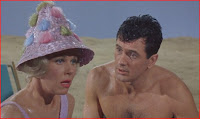
Don't you love Doris's hat?
9. Lover Come Back – There aren’t many comedies in my 100 Favorite Movies and only two in the Top 10—there just aren’t that many films that tickle my funny bone. A major exception is this bright 1960s laugh fest with Rock Hudson and Doris Day as advertising rivals. To distract Doris, Rock comes up with a fake product called Vip. He even films commercials for the fake product—which are, unfortunately aired on TV. To avoid criminal charges on fraud, he hires a Nobel scientist to invent something that could be passed off as Vip. Meanwhile, Doris mistakes Rock for the Vip inventor and he plays along. It’s a classic “snowball comedy” played by a cast of pros, including Tony Randall and Edie Adama. But the main attraction here is the pairing of Doris and Rock in their best outing. This is the film that reminded me that Rock Hudson was an exceptional comedian, as evidenced by his expert timing in the delicious scene when he tries to seduce Doris.

Tippi as another Hitchcock blonde heroine.
8. Marnie – When I first saw Marnie as a teenager, it made no impression at all. I thought Tippi Hedren was miscast and Sean Connery dull. The plot--what there was of one--seemed thin and the characters lacked interest. Decades later, I watched it it again and, to my complete surprise, I loved it! Tippi Hedren's subtle detached performance made Marnie a vulnerable, intriguing character. The progressively complex relationship between Marnie and Sean Connery’s character generated suspense--in its own quiet way--worthy of Hitch’s best man-on-the-run films. I was captivated by Hitch's finest use of color (especially during the opening scenes). And finally, there was Bernard Herrmann's incredible score (which, for me, ranks second only to Vertigo among his Hitchcock soundtracks). I've often wondered how I missed all of this the first time around?
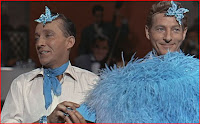
Bing and Danny singing "Sisters."
7. White Christmas – There was a time when I grumbled because White Christmas was shown every Yuletide season while Holiday Inn (1942) only made sporadic appearances. Most critics consider the latter film, in which the song “White Christmas” was introduced, to be the superior musical. It was only after my wife and I acquired both films on video that I recognized the virtues of White Christmas. It’s a near-perfect blend of music and comedy, with the cast and crew at, or near, the peak of their careers. The dance numbers are staged energetically, with the highlight being Danny and Vera-Ellen dancing outside a nightclub to the melodic “The Best Things Happen While You’re Dancing.” Crosby and Clooney generate a more subdued, but no less effective, chemistry. Their duet “Count Your Blessings” was the big hit song from the film. The most effective pairing in the film, though, is the one between Crosby and Kaye. They’re a sensational team, whether doing musical numbers or comedy (their version of “Sisters”, done originally as a joke on the set, is hysterically funny).
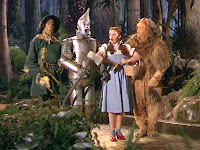
The quartet on their way to Oz.
6. The Wizard of Oz – When I was growing up, the annual network broadcast of The Wizard of Oz was a big event. I never failed to watch it. It’s so much a part of my movie-watching DNA that it’s hard to describe its appeal other than to say it’s one of the most perfect films ever made. The cast, the characters, the themes, the sets, the costumes, the music—does Oz fail to earn a top grade in any of those categories? But for me, the most amazing aspect of the film is this: Despite the thousands of pop culture products derived from the film over the last 70-plus years—which are more than enough to overwhelm even a dedicated fan—I never tire of watching The Wizard of Oz.

Danny and Basil in their delightful
duel (snap!).
5. The Court Jester – My favorite comedy is a spot-on, delightful spoof of swashbuckling films. In a rare role worthy of his talents, Danny Kaye gets to sing, dance, use funny voices, contort his expressive face, and excel at physical comedy (such as walking in magnetized armor). The supporting players are all at the top of their game, too. Basil Rathbone has a grand time parodying past roles such as Sir Guy of Gisbourne in The Adventures of Robin Hood. Angela Lansbury displays a deft comedic touch, while Cecil Parker steals his scenes as the bored king whose only interest appears to be “wenches.” The Court Jester also includes Danny’s most famous routine—the one that involves the pellet with the poison in the chalice from the palace, the vessel with the pestle has the brew that is true, and (finally) the flagon with the picture of a dragon (which is used for the brew that is true after the vessel with the pestle is broken). And did I mention that Danny and Basil Rathbone engage in the funniest sword duel in the history of cinema?

Gort melts a tank...how cool is that?
4. The Day the Earth Stood Still – If there were a Hall of Fame for Timeless Movies, then one of its founding members would be The Day the Earth Stood Still. I've probably watched it at least once every decade since I first saw it on NBC's Saturday Night at the Movies in the 1960s. When I was a youngster, the film's fantastic elements--and Gort, the coolest robot in the history of cinema--appealed to me. When I was a teen, its stern warning about the perils of nuclear war resonated with me. With each subsequent viewing, The Day the Earth Stood Still has revealed something new: presenting itself as a Biblical analogy, an editorial on the influence of media on public opinion, a portrait of fear of the unknown, etc. Its themes never fail to thrill me…making it much more exciting than any action-oriented sci fi film.

3. Anatomy of a Murder – Otto Preminger’s enthralling courtroom drama requires multiple viewings to be fully appreciated. When I first saw it, I focused on the riveting story, which treats the viewer much like the jury. We listen to testimonies, watch the lawyers try to manipulate our emotions, and struggle to make sense of the evidence. When I saw it a second time, I knew the case’s outcome and was able to concentrate on the splendid performances. James Stewart, Arthur O’Connell, and George C. Scott earned Oscar nominations, but the rest of the cast is also exceptionally strong. In subsequent viewings, I’ve come to appreciate the film’s well-preserved details, from the small town upper-Michigan atmosphere to Preminger’s brilliant direction (e.g., in one shot, as Scott cross-examines a witness in close-up, Stewart—the defending lawyer—is framed between them in the background).

Talk about doomed love...
2. Vertigo – This richly-layered masterpiece reveals its big twist when least expected--turning the film on its proverbial head. It causes love to blur with obsession and greed to give way to guilt and perhaps love. What we see at the bell tower is initially false, but ultimately true. I could go on and on…but, hey, whole books have been devoted to this film. I think it’s Hitch’s best job of writing (as usual uncredited) and directing…plus we get superb performances (especially from James Stewart), a marvelous San Francisco setting, an unforgettably disturbing score from Bernard Hermann, and nifty Saul Bass titles. Like all great films, I glean something new from it or appreciate another facet every time I watch it. My latest viewing reminded me just how brilliant James Stewart is in the lead. In a career filled with fine performances, I think Stewart does his finest work as a typical Stewart “nice guy” who evolves into a man obsessed with an illusion. Contrast Scotty’s (Stewart) playful banter early on with Midge with his climactic confrontation with Judy—his eyes ablaze with confusion, hate, and something akin to love. It’s a brilliant and chilling transition.

1. The Adventures of Robin Hood – For many readers, I’m sure it comes as no surprise that Robin Hood occupies the No. 1 spot on my list. For me, it shares many traits with The Wizard of Oz in that, from top to bottom, it’s a flawless film (well, except for one tiny continuity gap). The early Technicolor color is rich. Michael Curtiz, who took over the film from William Keighley, keeps the pacing tight. Errol and Olivia, one of the great screen couples, exude celluloid chemistry. Basil and Claude make for dastardly villains. And the supporting cast, from Alan Hale to Una O’Connor, is incredible. My favorite aspect, though, is that it’s the ultimate “let’s form a team” movie. As discussed in this blog before, I hold a special affection for movies in which one character recruits others to form a team to accomplish a goal (e.g., The Magnificent Seven, The Dirty Dozen). There’s nothing as satisfying as watch Errol assmble his Band of Merry Men. As for that one tiny flaw in Robin Hood, watch where the sword lands when Basil drops it on the staircase and note how it magically moves courtesy of a continuity gaff. Those are the kinds of things one notices when watching a favorite film a few dozen times!

Saturday, July 9, 2011

The 5 Best James Stewart Performances

The problem with listing the 5 best James Stewart films is that there are many more than five. But this month’s theme is the “5 Best” and I’ll stick to it. I don’t like it, though. One of my all-time favorite movies, Anatomy of a Murder (which features a superb Stewart performance), wound up as an honorable mention. And I am ready to incur the wrath of fans of The Philadelphia Story.

1. Vertigo – Stewart did his best work in the 1950s, often playing down his natural charm to portray obsessive, driven characters. His finest acting came in Hitchcock’s masterpiece, where we watch a typical Stewart “nice guy” evolve into a man obsessed with an illusion. Contrast Scotty’s (Stewart) playful banter early on with Midge with his climactic confrontation with Judy—his eyes ablaze with confusion, hate, and something akin to love. It’s a brilliant and chilling transition.

2. Rear Window – As injured photographer “Jeff” Jeffries, Stewart played a character that seems like a natural progression to Vertigo’s Scotty. Jeff is charming and likable, but his “hobby” of spying on his neighbors masks a subtle obsession with voyeurism. Stewart explores the shadows of Jeff’s personality, but never goes too far. We may question Jeff’s motives, but we always root for him.

3. It’s a Wonderful Life – Its frequent showings may have diluted its impact and Stewart’s brilliant acting job as George Bailey. However, Stewart’s post-World War II performance revealed a new maturity and depth that enable him to capture George’s desperation and passion. Those elements were present in earlier Stewart films, in particular Mr. Smith Goes to Washington, but not to the extent that the actor channels them here.

4. Winchester ’73 – Any of the five Anthony Mann-James Stewart Westerns could fall into this slot, but I opted for Winchester ’73 simply because it was the pair’s first collaboration. In all of his Mann films, Stewart plays a loner with a dark past who is redeemed by love, friendship, and/or community acceptance. These grim, hard men are a stark contrast to the easygoing Tom Destry from Destry Rides Again and proof again of Stewart’s acting versatility.

5. Harvey – Playing a much older character, Stewart shines as the eccentric Elwood P. Dowd, whose best friend is a 6’ 3.5” invisible rabbit (well, technically a pooka). As evidence of Stewart’s mastery of the role, I ask if you imagine anyone else saying this line: “Years ago my mother used to say to me, she'd say, ‘In this world, Elwood, you must be’—she always called me Elwood—‘in this world, Elwood, you must be oh so smart or oh so pleasant.’ Well, for years I was smart. I recommend pleasant. You may quote me.”

Honorable mentions: Anatomy of a Murder, Mr. Smith Goes to Washington, Destry Rides Again, and The Shop Around the Corner.

Tuesday, September 21, 2010

Dial H for Hitchcock: North by Northwest at the Rafael...free to the public

When I was a little girl, the only director whose name I was familiar with was Alfred Hitchcock. Though I didn't see any of his signature films of the era in a theater - Rear Window (1954), To Catch a Thief (1955), Vertigo (1958), North by Northwest (1959) - I must've seen the trailers, because I was well aware that he made exciting, colorful and glamorous movies.

Psycho (1960) was the first Hitchcock film I saw on the big screen, and it was a far cry from his elaborate VistaVision/Technicolor creations of the mid- to late 1950s. I saw Psycho second-run (I was finally old enough) at the local movie house, the Ritz Theater, with a friend who'd already seen it. Pal that she was, she nudged me just as Arbogast reached the staircase landing and a figure with a knife darted toward him...so, naturally, I shrieked long and loud ...

I was fortunate to be able to see Rear Window when it was re-released into theaters in 1984, but have seen most of Hitchcock's films on television. There's no question that his films come through powerfully on TV, but they were made to be seen on a theater screen.

This past July the Rafael Theater screened the silent version of Blackmail (1929). It was an incredible experience; the film exceeded my expectations in just about every way possible. I was surprised that it was so well-crafted and fluid and that it contained so many components that later became Hitchcock trademarks. Accompaniment by the Alloy Orchestra underscored the action and added dimension. And it was thrilling to be surrounded by an appreciative SRO audience.

Six weeks later, at noon on Sunday, September 5, the Rafael presented North by Northwest free to the public as part of its quarterly "Everybody's Classics" series. At 11:40 a.m. the line was long, but good seats were still to be had. By show time Theater 1 was packed and anticipation ran high.

Then Bernard Herrmann's pulsing score began and Saul Bass's title sequence of crisscrossing lines filled the screen. North by Northwest was upon us and in just a few exhilarating moments I was whisked into the adventure.

Possibly Hitchcock's quintessential thrill-ride, North by Northwest incorporates many familiar themes and plot elements - an innocent man accused, a romance complicated by mistrust and betrayal, a double chase - the police after the innocent man and the innocent man after the true villain(s), a backdrop of international espionage...

North by Northwest has been linked to two of Hitchcock's earlier classics, The 39 Steps (1935) and Notorious (1946), but by 1959 the director, at the height of his powers, was in a position to control just about every aspect of his films, much more so than he had been 10 and 20+ years earlier.

He was able to get his favorite actor/star, Cary Grant, for the lead. And though he was unsuccessful in enticing Princess Grace back to the screen as his leading lady, he transformed Academy Award-winning method actress Eva Marie Saint into a stunning and complex femme fatale. James Mason, Martin Landau, Leo G. Carroll and Jessie Royce Landis rounded out his first-rate cast.

Bernard Herrmann, who by now had worked with Hitchcock on several films, was just completing the score for the pilot of "The Twilight Zone" when he began work on North by Northwest. Ernest Lehman wrote a sophisticated and witty script for which he earned an Oscar nomination. Oscar winning cinematographer Robert Burks, production designer Robert F. Boyle (also Oscar-nominated for this film) and others with whom Hitchcock had worked over the years joined the collaboration.

All of these ingredients plus glorious VistaVision and Technicolor added up to create one of Hitchcock's most successful films.

I've seen North by Northwest countless times. I felt like I knew the film well, but to finally see it on a movie screen was to see it with new eyes.

Cary Grant's starpower was almost overpowering - his screen persona was that commanding. What grace, what aplomb! It's not surprising that Bernard Herrmann adjusted his score to match what he described as Grant's "Astaire-like agility."

As for special effects, the crop-dusting set piece with its truck-explosion finale and the moonlit chase across the face of Mount Rushmore have long been legendary. Via the big screen I could almost feel the heat of the explosion and smell the night air of South Dakota. As I watched, I was reminded of how the crop-dusting sequence was echoed in early James Bond films...and of Steven Spielberg's homage in Close Encounters (1977) when he nearly replicated the set design of Hitchcock's night-time Black Hills.

Of course, the suspense seemed magnified, but I also noticed the film's humor seemed more overt and the seduction scenes between Grant and Saint more intimate and...erotic. The film was so precisely paced, with suspense building, then relieved with either humor or romance, then building again...

Afterward, I couldn't help wishing I'd been able to see North by Northwest back in 1959 at the Ritz. The young girl I was then would've thought she'd been on the greatest rollercoaster ride of her life!

Alfred Hitchcock has been widely acknowledged for his amazing ability to, with the artful use of various techniques, easily maneuver an audience's emotions and point of view. It's hard to maintain much distance from Hitchcock's best films. This could be why I often enjoy experiencing his films a bit more than I enjoy understanding them.

As with all Hitchcock films, North by Northwest has a a thing or two going on beneath its glossy surface. But on that Labor Day weekend in San Rafael inside a darkened theater full of laughing, sighing, cheering people, I was a kid again for a while. Happily immersed in a suspenseful, clever, sexy adventure, I didn't even notice that, from the first note of Herrmann's score to the final shot of a darkened railroad tunnel, we were all being swept along as if aboard a sleek 20th Century Limited under the command of a brilliant and crafty locomotive engineer.

Saturday, October 3, 2009

Shooting on a Beautiful San Francisco Day


On Friday my good friend Dave (a production director) and I spent the afternoon in San Francisco shooting video of sites in the city used as movie locations. We started on Nob Hill and worked our way to Russian Hill, North Beach and Pacific Heights. We shot locations featured in Vertigo, Play it Again, Sam and Days of Wine and Roses. We have plans to go out again next week and shoot locations downtown and South of Market that were used in these and other films. Once we're done shooting, have done some editing and added voice-over, I'll post the video here. In the meantime, here are a couple of snapshots of 900 Lombard Street. This location was used in Vertigo as the apartment where Scottie Ferguson (James Stewart) lived. Amazingly, the building is much the same as it was when the film was made 50+ years ago. The larger photo shows the entrance to his apartment. The smaller one is of a garden behind the building. I found it interesting that the apartment actually seems to have a layout similar to that depicted in the film - it does have a full view of Coit Tower. Lombard Street is famous for being "the crookedest street in the world," but the 900 block is quite straight - it's a few blocks down from the section known for its curves...

Sunday, September 13, 2009

I Left My Heart...Five San Francisco Favorites


I love San Francisco, I admit it. I've lived in the Bay Area for more than 30 years and don't plan to ever leave...so, for this, my premiere Cafe blog, I've picked five of my favorite films set in San Francisco and will briefly discuss each. My primary criterion in selecting these five was that each be set here. Quality was also taken into account. Each of these is a classic with a solid director, cast and script...and most are Oscar-nominated films. This time around I picked films primarily set in the city itself, not the surrounding area; Shadow of a Doubt was set in Santa Rosa and American Graffiti was filmed, in part, in San Rafael, but I focused on the city, the town Salvador Dali once referred to as "the jewel of American cities"....

1. Vertigo (1958) Hitchcock's dark, mesmerizing masterpiece has been called a valentine to the city, and it's my favorite of any film set in, shot in or that even mentions San Francisco. I could probably write more than anyone would ever want to read on the subject of why Vertigo is irresistible to me and how gloriously I feel it portrays SF in the late 1950's. But...to be brief and to the point, this is one of those rare films that pulls me entirely into its magnetic field and sweeps me along to its devastating conclusion: Scottie Ferguson (James Stewart) gazing, vacant and in shock, down upon the body of his idealized dead love...a love he's just lost for the second time. To quote Martin Scorsese, Vertigo is "like being drawn into a very, very beautiful, comfortable almost nightmarish obsession." As for its depiction of San Francisco, Vertigo shows the city off to its very best advantage...a stunning city to begin with, Hitchcock renders it flawlessly with his extensive Technicolor/VistaVision location shots: cityscapes, landmarks (the Golden Gate Bridge, the Mission Dolores, Nob Hill, Coit Tower) and street scenes. Hitchcock also does a meticulous job of recreating some classic local interiors: Ernies Restaurant, Ransohoff's dept. store, Podesta Baldocchi's florist shop.

2. The Maltese Falcon (1941) This is the first film directed by John Huston...on top of being Huston's remarkable debut (which he adapted from Dashiell Hammett's novel), it boasts an inspired cast (Greenstreet and Lorre's first of many pairings), an intriguing noir mood (it's been called the first major work of film noir), is tight and taut and delivers the goods, as Sam Spade might've remarked. Many years ago I took the "Dashiell Hammett Tour" of San Francisco (led by Don Herron who continues to conduct tours). I don't remember that much about it now other than our stop at one of Spade's haunts, John's Grille on Ellis St. (a steak/seafood joint in business since 1908 and visited by many a celebrity), and our pause at Burritt Alley, near the corner of Bush and Stockton, where a plaque proclaims: "On approximately this spot, Miles Archer, partner of Sam Spade, was done in by Brigid O'Shaughnessy." The Maltese Falcon was mostly shot at Warner Bros. studios in Burbank with some stock footage of SF, but it conveys a strong sense of San Francisco in the late 30's/early 40's...it's also one of Humphrey Bogart's early star turns which leads nicely to...

3. Play it Again, Sam (1972) Adapted from his Broadway hit and starring Woody Allen but directed by Herb Ross, the film also stars Diane Keaton, Tony Roberts and Jerry Lacy as an imaginary "Bogart". This is a Woody Allen classic that hasn't been getting it's due lately. It's an outrageously funny take on bouncing back from rejection and re-entering the "dating pool," circa the early 70's. It also happens to include a great panorama of Bay Area locales that reflect the city and the general scene at the time. Allen's character, Allan Felix, a film critic/classic film buff, lives in North Beach and makes his way around the city and area in pursuit of romance - as far north as Sausalito, Stinson Beach and Bolinas. He tries desperately and hilariously (often on Bogart's advice) to connect with women after being unceremoniously dumped by his wife. TCM viewers and other classic film fans will appreciate the amusing homage to Casablanca and many references to classic film.

4. Days of Wine and Roses (1962) An Oscar winner for Henry Mancini's original song and nominated for four others, this film addressed a difficult subject for the time: alcoholism. Directed by Blake Edwards, Jack Lemmon and Lee Remick portray a young couple on the brink of what could be an exciting life together, he's a PR dynamo, she's beautiful and sweet, they adore each other...and their swank, modern apt. features a panoramic view of the Golden Gate Bridge. But their life takes a dark turn. All in all, the beauty of San Francisco seems a perfect backdrop and metaphor for the couple's lost dreams.

5. I Remember Mama (1948) Directed by George Stevens and starring the sublime Irene Dunne, this is a sentimental favorite of mine. But first, will someone please explain why Irene Dunne never won an Oscar?!? This film was nominated for five, including Dunne's fifth and final nomination for Best Actress. Set in San Francisco around 1910, it's the story of the trials and triumphs of a family of Norwegian immigrants who have settled in the Cow Hollow district (today an upscale neighborhood, but around that time...well...cows). It's a warm family drama with Dunne as the very practical yet caring matriarch. I especially enjoy the exterior scenes that depict San Francisco 100 years ago.

Those are my five. I may have more to say about some of them and other aspects of Bay Area films, but that's it for now. Look forward to comments about these and other films set in San Francisco.