Showing posts with label steve mcqueen. Show all posts

Monday, August 11, 2025

Seven Things to Know About Alfred Hitchcock Presents

1. Alfred Hitchcock's daughter, Pat, appeared in ten episodes of Alfred Hitchcock Presents. Her first appearance was in the season1 episode "Into Thin Air." Its premise was based on an urban myth known as "The Vanishing Hotel Room," which also served as the basis for the novel and film So Long at the Fair (the latter starred Jean Simmons and Dirk Bogarde). Pat also appeared in the memorable season 3 episode "The Glass Eye" (but more on that later).

2. The final episode of Alfred Hitchcock Presents was never broadcast on network television. Written by Robert Bloch (Psycho), it dealt with a manipulative woman, an easily-influenced young man, and the famous magician's trick of sawing a woman in half. NBC censors nixed the episode for being too disturbing. However, was included in the show's syndication package and has since been shown on TV frequently!

Barbara Bel Geddes.
3. The two most famous episodes are undoubtedly "Man from the South" and "Lamb to the Slaughter." The latter, directed by Hitchcock from a Roald Dahl teleplay, stars Barbara Bel Geddes as a woman who murders her cheating husband with a frozen leg of lamb. It earned Emmy nominations for Hitchcock (Best Direction) and Dahl (Best Teleplay Writing). In 2009, TV Guide ranked "Lamb to the Slaughter" at No. 59 on its list of the 100 Greatest TV Episodes. "Man from the South," based on another Dahl story, stars Steve McQueen as a young man who makes a macabre bet on how many times in a row a lighter will light. The episode co-stars Peter Lorre and McQueen's then-wife Neile Adams. Both "Man from the South" and "Lamb to the Slaughter" were also adapted for the 1979-88 TV series Tales of the Unexpected.

Steve McQueen in "Man from the South."
4. A number of prominent writers had stories that were adapted or wrote teleplays for Alfred Hitchcock Presents, including: Ray Bradbury, John Cheever, Roald Dahl, Saki, Garson Kanin, Eric Ambler, Robert Bloch, Stirling Silliphant, Richard Levinson and William Link, Dorothy L. Sayers, Ira Levin, Charles Beaumont, and Cornell Woolrich.

5. CBS broadcast Alfred Hitchcock Presents for its first five seasons and the show was perennially ranked in the Top 30 shows according to the Nielsen ratings. The ratings dropped when it moved to NBC in 1960 and was aired opposite The Many Loves of Dobie Gillis. Although it never cracked the Top 30 again, Alfred Hitchcock Presents ran for seven seasons and 268 episodes. The show expanded to an hour in 1962 and was appropriately retitled The Alfred Hitchcock Hour. In that incarnation, it lasted three more seasons and 93 episodes.

Janet Leigh in Psycho.
6. When Alfred Hitchcock's plans to make Psycho in 1959 were nearly rejected by Paramount, the director cut production costs by using his Alfred Hitchcock Presents TV crew. Specifically, he "borrowed" the show's cinematographer (John L. Russell), set designer (George Milo), script supervisor (Marshall Schlom), and assistant director (Hilton A. Green) to make Psycho.

7. My favorite episode may be "The Glass Eye" from the third season. The remarkable cast features Jessica Tandy, Tom Conway, William Shatner, and Pat Hitchcock. Shatner's character tells the story of his sister, a lonely woman who becomes infatuated with a handsome ventriloquist and longs to meet him. As with many episodes, it ends with a devious twist--but this one packs a wallop (thanks largely to Tandy's acting). Stirling Silliphant (Route 66 co-creator and Oscar winner for In the Heat of the Night) penned the teleplay.

Wednesday, March 7, 2018

Steve McQueen Makes Use of the Honeymoon Machine

Steve McQueen as Fergie.
Before he played a sailor in The Sand Pebbles and gambled for high stakes in The Cincinnati Kid, Steve McQueen starred as a Naval officer gambling for big bucks in The Honeymoon Machine (1961). But whereas the later films were "A" list dramas, The Honeymoon Machine is a modest comedy intended as a showcase for its up-and-coming stars.

McQueen plays Lieutenant Fergie Howard, who hatches a scheme to take advantage of a state-of-the-art computer--the Magnetic Analyzer Computer Synchrotron--on board his ship. With the help of a scientific genius pal (Jim Hutton) and a gullible fellow officer (Jack Mullaney), Fergie plans to make a fortune playing the roulette wheel at a Venice casino.

Paula Prentiss as a wiener heiress.
Based on the outcomes of hundreds of roulette wheel spins, the computer can predict the three most likely winning numbers based on the result of the previous spin. Pretty soon, Fergie and his pals are rolling in cash. Their plan gets more complicated, though, when Fergie falls for an admiral's daughter (Brigid Bazlen) and his scientist pal encounters an old flame (Paula Prentiss). Even worse, the admiral intercepts the ship-to-shore communications with the computer and thinks that high-level espionage is being plotted.

The screenplay for The Honeymoon Machine was written by Lorenzo Semple, Jr. and George Wells. It was based on Semple's 1959 Broadway play The Golden Fleecing, which starred Tom Poston as Fergie. Constance Ford and (Poston's future wife) Suzanne Pleshette played the female leads. The film version was Semple's first big screen credit. He would go on to write major films such as Papillon (1973) and Three Days of the Condor (1975)--though he is best known for creating the original Batman TV series.

Steve McQueen was not the first choice to play Lt. Fergie Howard. MGM wanted Cary Grant for the part (yes, for a role originated by Tom Poston!). When Grant passed, the studio cast McQueen, who had just been signed to a three-picture deal. According to several sources, McQueen didn't like The Honeymoon Machine and walked out of a screening of it. He certainly doesn't put forth much effort on the screen. It's not a bad performance, but clearly McQueen seems to be relying on little more than his natural charisma.

Jack Weston as Signalman Taylor.
On the other hand, The Honeymoon Machine affords Jim Hutton, Paula Prentiss, and Jack Weston an opportunity to shine. Prentiss steals all her scenes as an heiress who dislikes wearing her glasses--though clearly she can see very little without them. Weston has a field day as a bourbon-loving sailor who imagines seeing Martians.

The always affable Hutton was paired with Paula Prentiss in five films. Their height had something to do with the casting--Hutton was 6'5" and Prentiss 5'11"--but they also displayed an effective on-screen chemistry. They make The Honeymoon Machine an entertaining endeavor--though it's one of those frothy 1960s comedies that once consumed is easily forgotten.

The irrelevant title is a reference to "Operation Honeymoon," a missile project involving the computer in the opening scene of the movie. It has nothing to do with the rest of the film!

Sunday, April 9, 2017

Working with Steve McQueen on "Le Mans": An Interview with Don Nunley

The new book Steve McQueen: Le Mans in the Rearview Mirror, which arrives in stores today, chronicles the making of McQueen's 1971 cult classic about the famous international endurance race. It was written by Don Nunley, who worked as the film's property master, and Marshall Terrill, who has written biographies about McQueen, Elvis Presley, and Pete Maravich. Filled with over 400 fabulous photos, this book will appeal to anyone who enjoys reading about the making of motion pictures. Co-author Don Nunley--who purchased, acquired, manufactured, and placed props in over 30 motion pictures and television series--took time out of his busy schedule to stop by the Café for an interview. 

Café:  What inspired you to follow in your father's footsteps as a property master? 
         
Don Nunley on the Le Mans set.
Don Nunley:  My father did not encourage me to follow him into the film business. He knew how hard it was on your personal life. Long hours, and travel away from home and family. And the need to deal with personalities and huge egos on a regular basis. I started in 1960. There was an opening at Universal Studios in the Labor Department. It was to be a summer job until school started again in the fall. I was already enrolled at UCLA. It turned out I liked working at the studio. Later I moved into the prop department and that's where I stayed for my entire career. Call it serendipity. 

Café:  How did you first meet Steve McQueen?
Steve McQueen in 1971.

DN:  I met Steve McQueen on the set of Wanted: Dead or Alive. We weren't formally introduced. It was more of an acknowledgment of each other while I was working as part of the set-dressing crew for the series.

Café:  When production designer Phil Abramson fell ill, you replaced him on Le Mans. What additional duties did that involve? Was any there discussion of you receiving a credit for your production design work?

DN:  When Phil left the picture, we were well into production. Most of the locations had already been chosen since most of the film was shot on the Le Mans circuit itself. There were still a few sets to dress and, of course, the big one was the paddock that had to be re-created after Steve's refusal to be filmed walking through it on the actual day of the race. I never asked, nor did I expect, to take Phil's credit from him. I know the studio appreciated what I did and that was enough.

Café:  What led to the two-week production shutdown on Le Mans and the departure of director John Sturges?

Director John Sturges.
DN:  Nobody could come up with a script that everybody liked. We had been shooting for several weeks without a leading lady or one word of recorded dialogue. Steve did not give John Sturges the respect he deserved. The studio was watching its money evaporate. John Sturges told (executive producer) Bob Relyea he was going home, and Relyea thought John was going back to the hotel. But John got on a plane the next day, flew to LA, and never looked back. That's when the studio took over. Within two weeks they brought in a new director, Lee Katzen, and took away all control from Steve's company, Solar Productions.

Café:  Next to Steve McQueen's erratic behavior, what was your biggest challenge with making Le Mans?

DN:  I would say matching the cars for the particular hour of the race we were shooting each day. The cars changed dramatically from hour one to hour 24. We wouldn't get our marching orders until the night before as to what we would be shooting the next day. This picture had no shooting schedule as a normal picture would have had.

Café:  You mention in your book that one of the Heuer watches worn by Steve McQueen in Le Mans fetched $800,000 at an auction many years later. What was your role in those watches being featured in the film?

The Heuer Monaco.
DN:  One of my duties as a prop master was to supply the personal effects an actor used in the film. Steve wanted to look like one of the top drivers on the circuit. He liked the way (auto racing drivers) Joe Siffert, Derek Bell, and Brian Redman looked. I always needed to offer options. Ray Summers, the costumer on the film, and I put together a variety of choices for Steve to pick to wear on his uniform and on his person. One of the patches Steve choose to wear on his driving suit was the patch for the Heuer watch. He then selected, from the several brands of watches I provided, the Omega Moon watch. I tactfully pointed out to Steve that he wouldn't wear an Omega watch and a Heuer watch patch.  I had several choices of the Heuer chronograph for him to choose from. I thought he would pick one that was more subtle and mainline, but to my astonishment he chose the now famous square, blue-faced Monaco. Now, it's perhaps better known as the Steve McQueen watch.

Café:  Looking back over his career, what is your final assessment of Steve McQueen--both as an actor on the silver screen as well as a person you worked with on the set?

Steve McQueen and Don Nunley (center).
DN:  I was never one to hang around with actors. Steve had a lot of buddies, people who rode motorcycles and raced cars with him. When we started Le Mans, Steve was the number one box office star in the world. He was not the most difficult actor I worked with, but he certainly wasn't the easiest. He was careless with his props and required one of my staff to shadow him to make sure we got back what we gave him each day. He did not demand special treatment, at least not from my department. For me, Steve was always interesting and made the kinds of movies I wanted to see. 

Café:  You were involved in a host of other famous films, including Little Big Man, The Scalphunters, and The List of Adrian Messenger (one of our faves). What was your favorite movie that you worked on and why?

Dustin Hoffman in Little Big Man.
DN:  I would have to say Little Big Man. Working with Dustin Hoffman very early in his career, and Arthur Penn, one of the top directors in Hollywood, was both a great challenge and a delight. With Arthur's support, I was able to spend the money, and do things right. I am very proud of my work on the film. In 2014, Little Big Man was deemed "culturally, historically, or aesthetically significant" by the Library of Congress and selected for preservation in the National Film Registry. 

Café:  Finally, your filmography includes one acting credit as "Doctor" in the 1983 Kirk Douglas movie Eddie Macon's Run. There's got to be a story there, right? 

DN:  In Eddie Macon's Run, I became an actor by default. It turned out that the actor chosen to play a doctor could not remember his lines. Out of frustration, the director, Jeff Kanew, turned around, looked at me and asked: "Can you remember the lines?" By then, I think everyone on the set--except for that actor--knew the lines. I put on the doctor's coat, grabbed a prop stethoscope and somehow did a page of dialogue in one take. I still receive about two dollars a year in residuals. So much for my acting career. 


All photos are from the book Steve McQueen: Le Mans in the Rearview Mirror (except for the one from Little Big Man). Don Nunley's book was published by Dalton Watson Fine Books.

Friday, September 20, 2013

Seven Things to Know About "The Magnificent Seven"

1. The Magnificent Seven (1960) is a pretty faithful adapatation of Akira Kurosawa's classic Seven Samurai (1954)--except that the American Western is 79 minutes shorter! It does have a scene not in the original: the one where Chris (Yul Brynner) and Vin (Steve McQueen) drive the hearse to boot hill.

2. Yul Brynner was the only one of the original cast to appear in a sequel. He reprised the role of Chris for Return of the Seven (1966), which featured Robert Fuller (Laramie) as Vin. In subsequent movies, Chris was played by George Kennedy (Guns of the Magnificent Seven) and Lee Van Cleef (The Magnificent Seven Ride!).

3. Steve McQueen fidgets with his hat frequently during the film--allegedly in an attempt to draw attention to himself. He wasn't a star yet and, in fact, was still headlining the TV series Wanted: Dead or Alive.

4. Brynner was already a star, of course, but four other Seven actors went on to achieve film or television fame: McQueen, Robert Vaughn, James Coburn, and Charles Bronson. In fact, McQueen, Coburn, and Bronson reteamed for the 1963 classic The Great Escape. As for the rest of the Seven, Horst Buchholz was already considered a promising newcomer and subsequently appeared in Billy Wilder's One Two Three. That leaves Brad Dexter--who played Harry--as the odd man out. Dexter never came close to stardom, but had a long career as a supporting player; he appeared in several films with best pal Frank Sinatra.

5. In his autobiography, Eli Wallach wrote: “The one regret I had in making The Magnificent Seven was that I never heard Elmer Bernstein’s musical score while making the film. If I had heard that score, I think I would have ridden my horse differently.” Wallach originally wanted to play the Buchholz role--until he read the script and realized that the villainous Calvera was the juiciest part.

6. Elmer Bernstein's music score didn't gain fame until part of it was used in Marlboro cigarette commericials. The Philip Morris Tobacco Company licensed Bernstein's music in 1963 for a Western-themed ad campaign and the rest is history. In fact, it became widely known as the "Marlboro theme." A 1967 album was released called The Music from Marlboro Country, which included musical tracks from The Magnificent Seven and Return of the Seven.

7. Robert Vaughn appeared in two other versions of The Magnificent Seven. He played a mercenary in Battle Beyond the Stars (1977), a low-budget remake that transplanted the premise to an outer space colony harassed by John Saxon's villain. Vaughn's character was "adopted" by the colonists' children (as Bronson's character was by the peasant children in the original). Then, for the 1998-2000 CBS TV series The Magnificent Seven, Vaughn guest-starred as a judge on six episodes.

Thursday, May 30, 2013

Bullitt: Steve McQueen Plays It Cool (What Else?)

Bullitt was not the film that established the Steve McQueen "cool quotient." Steve was displaying coolness earlier in the 1960s in movies such as The Great Escape (1963), The Cincinnati Kid (1965), and The Thomas Crown Affair (1968). Heck, his character was even known as The Cooler King in The Great Escape (okay, that was a different kind of "cooler"). Yet, if Steve was already cool, Bullitt elevated him to a new level and became perhaps his most iconic film. Think of Bullitt and two things spring to mind: the high-speed car chase through San Francisco and the poster with McQueen in a dark turtleneck with shoulder holster looking...yes...pretty damn cool.

McQueen plays Lieutenant Frank Bullitt, a no-nonsense detective for the San Francisco Police Department. An ambitious politician (Robert Vaughn) handpicks Bullitt to protect a mob informant who's scheduled to testify at a Senate subcommittee hearing. Despite taking all the normal precautions, a professional hit man shoots the informant at the safe house. When the would-be witness dies in the hospital, Bullitt covers up the death. Bothered by too many loose ends (e.g., who divulged the location of the safe house?), he launches his own investigation--even as others look to make him a scapegoat.

In her big scene, Bisset's face is obscured
by McQueen's shoulder and green weeds.
Stripped of McQueen's charisma, the famous car chase, and the scenic splendor of San Francisco, Bullitt is just another urban cop drama. Veteran actors such as Simon Oakland, Don Gordon, and Norman Fell are in fine form, but they're just inhabiting stock characters: the tough, trustworthy boss; the loyal partner; and the agitated superior. Jacqueline Bisset fares even worse in a throwaway part as Bullitt's girlfriend, who--in her one meaty scene--gets saddled with insipid dialogue such as: "Do you let anything really reach you? You're living in a sewer, Frank, day after day." (Well, he's a police detective in a big city...who did she think she was dating?)
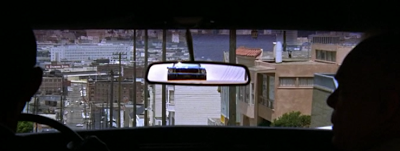
McQueen's Mustang GT appears in the rearview mirror as the chase gets underway.
The car chase officially begins at the 1:08 mark in the film when the bad guys in the Dodge Charger strap on their seat belts. The next seven minutes are a delirious combination of squealing tires, burning rubber, skidding turns, roaring engines, and speeding cars flying over the hills of San Francisco. Director Peter Yates and editor Frank P. Keller--who won an Oscar for his work--expertly cut between shots of the cars, the drivers' faces, and nerve-racking first-person views. I love the shot where the driver of the Charger looks through his rearview mirror and sees nothing but dust. Assuming that Bullitt's Mustang has crashed, a very slight smile crosses his face.
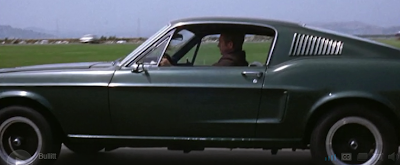
Steve driving his iconic car. Actually, two Mustangs were used in the film.

Stunt driver Bill Hickman.
Steve McQueen and stunt driver Bud Ekin drove the dark-green Mustang GT, while Bill Hickman drove the black Charger. Hickman was also behind the wheel in The Seven-Ups, which features--yes, I said it--an even more impressive car chase sequence. It was directed by Philip D'Antoni, who produced Bullitt. (For our picks for cinema's five best car chases, click here.) By the way, the Bullitt car chase is often listed as nine minutes long, but that includes a prelude in which the baddies tail Bullitt. It's when our hero craftily creeps up behind them--and the seat belts get clicked--that the high-speed chase officially starts. From that point until the fiery conclusion, it's almost seven minutes.
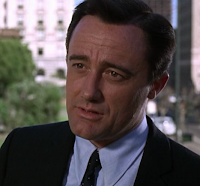
Robert Vaughn.
As for McQueen, he plays his authority-defying hero to perfection. In a typical scene, Bullitt even refuses to
back down from Vaughn's powerful politician, telling him: "You work your side of the street. I'll work mine." It's a typical McQueen role, but one that audiences expected at that point in the actor's career.


Yes, that's Steve McQueen!
Still, the huge success of Bullitt cemented McQueen's superstar status and enabled him to take more chances on future films. He collaborated with Sam Peckinpah on Junior Bonner and The Getaway (both 1972). The former contains what critics now consider one of McQueen's best performances. The latter was one of his biggest hits and also where he met his second wife (of three) Ali MacGraw. And in 1978, he was almost unrecognizable as the bearded, bespectacled protagonist in An Enemy of the People, an adaptation of Henrik Ibsen's 1882 play.

Monday, December 17, 2012

The Five Best Steve McQueen Performances

McQueen & motorcycle.
1.  The Great Escape (1963). Steve McQueen probably would have become a superstar anyway, but his charismatic performance as "The Cooler King"--along with a terrific, fence-jumping motorcycle chase--hastened his fame. Although this classic POW action film features a fine ensemble cast (featuring James Garner, Charles Bronson, Richard Attenborough, etc.), McQueen stands out thanks to a distinctive, immensely likable character and the actor's unique brand of offhand humor.

McQueen and Natalie Wood.
2.  Love With the Proper Stranger (1964). This dramedy co-stars Natalie Wood as a sales clerk who seeks out McQueen's musician when she becomes pregnant following a brief fling. He doesn't even remember her--but agrees to help raise the money for an abortion. Wood earned an Oscar nomination for her performance, but McQueen steals the film with his realistic transformation from schmuck to suitor. Career-wise, it opened the door to more dramatic roles for the young actor.

3.  Bullitt (1968). On the one hand, you could argue that San Francisco police detective Frank Bullitt is a one-dimensional character that hardly warranted his own film--and I'd agree. However, it's a moot point because Bullitt is responsible more than any other film for defining the "McQueen cool." Think of Steve McQueen and chances are the first image will be of him wearing the black turtleneck, with shoulder holster, from Bullitt. And, of course, the shots of McQueen driving his dark green Mustang over the streets of San Francisco are so iconic that the film was selected for preservation by the U.S. National Film Registry in 2007.

4.  The Sand Pebbles (1966). 
Steve McQueen received his only Oscar nomination playing a Naval engineer who falls in love with a missionary in war-torn China in 1926. It's a good movie, but I wouldn't rank it among McQueen's best. Still, this is a list of his best performances and New York Times film critic Bosley Crowther noted this was "the most restrained, heartfelt, honest acting he (McQueen) has ever done."

5.  The Magnificent Seven (1960). This popular Western remake of the Akira Kurosawa's classic The Seven Samurai is my favorite McQueen film and features my personal favorite of his performances. As with The Great Escape, The Magnificent Seven boasts an incredible ensemble cast peppered with engaging actors (e.g., Yul Brynner, Charles Bronson, James Coburn, etc.). McQueen makes every effort possible to steal all his scenes (a documentary once pointed out the numerous times he touches his hat to draw attention to himself). None of that is necessary as McQueen hits all the right notes as Brynner's de facto second-in-command.

Honorable Mentions: Hell Is for Heroes (a highly effective, modestly-budgeted war film with Fess Parker, Bobby Darin, James Coburn, and Bob Newhart); The Reivers (a change-of-pace role as Boon Hoggenbeck, a Faulkner character); and The Getaway.

What are your picks for Steve McQueen's best performances?

Thursday, September 20, 2012

Studio One's "The Defender" Examines the Drama Outside the Courtroom

Shatner and McQueen.
A courtroom drama in which the verdict doesn't matter? That's the case with "The Defender," a 1957 two-part television play by Reginald Rose that was originally broadcast on Studio One. Ralph Bellamy and William Shatner play father-and-son attorneys who are appointed to defend a moody young man (Steve McQueen) accused of felony murder. As zealous prosecutor Martin Balsam explains to the jury from the outset: A "felony murder" is an unpremeditated murder or accidental death caused while performing a felony--and it can result in a death sentence.

Walter Preston (Bellamy) plays to the jury.
Walter Preston (Bellamy) is a veteran attorney nearing the end of a long career. His gut instinct is that his client, Joseph Gordon (McQueen), is guilty. Disgusted with the crime--a young woman murdered in her apartment for a small amount of money--Preston decides to mount a decent defense...but no more. When he tells his son, Kenneth (Shatner), the recent law school graduate is shocked to learn his father is unwilling to do anything to defend his client. In fact, Kenneth wants to push the boundaries of ethics by employing a courtroom trick to increase the odds of getting the charges against Gordon dismissed.

The best scenes in "The Defender" occur not in the courtroom, but in the back rooms and hallways of the justice building. Father and son each state their point of view with conviction. It's clear that Walter will do what's expected of him, but that he will stop short of exploiting all his skills as a lawyer. As for Kenneth, his win-at-all-costs approach is constrained by the law. He's willing to violate courtroom etiquette, but understands his legal boundaries.

The discussions between the Walter and Kenneth evolve into arguments that also reveal the frailty of their own relationship: Walter as a father who spent more time with clients than with his son; Kenneth as a son who aspired to be like his father without understanding why. Yet, despite their emotional confrontations, it's a key out-of-court exchange between Walter and the prosecuting attorney that changes the outcome of the case.

Vivian Nathan as McQueen's mother.
Although Bellamy, Shatner, and McQueen all deliver believable performances, acting honors go to Vivian Nathan as McQueen's simpleminded mother and Eileen Ryan as his meek girlfriend. Nathan belonged to the Studio One "repertory" from 1956-58, appearing in six other teleplays.

Writer Reginald Rose, the son of a lawyer, is best known for 12 Angry Men and the TV series The Defenders. Rose originally wrote "12 Angry Men" as a teleplay for Studio One in 1954. He later adapted it for the film version directed by Sidney Lumet and earned an Academy Award nomination (his screenplay lost to The Bridge on the River Kwai).

Marshall and Reed in the TV series.
In 1961, Rose adapted "The Defender" into the legal TV series The Defenders. E.G. Marshall and Robert Reed played Walter and Kenneth Preston for four years. The series tackled many controversial issues such as abortion, custody rights, censorship, the insanity plea, and capital punishment. The Defenders won 13 Emmys, including three for outstanding dramatic program. In 2009, TV Guide ranked it at No. 31 among its Top 50 Shows of all-time.

In 1997, Rose developed a reworking of The Defenders, with Beau Bridges and Martha Plimpton as Walter Preston's grandchildren. The series was cancelled when E.G. Marshall died after completion of the second episode.Clips from the 1961-65 series have appeared on Boston Legal and Mad Men.

Amazingly, the original Defenders TV series is still unavailable on DVD. While awaiting its eventual release, one can still enjoy its origin on Studio One. "The Defender" does for attorneys what 12 Angry Men did for juries--and that is high praise.

Saturday, April 30, 2011

The Towering Looker from San Sebastian

I'm often surprised by what's available among the free on-demand movies offered by my cable service. Recently, I had an opportunity to revisit three films, one each from the 1960s, 1970s, and 1980s: Guns for San Sebastian, The Towering Inferno, and Looker.

Guns for San Sebastian (1968) is often described as a Spaghetti Western, though it was made in Mexico and none of the four stars are Italian. But, hey, Ennio Morricone composed the score, so it sounds like a Spaghetti Western. Anthony Quinn stars as an outlaw who seeks sanctuary in a church to avoid capture. When the priest (Sam Jaffe) who protects him is exiled to a remote desert village, Quinn accompanies him. Shortly after their arrival, the priest is killed and the villagers--and bad guy Charles Bronson--mistakenly assume that Quinn is the new priest. I thought this was a spiffy premise with lots of potential, but, alas, Guns for San Sebastian squanders its opportunities and settles for being a routine action film. Quinn seems to be willing to do more with his role, especially during the film's first half. Bronson, whom I've always liked, and Jaffe are respectable, though their characters are pretty one-dimensional. As Quinn's quasi-love interest, Anjanette Comer is dreadful and appears to own an impressive stash of cosmetics for a peasant girl. Our on-demand grade: C.

Newman and McQueen discuss how
to extinguish the big blaze.
The Towering Inferno (1974) has an interesting backstory: After Irwin Allen's The Poseidon Adventure cleaned up at the box office, Warner Bros. bought the rights to The Tower, a novel about a burning skyscraper. Around the same time, 20th Century-Fox obtained the rights to The Glass Inferno, which featured a similar plot. Concerned that their competing movies would cancel each other out with moviegoers, the two studios opted to co-produce The Towering Inferno and put the film in Allen's hands. It features an all-star cast of screen vets (William Holden, Jennifer Jones, Fred Astaire), then-current stars (Paul Newman, Faye Dunaway, Steve McQueen), and even one of the The Brady Bunch kids (Mike Lookinland). It's as if The Towering Inferno wants to offer something for viewers of every age. What it lacks is a strong narrative, which is odd considering that Stirling Silliphant (The Poseidon Adventure, In the Heat of the Night) penned the script. Poseidon worked well because it focused on one group's quest to survive and featured a dynamic performance from Gene Hackman as its leader. In contrast, Inferno comes across as a series of vignettes and we never spend long enough with any of the characters to really care about their fates. There are some suspenseful sequences, especially when Newman and Holden are trying to evacuate party guests from a top floor. But, in the end, the film doesn't gel and we're left with lots of 1970s orange-colored decor and Maureen McGovern singing "We May Never Love This Way Again" (a limp variation of "The Morning After"). Believe or not, Fred Astaire--who looks mostly bored--earned his only Oscar nomination for The Towering Inferno. Our on-demand grade: B- (I like orange...and Fred)

Susan Dey and Albert Finney.
About once every ten years, I feel compelled to watch Michael Crichton's Looker (1981). When it's over, I always wonder:  Why did I waste my time watching it again? I think the problem is that I remember the premise (intriguing) and forget the execution (which is ludicrous). Albert Finney plays a plastic surgeon whose latest clients are beautiful women seeking minor facial changes so they'll look "perfect." When a couple of these women end up dead, Finney begins an investigation (while he comes under suspicion by the police). Finney's sleuthing leads to a mysterious company called Digital Matrix, a sneaky politician played by James Coburn, and something called Light Occular-Oriented Kinetic Emotive Responses (hey, it spells "looker"!). He also meets a model played by Susan Dey in the horrible period in her career between The Partridge Family and L.A. Law. She and Finney have negative chemistry! Plus, they appear to be in different kinds of movies: he's doing a serious suspense film and she's acting in a playful mystery. Ultimately, intriguing ideas are spewed all over the place and I'm never quite sure what the heck the movie is about. Sadly, though, I'll probably watch it again in about ten years. Our on-demand grade: D.

Friday, December 4, 2009

Trivia Time Extra

Below is the coolest TV spot that was never seen in the US. It's almost perfect, but there is a major flaw. The first two persons who can tell me in detail what the flaw is wins a Free Pass for the month of January on Trivia Time.

Sunday, November 1, 2009

The Christmas TV Companion by Joanna Wilson -- A Stocking Full of Christmas Treats (and some tasty lumps of coal)

And now for something completely different -- The Christmas TV Companion: A Guide to Cult Classics, Strange Specials and Outrageous Oddities by Joanna Wilson. The author diligently viewed and researched hundreds of TV episodes, motion pictures, and animated features and shorts, to create a compendium of the charming, offbeat, bizarre, irreverent, offensive and crude interpretations of Christmas and its popular icons, including Santa Claus, Rudolph the Red Nosed Reindeer, and the Nativity Story. Her entries run the gamut from amazing to thoroughly tasteless; however, they are never dull and often fascinating.

The book is divided into five major chapters, Macabre , Sci-Fi, Variety, Animation, and Dark. Each section includes three subcategories, Kids' Christmas, Hidden Gems, and Make Your Own Marathon, which highlight additional material not previously covered and deserving of a special mention. Some of the well-known Christmas staples are omitted in favor of presenting a worthy list of esoteric, rarely seen, and difficult-to-find holiday fare. The author made sure that the majority of the titles were available for public viewing, either on DVD, VHS or online. The details of each selected title are summarized in paragraphs, ranging in length from one devoted to the Academy award nominated 1993 short film Franz Kafka's It's a Wonderful Life to an in-depth analysis of the 1978 debacle The Star Wars Holiday Special. She also provides occasional margin notes as further comment on the current topic. Other entries in this eclectic compilation include Mad TV's send-up of Rudolph the Red-Nosed Reindeer as a Martin Scorsese-directed mobster film, Raging Rudolph; Hard Nut, a revisionist version of The Nutcracker Suite by the highly-regarded Mark Morris Dance Company; a 1958 Christmas episode of the Western TV series Wanted Dead or Alive entitled "8 Cent Reward"; and Carol for Another Christmas, a 1964 made-for-television movie retelling of the Dickens Christmas classic, written by Rod Serling as a film with a political message. It boasted a star-studded cast including Sterling Hayden, Ben Gazzara, Peter Sellars, and Eva Marie Saint.

The above-mentioned titles are merely a micro sample of the wealth of information found in this unique guide. Television enthusiasts searching for unusual Christmas TV and film topics, presented in an informal and entertaining format, should seek out The Christmas TV Companion: A Guide to Cult Classics, Strange Specials and Outrageous Oddities. The extensive index provides references and cross-references to all material contained in the book, the good, the bad, and the ugly of holiday entertainment, offering myriad possibilities for creating personalized Christmas viewing schedules based on family traditions, childhood memories and genre preferences.

This is the first book by Joanna Wilson, a bona fide TV junkie from childhood, who earned a college degree in film and an advanced degree in philosophy. She draws upon these two areas of expertise to provide cogent analysis of the film and television elements which comprise the content of her initial effort as a published writer.


The Christmas TV Companion: A Guide to Cult Classics, Strange Specials & Outrageous Oddities will be published by 1701 Press on November 10, 2009. This 160-page book retails for $22.00 and can be ordered through Amazon.com and booksellers everywhere.