Showing posts with label tyrone power. Show all posts

Monday, November 17, 2014

Witness for the Prosecution: It's Billy Wilder--Not Hitch!

A dear friend of mine has referred to Witness for the Prosecution as an Alfred Hitchcock movie on more than one occasion. That's understandable--it looks, smells, and feels like a Hitch pic. The fact that it was directed by Billy Wilder is a testament to Mr. Wilder's versatility as a filmmaker. The Austrian-born writer-director was adept at making screwball comedies (One, Two, Three), film noir (Double Indemnity), satire (The Apartment), sophisticated comedy (Sabrina), drama (The Lost Weekend), and romance (Avanti!). In Witness for the Prosecution, he expertly blends courtroom drama and humor--in the best Hitchcockian tradition.

Tyrone Power as the defendant.
Charles Laughton stars as Sir Wilfred Robarts, a grumpy but shrewd London barrister who was recently released from the hospital after suffering a heart attack. Against the advice of his physicians, Sir Wilfred takes on a murder case (his specialty). His client is an affable chap named Leonard Vole (Tyrone Power) accused of killing an elderly lady. Vole's alleged motive is that the murder victim left him a substantial amount of money in her will. His alibi rests on the testimony of his German wife Christine (Marlene Dietrich), who leaves a decidedly cold impression with Sir Wilfred.

Based on a short story and stage play by Agatha Christie, Witness for the Prosecution is justly famous for its twist ending--which is flawlessly executed. It was probably one of the first films that marketed its climatic twist. Indeed, a voiceover prior to the closing credits asked moviegoers not to reveal the ending to their friends. However, like Hitchcock's Psycho, Witness is a strong film that's enhanced by its famous plot device. It certainly doesn't rely on a clever trick to be entertaining.

The film's success can be attributed to those old basics of good acting and good script writing. Laughton, who had a tendency to ham up some of his later roles, finds the perfect blend of seriousness and humor. He is matched by Dietrich and his wife Elsa Lanchester as Miss Plimsoll, a nurse charged with the unenviable task of caring for Sir Wilfred. Lanchester and Laughton make a delightful comic team, one savvy enough to generate laughs out of the contents of a thermos. Dietrich has a more difficult role, especially since her character is a conundrum for much of the film. However, when it comes to her big scenes, she exceeds all expectations.

Nurse Plimsoll and Sir Wilfred.
There was a time when I considered Tyrone Power to be the film's weak link. I still don't believe his performance ranks with the ones delivered by his co-stars. However, I have gradually come to the realization that Power is portraying a character playing a character. That's got to be a challenge, so, on that level, he does a solid job as the smarmy Vole.

Marlene Dietrich in the witness box.
In adapting Christie's play, Wilder and co-writers Larry Marcus and Harry Kurnitz made two significant additions. First, they added scenes showing how Leonard met Christine and later befriended the murder victim. The latter doesn't add much to the plot, but the scenes of Christine soften her character and help justify actions taken later in the film. Dietrich's nightclub number was reportedly based on a scene cut from Wilder's A Foreign Affair (1948), which starred Dietrich, Jean Arthur, and John Lund. The cabaret set cost over $75,000 to build.

Still, Wilder's most significant contribution to the script was the creation of the delightful Nurse Plimsoll. Many of the film's best lines are delivered by her or directed at her by the gruff barrister (Miss Plimsoll: "Sir Wilfred, we mustn't forget that we've had a teeny weeny heart attack."). Plus, Wilder gets a lot of mileage out of Sir Wilfred's amusing attempts to hide his vices (e.g., cigars and brandy) from Miss Plimsoll's watchful eyes.

Witness for the Prosecution earned six Academy Award nominations, including Best Director for Wilder, Best Actor for Laughton, and Best Supporting Actress for Lanchester. It was remade for television in 1982 with another impressive cast: Ralph Richardson as Sir Wilfred, Deborah Kerr as Miss Plimsoll, and Diana Rigg as Christine. I haven't seen that version since it's original broadcast, but recall it being very well done.

Thursday, August 28, 2014

Tyrone Power Goes Gambling on the Mississippi

Mark:  Since you spare me only a moment, I'll tell you very bluntly: You and I are in love with each other and we always will be. We've known it since that first moment in St. Louis. 

Angelique:  I could have you run out of town for speaking to me like this!

Mark:  No need to run me out. I'll be leaving tomorrow. You're not ready yet for marriage. And I won't be ready until you come to me. 

Angelique:  Why, you completely egotistical...

Mark:  Yes, it does sounds that way when put into words. But it's the only way a woman can be truly happy with a man. 

Tyrone Power plays a good hand.
For those who have never seen The Mississippi Gambler (1953), I don't think I'm giving away the end by saying that Angelique does indeed go to Mark en route to true happiness. Of course, along the way, three people die from a duel, an accidental death, and a suicide. Two women fall in love with the same man and the brother of one of them falls in love with the other. Plus, two men build and lose a fortune.

Yes, a whole lot happens in The Mississippi Gambler, which boasts a plot structured like a crooked river filled with unexpected bends. That's part of the film's charm, along with an appealing cast consisting of Tyrone Power (Mark), Piper Laurie (Angelique), John McIntire, Julie Adams, and Paul Cavanagh.

The film opens with Mark Fallon, the son of a New York fencing master, setting out to become a professional gambler on the Mississippi riverboats. He quickly befriends a con man (McIntire, in one of his best roles) and falls in love at first sight with Angelique, a stunning aristocratic woman. In fact, he rescues the latter from a runaway carriage, but negates his chivalry when he quips: "Sometimes, beautiful women and horses are upset by whistles."

Piper Laurie looking serious.
The film's central conflict arises when Mark beats Angelique's wimpy brother, Laurent, in a poker game. Mark gives Laurent a chance to walk away with minimal losses, but the hot-headed young man insists on continuing and loses his sister's diamond necklace, a family heirloom. None of this is Mark's fault, of course, but the stubborn Angelique refuses to acknowledge her brother's many weaknesses. That keeps her and Mark apart for almost the entire movie.

In spite of occasionally hokey dialogue, The Mississippi Gambler is a lively, entertaining yarn, Though shot on Universal-International's backlot, it looks fabulous (especially the interiors). Along with the colorful costumes, one would think that it was a costly film. However, given the studio's then-thrifty reputation, I suspect most of the budget went to pay Tyrone Power's salary. Actually, he made The Mississippi Gambler while on hiatus from his 20th Century-Fox contract and wisely took a percentage of the film's profits. It turned out to be one of 1953's biggest hits.

I recently watched The Mississippi Gambler at a film festival screening attended by star Piper Laurie. She said Power was also one of the film's producers, although not credited as such, adding:

I was in a competition for the part with Linda Christian, his wife. We both made screen tests. That was a frightening moment. I had never met with Power, although I had seen he and his wife walk into the commissary, dressed in white, looking like gods. I did my best (with the audition) and she did, too. They made us both wait for about a week and then I found out I had the job.


Piper's co-star and friend
Julie Adams.
It's hard to imagine any actress other than Piper Laurie as Angelique. Radiant, pouty, and charming, she makes it easy to believe that any man could fall instantly in love with her. That's no easy task when Julie Adams is also in the movie. Incidentally, the two actresses became friends during their days as contract players at Universal--and remain so today. They toured Korea together in the early 1950s, performing musical numbers for servicemen.

As for Linda Christian, she eventually got to play Angelique--in a Lux Radio Theater production with her husband. She and Tyrone Power would divorce three years later.

Monday, March 17, 2014

Family Business: Actors with a Classic Film Star Parent

I recently watched Sinbad and the Eye of the Tiger, which co-starred the adult children of John Wayne and Tyrone Power. So, I thought it'd be fun to write about actors that were the children of classic film stars. The challenge with this kind of post is narrowing the topic to a manageable size. You could write a book on it (and there probably is one). Also, many movie star children became famous in their own right (e.g., Michael Douglas, Lon Chaney, Jr., Carrie Fisher, the Barrymores, the Carradines, etc.). For this post, I just want to focus on a handful of lesser-known--but still interesting--classic film star offspring.

Sean Flynn - Errol Flynn's son with Lili Damita made his acting debut at age 15 opposite his father and stepmother Patrice Wymore in an episode of The Errol Flynn Theatre. His first film was 1960's Where the Boys Are, though he was uncredited and you'll miss him if you blink. He spent the rest of the decade starring in European films, the most famous being The Son of Captain Blood. He left acting in 1966 and became a respected photojournalist. He was under contract to Time Magazine when he disappeared in Cambodia in 1970. It's now believed that he and fellow photojournalist Dana Stone were captured by guerillas and later killed. Sean Flynn was declared legally dead by his mother in 1984.

Taryn Power - The daughter of Tyrone Power and Linda Christian was born in 1953 and was only five when her father died of a heart attack. She appeared in just eight movies, with the most notable ones being The Count of Monte Cristo (1975) with Richard Chamberlain and the Ray Harryhausen fantasy Sinbad and the Eye of the Tiger (1977). The latter film also starred Patrick Wayne, the son of John Wayne.

Jody McCrea - Best known as a regular in the Beach Party films, Joel Dee McCrea's parents were Joel McCrea and Frances Dee. After a stint in the Army, he had small parts in several 1950s films and co-starred with his father in the short-lived TV Western Wichita Town. He appeared in six of the seven Beach Party movies playing the same dull-witted character who was known as Deadhead (Beach Party, Bikini Beach, Muscle Beach Party), Bonehead (Beach Blanket Bingo, How to Stuff a Wild Bikini), or Big Lunk (Pajama Party). He even recorded a novelty song in support of Bikini Beach. Jody retired from acting in 1970 and became a rancher. He died in 2009 at the age of 74.

Christopher Mitchum - The second son of Robert and Dorothy Mitchum appeared in over 60 films from the 1970s through the 1990s, including three John Wayne Westerns: Chism, Rio Lobo, and Big Jake. He served on the Board of Directors for the Screen Actors Guild in the 1980s. A political conservative, he ran for a Congressional seat in 2012 and plans to run again later this year. He and his wife Cindy have been married since 1964 and have four children.

James Mitchum - Robert and Dorothy Mitchum's oldest son made his first credited appearance in his father's moonshine drive-in classic Thunder Road (1958). He played his father's younger brother! He carved out a niche as a supporting player, sometimes playing unsavory characters (he's the de facto villain in Ride the Wild Surf, one of my favorite sand-and-surf pictures). His only "A" picture was the all-star In Harm's Way (1965).

Patrick Wayne - Born Patrick John Morrison in 1939, the Duke's son appeared in nine movies with his father and had significant roles in McLintock!, The Green Berets, and Big Jake. He performed admirably as the dashing lead in two modest 1977 fantasy films: Sinbad and the Eye of the Tiger and The People That Time Forgot. Alas, major stardom eluded him, though he continued to appear regularly in films and on television throughout the 1980s.

Mary Crosby - The daughter of Bing Crosby and Kathryn Grant is best known for playing Sue Ellen's sister, Kristin Shepard, on the TV series Dallas. The devious Kristin secured her place in the annals of TV history when it was revealed that she shot J.R. in one of the highest-rated TV episodes of all time. Mary Crosby has appeared in numerous TV series and miniseries. She had little success on the big screen, though she made a spunky heroine in the action-fantasy The Ice Pirates. It's interesting to note that Mary's mother was the female lead in The 7th Voyage of Sinbad (1958), which sorta connects Mary to Patrick Wayne and Taryn Power.

Sunday, May 5, 2013

"Z" for Zorro--Tyrone Power's 1940 Version

Tyrone Power in full Zorro guise.
For me, Errol Flynn dominated the swashbuckler genre from his appearance in Captain Blood (1935) through Against All Flags (1952). However, I freely admit that I can't envision him as the lead in one of the best swashbuckler pictures of that period. Simply put, The Mark of Zorro is not a Flynn vehicle--but it fits Tyrone Power like a glove...or rather, a black mask with holes for the eyes.

There may be some of you that argue The Mark of Zorro isn't really a swashbuckler film at all. You would be wrong, of course. The setting may be Los Angeles in the early 19th century, but the plot and sword fights are straight out of Sherwood Forest with perhaps a dash of The Scarlet Pimpernel.

Power plays Diego de Vega, a Spanish officer-in-training known for his prowess with a sword and his cocky attitude (due to his American upbringing, his nickname is the California Cockerel). When Diego's father suddenly calls him back to California, the dispirited young man tells his friends: "Think of me in the land of gentle missions, happy peons, sleepy caballeros, and everlasting boredom."

Diego playing the aristocratic dandy.
Of course, shortly after his arrival back home, Diego learns that things have changed for the worse. A greedy buffoon has replaced his father as alcalde (i.e., magistrate), the cruel Captain Pasquale mistreats the villagers, and taxes are high and going higher. Assessing the situation quickly, Diego decides to play the role of an aristocratic fop more interested in fabrics, scents, and lotions than politics. His deceit not only fools the alcalde and Pasquale, but also Diego's parents. Meanwhile, the young Spaniard dons a black mask and takes up the people's cause as the defiant Zorro--who steals from the rich and distributes the gold to the villagers through the local padre (Eugene Pallette).

No, Eugene Pallette is not playing Friar Tuck!
Although based on Johnston McCulley's serialized 1919 novel The Curse of Capistrano, The Mark of Zorro is highly derivative. The premise of a bold hero disguised as a fop has appeared in numerous literary works, most notably Baroness Orczy's The Scarlet Pimpernel. Not only is the plot lifted from the Robin Hood legend, but whole scenes are strongly reminiscent of The Adventures of Robin Hood (1938), such as robbing the coach, appearing on his love's balcony, and the climatic sword duel with--yes--Basil Rathbone. I would also be remiss to not mention Douglas Fairbanks' splendid 1920 silent Mark of Zorro, which undoubtedly provided the impetus for this remake.

Power and Rathbone cross swords.
Yet, while The Mark of Zorro lacks originality, it is executed with flair (underlined by Alfred Newman's rousing Oscar-nominated music score). I disagree with Leslie Halliwell, one of my favorite film critics, who wrote in Halliwell's Harvest that Diego is "unsatisfactorily played by a chubby young Tyrone Power, who simply can't manage, without unseemly grimaces, the elements of self-mockery which came so easily to Errol Flynn." I think Power is well-cast as both the effeminate Diego and the robust Zorro. He certainly handles a sword well, with the big showdown opposite Rathbone (a fine fencer in real life) ranking as the film's highlight.


Linda Darnell dressed in black and white.
The rest of the cast lends solid support, except for the lovely Linda Darnell. Granted, her role is barely developed as the film's heroine (in contrast to Merle Oberon's prominent role in the 1934 Scarlet Pimpernel). My chief complaint is that her line readings simply sound too contemporary. Perhaps, it was just a young actress still learning her craft--this was easily her biggest part to date.

Michael Curtiz might have directed a more lively film, but Rouben Mamoulian adds his own distinctive touches. His use of deep black contrasted against white is highly effective, especially when Zorro makes his first appearance--dressed head to foot in black aboard his black stallion as he rides swiftly through a sleepy village filled with drab off-white colors. (I have no idea why Fox bothered to colorize the film for one of its DVD releases, thereby ruining Mamoulian's photography.)

The success of The Mark of Zorro led to other action hero roles for Power (e.g., Captain from Castille, Prince of FoxesThe Black Rose). Zorro continued to be a popular character and has been played by: Guy Williams (in a Walt Disney TV series); Frank Langella (in a made-for-TV movie); George Hamilton (in a spoof); Antonio Banderas; and others.

Friday, August 12, 2011

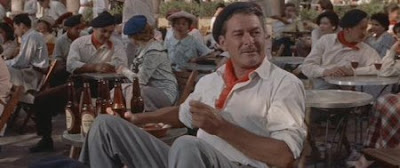
A Tribute to Errol Flynn As His Own Sun Was Setting - His Performance in The Sun also Rises


Errol Flynn as Mike Campbell in The Sun Also Rises.

 Errol Flynn died at the age of 50, a little over two years after appearing in 1957's The Sun Also Rises.  Ernest Hemingway's novel is a story of people whose lives had been changed forever, some ruined, by the horrors of World War I.  Hemingway's characters were damaged human beings who had lost their personal centers of identity with their war experiences, and they wandered in disillusionment and disenchantment.  Flynn's character, Mike Campbell, is the most heartbreaking, and his performance was superb.  The Sun Also Rises was not his last film, but it was his last significant performance, one which should have put to rest once and for all the ridiculous question of whether or not Errol Flynn was a real actor.
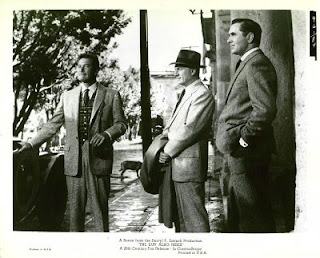
Errol Flynn, Eddie Albert and Tyrone Power
My piece about this movie is not intended as a review, but as a spotlight for a wonderful actor who was never given his due by the industry to which he gave his talent, and for whose success he played a significant part.  In discussing Flynn's work in The Sun Also Rises, it should be noted that the film was criticized for the choices of actors to play the leading roles.  All were older than called for.  Tyrone Power as Jake Barnes, Flynn as Mike Campbell, and Eddie Albert as Bill Gorton were all in their late 40's.  As per the usual Hollywood double standard, beautiful 34-year old Ava Gardner, who always looked younger than she was anyway, was cast as Brett Ashley, much too young and fresh to be believable as a contemporary of the men.  Gardner did a fine job, but casting her only further pointed up the age factor.  Power and Flynn, both of whom battled alcoholism, difficult personal lives and the ravages of time, had lost the beauty of their youth, and viewers were shocked.  Inexplicably, movie audiences were apparently unaware that youth and beauty do not last forever, even for movie stars, and perhaps they could not forgive their heroes for being real men.  Hemingway's book was very challenging to transfer to screen, requiring filming on location in Paris and Spain, with the difficult filming of actual bullfights, but this was achieved beautifully.  Perhaps not a perfect movie, I believe that The Sun Also Rises is a great film.  This is due in large part to the performances of Power, Albert and especially Errol Flynn.

It has been said that the character of Mike Campbell was so much like Flynn himself that it did not require much acting on his part.  To my mind, that criticism shows incredible ignorance of acting as a craft as well as a gift.  Mike Campbell was an aging playboy, a man of great charm whose looks and money were gone, a man forced to question all of the decisions of his life.  Flynn was at this time toward the end of his life and  learning what we all learn -- the mistakes of our youth catch up with us.
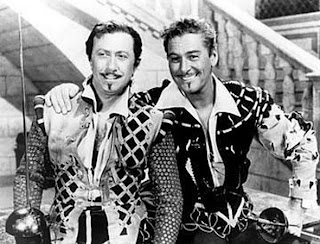
Even in his older years -- always a dash of color in a drab world
(From Crossed Swords)
When he was very young with all of life before him, Flynn said "I intend to live the first half of my life.  I don't care about the rest." What young person ever truly believes he will get old and ill, or addicted to dangerous habits, or find tragedy in life?  That belief in immortality is the charm of youth, and Flynn had more charm than anyone around him.  When he matured and found that life as a movie star was not the picture of glamour most of us think, he once said  "It isn't what they say about you. It's what they whisper."  There were many whispers surrounding Flynn's life, as well as headline shouts.  When he began to age, and cruel remarks were made about him playing caricatures of himself,  he said "I allow myself to be understood as a colorful fragment in a drab world." Flynn was an enigma, charismatic and determined to live fully to the end of his life, but also a man with demons to battle.  Olivia deHavilland, who knew him well in his peak career days, said of Flynn, "He was a charming and magnetic man, but so tormented."  Most surprising to me, even Jack Warner, known to be a harshly insensitive man who didn't like actors, Flynn included, once said, "Errol Flynn was one of the most charming and tragic men I have ever known."
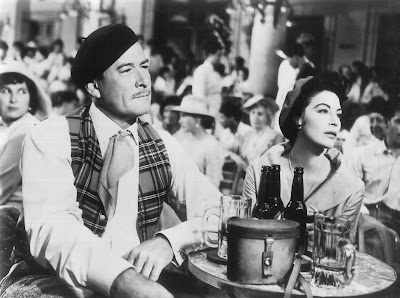
Errol Flynn and Ava Gardner
The complex role of Mike Campbell required the ability to play charm, frighteningly-quick anger, self-deprecating humor, passion, jealousy, disappointment and deep sadness.  This was not an easy part, and despite his personal problems, Flynn was magnificent.  The character of Mike carried much of the movie's pathos on his shoulders, and Flynn's many scenes are some of the best.  He received critical praise for his performance.  So he was obviously nominated for an Oscar for best supporting actor, right?  No.  According to daughter Rory Flynn's website devoted to her Dad:  A recent Australian documentary on his life and career, narrated by Christopher Lee, included a film clip of Errol Flynn being interviewed on his being nominated for the Academy Award for his critically acclaimed performance in The Sun Also Rises. We are then told that the nomination "disappeared".  (http://www.inlikeflynn.com/.)  That is all I could find out.  You know, I'm sure that the incredibly handsome, don't-give-a-damn-what-you-think type of man like Flynn grated a lot of people the wrong way.  I'm quite sure he could be very difficult to deal with, as are many people.  I'm certain men felt a jealous hate because their women wanted him -- women felt similar emotions because they couldn't have him exclusively.  And I would bet the farm that many of these were the very people in the movie industry who had the ability to deny him a well-deserved chance at an award. 

He might have not have won because he would have faced stiff competition that year -- Red Buttons, who won for Sayonara, and Sessue Hayakawa, nominated for The Bridge On The River Kwai, both gave fantastic performances.  Vittorio de Sica was wonderful in A Farewell To Arms.  But do you know who the the other nominees were?  Russ Tamblyn and Arthur Kennedy for Peyton Place!  No disrespect intended to those actors, but for that movie and those performances, it was an absolute joke. Somebody wanted to be sure Flynn was left out, and did so in such a manner that they may as well have knocked on his door and slapped his face.  Shameful.

Even today, when our culture is supposedly more tolerant and open, and when Flynn is more loved than ever before by classic film fans, his loving daughter Rory has been trying to get a tribute to her Father from the Oscar people, and recently had to post on her aforementioned website:  Dear supporters, We have all struggled to have the Academy of Motion Pictures award a posthumous Oscar to Errol Flynn.  I am sad to share with you that the academy will not be able to do so.  The president of the Academy, Mr. Sid Janis has informed me that the academy will not and has not given the award posthumously.  It is a  sad moment for me personally and I know to the many who share with me the joy and happiness that Errol Flynn brought to the screen and to our hearts.  Thank you for your support.  Rory.   What the hell?  But then, Flynn himself probably would have said, "What the hell - I lived a man's life and loved it all.  They know what they can do with their award."  (I made that up, but it sounds plausible!)

I am providing a link to Youtube so that any interested readers who have not done so, can see first-hand the quality of  Flynn's performance in The Sun  Also Rises.  Actually, the link is to the entire movie, which surprised me to find.  I am providing here 3 particular scenes in which Flynn just shines, with the exact places for you to forward to to find them.  If you choose to watch these, I hope you enjoy them.  It is worth every second.

http://youtu.be/d3la1ueMgxw

(Opening credits with composer Hugo Friedhofer's magnificent score:)
   From the very beginning to the director's credit.

Cafe scene after bullfight:
   1:16:20 - 1:19:16

Outdoor cafe after the fiesta:
   1:34:20 - 1:37:10

Flynn's best small scene, very short, shows Mike as he is in private
   1:51:20 - 1:53:22

Thursday, December 3, 2009

Nightmare Alley - A Dark Gem

By 1947, Tyrone Power was an established star best known for his romantic and swashbuckling roles, an extremely handsome matinee idol. However, like many actors since the inception of motion pictures, he wanted to break out and do some serious acting in a serious role. In 1946, he appeared in W. Somerset Maugham’s The Razor’s Edge in the role of Larry Darrell, a young man searching for truth and the meaning of life. This was a good role taken from the pages of great literature, and Power’s first real introduction into a story with depth and dignity. However, it was not enough for Power, who in that same year bought the rights to a novel called Nightmare Alley by William Lindsay Gresham. The part that Power wanted to play was that of Stanton Carlisle, a manipulative, sociopathic grifter working in a seedy carnival.


Darryl Zanuck of 20th Century Fox was not happy with the thought of Power playing such a character. He believed that such a dark role would hurt Power’s image. However, Power insisted, and the project got underway in 1947. The film was produced by George Jessel, the vaudevillian who later became known as the Toastmaster General of the United States because of his many roasts of political and entertainment figures. Zanuck decided to back his star with A film treatment. However, he still didn’t approve, gave it minimal publicity and shelved it after the first round of showing. This hurt the reputation of the movie, critics were not kind, and the public barely got a chance to respond because of this negligible handling. I believe that the critics were wrong. Nightmare Alley is a marvel of a movie with one of Power’s best performances. It is dark and frightening, depicting the lowest class of man, and one man in particular who uses the vulnerable and the needy to further his own ambitions.


The story begins in a seedy carnival, for which 20th Century Fox built a full, working set and hired real carny workers. Power as Stan is a roustabout and a barker, working for Zeena and Pete in their phony mind-reading act. Zeena (wonderful Joan Blondell) is hard-boiled yet soft-hearted for the pitiable drunk that the once great Pete has become. Pete is played by Ian Keith in what I consider to be an academy-award worthy performance. (Ian Keith’s career spanned a long period, with many of his movies directed by Cecil B. DeMille such as The Crusades, Cleopatra, The Sign of the Cross and The 10 Commandments.) The carnival carries a “geek”, an attraction of which Zeena says “lots of performers won’t work in a show that carries one.” Stan is fascinated by the geek, purported to be a wild man, but really only a pathetic alcoholic who actually eats live chickens for the customers, all for a bottle a day and a bed to sleep in. Stan can’t understand how anyone can sink so low. Soon, Stan learns of a valuable code used by Pete and Zeena in their glory days, a code for use in a realistic and mesmerizing mind-reading act. Zeena can sell the code for a great deal of money, but is saving it for her and Pete, partly to pay for “a cure” for Pete’s alcoholism. Once Stan learns of the code, he moves in on Zeena, seducing her in an effort to get the code for himself. After the tragic death of Pete, in which Stan plays a part, Zeena agrees to teach him the code.


Stan betrays Zeena, and marries Molly (Colleen Gray), a beautiful girl who is one of the carnival’s entertainers. Stan wonders aloud why it doesn’t matter to him if he hurts people. He doesn’t know why, but doesn’t have the conscience to do anything about it. Molly is deeply in love with Stan, but Stan sees her merely as window dressing for the new act he designs. He becomes “The Great Stanton” in a nightclub mind-reading act with Molly and the code. He meets Lilith (Helen Walker), a therapist who sees through Stan’s pose and likes it. The mind-reading act is not enough for Stan’s ambition. He goes into the medium game, garnering secrets of Lilith’s rich clients and pretending to be speaking to their dead loved ones. His specialty is rich, grieving, vulnerable people. Molly is horrified at Stan’s phony religious posturing, warning him that he is trying to play God. Stan retorts that a lot of people do so, but Molly says “But they don’t sound like ministers. You do!” Stan doesn’t heed Molly’s warning and continues to use phrases from the Bible, even going so far as to use the words of Jesus in his spiel. Stan finally goes too far, finds that Lilith is really himself in female form, and his downward spiral begins.

Nightmare Alley is directed by Edmund Goulding, a great director responsible for such films as The Razor’s Edge, The Great Lie, Dark Victory and Dawn Patrol. The score by Cyril Mockridge blends beautifully with this disturbing story, discordant and weaving elements of carnival music throughout. Mockridge was a prolific composer, with some of his better-known films being Cheaper by the Dozen, Desk Set and Bus Stop. Perhaps one of the most marked talents is makeup man Ben Nye, who manages to turn the strikingly handsome Power into a man who has created nightmares for others and finally lives one himself. Nightmare Alley is a must-see for classic movie fans and fans of Tyrone Power. It never got the praise or promotion it deserved, and is well worth the search to find it. (Fox Movie Channel shows it periodically.)