Showing posts with label bruce dern. Show all posts

Monday, June 16, 2025

John Frankenheimer's Black Sunday

Having recently watched John Frankenheimer's superb Seven Days in May again, I became interested in revisiting his 1977 thriller Black Sunday. I saw it during its original theatrical run--and that may have been the one and only time. To my surprise, my assessment of the film has not deviated over the last 48 years.

Based on Thomas Harris' bestseller, Black Sunday centers on Michael Lander (Bruce Dern), a mentally-unstable U.S. Navy veteran who is exploited by a member of a middle eastern terrorist organization (Marthe Keller as Dahlia). Their goal is to capture attention for their cause by killing thousands of people at a large-scale event in Miami. The movie unfolds as if the audience doesn't known the precise nature of their massacre. However, the movie's poster gives away the plot so there is no element of mystery in regard to the terrorist plans.

Robert Shaw.
What remains is a cat-and-mouse game between the good guys, led by an Israeli commando (Robert Shaw), and the villains. It's a structure similar to the earlier The Day of the Jackal (1973), in which an assassin meticulously plans to assassinate French president Charles de Gaulle. The difference is that Jackal director Fred Zinnemann and star Edward Fox manipulate the audience into rooting for the assassin for most of that film's running time. 

Bruce Dern as Lander.
In contrast, the screenwriters and cast in Black Sunday let down Frankenheimer by failing to create involving characters. We should feel sympathy for Lander and, to a lesser degree, Dahlia. However, Dern’s acting is so wildly over the top that he loses the humanity in his character. Keller doesn't even get the chance to express or explain Dahlia's motives; they're provided by a Russian spy during a quick conversation with Shaw. Her character remains an enigma, killing with efficiency in one scene and crying for no apparent reason in another. Robert Shaw fares better as the film’s hero, but it’s almost by sheer will. His role is underwritten as well, especially when reacting to the murder of a long-time friend. 

Marthe Keller as Dahlia.
To Frankenheimer's credit, the final 45 minutes ratchet up the thrills effectively as the terrorist plot reaches its crescendo. Producer Robert Townsend worked with the National Football League to film an actual football game. Frankenheimer incorporates that footage seamlessly, adding an authenticity to the climatic disaster. His purposefully chaotic direction--especially as crowds pour out of the stands--creates an almost cinema vérité effect. It's a shame that an exciting sequence involving a blimp includes some unconvincing rear screen shots.

It's too bad that Black Sunday never reaches its potential as a nail-biting suspense film. The climax delivers the goods, but a weak script, uneven acting, and a bloated running time (over two hours) keep it from providing a growing feeling of tension. It's a far cry from Seven Days in May and just goes to show that a fine director can only do so much with the material and cast that he's given.

Monday, December 18, 2023

The Laughing Policeman and Warning Shot

The Laughing Policeman (1973). Walter Matthau starred in two of the finest crime dramas of the 1970s: Charley Varrick (1973) and The Taking of Pelham One Two Three (1974). Sandwiched between those classics, he made The Laughing Policeman, a solid crime picture steeped in urban grittiness. Matthau plays Jake Martin, a San Francisco police detective investigating the brutal murders of a bus driver and his passengers. The case becomes personal quickly when one of the victims turns out to be Jake's partner, who was looking into one of Jake’s old unsolved cases on his own. While the police department mounts a large scale effort to find the killer, Jake follows his own leads--while also dealing with his meddling new partner Larsen (Bruce Dern). The Laughing Policeman differs from most Matthau movies in that its protagonist is something of an enigma. He ignores his wife and teenage son, sleeps in a separate room in his home, and has no close friends at work. He wasn't even close to his dead partner. He definitely doesn't want a bigoted, violent, loud-mouthed new partner--but his evolving relationship with Larsen is the best part of The Laughing Policeman. Bruce Dern injects life into every frame and counterbalances Matthau's low-key performance. Director Stuart Rosenberg, perhaps best known for Cool Hand Luke, effectively contrasts the colorful neon lights of the city with its dour underside. The Laughing Policeman was based on a 1968 Swedish novel written by Maj Sjöwall and Per Wahlöö. It was one of ten books featuring detective police detective Martin Beck, who was renamed for the film adaptation. 

Warning Shot 
(1967).
Released during the final season of The Fugitive, Warning Shot features David Jansen as L.A. police detective Tom Valens, who kills a burglar in self-defense outside an apartment complex. The problem is that the “thief” was actually a prominent physician and no one can find the gun that Valens claims he saw. When a politically ambitious D.A. charges Valens with manslaughter, the veteran detective sets out to clear his name. Although released theatrically, Warning Shot looks and feels like an above-average made-for-TV movie. Many of the supporting players were working mostly in television at the time. Some of their appearances amount to little more than cameos, such as Walter Pidgeon as a lawyer, Eleanor Parker as the victim’s non-grieving widow, and Joan Collins as Valens’ estranged wife. Janssen is fine as the world-weary detective, but it's the kind of the role he played often in his career. George Grizzard nearly steals the film as a self-proclaimed ladies man who may be involved in shady dealings and Stefanie Powers has some good scenes with Janssen. At its best, Warning Shot has a late 1960s L.A. vibe reminiscent of Harper. It's reasonably engrossing, but the cast is the best reason to see it. 

Thursday, October 4, 2012

Hitchcock's Swan Song: "Family Plot"

Following a number of commercial and artistic successes in the 1950s and early 1960s, Alfred Hitchcock's career took a plunge after The Birds (1963). Starting with Marnie (1964), Hitchcock often found himself out of favor with the movie-going public and the critics. An exception was 1972's Frenzy, which some reviewers hailed as a comeback for the Master of Suspense. Personally, while I admire elements of Frenzy, Hitchcock's sole R-rated film leaves something of an unpleasant aftertaste. Thus, I was enthused that  his follow-up--and final film--was a Hitchcockian mix of suspense and humor. Make that a little suspense and a little humor.

Devane as a crafty kidnapper.
Family Plot (1976) unfolds with two parallel stories that predictably intersect at the halfway point. In the first, fake psychic Blanche Tyler (Barbara Harris) and her taxi driver boyfriend George (Bruce Dern) learn that one of Blanche's wealthy, elderly clients wants to make amends for forcing her sister to give up a child for adoption years earlier. Blanche and George can earn $10,000 by finding the now-adult nephew. In the second plot, high-class criminals Arthur and Fran Adamson (William Devane and Karen Black) abduct rich people and hold them for ransom--the payment always being in the form of hard-to-trace diamonds.

George (Dern) in the cemetery.
The persistent George tracks Edward Shoebridge, the missing nephew, to a grave in a small-town cemetery. Initially bummed that Shoebridge apparently died in 1950, George realizes that the tombstone looks newer than others in the graveyard. When he later learns that the headstone was purchased with cash in 1965, he suspects that Shoebridge is still alive--but doesn't want to be found.

Family Plot has its admirers. Donald Spoto, in The Art of Alfred Hitchcock, calls it "the purest film Hitchcock has given us since Psycho, and it is this meticulous structure and the lightness of tone that make it unique among recent Hitchcock works." Certainly, there's a comic element to the relationship between Blanche and George that recalls the offbeat humor of The Trouble With Harry. Indeed, Barbara Harris sometimes acts as if she was starring in a screwball comedy. Her broad attempts at humor seem totally at odds with the rest of the film, especially the scenes featuring sinister Arthur Adamson, who--in the capable hands of Devane--is one of Hitchcock's most heartless (if perhaps one-dimensional) villains.

Harris and Dern in the runaway car.
Surprisingly, Hitchcock struggles to generate any palpable suspense. A scene with Dern driving down a twisting mountain road without brakes starts out well, but its impact fades as it becomes too long and repetitious. Still, there are some trademark Hitchcock touches, such as Devane trying to hide a priest's body quickly, only to have a piece of a bright red robe peek out from under a black car door.

Hitchcock and screenwriter Ernest Lehman (who penned North By Northwest) reward discerning viewers with some subtle in-jokes: a street named Bates Avenue, someone smoking at a gasoline station, and discussions about having a "bird in hand." The film's best joke, though, lies with its ironic plot twist (not revealed here!). Interestingly, Lehman had earlier rejected an opportunity to make his own version of The Rainbird Pattern, the 1972 novel on which Family Plot was based.

Hitchcock was 75 when he completed Family Plot, his 53rd film and a modest success. During the final years of his life, he worked with Lehman and James Costigan on the screenplay for a spy film tentatively titled The Short Night. Hitchcock died in 1980 of renal failure.

Wednesday, February 15, 2012

The Price of Political Ambition in "Posse" and "The Candidate"

This month's focus on politics in movies continues with two films from the 1970s, each a labor of love for its star: Posse and The Candidate.

Kirk Douglas produced, directed, and starred in Posse, an ambitious political Western about Texas marshal Howard Nightingale, a candidate for the U.S. Senate. Nightingale has built his campaign around capturing the notorious railroad-robbing outlaw Jack Strawhorn (Bruce Dern). Unfortunately, with the election approaching quickly, Strawhorn's capture has proven difficult--even for Nightengale's posse of six highly-paid professionals. However, when a payoff reveals Strawhorn's whereabouts, Nightingale and his posse burn down the barn containing Strawhorn's men and the $40,000 loot obtained from their latest robbery. To the marshal's extreme displeasure, Strawhorn manages to escape...though not for long.

If Posse was intended as a cynical editorial on the politically-turbulent 1970s, it never quite reaches that goal. Its message is ultimately muted, but there are still pleasures along the way. Douglas and company nicely convey that political strategies have changed little over the last 120 years. Nightingale's campaign speeches consist of vague promises like being tough on crime. He fights with a local newspaper editor played by James Stacey. He employs his own photographer to make sure that no photo opportunities are missed (even when he poses solemnly after burying one of his posse). Nightingale even travels in a luxurious train car, courtesy of the railroad--it's no coincidence that his populist rhetoric stresses the importance of railroads in building the country's future.
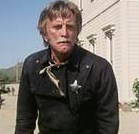
Yet, while Nightingale's future looks promising, the same can't be said for his posse. Their boss proudly informs the gunmen that he has secured them jobs as security guards for the railroad for $100 a month. Their response: We make more than that now. When a Native American member of the posse notes that the railroad doesn't hire Indians, Douglas replies with an offhand: "We'll have to work that out." Yes, trouble is brewing within the ranks of the posse.

Kirk Douglas directs with a sure hand, though at the expense of fleshing out what really makes Nightingale tick. Bruce Dern fares much better as the charming and crafty Strawhorn. Remarkably restrained, it may be my favorite Dern performance.

An unnecessary death mars what could have been one of cinema's all-time great endings--but it's still very good. In the end, Posse is a satisfying, offbeat portrait of political ambition and its consequences.
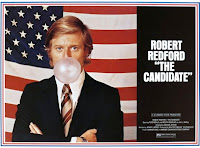
The same theme gets a very different treatment in The Candidate, Robert Redford's inconsistent tale of a young California lawyer's rise from small-time crusader to the U.S. Senate. Redford stars as Bill McKay, the son of a popular former governor, who has no political aspirations--until an astute campaign manager (wonderfully played by Peter Boyle) seeks him out. McKay is reluctant to agree to run for office. He wants a guarantee that he can "say what I want, do what I want, go where I please." Boyle's character agrees, noting that it means McKay will lose the election.

The campaign gets off to a promising start, with the press embracing McKay's frank views. But when his message fails to click with the public, his campaign team shifts to vague rhetoric and (amusingly) empty TV spots that capitalize on the candidate's looks while saying nothing of substance. McKay starts to rise in the polls and suddenly seems capable of unseating his three-term incumbent opponent.

It's easy to see what Redford and director Michael Ritchie wanted to do with The Candidate. Three years earlier, they had teamed for Downhill Racer, a sharp portrait of an inconsiderate human being who also happened to be a great skier. Unfortunately, the lead character in The Candidate simply lacks interest. We should feel something when McKay realizes--quite belatedly--that he has sold out. Instead, it means little because we never really got to know McKay in the first place. He is a bland enigma at the start of the film and remains so at the end.

To his credit, Ritchie provides an absorbing insider look at the campaign trail, from the musty hallways of the hotels to the camera crew following the candidate around, hoping for a snippet that can be used in a TV spot. His use of handheld cameras is effective at first, but quickly grows weary.

Despite its shortcomings, The Candidate was a boxoffice hit. Redford was on the verge of superstar status and the film was certainly timely (it was released during the 1972 Presidential primaries). However, if you're seeking an original political picture from the 1970s, then I recommend you ride along with Kirk Douglas's Posse.