Showing posts with label beach party series. Show all posts

Wednesday, June 10, 2015

The Beach Party Series Comes to a Sad End with "The Ghost in the Invisible Bikini"

This was not the film's original title.
As visitors to this blog know, we are Beach Party proponents, Annette admirers, and Frankie aficionados. Yes, we like our BP movies, but what is one to make of the last--and least--entry in American International's seven-film series? Frankie and Annette are nowhere to be seen. Other prominent series regulars that are also missing include Candy Johnson, Donna Loren, John Ashley, and, most notably, Jody McCrea (Bonehead/Deadhead). Even William Asher, who directed five of the series' entries, opted to avoid this outing (he had shifted his focus to his then-wife's TV series Bewitched).

In the closing credits of 1965's Dr. Goldfoot and the Bikini Machine, AIP announced that Annette Funicello, Deborah Walley, Harvey Lembeck, and Aron Kinkaid "would soon appear in The Girl in the Glass Bikini" (we'll address the title change later). However, by the time production commenced, Annette was no longer attached to the project. Deborah Walley became the female lead and Tommy Kirk, who had previously appeared in Pajama Party, was cast as her co-star.

Kirk and Walley hold hands for a seance.
The plot sends Chuck Philips (Kirk), Lili Morton (Walley), and the older Myrtle Forbush (Patsy Kelly) to the recently-deceased Hiram Stokely's creepy mansion. The trio are the rightful heirs to Hiram's estate, which includes a large sum of money hidden in the house. The dead man's lawyer, Reginald Ripper (Basil Rathbone), wants to swindle them out of their inheritance. Meanwhile, Myrtle's partying nephew Bobby (Kinkaid) shows up at the estate--as does motorcycle gang leader Eric Von Zipper (accompanied by the Ratz and Mice) and J. Sinister Hulk (Jesse White reprising his role from Pajama Party).

Karloff was too ill to stand.
When the completed film, now titled Bikini Party in a Haunted House, was screened for AIP heads James Nicholson and Samuel Z. Arkoff, they deemed it a disaster. Nicholson came up with the idea to add a subplot in which Hiram's ghost (Boris Karloff) has to perform a good deed to get into heaven. A bikini-clad Susan Hart (who had recently married James Nicholson) was also inserted in the proceedings and the movie was retitled The Ghost in the Invisible Bikini. Unfortunately, the title change meant a big production number called "Bikini Party in a Haunted House"--featuring Aron Kinkaid and Danny Thomas protegee Piccolo Pupa on lead vocals--had to be jettisoned.

Still, the remaining songs penned by Beach Party veterans Guy Hemric and Jerry Styner are quite listenable. Nancy Sinatra does an energetic poolside rendition of "Geronimo" while the Bobby Fuller Four serves as the film's "house band." Piccolo Pupa (that was not her real name) sings lead on "Stand Up and Fight." The Italian performer never achieved success in the U.S. despite three appearances on The Danny Thomas Show and a gig on Shindig! 
Nancy Sinatra sings "Geronimo" and Piccolo Pupa dances.
The saddest part of The Ghost in the Invisible Bikini is watching a fine cast being wasted. Karloff, Rathbone, and Francis X. Bushman were all in the twilight of their careers (and Boris was quite ill). It's painful to watch these classic era stars struggle with horrible material. Just two years earlier, Karloff and Rathbone had an opportunity to show off their comedic skills in Richard Matheson's funny The Comedy of Terrors.

Quinn O'Hara as Sinistra.
It's equally frustrating to see Beach Party veterans like Harvey  Lembeck and Bobbi Shaw forced to recycle old gags. Indeed, the only cast member that escapes unscathed is Quinn O'Hara. She's pretty funny as Sinistra, Rathbone's statuesque, but blind-without-her-glasses, daughter who keeps trying to kill Kinkaid's character.

After The Ghost in the Invisible Bikini crashed at the boxoffice, American  International Pictures concentrated on biker and horror flicks (the latter was always one of the company's staples). The Beach Party series, which had started off with such promise in 1963, had lasted just four years and produced only seven films (if you don't count Ski Party). It would take a few decades for their simple nostalgia and memorable music to become fully appreciated. But these days, I can safely say I am not alone in my affection for such drive-in classics as Beach Blanket Bingo and Muscle Beach Party.


This review is part of the Beach Party Blogathon hosted by Silver Screenings and Speakeasy. Click here to view the full schedule of awesome beachy posts!

Friday, March 14, 2014

From the Cafe's Bookshelf: "Hollywood Surf and Beach Movies"

Fans of the Beach Party movies and other 1960s surfing flicks will find no better spring break reading than Thomas Lisanti's Hollywood Surf and Beach Movies: The First Wave, 1959-1969. Originally published in 2005 and reprinted as a paperback in 2012, Lisanti's book provides a comprehensive look at the genre from Gidget (1959) to The Sweet Ride (1969). While other books have covered these films in the context of 1960s pop culture, Hollywood Surf and Beach Movies goes behind the scenes with production details provided by veteran stars such as Shelley Fabares and Jody McCrea.

Sandra Dee and Cliff Robertson
in Gidget.
Hollywood Surf and Beach Movies is divided into three parts: an introduction; entries on each of the 32 films covered; and biographical sketches of selected performers. The introduction provides an historical overview, starting with Frederick Kohner's novel Gidget, which was based on his teenage daughter Kathy's obsession with surfing. Beginning the film version of Gidget, Lisanti traces the evolution of the beach movie genre and the influence of films such as Where the Boys AreBeach Party, and The Endless Summer.While the author states that his "book does not contain in-depth analyses about the films in terms of their cultural importance," his introduction nonetheless offers insight into what made them popular and why they faded by the end of the decade.

Still, the focus of Hollywood Surf and Beach Movies is on the individual movies. For each film, Lisanti lists the complete credits, describes the plot, provides quotes from reviews, and--best of all--takes the reader behind the scenes for fascinating trivia, such as:
  • The Beach Party series almost starred Fabian and Sandra Dee instead of Frankie and Annette.
  • American International Pictures originally intended Bikini Beach for the Beatles--until the band's appearance on The Ed Sullivan Show made their salaries too costly.
  • Nancy Sinatra was first offered the role of Sugar Kane (played by Linda Evans) in Beach Blanket Bingo.
  • Neil Sedaka and Howard Greenfield wrote two title songs for Where the Boys Are. The version they and Connie Francis preferred was not the one selected by producer Joe Pasternak. The Pasternak-preferred song became a huge hit, of course, and Connie's signature song.
Lisanti quotes frequently from many of the performers who appeared in these movies, particularly Jody McCrea, Aron Kincaid, and Luree Nicholson (daughter of AIP co-founder James H. Nicholson). Although the genre's biggest stars--Frankie and Annette--did not participate in interviews for the book, they are liberally quoted from other sources. McCrea offers an interesting perspective on his co-stars: "I got along very well with Frankie and Annette because I left them alone. They always had many lines to memorize or songs to sing. I just concentrated on my part and didn't fraternize with either of them at all."

Jody McCrea and Mary Hughes.
The comprehensiveness of Lisanti's film coverage is commendable. He does a fine job highlighting lesser-known films of interest such as The Girls on the Beach, A Swingin' Summer, and cult fave Ride the Wild Surf. Indeed, the only obvious omission is the Troy Donahue-Stefanie Powers 1963 romp Palm Springs Weekend. While it doesn't take place at a beach, it certainly fits within the genre. Plus, Lisanti does includes other non-beach efforts like the aforementioned A Swinging' Summer (Lake Arrowhead) and Ski Party (and its imitators).

In the third section of Hollywood Surf and Beach Movies, Lisanti profiles "a select number of actors and actresses who made their marks in...the genre." It would have been helpful to include the criteria for selection, for there are some notable omissions, to include: Harvey Lembeck, Bobbie Shaw, Dwayne Hickman, Timothy Carey, and Donna Loren. These performers are mentioned throughout the book, so it's not as if the author ignores them. It's just that their contributions to beach movies seems as notable as profiled performers Kincaid, Ed Garner, and Peter Brown (who only appeared in one surf movie).

Still, such criticisms amount to mere quibbles. With an exhaustive bibliography, an index, and 96 photos, this 456-page reference volume is highly recommended for fans of the beach movie genre and for libraries with extensive film book collections. So, the next time you head to the beach, be sure to grab your surfboard, your sun tan lotion, some Beach Party DVDs, and a copy of Hollywood Surf and Beach Movies!

McFarland & Company, Inc. Publishers provided a review copy of this book.

Wednesday, March 12, 2014

Seven Things to Know About Miss Perpetual Motion (that'd be Candy Johnson!)

1. Candy Johnson gained fame as the fast-shakin' go-go dancer in the colorful fringe outfits in four Beach Party movies made in 1963-64: Beach Party; Bikini Beach; Pajama Party; and Muscle Beach Party (shown on right with "Little" Stevie Wonder in the background). Those are the only movies she made!

2. In the first film, Candy is aptly billed as the "perpetual motion dancer." In the other three films, her character's name is...Candy. Her character's hip gyrations are so dangerous that--if aimed properly--they could send a guy flying across a room without even touching him. Thus, Candy comes in handy when Frankie and the boys are fighting Eric Von Zipper's gang.

Candy's hips send Deadhead flying in Bikini Beach.

Candy doing her act in a nightclub.
3. Candy was discovered by Red Gilson, who managed a West Coast band called The Exciters. Gilson convinced her to join the band and she became its "frontman." The band, which became billed as Candy Johnson and Her Exciters, played lounges in Palm Springs and Las Vegas. That's where she attracted the attention of American International Pictures executives.

4. Candy could have made a fortune with her weight loss program; she allegedly burned off five to fifteen pounds a night when performing her lounge act. In Tom Lisanti's book, Drive-in Dream Girls: A Galaxy of B-movie Starlets of the 1960s, he mentions that Candy ate steak and potatoes every night to make up for the weight loss. He also included one of Candy's quotes to the press: "If your trouble is too much weight, just twist it off!"

5. Red Gilson started a small label called Canjo Records (the name being a truncation of Candy Johnson, of course). Canjo only released two albums: The Candy Johnson Show at Bikini Beach and Ray Ryan Presents The Candy Johnson Show. They're both very rare, but not pricey for collectibles. You can buy a near-mint copy of either album for around $40. Canjo Records also released 45s featuring Candy's Beach Party series co-stars Jody McCrea (Bonehead or Deadhead) and Meredith MacRae (Animal). The "A" side of McCrea's single was "Chicken Surfer" and the "B" side was "Looney Gooney Bird." Meredith MacRae, who later gained fame on My Three Sons and Petticoat Junction, sang "Image of a Boy" on her single.

A rare moment of stillness.
6. Candy performed at the World's Fair in New York in 1964-65. Allegedly, that's where the members of The Strangeloves saw her and were so inspired they wrote their #11 pop hit "I Want Candy."

7. Candy Johnson and Red Gilson married in the late 1960s and opened a New York City nightclub called The Candy Store. It didn't last long and neither did her marriage to Gilson. Candy subsequently retired from show business (some sources claimed she turned down the role on Rowan and Martin's Laugh-in that eventually went to Goldie Hawn). Candy kept a low profile for many years, but did make a rare public appearance at a special 2006 screening of Beach Party--where she received a standing ovation. Candy Johnson died in 2012 at the age of 68.

Monday, March 25, 2013

Beach Party Tonight!

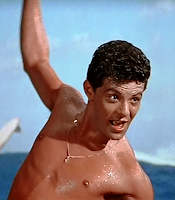
Frankie surfing...in front of a rear screen.
With one notable exception, 1963's Beach Party--the first entry in American-International's seven-film series--provided the blueprint for a new genre: the teen sand 'n' surf musical. It wasn't the first teen movie with surfing (see Gidget) and certainly not the first teen musical (see Rock Around the Clock and many others). However, Beach Party combined both elements into one sunny, sandy, frothy mix.
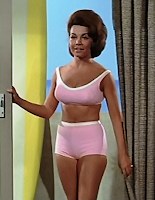
Annette--pretty in pink!
The aforementioned exception in Beach Party is the presence of adult leads Bob Cummings and Dorothy Malone. Although integrated into the plot, I think they were added to draw an older audience that this genre ultimately didn't need. American-International apparently came to the same conclusion. Starting with Muscle Beach Party, the first stars listed above the title are Frankie Avalon and Annette Funicello. Their popularity grew to the point where just one of the two stars was enough to attract an audience. (In contrast, the only film with neither one, The Ghost in the Invisible Bikini, was the least successful entry in the series...and a bad movie, too.)

Beach Party opens with Frankie and Annette singing the catchy "Beach Party (Tonight)" as they cruise down a seaside road in Frankie's yellow jalopy, with surfboards protruding from the back. Their destination is a beachfront cabin where they will spend the summer together--although with different expectations as highlighted in this dialogue exchange:

Frankie (motioning to the cabin): There it is, Honey. It's all ours.
Dolores: Just you and me. All alone.
Frankie: Exactly.
Dolores: It's just like we were married.
Frankie: Exactly!

Thus, in the film's first scene, we learn the source of friction in the relationship between Frankie and Dolores: She wants to get married; he wants the sexual benefits of marriage without the commitment. This theme carries throughout most of the films in the series and results in each character going to extremes to make the other jealous.
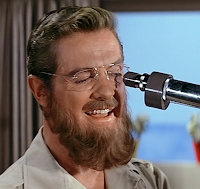
Bob Cummings watching "tribal" teens.
In Beach Party, these "tribal customs" of the American teenager attract the attention of middle-aged anthropologist Robert Sutwell, who is writing a book titled The Behavior Pattern of the Young Adult and Its Relation to Primitive Tribes. His attractive assistant Marianne (Dorothy Malone) describes it more accurately as Teenage Sex. Sutwell’s plan is to observe the teenagers through his telescope and eavesdrop with his high-tech sound equipment.
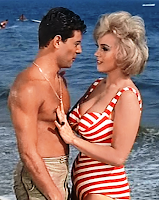
Frankie gets cozy with Eva Six.
Meanwhile, Dolores confides to her friend Rhonda (Valora Noland) that she wants to be with Frankie, but take their relationship slowly. Frankie expresses his frustration to his friends, who advise him to dump Dolores. Frankie confesses that he can’t do that—because he loves her. They hatch a scheme to make Dolores jealous: When the gang goes to Big Daddy’s that night, Frankie will flirt with the voluptuous waitress Ava (Eva Six).

Everyone shows up at Big Daddy’s that evening, including Sutwell, who has decided he needs to get closer to his subjects. Unfortunately, Eric Von Zipper (Harvey Lembeck), an unpopular motorcycle gang leader, also makes an appearance. When Dolores decides to leave after watching Frankie flirt with several other girls (including Ava), Von Zipper approaches her. “Hey, baby, girls fall for Eric Von Zipper,” he tells her. “I like you and what Eric Von Zipper likes, he gets.”
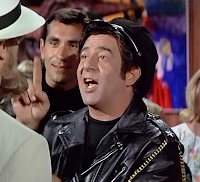
Lembeck as Eric Von Zipper.
Hearing Von Zipper’s unwanted advances, Sutwell comes to Dolores’s rescue. When Von Zipper confronts him, Sutwell pushes his index finger against Von Zipper’s temple and the gang leader's body freezes immediately. Sutwell explains this is the “Himalayan time suspension technique” and that Von Zipper will be fine in a few hours. Sutwell then escorts Dolores back to her beach house, where she hatches her own scheme for making Frankie jealous.
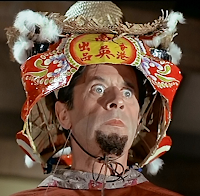
Morey Amsterdam spouting
beatnik poetry.
It's a slight plot, but that doesn't matter, of course. If you're a fan of the Beach Party films--as I am--it's because of the casts and the music. Beach Party introduces many performers who would become regulars in the series:  the delightful Lembeck supported by Andy Romano as his crony J.D. (for Juvenile Delinquent); Jody McCrea as the dim-witted Deadhead (later renamed Bonehead); the shimmying Candy Johnson; and John Ashley as the other good-looking male in the gang. Morey Amsterdam became the first veteran comedian to appear in the series--and would be followed by Don Rickles (four films), Buster Keaton (three), Paul Lynde, and Jesse White. Likewise, Vincent Price became the first classic film star to make a cameo, paving the way for Peter Lorre, Boris Karloff, Dorothy Lamour, Elsa Lanchester, and Basil Rathbone.
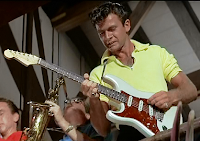
Dick Dale jamming on his guitar.
As for the music, Dick Dale and the Del Tones perform the beach classic "Swingin' and a-Surfin'" while Frankie and Annette (as a duo and separately) croon the rest of the tunes. It's one of the best scores in the series with songs written by Bob Marcucci, Gary Usher and Roger Christian (who sometimes collaborated with the Beach Boys), and Guy Hemric and Jerry Styner (who wrote songs for several Beach Party pictures).

While Beach Party isn't the series' best entry (that'd be Beach Blanket Bingo), it's a pleasant diversion and deserves kudos for establishing the prototype for all subsequent 1960s teen sand 'n'surf movies. That makes it historically significant! And if that's not enough to convince you to watch it, then you might have to deal with Eric Von Zipper and the Ratz....

Thursday, April 19, 2012

Buff Guys, Bikini Babes, and Rockin' Surf Music Abound in "Muscle Beach Party"

Julie, the Contessa, watches
as Flex flexes his muscles.
Contessa: You’re so strong. Flex: I’m the strongest.
Contessa: And so handsome.
Flex: I’m the handsomest.
Contessa: And so big.
Flex: Yes, ma’m.
Contessa: I want to be alone with you.
Flex: Did you see this tricep?
Contessa: I want to take you away with me.
Flex: The way I can make it ripple?
Contessa: Right now.
Flex: I haven’t had my lunch.

Jack Fanny (Don Rickles) motivates his bodybuilders,
led by Peter Lupus on the far right.
I have something in common with a Contessa. No, it’s not the wealth, nor the beauty. But we both think Peter Lupus, billed under the stage name Rock Stevens, is cute and fun. Muscle Beach Party gives Lupus’s character Flex Martian, also known as Mr. Galaxy, a chance to really show off his award-winning physique. Lupus became regular Willie Armitage on Mission: Impossible two years after this classic entry in the Beach Party series. Flex proudly wears a shiny purple bathing suit with a gold cape and is surrounded by seven shorter muscular men in shiny pink bathing trunks and pink capes (named Biff, Rock, Tug, Riff, Hulk, Sulk, and Clod) and their manager Jack Fanny, perfectly portrayed by Don Rickles.

Frankie explains to Dee Dee, a bit
condescendingly, that "girls don't fly."
Series regulars Frankie Avalon and Annette Funicello are back in this second Beach Party entry as Frankie and Dee Dee, along with Jody McCrea as their friend Deadhead and shimmying Candy Johnson as Candy. The film opens with Frankie beginning to feel pressured by Dee Dee to make a commitment to settle down when he just wants to keep having fun with his beach friends.

Luciana Paluzzi before Thunderball.
Meanwhile, the Contessa Julie, played by the luminous Luciana Paluzzi (best known as Fiona Volpe in Thunderball), arrives in her luxury ocean liner. She proves to be indecisive, thinking she is in love first with Flex and then with Frankie, when she comes across him wistfully singing “A Boy Needs a Girl (He Can Count On)” on a moonlit beach. She decides she likes Frankie’s voice and boyish charms even more than the buff strongman’s--to the disgust of Dee Dee, who calls her the Bride of Godzilla at one point.

Annette surfing in her cute suit...
in front of a rear screen wave.
Annette plays the lovely girl next door and wears one of her prettiest two piece swimsuits, with a net draped across the top. We hear her sing “A Girl Needs a Boy (She Can Count On)” with an echo effect that came to be known as the "Annette sound." Part of the fun of Muscle Beach Party is hearing songs performed enthusiastically by Donna Loren, Little Stevie Wonder (who was 14 at the time), and Dick Dale and the Del-Tones.

Morey Amsterdam mugging
as Cappy.
Entertaining supporting performances abound, including Morey Amsterdam reprising the role of proprietor Cappy from Beach Party, Buddy Hackett as the Contessa's business manager, Peter Turgeon as Julie’s lawyer, and even a turn by Peter Lorre as the strong yet silent partner of Jack Fanny. Yet, despite the presence of such veteran funnymen, Harvey Lembeck is sorely missed as motorcycle gang leader Eric Von Zipper. Muscle Beach Party is the only one of the seven Beach Party movies without Lembeck.

The ending is not a surprise but viewers watch Beach Party films for the fun in the sun and the singing and dancing. There are lots of shots of surfing and even a “walls of Jericho” to separate the young women from the young men in their cramped lodging. It's a perfect movie for light summer viewing, with or without a beach.