Showing posts with label month of mysteries. Show all posts

Thursday, September 13, 2012

Alastair Sims Hosts an Evening of Revelations in "An Inspector Calls"

A well-to-do British family of four, the Birlings, is seated around a dinner table in 1912. Each is dressed to the nines and the family is celebrating the betrothal of the daughter, Sheila, to Gerald Croft, the fifth person present. The remaining family members include the father, mother, and son, Eric.

We receive some hints about their personalities from small comments made casually. Sheila sometimes has a bad temper. Eric drinks to excess. Gerald’s mother thinks he can better himself socially. Mrs. Birling is extremely concerned about maintaining correctness in everything. And Mr. Birling is pleased about the prosperity and progress of the times, but naïve about the potential for war. He announces to Gerald that there is a good chance for him (Mr. Birling) to receive a knighthood “so long as we all behave ourselves and don’t get into the police courts.” Gerald responds, “You seem a nice, well behaved family to me.”

Right on cue, into their midst, appears Inspector Poole, who is about to change their lives forever. He brings the news that a young woman, Eva Smith, has just died from ingesting disinfectant. The inspector wants to speak with all five people and, one by one, a complex story emerges.

He starts with the beginning of the story. In the autumn of 1910, the father opened a new machine shop at The Works. It was brought to his attention that five female employees were dissatisfied with their low pay and having trouble making ends meet. One young woman, Eva Smith, boldly asked her employer why he couldn’t increase their pay. Mr. Birling’s solution was to fire them all.

After a few months, Eva found another position but had an encounter with a customer who had a hissy fit when she tried on a hat that didn’t suit her. The rude patron also happened to be a Birling, which resulted in Eva’s second firing. The story continues with each member at the table’s history with this woman.

Inspector Poole is expertly portrayed by Alastair Sim. He is an unusual detective who seems to know everything before it is revealed. As the story unfolds in flashbacks, we see that some members of the family truly are concerned for the part they may have played in Eva Smith’s predicament.

The mystery conveys a strong message: sometimes we can impact another person’s life much more profoundly than we may realize.

All of the cast members had busy careers on film but the one I have seen most often, besides Alastair Sim, was Brian Worth (Gerald Croft). Worth appeared in a host of popular British television shows including the Quatermass and the Pit serial, Danger Man, The Saint, The Prisoner, The Champions, and The Protectors. The other five actors include Jane Wenham as Eva, Eileen Moore as Sheila, Olga Lindo as Mrs. Birling, Arthur Young as Mr. Birling, and Bryan Forbes as Eric.

Friday, January 29, 2010

A Month of Mysteries: Warren Williams as Philo Vance in "The Dragon Murder Case"

This snappy 1934 B-movie mystery represents the most successful attempt to bring S.S. Van Dine's erudite sleuth, Philo Vance, to the screen. Van Dine (a pseudonym for Willard Huntington Wright) introduced Vance to mystery readers in 1926 with The Benson Murder Case. Over the next 13 years, Van Dine published twelve highly successful Vance novels.

These intriguing-plotted mysteries became sought-after movie properties in spite of some significant obvious liabilities. These drawbacks included Van Dine's tendency to expound excessively on artistic or scientific subjects related peripherally to the mysteries. He also wrote the novels in first person, casting himself as Vance's companion/lawyer, a literary device borrowed from Arthur Conan Doyle's Sherlock Holmes stories. However, whereas Conan Doyle had Dr. Watson occasionally play an active role in Holmes' investigations, Van Dine (the writer) used Van Dine (the character) simply to narrate the proceedings.

Yet, the biggest problem with adapting these best-selling mysteries was Philo Vance himself. The wealthy, amateur criminologist was an aloof intellectual and could be downright cold when questioning suspects. He also lived by his own moral code--to the point of rearranging poison-filled glasses to trick a murderer into killing himself. Many filmmakers deemed such a detective too unlikable for the screen. Therefore, most of the movie Vances were rich and intelligent, but also charming and debonair. The best-known screen Vance was the always-likable William Powell, who played the sleuth four times with his best effort being The Kennel Murder Case (1933). Powell was a fine performer, but his film detective was not the Philo Vance admired by Van Dine's readers.

Enter Warren William, who debuted as Philo Vance in 1934's The Dragon Murder Case, an adaptation of the seventh Vance novel published the previous year. William projected the perfect note of acidity as Vance. He handled his white gloves and cane with aplomb, while talking down to everyone in sight. He also benefited from a tight adaptation of one of Van Dine's more baffling crimes.

The film's plot follows the book closely, although it adds a restaging of the murder and deletes an incident in which a boulder conveniently crushes the guilty party. As in the novel, the identity of the killer is fairly obvious. The puzzle lies in how the murder was accomplished.

The crime takes place at a country estate in upper New York where wealthy playboy Sanford Montague disappears after a night-time dive into a natural lake called the Dragon Pool. When Montague fails to turn up after a day, the police drain the pool and discover claw marks on the sandy bottom. Later, Vance discovers Montague's dead body in a "glacial pot-hole" on another part of the estate. The victim's mangled body is covered with large claw marks--as if he had been ripped open by a dragon.

Although shot entirely on a stage, The Dragon Murder Case utilizes its atmospheric sets effectively. The mysterious pool looks eerie, with its lighted areas contrasting with the dark, murky waters. The only other principal set, the living room of the country mansion, is filled with exotic aquariums, including one suspended from the ceiling. (The aquariums naturally afford Vance the opportunity of showing off his knowledge on breeding tropical fish.)

The performers playing the suspects have little to do. They exist principally to provide verbal targets for William's Vance. However, Eugene Pallette gives one of his most restrained performances as Sergeant Heath (he played the role with William Powell, too). Etienne Girardot steals several scenes as coroner Dr. Doremus, who gripes constantly at having his meals interrupted by inconvenient dead bodies.

Still, the film belongs to Warren William and he makes it a delight for viewers who have actually read the Van Dine novels. Sadly, William's only other portrayal of Vance was in the 1939 comedy-mystery The Gracie Allen Murder Case. It's too bad he didn't get a crack at the best of the books: The Greene Murder Case (filmed with Powell) and The Bishop Murder Case (with Basil Rathbone).

Neither the Vance films nor the novels achieved the classic status of fellow sleuths such as Jane Marple, Peter Wimsey, and Philip Marlowe. The last Vance film appeared in 1947. Several attempts to create reader interest with paperback editions of the novels failed. Despite such setbacks, Philo Vance has maintained a few loyal mystery fans who admire cynical, detached, and morally questionable detectives.

Monday, January 18, 2010

A Month of Mysteries: The Police and the Underworld Seek the Same Killer in Fritz Lang's M (1931)


This Cafe Special was written by Kim Wilson.

The original title of this classic 1931 German film was Murderers Among Us. Though Hitler had not come to power yet, his little friends, the Nazis, had achieved great success in recent Reichstag elections. So, when they saw this title they naturally assumed it was about them--you would think this admission would have had a bigger effect on the German population. Anyway, they tried to derail director Fritz Lang’s production, via, not surprisingly, death threats. Though they weren’t right about many things, the Nazis and their reliance on mob mentality were essentially a key underlying theme. In the end, the name was simply changed to M. Two years later, with the Austrian madman fully in charge, Lang thought it best if he leave Germany. Unlike the Nazis, he was right.

Based on the real-life case of the Monster of Dusseldorf, Peter Kurten, this German Expressionistic film about the hunt for a child killer is Fritz Lang’s greatest talking picture. Not only was it provocative storytelling at its best, it was also one of the biggest influences on the development of film noir. Darkness, both internal and external, is at the core of this picture.

Peter Lorre plays Hans Beckert, a pathologically-driven serial killer of children. In the beginning of the film we learn that 8 children have been murdered over the past year. We see a blind man (Georg John) selling balloons and a little girl, Elsie Beckmann, taking the hand of a whistling man who buys her a balloon. A ball, the simple toy of a child, rolls down a hill and comes to a rest—and so has little Elsie. The murder takes place off-screen, but Lang uses Elsie’s balloon to show us all we need to see: now separated from her empty hand it ends up ensnared in telephone wires.

With angry parents demanding justice, the police begin to feel threatened and turn their investigation toward the seedier side of town: the criminal underworld. Seeing their activities strongly scrutinized by the police, the criminals, led by Shranker (Gustaf Grundgens), must now join in the search for the killer to ensure their own survival. Lang uses intercut scenes to show how both police and criminals plot strategies to get the killer—in essence saying there is no difference between the two groups. They decide to place those least likely to be noticed to set up surveillance: beggars. Again, Lang is making a social comment, especially when you consider what was going on in Germany at this time.
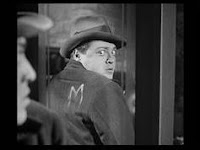
When the balloon seller hears a man whistling Edvard Grieg’s “Hall of the Mountain King” he remembers that a man was whistling the same tune the day of Elsie Beckmann’s murder. He tips off a nearby beggar, who follows Beckert leading a girl into a candy store. After When Beckert throws an orange peel on the sidewalk the beggar pretends to slip on it. Catching Beckert as he slips, he places a “M” on Beckert's shoulder, via his chalked palm. Beckert is now, literally, a marked man. In addition to this, the police have now tracked a postcard sent to the newspaper by the killer to Beckert’s apartment. When they search his room they find clues that link him to the crimes: Ariston cigarettes and a red pencil.

When the little girl he’s about to kill notices the “M” on his back and offers to wipe it off Beckert realizes he’s caught and runs into an office building. Schränker sends his men to search the building. Not knowing what is happening, a night watchman sounds the alarm. Just before the police arrive, the criminals find Beckert and leave the building—all except Franz (Friendrich Gnass), who now becomes the suspect. To save his own skin, Franz tells the police his friends have taken Beckert to an abandoned distillery to stand trial.
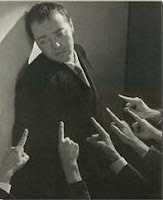
At his trial, Beckert attempts to explain that he can’t be held accountable for his actions because he does them unwillingly. It is an evil inside him that compels him to kill. He utters the classic line, “Who knows what it feels like to be me?" I find it especially interesting that his judges, the criminals, are wearing long leather coats instead of robes—another nod to the Nazi’s? Yet, before the criminals can inflict their brand of justice, the police arrive and take Beckert away. At his “real” trial, crying mothers await the verdict of the killer of their children and one says, “One has to keep closer watch over the children. All of you." No wiser words were ever uttered in Germany in the 1930s!

There are very few German films of the 1930s (with good reason) that capture the sense of doom that looms during this period. Lang uses lighting, specifically chiaroscuro, and high-angle shots to emphasize the evil that looms above. It is a menace that can’t be seen, but that doesn’t mean that it doesn’t exist. It is foreshadowing (literally) at its best.

It is apt that Lang would use Edvard Grieg’s “Hall of the Mountain King” from Peer Gynt to identify Beckert to his victims and the viewers. As this opera is all about identity crisis. I suppose Lang took great pride in the fact that he himself was the actual whistler of this tune, since Lorre couldn’t do it himself.

Finally, the choice of Peter Lorre, with his bulging, sad eyes and strange ability to make sympathetic (and creepy) grimaces, was a wonderful choice for Beckert. This role elevated his career, but also typecast him as the villain for years to come. He, like Lang, had to flee Germany and the Nazis.

A must-see on many levels: cinematic, societal, and historical.


Be sure to check out Kim's new blog 1001 Movies You Must See Before You Die.

Friday, January 15, 2010

A Month of Mysteries: Is Troy Donahue a Psycho in "My Blood Runs Cold"?

While speeding down a coastal highway in her convertible, Julie Merriday (Joey Heatherton) almost runs over motorcyclist Ben Gunther (Troy Donahue). Although Ben is shaken up, he appears to be okay—except that he keeps staring at Julie and calling her Barbara.

Ben eventually reveals that he believes Julie is the reincarnation of her great grandmother Barbara Merriday and that he was Barbara’s lover in a previous life. Ben gives Julie an antique locket with an authentic portrait of Barbara…who looks just like Julie. Ben also seems to know details of the Merriday family history heretofore only known to Julie’s Aunt Sarah (Jeanette Nolan). Are Ben and Julie really reincarnated lovers? Is this a scam perpetrated by someone with intimate knowledge of the family—like Aunt Sarah? Is Ben just plain crazy? But if he is, how does he know so much about Julie’s family?

For most of its running time, My Blood Runs Cold holds its cards closely and functions nicely as a low-budget thriller. Actor William Conrad (TV’s Cannon, radio’s Matt Dillon) directed a lot of TV episodes in the 1960s, but this was one of his few feature films at the helm. He takes advantage of the seaside setting, using the waves and washed-up seaweed, for example, to hide most of the corpse on the beach. He also recognizes that his picture is targeted toward teens and thus doesn’t miss an opportunity to show hunky Troy with his shirt off or shapely Joey Heatherton in a bathing suit.

Heatherton is quite appealing as Julie, often reminding one of Donahue’s frequent co-star Connie Stevens. Her best scene is a conversation with Nolan as Aunt Sarah, in which Julie confesses that she doesn’t know what to do with her life. She wants to do something meaningful and Ben provides her with an opportunity. My Blood Runs Cold turned out to be one of Heatherton’s few films. She fared better as a Vegas entertainer and on USO tours (and TV specials) with Bob Hope.

As for Donahue, it’s easy to see why the role of Ben appealed to him. He had just completed four “soaps” with director Delmer Daves, a teen comedy (Palm Springs Weekend), and a Western directed by Raoul Walsh (the cult pic A Distant Trumpet). In My Blood Runs Cold, he got to headline a contemporary thriller in which it’s not obvious if he’s the hero or the villain. Never a strong actor, Donahue succeeded because of his natural appeal and good looks. He might have developed into a better actor had he been groomed by the studio system. But by the time he came along in the late 1950s, Warner Bros. was content to cast him in anything. He was being overexposed on TV in Surfside 6 and Hawaiian Eye while concurrently starring in films like Parrish and Susan Slade (both 1961).

My Blood Runs Cold isn’t an unknown classic thriller waiting to be discovered. It has its flaws (especially the drawn-out ending), but still works as a consistently interesting B-film with two likable leads. It’s the kind of movie you might have seen as a second feature at the drive-in in the 1960s…and driven home thinking: “That was better than I expected.”

Thursday, January 14, 2010

A Month of Mysteries: "Jagged Edge" is a Movie with Many Edges

Made in 1985, Jagged Edge is one of my favorite mystery/suspense movies. It was directed by Richard Marquand, who is famous for directing Star Wars Episode VI: Return of the Jedi two years earlier. The screenplay was written by Joe Eszterhas who also wrote Basic Instinct in 1992. Many film critics think there is a similarity in the plot between the two films.

Jagged Edge reminds me of a courtroom mystery thriller made during the 1940s. It begins with a woman who is sleeping in a bed in a beautiful beach house. A person dressed in black with a black mask enters her room with a jagged-edged hunting knife. He overpowers her and ties her hands and feet to the bed. Then, we hear her screaming and see the outside of the house.

The murdered woman is Page Forrester, a wealthy socialite who owns a newspaper. The district attorney Thomas Krasny (Peter Coyote) immediately suspects that the victim's husband, Jack (Jeff Bridges), murdered his wife. Krasny is a lawyer who views this high profile case as a step to further his career. He is an interesting character who will stop at nothing to convict Jack.

Teddy Barnes, played by Glenn Close, is the lawyer who decides to defend Jack even though she has not tried a criminal case for four years. Teddy has her reasons for taking the case. She worked with Krasny four years ago. The two of them prosecuted a low-life criminal named Henry Styles for a crime. Teddy learned after Styles was convicted that Krasny knew information that could have proved Styles’ innocence. Teddy quit practicing criminal law because she said nothing about this and Styles went to prison. Krasny sees Teddy having dinner with her ex-husband in a restaurant. He informs her that Styles hanged himself in prison. Krasny hopes this fact will make Teddy feel even guiltier and she will not defend Jack. Instead, it only makes Teddy more determined to defend Jack; she views proving his innocence as a way to right the wrong done to Styles.

Teddy tells Jack she will not defend him unless she believes he is innocent. Jack is a clever man and convinces her that he truly cared for his wife. As the plot progresses, we see Teddy falling in love with Jack. They begin having an affair even though Teddy knows it is unethical. Teddy works with an investigator named Sam Ransom, played by Robert Loggia (who has the best lines in the movie). He is a crusty foul-mouthed investigator who warns Teddy about her relationship with Jack. He tells her he thinks Jack murdered his wife. Teddy defends Jack.

As the trial progresses, facts appear that make Jack look less guilty. Page Forrester’s best friend is put on the witness stand by Krasny. She tells the jury that Page was going to divorce her husband. Krasny points out that Jack Forrester is the sole beneficiary of his wife’s will and if his wife had divorced him, he would lose everything. Teddy questions the wife’s best friend and has a letter written by her saying how much she wanted Jack to become her lover—then an unexpected twist occurs. A note written on a 1942 Corona typewriter sent to Teddy suggests that a similar murder may have been attempted on another woman four months earlier. Teddy finds the intended victim, who tells the jury about her attacker. The attack and her attacker fit the murder of Page Forrester, throwing doubt onto another man. Will this latest revelation sway the jury?

I won't divulge the rest of the plot because it would ruin the ending. There is another twist and the climax of Jagged Edge is an absolutely stunning surprise. The last line in the movie, said by Sam Ransom, is just priceless--it's one you will remember forever.

The plot is carefully developed with intricate details. The viewer goes from thinking Jack is guilty to Jack is innocent several times. Is Teddy being fooled by Jack and his charm or is Jack really in love with her as she is with him? Will the two be happy forever in the end of the film? You will have to watch and see for yourself.

Robert Loggia was nominated for Best Supporting Actor in 1985. He didn’t win, but I think he should have. John Barry composed the haunting music. Barry is famous for composing many scores, including the ones for the James Bond movies. The 1942 Corona typewriter used in the movie was the same one that Joe Eszterhas used in writing the screenplay. I am a Star Wars fan so I have to mention this fact. When the ex-husband goes into his son and daughter’s bedroom to kiss them good night, there is a movie poster on the back of the bedroom door of Star Wars Episode VI: Return of the Jedi, which, as previously mentioned, was also directed by Marquand.

If you watch this movie, play close attention to all the details and events that occur. That is the most interesting and fascinating thing about it.

Wednesday, January 13, 2010

A Month of Mysteries: Murder Comes Ringing in "The Nine Tailors"

The quaint English town of Fenchurch St. Paul hardly seems like the proper place for two connected crimes—involving the theft of an emerald necklace and a mutilated corpse—committed over a decade apart. But then, there are many surprises awaiting mystery fans in the BBC’s 1974 adaptation of Dorothy L. Sayers’ The Nine Tailors.

Sayers wrote eleven novels and several short stories between 1923 and 1939 featuring Lord Peter Wimsey, a well-to-do amateur detective, assisted in sleuthing by his butler Bunter. Peter Haddon played Wimsey in the now-obscure 1935 British film The Silent Passenger and Robert Montgomery was the aristocratic detective in 1940’s Haunted Honeymoon (which Sayers refused to see). Edward Petherbridge played a married Wimsey in three limited-run television series in the late 1980s. But the most famous of all Wimsey interpreters is Ian Carmichael, who starred in The Nine Tailors and four other BBC Wimsey mysteries that played stateside on Masterpiece Theater: Clouds of Witness (1972); The Unpleasantness at the Bellona Club (1973); Murder Must Advertise (1973); and The Five Red Herrings (1975). All five adaptations are first-rate television, but my favorite is The Nine Tailors.

The first of the four 50-minute episodes is an extended prologue set on the eve of World War I that finds Lord Peter subbing for his brother, the Duke of Denver, at the Thorpe family wedding in Fenchurch St. Paul. That night, an emerald necklace worth over 60,000 pounds is stolen from Mrs. Wilbraham, a wedding guest. The culprits, the Thorpe’s butler and a professional jewel theft, are captured quickly—but the necklace is never found. Learning that the insurance policy has lapsed, Mr. Thorpe reimburses Mrs. Wilbraham for the cost of the necklace, an honorable act that brings near-financial ruin on the family.

Over a decade later, Lord Peter and Bunter get stranded in the countryside when their auto slides off an icy road while en route to a Wimsey family New Year’s gathering. The nearest town turns out to be Fenchurch St. Paul, whose residents are coping with an influenza outbreak. Lord Peter and Bunter spend the night at the home of the local vicar, who now lacks enough healthy men to set a new record by ringing the church bells for nine hours. Lord Peter professes some knowledge of bell ringing and steps in to assist. When he and Bunter depart the following day, they learn that Mrs. Thorpe (the bride from the earlier wedding) has died from the flu. When her husband also dies a few months later, an unidentified man’s corpse is discovered in Mrs. Thorpe’s grave…the face has been mutilated and the hands removed. Needless to say, that brings Lord Peter back to Fenchurch St. Paul for his third and final visit.

The unraveling of the multiple mysteries in The Nine Tailors keeps the series engrossing from start to finish. Some Sayers enthusiasts argue that one of the twists is revealed in the prologue. While that’s true, it doesn’t detract from the main questions: Where is the emerald necklace? Who killed the victim, why, and how? It’s the “how”—revealed in the final ten minutes of the series—that make The Nine Tailors both memorable and satisfying.

Carmichael sparkles as Lord Peter, capturing both his upper crust manner and his genuine concern for others. If there’s a quibble with The Nine Tailors, it’s that Glyn Houston, as Bunter, has less to do than in other adaptations in the series. On the bright side, the prologue includes a couple of rewarding scenes between Major Wimsey and Sergeant Bunter during the war. Plus, it also explains how Bunter came to work for Lord Peter.

The BBC produced some of its finest productions in the 1970s, to include Upstairs, Downstairs, The Pallisers, Poldark, and I, Claudius. All of these series exhibited first-rate production values and impeccable casts (including many London stage veterans). The Lord Peter Wimsey series is another fine representative of the BBC’s “Golden Era.” So, brew yourself a cup of stout tea (with sugar and milk), grab some biscuits (cookies for us Yanks), and cozy up for a classic Lord Peter Wimsey mystery. (By the way, the title has nothing to do with tailors!)

Thursday, January 7, 2010

A Month of Mysteries: Niagara (1953)

Niagara (1953) thriller/noir. Directed by Henry Hathaway. Niagara was filmed in Technicolor instead of black and white, like most of the film noirs of the 50s. Cast: Marilyn Monroe, Joseph Cotten, Jean Peters. Along with Gentlemen Prefer Blondes and How to Marry a Millionaire, it helped Monroe become a star.

The film begins when businessman Ray Cutler wins a trip to Niagara Falls. Ray and his wife arrive to find that their reserved cabin has not been vacated by George and Rose Loomis. Rose tells the motel manager and the Cutlers that her husband has not been feeling well and asks them not to wake him, so the Cutlers take another cabin. Rose also confides that George had spent time in a military psychiatric hospital.

On a walk, Polly accidentally sees Rose in the arms of another man at Horseshoe Falls.

In one of my favorite scenes: Back at the motel, Rose, in a sexy hot pink dress, asks some teenagers to play a record of her favorite song, "Kiss." George in a rage storms out of their cabin and smashes the record. Rose tells the Cutlers that George has a bad temper. While Polly tends to George's cut hand, George tells her that he loves Rose, but she is a tramp. Ray joins them, and George says that he gave up his farm because Rose was bored with country life, then volunteered for duty in Korea. He was sent home early with battle fatigue and discovered Rose was having an affair.

In the meantime, Rose calls her lover Ted Patrick, and tells him that they "must put their plan to kill George into action in the morning." Ted agrees. The next day, George, thinking something is up, follows Rose when she goes to buy bus tickets for their trip home. Rose knows she is being followed.. She ducks into the Horseshoe Falls gift shop and loses George. After leaving Rose a card telling her that if things go well, the bell tower will play "Kiss," Ted follows George. Later in the day, Rose asks Polly and Ray if they have seen George. The Cutlers file a missing persons report.  Later that day, the attendant at the Horseshoe Falls finds one rain slicker and one pair of shoes is missing. He informs Inspector James Starkey. Starkey asks Rose and the Cutlers to go with him, where Rose identifies the shoes as George's. While Rose is walking home, she hears the bell tower playing "Kiss" and smiles. Soon, the police discover a body along the shore and ask Rose to identify it.

Will Rose and Ted get away with murder?

This is one of my favorite noir movies. It has Marilyn Monroe and beautiful Niagara Falls for breathtaking scenery. Marilyn's performance as the bad girl was amazing. I do not think any other actress could have done a better job with Rose's character.

Monday, January 4, 2010

A Month of Mysteries: The Falcon and the Co-Eds

I love mysteries and films with clever settings. The Falcon and the Co-Eds (1944) offers both in one 67-minute RKO movie. The Falcon, otherwise known as Tom Lawrence (and portrayed by Tom Conway), is entreated to visit Bluecliff Seminary, an all-girls’ school, where a male instructor has died. A student named Jane Harris, the daughter of a friend of the Falcon, seeks him out and tells him that her psychic roommate, Marguerita Serena, said the teacher was murdered. The police arrive as she drives off in the Falcon’s car, knowing he will have to come out to the school to retrieve it.

At the little town just outside where Bluecliff is located, the Falcon meets three fun young girls, who are the daughters of the caretaker at the school, and rides in with them in the school car. They provide information and legwork for the Falcon and some comic relief for movie watchers. The credits refer to them as the first, second, and third Ughs but these talented young ladies sing as well as act.

The story focuses on the young psychic, three members of the faculty (played by Jean Brooks, Isabel Jewell, and George Givot), and the headmistress Miss Keyes (Barbara Brown). The ivy-covered buildings are charming but it is the seaside setting, complete with the Devil’s Ladder cut out from the rocks and leading to a narrow ledge that lends intrigue and provides the perfect place for the film’s climax.

Technically, Tom Conway took over the reel part of the Falcon’s brother from his real-life brother George Sanders, who is reported to have fatigued with the B-movie role. Conway first appeared in The Falcon’s Brother (1942) and then in nine additional offerings where he was referred to as simply the Falcon.

Jean Brooks appeared as different characters in six Falcon offerings. She and Isabel Jewell appeared together again in The Leopard Man, written by Ardel Wray, who also did the story and screenplay for The Falcon and the Co-Eds. Two of the Ughs were sisters and also appeared in The Falcon in Mexico.

Sunday, January 3, 2010

A Month of Mysteries: Who Is Murdering the People on "The List of Adrian Messenger"?

John Huston’s 1963 mystery is best known for its gimmick: several famous stars make cameos in heavy make-up. While trying to spot the stars is undeniably fun, the gimmick disguises the fact that The List of Adrian Messenger is a highly-entertaining, crafty film that starts as a mystery and evolves into a suspenseful cat-and-mouse game.

At the Gleneyre estate In England, author Adrian Messenger (John Merivale) provides a list of ten names to his friend Anthony Gethryn (George C. Scott), a former MI5 operative. Messenger, acting both concerned and mysterious, asks Gethryn to quietly find out if the ten people on the list are still alive. Gethryn agrees to undertake the assignment. A few days later, a bomb explodes aboard a plane carrying Adrian as a passenger. Everyone dies in the crash, except for a Frenchman called Raoul Le Borg (Jacques Roux), who hears Messenger’s final words as they drift together in the icy ocean.

When Gethryn learns that most of the men on Messenger’s list are dead, he surmises that the plane crash was designed to kill his friend. He interviews Le Borg, who recalls Adrian’s last words before dying...but they don’t make sense. Was Adrian trying to leave an important message in code with his final breath? What’s the connection between the men on Messenger’s list and why is someone murdering each of them?

Gethryn solves the mystery with a third of the film’s running time remaining. The action then shifts back to Gleneyre—home of the wealthy Bruttenholm (pronounced “broom”) family—as Gethryn tries to outfox the killer, who has now also arrived on the scene.

Based on a 1959 novel by mystery author and screenwriter Philip MacDonald, The List of Adrian Messenger borrows the killer’s motive from another famous detective novel (no spoilers here!). But the “why” is only part of the fun in The List of Adrian Messenger. It’s the “how” that differentiates it from other mysteries. Among his many skills, the murderer is also a master of disguises, which provides the opportunity for Kirk Douglas to don a number of incredible “looks” designed by make-up master Bud Westmore. Thus, the killer appears as a pointy-chinned priest, a short mousey man, a white-haired elderly villager, and others.

George C. Scott grounds the story with a finely-etched portrait of a man just past his prime professionally, who realizes he will only be friends with the woman he loves. One wonders if Gethryn’s zeal in solving Adrian’s murder can be partially attributed to the fact that it provides a mental challenge for the former espionage agent. Gethryn even notes his admiration for the killer’s cleverness at one point. It’s a shame that Scott didn’t appear in additional films as Gethryn (MacDonald wrote 12 novels with the character; The List of Adrian Messenger was the last one).

Though the film would have worked just fine on its own merits, there’s no denying that the guest star cameos are amusing. Look closely and see if you can spot the heavily-disguised Tony Curtis, Frank Sinatra, Burt Lancaster, and Robert Mitchum (an easy one…he looks like an old Bob Mitchum). After the closing credits, each actor removes his disguise. According to some sources, other actors played the disguised characters in one or two scenes. I’m not sure about that, but some of the voices are definitely dubbed. Allegedly, Elizabeth Taylor turned down the chance to do a cameo because the make-up was so time-consuming.

There are other pleasures to be gained from The List of Adrian Messenger. Director John Huston keeps the plot moving quickly and does a wonderful job of foreshadowing (e.g., watch carefully and you can guess how the killer will meet his end). Jerry Goldsmith’s terrific music score is both playful and disturbing. And the English country setting provides the ideal backdrop for a climax that culminates in a fox hunt.

So, while you may enjoy the gimmicky guest stars in The List of Adrian Messenger, you’ll remember it for being a smart, inventive mystery. Maybe that’s why it’s one of those films that’s fun to watch over and over.