Showing posts with label book reviews. Show all posts

Monday, May 23, 2022

Book Review: The Films of Delmer Daves by Douglas Horlock

At long last, the career of Delmer Daves, one of Hollywood's most under-appreciated filmmakers, has received an in-depth, scholarly treatment courtesy of Douglas Horlock's The Films of Delmer Daves: Visions of Progress in Mid-Twentieth Century America (University of Mississippi Press, 248 pages). Horlock examines Daves's films through the lens of political and social values, race and civil rights, and gender. He also provides an overview of Daves's life and career, painting the portrait of a screenwriter and director who crafted his own vision within the confines of the Hollywood studio system.

Daves became interested in acting, writing, and directing theater while studying law at Stanford University. His initial foray into the film industry was as a property assistant on The Covered Wagon in 1924. After graduating from Stanford in 1927, he pursued his interest in movies and received credit for his first screenplay with 1929's So This Is College. Over the next decade, he carved a highly successful career as a screenwriter with films such as Dames (1934), Flirtation Walk (1934), an adaptation of The Petrified Forest (1936), and Love Affair (1939). 

Delmer Daves.
Daves's career took a different turn in 1943 when, after co-writing the screenplay for the World War II drama Destination Tokyo, Warner Bros. executive Jack Warner "ask(ed) an initially reluctant Daves to accept his first directorial assignment." Over the next two decades, Daves became one of the most reliable and successful writer-directors for Warner Bros. Horlock points out that Daves's films Destination TokyoHollywood Canteen, Broken Arrow, 3:10 to Yuma, A Summer Place, and Spencer's Mountain were "among the top-grossing films of their respective years." Daves also showed his versatility by working comfortably in genres such as Westerns, Biblical epics, romances, and family dramas.

Yet, Horlock notes that "Daves has remained largely overlooked in scholarly literature and film retrospectives" and has not achieved the auteur status attributed to directors such as Alfred Hitchcock, John Ford, Samuel Fuller, and even Douglas Sirk (whose glossy 1950s melodramas are comparable to Daves's later films A Summer Place and Parrish). Yet, like Hitchcock, Daves was intimately involved in the screenplays for his films, even those with which he did not receive a writing credit. Horlock traces recurring themes in Daves's films in chapters devoted to political and social values, race and civil rights, and gender. Horlock also includes this insightful comment from actor Glenn Ford, who worked with Daves on 3:10 to Yuma, Jubal, and Cowboy"Nothing happened in a Delmer Daves film that wasn't intentional, from the camera set-ups to the wardrobe."

Delmer Daves's The Hanging Tree (1959).
Horlock's most engrossing chapter is the one in which he analyzes gender in Daves's films, focusing on the filmmaker's use of strong, independent female characters. Horlock provides a number of excellent examples. In A Summer Place, Molly (Sandra Dee) defies her domineering mother by spending time with Johnny (Troy Donahue). In the 1959 Western The Hanging Tree, one of Daves's finest films, Elizabeth (Maria Schell) seeks independence after being rejected by the man (Gary Cooper) she loves. She forms a partnership with two other men to dig for gold and impresses them with her work ethic. Even in the romantic travelogue Rome Adventure, Suzanne Pleshette plays a young woman who defies a school board and then goes traveling in Italy on her own.

As befits its subtitle, The Films of Delmer Daves: Visions of Progress in Mid-Twentieth Century America is a scholarly volume for movie fans interested in thoughtful analyses. Still, that's not to say it isn't filled with fascinating facts (e.g., Warren Beatty was the original choice for the title role in Parrish, Daves's admirers include Humphrey Bogart, Alan Ladd, and Gary Cooper). At one point in his book, Horlock states: "Despite his working within the confines of a restrictive studio system, Daves's films deserve to be examined as the work of a serious artist of the cinema." That is exactly what the author has accomplished with his new book.

Monday, July 12, 2021

Michael Asimow Discusses His New Book on Truth and Trickery in Courtroom Movies

What movie fan doesn’t love a good courtroom drama?

In Real to Reel: Truth and Trickery in Courtroom Movies, co-authors Michael Asimow and Paul Bergman dissect over 200 movies that “take place in a courtroom, defined broadly enough to include pretrial discovery, plea negotiations, jury deliberations and appellate court arguments.” Michael Asimow is a professor at Santa Clara Law School and a professor of law emeritus at UCLA Law School. Paul Bergman is a professor of law emeritus at UCLA Law School.

The films in their book range from classics like To Kill a Mockingbird to fact-based dramas (Judgment at Nuremburg), comedies (My Cousin Vinny), and intriguing lesser-known fare such as Never Take Candy from a Stranger. Each film review includes a synopsis, an analysis of the courtroom events that “distinguishes truth from trickery,” and production notes. The authors also provide extensive details on the actual cases that served as the basis for fact-inspired films.

We had the opportunity to recently discuss Real to Reel: Truth and Trickery in Courtroom Movies with co-author Michael Asimow.

Café:  What inspired you and your co-author Paul Bergman to embark on the fascinating endeavor of analyzing the courtroom scenes of over 200 movies from their legal and ethical perspectives?

Michael Asimow:  Paul and I love old movies and we love the law. We’ve had long and great careers as law professors. And we thought we’d bring our passions together by providing a guidebook to courtroom movies. It will enable our readers to find courtroom movies from the 1930s to the present that they’ve never seen or to revisit the ones they saw years ago. We provide a rating scheme (of one to four gavels) for each film to help readers select the best ones. We hope our discussions will help answer the questions viewers might have after watching the films. 

Café:  Aside from tracking down all the movies, what was the most challenging aspect of writing Real to Reel: Truth and Trickery in Courtroom Movies?

Michael Asimow:  One challenge was to provide a gentle analysis of the films that would be fun for non-lawyer readers to think about without getting too technical, yet not oversimplifying serious issues. Another big challenge was dealing with "reality." Of course, courtroom films aren’t "realistic." If they were, they would last for eight days and be indescribably boring. These films aren’t documentaries, they are entertainment vehicles. Filmmakers have to select the best bits of the trial process and make them as dramatic as possible. We don’t want to criticize the filmmakers for taking those necessary shortcuts, yet we wanted to let readers know when the films depart too far from courtroom procedures or legal ethics. That was a serious challenge. 

Café:  Based on your analyses, which movies feature the most believable lawyers or do the best job of presenting a case realistically?  

George C. Scott and Lee Remick in Anatomy of a Murder.
Michael Asimow:  Our all-time favorite is Anatomy of a Murder (1959), the classic film starring Jimmy Stewart and George C. Scott. Almost all of it is a gripping murder trial, with two great lawyers going after each other, full of twists and turns and with an ambiguous ending. Watch this movie—you’ll be amazed at how good it is.  

Café:  I know you teach a course on "Law and Popular Culture," but have you ever used a movie’s courtroom scene to emphasize a point or stimulate discussion in other law school courses?

Michael Asimow:  Oh, sure. Paul uses courtroom scenes in teaching evidence and trial practice and I use them in teaching contract law. When students see the great actors entangled in legal problems and procedure, they remember it long after they’ve forgotten what the professor said. 

Café:  One of the most interesting aspects of your book is where you describe the actual cases behind fact-based films such as Compulsion, Inherit the Wind, and Marshall. What are your favorite fact-based courtroom dramas and why?

Humphrey Bogart in Marked Woman.
Michael Asimow:  So many of the films we discuss are based on actual trials like the three ones you name. We love the recent ones like The Trial of the Chicago 7 (2020), which is closely based on the famous Chicago conspiracy case of 1969, and Denial (2016) which retells the story of Holocaust-denier David Irving’s libel suit against historian Deborah Lipstadt who had called him out. But some oldies are equally good. Marked Woman (1937) is based on the trial in which crusading prosecutor Thomas Dewey puts away gangster Lucky Luciano, who controlled New York rackets and prostitution.   

Café:  You note that the lawyers in many films violate certain principles of law or ethics—such as when James Stewart’s defense attorney coaches the defendant (Ben Gazzara) in Anatomy of a Murder. Are you surprised that more movies don’t have legal experts who review the screenplays for inaccuracies?  

Michael Asimow:  They often have experts, but filmmakers love ethical dilemmas. These aren’t inaccuracies, they are deliberate attempts to tell great stories. We try to identify ethical lapses in our discussions, but we don’t criticize the filmmakers for putting them there. Lawyers often find themselves in terrible ethical positions as in And Justice for All (1979), in which lawyer Arthur Kirkland (Al Pacino) is stuck with a client who confesses his guilt, but insists that Kirkland give him a full defense complete with testimony that Kirkland knows will be perjured. 

Café:  What are your five favorite courtroom movies and why?

Paul Newman in The Verdict.
Michael Asimow:  It’s a tough call as there have been so many great ones. Besides Anatomy of a Murder, which we already talked about, I’d have to choose: Witness for the Prosecution (1957), which has the best twist ending; To Kill a Mockingbird (1962) which will tear your heart out; My Cousin Vinny (1992) which is by far the best comedy; The Verdict (1992) for best lawyer epiphany; and A Few Good Men (1992) for best military justice movie and terrific cross-examination.  

Café:  You’ve also written Lawyers in Your Living Room: Law on Television, so I must ask your opinion on one of my favorite legal shows: The Defenders.

Michael Asimow:  Me too! The Defenders (1961-65) involved a father and son law firm (played by the great E.G. Marshall and Robert Reed). Each week they took up another big social or legal problem and framed it in the context of a trial.  Some especially memorable shows concerned the anti-Communist blacklist, defending Nazi protestors, and abortion. The first season of The Defenders is available on DVD.  Well worth watching! 

Café:  Thank you so much, Michael, for taking the time to talk with us.

Michael Asimow:  My pleasure, Rick!  

You can purchase Real to Reel: Truth and Trickery in Courtroom Movies from booksellers such as Amazon.

Thursday, April 27, 2017

Book Review: Opening Wednesday at a Theater or Drive-In Near You

Subtitled The Shadow Cinema of the American '70s, Charles Taylor's new book contains sharply-written essays on fourteen "B" classics from what he calls "the third--and, to date, last--great period in American movies." I'll just say upfront that any book that praises Walter Hill's under-appreciated Depressive-era drama Hard Times is going to get a good review from me.

In his introduction to these films, Taylor points out that, unlike the blockbusters that dominate today's screens, these 1970s pictures captured the "small towns, gas stations, and two-lane highways" (e.g., Vanishing Point, Two Lane Blacktop) and the "seamy views of American cities" (e.g., Prime Cut, Hickey & Boggs). There's a genuine grittiness in these pictures, almost as if one can feel the grain on the film stock.

Lee Marvin in Prime Cut.
Taylor's best essays focus on movies featuring two of the most iconic stars of their era: Lee Marvin and Charles Bronson. In Prime Cut (1972), Marvin plays a Chicago mobster sent to the Midwest to settle a debt. The joke, notes Taylor, is that a "big-city mob enforcer is in much more danger in the Kansas City heartland than any Kansan would be in Chicago." The film's real villain is a slaughterhouse owner named "Mary Ann" (Gene Hackman), who sells women and makes sausage out of his enemies. Yet, these atrocities are performed against a backdrop of "county fairs...amber waves of grain, (and) white clapboard houses in the beautiful countryside." Prime Cut is not an easy film to watch, but Taylor makes a convincing case that it's a film true to its convictions and characters.

Bronson in Hard Times.
In Hard Times (1975), Charles Bronson plays a Depression-era drifter in New Orleans who earns money by participating in bareknuckle fights arranged by small-time hustler James Coburn. Taylor not only recognizes Hard Times as a quietly efficient "beautifully directed film," he also sings the praises of the underrated Charles Bronson. He notes: "Throughout his film career, Bronson was most at home in the realm of the stoic and the taciturn. But at least until the success of Death Wish trapped him in one vigilante role after another, he possessed an instinctive sense of how the camera magnifies gestures and changes of expression."

It's these insights that make Opening Wednesday at a Theater or Drive-In Near You a quick, absorbing read. Some of the other films reviewed include: Foxy Brown and Coffy (a Pam Grier double-feature!), American Hot Wax, Ulzana's Raid, Winter Kills, and Eyes of Laura Mars.

Opening Wednesday at a Theater or Drive-In Near You: The Shadow Cinema of the American '70s is 199 pages and contains no photos. It was published by Bloomsbury USA, which provided a courtesy copy for this review.

Monday, July 6, 2015

Book Review: The Making of "The Magnificent Seven"

In his new book The Making of The Magnificent Seven: Behind the Scenes of the Pivotal Western, author Brian Hannan provides a fascinating look into how the 1959 Western classic reached the silver screen. He also makes a compelling argument that John Sturges' remake of Akira Kurosawa's Seven Samurai should take its place alongside the more critically-acclaimed Westerns made by John Ford and Howard Hawks.

Hannan divides The Making of The Magnificent Seven into three parts: (1) the "movie's long genesis"; (2) the actual production and an analysis of the film; and (3) a brief discussion of its release and enduring appeal. The most engrossing chapters are those that deal with its production history.

"It was Anthony Quinn's idea," writes Hannan in his book's first chapter. That alone is likely a revelation to most of the film's fans. Quinn saw Seven Samurai in 1956 and came up with the idea to remake it as a Western. He mentioned it to Yul Brynner as a possible starring vehicle for the two of them. Over the next three years, The Magnificent Seven's journey to the screen would take many unexpected twists along the way.

Hannan meticulously charts Brynner's rise to stardom and his desire to direct. Originally, the actor was set to direct and star in The Buccaneer (1958). In fact, according to a Variety article (quoted by Hannan), Brynner wanted to pull out of the film as its star and only direct, "but DeMille wouldn't have it." Ironically, Anthony Quinn, who was DeMille's son-in-law at the time, was credited as director (although how much he directed vs. DeMille has been debated).

The Spanish poster emphasizes
the numeral "7."
Brynner's and Quinn's plans for The Magnificent Seven hit a major snag when the two discovered that screenwriter Lou Morheim had already bought the remake rights for $2,500 in 1957. Brynner's production company eventually negotiated a deal with Morheim for the rights (the latter is listed as an associate producer in the credits of The Magnificent Seven). Quinn was still interested in starring in the Western, but his salary and billing demands were too great. He eventually dropped out of the production.

Hannan goes to on to explain how John Sturges became attached as director, how the script was penned by six (or seven!) screenwriters, and how one of cinema's greatest casts was assembled. The author notes that the "final piece of 'casting'...was the recruitment of Elmer Bernstein to write the score." Amazingly, Bernstein was not the first choice as the film's composer. He joined the project after Dimitri Tiomkin, Aaron Copeland, and Alex North were considered and rejected.

Hannan's analysis of The Magnificent Seven focuses largely on Sturges' directorial style and a discussion of the film's themes ("Men in professions which cannot change are forced into inevitable collision with an altered world--that, in a nutshell, is the proposition of The Magnificent Seven").

Hannan says McQueen removes his
hat 9 times--to draw attention.
I don't agree with the author's assessment that The Magnificent Seven marked the end of the Ford/Hawks Western era and "sowed the seeds for the films of Sergio Leone, Sam Peckinpah, and Clint Eastwood." The 1950s Westerns of Anthony Mann, Budd Boetticher, and Delmer Daves had already paved that road. And while it's a stretch to state that "The Magnificent Seven can certainly lay claim to being the most loved Western," there is no doubt that it remains one of the most popular (as evidenced by its frequent TV broadcasts).

The Making of The Magnificent Seven (McFarland & Company, 277 pages) contains numerous photos, extensive footnotes, a bibliography, and an index. Its strongest virtue is the detailed history of the production. For that reason, we strongly recommend it for fans of The Magnificent Seven. It will also be an engrossing read for any film buff interested in the convoluted processes that go into the making of a movie.

McFarland & Company, Inc. provided a review copy of this book.

Friday, March 14, 2014

From the Cafe's Bookshelf: "Hollywood Surf and Beach Movies"

Fans of the Beach Party movies and other 1960s surfing flicks will find no better spring break reading than Thomas Lisanti's Hollywood Surf and Beach Movies: The First Wave, 1959-1969. Originally published in 2005 and reprinted as a paperback in 2012, Lisanti's book provides a comprehensive look at the genre from Gidget (1959) to The Sweet Ride (1969). While other books have covered these films in the context of 1960s pop culture, Hollywood Surf and Beach Movies goes behind the scenes with production details provided by veteran stars such as Shelley Fabares and Jody McCrea.

Sandra Dee and Cliff Robertson
in Gidget.
Hollywood Surf and Beach Movies is divided into three parts: an introduction; entries on each of the 32 films covered; and biographical sketches of selected performers. The introduction provides an historical overview, starting with Frederick Kohner's novel Gidget, which was based on his teenage daughter Kathy's obsession with surfing. Beginning the film version of Gidget, Lisanti traces the evolution of the beach movie genre and the influence of films such as Where the Boys AreBeach Party, and The Endless Summer.While the author states that his "book does not contain in-depth analyses about the films in terms of their cultural importance," his introduction nonetheless offers insight into what made them popular and why they faded by the end of the decade.

Still, the focus of Hollywood Surf and Beach Movies is on the individual movies. For each film, Lisanti lists the complete credits, describes the plot, provides quotes from reviews, and--best of all--takes the reader behind the scenes for fascinating trivia, such as:
  • The Beach Party series almost starred Fabian and Sandra Dee instead of Frankie and Annette.
  • American International Pictures originally intended Bikini Beach for the Beatles--until the band's appearance on The Ed Sullivan Show made their salaries too costly.
  • Nancy Sinatra was first offered the role of Sugar Kane (played by Linda Evans) in Beach Blanket Bingo.
  • Neil Sedaka and Howard Greenfield wrote two title songs for Where the Boys Are. The version they and Connie Francis preferred was not the one selected by producer Joe Pasternak. The Pasternak-preferred song became a huge hit, of course, and Connie's signature song.
Lisanti quotes frequently from many of the performers who appeared in these movies, particularly Jody McCrea, Aron Kincaid, and Luree Nicholson (daughter of AIP co-founder James H. Nicholson). Although the genre's biggest stars--Frankie and Annette--did not participate in interviews for the book, they are liberally quoted from other sources. McCrea offers an interesting perspective on his co-stars: "I got along very well with Frankie and Annette because I left them alone. They always had many lines to memorize or songs to sing. I just concentrated on my part and didn't fraternize with either of them at all."

Jody McCrea and Mary Hughes.
The comprehensiveness of Lisanti's film coverage is commendable. He does a fine job highlighting lesser-known films of interest such as The Girls on the Beach, A Swingin' Summer, and cult fave Ride the Wild Surf. Indeed, the only obvious omission is the Troy Donahue-Stefanie Powers 1963 romp Palm Springs Weekend. While it doesn't take place at a beach, it certainly fits within the genre. Plus, Lisanti does includes other non-beach efforts like the aforementioned A Swinging' Summer (Lake Arrowhead) and Ski Party (and its imitators).

In the third section of Hollywood Surf and Beach Movies, Lisanti profiles "a select number of actors and actresses who made their marks in...the genre." It would have been helpful to include the criteria for selection, for there are some notable omissions, to include: Harvey Lembeck, Bobbie Shaw, Dwayne Hickman, Timothy Carey, and Donna Loren. These performers are mentioned throughout the book, so it's not as if the author ignores them. It's just that their contributions to beach movies seems as notable as profiled performers Kincaid, Ed Garner, and Peter Brown (who only appeared in one surf movie).

Still, such criticisms amount to mere quibbles. With an exhaustive bibliography, an index, and 96 photos, this 456-page reference volume is highly recommended for fans of the beach movie genre and for libraries with extensive film book collections. So, the next time you head to the beach, be sure to grab your surfboard, your sun tan lotion, some Beach Party DVDs, and a copy of Hollywood Surf and Beach Movies!

McFarland & Company, Inc. Publishers provided a review copy of this book.

Wednesday, October 9, 2013

A Review of "Star Trek: The Art of Juan Ortiz"

As the holidays approach, the Cafe's staff is always on the lookout for unique gift ideas for classic film and TV fans. A great recent find, Star Trek: The Art of Juan Ortiz, is sure to delight fans of the original Star Trek TV series. In his oversized 112-page book, Ortiz has designed a poster for each of the 80 episodes of Gene Roddenberry's 1966-69 series. While the majority of the posters are done in a movie style, some of them replicate the look of pulp novel covers, comic books, and advertisements.

One of my favorites (shown below) is the poster for the season one episode "Arena," which pits Captain Kirk against a reptilian alien in a potential battle to the death. Note the discoloration around the edges to give the impression that the poster was originally created in the 1960s.
In the book's introductory interview, Ortiz describes his approach to the posters: "Star Trek was many things. It wasn't just a show about science fiction. Episodes ranged from war, love, horror, court dramas, death, mental illness, politics, social issues, and of course the Western theme, to name just a few. Therefore, I was able to approach each poster with its own take, without feeling as though I were repeating myself."

At the back of the book, Ortiz includes a brief commentary about each poster, in which he describes his influences or intent. For the season one episode "What Are Little Girls Made Of?", his inspiration was the episode's two androids: the imposing Ruk (played by Ted Cassidy) and the beautiful Andrea (Sherry Jackson). "I thought a bit about Frankenstein while working on this one," writes Ortiz. "I like how Ruk and Andrea form a singular silhouette."
At a suggested retail price of $39.95, Star Trek: The Art of Juan Ortiz is not an inexpensive book. Still, it's a must-have for fans of the original series. The posters are stylish, colorful, clever, and suitable for framing (though you'd have to cut up your book!). Any trekker would beam it aboard his or her starship without hesitation.

Titan Books provided a review copy of this book.

Monday, July 22, 2013

From the Café's Bookshelf: "My Lunches With Orson"

The most addictive film book in recent memory, My Lunches With Orson portrays Orson Welles at his unvarnished best during his twilight years. From the cinematic splendor of Citizen Kane to his Paul Masson wine commercials, Welles was always an enigma--a brilliant filmmaker, theater producer, and actor who appeared in his share of dreadful movies (e.g., 1967's Casino Royale) and even considered a Love Boat appearance. This new book, edited by Peter Biskind, consists of highlights of recorded conversations between Welles and independent filmmaker Henry Jaglom between 1978 and 1985. Talking off the record, Welles provides rare insights into his own works, amusing anecdotes, frank assessments of other films and performers, and the reasons why some of his projects never came to fruition.

In his pithy introduction, Biskind describes how Welles and Jaglom met while the latter was writing and directing his first film, 1971's A Safe Place. After learning from mutual friend Peter Bogdanovich that Welles was in NYC, Jaglom tried to convinced his filmmaking idol to appear in his debut film. Jaglom piqued Welles' interest by offering him a role as "The Magician" (Welles was fascinated with magic in his youth). After several questions, Welles asked his most important one: "Can I wear a cape?" When Jaglom responded yes, Welles agreed to appear in the young man's film.

The two men reconnected in 1978 when Jaglom ran into Welles at Ma Maison, a French restaurant in West Hollywood. Welles and Jaglom met almost weekly for lunch for the next seven years, until Welles' death in 1985. With Welles' permission, Jaglom began recording the conversations in 1983 and those discussions are the basis for My Lunches With Orson. The conversations are not 100% Welles; editor Biskind notes that he added or subtracted phrases "for the purpose of making the conversations more concise and intelligible" and that he altered some of Welles' comments "with an eye to furnishing context."

Readers who expect a series of in-depth interviews focusing on Welles' films, like Francois Truffaut's Hitchcock, will be disappointed. These are literally "lunch conversations" that jump from topic to topic--it just happens that one of the men talking ranks with the greatest filmmakers in cinema history. A running thread throughout the conversations is Welles' inability to gain financing for a new film. By this point in his career, his friend Jaglom had also become his de facto agent.

With Jaglom's encouragement, Welles wrote a screenplay for a political drama called The Big Brass Ring. He even secured $8 million in financing with a guarantee of total control of the film. There was just one caveat: He had to get a major star--from a list of "six or seven A-list actors" to agree to play the lead. Unfortunately, Welles was rebuffed, for various reasons, by Robert Redford, Clint Eastwood, Burt Reynolds (!), and even his friends Warren Beatty and Jack Nicholson. (Interestingly, The Big Brass Ring was eventually made in 1999 by another director, with a revised screenplay, and starring William Hurt.)

Although the conversations portray Welles as a frustrated artist, he rarely sounds bitter. That doesn't mean that he holds back on his assessments of other films and performers. His unadorned comments are surely the most entertaining aspects of My Lunches With Orson. Here's a sample:

Joan Fontaine: "She's just a plain old bad actor. She's got four line readings, and two expressions, and that's it."

John Ford: "I recently saw what I've always been told was Jack [Ford's] greatest movie, and it's terrible. The Searchers. He made many very bad pictures."

Jean Renoir's The Grand Illusion: "Probably one of the three or four best ever. I burst into tears at Grand Illusion every time."

W.C. Fields: "Nobody who didn't see him in the theater will ever know how great W.C. Fields was. He was a shadow of himself in films. A shadow! A tenth as funny as he was on stage."

John Huston: "His first picture, The Maltese Falcon, was totally borrowed from Kane. It was made the next year, you know."

The Third Man: "It's a hell of a picture."

Rear Window: "Everything is stupid about it. Complete insensitivity to what a story of voyeurism could be. I'll tell you what is astonishing. To discover than Jimmy Stewart can be a bad actor. But really bad."

In addition to his introduction, editor Peter Biskind includes a descriptive list of Welles' unfinished projects (e.g., King Lear), brief biographical sketches of selected people, and an epilogue written by Jaglom. There are a handful of photographs of the two filmmakers. Unfortunately, there is not an index, which is perplexing.

My Lunches With Orson is a must-read for any film buff. You may not agree with what Welles has to say. In fact, sometimes you may think that he's just being contrary for the fun of it. But there is no denying that these conversations are highly entertaining and never dull. In short, this book is the next best thing to being one of Orson's guests at Ma Maison.

Metropolitan Books provided a review copy of this book.

Monday, April 22, 2013

John Frankenheimer: Interviews, Essays, and Profiles

In his new book John Frankenheimer: Interviews, Essays, and Profiles, editor Stephen B. Armstrong lets his subject largely speak for himself. The result is a fascinating look inside the mind of a filmmaker whose career ranged from bonafide classics--such as The Manchurian Candidate and Seven Days in May--to unmitigated disasters. Frankenheimer discusses his work in unflinching terms, defending some critical failures (e.g., Prophecy) while acknowledging that others were made to pay the bills (e.g., The Extraordinary Seaman). His realistic approach to his craft can be summarized in this marvelous quote: "Every movie you make is a compromise."

Twenty-six of the thirty-one chapters are either interviews with Frankenheimer or essays penned by the director. The remaining five chapters are written by Frankenheimer's family, colleagues, and the editor. Armstrong has done a masterful job in selecting the articles, which were originally published between 1964 and 2010. The chronology of the articles allows the reader to learn how the acclaimed director viewed his films at different points in his life.

Frankenheimer fondly discusses his early career in live television in several articles ("I look back on that as the highlight of my life"). He directed over 125 television dramas, earning Emmy nominations for five consecutive years, starting in 1956. In this "Golden Age of Television," he worked with established stars (Robert Mitchum, Claudette Colbert, James Mason, etc.) and actors destined to become stars (e.g., Paul Newman, Ben Gazzara, and Lee Marvin).

Frankenheimer was just 26 when he made his first theatrical film, The Young Stranger (1957), which he describes as "a lousy movie" and a terrible experience with the crew and studio. He credits David O. Selznick with reviving his interest in a theatrical film career. He and Selznick collaborated on the script for F. Scott Fitzgerald's Tender Is the Night (which Selznick abandoned). After making The Young Savages in 1961, the first of five films with Burt Lancaster, Frankenheimer directed Birdman of Alcatraz and The Manchurian Candidate (both 1962)--and sealed his place among the great directors of the 1960s.

Lansbury as one of cinema's worst mothers.
Some of Frankenheimer's best anecdotes focus on the casting choices in his films. Frank Sinatra wanted Lucille Ball to play the maternal role made famous by Angela Lansbury in The Manchurian Candidate. In Seven Days in May,  Frankenheimer originally wanted Paul Newman to play Colonel Jiggs Casey with Kirk Douglas as the scheming General James Mattoon Scott. Douglas eventually played Casey instead and Burt Lancaster gave one of his best performances as Scott. The race-car drama Grand Prix was written for Steve McQueen and James Garner was cast only because McQueen was unavailable. And in Seconds, Frankenheimer had convinced Laurence Olivier to play both the old and "young" versions of the film's protagonist. When the studio insisted on Rock Hudson as the star, the director decided to cast two actors, with John Randolph playing the middle-aged Arthur Hamilton and Hudson as the transformed Hamilton.

Burt Lancaster in Birdman of
Alcatraz.
Frankenheimer excels at capturing the frustrations and challenges of making movies. For example, his 1971 film, The Impossible Object starring Alan Bates, was never released. Even Birdman of Alcatraz proved to be a difficult shoot. Frankenheimer reveals that the first cut ran four hours and ten minutes, with the birds not appearing for the first two hours. Deciding that there was no way to cut the film, Frankenheimer convinced the producer to let him rewrite and reshoot the first half: "We put the film together and it is what it is. But we shot (it) one and a half times."

Editor Stephen B. Armstrong, a professor at Dixie State University in St. George, Utah, includes a comprehensive filmography, a bibliography, and an index. His book is a must for any library with a film reference collection and for anyone interested in what goes on behind the scenes in the making of a motion picture.


Scarecrow Press, an imprint of Rowman & Littlefield, provided the Cafe with a review copy of this book.

Monday, February 18, 2013

"Lee Marvin: Point Blank" - Dwayne Epstein's New Biography of The Merchant of Menace

In Lee Marvin: Point Blank, author Dwayne Epstein puts together a convincing portrait of the enigmatic actor that New York Times film critic Vincent Canby once called "The Master of Menace." Epstein augments Marvin's insightful letters and colorful quotes with anecdotes from family, friends, and especially former wife Betty Ebeling Marvin. The result is a lively biography of a dedicated, hard-drinking actor whose detached, violent "heroes" came alive vividly in films such as The Dirty Dozen, The Killers (1964), and Point Blank.

Born in New York in 1924, Lee Marvin--like his brother Robert--was named after Robert E. Lee. Their mother, Courtenay, was an ancestor of the famous Confederate general. Author Epstein speculates that Lee Marvin suffered from Attention Deficit Disorder as a youth as well as dyslexia. The young Marvin displayed a rebellious nature at home--he and his mother never got along--and in school. Later in life, he boasted of being expelled from fifteen schools.

He eventually played authority figures
in war films like The Dirty Dozen.
For a young man who often defied authority, it's ironic that Marvin not only enlisted in the armed services in 1942, but chose the Marines. However, as Epstein points out, "it was a time of extreme patriotism" following Pearl Harbor; Marvin's brother and father, a World War I veteran,  also enlisted. Undoubtedly, his years as a Marine shaped the rest of Marvin's life. Excerpts from his early letters show a young man at conflict. He proudly discusses his test scores and marksmanship, but also writes "sometimes I wonder what I joined up for." Marvin participated in many bloody battles following his deployment to the Pacific in 1944. When a wound ended his military career in 1945, Marvin "could not shake off the intense feeling he was experiencing: anger, frustration and worst of all, survivor guilt as the war stubbornly wore on."

Following the end of the war, Marvin contemplated working as a forest ranger and car salesman before becoming a plumber's apprentice. However, Marvin's career took a different path when he became involved in a Red Cross benefit called "Ten Nights in a Barroom" in Woodstock, New York, in 1946. That eventually led to a summer stock gig with the Maverick Theater in 1947. Epstein notes that acting provided an "outlet to express his inner demons that had been frustrating him since the war." Marvin used his G.I. bill money to attend the American Theater Wing, which led to small parts. However, he later said that Broadway "was a damn bore...the New York stage is a hustle." When colleague James Doohan (Star Trek's Scotty) recommended Marvin move to the West Coast, Marvin took the advice.

As the no-nonsense hero of M Squad.
In Hollywood, Lee Marvin excelled in movies that featured a "much darker tone...creeping like an uninvited guest into American popular culture." He played villains and tough guys in films such as The Big Heat, Bad Day at Black Rock, A Life in the Balance, Violent Saturday, and The Rack. Despite steady work, stardom eluded him and, at the urging of his trusted agent Meyer Mishkin, Marvin took the lead role in the TV series M Squad. The 1957 documentary-style series featured Marvin as detective Lieutenant Frank Ballinger; it was a minor hit and proved that the actor could handle starring roles. In typical fashion, Marvin downplayed the series, telling the press: "Cops and robbers series sell. You don't make TV shows for fun--you make them for money."

As Epstein skilfully traces Marvin's rise to big-screen stardom in the 1960s, he paints a picture of a man struggling with personal relationships and alcoholism. Toward the end of his 16-year marriage to the former Betty Ebeling, Marvin started a relationship with actress Michelle Triola. Although they broke up in 1970, she sued Marvin in what became a landmark palimony case in the state of California. Marvin, meanwhile, married Pamela Feeley, a former girlfriend from his summer stock days. They remained together until his death in 1986.

With Lee Marvin: Point Blank, author Dwayne Epstein has written an engrossing, well-researched biography of an unlikely Hollywood star. He praises Marvin's best films (The Professionals, Point Blank), but also provides honest assessments of the bad ones (The Klansmen). I don't buy his contention that "the roots of physical aggression were genetically set in place long before (Marvin's) very existence." Indeed, Epstein does a fine job of explaining the events that shaped Marvin's persona on and off the screen--and that's no easy feat. The 303-page book features candid black and white photos, an index, footnotes, an in-depth bibliography, and a list of roles that Marvin turned down (e.g., Patton). It's a must for Lee Marvin fans and is also recommended for any film buffs interested in American cinema in the 1950s-70s.

Independent Publishers Group provided the Cafe with a review copy of this book.

Friday, February 8, 2013

A Review of "Darkness Visible: Hitchcock's Greatest Film"

With Darkness Visible: Hitchcock's Greatest Film, author Brian Hannan attempts the daunting task of selecting and justifying Alfred Hitchcock's greatest motion picture.The inherent challenges in this endeavor are obvious: Hitchcock made more than 50 films over six decades, to include many of American cinema's most acclaimed works. How can one anoint a single film above all the others? The second challenge is coming up with a standard definition of "greatest." Most influential? Most enduring? Most representative of his recurring themes?

Author Hannan tackles the first challenge by reducing the number of films in the running for the "greatest" title.  He explains his methodology:

"In arriving at a shortlist, I have had to be ruthless and so I have first of all removed from the equation the early silents because of their technical limitations and also the later films, from Marnie onwards because, although many of the films have fine moments and certain Hitchcock touches, they do not hang so well together. With some regret, I have also omitted the 1940s Hollywood films like Rebecca and Spellbound because of the influence of producer David Selznick on the finished article (it is his name above the title not Hitchcock’s) and also his British films of the 1930s because they lack the moral dimension that was a hallmark of his later films."

While I can't argue with Hannan's six remaining "finalists," his explanation contains some pot holes. Hitchcock's 1930s films are ripe with moral dilemmas: the hero's involvement in the murder of an innocent man in Secret Agent; the heroine shielding an accused murderer in Young and Innocent; and Hitchcock's own decision to explode the bomb in the bus in Sabotage. Likewise, it's hard to dismiss Hitch's 1940s filmography because of Selznick's involvement. Thematically and in terms of overall impact, any discussion of Hitchcock's greatest films must include Shadow of a Doubt and Notorious.

After narrowing the finalists, Hannan devotes a chapter each to: Strangers on a Train; Rear Window; North By NorthwestVertigo; Psycho; and The Birds. To his credit, the author avoids plot summary and focuses on providing an analysis of each film. There are some interesting insights (i.e., in Rear Window, "a full seventeen minutes, spread over several scenes, are silent apart from incidental music playing from different apartments"). However, there has been so much written and discussed about these films that it'd be hard to come up with anything new. 

Hannan waits until his three-page conclusion to state his case for which of the six finalists is Hitch's greatest film. Then, he dismisses Rear Window, Strangers on a Train, and North By Northwest in a single paragraph because "despite lingering undertones, they are not dark enough." When did "darkness" because a criterion for "greatness"? And how can Strangers on a Train not be considered "dark" when it features one of the most disturbing characters in the Hitchcock canon?

I won't reveal Hannan's pick for Hitchcock's greatest film, but admit that it intrigued me--I just wanted more in-depth justification for his selection. While scholars may scoff at the premise of Darkness Visible: Hitchcock's Greatest Film, I have no issue with it. I'm always game for a good discussion, even it requires a great deal of subjectivity--that's part of the fun of being a film buff. However, at a little over 50 pages, Darkness Visible: Hitchcock's Greatest Film kicks off the discussion, but cannot sustain it en route to a fully-supported conclusion.

The Cafe received a review copy of this e-book published by Endeavour Press.

Monday, December 3, 2012

From the Cafe's Bookshelf: "Jaws: Memories from Martha's Vineyard"

While typically not a fan of coffee table books, I recently quite enjoyed  Jaws: Memories from Martha's Vineyard, an updated edition of Matt Taylor's exhaustive collection of fascinating photographs and anecdotes surrounding the making of the 1975 blockbuster. What makes Taylor's book unique is that--instead of a bunch of publicity photographs--it consists of:  photos snapped by Martha's Vineyard residents; extensive insights by the film's crew; the locals' recollections of the film's production (many of them appeared as extras); newspaper articles from island publications such as the Vineyard Gazette and The Grapevine; and, of course, a foreword by some guy named Spielberg.

A young Spielberg.
Although Spielberg's challenges with the mechanical shark are legendary, author Taylor highlights other significant obstacles that threatened Universal's $3.5 million production (yes, that was the cost of a blockbuster in the 1970s!). Initially, the islanders were hesitant about a big Hollywood film being shot in their backyard. Five years earlier, the media had descended on the area in the aftermath of the Chappaquiddick incident and that left a bad flavor in the mouths of some residents. There was also concern that the film's production, scheduled to start in May 1974, would create traffic and lodging problems impeding the tourist season that typically began in July. A potential Screen Actors Guild strike, which could have compressed the production schedule, was narrowly avoided. And, on the eve of the filming's start, Universal had to reach last-minute agreements to resolve local zoning problems.

Working on Bruce the shark.
The most entertaining chapter in Taylor's book naturally focuses on "Shark City," the nickname given to the corner of Oak Bluffs Harbor that belonged to the special effects crew. Although the mechanical sharks weren't built there, that's where they were maintained and continually rebuilt during the filming. One of the biggest challenges was repairing the damage caused by salt water electrolysis. Eric Ropke, a 27-year-old local carpenter, remembers: "After the initial problems of electrolysis had been solved, corrosion wasn't so much of an issue as learning how to get the shark to run through all its motions in a coordinated fashion. It would come up, break the surface, the jaws would start snapping, but maybe the eyes wouldn't roll the way they were supposed to. Or only one eye would roll and the head would move too slowly from side to side."


Roy Scheider takes a break.
By the time the production ended in late September, prop construction foreman Marty Milner noted: "There was a real psychological crash in everyone's lives after the movie ended. It had almost been a military campaign, like a band of brothers who had lived through this incredible experience together. It took everyone's complete attention, every minute of every day through the entire spring and summer."

Jaws fans will love Jaws: Memories from Martha's Vineyard, but it's also recommended for any film buff interested in learning about the creativity and hard work behind the magic of cinema.

Titan Books provided a review copy of this book. The photographs appearing in this post cannot be reproduced and are included here solely as representative content of Matt Taylor's book.

Wednesday, November 7, 2012

Twitch Upon a Star: A New Elizabeth Montgomery Biography

There are two kinds of movie star biographies: those featuring startling revelations and those that affectionately portray the lives of their subjects. Herbie J. Pilato's entertaining Elizabeth Montgomery biography Twitch Upon a Star falls into the latter category. Pilato, who has written two previous books about the classic TV sitcom Bewitched, knows he has a highly likable subject in the spunky Montgomery. In addition to creating a beloved, nose-twitching, contemporary witch, she also earned acclaim in some of the highest-rated television movies of the 1970s. It also doesn't hurt that her father was a popular star of Hollywood's Golden Age and her mother a respected Broadway actress.

Pilato describes Elizabeth's relationship with her father, Robert Montgomery, in great detail (he was a staunch Republican, she became a Democrat). Her father supported her acting career, which included attending the American Academy of Dramatic Arts in New York and appearing frequently in the anthology TV series Robert Montgomery Presents. In contrast, Pilato provides little insight into Elizabeth's relationship with her mother, Elizabeth Bryan Allen, despite the fact that she and Robert Montgomery were married for 22 years.

When Elizabeth Montgomery turned 20, she married Fred Cammann, a Harvard graduate with aspirations of working in the entertainment industry. The union lasted a little over a year, with Pilato asserting that Cammann wanted "an old world wife and Lizzie wanted to be a newfangled actress." A six-year marriage to Gig Young followed, but it was doomed by Young's alcoholism and jealousy--he once accused Elizabeth of sleeping with Elvis while Young and Presley were making Kid Galahad! Prior to and between marriages, Elizabeth Montgomery had other alleged lovers, too, to include Gary Cooper (her film debut was in Cooper's The Court Martial of Billy Mitchell) and Dean Martin (her co-star in Who's Been Sleeping in My Bed?).

Montgomery in The Untouchables.
By the early 1960s, Montgomery had developed a reputation as a promising actress, earning kudos for her performance in The Twilight Zone episode "Two" (with Charles Bronson) and receiving an Emmy nomination for playing a prostitute in The Untouchables ("The Rusty Heller Story" episode). She also starred in the 1963 gangster drama Johnny Cool, where she met director William Asher--who became her third husband.

Shortly after their wedding, Asher and Montgomery approached 20th Century-Fox producer William Dozier (Batman) with an idea for a series called Couple. However, Dozier steered them toward a new series already in development about a witch who marries a mortal. Thus, Bewitched was born.
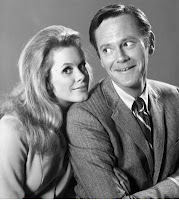
With co-star and friend Dick Sargent.
Pilato's work on his previous Bewitched books shows in his entertaining behind-the-scenes look at the classic sitcom. Among the highlights for Bewitched fans:  Dick Sargent and Richard Crenna were considered for the role of Darrin before Dick York was cast; York was "smitten" with Montgomery; Agnes Moorehead and Montgomery overcame personal friction between each other to forge a professional relationship; Paul Lynde adored Montgomery, but displayed a "different attitude" when she portrayed Samantha's mischievous lookalike cousin Serena; and, though Montgomery had praise for both of her leading men, she became good friends with Dick Sargent. After Sargent revealed he was gay in 1991, Montgomery served as co-Grand Marshal with him for the Los Angeles Gay Pride Parade.

After eight seasons of Bewitched, Elizabeth Montgomery decided to end the series although ABC tried to convince her otherwise. Pilato quotes television executive Peter Ackerman, who noted that "with it (the cancellation of Bewitched), more to the point, because of it, Bill and Liz ended their marriage." The couple had three children by then.
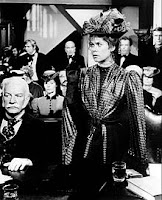
Playing accused murderer Lizzie Borden.

Elizabeth Montgomery's post-Bewitched acting career included Emmy nominations for two made-for TV movies: the potent drama A Case of Rape (1974) and the fact-based The Legend of Lizzie Borden (1975). On another television movie, Mrs. Sundance, Montgomery met actor Robert Foxworth, who became her partner and eventual husband until her death in 1995 from colon cancer. (Pilato also relates the story of Montgomery and Emma, the Labrador Retriever, who starred together in my favorite of her made-for-TV movies, Second Sight: A Love Story.)

Author Herbie J. Pilato's sources include new interviews with Montgomery's friends (e.g., Cliff Robertson, Sally Kemp), magazine articles, TV interview transcripts,  interviews conducted with his subject, and unused materials from his Bewitched books. He lists Montgomery's complete professional credits and includes an index and a nice selection of photographs.

Pilato's claims may occasionally be exaggerated (it's a stretch to call I Married a Witch "one of the best English-language motion pictures of its time"). On one page, he labels Montogomery's Twilight Zone performance as her best pre-Bewitched work. Elsewhere, he bestows that honor on her guest stint in The Untouchables. He also italicizes the proper names of all fictional characters, a small editing quirk perhaps, but one that becomes annoying.

Still, Twitch Upon a Star is an engrossing look at a strong-willed actress whose career spanned five decades. It will satisfy Elizabeth Montgomery's fans, as well as Bewitched buffs interested in learning more about that series' leading lady--and even how the famous twitch was "invented."

The Classic Film & TV Cafe received a review copy of this book.

Monday, October 1, 2012

Essential Books for Classic Film Lovers

Over the last decade, Internet film sites have displaced reference books as the primary source of classic film information. While I appreciate having access to an expansive virtual library, I always approach its content with some caution. Popular sources, such as the Internet Movie Data Base and Wikipedia, are written by... well...anyone who can log into their sites. I like to balance what I learn from those sources with what's available in reference books written by film literature professionals. Over the next year, the Cafe will periodically review what we consider to be some of the essential reference books on classic movies. This month, we'll start with seven film encyclopedias.

The Film Encyclopedia by Ephraim Katz - First published in 1979, Katz's mammoth book is universally recognized as one of the finest film references--with accolades from Library Journal, Newsweek, and even Katharine Hepburn. It's not a book of film reviews, but rather an encyclopedia with entries on performers, filmmakers, studios, film terms, and even short histories of the evolution of cinema in various countries. It's noted for its accuracy (indeed, I've used it for four decades and found one error). Katz, who was also a documentary filmmaker, died in 1994 before completing a second edition. It has been updated by others since, but I recommend seeking out Katz's original edition.

Halliwell's Film Guide by Leslie Halliwell - Halliwell was best-known for writing The Filmgoer's Companion, one of the first important film reference books. But since there's a good deal of overlap between it and Katz's even better Film Encyclopedia, I recommend adding Halliwell's Film Guide to your library. First published in 1977, it's an incredible collection of capsule film reviews--all written by one person! That's why the Film Guide is superior to rivals, such as Leonard Maltin's books, which are authored by panels of film reviewers. Some critics claim that Halliwell's personal prejudices are a detriment to his reviews. I strongly disagree for two reasons. First, I often agree with Halliwell. More importantly, those "prejudices" provide the book with a singular point of view that gives it a consistency missing in other books of capsule film reviews. As with Katz's book, I recommend you steer clear of later editions updated after Halliwell's death in 1989.

TV Movies by Leonard Maltin - No, the title is not a mistake. The best editions of Maltin's book were the earlier ones called TV Movies and later TV Movies and Video Guide. These editions contain thousands of capsule reviews, generally ranging from the start of the sound era and ending nine or so months prior to publication. They include made-for-television films, as well as reviews of film series such as Tarzan, Maisie, and Boston Blackie. Maltin did not write all the reviews, but selected a panel of collaborators to assist him. As he continued to add movies each year, the book eventually became too large and, unfortunately, many older reviews were relegated in 2005 to a separate volume called Leonard Maltin's Classic Movie Guide. I recommend you seek out an older edition of Maltin's book.

Movies on TV by Steven H. Scheuer - Although many people think Maltin pioneered the capsule film review encyclopedia, that honor goes to Scheuer. He published the first edition of Movies on TV in 1959, ten years between Maltin's TV Movies. As a youth, I regularly consulted both Scheuer and Maltin--it was always good to get a second opinion on a movie. Scheuer stopped updating his book in 1993.

Guide for the Film Fanatic by Danny Peary - Although Peary is better known for his books on cult movies, I prefer this quirky encyclopedia of pithy reviews. Peary includes a healthy mix of classic American movies (Way Down EastThe Letter), foreign-language films (The Conformist), British and Australian cinema (My Brilliant Career), cult movies (Queen of Outer Space), and even famous adult films. His reviews are longer than those in the books by Halliwell, Maltin, and Scheuer. And, although his approach could never be construed as academic, Peary offers an occasional fresh view on a popular classic.

The Motion Picture Guide by Jay Robert Nash, Stanley Ralph Ross, and Robert B. Connelly - A true encyclopedia, the 1985 edition of The Motion Picture Guide included 25,000 in-depth reviews in ten volumes. A later volume added 15,000 silent films. A huge undertaking, it's a shame that it wasn't updated over the years. Still, what was once an expensive purchase only for libraries, can now be bought used for under $100--and you still get all the classic films plus fabulous write-ups on many film series.

Encyclopedia of Film Themes, Settings and Series by Richard B. Armstrong and Mary Willems Armstrong - For personal reasons, I'll keep this write-up brief. However, if you are looking for a reference guide to films by category, this book is your best bet. In other words, if you can't recall the name of that movie about reincarnation, you can look the topic up and find a list of representative films, along with a brief overview of the category. There are over 670 categories, ranging from the Abominable Snowman to Zorro. When originally published as The Movie List Book in 1990, Library Journal called it "the most important film reference in several years."