Showing posts with label george sanders. Show all posts

Monday, November 15, 2021

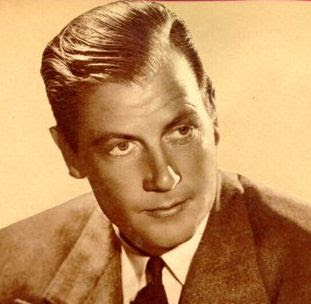
Seven Things to Know About George Sanders

1. In his autobiography Memoirs of a Professional Cad, George Sanders recalled his first film role in The Man Who Could Work Miracles (1937) as one of the gods: "The part called for me to ride half-naked and shiny with grease, at four o'clock in the morning during one of England's coldest winters, on a horse which was also coated with grease. Torin Thatcher and Ivan Brandt were the other two greasy gods. Though I never fancied myself as a horseman, I was the only one of the three that didn't fall off. In that regard at least I was already a successful film actor."

2. George Sanders was born in St. Petersburg, Russia, in 1906. His family moved to Great Britain in 1917. After studying at Brighton College and Manchester Technical College, Sanders worked in the textile industry and on a tobacco plantation in South America. On his return to Great Britain, he was working for Lever Brothers when his co-worker Greer Garson suggested he take up acting.

3. George Sanders was married four times. His second wife was Zsa Zsa Gabor (1949-54) and his fourth wife was Zsa Zsa's sister Magda Gabor (1970-71). That marriage only lasted for a month. In between, Sanders was married to actress Benita Hume, the widow of Ronald Colman, until her death in 1967. When asked about ex-husband Sanders, Zsa Zsa once said: "We were both in love with him. I fell out of love with him, but he didn't."

4. George Sanders played debonair detective Simon Templar in five films starting with The Saint Strikes Back in 1939. Sanders then transitioned to a similar "B" detective series in which he played another suave detective, Gay Lawrence aka The Falcon (loosely inspired by a Michael Arlen short story). By the time he had appeared in three Falcon movies, Sanders was in demand for "A" pictures. RKO wanted to continue The Falcon film series, so it made The Falcon's Brother (1942), in which Gay Lawrence is killed and his brother, Tom, takes over as The Falcon. The nifty part is that the role of Tom Lawrence was played by George Sander's real-life brother Tom Conway. He went on to star as The Falcon in nine more movies (see The Falcon and the Co-eds, easily the best in the series).

With Joan Fontaine and Judith Anderson in Rebecca.
5. Although Sanders' breakthrough role was in Hitchcock's Rebecca (1940), as the adulterous title character's lover, his first starring role wasn't until 1942. He played a stockbroker-turned-painter in The Moon and Sixpence, which co-starred Herbert Marshall and Doris Dudley (who made only four films). Subsequent roles, though, often typecast him as a cad--such as the married children's book author who romances Gene Tierney in The Ghost and Mrs. Muir (1947). He got another break in 1950 when he played a cynical theatre critic in Joseph L. Mankiewicz's All About Eve and won a Best Supporting Actor Oscar. Although Jose Ferrer was originally considered for the part, it's hard to imagine anyone other than George Sanders as the velvet-voiced, part-time narrator who introduces himself so memorably: "To those of you who do not read, attend the theater, listen to unsponsored radio programs, or know anything of the world in which you live, it is perhaps necessary to introduce myself. My name is Addison DeWitt. My native habitat is the theater. In it, I toil not, neither do I spin. I am a critic and commentator. I am essential to the theatre."

Elizabeth Taylor and George Sanders.
6. His Oscar win afforded him more choices in his next few roles. He got the opportunity to sing opposite Ethel Merman in Call Me Madam (1953). He played a well-written villain in love with Elizabeth Taylor's character in Ivanhoe (1952). He even hosted a short-lived, half-hour anthology TV series called The George Sanders Mystery Theatre in 1957 (also starring in one episode).

7. George Sanders was still acting at age 65 when he committed suicide in 1972. According to his New York Times obituary, he died of an overdose of sleeping pills and left the following note: "Dear World, I am leaving because I am bored. I feel I have lived long enough. I am leaving you with your worries in this sweet cesspool. Good luck." 

Thursday, May 14, 2020

The Ghost and Mrs. Muir

Rex Harrison and Gene Tierney.
A year after her husband's death, widow Lucy Muir has made the bold decision to move to the coastal village of Whitecliff-by-the-Sea with her young daughter and housekeeper. It's a decision that's derided by her sister-in-law and mother-in-law--but Lucy (Gene Tierney) knows her mind and no one is going to change it.

A village realtor learns that same lesson when he tries to talk Lucy out of renting Gull Cottage, an isolated home previously owned by a sea captain. Lucy falls in love with Gull Cottage instantly--despite the rumors that it's haunted by the ghost of Captain Daniel Gregg (Rex Harrison). On the family's first night in their new home, Captain Gregg appears before Lucy. Instead of screaming and running away, Lucy talks with the salty sea man and convinces him to let her family stay on a "trial basis."

It's the beginning of a friendship between Lucy and Daniel that develops into something more. But what future can there be in the love between a very human woman and a ghostly man?

Gene Tierney as Lucy Muir.
Based on Josephine Leslie's 1945 novel, The Ghost and Mrs. Muir (1948) is a grand Hollywood romance made with care and craftsmanship. Set at the turn of the century, it offers a unique mix of quaint charm and haunting imagery. Famed cinematographer Charles Lang earned an Oscar nomination for his striking black-and-white photography. Composer Bernard Herrmann should have been honored as well. His beautiful, expressive score will linger with you long after the movie. The composer considered The Ghost and Mrs. Muir his finest film score. Entire books have been written about it (e.g., Bernard Herrmann's The Ghost and Mrs. Muir: A Film Score Guide).

George Sanders as a suitor.
While The Ghost and Mrs. Muir earned mixed reviews on its original release, it has become a bona fide classic over the years. In the American Film Institute's list of the 100 greatest movie love stories, it ranked #73 (far too low in my opinion). Its enduring popularity has much to do with the natural chemistry between stars Gene Tierney and Rex Harrison and Philip Dunne's masterful screenplay that makes the audience invest fully in this unlikely romance. It helps, too, to have a wonderful supporting cast that features George Sanders as a cad (who writes children's books, no less) and Edna Best as Mrs. Muir's housekeeper and friend.

In hindsight, it's also interesting to note that Lucy Muir is a very strong, independent woman for a Hollywood romance of this period. She takes bold risks, doesn't frighten easily, and isn't afraid to face loneliness. One of the film's best scenes is when she reflects back on her life with her grown daughter near the end.

Hope Lange & Edward Mulhare.
Though The Ghost and Mrs. Muir has never been remade, it was adapted for radio twice: in 1947 with Madeleine Carroll and Charles Boyer and in 1951 with Jane Wyatt and Charles Boyer. It was adapted into a TV sitcom in 1968 with Hope Lange as Carolyn Muir and Edward Mulhare as Captain Gregg. The TV series added another child (as in the novel) and a dog. The show only lasted two years--despite the fact that Hope Lange won two Emmys for playing Mrs. Muir!

Monday, August 7, 2017

The Falcon Goes on a Date...and then Strikes Back!

George Sanders as The Falcon.
A Date With the Falcon (1942) is a direct sequel to the series' first film, The Gay Falcon, with Wendy Barrie returning as Gay Lawrence's fiancée. She wants to whisk the Falcon away to get married. Instead, the debonair adventurer gets involved with an investigation into a missing scientist who has invented a near-perfect synthetic diamond. In fact, almost no one can tell the difference--which could be devastating for the jewelry industry.

The Falcon movies, which starred George Sanders and later his brother Tom Conway, were consistently entertaining "B" detective movies. Sometimes, the "comic relief" (typically provided by the Falcon's crony Goldy Locke) was a bit excessive. However, Sanders and Conway always found a way to elevate these fast-paced programmers above the likes of Charlie Chan, Boston Blackie, and Michael Shayne. Certainly, the brothers were charming on screen and seemed to define the word "suave." But I think their true secret was that they looked like they were having fun--and invited the audience to have fun with them.

A Date With the Falcon is a solid entry in the series, though I do find it silly that the writers decided the Falcon should get engaged. Sanders flirts with every woman in sight, inspiring a flower girl to quip: "He's much too nice and undependable to be taken out of circulation." There was no fiancée in sight when Gay Lawrence returned in The Falcon Takes Over, an unusual reworking of Raymond Chandler's Philip Marlowe novel Farewell My Lovely.

Tom Conway as The Falcon's brother.
When George Sanders moved on to bigger roles, RKO casts his real-life brother as Gay Lawrence's brother Tom. The transition was effected rather cleverly in the appropriately-titled The Falcon's Brother (1942). Conway's first solo outing is one of the best in the series, The Falcon Strikes Back (1943).

It opens with Tom Lawrence recovering from a hangover, only to be visited by a beautiful mysterious woman (Rita Corday) that wants him to find her missing brother. Lawrence's search leads to a cocktail bar when he's knocked unconscious. He awakens in the backseat of his convertible and quickly discovers he's been framed for the murder of a bank messenger and the theft of $250,000 in war bonds. When he returns to the cocktail bar, it's now the home of the Volunteer Knitters of America!

Harriet Nelson and Tom Conway.
Lawrence's investigation leads him to the Pinecrest resort hotel, where he encounters more murder, a bizarre puppeteer, and Harriet Nelson from Ozzie and Harriet fame. Who could ask for more?

I've always preferred Tom Conway as the Falcon, perhaps because he seems tougher than George Sanders. The Falcon Strikes Back is an enjoyable series' outing with the added distinction of being directed by Edward Dmytryk one year before Murder, My Sweet cemented his reputation.

Don't you love the irony? An earlier Falcon movie was based on Farewell, My Lovely, which was adapted again in 1944 as Murder, My Sweet. The director of that movie? Edward Dmytryk.

Thursday, June 1, 2017

In Memory of Roger Moore: The King's Thief

Roger Moore in The King's Thief.
Roger Moore signed a seven-year contract with MGM in 1954 at the age of 27. Although he had studied at the Royal Academy of Dramatic Arts, Moore didn't consider himself a very good actor. But the truth is that he had already developed the on-screen charisma that would define his stardom--well, that along with his good looks.

Roger Moore is not the star of The King's Thief, a modestly-budgeted 1955 costumer about a plot to overthrow King Charles II. Edmund Purdom has the role lead of Michael Dermott, a former soldier loyal to the king who has resorted to robbing wealthy noblemen. One such target is the Duke of Brampton (David Niven), who seems particularly distraught when Michael steals a little black book in addition to some jewels. The book contains the names of influential landowners who support Charles II. Brampton's plan is to dispose of them one by one, claim their estates, and eventually oust the king.

Ann Blyth as Lady Mary.
Meanwhile, Michael meets beautiful Lady Mary, whose father was one of Brampton's first victims. She seeks revenge and recognizes that Michael could be a valuable ally. So where does Roger Moore fit in all this? He plays Michael's right-hand man.

The King's Thief is something of an oddity. Running a scant 78 minutes, it was clearly not intended to be a lavish historical drama on the scale of MGM's Ivanhoe (1952) or Knights of the Round Table (1953). Some of the backdrops give the film a cheap look, although there's a fairly impressive recreation of a medieval town. The film also boasts rich color and was filmed in Cinemascope at a time when that was a luxury.

David Niven as the villain.
Edmund Purdom, who supposedly took over when Stewart Granger dropped out, makes an adequate hero--but there's nothing exciting about his performance. His career in Hollywood was short-lived and it's not hard to see why. However, the rest of the cast is first-class, with David Niven as the suave villain, Ann Blyth as the plucky Lady Mary, George Sanders as Charles II, and, of course, Roger Moore as Purdom's pal.

Purdom and Moore share the film's best scene, a prison escape in which they climb up through a chimney, cross over into a bell tower filled with whistling winds, and then descend from the tower and rooftops.

Roger Moore followed The King's Thief with Diane (1956), another costume drama in which he was third-billed after Lana Turner and Pedro Armendáriz. Still, big screen stardom eluded him and he found work as a regular in 1950s television shows such as Ivanhoe, The Alaskans, and Maverick. In 1962, he was cast as Simon Templar in The Saint TV series...and the rest, as they say, is history.

Saturday, October 25, 2014

The Town of Midwich Becomes the Village of the Damned

There’s nothing to distinguish Midwich from any other rural English village—except that one day, every living inhabitant passes out for four hours. A man slumps over the steering wheel of a tractor as its runs in circles. An unconscious telephone operator doesn’t hear the constant ringing of incoming calls. Water overflows bathtubs, irons scorch clothes, and a stuck phonograph record repeats the same musical notes over and over. Then suddenly, everyone wakes up and all seems normal again.

Except it isn’t, of course. A month later, every woman capable of bearing a child is pregnant. Twelve perfectly healthy children are eventually born, each with blonde hair, “arresting” eyes, and narrow nails. At the age of 12 months, one of them opens a Chinese puzzle box. And what one learns, they all do—immediately—as if they share the same consciousness.

Few films can match Village of the Damned for its eerie opening and original premise. Much of the credit belongs to John Wyndham, who wrote the source novel The Midwich Cuckoos (as well as The Day of the Triffids). However, director Wolf Rilla builds on Wyndham’s ideas by giving the film an otherworldly quality. Some of his images are disturbingly hypnotic, such as the sight of the Aryan-like children, walking like a pack, through the quaint village. Likewise, his use of natural sound—even the opening credits roll over church bells instead of music—gives the film a different aural quality.

George Sanders portrays the only sympathetic father (as you can imagine, the “fathers” have difficulty accepting the children). Sanders’ character, though, appreciates the children’s tremendous intellectual potential. He and his son, David, may not love each other in a conventional sense, but they admire and respect one another. In contrast, David has little need for his coddling mother, though he is always polite to her.

As David, young Martin Stephens gives a fine performance. One of the best child actors of the 1960s, Stephens had enough screen presence to hold his own against Deborah Kerr in The Innocents (1961). He had the unique ability to act like an adult trapped in a child’s body.

Village of the Damned is an unconventional science fiction film, so don’t expect answers to the questions it poses. A 1964 sequel, Children of the Damned, expanded on the notion that the children are feared mainly because they’re different (a theme also explored in Larry Cohen’s It’s Alive movies). John Carpenter directed a lifeless remake of Village of the Damned in 1995.

(Incidentally, co-writer Stirling Silliphant had an interesting career. He created the TV series Route 66 with Herbert B. Leonard and wrote most of the episodes. He later won an Oscar for In the Heat of the Night, had a boxoffice smash with The Poseidon Adventure, and became a martial arts student and friend to Bruce Lee. Silliphant, Lee, and James Coburn conceived a martial film called The Silver Flute. It was eventually made as Circle of Iron with David Carradine in the role intended for Bruce Lee.)

Thursday, May 2, 2013

Farewell, My Falcon

Raymond Chandler--the creator of Philip Marlowe, one of literature's great detectives--signed a contract in 1941 for RKO to film his novel Farewell, My Lovely. The price: $2000. According to Frank McShane's The Life of Raymond Chandler, it was a decision the writer later regretted, blaming the "unparalleled stupidity on the part of my New York agent."

Even worse, RKO took Chandler's now-acclaimed novel and adapted it as The Falcon Takes Over (1942), a "B" detective film. It was the third entry in the Falcon film series, based on a gentleman detective created by Michael Arlen in a 1940 short story. In fact, the film's opening credits state the screenplay was "based on the character created by Michael Arlen" and then in smaller letters, it includes "From the novel Farewell, My Lovely by Raymond Chandler."

George Sanders as The Falcon,
with Lynn Bari.
Surprisingly, the plot adheres pretty closely to Chandler's novel with a big lug named Moose Malloy (Ward Bond) looking for his girlfriend Velma. Moose has recently escaped from the state pen, where he spent five years taking the rap for Velma's boss. Now, he's mad--and that's neck-breaking bad news for anyone getting in his way. After Moose kills a nightclub owner, Gay Lawrence (George Sanders) takes an interest in the case, especially the whereabouts of Velma. He also becomes involved with an alleged necklace theft, a beautiful icy blonde, and a fake psychic. Since this is a plot devised by Raymond Chandler, one can rest assured that somehow it all ties together. (Chandler often interwove plots from previously-written short stories into his novels; for Farewell, My Lovely, the stories were "Try the Girl" and "Mandarin's Jade.")

For anyone who has read Chandler's novel or has seen the superior 1944 adaptation Murder, My Sweet, it's jarring to see George Sanders' upper-class detective filling in for Marlowe. Marlowe's cynical first-person narrative and the seedy settings have been replaced with lighthearted title music and a bumbling assistant named Goldy (Allen Jenkins) who provides comic relief.

Brothers Tom Conway and George
Sanders, with Jane Randolph.
Sanders, after five movies as The Saint--a similar character--and two as The Falcon, looks relatively bored. He would make one more Falcon movie, The Falcon's Brother, in which Gay Lawrence is killed off and replaced with his brother Tom Lawrence (played by Sanders' real-life brother Tom Conway). This clever idea was good news for Sanders' career and for The Falcon series, which improved with Tom Conway and produced a low-budget gem with The Falcon and the Co-eds.

Why didn't Helen Gilbert
get better roles?
Still, at 65 minutes, The Falcon Takes Over is a watchable mystery and features good performances from Ward Bond as Moose and Helen Gilbert as the chilly Diana Kenyon. Judging from this film alone, it's surprising that Gilbert didn't get better parts. Although she appeared in major film series like Andy Hardy and Dr. Kildare, her career stalled after the mid-1940s, although she made a handful of television appearances in the 1950s.

The supporting cast in The Falcon Takes Over also includes Turhan Bey as the fake psychic (foreshadowing his role in The Amazing Mr. X), James Gleason as a police detective, and Hans Conrad (who is unbilled).

A third version of Farewell, My Lovely (with that title, for a change) appeared in 1975 with Robert Mitchum as Marlowe. It earned generally positive reviews, although I was less enthused, principally because Mitchum seemed at least a decade too old to be playing Chandler's detective.

Monday, December 10, 2012

Ivanhoe and The Black Shield of Falworth: A '50s Swashbuckler Double-feature

Ivanhoe (1952)
Robert Taylor as Ivanhoe.
MGM mounted this colorful adaptation of Sir Walter Scott's tale of a noble Saxon knight trying to restore the throne of England to King Richard, who has been kidnapped by his brother Prince John. This popular, trendsetting film earned a Best Picture nomination and fueled other 1950s medieval actions films. The impressive action scenes include a thrilling jousting tournament, a large-scale assault on a castle, and a brutal climatic duel in which Robert Taylor and George Sanders whale on each other with axe and mace, respectively.

Elizabeth Taylor and George Sanders.
But what separates Ivanhoe from its peers is its low-key realism: Ivanhoe may be a nobleman, but he can't read; Ivanhoe's father is a kindly lord, but his servants still wear metal collars; and Elizabeth Taylor's Rebecca is shunned by Saxons and Normans alike because she is a Jew. The cast is in fine form, except for Joan  Fontaine--she brings no fire to her character, leaving one to wonder why Ivanhoe prefers her over the intelligent, gorgeous Rebecca.

Elizabeth Taylor as Rebecca.
Sanders provides surprising depth to his villain, whose lust--and eventual love--for Rebecca causes him much internal conflict. Emlyn Williams, who gives a delightful performance as a servant-turned-knight's squire, was also a successful playwright with stage hits such as Night Must Fall.  Robert Taylor and director Richard Thorpe teamed up for two other 1950s costume dramas, Knights of the Round Table (1953) and Quentin Durward (1955), also based on a Scott novel. The latter is the more entertaining of the two and features a nifty swordfight with the opponents swinging on ropes in a burning bell tower. Anthony Andrews played Ivanhoe in an above-average 1982 made-for-TV movie.

The Black Shield of Falworth (1954)
Tony Curtis and Janet Leigh.
This modestly-budgeted, by-the-numbers swashbuckler was clearly intended as a training ground for rising stars Tony Curtis and Janet Leigh (appearing in the second of their six films together). The radiant Leigh, draped in stunning gowns, is clearly more at home than Curtis. He struts around in tights like he was getting ready for a Brooklyn rumble. Still, he gets ample opportunity to display his athletic prowess and, considering that the film's hero is a hothead, his vigorous performance ultimately gets a passing grade.

Torin Thatcher and Curtis.
Set in England during the reign of Henry IV, the plot follows Myles (Curtis) and Meg (Barbara Rush), two peasant orphans who don't know that their noble father was unjustly branded a traitor. The local vicar sends them to live in the castle of the Earl of Mackworth, with Meg to attend the earl's daughter Lady Anne (Leigh) and Curtis to be trained as a squire. Once Mackworth realizes Myle's true identity, he hatches a plot to use him to defeat the evil Earl of Alban--who is plotting to overthrow the king and also happens to have been responsible for the death of Myle's father.

David Farrar (right) as the villain.
The Black Shield of Falworth gets a huge boost from an outstanding supporting cast:  Herbert Marshall as the fatherly Mackworth; Dan O'Herlihy as Prince Hal, who plays the fool to deceive the bad guys; David Farrar as the villainous Alban (decked out in black from head to toe); and Torin Thatcher as the eye-patched, staff-wielding taskmaster that transforms Myles into a valiant warrior.  One wishes that these fine performers received more screen time, but their presence is reason enough to spend 99 minutes with The Black Shield of Falworth. Plus, at the risk of sounding shallow, the two leads are easy on the eyes.

Monday, March 8, 2010

Dial H for Hitchcock: Foreign Correspondent...an underrated gem

In 1941 Alfred Hitchcock became one of a select few who have directed more than one film nominated for Best Picture in the same year. What makes this especially significant in Hitchcock's case is that the two of his films nominated for the 1940 award were his very first Hollywood movies: Rebecca and Foreign Correspondent.

Rebecca won the golden statuette, one of nine nominations and two wins, and it remains highly respected today. Foreign Correspondent was nominated for six Oscars but eventually fell into a relative obscurity. Though not one of the director's ultimate tours de force, it is nevertheless a well-made classic that deserves recognition.

The story is set on the eve of World War II. A newspaper publisher (Harry Davenport) is fed up with the fluff his correspondents in Europe have been sending back. He decides to assign an ambitious crime reporter (Joel McCrea) to London in hopes of getting the real story as events unfold. The intrepid reporter eagerly pursues his assignment and in the process uncovers an espionage ring, befriends a trusty pair of cohorts (George Sanders and Robert Benchley) and falls in love with a beautiful woman (Laraine Day).
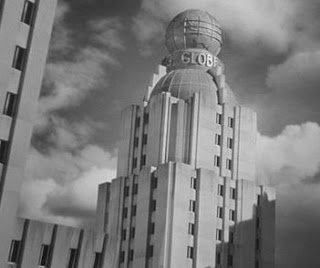
The film harkens back to Hitchcock's earlier British films and connects with his later films in various ways. As with The 39 Steps, The Lady Vanishes and other of his British movies, foreign intrigue drives the plot (a scenario Hitchcock returned to several times on later films including Saboteur, Notorious and North by Northwest). The director's penchant for 'doubles' also surfaces here (the diplomat and his imposter, McCrea's character has two names, Herbert Marshall's character leads a double life). Hitchcock also makes effective use of landmark locations, another trademark device.

Foreign Correspondent is a showcase of Hitchcock's cinematic artistry, particularly his mastery of the set-piece. One of the film's most striking features is a series of famous set-pieces that established a high-water mark to that point and set the standard for his later films.

The first involves a political assassination on the steps of Amsterdam Square during a downpour. The sudden, shocking murder is followed by pursuit of the assassin through a visual sea of bobbing umbrellas and into rain-washed city streets.

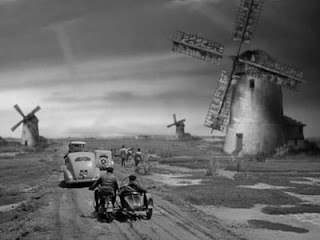
The next takes place in the Dutch countryside, where McCrea and two others have tracked the assassin. As McCrea takes in the scene from a Frankenstein-ian windmill, he notices that one of the windmills is turning backward, against the wind, and this tips him off that things are amiss. He moves in closer to investigate...

A third is set back in London, where McCrea agrees to take on a bodyguard who is actually a killer (Edmund Gwenn). This jovial henchman repeatedly puts the reporter in harm's way, and their final harrowing scene together takes place in the tower of Westminster Cathedral. The entire sequence is both amusing and terrifying.
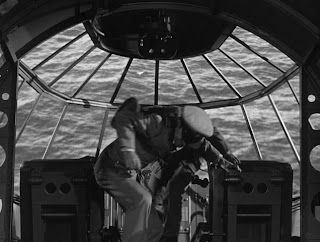
Finally, and most dramatically, is the crash of a transatlantic clipper into the sea. Devised long before the advent of sophisticated special effects and CGI, the scene was magnficently and simply conceived. The crash is viewed from the back of a cockpit set. Footage filmed from a stunt plane diving over the ocean was rear-projected onto rice paper at the front of the set. Behind the rice paper were water tanks with chutes aimed at the cockpit windshield so that, at the precise moment Hitchcock pushed a button, water would burst through the paper giving the effect that the plane is crashing nose-first into the ocean. The action surrounding the crash encompasses the chaos and hysteria aboard the clipper when it comes under attack as well as the struggle of passengers to escape the sinking plane and survive on a floating wing.

Though Hitchcock's first choice for the lead was Gary Cooper, Joel McCrea hits all the right notes as the dedicated news hound, a slightly rumpled American everyman. He is ably assisted by Sanders as a wry and eccentric newsman, and Benchley as another quirky reporter. Edmund Gwenn's turn as the affable would-be killer is marvelous; Albert Basserman was Oscar-nominated for his role as an abducted diplomat. Herbert Marshall delivers his usual fine performance as the head of an international group and Harry Davenport is always an asset. Laraine Day is fetching as Marshall's daughter and McCrea's love interest, but doesn't bring much more to the part. In this case either of Hitchcock's original choices, Barbara Stanwyck and Joan Fontaine, would've better filled the bill.

Foreign Correspondent has sometimes been called a propaganda film, and foremost among those making the claim was Nazi Propaganda Minister Joseph Goebbels. Although McCrea's final speech is an impassioned wake up plea to America (and was reportedly added by producer Walter Wanger), it hardly characterizes the film as a whole. In my view, Foreign Correspondent is one very fine brew of mystery, suspense, romance and wit.

What do you think? Love it or hate it, take it or leave it..what are your impressions of Foreign Correspondent?

Sunday, January 17, 2010

Underrated Performer of the Week: Tom Conway

He was good-looking, suave, and always seems poised for a lead role that would propel him to film stardom--like his brother George Sanders. Unfortunately, Tom Conway never quite made it, though he forged a steady career in "B" pictures and headlined a couple of a cult classics.

Born Thomas Charles Sanders, Tom's family fled Russia at the outbreak of the Revolution and settled in England. As a young man, Tom tried his hand at several jobs (e.g., copper mining), but eventually entered show business. After working on the British stage, he went to the U.S. in 1941 at the invitation of his brother. Allegedly, Tom and George flipped a coin to see who would keep the family's last name; they were concerned that Hollywood producers might get confused if there were young male actors named Sanders.

Tom's first big break came when George wanted to depart from The Falcon series. George had played B-film "gentleman detectives" in five Saint films and three Falcon films. After a strong supporting performance in Rebecca (1940), Sanders was ready to graduate to "A" pictures as a lead. RKO, though, was making a tidy profit with The Falcon movies. So, in a case of inspired casting, RKO introduced Tom Conway as The Falcon's Brother (1942). The plot has the original Falcon (played by George) being killed and his brother, Tom Lawrence (Conway), solving the murder and taking over as the new Falcon!

Conway made ten Falcon movies, making it one of the most successful "B" detective series. The best of the bunch is The Falcon and the Co-Eds, which benefits from an delightfully atmospheric seaside setting. Concurrently, Conway was cast in major roles in three of Val Lewton's acclaimed horror/suspense films:  Cat People (1942), I Walked with a Zombie (1943), and The Seventh Victim (1943).

In the 1950s, roles became more scarce and Conway found himself working in low-budget films, television, and radio (providing the voice of both The Saint and Sherlock Holmes). His best post-1940s performance was as a ventriloquist in IThe Glass Eye",  a classic episode on Alfred Hitchcock Presents.

Alcholism took its toll in the 1960s and a newspaper article revealed that Conway was practically broke and living in a cheap flophouse. He and George had become estranged by then.

Tom Conway died in 1967, at age 62, from cirrhosis of the liver.

Several of Conway's film have been reviewed at the Cafe. You may want to check out the following (click on the title to read the post):  The Seventh Victim, The Falcon and the Co-Eds, and A Toast to New Year's Eve Movies (includes Repeat Performance, which co-starred Conway).

Thursday, November 5, 2009

Dial H for Hitchcock: Rebecca

Welcome to Dial H for Hitchcock, a monthly online gathering where we discuss the work of "the Master" (of suspense and quite a bit more). Alfred Hitchcock's first American film, Rebecca (1940), is the featured film this month.

By the late 1930's, Hitchcock's reputation was riding high based on several suspense films he'd made in Britain. He came to Hollywood under contract to producer David O. Selznick. Selznick intended Rebecca to rival his previous film, the award-laden Gone With the Wind (1939). The two men had a contentious collaboration on Rebecca but ultimately produced a critical and commercial success that was nominated for 11 Academy Awards. It won two: Best Picture and Best B&W Cinematography.

Rebecca is a favorite of mine, and here are a few reasons why...
A strong sense of atmosphere that underscores the story's gothic quality and mood of vague but insistent foreboding. Manderley, where much of the action occurs, conveys a cavernous and chilly ambiance of inhospitable elegance.

Multi-layered characters, evocative performances. Joan Fontaine is palpably anxious and apprehensive as the second Mrs. de Winter. She doesn't miss a beat and, late in the film, smoothly portrays the young woman's transition as she gains poise and confidence. Laurence Olivier's Maxim de Winter is guilt-riddled, highly strung and volatile...with aristocratic charm. Judith Anderson creates one of Hitchcock's and the screen's great villains as the unbalanced and eventually dangerous Mrs. Danvers. George Sanders as Jack Favell and Florence Bates as Mrs. Van Hopper both play unsavory types, but with comic overtones. Favell is an oily bounder, but a witty one. Van Hopper is insufferably demanding and grandiose - and more than slightly ridiculous.

A final note...Hitchcock reportedly edited "in camera" to prevent Selznick from re-editing his work. Rebecca strikes me as classic Hitchcock with the Selznick treatment: top-notch cast, the finest writers and technicians - and a big budget that shows.

Those are some of my thoughts...but what do you think? What are your opinions, observations and comments...and, if you've read Daphne du Maurier's novel, how would you compare the film to the book?