This month, the second half of the countdown begins as we work our way to No. 1. As a reminder, these films are not what I'd consider the best 100 movies ever made (though some are). These films are simply one classic fan's favorites. (An underlined title means there's a hyperlink to a full review at the Cafe.)
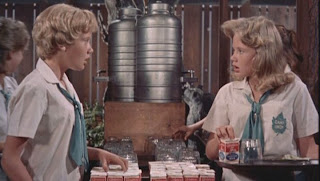 |
| Twins meet for the first time...at a summer camp. |
50.
The Parent Trap - Following the delightful
Pollyanna, Hayley Mills and writer-director David Swift teamed up again for
The Parent Trap, Disney’s best live-action comedy. The gimmick of having Hayley play twins was achieved through the then-innovative use of traveling mattes and split screens. It works amazingly well—and Hayley is great—but the film’s enduring appeal has nothing to do with its clever special effects.
The Parent Trap retains its popularity because of its ability to function as a smart, romantic comedy (for adults) and an enjoyable children’s film (in which the teen protagonists outwit their elders). The film’s breezy nature and charm mask two major flaws in its premise. First, how could any parents be so cruel as to separate twin sisters—and never even tell them about one another? Secondly, it’s obvious that the parents are still very much in love, so why did they split up in the first place? Since any answers would be unsatisfactory, writer-director Swift wisely chooses to ignore them altogether!
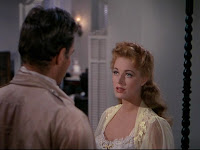 |
| Mail-order bride Eleanor Parker. |
49.
The Naked Jungle – It’s easy to remember this well-written character study for its lively climax involving billions of soldier ants (a local commissioner notes that the ant column is “twenty miles long and two wide, forty miles of agonizing death—you can't stop it”). However, when viewed in the context of the entire film, the ant attack constitutes a subplot which serves the purpose of bringing together two lonely people (Charlton Heston and Eleanor Parker) on a South American plantation. In that sense,
The Naked Jungle is no more about ants than
The Birds was about birds. In both films, an “attack by nature” is used to resolve a conflict between two characters.
48.
The Last Man on Earth - This first adaptation of Richard Matheson’s terrifying 1954 novel
I Am Legend—about a single human in a world inhabited by vampires—was made in Italy on a shoestring budget. Vincent Price is the only English-language actor in the cast. But, despite its financial limitations, it remains an impressive work filled with compelling images. The scenes of the vampires pounding nightly on Price’s door foreshadow similar images in the better-known
Night of the Living Dead (1968). There are also some genuinely frightening sequences, such as the one where Price’s character falls asleep in a church, only to awake at sunset and struggle to reach the safety of his fortress home. For a movie that doesn’t even rate as a cult film in most reference books, it’s amazing how many of my movie buff friends remember it as fondly as I do.
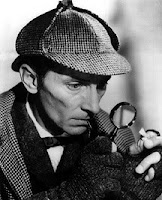 |
| Cushing made a fine Holmes. |
47.
The Hound of the Baskervilles (1959) Throughout the late 1960s and early 1970s, I tried in vain in see the Basil Rathbone version of
The Hound of the Baskervilles (1939). Every time it was listed in the newspaper, I’d tune in eagerly—only to see Hammer Films’ 1959 version starring Peter Cushing. I later learned that copyright issues prevented the Rathbone film from airing for many years. When it finally popped up on TV (on
The CBS Late Movie, of all places), I was somewhat disappointed. Though Basil was entertaining as always, his
Hound was surprisingly inferior to the 1959 version. Indeed, the Hammer
Hound has improved with age, like a fine wine or, more appropriately, a glass of sherry (the vicar in the film has a fondness for it). Cushing makes a superb Holmes, all nervous energy as if his brain can barely contain his superior intellect. His interpretation is every bit as good as Basil Rathbone’s more acclaimed one. Andre Morrell‘s Watson is one of the screen’s best--intelligent, affable, and observant, very much like the character in Conan Doyle’s works.
46.
Cat on a Hot Tin Roof – The most popular criticism of films adapted from stage plays is that the director fails to “open them up”—to transform them from theatrical productions to motion pictures. That always amuses me, for if a film is well-directed and performed, I don’t care if it all takes place in one room (which
12 Angry Men basically does and it’s a favorite, too). Richard Brooks’ adaptation of Tennessee Williams’ hit stage play is a perfect convergence of great acting and a director comfortable with enhancing, but not overpowering strong source material. Burl Ives recreates his masterful Broadway portrait as Big Daddy and Elizabeth Taylor gives what I consider to be her best performance. Williams purists quibble that some of the play’s content is watered down, but the result is still a first-rate film about (as Big Daddy would say) mendacity.
 |
| Cary in Baby. |
45.
Bringing Up Baby/
Holiday – Yes, I know I’m cheating again by listing two films in one slot. But, to my defense, these two films are essentially bookends with Cary Grant and Katherine Hepburn swapping roles in each. In
Holiday, Cary Grant is the free spirit and Kate the more uptight of the two and in
Bringing Up Baby, they switch roles with Cary as a conservative paleontologist and Kate as a wacky heiress. In both movies, the stars exhibit tremendous chemistry (surprisingly, I’m not nearly as fond of their pairing in
Philadelphia Story). I’m not surprised that
Bringing Up Baby is better-known than
Holiday; the former film is loaded with inspired screwball situations. Still,
Holiday is a very engaging film that’s funny and romantic but (in its own way) more serious and heartfelt.
44.
Spartacus – Stanley Kubrick’s most atypical film is my favorite among his works. He masterfully interweaves strong character relationships with spectacle to create an action film that resonates on a deep emotional level. The justly famous “I am Spartacus” scene as well as the closing one between Jean Simmons and Kirk Douglas still carry a tremendous impact after repeated viewings. Interestingly, Kubrick said in a 1968 interview that
Spartacus was the only one of his films he didn’t like. Certainly, he had less control over it, but I believe that working within the confines of a “Hollywood production” brought out the best in Kubrick and the result is an epic for the ages.
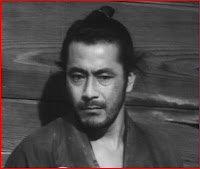 |
| Mifune as a helpful samurai. |
43.
Sanjuro - This was my first foreign film, my first samurai film, and my first Kurosawa film. When I watched in it on PBS in the early 1970s, I’m not sure if I even knew who Akira Kurosawa was (but suspect I soon learned). I found
Sanjuro charming, intriguing, and mesmerizing. Each time I watch it again, I’m reminded of that unique blend of qualities. Although I admire the more critically-acclaimed Kurosawa films such as
The Seven Samurai and
The Hidden Fortress, none of them has toppled
Sanjuro as my favorite. Kurosawa’s direction is seamless, flowing effortlessly from kinetic (as in the swordfights) to poetic (camellia blossoms flowing down a creek). The final showdown between Toshiro Mifune’s character and another samurai (whom he respects) is stunning in its efficiency and shock value.
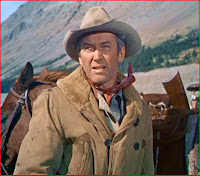 |
| Stewart in The Far Country. |
42.
The Far Country - James Stewart and director Anthony Mann made five classic Westerns together between 1950 and 1955, starting with
Winchester ’73. This is my fave of the bunch, although they’re all excellent. While Stewart plays a different character in each film, his protagonists are social misfits that share traits such as bitterness, shady pasts, and, when necessary, ruthlessness. As cowpoke Jeff Webster in The Far Country, his mottos are: “Nobody ever did anything for nothing” and “I take care of me.” The plot is secondary to Mann’s themes of civilization overtaking the frontier and the importance of community.
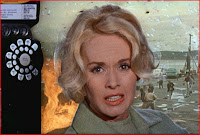 |
Tippi wishes cell phones had
been invented. |
41.
The Birds - This one functions on two levels for me. It is, of course, a masterfully directed thriller about unexplained bird attacks in a small California seaside community (I love the playground and gas station sequences). But it’s also a well-acted 1960s relationship drama about three women and their interactions with the bland, but likable, Mitch Brenner (Rod Taylor). Mitch’s mother (wonderfully played by Jessica Tandy) fears losing her son to another woman—not because of jealousy, but because she can’t stand the thought of being abandoned. Young socialite Melanie Daniels (Hedren) views Mitch as a stable love interest, something she needs as she strives to live a more meaningful life. And Annie Hayworth (Pleshette) is the spinster schoolteacher, willing to waste her life to be near Mitch after failing to pry him from his mother. These relationships are what the film is about—the birds are merely catalysts. That’s why the ending works for me; when the relationships are resolved, the bird attacks end.
Next month, I'll count another ten, including a Val Lewton classic, a Michael Crichton sci fi thriller, and two films each starring Sidney Poitier and William Holden.