Showing posts with label edmund gwenn. Show all posts

Saturday, June 18, 2016

MGM's Pride and Prejudice (1940)

Greer Garson and Laurence Oliver.
After viewing MGM's 1940 adaptation of Jane Austen's Pride and Prejudice, comparisons with the BBC's popular 1995 miniseries are inevitable. That's not altogether fair to the 1940 version which is much shorter than the later miniseries (two hours vs. six hours). However, the simple fact remains that MGM's Pride and Prejudice is now regarded as a very good film while the BBC version instantly became a pop culture phenomenon that still boasts a loyal following.

Garson as Elizabeth.
For those unfamiliar with Austen's 1813 classic, the plot centers around the relationship between the wealthy, snobby Mr. Darcy and the headstrong Elizabeth Bennett. She comes from a modest family (though they still have a butler) headed by the sensible Mr. Bennett. Unfortunately, Mr. Bennett does not have a male heir, meaning that the family's home will go to a clergyman named Mr. Collins upon Mr. Bennett's death. Thus, Mrs. Bennett is focused on getting her five daughters married off to gentlemen with ample financial means.

Elizabeth overhears Darcy.
To his surprise, Darcy (Laurence Olivier) finds himself attracted to the witty, elegant Elizabeth (Greer Garson) at a country ball. Yet, that doesn't dissuade him from expressing his contempt for other members of the Bennett family to a close friend--a conversation that Elizabeth overhears. As a result, Elizabeth rebuffs Darcy's invitation to dance, even though she is also interested in him. Thus begins a series of advances and retreats in the slowly-developing romance between the two.

For me, the joy of Austen's novel (and all its adaptations) is watching the feelings of Elizabeth and Darcy evolve as the plot progresses. Elizabeth knows that Darcy's assessment of her family is mostly accurate. Her mother is overwrought and obvious in her marital intentions for her daughters. Sister Mary insists on singing in public despite being tone deaf. Younger sisters Lydia and Kitty are just plain silly, chasing after army officers and getting tipsy at parties. And yet, it's one thing to acknowledge the shortfalls of one's family and another to watch as a third party scoffs at them. For his part, once he realizes that he loves Elizabeth, Darcy sets out to prove his worthiness to her--even though she has made it clear that she could never love him.

Olivier as Mr. Darcy.
Greer Garson and Laurence Olivier fare well as Elizabeth and Mr. Darcy, even though both are too old for the parts (Elizabeth is supposed to be 20 and Greer was then 36). It's impossible not to compare them with Jennifer Ehle and Colin Firth who played the couple in the BBC miniseries. Garson's performance brims with intelligence and charm, but its lacks the introspection that Ehle (born in my hometown of Winston-Salem, NC) brought to it. Likewise, Olivier makes a memorable Darcy, but falls short of Firth in displaying his character's internal struggles (especially during my favorite scene--Darcy's first proposal to Elizabeth).

Melville Cooper as Mr. Collins.
In my opinion, acting honors in the MGM film go to the always reliable Edmund Gwenn as Elizabeth's father, Melville Cooper as the pretentious Mr. Collins (who constantly babbles about his "esteemed patroness Lady Catherine de Bourgh"), and Frieda Inescort as the haughty Ms. Bingley.

Acclaimed British noveliest Aldous Huxley (Brave New World) co-wrote the screenplay. However, credit for the excellent abridgment of Austen's novel probably belongs to Helen Jerome. Her 1935 Broadway play served as the basis for the MGM film. Incidentally, that stage play starred British actress Adrianne Allen as Elizabeth. Ms. Allen was then married to Raymond Massey.

A recent viewing of the 1940 film reminded me, though, how much of the dialogue was penned by Jane Austen. It's the author and her vivid characters, lively dialogue, and understanding of human nature that makes Pride and Prejudice a true classic. Cast it with good actors and I don't think one could go wrong--whether it's this version, the BBC one, or the 2005 adaptation with Keira Knightley and Matthew Macfadyen.

Thursday, November 20, 2014

Double Dog Daring with MGM's Lassie

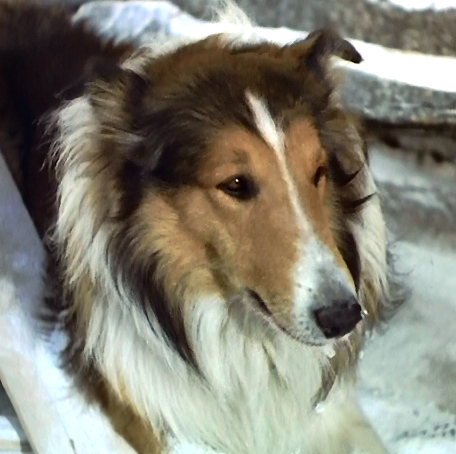
Given the public's embrace of 1943's Lassie Come Home, it was inevitable that MGM would launch a film series featuring the lovable, clever canine. Most of the pictures were connected only in that the lead character was a collie named Lassie. However, Son of Lassie (1945) was a direct sequel starring Peter Lawford as Joe Carraclough, who was played by Roddy McDowall as a lad in Lassie Come Home.

Joe still lives on the Duke of Rudling's (Nigel Bruce) estate, where his father (Donald Crisp) tends to the kennels. The Duke's granddaughter Priscilla (June Lockhart) is obviously smitten with Joe, but by the time he gets around to confirming his affection for her, he's off to fly planes for the RAF.
June Lockhart, an unknown actor as Laddie, and Peter Lawford.

Meanwhile, Joe's dog Laddie, one of Lassie's pups, joins the military too when Joe's father agrees to train a canine corps. Missing his owner, Laddie runs away and eventually stows away on an airplane piloted by Joe. When their plane is shot down over Nazi-infested Norway, Joe and Laddie must find each other and then find their way back home.

The bulk of Son of Lassie is a solid World War II adventure that reminded me of Powell and Pressberger's more impressive One of Our Aircraft Is Missing. Both films highlight the resilience of the inhabitants of occupied territories, who take great personal risks to aid the escape of Allied troops.

Peter Lawford and Pal as Laddie.
Lawford, in his first lead role, is a likable hero and assisted by a first-rate supporting cast. Unfortunately, there aren't enough scenes of him with June Lockhart and therefore their climatic reunion generates little emotion. On the other hand, the bond between man and dog is captured nicely and Pal, the canine star, is convincing as both the adult Laddie and his mother Lassie. (Lockhart, of course, would later forge her own relationship with her collie co-star, playing Timmy's mother on the Lassie TV series).

It's not Norway!
For what is essentially a "B" film, Son of Lassie reflects the typical high MGM production values. The breathtaking, colorful landscapes of  British Columbia and Wyoming substitute effectively for Norway.

After another war-themed series entry, the fine Courage of Lassie, MGM cast its canine star in Hills of Home (1948). This heartfelt story of a rural Scottish doctor reunited Pal and Edmund Gwenn from Lassie Come Home. The pair would appear together again the following year in Challenge to Lassie.

Gwenn's character was inspired by Ian
Maclaren's Doctor of the Old School.
In Hills of Home, the aging Dr. MacLure worries about what will happen in Glen Urtach when age forces him to eventually retire. His plan is to send bright young Tammas Milton (Tom Drake) to medical school in Edinburgh, but Tammas's family and sweetheart (Janet Leigh) aren't sold on the idea.

A lonely bachelor, MacLure accepts a collie in trade for medical services. What he doesn't know is that the dog is afraid to cross running water. Over time, MacLure's frustrations with his bonnie collie give way to love--and when it comes time for Lass to prove her worth, she comes through admirably.

Janet Leigh and Tom Drake.
Still, this is an intimate portrait of a country doctor told through a series of sketches and performed admirably by Gwenn, Donald Crisp as his best friend, and Tom Drake in one of his best performances. Many of the cast and crew appeared in previous and future Lassie films, to include: Gwenn; Crisp (Lassie Come Home, Son of Lassie, Challenge to Lassie); Drake (Courage of Lassie); Reginald Owen (Challenge to Lassie); and director Fred M. Wilcox (Lassie Come Home, Courage of Lassie).

MGM went on to make three more Lassie films. The Sun Comes Up (1948) starred Jeanette MacDonald in her last movie role. The aforementioned Challenge to Lassie (1949) was based on the true story of Greyfriars Bobby (a Skye Terrier). The film series ended with The Painted Hills (1951)--although the long-running Lassie TV series would debut in 1954 and rack up 352 half-hour episodes over the next 19 years. One of its stars, Jon Provost, recently shared his Lassie memories with us.

As an added bonus to promote the Cafe's new YouTube Channel, here's the opening scene from Son of Lassie (if your mobile device blocks embedded YouTube videos, click here to view it):


Wednesday, October 19, 2011

And the Beasts Shall Reign Over the Earth: Them!

The title appeared in color, though
the film was shot in B&W.
In a New Mexico desert, two state troopers pick up a six-year-old girl wandering aimlessly in a bathrobe and slippers, carrying a broken doll. When Sergeant Ben Peterson (James Whitmore) tries to question the little girl, she remains silent, staring in space--a victim of shock. Up the road, Peterson and his partner discover a trailer with a large hole ripped in one side. Bloody clothes and dollar bills litter the floor...as well as a corpse. Outside the trailer, the troopers discover an unusual footprint in the sand, made by neither man nor known beast. As the desert wind whistles, an eerie sound causes the girl to look up in trepidation.

The young survivor of the first attack.
This brilliant opening scene sets the stage for the first-third of Them!, which unravels more as a mystery than a science fiction film. The clues are revealed one by one: a hardware store destroyed in the same manner as the trailer; the sudden arrival of scientists from the Department of Agriculture; an autopsy that reveals a victim may have died from an injection of formic acid; and finally the little girl screaming "Them! Them!" after taking a whiff of the acid.

The first we see a giant ant
is during a sandstorm.
By the time Dr. Medford (Edmund Gwenn) reveals that the culprits are giant ants, it's almost anticlimactic. It also marks a shift in approach as the mystery gives way to a standard science fiction formula. To be sure, Them! executes the formula with precision, with three marvelous set pieces: the first glimpse of the ants as one becomes visible during a sandstorm; a cyanide gas assault on the ants' nest; and the climax in Los Angeles storm drains.

Yet, its very success is what makes Them! slightly disappointing on second and later viewings. Certainly, it ranks above all but a handful of science fiction films produced during the 1950s; it's a unqualified genre classic. However, stripped of its novelty "mystery approach" and big pay-off scenes, it lacks a potent theme that resonates in the same way as truly timeless genre films like The Day the Earth the Stood Still, Invasion of the Body Snatchers, and even The Incredible Shrinking Man.

One could argue that Them! is the definitive example of the "nuclear power-caused mutant creature subgenre." Still, that's nothing new thematically. Man invented nuclear power, so we're back to the old sci fi staple of man messing around in areas he shouldn't and inadvertently creating monsters. This is a theme at least as old as Mary Shelley's Frankenstein and featured in earlier sci fi films such as The Invisible Ray (1936). What Them! brings to it is a dark sense of humor, in that through man's intervention, the tiniest of creatures threatens to wipe out all of mankind.

Whitmore opens fire as Gwenn's
scientist observes the giant ant.
It seems unfair perhaps to criticize Them! because of its own high standards. To be sure, the cast is above average for a 1950s sci fi opus, with Edmund Gwenn giving new life to the standard role of the scientist that figures it all out. The special effects, while not on a Harryhausen level, work well enough, aided considerably by the inspired settings (e.g., the sandstorm, the tunnels). And although there is some sexism directed toward Joan Weldon's Dr. Pat Medford (e.g., she's introduced legs first), she evolves into a strong character. True, she investigates the first crime scene in a dress suit and high heels. But later, she ditches that for a military uniform and accompanies the male heroes in the tunnels to make sure the ants are dead.

Even if its potency fades during repeated viewings, Them! has earned its status as a genre classic. Its "mystery approach" alone makes it a unique sci fi film. There can also be no doubt that it was an influential film, inspiring 1950s imitators such as Beginning of the End (giant grasshoppers), Tarantula, Earth vs. the Spider, and The Deadly Mantis (as in big preying mantis).

Monday, March 8, 2010

Dial H for Hitchcock: Foreign Correspondent...an underrated gem

In 1941 Alfred Hitchcock became one of a select few who have directed more than one film nominated for Best Picture in the same year. What makes this especially significant in Hitchcock's case is that the two of his films nominated for the 1940 award were his very first Hollywood movies: Rebecca and Foreign Correspondent.

Rebecca won the golden statuette, one of nine nominations and two wins, and it remains highly respected today. Foreign Correspondent was nominated for six Oscars but eventually fell into a relative obscurity. Though not one of the director's ultimate tours de force, it is nevertheless a well-made classic that deserves recognition.

The story is set on the eve of World War II. A newspaper publisher (Harry Davenport) is fed up with the fluff his correspondents in Europe have been sending back. He decides to assign an ambitious crime reporter (Joel McCrea) to London in hopes of getting the real story as events unfold. The intrepid reporter eagerly pursues his assignment and in the process uncovers an espionage ring, befriends a trusty pair of cohorts (George Sanders and Robert Benchley) and falls in love with a beautiful woman (Laraine Day).

The film harkens back to Hitchcock's earlier British films and connects with his later films in various ways. As with The 39 Steps, The Lady Vanishes and other of his British movies, foreign intrigue drives the plot (a scenario Hitchcock returned to several times on later films including Saboteur, Notorious and North by Northwest). The director's penchant for 'doubles' also surfaces here (the diplomat and his imposter, McCrea's character has two names, Herbert Marshall's character leads a double life). Hitchcock also makes effective use of landmark locations, another trademark device.

Foreign Correspondent is a showcase of Hitchcock's cinematic artistry, particularly his mastery of the set-piece. One of the film's most striking features is a series of famous set-pieces that established a high-water mark to that point and set the standard for his later films.

The first involves a political assassination on the steps of Amsterdam Square during a downpour. The sudden, shocking murder is followed by pursuit of the assassin through a visual sea of bobbing umbrellas and into rain-washed city streets.

The next takes place in the Dutch countryside, where McCrea and two others have tracked the assassin. As McCrea takes in the scene from a Frankenstein-ian windmill, he notices that one of the windmills is turning backward, against the wind, and this tips him off that things are amiss. He moves in closer to investigate...

A third is set back in London, where McCrea agrees to take on a bodyguard who is actually a killer (Edmund Gwenn). This jovial henchman repeatedly puts the reporter in harm's way, and their final harrowing scene together takes place in the tower of Westminster Cathedral. The entire sequence is both amusing and terrifying.

Finally, and most dramatically, is the crash of a transatlantic clipper into the sea. Devised long before the advent of sophisticated special effects and CGI, the scene was magnficently and simply conceived. The crash is viewed from the back of a cockpit set. Footage filmed from a stunt plane diving over the ocean was rear-projected onto rice paper at the front of the set. Behind the rice paper were water tanks with chutes aimed at the cockpit windshield so that, at the precise moment Hitchcock pushed a button, water would burst through the paper giving the effect that the plane is crashing nose-first into the ocean. The action surrounding the crash encompasses the chaos and hysteria aboard the clipper when it comes under attack as well as the struggle of passengers to escape the sinking plane and survive on a floating wing.

Though Hitchcock's first choice for the lead was Gary Cooper, Joel McCrea hits all the right notes as the dedicated news hound, a slightly rumpled American everyman. He is ably assisted by Sanders as a wry and eccentric newsman, and Benchley as another quirky reporter. Edmund Gwenn's turn as the affable would-be killer is marvelous; Albert Basserman was Oscar-nominated for his role as an abducted diplomat. Herbert Marshall delivers his usual fine performance as the head of an international group and Harry Davenport is always an asset. Laraine Day is fetching as Marshall's daughter and McCrea's love interest, but doesn't bring much more to the part. In this case either of Hitchcock's original choices, Barbara Stanwyck and Joan Fontaine, would've better filled the bill.

Foreign Correspondent has sometimes been called a propaganda film, and foremost among those making the claim was Nazi Propaganda Minister Joseph Goebbels. Although McCrea's final speech is an impassioned wake up plea to America (and was reportedly added by producer Walter Wanger), it hardly characterizes the film as a whole. In my view, Foreign Correspondent is one very fine brew of mystery, suspense, romance and wit.

What do you think? Love it or hate it, take it or leave it..what are your impressions of Foreign Correspondent?