All of us have certain movies that capture something that speaks to our dreams. Usually I suppose they are the great dramas, but I have found that isn’t always the case.
The Time Machine, released by MGM in 1960, mesmerized me from the beginning, even before the credits. It begins with silence, then the tiny ticking of a clock that moves across the screen. Then more clocks pass by, each with their own cadence, becoming a little larger and a little louder until finally London’s Big Ben gives its thunderous toll and the music crashes in to begin the title and credits.
The Time Machine pulls you along from the picturesque, quiet Victorian age of great beauty, to excitement and action, and on to horrific futuristic events as the time traveler takes his journey.
George Pal produced and directed
The Time Machine, based on H.G. Wells’ novel of the same name. The screenplay takes many liberties with Wells’ original novel, but then when has that ever been a problem for Hollywood? Pal’s other well-known movies include The War of the Worlds (1953), Houdini (1953) and Conquest of Space (1955). Pal had been an animator for most of his career, and his best movies carry his stamp of thrilling, larger-than-life story telling, with dynamic music and vivid, eye-popping color. However, with
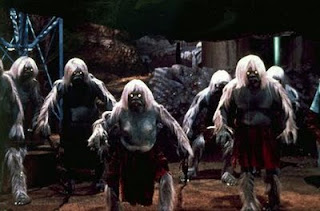
The Time Machine, Pal created more than just an action sci-fi movie. An important contributing factor is the music. I have always believed that the musical score can make or break a movie, and part of the credit for the feel of this movie must include composer Russell Garcia, who set the stage for the Victorian age with lilting, Irish-sounding music of great sentimentality, and was also responsible for creating an electrifying, frightening score during the action sequences. Cinematographer Paul Vogel brought the screen to dazzling life, and the make-up artist William Tuttle, working on George Pal’s own design, helped to create one of the most famous monster tribes in sci-fi history, the dreaded Morlocks.
The Time Machine was awarded one Oscar, for its special effects, considered groundbreaking for its time.
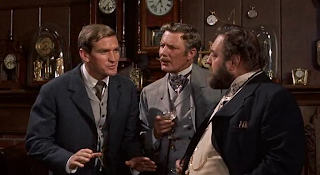
The story is that of H. George Wells (sound familiar?), played by one of my favorites, Rod Taylor. (Pal originally wanted Paul Scofield for the part of George, a role that doesn’t seem to be at all suitable for the great British stage actor. I believe that Rod Taylor, with his young and vigorous talent and singular mannerisms, better fit the bill.) George is an inventor, a dreamer, unhappy with the world he lives in. He is preoccupied with the concept of time, and his house is filled with the most beautiful clocks you’ll ever see. George has invited a group of his friends to dinner, mostly practical businessmen, one a doctor who has little sense of humor (played by Sebastian Cabot in a wonderful harrumphing, stolid British manner), none of whom are the dreamer type, and one who is always happily soused. Then there is one of my most beloved best friend characters, a Scot named David Filby, played sweetly by Alan Young. (Sad to say, Alan Young is best remembered for his role in the TV series Mr. Ed as the owner of a talking horse.) George has not arrived for his own dinner, and his faithful housekeeper, Mrs. Watchett (Doris Lloyd) announces that George left instructions to serve dinner if he was detained. The men settle comfortably at the dining room table, when suddenly George appears in the doorway, disheveled, wounded, exhausted. He sits down and asks for food and wine. His friend, the pleasant drunk, pours a large glass of wine with shaking hands and unintentionally drinks it himself. Then George begins to tell his story.
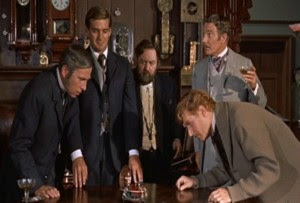
George reminds the men of their dinner the week before, when he announced that he had built a machine that could move through time. The friends of course don’t believe it, and George brings out his miniature model. It is a small, exquisitely crafted little machine that looks somewhat like a sled with a sphere-shaped circle behind the traveler’s seat. George asks the doctor to give him a cigar to represent a time traveler, which he bends to fit in a seated position. He explains that if his experiment works, they will never see the machine again, as it will forever speed forward in time. He asks the doctor to use his own finger to throw the tiny switch. The little machine begins to hum, the sphere begins to twirl, and the chandelier above their heads tinkles and shakes. The humming grows louder, the sphere twirls until it blurs, then suddenly the machine is gone with a final whistling echo.
George is exhilarated with the success, but even after having seen with their own eyes, his friends refuse to believe it could have happened. They leave in a group, thanking George for an interesting evening. George, angry and dismayed at their reaction, strides to his desk to write a note. Then David peeks around at him from one of the large chairs in front of the fire. “I thought I should stay,” he says. He tells George he is worried about him and wants to help. He learns that George is not interested in going into the past, but into the future. “I don’t much like the time I was born in,” George says. He thanks David for his concern, but says he would rather be alone.
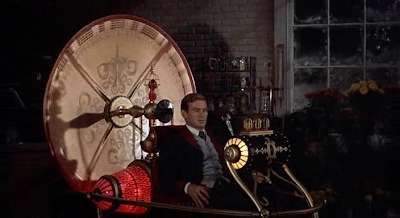
As soon as David leaves, George goes to his laboratory. The door opens, the music swells and there is the full-size time machine. What an exciting moment. The machine is absolutely stunning in every way. It is just like the miniature, incredibly crafted with brass engravings, velvet seat and gorgeous colors, a real thing of beauty. The camera follows George around the machine, accompanied with haunting music, so that the audience can see its exquisite nature. The machine was designed by MGM art director Bill Ferrari, with George Pal’s direction that since he had loved his sled as a child, he wanted it to be sled-like. George climbs onto the seat, pulls the handle and begins his voyage into the future
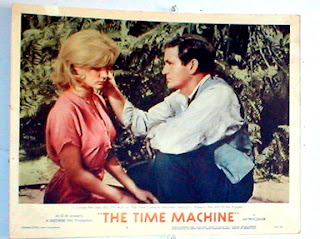
His journey is fascinating. He stops at different points in time, is able to see what becomes of his home and his friend, watches his city grow and sees its destruction and much more. The techniques used to show the passage of time, both slow and fast, are very clever. One involved a lit candle that burns down, showing the passage of time. Although it sounds like a simple scene, it took 5 days to shoot to get the right effect. One of the most memorable is a store mannequin that George can see from his lab window. As time passes, the lady mannequin’s clothes change, going from chaste Victorian to modern short skirts and bathing suits. George feels a kinship with the mannequin because, like himself inside the time machine, she never ages. Cataclysmic events begin to occur, and George finally has to speed his way through time at a blurring rate. He stops in the year 802701. There he finds a world that looks wonderfully evolved. Young beautiful people called the Eloi play and swim and somehow are fed without any work. (The word “eloi” means “My God” in Aramaic.) George notices that there are no old people, and also that the Eloi are strangely ignorant, uninterested in what goes on around them, and careless of life itself. Yvette Mimieux, only age 17, plays Weena, a young girl who does find interest in this strange man who has appeared from nowhere. Soon, George is to learn the true nature of the Eloi and the meaning of the strange Sphinx in the middle of the forest when he is made aware of the horror in that seemingly lovely world, another group that lives underground, the Morlocks.

That is as much of the story as you need to whet your appetite. I did not describe many of the exciting events of George’s journey so as to avoid spoiling everything for those who have not seen it. I would love to tell the ending because it is one of my favorite movie endings, but I am restraining myself. Suffice it to say that The Time Machine does not disappoint. As an interesting note, George Pal kept the miniature time machine in his home until it was destroyed by a fire. The larger model was found years later in a thrift shop in California, covered with dust and in pieces. However, the lucky finder bought and restored it. What I wouldn’t give to have that beautiful thing – it would be the admittedly unusual centerpiece of my living room!
George Pal hoped to make a sequel to the movie, and Rod Taylor was interested as well, but MGM rejected the idea. Perhaps that is just as well. This movie is unique and its reputation would likely only be tainted by what might have been the usual inadequate sequel. I remember seeing a showing of
The Time Machine on TV around 1995 that was hosted by Rod Taylor. He was of course 35 years older than when he played George, and with a wistful grin he said “It’s very strange to see myself so young as I find myself becoming more aged.” He loved being part of
The Time Machine, and with good reason. It’s a damn good movie. (Well, if Rhett Butler can say damn, I guess I can too!)