Showing posts with label melanie griffith. Show all posts

Monday, January 15, 2024

Working Girl and The Verdict

Melanie Griffith and Harrison Ford.
Working Girl (1988). Mike Nichol's R-rated update of a familiar comedy formula, Working Girl earned six Oscar nominations, made a star (albeit briefly) of Melanie Griffith, and transformed Harrison Ford into a romantic lead. Griffith plays Tess McGill, a hard-working, ambitious young woman who thinks she has landed the perfect job when she becomes the personal assistant to business executive Katherine Parker (Sigourney Weaver). Katherine listens to Tess's ideas. It turns out that she also steals one of them, which Tess discovers while Katherine is in the hospital recovering from a skiing accident. Rather than confronting her boss, Tess passes herself off as one of Katherine's fellow executives. She uses her smarts to set up a big business deal, but will she be able to pull it off before Katherine discovers the charade? Kevin Wade's script offers no surprises, so Working Girl relies heavily on Griffith, Ford, and Weaver. Fortunately, they deliver whatever is required: Griffith's plucky heroine is vulnerable yet tough; Ford provides a charming romantic foil; and Weaver delivers a deliciously funny performance as the film's villain. Director Mike Nichols makes fine use of the New York City locations. However, his inclusion of three brief nude scenes (including two of Griffith) seems unwarranted in a film about female empowerment. Carly Simon's song "Let the River Run" earned Working Girl its only Oscar despite those six nominations. (Personally, I think a more deserving Carly Simon song was "Coming Around Again" from Mike Nichols' 1986 movie Heartburn.) 

Paul Newman as Frank Galvin.
The Verdict (1982). Paul Newman earned the seventh of his nine Best Actor Oscar nominations as Frank Galvin, an alcoholic, washed-up Boston lawyer. When a friend tosses a medical malpractice case his way, Galvin chooses not to settle it out of court. Instead, he ignores his clients' wishes and takes the case to trial. The reasons for his decision are unclear. Has Frank rediscovered his passion for law? Is he trying to prove to himself that he can still be a successful attorney? Is he solely concerned with justice for the comatose victim? David Mamet provides no clear answers. In his original draft of the screenplay, the verdict was never even revealed (the movie does include it). While I admire Mamet's intent, I find the The Verdict to be ambitious without being fully successful. There's a twist involving Charlotte Rampling's character that's obvious from the moment she is introduced. James Mason, a fine actor, struggles to find any nuance in his high-powered defense attorney who will do anything to win. On the plus side, Paul Newman breathes life into Galvin and convinces the audience to root for this self-pitying attorney--who may or may not have found his self-respect at the film's conclusion. I know many fans of The Verdict and I encourage them to make their case in the comments below or on Twitter (I'm @classic_film). I have made my final summation.

Monday, December 2, 2019

Just Another Stormy Monday

Sting as Finney.
It's "American Week" in Newcastle upon Tyne and the English town is abuzz with U.S.-themed parades, movies, and concerts. The mayor is also hosting a visit from Mr. Cosmos (Tommy Lee Jones), an American businessman with ambitious plans to revitalize the local economy. Cosmos has run into an obstacle, though, in the form of a nightclub owner named Finney (Sting). Finney has rejected Cosmos's lowball offer to buy The Key Club, which occupies prime real estate near the riverfront.

Meanwhile, Kate--a waitress who moonlights as a hooker for Cosmos--has a chance encounter with a young Irishman named Brendan. Newly arrived in the city, Brendan (Sean Bean) applies for a janitorial job at The Key Club and takes an immediate interest in Kate (Melanie Griffith). He also overhears two of Cosmos's goons planning to "convince" Finney to sell his nightclub.

Melanie Griffith as Kate.
Stormy Monday (1988), writer-director Mike Figgis's first theatrical film, features a fascinating, interweaving plot populated by characters whose backgrounds remain intentionally vague. The narrative's catalyst is the seemingly naive Brendan, who unintentionally works against Cosmos by warning Finney about the goons and then changing Kate's outlook on her life. It's interesting that Brendan interacts with every major character in the film except Cosmos, whom he doesn't meet until the climax.

Figgis goes out of his way to provide minimal background details about most of his characters. He reveals almost nothing about Brendan, allowing the audience to draw its own conclusions based solely on Brendan's actions on the screen (e.g., he respects women, he knows how to use a gun). Likewise, Cosmos and Finney are painted with broad strokes. Kate is the only character who offers any meaningful revelations about her past and even she is guarded in what she confides to Brendan.

Sean Bean as Brendan.
The result is that the actors appear to have been given the flexibility to shape their performances. This approach works well for the most part. Melanie Griffith exposes Kate's vulnerability. Sean Bean captures Brendan's innocence as he tries to connect the dots. Sting adds a little compassion to his smooth, cool nightclub owner. Only Tommy Lee Jones falters by making Cosmos nothing but a stereotypical American gangster.

Running a snappy 93 minutes, Stormy Monday mostly succeeds in putting a different spin on the British crime drama genre. It was adapted into a 1994 TV series called Finney, with David Morrissey in the title role. The action takes place prior to the events in Stormy Monday.

Incidentally, I'm not sure if the movie takes place on Monday. There is some rain in it, but not persistent precipitation. Therefore, I'm guessing the film's title is just an ode to the song "Stormy Monday," which B.B. King sings over the closing credits.


Here's a scene from Stormy Monday, courtesy of the Cafe's YouTube Channel:


Monday, July 17, 2017

Paul Newman Gets Wet in "The Drowning Pool"

Harper arrives in New Orleans.
It probably sounded like a good idea at the time: Send Paul Newman's California private eye Harper to New Orleans and get him involved with a former flame, corrupt cops, a devious oil man, a dangerous young woman, and a whole lot of water. It took three screenwriters--typically a sign of trouble for a movie--to try to combine these elements into a coherent mystery. "Try" is the operative word here and, to the defense of the writers, I don't think Billy Wilder could have made a decent movie out of The Drowning Pool--though his version would have been more fun.

Newman first appeared as Lew Harper in the 1966 boxoffice hit Harper. That film was based on the Ross MacDonald novel The Moving Target, which featured private eye Lew Archer. There are several stories explaining the name change from "Archer" to "Harper," but--whatever his name--audiences loved Newman in the part. Still, sequels weren't as common in the 1960s as today, so it was something of a surprise when Newman decided to revive Harper nine years later in The Drowning Pool.
 
Joanne Woodward as Harper's client.
This time around, the easygoing detective goes to The Big Easy at the request of an old flame (Joanne Woodward) who has received an anonymous blackmail letter. Harper has barely walked into his motel room before a young woman (Melanie Griffith) tries to entrap him and he's arrested by an overprotective police detective (Tony Franciosa). He spends most of the film asking questions and getting beat up. There are two murders and a suicide along the way, but, to his credit, Harper eventually figures out the identity of the killer.

The Drowning Pool is a sluggish affair peppered with dull characters. It's hard to fault the actors. After all, Newman, Woodward, and Franciosa all appeared in another Southern drama, The Long, Hot Summer (1958), and that turned out marvelously. In The Drowning Pool, though, even Mr. and Mrs. Newman don't seem to have any chemistry in their scenes. It doesn't help that their tender moments are inexplicably underscored by a sappy instrumental version of "Killing Me Softly With His Song."

Newman and Gail Strickland in the best scene.
As for the title of The Drowning Pool, that brings us to the movie's best scene. Murray Hamilton, sporting a stylish red, one-piece jumpsuit, strands his wife (Gail Strickland) and Harper in a hydrotherapy room in an abandoned mental institution. Not wanting to face Hamilton's goons the next day, Harper decides to flood the room so he and his companion can float up to the ceiling and escape. It doesn't work as planned, but Harper still breaks free.

Of course, it could also be that The Drowning Pool refers in some esoteric way to the films's characters who are emotionally drowning in a swamp of apathy. Frankly, though, I think it refers to the angst experienced by unfortunate viewers who sit through this vapid mystery for 109 minutes.

Thursday, November 3, 2016

Gene Hackman Looks for Meaning in "Night Moves" (Me, too)

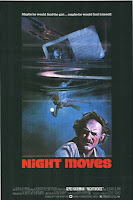
There are certain movies I feel compelled to watch periodically--even though I've seen them and know they will disappoint me again. One such film is Michael Crichton's Looker, which I've reviewed for this blog, and another is Arthur Penn's Night Moves. Both films have impressive pedigrees, with Crichton and Albert Finney responsible for the first and Arthur Penn and Gene Hackman teaming up for the second. Certainly, Night Moves is the more critically acclaimed of the duo--although let me stress that you won't find me among its admirers.
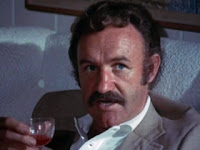
Dig the moustache?
Hackman plays Harry Moseby, a former Oakland Raiders football player who has become a private investigator. Because Night Moves was made in the 1970s, there must be a psychological reason for why he chose such an unusual profession. Sure enough, it turns out that Moseby's father abandoned him as a youth and that he tracked down Dad as an adult. Harry now finds meaning in finding people (more on that later), so he becomes a detective.
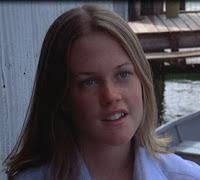
A young Melanie Griffith.
Arlene Iverson (Janet Ward), a former "B" movie actress, hires Harry to find her 16-year-old daughter Delly (Melanie Griffith), who has been missing for two weeks. Harry doesn't like Arlene, who won't win any parenting awards, but he takes the job for $125 a day and expenses. His investigation leads to a movie shoot in Mexico and eventually to Delly's stepfather's in the Florida Keys. He finds Delly, but also a lot of messed-up people and, yes, even murder.

Meanwhile, Harry's seemingly-grounded wife (Susan Clark) asks if he wants to see a revival of My Night at Maud's. Harry declines by quipping: "I saw a Rohmer film once. It was kind of like watching paint dry." This is the film's most famous quote...which is probably meaningful in some psychological way. (Incidentally, I like Rohmer.) Harry changes his mind later and shows up at the movie theater to discover his wife getting into a car with an unknown man. He follows them and later confirms that his wife is having an affair. Yes, this private detective isn't observant enough to note that his own marriage is on the rocks. I think this is intended to be psychologically meaningful.

James Woods is effective in a small role.
I believe there's a solid premise buried somewhere within Night Moves and that, plus Hackman's performance, may be what compels me to return occasionally to this film. However, I always end up flustered by the half-baked ideas. There are references to Kennedy and some hand-held footage of a car crash that may not be an accident (ah, an analogy to the Zapruder footage). Harry plays chess and discusses a knight move in a famous game (ah, "knight move" and "night move"). It turns out that Harry lied to his wife about finding his father. (I did pick up on the reference to football player Alex Karras, who was co-star's Susan Clark's husband in real life.)

Night Moves intentionally posts some key questions and then ends without answering them. That's how life is and I respect that approach. I don't mind a challenging film either--heck, I watched Last Year at Marienbad and count myself among the millions baffled by it. However, Night Moves is simply unsatisfying on too many levels to make it a meaningful viewing experience. Please note that I'm in the minority among my film critic brethren. Roger Ebert thought it was a new kind of film noir about "an old-fashioned private eye who says and does all the expected things while surrounded by a plot he completely fails to understand."

As for me, I'm glad I wrote this review. Ten years from now, when I'm intrigued to watch Night Moves again, I can re-read this post and then opt for a Rohmer movie instead.