Showing posts with label olivia de havilland. Show all posts

Monday, April 6, 2026

Devotion: A Biographical Misfire

Ida Lupino as Emily Bronte.
With a top-flight cast, rich source material, and high production values, Devotion (1946) has all the makings of a classic film biography of the Bronte sisters. And yet, when "The End" finally flashed on the screen, all I could do was ponder how things went so terribly wrong. It's not a dreadful movie, mind you--but it's inaccurate, inconsiderate, and empty.

The inaccuracy is nothing new when it comes to film biographies. There are plenty of biographies that take dramatic license with real events. Devotion imagines that Charlotte Bronte (Olivia de Havilland) and her sister Emily (Ida Lupino) fell in love with the same man, a curate (Paul Henreid) who worked for their father. Each sibling pours their passion into their novels and the results are Charlotte's Jane Eyre and Emily's Wuthering Heights

According to most accounts, real life featured less emotional turmoil and more interesting people. There was no love triangle. Emily never married; in fact, there is no indication of any romantic relationship in her life. Wuthering Heights was the product of her literary imagination. She and Charlotte were not close (the latter was eight years older); Emily felt a more kindred connection with her younger sister Anne. Keith Winter's screenplay does get some things right: brother Bramwell was an alcoholic; the sisters attended a school in Belgium; and Jane Eyre was a contemporary popular success while Wuthering Heights was not.

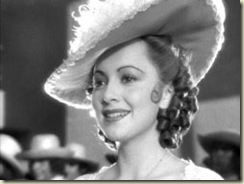
Olivia de Havilland as Charlotte.
The inaccuracies in Devotion, though, are less offensive than the film's inconsiderate treatment of its audience. The filmmakers seem to assume that the audience can't handle a serious portrait of the Bronte sisters' lives. The first half of Devotion unfolds like an adaptation of Little Women with the sisters and their brother frolicking on the moors and Charlotte developing a schoolgirl crush on her headmaster. Just as Ida Lupino, who provides some much-needed gravitas, finally steers the film in the right direction, Emily is relegated to the background as Charlotte becomes a London celebrity. From there, Devotion limps to its conclusion.

There are small pleasures to enjoy along the way, in particular Erich Wolfgang Korngold's rich music score and Ernest Haller's atmospheric cinematography. There is almost a quaint charm about the stagey "B" movie sets that are supposed to be the moors. Yet, nothing can save Devotion from its fate as a subpar biography dressed up like a Warner Bros. "A" production.

Although completed in 1944, Devotion was not released until two years later--a rare practice in the 1940s. Some historians believe that the delay was related to Olivia de Havilland's landmark lawsuit against Warner Bros. that resulted in the creation of the De Havilland Law.

Monday, April 12, 2021

The Alternate Movie Title Game (Olivia de Havilland Edition)

Here are the rules: We will provide an "alternate title" for a film that starred Olivia de Havilland and ask you to name the actual film. Most of these are pretty easy. Please answer no more than three questions per day so others can play. You may have an answer other than the intended one--just be able to defend it!

1. Funerals with Footwear. 

2. No Room for a Quartet.

3. Vipers' Den.

4. Charlotte & Emily.

5. The Evil Sister.

6. Elevator!

7. What Ever Happened to Cousin Charlotte?

8. The Mysterious Past of  Mark Sebastian.

9. Rejection.

10. Mother Without a Son.

11. Outlaw Town.

12. The Brothers Vickers.

13. Voice from the Grave.

14. A Wedding in Florence.

15. Trapped Underwater!

Thursday, January 11, 2018

The Five Biggest Stars of the 1940s

After previously listing our picks for the Five Biggest Stars of the 1950s and the Five Biggest Stars of the 1960s, we turn our attention to the 1940s. The major Hollywood studios were still at their peak, though Olivia de Havilland's 1944 legal victory against Warner Bros. planted the seeds of change. World War II made a major impact, too, as some of cinema's biggest stars joined the Armed Forces.  As with our other Biggest Stars posts, our criteria focused on boxoffice power, critical acclaim, and enduring popularity.

1. Humphrey BogartHigh Sierra cemented Bogart's stardom in 1941 and he followed it with one of the most successful decades of any actor. His filmography for the 1940s includes: The Maltese Falcon (1941), Casablanca (1942), To Have and Have Not (1944), The Big Sleep (1946), Dark Passage (1947), and Key Largo (1949). Note that this list includes Bogie's two most iconic roles, as Sam Spade in The Maltese Falcon and Rick Blaine in Casablanca.

2. Olivia de Havilland - Ms. de Havilland started the decade with her final two pairings with Errol Flynn (Santa Fe Trail and They Died With Their Boots) and ended it with Best Actress Oscars in 1947 (To Each His Own) and 1949 (The Heiress--likely her most popular role among classic film fans). In between, she earned critical acclaim for films like Devotion (1946) and The Snake Pit (1948).

3. Cary Grant - Cary was an established star at the start of the decade and maintained that status with a string of popular films: The Philadelphia Story (1940), My Favorite Wife (1940), Suspicion (1941), Notorious (1946), and The Bishop's Wife (1947). His career would continue to thrive in the 1950s as well.

4. John Wayne - The Duke's most significant contribution to the decade may have been his Cavalry Trilogy with director John Ford: She Wore a Yellow RibbonFort Apache, and Rio Grande. But he also scored other critical successes (Red River) and boxoffice hits (Sands of Iwo Jima). It's interesting to note that neither Wayne nor Grant served in the Armed Forces during World War II. (Bogart had a stint in the Navy at the end of World War I.)

5. Bette Davis - Although she was perhaps a bigger star during the previous decade, Bette Davis still forged a glittering career in the 1940s with films such as The Letter (1940), The Little Foxes (1941), Now, Voyager (1942), and The Corn Is Green (1945).

Honorable Mentions:  Barbara Stanwyck, Gary Cooper, Bing Crosby, and Bob Hope.

Thursday, July 6, 2017

Dirk Bogarde and Olivia de Havilland Seek the Truth in "Libel"

Dirk Bogarde as Sir Mark Loddon?
During a two-day stopover in London, a Canadian World War II veteran named Jeffrey Buckenham sees a snippet of a television show about English country estates on a pub’s television. Buckenham recognizes the estate’s owner and is next seen participating in a tour of the manor house. He remains behind when the tour departs and confronts the owner, Sir Mark Loddon.

Buckenham is convinced that the man claiming to be Loddon is a nefarious imposter named Frank Wellney. Loddon acts perplexed and becomes angry when Buckenham snarls: “I want to see you crawl, Frank.”

Buckenham pursues his contention and convinces a local newspaper to publish an open letter in which he exposes Loddon as a fraud who assumed a dead man’s identity during an escape from a prisoner of war camp.

Loddon claims to have virtually no memory of his pre-war life due to his traumatic war injuries. He wants to ignore the allegations. However, his wife Margaret feels strongly that he should file a libel lawsuit against Buckenham and the newspaper. Loddon reluctantly agrees—even though it’s quite possible that it will become a trial to prove his identity.
Olivia de Havilland and Dirk Bogarde as the Loddons.
Based on a 1934 stage play by Edward Wooll, Libel (1959) is an exceedingly well-crafted film with plenty of drama inside and outside the courtroom. Its most intriguing element is that there are three possible outcomes to the story: (1) Frank Wellney could be impersonating Loddon; (2) Loddon could be the real Loddon; or (3) Loddon could be Wellney, but doesn’t know it because of war-induced amnesia. During the trial, though, the evidence against Loddon becomes so persuasive that even his wife begins to have her doubts. (It’s interesting to note that the plot wouldn’t work today as DNA tests could determine Loddon’s identity.)

Dirk Bogarde is superb in the lead role, leaving the audience to determine if his character’s perpetual haunted look is because he can’t remember what happened during the POW escape or because he fears being exposed as a fraud. His most impressive work is in the flashbacks in which he portrays both Loddon and Wellney in the same scene.


Olivia as Margaret Loddon.
The rest of the cast provides outstanding support. As Margaret Loddon, Olivia de Havilland has one of the best roles of her later career and her climactic scene with Bogarde is charged with emotion. Paul Massie is quietly convincing as Buckenham. The only other film I’ve seen him in was Hammer’s The Two Faces of Dr. Jekyll, in which he played Jekyll as a milquetoast and Hyde as a dashing villain. Finally, British veterans Robert Morley and Wilfrid Hyde-White are ideally cast as the battling barristers who are best friends outside the courtroom.


Robert Morley as a barrister.
Director Anthony Asquith obviously knew his way around cinematic courtrooms, having earlier helmed legal dramas The Winslow Boy (1948) and Court Martial (1954). He also directed several other highly-regarded British classics, to include Pygmalion (1938), The Browning Version (1951), and The Importance of Being Earnest (1952).

Libel was nominated for one Academy Award…for Best Sound. Inexplicably, it’s not a well-known movie despite the acting pedigree and intriguing plot. Fortunately, it’s currently available on Warner Archive’s streaming service. Really, though, TCM should have a Dirk Bogarde day and include Libel as part of the schedule.

Here's a clip from Libel. You can view it full-screen on the Classic Film & TV Cafe's YouTube Channel. (You can also stream the entire movie at warnerarchive.com).

Thursday, June 22, 2017

Love It or Shove It: Classic Movie Edition

In this new occasional feature, we'll make a statement about classic cinema and then ask our panel of movie experts to "love it" (they agree) or "shove it" (they disagree). It should be a fun way to get some different perspectives. This month, our expert panel is comprised of: Connie Metzinger from Silver Scenes, John Greco from Twenty Four Frames, and Cafe staff member Toto.

So, let's get started!

Is Nicholson's film a classic?
1.  The best films of the 1970s--such as One Flew Over the Cuckoo's Nest and The Godfather Part II--are classic films in every sense of the term.

Connie:  Shove it. I appreciate 1970s films as much as 1940s films, but no matter how stellar the picture may be, it's not a classic in my book.

Toto:  Love it. An important element of classic films is that they hold up over time as evidenced by the powerful performances of Jack Nicholson and Louise Fletcher in One Flew Over the Cuckoo's Nest. Classic films also impact us socially. Though personally not a fan of The Godfather saga, it continues to influence culture as evidenced by The Sopranos and parodies on MADtv.

John:  Love it. For me, the classic film did not end with the demise of the studio system.  It continued with many of the 1970s filmmakers, who grew up during the studio heydays and fell in love with Hollywood. Francis Ford Coppola's Godfather films are brilliant cinema. They embody the visual technique of old Hollywood with a modern touch. Coppola and his films are just one example. Others include Brian DePalma, who mixed Hitchcock suspense with modern day visual cinematic techniques (Sisters, Carrie). Martin Scorsese's love of classic Hollywood is well known, and it comes through in Mean Streets, Taxi Driver, and New York, New York. Woody Allen's comedies of the 70s are revisionist takes of Hollywood’s classic romantic and slapstick comedies. Finally, Peter Bogdanovich's The Last Picture Show, Nickelodeon and What’s Up Doc? all pay tribute to Hollywood’s golden years. The filmmakers of the 70s embraced the old Hollywood as much as they rebelled and changed it.

2.  Alfred Hitchcock's best decade was the 1950s, which included Rear Window, Vertigo, and North By Northwest.

Connie:  Love it. It took the master of suspense twenty years to perfect his craft and he reached his directorial prime in the 1950s.

Toto:  Love it. I like every Hitchcock film from the 1950s and that isn't a statement I can say for all directors.

John:  Love it. Alfred Hitchcock made brilliant films in every decade, but few filmmakers, if any, had a run of four masterpieces in a ten year period with Strangers on a Train, Rear Window, Vertigo and North by Northwest. Any other filmmaker would find this hard to beat.  In addition, during that same decade of the 1950s, Hitch made lesser, but still fascinating, films like Stage Fright, Dial M for Murder, To Catch a Thief, The Man Who Knew Too Much and two underrated gems The Trouble with Harry and I Confess. Even Hitchcock’s own 1930s period which is filled with some brilliant work does not match his 1950s output.

Cary Grant at age 62.
3.  Cary Grant retired too soon. He was 62 when he made his last film, Walk Don't Run, in 1966.

Connie:  Shove it. Cary Grant didn't have outstanding acting abilities and if he were to have continued to perform into his 70s and 80s he would have had to rely solely on his talent and not his debonair charm or good looks. Besides, it would have been too sad to see him end his career in a cheap horror film as so many actors did.

Toto:  Shove it. I love Cary Grant! He entertained people all of his life. Retirement at 62, when he became a father for the first time, was well deserved.

John:  Hate it. Retirement was a personal choice on Cary Grant’s part, so it’s hard to argue. He didn't like the limelight. After retirement, he kept himself busy with family and various business dealings (he was on a couple of corporate boards.) As a fan, I don't like it that Grant left the screen so early; that's where the "hate it'" comes from. I felt we were cheated. However, I can understand it on a personal level that he wanted out. He was still a big star, and he left it all behind. That in itself takes some guts.
Sisters Olivia and Joan.

4. Based on the body of her work, Olivia de Havilland was a better actress than her sister Joan Fontaine.

Connie:  Love it. Joan Fontaine was an extremely talented actress, but unlike her sister she didn't have the skill in selecting noteworthy parts that showcased her talent, and that's an important part of being an actress. Joan would often follow a marvelous performance in a great movie by a mediocre role in a mediocre comedy.

Toto:  Love it. From Captain Blood through They Died With Their Boots On, I really enjoyed the eight pairings of Olivia de Havilland and Errol Flynn. She was enchanting in Gone With the Wind and left us guessing in My Cousin Rachel.

John:  Love it. At first, I was jumping back and forth on who I thought was better. However, while Joan Fontaine was excellent in both Suspicion and Rebecca, I am not sure she ever did anything as challenging as sister Olivia's work in The Snake Pit and The Heiress. During her career, Olivia de Havilland either went after more difficult roles than Fontaine or was fortunate enough have them handed to her by the studio. Either way, I ended up leaning toward the older sister.

Saturday, May 16, 2015

My Favorite Classic Movie Blogathon: Why I Love "The Adventures of Robin Hood"

This post is part of the My Favorite Classic Movie Blogathon in celebration of National Classic Movie Day (May 16th). Click here to view the schedule listing all the great posts in this blogathon.

Much has been written about Warner Bros.' 1938 classic swashbuckler, including several posts at this blog. So, in lieu of a traditional film review, I decided to write about why I love The Adventures of Robin Hood. After extensive reflection, it has boiled down to these six reasons:

Rains, Rathbone, and Cooper.
1. A Perfect Cast. With the possible exception of The Wizard of Oz, I can't think of another large-scale film with a stronger cast from top to bottom. Let's start with the four immortal screen stars in the major roles: Can you imagine anyone more suited to play Robin Hood (Errol Flynn), Maid Marian (Olivia de Havilland), Sir Guy of Gisbourne (Basil Rathbone), or Prince John (Claude Rains)? Moving on down the cast, Robin Hood features some of the screen's finest character actors in Hollywood history with Alan Hale (Little John), Eugene Pallette (Friar Tuck), and Una O'Connor (Marian's lady-in-waiting Bess). Even the smallest roles are brought to life skillfully by the likes of Melville Cooper (the buffoonish Sheriff of Nottingham), Patric Knowles (Will Scarlet), Herbert Mundin (Una's lovable suitor), Montagu Love (the appropriately-named Bishop of Black Canons), and Ian Hunter (a noble-looking King Richard).

2. Erich Wolfgang Korngold's Score. For much of my youth, I didn't pay attention to a movie's background music unless there was a prominent theme (e.g. Laura). That changed when my sister and I gave my father an album featuring selections from Korngold's greatest scores, including The Adventures of Robin Hood. Korngold's exhilarating music stands nicely on its own, but it's even better as a tailor-made complement to a classic swashbuckler. Ironically, Korngold had doubts for his ability to score an action film, stating that he "had no relation to it." He was oh so wrong!

3. 1930s Technicolor. In his book Harnessing the Technicolor Rainbow: Color Design in the 1930, Scott Higgins wrote: "The Adventures of Robin Hood is a turning point in Technicolor design. For the first time in a three-color feature, the palette is opened wide and intricately organized. Far from returning to demonstration, Robin Hood's assertive design modulates color to effectively direct attention and underscore drama." Certainly, it's a stunning visual screen experience with the many earth tone colors accented by brilliant reds and greens. With the exception of Powell and Pressburger's brilliant color films, I would argue that the three-strip Technicolor films of the 1930s are unmatched in their graphic splendor.

4. The Outlaw That's Really a Hero. This is a plot that always appealed to me and obviously I'm not alone. In addition to the many versions of the Robin Hood legend, there are numerous other engaging literary and cinematic variations such as The Mark of Zorro, Doctor Syn, and The Green Arrow.

Olivia looking concerned during the
archery tournament.
5. It's in the Genes. My parents, especially my father, were huge Errol Flynn fans. Thus, in the pre-VCR days, it was a family event when any of his movies turned up on television. However, it was a special event when it was The Adventures of Robin Hood. I don't think my father ever named a favorite film, but certainly Robin Hood would have been among the front-runners. I'm a firm believer that one's film-watching experience influences how one remembers a movie. I have nothing but delightful childhood remembrances of sitting with my family in front of the TV and watching Errol romancing Olivia, battling Basil, and--through the magic of cinema--splitting an arrow.

6. Let's form a team! I once devoted a whole post to my love of movies in which the hero forms a team to go battle the bad guys, steal something valuable, or liquidate a witch. I call it the Robin Hood Syndrome because, for me, it originated from watching The Adventures of Robin Hood. I think the appeal has to do with the idea that even the bravest hero needs help and that (to paraphrase Mr. Spock) the strength of the many is stronger than the strength of the one.

Thursday, May 22, 2014

My Cousin Rachel: Is Olivia de Havilland a Murderer?

Can you name two real-life sisters who each starred in a Hollywood adaptation of a Daphne Du Maurier novel? The answer, as you may have known, is Joan Fontaine and Olivia de Havilland. Joan naturally starred in Rebecca, Alfred Hitchcock’s 1940 Oscar-winner. Olivia portrayed the title role in 1952’s lesser-known, but equally compelling, My Cousin Rachel. It’s not surprising that Rebecca was the bigger hit of the two, given its all-star cast and the collaboration of Hitchcock and David O. Selznick. Also, it boasted a happy ending. But while I admire Rebecca, I find the intentionally ambiguous My Cousin Rachel to be the more intriguing film.

Richard Burton (in his first major screen role) plays Philip Ashley, a young man raised by his older cousin Ambrose on an isolated estate along the Cornish coast. The two men have a close relationship, as evidenced by Philip’s description of Ambrose as “father, brother, friend--everything in the world to me.” Thus, Philip is surprised when his cousin departs for an indefinite holiday in Italy for health reasons. That surprise only grows when he receives a letter from Ambrose announcing his marriage to Rachel Sangalletti, a widowed distant cousin. Weeks later, Philip receives a series of disturbing letters in which Ambrose accuses Rachel of trying to kill him. Philip rushes to Florence to see his cousin, only to learn that Ambrose has died and Rachel has vanished.

Philip confronts his cousin's widow.
Shortly after Philip’s return to Cornwall, Rachel (Olivia de Havilland) appears on an apparent pretense to deliver some of her late husband’s possessions. Philip wants to accuse her of Ambrose’s murder, even though there is medical evidence that a brain tumor may have caused his cousin’s paranoid behavior. However, Philip—like everyone else—finds Rachel to be completely charming. In fact, he begins to fall in love with her, despite rumors of questionable behavior on her part.

Philip searches for murder evidence.
There have been numerous films built around the “did they or didn’t they” premise (Suspicion, anyone?). But I can’t think of a movie that plays on that premise more skillfully than My Cousin Rachel. At various points during the film, the viewer is equally convinced that Rachel is a clever, money-grubbing murderer or an innocent woman coping with conflicting emotions. Her actions ensure that she remains a enigma. Rachel appears to return Philip’s affections, but she coldly turns down his marriage proposal. She nurses him when he is gravely ill, but rejects him again when he recovers. She announces her departure from Cornwall, but confides to a friend her strong feelings for Philip. We’re never sure if she’s wrestling with her emotions or just very devious.

As for Philip, there is no doubt that he is naïve and prone to quick decisions. He ignores sound financial advice from his solicitor. He rejects all criticism and acts peevish when he doesn’t get his way. One explanation for his behavior may be his desire to replace Ambrose with Rachel, as if the thought of being alone is more than he can bear. He dismisses any romantic interest in Louisa, his pretty neighbor and long-time friend. It’s as if only Rachel can fill the lonely void left by Ambrose.

Richard Burton and Olivia de Havilland excel at playing these complex characters. Daphne Du Maurier recommended Burton for the part. It’s not a subtle performance, perhaps because the stage-trained actor was still adjusting to the medium of film. However, his tendency to sometimes overplay works to his advantage, imbuing Philip with an almost manic personality. Burton earned an Academy Award nomination for Best Supporting Actor.

Richard Burton at age 27.
Some sources claim that Burton and de Havilland did not get along well. In his biography Richard Burton: Prince of Players, Michael Munn quotes de Havilland: “(Burton is) a coarse-grained man with a coarse-grained charm and a talent not completely developed.” However, in an interview with Irene Kahn Atkins, My Cousin Rachel’s director Henry Koster claimed there was no friction between his two stars. In reference to the young Burton, he stated: “Without him, this picture wouldn't have been what it was.”

Olivia de Havilland as Rachel.
For her part, Olivia de Havilland gives one of her best performances. She had not made a film in three years, but was still basking in the glow of critical acclaim for The Snake Pit (1948) and The Heiress (1949). Still, she was not the first choice for the title role in My Cousin Rachel. George Cukor considered directing the film at one time, with the goal of bringing Greta Garbo out of retirement to play Rachel. Vivien Leigh was also a candidate for the role before Olivia de Havilland was cast.

From a production standpoint, My Cousin Rachel looks impressive and believably recreates the Cornish coast (although some footage was shot in Cornwall). It’s no surprise that the film’s crew earned Oscar nominations for art direction, costume design, and cinematography (black & white).

Daphne Du Maurier’s novel was remade as a four-part British miniseries in 1983 with Geraldine Chaplin as Rachel and Christopher Guard as Philip. Alas, I’ve never seen it so I cannot make a comparison. It would have to be very good, though, to rank with the splendid 1952 version.


This review is part of the CMBA's Fabulous Films of the 1950s Blogathon. Click here to check out this wonderful blogathon's complete schedule.

Monday, May 19, 2014

Seven Things to Know About "The Adventures of Robin Hood"

1. It's been well-documented that Warner Bros. seriously considered James Cagney for the title role after his success in A Midsummer Night's Dream (1935). However, did you know that Warner Bros. originally wanted Guy Kibbee for Friar Tuck and David Niven for Will Scarlet? Although Olivia de Havilland was the first choice for Maid Marian, Jack Warner briefly considered Anita Louise before finally settling on Ms. de Haviland.

2. Bidwell Park, located in Chico, California, was used for the scenes in Sherwood Forest. Located about 500 miles north of Los Angeles, the park is over 3600 acres today.

Director Michael Curtiz.
3. William Keighley, the original director, shot most of the exterior scenes--only to be replaced during the production by Michael Curtiz. In Hal B. Wallis's 1980 autobiography Starmaker (written with Charles Higham), he offered this explanation: "The action scenes were not effective, and I had to replace the director mid-production, an unheard-of event at the time. I felt that only Michael Curtiz could give the picture the color and scope it needed. The reason we hadn't used him in the first place was because Errol had begged us not to."

4. Composer Erich Wolfgang Korngold originally turned down Warner Bros.' offer to score The Adventures of Robin Hood. In Robin Hood: An Anthology of Scholarship and Criticism, writer Rudy Behlmer quotes Korngold's assessment of the film (after viewing a working print): "Robin Hood is no picture for me. I have no relation to it and therefore cannot produce any music for it. I am a musician of the heart, of passions and psychology; I am not a musical illustrator for a 90% action film." Fortunately, Leo Forbstein, the head of Warners' music department, convinced Korngold to change his mind.

5. Master archer Howard Hill was the man who actually fired the arrows from a longbow. Hill provided his services for other films, too, such as The Private Lives of Elizabeth & Essex, They Died with Their Boots On, Dodge City, Virginia City, and Bandits of Sherwood Forest. He started the company Howard Hill Archery in the 1950s and it's still thriving today (www.howardhillarchery.com). There are various accounts as to whether or not Hill actually split an arrow with another one in Robon Hood's famous archery tournament scene. In the TV series Mythbusters, the gang tried to replicate the arrow splitting--but were unable to do it.

6. In his book Harnessing the Technicolor Rainbow: Color Design in the 1930s, author Scott Higgins maintains that "The Adventures of Robin Hood is a turning point Technicolor design" and "is also one of the best-remembered early three-color productions because it brought Technicolor to a genre that would become a staple of 1940s and '50s color production."

Technicolor at its most vivid.
7. At a cost of $2 million, The Adventures of Robin Hood was Warners Bros' most expensive film to date. It made also $4 million at the box office during its original release.

Saturday, November 12, 2011

Speaking to Scarlett O’Hara

gonewith
Why, Ms. Scarlett (Vivien Leigh), I do declare that you are one of the greatest female characters, both in film and prose, in American history.  You might be calculating but oddly still stupid at times, but I still like you and your 18 inch waist (pre Bonnie, rest her dear soul). Perhaps I often found myself hoping that Ms. Melly (Olivia de Havilland) would slap you or that a Yankee soldier would defile you—both to teach you a lesson—but I still hoped beyond hope that you would triumph in the end.  Alas, your god and creator, Margaret Mitchell, got it right in the end—let the reader/viewer decide how  your tomorrow turned out.  Of course, had Mitchell known that her money-grubbing descendants would allow Alexandra Ripley to write a trashy sequel (I won’t name the title, but the title is the most creative thing about it…and that’s all you need to know, Ms. Scarlett), perhaps she would have relented about writing the end of your story.  So, what makes you and your film merit a four-star rating, Ms. Scarlett? 

GWTW_3lgStar one: your theme music.  Dramatic and memorable—just like you Ms. Scarlett. Whenever I hear it I immediately think of the lush green gardens of Tara (and the burning of Atlanta, too—damn those Yankess, Miss Scarlett, damn them!),  Ah, and just like you were robbed by those damn Yankees, composer Max Steiner was robbed by the Academy when he lost the Oscar to some silly guy named The Wizard of Oz—now you know that’s not a decent, Southern gentleman’s name, Ms. Scarlett. Of course, it only makes sense that you would have one of the most memorable film scores ever, Ms. Scarlett, as you are the most memorable female film character in history.  Every badass needs a badass theme song, Ms. Scarlett, and rest assured, when your overpriced barouche is cruising the streets of Charleston (or Savannah, Atlanta, etc.) people know what badass is coming. 

Star two: your clothes.  With a figure like yours, Scarlet-OHaraMs. Scarlett, you would look good in anything.  While I don’t know how wise it is to wear a green and white dress to a BBQ, I still think you make it work—and that green ribbon that attaches your hat to the rest of you could be used as a napkin if need be. What I’m saying is, you know how to make any dress work.  Take for example the white ruffle dress—some people would look like a roll of toilet paper gone wrong, but somehow it looks flouncy on you.  Another example is the red garnet gown that you look ultra-fierce in.  Some people just couldn’t work those feathers and the gauze-veil thingy, but you rock it. And, who but you could make a dress out of green velvet drapes seem stylish (sort of)?  Granted, it was because of those damn Yankees that you had to rip those curtains down and wear the tassels as an accessory belt, but we can’t blame the dress for the circumstances into which it was born. 

gone_with_the_wind_movie-11469Star three: your crew. Rhett Butler (Clark Gable) may have left you in the end, but while he was with you he was the man in charge.  Your scenes together alone could have burned down Atlanta—damn Yankees.  I have to admit, I just couldn’t understand why you were always after that loser Ashley Wilkes (Leslie Howard) when you had a man like Rhett around. Was it that he rejected you, Ms. Scarlett?  You were just too much woman for that weak man!  He needed a calm woman like your cousin Ms. Melly, so he could continue the cycle of inbreeding. Melly, now there was a woman who knew how to endure, Ms. Scarlett.  Just think of all the insufferable things Aunt Pittypat (Laura Hope Crews) said over the years to that poor girl!  And you thought listening to Prissy (Butterfly McQueen) and Mammy (Hattie McDaniel) all the time was almost too much to bare.

Star four: your attitude.  There’s one thing that makes a person memorable, and that’s their attitude.  Sometimes things don’t go the way you want, but that doesn’t mean you give up. And, Lord knows, Ms. Scarlett you never give up.  Ashley married Melanie, so you married Charles (he was better looking anyway, plus he died and ScarletonStaircaseleft you some worthless Confederate money—damn Yankees!). When you didn’t have the money to pay the taxes on Tara you and your drape dress found Frank Kennedy.  When the damn Yankees came calling you shot one dead. To me, this is a can-do attitude.  Plus, you always know you are the most interesting woman in the room.  Of course, you do have a touch of willfullness and a rather nasty temper, but Irish blood runs hot!  Now, if I had to make one constructive suggestion to you it would be this: get over your procrastination issue. Tomorrow might be another day, but sometimes that day can turn out to be really crummy. Still, I like the can-do attitude about getting your man back. 

And, that, Ms. Scarlett, is why you and your film are so memorable.

Wednesday, April 21, 2010

Errol Flynn Leads the Charge of the Light Brigade

In his second starring role, following the previous year’s Captain Blood, Errol Flynn cemented his claim to superstardom. His quick success owed much to his good looks, his natural charm (especially in the scenes with Oliva de Havilland), and his ability to portray a convincing leader. Audiences believed it when he asked men to follow him—even to their deaths—in this film, They Died With Their Boots On, and Rocky Mountain.

The Charge of the Light Brigade takes place in India in 1854 during the Crimean War between Russia and England (and other European countries). An unstable political situation becomes worse when England withdraws financial support from Surat Khan (C. Henry Gordon), the influential leader of the Suristani tribesmen. Khan eventually pledges his allegiance to Russia and commits a ruthless act that sets into motion the charge of the film’s title.

Against this backdrop of war, Major Geoffrey Vickers (Flynn) and his brother Perry (Patric Knowles) vie for the affections of Elsa Campbell (de Havilland). An early scene informs us (the audience) that Elsa, though engaged to Geoffrey, has secretly fallen in love with Perry. This knowledge causes us to empathize with Geoffrey as his emotions evolve from disbelief to anger to understanding. Geoffrey’s scenes with Elsa are all the more touching, because as he professes his love, we know she is consumed by guilt.

On the surface, The Charge of the Light Brigade comes across as a well-crafted action film with a love triangle subplot. But it also offers a subtle commentary on the military mind. At one point in the film, Vickers follows orders against his better judgment—because following orders is what officers do. The result is a bloody massacre that haunts Vickers and his men. When an opportunity for revenge arises later, Vickers chooses not to follow orders, an act that results in both tragedy and triumph.

Warner Brothers lavished high production values on The Charge of the Light Brigade, although it’s too bad it’s not in color. Max Steiner’s marching musical score is inspirational. The cast is top-notch (though Nigel Bruce is perhaps too silly for a Army colonel). And, under the sure hand of director Michael Curtiz, the climatic charge is impressive and exciting.

It was filmed in San Fernando Valley during cold temperatures. Both Errol Flynn and co-star David Niven describe the difficult production in their entertaining autobiographies My Wicked, Wicked Ways (Flynn) and Bring on the Empty Horses (Niven). The title of the latter book is attributed to Curtiz, who frequently shouted to the film crew to "bring on the empty horses" to portray the number of fallen lancers during the charge. Sadly, trip wires were used to cause the horses to stumble, which sometimes caused injuries so severe that the animals had to be killed. Humane societies, including the Society for the Prevention of Cruelty to Animals, sent formal complaints to Warner Bros., which ultimately resulted in measures to monitor animal scenes during film productions. Charge is one of the few Flynn hits never re-released by Warner Bros., largely because of the concern over the treatment of horses during the climatic charge.

Charge of the Light Brigade was the second of nine Flynn-de Havilland films. Ironically, Anita Louise was originally cast as the female lead and Olivia was a last minute replacement. Flynn and Patric Knowles would appear in three additional films together (Patric's biggest roles were probably in Charge and Four's a Crowd). Flynn and Niven reteamed again for The Dawn Patrol. Finally, although they famously didn't get along, Flynn and Curtiz made twelve films together, if one counts the Perry Mason mystery The Case of the Curious Bride (in which Flynn is the corpse and shown briefly in flashback).

In 1968, Tony Richardson (Tom Jones) directed another version of The Charge of the Light Brigade, which was not technically a remake. Though based on the same historical incident (and also borrowing the title of Alfred Tennyson's famous poem), it's an anti-war film with a satirical edge. Trevor Howard and David Hemmings were the stars. Though probably more accurate, I much prefer the Curtiz-Flynn version.

Saturday, April 10, 2010

Errol Flynn Is the Swashbuckling Captain Blood

cap
Before 1935, Errol Flynn was an Australian nobody in Hollywood. He’d made five very forgettable films (only one of which he “starred” in) and his career was in neutral. And, then Robert Donat turned down (rather vehemently) the role of Captain Blood. Although he may have been a stingy S.O.B., Jack Warner often could spot diamonds in the rough and he saw something in Flynn’s raw animal magnetism and gave Flynn the role that would launch an adventurous career.

Based on Rafael Sabatini’s novel of the same name, Captain Blood was directed by Michael Curtiz and was nominated for 5 Academy Awards. Errol Flynn plays a 17th Century Irish doctor who is found guilty of treason in England after treating a man wounded in the Flynn,%20Errol%20(Captain%20Blood)_01 Monmouth Rebellion (this was a rebellion to overthrow King James II). Sentenced to slavery in the West Indies (specifically Port Royal, Jamaica), he is condemned to the sulfur mines after refusing to allow the colony’s military commander, Colonel Bishop (the strangely entertaining Lionel Atwill), to examine his teeth. Attracted by Blood’s open defiance of her uncle, the plucky Arabella Bishop (Olivia de Havilland) decides to rescue Blood from sure death and buys him for 10 pounds. Oh, what would a gorgeous woman want with a rebellious slave stud? Get your minds out of the gutter! Blood is openly resentful towards Arabella for interfering and the two often trade barbs with one another, captain_blood19but she’s still the boss (kind of). Both Arabella and Blood are fiery, strong-willed individuals, so it is great fun to watch their scenes together. In particular, de Havilland seems to have a mischievous gleam in her eye throughout the film. This was the first of eight film pairings for Flynn and de Havilland—one of the most successful in screen history.
In the begging of his servitude with the Bishops, Blood finds himself working on their plantation. When Arabella sees that Blood is getting the lash a bit too much for his unchecked attitude, she decides to set him up in a more cozy position. It just so happens that the governor captblood2 of Port Royal has gout, and who better to treat him than Dr. Blood? Later, she rescues him again when she provides an alibi for him when he is making plans for an escape. This sets up one of the more comical scenes of the film: Blood apologizes and tries to explain why he’s been so rude to Arabella. Her response is pure delight, “I've had men tell me they had reasons for admiring me. And some few, it came, had reasons for loving me. But for a man to store up reasons for resenting me. How refreshing!" For some reason Blood thought this was an invitation to a kiss—oh, no you didn’t! Slap!

As Blood and his friends continue their escape plans, the island is attacked by Spanish pirates. This causes the necessary diversion for them to make their escape. Yet, when they get to their hidden boat they find it damaged and unseaworthy. Not letting this deter them, they decide to take over the weakly guarded Spanish boat. After subduing the Spanish crew, and thus, saving Port Royal, the escaped prisoners are told by Colonel Bishop (who somehow made his way to the ship) that the king might reduce their sentences for their bravery. They toss him overboard and become the Pirates of the Caribbean (take that Johnny Depp!), with Dr. Love becoming Captain Blood.

Later, in a stop in Tortuga, Blood meets cb107 French pirate Captain Levasseur (Basil Rathbone). This was the first of many screen partnerships between Rathbone and Flynn. Drunk as a skunk, Blood forms a partnership with this most untrustworthy Frenchman. The partnership is rather fortuitous, because Levasseur soon captures an English ship carrying Arabella and an emissary of the king, Lord Willoughby (Henry Stephenson). Levasseur wants to sell them back for a ransom, but Blood decides to flynn-de-havilland-captain-blood buy them for a handful of pearls. Both Arabella and Levasseur aren’t happy with this deal. She, because it’s a blow to her pride—Blood is the boss now. Levasseur, because he has plans for the haughty prisoner. Blood is forced to draw his sword on Levasseur, thus ending their already fragile partnership. In the first of many crossed saber scenes between Rathbone and Flynn, Levasseur is killed. This is a great swordsmanship scene that tab_capt_blood_duelwas timed to the incoming waves. Filmed at Laguna Beach, in this scene Rathbone had to fall at exactly the same moment that a wave was coming in and could cover him and then wash back out to sea to reveal his dead body. They did it in one take.

Good news, King James II is dead and William and Mary are now the rulers of England—praise be upon the Glorious Revolution of 1688! Lord Willoughby informs Blood that he will grant the entire crew a pardon if he returns them to Port Royal. annex20-20flynn20errol20captain20blood_02 When Arabella tells him she wants nothing to do with his pirate way of life, he decides to return his new purchases to Port Royal. This could be a problem, because due to his rather profitable ventures on the high seas, the governor of Port Royal has been replaced by Colonel Bishop, who has sworn vengeance on Blood. When the ship returns to Port Royal they find it under French attack. It would seem that instead of protecting the colony, the English fleet is out at sea trying to hunt down pirates. In cb2 a bit of irony, Blood and his crew overtake the French ship and save Port Royal yet again! As a reward, Lord Willoughby appoints Blood the new governor of the colony and Arabella gives in to her love for her heroic hunk.

The chemistry between Flynn and de Havilland is undeniable. I always appreciate how well de Havilland seems to play feisty but refined women. In addition, the role reversal between the two lovers is enjoyable to watch. Plus, she could always carry off just about any costume they put her in in her many period films.
Besides being a great adventurous love story, this film made good use of special effects, camerawork, and a fantastic Oscar nominated musical score. Director Curtiz carries the film at a fast pace and makes good use of cinematographers Ernest Haller and Hal Mohr. Eric Wolfgang Korngold’s score is very memorable as well. Although it lost the Best Picture Oscar to Mutiny on the Bounty (which I will review next week), Captain Blood stands alone as one of the greatest pirate films (pre CGI) ever.