Showing posts with label perry mason. Show all posts

Monday, February 15, 2021

Seven Things to Know About William Hopper

1. William Hopper auditioned for the TV series Perry Mason--for the role of Perry! You can view his screen test opposite Ray Collins as Lieutenant Tragg on YouTube. The part went to Raymond Burr, of course, and Hopper was cast as private investigator Paul Drake. He was nominated for an Emmy for Best Supporting Actor (Continuing Character) in a Dramatic Series in 1959.

2. William DeWolf Hopper Jr. was born in 1915 to actors DeWolf and Hedda Hopper. His father became a theatre producer and his mother became a famous Hollywood gossip columnist. For William's film roles in the 1930s and 1940s, he was listed as DeWolf Hopper--if he got a credit at all.

3. In her 1962 book The Whole Truth and Nothing But, Hedda Hopper wrote about her son: "When he went off to war, he'd already attained stature as an actor. On his return--with a medal for valor which I've never seen--not one soul in the motion picture industry offered him a job. Hell would have frozen over before I'd have asked anyone for help for a member of my family. So Bill went to work selling automobiles for "Madman" Muntz. One day he woke up to the fact that he was an actor, got himself a part with Bill Wellman in The High and the Mighty--and asked Wellman not to tell anybody who his mother was."

4. William Hopper acted in over 100 films prior to joining the Navy during World War II. His appearances consisted of bit parts, though often in A-pictures with stars like John Garfield, James Cagney, and Edward G. Robinson. He was in six Errol Flynn films: Virginia City, They Died With Their Boots On, Dive Bomber, Footsteps in the Dark, Desperate Journey, and Gentleman Jim.

5. William Hopper and Raymond Burr each acted in films opposite Natalie Wood prior to Perry Mason. Hopper played Natalie Wood's father in Rebel Without a Cause (1955). Burr starred as a psychopath who held Wood's character captive in A Cry in the Night (1956). 

With Patty McCormick in The Bad Seed.
6. Hopper's other notable pre-Perry Mason film roles were in The Bad Seed (1956) as little Rhoda's father and in the science fiction movies The Deadly Mantis and 20 Million Miles to Earth (both 1957). He appeared earlier in Conquest of Space (1955), co-starring two other future TV stars: Eric Fleming (Rawhide) and Ross Martin (The Wild Wild West).

7. William Hopper retired from acting after Perry Mason ended its run--though he had a small unbilled part as a judge in Myra Breckinridge (1970). He died of pneumonia after experiencing a stroke in 1970; he was 55. He was survived by his second wife Jeanette Ward and daughter Joan from his first marriage. 

Thursday, July 9, 2020

A Perry Mason Primer

Warren William as Perry.
Raymond Burr will always be Perry Mason for millions of mystery fans, but Erle Stanley Gardner’s lawyer hit the big screen twenty years before the long-running TV series.

Warren William was a sharp-witted, gourmet-minded Mason in four Warner Bros. films, beginning with 1934’s The Case of the Howling Dog. William seemed a natural for the part, having already played that urbane sleuth Philo Vance and destined to play the Lone Wolf, a jewel thief and detective. In fact, William’s Mason did so much detection that it was easy to forget he was a lawyer and some entries were devoid of courtroom scenes. Two of William’s films are of special interest. The Case of the Curious Bride featured superstar-to-be Errol Flynn as a murder victim and Donald Woods, a future Perry Mason, in another supporting role. Meanwhile, The Case of the Velvet Claws found Mason and secretary Della Street (Claire Dodd) married and trying to take a honeymoon! Comic actor Allen Jenkins played Perry’s detective assistant Spudsy (not Paul) Drake in some of the films.

In 1936, former Sam Spade Ricardo Cortez replaced William in The Case of the Black Cat and Donald Woods finished the Warner series with 1937’s The Case of the Stuttering Bishop.

Raymond Burr.
The Perry Mason TV series debuted in 1957 and enjoyed a nine-year run on CBS. Burr played the lead, of course, with Barbara Hale as Della Street, William Hopper as detective Paul Drake, William Talman as prosecuting attorney Hamilton Burger, and Ray Collins as police Lieutenant Arthur Tragg (Collins died prior to the 1965-66 season). Interestingly, William Hopper also auditioned for the part of Perry (you can probably find his screen test on YouTube).

In 1973, CBS revived the show as The New Perry Mason starring Monte Markham, but it folded after half a season. It co-starred Sharon Acker as Della, Albert Stratton as Paul, Dane Clark as Tragg, and Harry Guardino as Burger. It has never been released on video, but you still might find a few episodes on the video website Daily Motion.

Burr's return as Perry.
Then, in 1985, NBC brought back Raymond Burr in the TV-movie Perry Mason Returns, reuniting him with Hale and introducing William Katt (Hale’s real-life son) as Paul Drake’s son. The premise had a bearded Perry resigning as appellate court judge to defend Della when she is accused of murder. The film’s ratings went through the roof and a series of equally high-rated made-for-TV movies quickly evolved. NBC showed two to four Mason films annually for the next eight years. William Katt bowed out after the 1988 season, with William R. Moses coming aboard as new private eye Ken Malansky. Following Burr’s death from kidney cancer in 1993, NBC produced four Perry Mason Mysteries that starred either Paul Sorvino or Hal Holbrook as Mason-like lawyers.  Barbara Hale and William R. Moses continued as series regulars. With a total of 29 films, the NBC Perry Mason films reign as the longest TV-movie series in broadcast history.

Finally, HBO revived Gardner's sleuth for television in 2020--but with some substantial changes. This new Perry Mason takes place in 1932 with Perry (Matthew Rhys) as a small-time private investigator. Intended as a "origin" series--but with no relation to the books--it also features Paul Drake (Chris Chalk) as a beat cop and Della Street (Juliet Rylance) as the legal secretary to Perry's mentor. The first season earned generally positive reviews.

Here's a list of Perry Mason movies:

The Case of the Howling Dog (1934)  (Warren William)
The Case of the Curious Bride (1935)  (William)
The Case of the Lucky Legs (1935)  (William)
The Case of the Velvet Claws (1936)  (William)
The Case of the Black Cat (1936)  (Ricardo Cortez)
The Case of the Stuttering Bishop (1937)  (Donald Woods)

Raymond Burr TV-Movies:
Perry Mason Returns (1985)
Perry Mason: The Case of the Notorious Nun (1986)
Perry Mason: The Case of the Shooting Star (1986)
Perry Mason and the Case of the Sinister Spirit (1987)
Perry Mason: The Case of the Lost Love (1987)
Perry Mason: The Case of the Murdered Madam (1987)
Perry Mason: The Case of the Scandalous Scoundrel (1987)
Perry Mason: The Case of the Avenging Ace (1988)
Perry Mason: The Case of the Lady in the Lake (1988)
Perry Mason: The Case of the All-Star Assassin (1989)
Perry Mason: The Case of the Lethal Lesson (1989)
Perry Mason: The Case of the Musical Murder (1989)
Perry Mason: The Case of the Poison Pen (1990)
Perry Mason: The Case of the Silenced Singer (1990)
Perry Mason: The Case of the Desperate Deception (1990)
Perry Mason: The Case of the Defiant Daughter (1990)
Perry Mason: The Case of the Ruthless Reporter (1991)
Perry Mason: The Case of the Maligned Mobster (1991)
Perry Mason: The Case of the Glass Coffin (1991)
Perry Mason: The Case of the Fatal Fashion (1991)
Perry Mason: The Case of the Fatal Framing (1992)
Perry Mason: The Case of the Reckless Romeo (1992)
Perry Mason: The Case of the Heartbroken Bride (1992)
Perry Mason: The Case of Skin Deep Scandal (1993)
Perry Mason: The Case of the Tell-Tale Talk Show Host (1993)
A Perry Mason Mystery: The Case of the Wicked Wives (1993)  (Paul Sorvino as Anthony Caruso)
A Perry Mason Mystery: The Case of the Lethal Lifestyle (1994)  (Hal Holbrook as “Wild Bill” McKenzie)
A Perry Mason Mystery: The Case of the Grimacing Governor (1995)  (Holbrook)
A Perry Mason Mystery: The Case of the Jealous Jokester (1995)  (Holbrook)

Monday, October 21, 2019

An Interview with Constance Towers


Born in Whitefish, Montana, Constance Towers became interested in show business in the first grade—when talent scouts visited her schools looking for young radio performers. She appeared in radio plays as a child and later studied music at the Juilliard School in New York City. Constance Towers made her film debut in the 1955 Blake Edwards comedy Bring Your Smile Along. She subsequently appeared in major motion pictures such as The Horse Soldiers (1959), Sergeant Rutledge (1960), The Naked Kiss (1964), and Fate Is the Hunter (1964). She has acted alongside actors such as John Wayne, William Holden, Glenn Ford, and Raymond Burr. Constance Towers also gained acclaim working on Broadway and on television. Her stage roles include a revival of The King and I with Yul Brynner. On television, she has won numerous awards for her performances in the daytime dramas Capitol, CBS Daytime 90, and General Hospital. Ms. Towers married actor and former U.S. ambassador to Mexico John Gavin in 1974; they remained together until his death in 2018. Constance Towers has been passionately involved in many charities, to include the Children’s Bureau of California, the National Health Foundation, and the Blue Ribbon of the Los Angeles Music Center.

Café:  You worked with two of the greatest auteurs of American cinema: John Ford and Samuel Fuller. How would you describe your experiences with each of them?

The Horse Soldiers with John Wayne.
Constance Towers:  The experiences were very different. Both were gentlemen, but John Ford was the epitome of being a gentleman until you really got to know him and then his sense of humor came through. He was bawdy in his own way. Sammy Fuller was totally uninhibited and so much fun because he communicated on a raw level. He really knew how to find the right words to help you find where you were trying to go emotionally as an actor. And because he was the writer, he knew the intent of the writing. Because he was the director, he knew what he wanted to bring out of the actor. He just understood the complete arc of what he had written. That was a treasure. As I said, he was totally uninhibited so he had a way of reaching those children in The Naked Kiss. He sat on the floor and just became a kid and worked with them. Both John Ford and Sammy were great directors in their own way. John Ford was a communicator on a different level. He certainly knew what he wanted from his actors and sometimes played a trick on an actor to get just the right emotion. There's the famous story of Victor McLaglen in The Informer, when he took him out and got him drunk the night before his big scene. The next morning, McLaglen sat down, found himself in front of the camera, and said: "Oh, my god." And then he gave an Academy Award performance. So, John Ford and Sammy Fuller were very different, but both were brilliant and great artists in their own way.

Café:  Our favorite of your movies is Samuel Fuller's The Naked Kiss and you recently discussed it at the Niagara Falls International Film Festival. What are some of your memories of starring in that cult classic?

In Samuel Fuller's The Naked Kiss.
Constance Towers:  Sam got truly honest performances out of the children, creating some of the most charming and touching moments in film. It was hard work. We did it in 21 days. It was a lot of filming and a lot of emotion to cover in that short time. I have great memories of working with Sam, because he was this wonderful director who communicated with you--and sometimes shocked you. If he felt he didn't have everyone's attention on the set, he shot off a gun he had. The bullets were blanks, of course, but can you imagine that today? Back then, you could do it without people leaving the studio and running back down the street. He had a way of communicating with everybody on a very human level, giving approval to you on what you were doing. It was a very enjoyable experience.

Café:  What was your reaction when you first read the script?

Constance Towers:  I sat and read the script with Sam and he explained every scene as we came to it. It was a different experience because I could discuss it with the director and the writer. As you envisioned each scene as an actor, he was there to help explain anything you didn't understand. I was concerned about the subject matter because child molestation was not a buzzword at that time. It was a whispered and dark secret that people were aware of, but unwilling to talk about it. Sam Fuller was very courageous. You've seen all of his movies and you know the subject matter of his films has a strong moral and message to it. Certainly, The Naked Kiss had a strong message. Today, child molestation and pedophilia are something that people readily talk about. It's on the front page of our papers practically every day, but it was not back then.

Café:  You guest-starred on Perry Mason five times. We’ve interviewed other actresses (e.g., Julie Adams, Jacqueline Scott, Ruta Lee) who enjoyed their time on that series and spoke highly of producer Gail Patrick. Was your experience similar?

With Raymond Burr in
"The Case of the Ugly Duckling."
Constance Towers:  I loved it. I had such fun on that show. Gail Patrick was a wonderful lady, such an intelligent woman. I'd have to go back and research to be sure, but I think she was one of the first female producers of successful TV series. Raymond Burr was intelligent and such a good actor.  Working with him was a handful, though, because he was so much fun. One of the stories about him is that he was having abdominal surgery around Christmas time. So, the nurses prepared him for the operation, which involved shaving the area. They got him all ready for the operation, sedated him, and sent him into the operating room. When they removed the sheet, printed across his stomach were the words: "Do not open until Christmas." He had this sense of humor that people weren't aware of because Perry Mason was very serious. Working with him was just a joy because he was such fun and was a brilliant actor.

Café:  How did you come to be cast in the 1977-78 Broadway revival of The King and I with Yul Brynner?

With Lillian Gish in Anya.
Constance Towers:  My career started in New York and I went back there after doing The Horse SoldiersThe Naked Kiss, and other films. I went there at the request of Edwin Lester, who was the director of the Civic Light Opera in Los Angeles. He thought I was right for the lead in the stage musical Anya, which was the play Anastasia set to the music of Rachmaninoff. I opened in it, but unfortunately there was a newspaper strike at the time and they were building the subway on Sixth Avenue near the Ziegfeld Theatre. So, we opened under a lot of problems at Christmas time. Frank Loesser, who was the producer of Anya, withdrew, so a golfing friend of George Abbott's--the great Mr. Abbott, the director--took over as producer. So, the show lacked a certain amount of support, even though Hal Prince was sitting there during rehearsals, helping Mr. Abbott. We were open for just three weeks, but I was fortunate that Richard Rodgers saw Anya and took me under his wing and cast me in his production of Show Boat at Lincoln Center in New York that summer. I just had one of those great experiences playing Julie, which was the Helen Morgan role. I sang the song "Bill" and had standing ovations every night, which was a great thrill. I continued to work for Richard Rodgers. I probably did more of The Sound of Music around the country for Mr. Rodgers than I did The King and I. Anyway, when they were casting The King and I revival with Yul Brynner, Mr. Rodgers called and asked if I would play Mrs. Anna and, of course, I said yes.

Café:  You recently reprised your role of Helena Cassadine for a couple of flashback episodes of General Hospital. You’ve made numerous appearances over the last 20 years as GH’s most famous villain. Why do you think Helena remains so popular?

As Helena Cassadine.
Constance Towers:  It's very interesting. When I first took the role, I thought: "Oh, what have I just done?" This is the villain of all villainesses and people hate the villain. I always played characters who were as pure as driven snow. Maybe they ended up on Perry Mason as the one who did it, but the least suspected of all characters. Suddenly, here was a character who was a magic marker villainess, over-the-top evil, and the richest woman in the world. Other actors didn't want to have a scene with me, because when I left their office, they were dead! So, I thought what am I doing to myself. But the character proved to be popular. People walk up to me wherever I go and say: "I just love to hate you!" And I say: "You don't mind that I'm so evil?" And they say: "No. Do more. We love it." We found the vulnerability in Helena Cassadine, which makes people feel a little sorry for her. She loved her grandson, Prince Nikolas, and he was her Achilles heel. She made mistakes because of him. That made her human and people loved that. Now, even though I've died four times on the show and managed to come back, I'm appearing in everyone's nightmares. They wake up and think, oh god, I thought she was really here! The writers keep the character alive that way, which is a very clever device. I just love playing Helena and however they write her, it's great to go back and play the character.

Café:  You probably can’t tell us, but is Helena Cassadine really dead?

Constance Towers:  She's coming back and they always talk about her. One time, my grandson Nikolas pushed me off a cliff and killed me. I came back and one of the characters said: "How did you survive?" And Helena said: "Just one mighty burst of adrenaline." Then, she walked away. The audience just accepted that she was alive. As Helena, I once killed my son Stefan and had him thrown off the back of a yacht. He was totally drunk, having consumed poison and a lot of wine. About three weeks later, he walked in on me. The first line I had after seeing him was: "I knew I shouldn't have taught you how to swim." So, other characters come back just like Helena. Who knows what they have in store for her?

Café:  How did you and your late husband John Gavin meet?

Constance Towers:  His godfather was Jimmy McHugh, the songwriter. He wrote "Don't Blame Me," "On the Sunny Side of the Street," and many other classic songs. We met in New York when I was singing in the Plaza Hotel. He told me I should call him if I went to Southern California. So, when I came out to California, I did. He invited me to a big party and took me out on the porch and introduced me to John Gavin. My impression was that he was just an absolutely gorgeous man. But he was engaged to someone else and just went off into the sunset. About five years later, I was married and my then-husband said that a very good friend of his was coming to dinner and John Gavin walked in the door with his wife. We became good friends. When we both divorced, we started going out and then we married. That's how that happened.

Café:  You sang on albums such as The King and I and Constance Towers Sings to The Horse Soldiers.  Did you ever consider a concurrent career as a singer?

Constance Towers' first film.
Constance Towers:  Well, I always had a career as a singer. I started out in New York, singing in the Maisonette in the St. Regis Hotel, which was one of the two rooms one could appear in as a cabaret kind of singer. I also sang at the Plaza. Both were big venues. I've been in musicals on Broadway for ten years. I've always been concurrently a singer as well as an actress. I've only sung in films a few times. I did in my first film, Bring Your Smile Along, which was Blake Edwards' first directorial effort at Columbia Pictures. Surprisingly, the first song I sing in the movie is "Don't Blame Me," which was written by Jimmy McHugh. I had not met John Gavin yet. I sang a song named "Lorena," which was an old Civil War song, in The Horse Soldiers and it ended up on the cutting room floor. I also sang with the children in The Naked Kiss.

Café:  Didn't you also sing during one of your guest appearances on Perry Mason?

Constance Towers:  That's right. I forgot that. That was my first one hour show and they had me play a cabaret singer and I sang in it.

Café:  You have been actively involved with many charities over the years. How did Project Connie come about and what is its mission?

Constance Towers:  In 1985, my husband John Gavin was U.S. ambassador to Mexico. And Mexico had that very tragic, horrible earthquake. I went into the streets with the Red Cross and tried to help wherever I could. I was just confronted by so many children who were either orphaned or seriously injured. One boy, a soccer player, had lost both legs at the hip. I brought him to UCLA. His one dream was to walk again. People contributed money and the UCLA rehabilitation center worked to help him walk on prostheses, which proved to be impossible for him. But at least, we gave him the opportunity to try. The staff then gave him a really hotshot skateboard. He could put his body on that skateboard and zip around to wherever he wanted to go, giving him mobility. He's now an older man and has a computer business in Mexico City. We did a lot of rehabilitation like that. Another little boy lost both arms at the elbows. I happened to have a friend in Mexico City, who lost both arms when he was taking down a kite on the Fourth of July and it hit in an electrical wire. He was a very successful businessman. So, he took this little boy under his wing and helped him emotionally as well as physically. He helped him get prostheses, so he had arms and hands that worked. It just changed the world for this little boy. We then decided to start Project Connie. We chose the name because it made it easier to raise money when people knew it was me. I think it would have been harder to do on my own if we were just living in Mexico without all the power of the United States. It was wonderful to be able to reach out and leave a lasting mark as the U.S. ambassador and the U.S. ambassador's wife. When my husband was no longer ambassador,  I put this project under the umbrella of the United Peace Movement and that's where it has remained. It has the people to watch the money and find situations that need it.

Café:  Last year, you starred in the family fantasy The Storyteller. Do you have any upcoming projects or appearances you’d like to share with our readers?

Rita Hayworth--the subject of
a new documentary.
Constance Towers:  At the moment, I'm doing a documentary on the 100th birthday celebration of Rita Hayworth. When I was at Columbia Pictures, Rita Hayworth was making the Rodgers and Hart musical Pal Joey. I didn't know her. I was just the young starlet on the lot and she was the big star. In the documentary, I'm going to take people onto the Columbia lot, which has retained some of the original buildings, where I met people like John Ford and Gregory Peck for the first time. Mr. Cohn was the big mogul of Columbia Pictures. His dining room is still there. I will be taking people around the Columbia lot and talking about Rita Hayworth and her contributions to film and why she's still one of the great film goddesses. I'll also be talking about Columbia as I knew it back in those days. It should be fun.


Café: 
 Thank you so much, Ms. Towers, for taking time out of your day to speak with us.

Constance Towers:  You're welcome.

You can follow Constance Towers on her Facebook page and Instagram.

Sunday, April 14, 2019

An Interview with Ruta Lee: A Lively Conversation about Seven Brides, Marlene Dietrich, Perry Mason, Khrushchev...and More!

Ruta Lee made her big screen acting debut in Seven Brides for Seven Brothers in 1953 at the age of eighteen. She has been performing ever since! Her film roles have run the gamut from portraying Tyrone Power's girlfriend in Witness for the Prosecution (1957) to starring opposite the whole Rat Pack in Sergeants 3 (1962). She has guest-starred in dozens of television shows, including multiple appearances in classics such as Perry Mason, Gunsmoke, and The Andy Griffith Show. She has also gained acclaim as a stage actress with credits ranging from Hello, Dolly to Steel Magnolias.  Ruta Lee is a great believer in volunteerism and serves as the Chairman of the Board Emeritus for The Thalians, a non-profit organization that "raises funds to educate and enlighten the world about mental illness." She recently returned from Lithuania where she was the keynote speaker at a women's conference.

Café:  Your first movie role was as one of the brides in Seven Brides for Seven Brothers. What are some of your memories from making that classic musical?

Ruta Lee:  There are so many memories that it would probably take four weeks of us sitting down and talking about them. I think the best part was my mother, who took me to the audition, going into the church across from casting at MGM and getting on her knees and praying. I, on the other hand, went into the audition in my little ballet tights and shoes and danced for the choreographer. He told me to do a little ballet and do a little a jazz. Then, he said: "How about a little something folksy?" Well, I'm of Lithuanian descent and if there's one thing I know, it's a good Lithuanian polka. So, I did my polka for him. I'm not sure if it was my polka or my mother's prayers, but I got the job.

Café:  In Billy Wilder's Witness for the Prosecution, you played Tyrone Power's girlfriend. What was it like working with Wilder, Power, Charles Laughton, and Marlene Dietrich?

Ruta, as a brunette, and Tyrone Power.
Ruta Lee:  First of all, Billy Wilder was probably one of the most innately funny people that God put on this Earth. He has a wonderfully wild sense of humor. It showed up in a great deal of his work, like Some Like It Hot. When I first came into Witness for the Prosecution, it was several weeks after production had started. The studio had taken two huge sound stages and built a replica of the Old Bailey courtroom to three-quarters scale, which was incredible. I had been warned by the make-up department, who said: "Listen, Ruta, Charles Laughton is sometimes a nasty old gay who doesn't like young girls, so just do your work, know your lines, and everything will be fine." So, I came onto the set, in my little tight dress and perky hat, and everyone is sitting around in British tea circles. No one is saying hello to me or welcome. For the first time in my life, I wished the floor would open up and swallow me--that kind of a feeling. And, as I'm standing there, somebody walks up behind me, smacks me on my butt, and sends me flying across the stage. I turn around and it's Charles Laughton. He says: "That's the best damn ass I've seen in a long time." And I became his baby doll. He would sulk if I didn't come in to say good morning to him before anybody else. He taught me to play all kinds of games like Perquackey and Scrabble; he was quite the game player. He and his wife Elsa (Lanchester) would sometimes invite me to lunch in their dressing room. She was trying to watch his weight...ha, ha! They helped me with my middle British accent. High English and Cockney are rather easy, but that middle English was tougher. They were the dearest, most wonderful people and I will love Charles Laughton until the day I die. As for handsome Ty Power, I adored him. He was a lovely, lovely man and very sweet. I will never forget telling him that I hadn't seen Blood and Sand, which was a terribly important movie in his career. He arranged a screening of it for me. Then, of course, there was Marlene Dietrich. Marlene is one of the most professional people that I've ever known, but she was not exactly thrilled with young girls. When she saw my screen test for Witness of the Prosecution, she said "nein" when she saw the blonde hair and I was a brunette overnight. She was very cool and had little to do with me. She was a little bit warmer when I saw her in later years. Boy, though, I learned a lot from her. All you had to do was watch her. She knew about cinematography and lighting and what worked for her and what didn't. She'd say to our cinematographer: "I believe I'd like that inky under my chin here because I could use a little more light." He'd say: "Oh, Marlene, you don't need it. You're well lit. I'm taking care of you. We don't even have an inky." And she'd say "I do" and she'd open up a big trunk and there was the inky she needed for a light. I wish all of us had taken lessons from her because she really knew what she was doing.
(Note: An inky, or inky dink, is a small light of 100-250 watts.)

Café:  You were the female lead in Sergeants 3 (1962), which starred Frank Sinatra and the whole Rat Pack. How would you describe that experience?
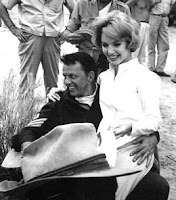
On the set with Frank Sinatra.
Ruta Lee:  The most fun of my life. We laughed all the way through making that film. Poor (director) John Sturges kept trying to get our attention. I tried to do all my work properly, but you could not help but laugh because Dean Martin is a truly funny man. Frank is a funny guy, Joey Bishop was a funny guy, and Sammy is one of the most delicious people ever. It was one big lark. And, of course, they all treated me like their little, baby sister that had to be taken care of. I thought, oh hell, I could have had an affair with all of them and written books...but I didn't.

Café:  You guest starred in almost every classic TV series in the 1960s (and many beyond that). What were some of your favorite guest star roles?
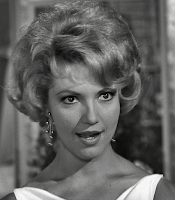
As a "bad girl" in Twilight Zone.
Ruta Lee:  I think that playing a bitchy, little tramp in The Twilight Zone ("A Short Drink from a Certain Fountain") was one of my favorites. When I got through doing a scene, there came a big round of applause from the crew members up on the catwalk. Later, when I finished work that day, they said the applause was because I was good and reminded the crew of their favorite: Carole Lombard. I thought, wow, what a compliment! I also believe I did a good job in a Bonanza episode ("A Woman Lost"), but it was before everyone's agent nominated them for an Emmy. I could have won one with the right publicity. One of the great learning experiences for me was the stuff I did on Perry Mason. Gail Patrick was a beautiful star from the 1930s and into the 1940s, who became a producer. She would hire me a lot. It was always very interesting to me that there was this exquisitely beautiful woman who was not afraid of young girls and not afraid of the competition. I did at least five Perry Mason episodes and that was almost like going to acting school. Working with that cast was absolutely wonderful. I could also say that about the work I did at Warner Bros. One of the mistakes that I made back then was that I said no when Warner Bros. wanted to put me under contract. The contract would have paid me $300 a week whereas I was doing one to two shows a month for $750 a week. But when you go under contract to a studio, you have a powerful machine behind you. You get lessons in whatever you need. You get a publicity department behind you. You get put into roles without having to audition for them. Still, I was very grateful, because I got to do shows like Cheyenne, Maverick, 77 Sunset Strip, and Hawaiian Eye. I was a fixture at Warner Bros. The house that I'm sitting in now I call the "House that Jack (Warner) Built" because my Warner Bros. salaries and residuals helped make the payments.

Café:  When we interviewed Julie Adams in 2013, she also said how much she enjoyed guest starring on Perry Mason.

Ruta Lee:  I don't know if this happened with Julie, but I would get invited as a guest to dinner parties, not every week, but maybe twice a year at Gail Patrick's home. She was married to a man named Cornwell, or Corny, Jackson. I just felt so honored to be among the elite of Hollywood and listen to their stories. It was a great honor and I will never forget Gail Patrick for that.

Café:  Were there any actors that you particularly enjoyed working with?

Ruta Lee:  I loved working with everybody. I am a very easy person to get along with and I enjoy people and their stories. Needless to say, Frank, Dean, and the boys were just the best. Jimmy Garner was great fun to work with on Maverick.

Café:  You have also appeared in a number of stage plays. What were some of your favorite stage roles and why?
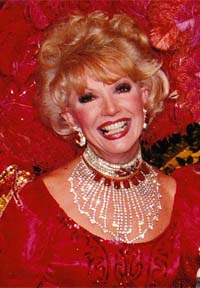
Ruta Lee in Hello, Dolly.
Ruta Lee:  My altogether favorite is one of the hardest roles to play and that's The Unsinkable Molly Brown. I played that role for the first time in Fort Worth, Texas, where I went on to perform it for 40 years. Because of Molly Brown, I became the darling of Fort Worth. The press would write that summer is here and Ruta is here, so everyone can enjoy their summer! It was a great role for me and the best part was the composer of the show, Meredith Wilson, came to see Molly Brown with his wife on opening night. When Meredith was interviewed by the press, he said: "Ruta is the best Molly of them all. If she had played it on Broadway, it would still be running." I also love Anne Get Your Gun, Bells Are RingingHello, Dolly, and The Best Little Whorehouse in Texas, which is the easiest and still a great role in which to strut your stuff.

Café:  You and your husband, business executive Webb Lowe, Jr., celebrated your 43rd wedding anniversary in February. How did you meet and what is the secret to your long marriage?
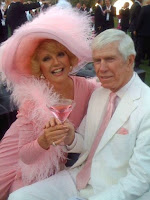
Ruta and her husband Webb.
Ruta Lee:  I'll answer the second question first. The secret to our long marriage is having a great sense of humor. My husband taught me something the first year we were married. As a new young bride, I'd get upset and distressed if he didn't hear what I had to say or didn't bring flowers on an occasion. He said to me: "Let me ask you something. At the end of the day, will this be important? At the end of the week? At the end of the month? At the end of the year, will this still be important and will you still be thinking about it?" I realized that nothing in life is worth stressing over. I'm not talking about serious tragedies, but the usual daily routine. If you can't just laugh it off, then you don't need to be married. Now, as to how I met him, that's a fun story. I had promised the Ladies Professional Golf Association (LPGA) that I'd be its guest star at an event in Naples, Florida. At the time, I was doing a show in Dallas, which was supposed to close on Sunday and then I'd go to Naples on Monday. The theater owners came to me and asked if I could play another week since my shows were selling out. I agreed to do two shows on Sunday, go to Naples, and return to Dallas. I hadn't been feeling well, but I threw myself together, flew to Miami, and ran across the tarmac to a small plane which took me to Naples. I put on the feather boas and long eyelashes and made my big appearance at the LPGA. The next day, of course, I had to return to Dallas for a show and I had a fluey thing going on. So, I put a babushka on my head, big sunglasses, and not a stitch of make-up. It's hot in Florida, so I carried my fur coat as I ran across the tarmac. I go over to American Airlines and they tell me it's a turnaround flight and that they'll pre-board me as soon as it gets cleaned up. So, I was leaning against the counter, my head in my hands, and looking down at the floor. I see a great pair of Gucci loafers coming towards me. And I look up a little further and see nice slacks with a crease on them. I look up a little higher to see a double-breasted blazer with gold buttons. A little further, there's a great tie. And then I see a shock of silver hair and a face that's a cross between Lee Marvin and Clint Eastwood. I said: "Be still my heart!" And he kept walking towards me...and then right past my counter and down the hall. I thought, oh shoot, we're just ships that pass in the night. So, the airline pre-boards me and I'm piling all my stuff under my seat and on the seat next to me. And all of a sudden, I look down and the same pair of shoes are standing there. And he said: "Is this seat taken?" And I said--for the last time in my life--no. And he leaned over and said: "Hello, my name is Webb Lowe." And I said: "Hello, my name is Ruta Lee. And we should be married, because then my name would be Ruta Lee Lowe and we could open a Chinese laundry."

Café:  That's a charming story! Now, I've read where you personally contacted Nikita Khrushchev in 1964, when he was the Premier of the Soviet Union, to secure the release of your grandmother from an internment camp. Can you provide the fascinating details?
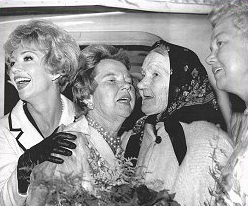
Ruta and family reunited.
Ruta Lee:  I had been trying for years to get my grandmother out of Siberia where she had been deported. She spent fifteen years there. Most of my family was deported to Siberia. No one knows why. We're not talking about brilliant, educated teachers and writers. These were peasant folk who tilled the land and grew their own vegetables to eat. My grandmother was finally permitted to go back to Lithuania with some of the family and we received word that she was dying. We tried to keep them alive by sending packages. You could only send forty-pound packages and the contents were dictated by the Communists...one pound of coffee, one pound of lard, one pair of socks...that kind  of thing. I came home from work one day and my mother was in a state of tears. We had received a letter, though much of it was blacked out, and my grandmother was thanking us for sending clothes for her to be buried in. She had been to a doctor and was told she was going to die. I was so distressed. She was my one remaining grandparent and I had never met any of them. I went out with friends that night and the more wine they poured, the more obvious it became that I should pick up the phone and call Khrushchev--so I did. In those days, there was person-to-person calling and you didn't pay for the call if you didn't get your party. If you got your party, you paid maybe twice as much. I kept calling and calling and the American operator would talk to the Russian operator who would talk with the Kremlin operator, who would get back to me and say: "Nyet, nyet, nyet." In the meantime, I called the Russian Embassy in Washington to get permission to go to Lithuania and I'd get "nyet" there, too. Finally, the Kremlin operator called back and said: "Mr. Khrushchev doesn't speak English. You speak to interpreter to Mr. Khrushchev." I remembered a good-looking young man who traveled with Khrushchev when he was here and had translated for him. Anyway, I spoke with the interpreter and he said: "Miss Lee, we would be very happy to have you travel to the Soviet Union. We know you here. We see your films here. Why don't you speak to your congressman about it?" And I said: "Excuse me, sir. What the hell does my congressman have to do with my traveling to your country? This is not a political matter. It is a matter of the heart. What are you going to do about it?" And he said: "In half an hour, present yourself again to the Soviet Embassy in Washington." I thought, oh no, here we go again! I hung up and a half-hour later I called the embassy. This time, I was connected immediately to the first secretary, who was Lithuanian. Of course, he knew me because I was the one doing the Voice of America broadcasts against Communism. It's an absolute miracle that within 48 hours, my parents and I were on a plane headed to Moscow and then to Lithuania. They took us to my grandmother and six months later, I was given permission to bring her and an aunt back to the United States. She lived for two years, two months, and two days.

Café:  That's an amazing story.

Ruta Lee:  I've been writing a book for the last ten years. One of these days, I'll hopefully get it together and finish it. Maybe you'll help me out by telling all your readers to go buy Ruta's book!

Café:  I will certainly do that. Now, I know you're passionate about volunteerism. You, along with other stars such as Debbie Reynolds, have been deeply involved with a charity called The Thalians for many years. Can you tell about its mission and about how others can help?
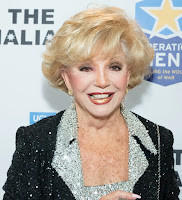
Ruta at a Thalians event.
Ruta Lee:  First of all, everyone can go online to thalians.org and read about us there. It all started in 1955 with a group of young actors who got tired of being called hard-drinking idiots who had nothing to contribute. We'd get together to laugh and play at parties, so we decided we should sell tickets and make a few dollars for a charity. So, we sent Jayne Mansfield and Mamie Van Doren to find out what charities were available. They came back a few months later and said that all the big charities were taken. But they had found a doctor who worked with emotionally-disturbed children at Mount Sinai Hospital. At first, we raised funds for the children and then, eighteen years later, we built a clinic and went from pediatric to geriatric care. We were very proud that this small group of Hollywood performers had shone a spotlight down into that dark pit, which is mental illness, and tried to bring it into the light of healing. Many years later, we changed our focus to returning veterans, who came back scarred not only physically but mentally. We joined up with a group at UCLA called Operation Mend. It deals with the broken arms and faces and we deal with the broken spirits through The Thalians. We ask everybody who has $5, $50, or $5 million to please contribute to The Thalians. We have raised millions of dollars by doing huge shows starring the stars of all-stars and they all did it gratis.

Café:  Do you have any upcoming events that you'd like to tell our readers about?

Ruta Lee:  Yes, The Thalians has an event at the Music Center in Los Angeles on the 18th of May. It's a wonderful luncheon and not a terribly expensive one. If you go to our website, you can read about it and call our office for more information.

Café:  Ruta, you've been a highly entertaining and informative interview subject. Thank you for all of your charity work and for all you've brought to classic movie and TV fans throughout the world.

Ruta Lee:  That's very kind of you. Thank you and all of your readers, Rick. God bless you all.

Monday, July 3, 2017

Perry Mason Returns!

Nineteen years after the last Perry Mason episode aired on CBS, Raymond Burr and Barbara Hale returned to the small screen in their most famous roles. The only surviving members of the original cast, they reprised Perry and Della for the logically-titled Perry Mason Returns, a 96-minute made-for-TV movie on NBC.

Barbara Hale as Della.
Della has spent the previous eight years working for Arthur Gordon (Patrick O'Neal), a wealthy executive that runs Gordon Industries. Gordon chooses his birthday celebration to inform his three children and wife (stepmom to the kids) that he has written all of them out of his will. He plans to leave the bulk of his fortune to his foundation and appoint Della to manage it. Later that night, Gordon is stabbed to death! We see the face of the murderer, but that's really irrelevant because it's obvious that he's just performing a job and isn't the brains behind Gordon's death.

The real culprit has gone to great pains to ensure that Della is framed for the murder. When she's arrested, Perry Mason steps down as an appellate court judge so he can defend her. In need of a good detective agency, Perry turns to Paul Drake, Jr. (William Katt). Initially, Perry is concerned that Paul, who plays sax at a local jazz club and dabbles in writing, lacks the experience for such an important investigation. Their developing relationship plays out in the background of Della's case.

Holland Taylor as a suspect.
Fans of the Perry Mason TV series may be disappointed with this revival. Whereas the TV episodes were typically concise, well-written mysteries, this TV movie lumbers along and takes its time to reach the courtroom climax. The suspects are a pretty lame bunch, too, with the exceptions of Holland Taylor (who plays the widow) and Richard Anderson (Donovan's lawyer). Anderson was actually a regular on the final season of the Perry Mason TV series, playing Lieutenant Drumm. Taylor later won an Emmy for portraying a judge on the legal TV series The Practice. She also had a connection with Barbara Hale (more on that later).

William Katt as Paul Drake Jr.
Still, the reason to watch Perry Mason Returns is to see Raymond Burr and Barbara Hale return to their famous roles. They do not disappoint--though it did take awhile for me to accept Perry with a beard. This telefilm became the second highest rated show for the 1985-86 TV season and led to 29 additional films that aired between 1986 and 1995. William Katt, Barbara Hale's real-life son, played Paul Jr, in the first nine. He was replaced with William R. Moses portraying a different private investigator in the remaining installments.

Burr starred in 26 of the 30 telefilms. When he died in 1993, each of the four remaining films were subtitled A Perry Mason Mystery (even though Perry was "out of town" during each case). Paul Sorvino was the lead attorney in The Case of the Wicked Wives, while Hal Holbrook played lawyer William "Wild Bill" McKenzie in the last three. Barbara Hale still played Della, though she only appeared briefly in the final installment The Case of the Jealous Jokester. Holland Taylor portrays McKenzie's assistant in that one.

Monday, February 6, 2017

The Case of the Color "Perry Mason" Episode

One of the Christmas gifts in our house last year was a DVD set called The Perry Mason 50th Anniversary Edition. The collection includes several episodes, the Perry Mason Returns TV movie, and a lot of interesting bonus content. But its most intriguing feature was the TV series' only episode filmed in color.

"The Case of the Twice Told Twist" aired on February 27, 1966 during the ninth and final season of Perry Mason. CBS executives were mulling whether to renew the series and wanted to see what a color episode would look like. By the mid 1960s, the cost of color photography had decreased significantly and it was becoming standard practice to film in color.

Victor Buono as the villain.
The episode selected was a contemporary variation of Oliver Twist written by series veteran Ernest Frankel. Guest star Victor Buono plays the Fagin-like Ben Huggins, leader of a gang comprised of teenage boys who strip cars of their parts which Huggins then sells in Mexico. Perry gets involved when his convertible becomes one of the gangs' targets and a youth named Lennie (Kevin O'Neal) is caught by the police.

The district attorney's office wants Perry to press charges against Lennie. However, Perry believes the teen can be rehabilitated. Two murders later, though, Perry finds himself defending Lennie of a much more serious charge: homicide.

"The Case of the Twice Told Twist" doesn't rank with the best Perry Mason outings. It'd be more interesting to let the audience discover the Oliver Twist theme on its own. Instead, Perry compares Huggins to Fagin and one of the characters is named Bill Sikes.

Beverly Powers.
The episode does feature an interesting guest cast. Victor Buono, who had appeared in three earlier episodes of Perry Mason, would make his first appearance as King Tut on Batman just two months later. Kevin O'Neal is the younger brother of Ryan O'Neal. Kevin appeared in several of his brother's movies and was a regular on the No Time for Sergeants TV series (1964-65). Finally, one of the strippers at Femmes a Go Go is played by Beverly Powers. Also known as Miss Beverly Hills, she was a real-life stripper and later actress. When she retired from acting, she became a minister in Maui.

Barbara Hale and William Hopper.
As for the color photography, it looks amazingly crisp after all these years. While it doesn't add anything to Perry Mason, it's still fun for the show's fans to learn, for example, that the familiar courtroom walls are gray.

If you're a fan of the show, I heartily recommend The Perry Mason 50th Anniversary Edition DVD set for the bonus features alone. They include screen tests of both William Hopper and Raymond Burr playing Perry (as well as Burr playing Hamilton Burger). There's an episode of a charades-like quiz called Stump the Stars with Burr, Hopper, Barbara Hale, and William Talman. And there's a potent anti-smoking public service announcement by Talman, which was filmed while he was dying from lung cancer at age 53. According to his family, Talman was the first actor in Hollywood to appear in an anti-smoking campaign.

Thursday, June 25, 2015

The Case of the Perry Mason Substitutes

With 271 cases over nine seasons, it’s safe to say that Perry Mason was television’s most successful attorney. I’m not even counting Perry’s court appearances in the “revival” made-for-TV movies nor the 1973-74  New Perry Mason TV series (with Monte Markham taking over for Raymond Burr). Yet, out of those 271 cases on the original series, six of them were won by lawyers other than Perry!

Raymond Burr did not appear in four consecutive episodes in the 1962-63 season and was missing in two more during the 1964-65 season. (Note that some of these episodes included brief scenes of Perry talking with other lawyers from his hospital bed—scenes that Burr filmed before his hiatus.) The reason given for his first absence was “minor surgery.” Some sources, such as Raymond Burr: A Film, Radio, and Television Biography, state that the surgery was to remove intestinal polyps. Other sources (e.g., Encyclopedia of Television Law Shows) maintain that this explanation has never been confirmed. Burr’s absences during the 1964-65 season were attributed to infected teeth (according to Associated Press columnist Cynthia Lowry) and an unspecified illness. Fatigue may have played a role as well, since Burr averaged almost 30 episodes during each of the show’s nine years. A full season order these days for a prime time series is 24 episodes.

Here are the six Perry Mason episodes without Raymond Burr:

Bette Davis visits a client.
The Case of Constant Doyle (Season 6 Episode 16)– Bette Davis plays Constant (not Constance) Doyle, a recently widowed attorney who defends a young man (Michael Parks) accused of breaking into a factory and assaulting a night watchman.

The Case of the Libelous Locket (S6 E17) – Law school professor Edward Lindley (Michael Rennie) takes on the case of student Janie Norland (Patricia Manning), who thinks she killed someone, gets blackmailed, and then is arrested for a real murder. Professor Lindley’s attitude toward trial attorneys must have amused Perry: “Someone once said, if you could cross a parrot with a jackass, you’d have the perfect trial lawyer.” This episode also guest-starred Patrice Wymore, Errol Flynn’s widow.

Hugh O'Brian knew about the law...
from his days as TV's Wyatt Earp.
The Case of the Two-Faced Turn-a-bout (S6 E18)- Hugh O'Brian stars as playboy lawyer Bruce Jason, who defends a political refugee in a homicide case brimming with international intrigue. Interestingly, O’Brien also plays another character in this episode (no spoilers here!).

The Case of the Surplus Suitor (S6 E19) – Corporate lawyer Sherman Hatfield (Walter Pidgeon) defends an indecisive young woman (Joyce Bulifant), who is accused of murdering her wealthy uncle. Alas, this subpar outing wastes Pidgeon’s talents.

Mike Connors a few years later as Mannix.
The Case of the Bullied Bowler (S8 E7)- Paul Drake takes a (well-earned) vacation and visits the town of Tesoro with attorney friend Joe Kelly (Mike Connors). A powerful woman tries to close the bowling alley owned by Paul’s friend Bill Jaris. When a health inspector is murdered, Bill becomes the prime suspect. The Perry Mason producers were impressed with Connors. When Raymond Burr hesitated on returning for season 9, Connors was allegedly considered as a replacement attorney. Of course, he later found TV fame in his own long-running private eye series Mannix (1967-75).

The Case of the Thermal Thief (S8 E16) -  Only recently returning to law practice, Ken Kramer (Barry Sullivan) gets involved in a complex case involving a stolen necklace and the death of a wealthy yachtsman four years earlier. Sullivan does a fine job in an above-average episode—he should have gotten his own lawyer show! It’s interesting to note that Kramer doesn't get a courtroom confession at the episode’s climax; it takes place offscreen.

Thursday, November 24, 2011

Holiday Gift Ideas for the Classic Film & TV Fan (2011 Edition)

One of the Cafe's most popular articles each year is a list of holiday gift ideas from our contributors (click here to read previous recommendations). This year, we're proud to present the third post in this series (hey, it's a trilogy now!). Hopefully, you'll find some gift ideas for the classic film and/or TV lover in your family. Our picks run the gamut from a boxed set from the Master of Suspense to Raymond Burr's Perry Mason TV series to creepy horror films from the 1980s.

Alfred Hitchcock: The Masterpiece Collection (recommended by Rick29). Although this boxed set of 14 Hitchcock classics retails for $120, you can buy it online for less than $75. It's a steal at that price, considering it includes Hitchcock favorites such as Shadow of a Doubt, Rear Window, Vertigo, Psycho, and The Birds. Plus, you get some genuine surprises such as the underrated Marnie and The Trouble With Harry (which improves with subsequent viewings for me). The films have been digitally remastered and come with lots of extra goodies: a 360-page booklet, 14 documentaries, and nine featurettes.

The Brigitte Bardot Classic DVD Collection (recommended by Dawn). One of the silver screen's best-known blonde bombshells sizzles in three stories of love, scandal and betrayal: The Night Heaven Fell (1958); Plucking the Daisy (1956);  and Don Juan (1973). Ms. Bardot's stunning looks often overshadowed that she was a fine light comedienne, as evidenced by Plucking the Daisy. The other two films in this collection were directed by her one-time husband, Roger Vadim.

West Side Story: 50th Anniversary Edition (recommended by Paul). A must-have for any West Side Story fan, this new three-disc Blu-ray set includes a book, postcards, tribute CD, and much more. For many fans, watching the film in high definition and listening to the remastered songs will be enough! Russ Tamblyn, who played Riff, said: "Fox has made this Blu-ray rendition that is just beautiful and so clear. You see so many things that you missed in the original."

Make your own Rebecca Gift Basket (recommended by TheLadyEve). My holiday gift recommendation this year springs from an idea that came to me a month or so ago when I started thinking about how best to enjoy chilly evenings at home. I spent a few nights reading Daphne du Maurier’s classic modern gothic, Rebecca and watching the classic 1940 film version starring Joan Fontaine and Laurence Olivier. In the end, I put together a couple of blog posts on the joys of books and the movies made from them – plus warm drink recipe suggestions to accompany…so here’s my 2011 gift idea…A Rebecca gift basket containing: one copy of Daphne du Maurier’s 1938 novel (from $5.98 new on Amazon); one copy of the Oscar-winning Hitchcock/Selznick film (DVD @$14.99 on TCM.com); one 14.5 oz. canister of Godiva Dark Chocolate Hot Cocoa mix (from $13.99 on Amazon); 16 oz. Hot & Spicy Winter Toddy Mix (add ice cream, hot water or spirits) available on Amazon.com for $6.95;  one 50 g. canister of loose leaf tea (black, green white or flavored tea of your choice from the Tea Fountain (from $4.95 at http://www.teafountain.com/). Feel free to add or subtract to your gift basket.

A Free Film! (recommended by ClassicBecky). It may seem mundane, but I would love to receive a gift packet for my favorite movie theatre, good for two shows with popcorn and a Coke for each.  Givers with more pocket money could add more tickets or give enough for prime-time movies.  Those with limited budgets could give a matinee packet.  Considering the high cost of going to the movies, I would be thrilled with such a gift!

Perry Mason (recommended by Rick29). Seasons 1-5 of Raymond Burr's first-rate courtroom TV series are available separately or in a (pricey) boxed set. If you want to go with just one season, I recommend the first, which includes a number of episodes adapted from the Erle Stanley Gardner novels. The mysteries are fun and Burr is fabulous as the clever, sometimes smug super-lawyer. Plus, as you and your friends watch, you can discuss the relationship between Perry and Della...are they more than just co-workers?

Any Horror Fans among your family and friends? (Recommended by Sarkoffagus) This holiday, scare yourself silly and see what terror looks like in high definition. Numerous horror movies have been released on Blu-ray just in time for the festive season. Movies that came out for Halloween but would still make great gifts include the 30th anniversary of the 1981 cult TV movie, Dark Night of the Scarecrow; William Lustig’s Maniac Cop (1988), featuring cinematic icons Bruce Campbell and Richard Roundtree; two impressive outings from famed Italian horror maestro, Lucio Fulci, Zombie (aka Zombi 2/1979) and The House by the Cemetery (1981); and Lon Chaney making horror movie history in the classic 1925 silent version of The Phantom of the Opera. Released this month was the 25th anniversary of Sam Raimi’s horror-comedy sequel, Evil Dead II: Dead by Dawn (1987), which also happens to star Bruce Campbell, and the Spanish/UK produced Horror Express (1972), featuring Christopher Lee, Peter Cushing and Telly Savalas, will make its way onto Blu-ray on Nov. 29th. Tuesday, Dec. 13th, will see two horror gems on hi-def format: The 1989 Intruder, written and directed by Scott Spiegel, who co-wrote Evil Dead II with Sam Raimi, who appears in Spiegel’s film (with appearances from Sam’s brother, actor Ted Raimi, and – one more time – Bruce Campbell); and the popular vampire flick, Fright Night (1985), whose release coincides with the home media debut of its recent 2011 remake. And finally, if you don’t mind dropping an IOU into people’s Christmas stockings, two offbeat classics will sleep through the holidays and sneak onto Blu-ray in late January 2012, The Deadly Spawn (1983) and Night Train Murders (aka L’ultimotrenodellanotte/1975).