Showing posts with label elke sommer. Show all posts

Monday, June 11, 2018

Search: The Curious TV Series That Should Have Been Named Probe

Burgess Meredith and Hugh O'Brien.
It was like Time Tunnel without the tunnel and the time travel. That's one way to describe Search, a 1972-73 TV series that combined science fiction elements, international settings, and handsome private eyes.

Burgess Meredith plays V.C.R. Cameron, a project director that provides intelligence data to three field operatives for the World Securities Corporation. Each operative is outfitted with high-tech devices that allow two-way communication with Cameron and his staff, one-way video surveillance, and the monitoring of health vitals. By accessing a powerful computer loaded with useful data, Cameron can provide any information the operatives may need--from a street address to a biography of someone they just met.

TV Guide cover with the stars.
It's an intriguing premise that sadly grew old within a few episodes. It didn't help that the show's structure--which focused on a single operative each week--made it difficult for viewers to identify with the hero. One week, the star was Hugh O'Brien as the cynical Hugh Lockwood. The next week, it was Tony Franciosa as tough guy Nick Bianco. And lastly, there was Doug McClure, who looked like he should still be playing Trampas on The Virginian. Of course, there have been popular shows with rotating stars, such as Maverick and The Name of the Game, but they also featured better-written characters.

DVD cover for Probe.
Leslie Stevens, who created The Outer Limits, wrote the pilot for Search, which aired as a made-for-TV called Probe in 1972. It was a cut above other telefilms of the era, thanks in part to guest stars Elke Sommer and John Gielgud. It also featured Angel Tompkins as one of Meredith's assistants, who bantered playfully with O'Brien (a more lighthearted version of Lee Meriwether's character in The Time Tunnel). Tompkins remained for the first episode of Search, but then disappeared from the series after a second appearance. (Incidentally, the original plan was to call the TV series Probe, but that idea was scrapped to avoid confusion with a public television series).

While Search may be remembered mostly for what it could have been, its catchy theme by Dominic Frontiere still has its fans--including me. Here's a clip from Warner Archive featuring the opening credits to the first episode:


Monday, April 11, 2016

CMBA Blogathon: "The Prize" and Rodgers & Hammerstein's "Cinderella"

Paul Newman as a cynical novelist.
The Prize (1963). Ernest Lehman adapted this mixture of North By Northwest and Grand Hotel from Irving Wallace's 1963 novel. If Lehman's name sounds familiar, it's because he also penned North By Northwest. Lehman keeps the basic structure of Wallace's multi-character story about a gathering of Nobel Prize winners in Stockholm. However, he gives the film a definite Hitchcock treatment.

Newman and Elke Sommer.
Paul Newman stars as Andrew Craig, a hard-drinking, cynical, but charming author who has won the Nobel Prize for his little-known, critically-acclaimed novels. He considers turning down the honor, but decides that $50,000 "ain't hay." While he is checking into the hotel, he meets an atomic scientist (Edward G. Robinson) who politely chastises him for his unpatriotic attitude. The following day, Andrew meets the scientist again, but the elderly gentleman doesn't recognize him--and makes disparaging remarks about the free world to the press. It's almost as if he's a completely different person. And, of course, he is!
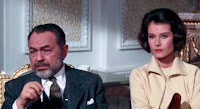
Edward G. Robinson and Diane Baker.
The Prize will never be mistaken for a Hitchcock classic, but it's still satisfying escapist fare headed by a game cast. The subplots involving the other Nobel Prize winners--a scientist who thinks a rival stole his discovery, a wife who wants to make her cheating husband jealous, etc.--provide some humor and, in one case, are tied into the kidnapping. Elke Sommer adds glamour and sass as Newman's eventual ally. Diane Baker keeps the viewer guessing whether she's actually good or bad. And Hitch favorite Leo G. Carroll adds the perfect touch as the fretful head of the awards ceremony.

Journeyman director Mark Robson knows how to keep the plot rolling along. He lacks the Hitchcock touch, but let's reflect for a moment. The Prize is a superior film to Torn Curtain, a European-set thriller about a physicist involved with spies, which was made the following year and starred Paul Newman. That misfire was directed by Alfred Hitchcock.

Stuart Damon and Lesley Ann Warren.
Cinderella (1965). Richard Rodgers and Oscar Hammerstein II originally adapted the famous fairy tale as a television musical in 1957. That version was broadcast live on the East Coast and earned Julie Andrews an Emmy nomination. However, we baby boomers harbor fond memories of the 1965 version starring Lesley Ann Warren as Cinderella and Stuart Damon as the Prince.

Shot on studio sets, it's essentially a filmed play, though that never detracts from its charms. Running just 77 minutes, Cinderella features a lovely score comprised of catchy tunes like "In My Own Little Corner," "Impossible," "Ten Minutes Ago," and the incandescent "Do I Love You Because You're Beautiful?"
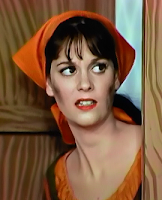
Eighteen-year-old Lesley Ann Warren got the lead role after she was turned down as the oldest Von Trapp daughter in The Sound of Music (1965). Her clear, melodious voice and youthful innocence led to a contract with Disney and plum parts in The Happiest Millionaire (1967) and The One and Only, Genuine, Original Family Band (1968). She had a long career on television and film, eventually receiving an Oscar nomination for Best Supporting Actress in Victor, Victoria (1982).

Her co-star, Stuart Damon, had appeared on Broadway in Irma La Douce in 1960. Despite a fine singing voice, he spent most of his career in non-musical roles. He starred in the 1968-69 British television series The Champions as a government agent with extrasensory powers. In 1977, he was cast as Dr. Alan Quartermaine on the daytime drama General Hospital. He played the role for 30 years, earning nine Emmy nominations and two wins along the way.

Ginger Rogers and Walter Pigeon.
The supporting cast in Cinderella consists of screen veterans Walter Pigeon (the King), Ginger Rogers (the Queen), Celeste Holm (the fairy godmother), and Jo Van Fleet (the stepmother). Alas, Ginger doesn't get a big dance scene!

There have been several other versions of this Rodgers and Hammerstein musical. The most notable ones are a 1997 television version with Brandy and Whitney Houston and a big budget 2013 Broadway adaptation. Both of these musicals added songs that expanded the show's running time. For me, though, I'll just stick with the original...well, the original remake with Lesley Ann and Stuart.


This post is part of the Words, Words, Words! Blogathon hosted by the Classic Movie Blog Association. Be sure to check out all the outstanding posts by clicking here.

Thursday, January 16, 2014

Dean Martin Ogles the Ladies in "The Wrecking Crew"

I was in the mood for a guilty pleasure recently and up popped The Wrecking Crew (1968) on TCM. Guilty pleasures don't get much guiltier than this fourth entry in Dean Martin's Matt Helm series. With spy movies all the rage in the 1960s, Columbia tried to posture Helm as a poor man's James Bond, Well, sort of. The Helm pictures were actually spoofs--not clever ones like Our Man Flint--but broad tongue-in-cheek efforts. That approach suited Dean Martin, who appeared as the turtle-necked protagonist while still doing his weekly variety TV series on NBC.

The plot resembles Goldfinger with Matt's agency, Intelligence and Counter Espionage (ICE), sending the secret agent to recover $1 billion in stolen gold bullion. Villain Count Contini (Nigel Green) plans to flood the financial markets, thus devaluing the economies of Great Britain and the U.S. Throw in some chases, fisticuffs, and plenty of pulchritude and you have The Wrecking Crew.

Dean sniffs Sharon Tate.
It's a far cry from Donald Hamilton's 1960 novel, the second of 27 Matt Helm spy thrillers. Indeed, the only resemblance is that Helm's cover was as a photographer in both the book and film. Otherwise, Hamilton's tough-minded hero had little in common with the cigarette-smoking, Scotch-drinking ladies man played by Dean Martin.

Martin's film series kicked off in 1966 with The Silencers, which co-starred Stella Stevens as Matt's klutzy cohort (the poster proclaimed: "Girls, Gags & Gadgets! The best spy thriller of Nineteen Sexty-Sex!"). A follow-up, Murderers Row, appeared later that year. It's probably the best of the four films, simply on the basis of a cast featuring Ann-Margret and an over-the-top Karl Malden as the bad guy. Still, the formula was wearing thin by the time The Ambushers (with Senta Berger) was released a year later.

Elke Sommer's "come hither" look.
What redeems The Wrecking Crew is its cast. Tina Louise and Nancy Kwan have little to do other than look glamorous (or, in Kwan's case, also manage a few karate kicks). However, Elke Sommer and Sharon Tate are perfectly cast. Sommer's European sultriness poses a perfect counterpoint to Martin's lecherous looks. In addition, she has a grand time playing a villain and (spoiler alert!) "dies in perfect beauty" (as she described in her interview with the Cafe). In contrast, Tate mixes kooky charm with buckets of sex appeal as Matt's female sidekick. I'm not sure that Tate would have evolved into a major star, but she shows her potential as an appealing comedienne in The Wrecking Crew.

While the karate fights leave much to be desired, they were still choreographed by a young Bruce Lee (granted, he didn't have much to work with). Also, if you look closely at the henchmen in the House of 7 Joys fight, you may notice Chuck Norris (in his film debut).

Dean takes a look at Sharon.
Although the closing credits of The Wrecking Crew promise a fifth installment to be called The Ravagers, another Matt Helm film was never made. Weak boxoffice receipts doomed the franchise and Martin, tired of the series, wanted out. Sharon Tate's murder, which occurred just a year after The Wrecking Crew, also cast a shadow over the series.

Still, decades later, the spirit of Dean Martin's Matt Helm movies lives on. It's hard to watch Mike Myers in his Austin Powers spy spoofs without concluding that he's channeling a lot of Matt Helm.

Monday, January 13, 2014

Elke Sommer Talks with the Cafe About Her Movies, Her Art, and How She Earned the Nickname "The Brute"


A glamorous international star by the time she was 23, Elke Sommer has played opposite leading men such as Paul Newman, Peter Sellers, Bob Hope, James Garner, and Glenn Ford. Born in Berlin in 1940, Elke's film career took off when acclaimed Italian director Vittorio De Sica cast her in the 1959 comedy Men and Noble Men (which starred, but wasn't directed by, De Sica). After going on to headline several European hits, MGM signed her to play Paul Newman's leading lady in The Prize (1963). She subsequently became one of the biggest international stars of the decade, appearing in films such as A Shot in the Dark (1964), The Art of Love (1965), The Money Trap (1966), and The Oscar (1966). She later branched out into singing, appearing in stage plays, guest starring on television, playing tennis and golf, and painting (one of her first loves). These days, Elke still plays golf with her husband of 20 years and supports the Amanda Foundation, a nonprofit organization that places homeless pets. Still, Ms. Sommer took time out of her busy schedule to drop by the Café for a chat.


Café:  A Shot in the Dark was one of the funniest comedies of the 1960s. Your performance as Maria the maid was a perfect complement to Peter Sellers' Inspector Clouseau. What was it like working with Sellers and director Blake Edwards?

Elke with Peter Sellers in A Shot in the Dark.
Elke Sommer:  Well, as young as I was at the time, I can say that this movie was one of the greatest experiences of my professional life. Blake Edwards was a very strict and tough director who knew exactly what he wanted. And this is helpful for a young actor because it shows you the way. But then, there was Peter Sellers. And he was not only an experienced actor but also a brilliant mind, a creative powerhouse who loved to improvise. He and I shared the same sense of humor so that we had a very close connection during the movie shoot, and I learned so incredibly much from his genius--and his courage when it came to improvising scenes. Courage that Sellers needed because Edwards was not amused. So, they started arguing. And in most cases, it was Peter Sellers who "won." And this explains why Blake Edwards is known for being one of the greatest directors of his time. He took his actors seriously and the result was one of funniest comedies of the 1960s--your words!

Café:  You made two films with acclaimed horror director Mario Bava: Baron Blood and Lisa and the Devil. How would you describe Bava as a director?

ES:  Mario Bava was one of the kindest, sweetest, and most fatherly men I ever knew. Actually, I called him my "papa." He was a very decisive director who told you exactly what he wanted and how he wanted it, and I clung to his every word and followed his orders to the letter. Because he was my "papa." And you do what your father says. 


Café:  You made a delightful--and glamorous--villain in the spy spoof The Wrecking Crew (we loved your death scene!). What are your memories of working with Dean Martin and Sharon Tate?

Elke with Sharon Tate.
ES:  Sharon Tate and I loved each other from the start and had a very close relationship. I wouldn't even call it a friendship, as it was more than that. I was a single child and Sharon was the sister I had never had. She left me with many wonderful memories and with an incredible gift: She got me acquainted with the music of Leonard Cohen and for that I will forever be grateful to her. Dean Martin was a close friend of mine. We had done twenty episodes of his Dean Martin Show together, dancing, singing, and acting together. So, working with him on The Wrecking Crew was just another experience of working with a great partner and a wonderful colleague. And the death scene that you are mentioning: You are right--I died in perfect beauty.

Café:  Of your English-language films, which one was your favorite and why?

ES:  The Oscar with Stephen Boyd--a movie that, in my opinion, did not receive the recognition it deserved. Tony Bennett had his first role in a motion picture in The Oscar and we became friends. We even went to the premiere together: he with his mother, and I with my mother. And he felt inspired by my paintings and started painting himself.

Café:  You appeared with most of the great comedians of the 1960s: Bob Hope, Jack Benny, Dick Van Dyke, and Peter Sellers. Who was the funniest and why?

Elke with Jack Benny.
ES:  Clearly Jack Benny because this genius had a genuine twinkle in his eye and his sense of delivery and timing was spot-on and his unbelievable ability to improvise did not distort the script, but contributed to the final product turning each and every scene into a piece of art. 

Café:  You appeared in a 1971 TV pilot for a sitcom called The Elke Sommer Show (aka Elke) co-starring Peter Bonerz. How did you feel when CBS didn't pick up the series?

ES:  Please don’t think of me as arrogant. I do remember Peter Bonerz, of course I do, but I do not remember that series, not at all. But please don’t hold this against me. I have been working in this business for more than fifty years and you would be amazed how many projects are planned or even started and never come to pass. It just happens and you move on. And, obviously, you forget--completely.

Café:  You've appeared in numerous stage plays, such as Woman of the Year, Irma La Douce, and Cactus Flower. You even won a Joseph Jefferson Award as Guest Artist in a Chicago production of Born Yesterday. What are some of your favorite stage roles and why?


ES:  
I have two favorites. Same Time, Next Year because, in my opinion, it is one of the greatest plays ever written, leaving the actors incredible room to create very real characters over an entire lifetime. And Born Yesterday because this is, in a way, the play of my career. It was my first huge success on stage, I played the role of Billie Dawn under the direction of great and famous artists like Leland Ball and Vernon Schwartz, and I played it under my own direction, not only in the U.S. but also abroad in my own productions.


Café:  You became interested in art at a young age and had your first painting exhibition at age 24 in Beverly Hills. How would you describe your artistic style and who were your greatest influences?


Elke Sommer's painting Elephant Girl.
ES:  As strange as it may seem, I have never felt influenced by anyone. I love art and I started loving art at the tender age of four. As to my artistic style, this is kind of hard to explain. I take a white canvas and draw my ideas with a pencil. Then I mix my own acrylic colors and fill them in before edging the pencil lines with black acrylic color. Then I take black watercolor and wash the black lines with a sponge until they are medium to dark gray and use very hard brushes in different colors to create these beautiful shadows where I want them to be. The result is a painting that looks like a stained glass window, like the lead glass windows that we all know from churches. I got the idea for this technique from an old gentleman by the name of Amandeo Mendici, who was already in his late 70s when I was just 20. He showed me his technique, which was different from what I just explained, and I reversed it, so to speak. 

Café:  You played tennis with greats like Ilie Natashe and Billie Jean King. In fact, Sports Illustrated nicknamed you "The Brute." Were you really that competitive on the court?

ES:  Yes, I was. I loved playing tennis and I was really good at it--not good enough to be a professional, but good enough to play celebrity tournaments and win a lot of them. They called me “The Brute” because of my topspin backhand, which must have been…well, brutal. 

Café:  How did you meet your husband Wolf Walther?


ES:  I was in New York City starring in Tamara and had to stay there for four months. So, I had to find an apartment but they were excruciatingly expensive, tiny and loud. As I knew the managing director of the Essex House, I wanted to talk to him about renting a room but the hotel had a new managing director, a man by the name of Wolf Walther. So we met. For him, it was love at first sight. For me, it took a little longer, but not much longer. As you may know, Tamara is a play, in which the audience follows the actor of their choice, and as you may also know, my husband is 6'5" and hard to miss. I saw him every night in the audience, following me. Every night. And that was the beginning of the greatest love story of my life, still unfolding and getting better by the day.


Café:  Do you have any upcoming appearances that you'd like to share with your fans?

ES:  I am constantly receiving offers, but so far, there hasn't been anything that interested me. I am dreaming of a role that’s really different. I would love to play an old hooker or a toothless street person. When this dream part comes along, I will shout it from the mountaintops. Until then, I can finally enjoy what I have, time with my husband and with our dog and my beautiful houses here in Beverly Hills and in Germany--life in a pure and unobstructed form.

You can learn more about Ms. Sommer by visiting her web site at www.elkesommeronline.com.


Embed from Getty Images

Friday, January 27, 2012

CMBA Comedy Classics Blogathon: A Shot in the Dark

It's ironic that A Shot in the Dark, the second Panther Panther film, turned out to be the one that established the formula for the film series. It was based on the French stage play, L'Idiote, which didn't even feature Inspector Clouseau. The play was adapted for Broadway in 1961 as A Shot in the Dark and starred Walter Matthau and Julie Harris. After Peter Sellers agreed to play the lead in a 1964 film version, the actor had second thoughts. He asked Pink Panther director Blake Edwards to take over the film.

Initially, Edwards declined, but finally relented on the condition that it be revamped as a Clouseau vehicle. Sellers enthusiastically agreed and convinced the film's backers. Edwards and William Peter Blatty (who would later write The Exorcist) completely rewrote what Edwards could come to call "the unintentional Clouseau" film.

Clouseau: "You've been cutting flowers."
As with all of The Pink Panther movies, the plot is just a framework for the gags. When a murder occurs at a millionaire's country estate (where everyone seems to be having an affair), Clouseau is sent to investigate. The obvious suspect is the maid Maria (Elke Sommer), who is found in possession of the murder weapon. However, Clouseau becomes smitten with her on first sight and becomes determined to prove her innocence.

Herbert Lom with eye twitch.
A Shot in the Dark introduces several elements that would define the Pink Panther formula. Herbert Lom makes his first appearance as Commissioner Dreyfus, who is slowly driven (literally) insane by Clouseau's incompetency. Burt Kwouk makes his debut as Clouseau's valet Kato, who attacks his boss at the most inconvenient times to "strengthen Clouseau's reflexes" (or so the French detective says). A Shot in the Dark also marks the first appearance of the running gag of a killer failing to assassinate Clouseau (often at the expense of innocent bystanders). This is even the film in which Sellers perfected Clouseau's unique mangling of the English language (in a French accent). In the documentary, The Pink Panther Story, Blake Edwards recounts a weekend in which Sellers inexplicably disappeared during the production. When he returned, Sellers told Edwards that he'd met a concierge whose voice was perfect for Clouseau.

Although there are classic comedic routines in other Pink Panther films, A Shot in the Dark features three of my favorites. The first occurs when Clouseau tracks Maria to a resort that turns out to be a nudist camp. The sight of Clouseau navigating among the camp members--with a guitar hanging strategically in front of him--is brilliant visual comedy. Equally amusing in a more subtle way is the running gag of Clouseau being arrested and carted away to jail for selling balloons without a licence, hunting without a license, painting on a sidewalk without a license, and--of course--indecent exposure while fleeing from the nudist camp. Of course, Sellers isn't responsible for all the best scenes. Herbert Lom's eye ticks and muffled manic laughs are funny on their own, but the part where an irritated Dreyfus accidentally cuts off one of his fingers is a classic.

Kato stops to answer the phone
during martial arts practice.
Yet, while Lom and Kwouk are fine supporting players, A Shot in the Dark--like all Pink Panther films--belongs to Sellers. He can generate laughs simply from walking into closets, destroying a rack of billiard cues, spinning a globe, or mispronouncing a word. Paired with a director like Edwards, who understood the dynamics of physical comedy, it's no wonder that the Pink Panther movies became immensely successful.

What is amazing is that additional Pink Panther films were made at all after A Shot in the Dark. Despite their successful partnership, Sellers and Edwards frequently clashed when working together. In fact, they swore they'd never work together again after A Shot in the Dark. Yet, four years later, they made The Party, a fairly funny film with Sellers as a small-time Indian actor mistakenly invited to a posh Hollywood party.

Clouseau in disguise!
Ironically, that same year saw the release of Inspector Clouseau, which starred Alan Arkin and was directed by Bud Yorkin. It proved that audiences weren't interested in a Clouseau movie without Sellers--though it still left the door open for future Pink Panther films. Seven years later, Edwards and Sellers rebooted the franchise with The Return of the Pink Panther (1975). Its worldwide success surprised everyone--save Edwards and Sellers--and set the stage for two direct sequels and a slew of spinoff and remakes.
None of them can match A Shot in the Dark for laughs per minute and originality. In 2000, when the American Film Institute saluted great screen comedies, it ranked A Shot in the Dark at #48 among the all-time comedy classics. I might have ranked it even higher.