Showing posts with label kevin mccarthy. Show all posts

Monday, February 9, 2026

Raquel Welch Races Around the Rink in Kansas City Bomber

Raquel Welch was at or near the peak of her career when she starred as a roller derby queen in Kansas City Bomber (1972). It's not the kind of role one would typically associate with the 1970s biggest sex symbol--but that's probably why she took it. Throughout her career, Welch sought out unexpected roles in films like Hannie Caulder (1971), The Wild Party (1975), and The Legend of Walks Far Woman (1982). Sometimes, her choices panned out (her delightful turn in The Three Musketeers) and sometimes they did not (the ill-fated Myra Breckenridge). Kansas City Bomber falls into the former category.

Welch stars as K.C. Carr, a promising roller derby player who is surprised to learn that she has been traded to the Portland Loggers. Most of her new teammates are unenthused about her arrival--especially Jackie Burdette who fears she is being replaced as the team's star. Actually, Burdette has little cause for concern, as the Loggers' owner (Kevin McCarthy) plans to sell the team and make K.C. a superstar for his new Chicago team. 

So, is Kansas City Bomber a character study? A chronicle of life on the road, in the vein of the later Slap Shot (1977)? Or a a portrait of hardcore fans obsessed with a scripted "sport"? The problem is that Kansas City Bomber is all of those things...and it's too much to pack into a 99-minute movie overstuffed with roller derby footage. 

Welch makes K.C. an fairly interesting, albeit confused, protagonist. The roller derby star wants to be a good single mother, but chooses a job that keeps her away from her family for weeks at a time. Her daughter (a young Jodie Foster) copes well enough, but her son rejects her (a subplot cast by the wayside). K.C. wants to fit in with her teammates, but starts an awkward romantic relationship with the team's owner (talk about accusations of favoritism!). She befriends a socially-challenged male player, totally misreading that he believes it's more than friendship.

K.C.'s exploits are framed against blue collar northwestern locations (much of it was filmed in Portland). Director Jerrold Freedman--who later helmed the excellent made-for-TV thriller A Cold Night's Death--captures the dingy locker rooms, the long bus rides, and the neon bars. He also paints an effective portrait of the manic fans, who spend their money to taunt the players and throw trash on the track. Though George Roy Hill covers the same ground more effectively in Slap Shot, it's worth noting that Freedman did it earlier. Indeed, Freedman's only misstep is the inclusion of too many extraneous roller derby scenes. (Ten minutes could have been easily trimmed from the 99-minute running time.)

Kansas City Bomber is not a hidden gem waiting to be discovered. It's a solid, unexceptional film that proves that Raquel Welch became a better actress as her career progressed. It's a must for Welch fans and for those who appreciate early 1970s cinema (as I do). For other viewers, there are worse ways to spend a lazy afternoon or late night.

Monday, April 29, 2024

Love Is a Ball and A Big Hand for the Little Lady

Love Is a Ball (1963).  I thought I had seen every 1960s romantic comedy until the blandly-titled Love Is a Ball popped up on the cable channel Screenpix. It stars Charles Boyer as Etienne Pimm, a matchmaker who is part Pygmalion and part con artist. He specializes in pairing titled, but financially poor, European aristocrats with wealthy potential spouses. The catch is that the latter have no idea that they're the "target" of a matchmaking scheme. Pimm's latest client is Duke Gaspard Ducluzeau (Ricardo Montalbán), who not only lacks wealth...he also lacks sophistication. To address Gaspard's deficiencies, Pim hires three men to teach Gaspard how to speak properly, how to drive fast cars and play polo, and how to eat fine food. Problems arise, though, when heiress Millie Mehaffey (Hope Lange) becomes attracted to one of Gaspard's teachers, former race car driver John Davis (Glenn Ford). The first half of Love Is a Ball moves along at a merry pace--and who knew that Ricardo Montalbán could be so funny? Inevitably, the focus shifts to the romance between Millie and John, who are the film's least interesting characters (and seem like a poor match to boot). Shot mostly on-location on the French Riveria, Love Is a Ball is a mildly pleasant romcom that overstays its welcome and mostly wastes the fine performances of Boyer, Montalbán, and Telly Savalas. Director and co-writer David Swift fared better at Disney where he made Pollyanna (1960) and The Parent Trap (1961). In Paul Mayersberg's book Hollywood, the Haunted House, Swift stated that Glenn Ford "approaches his craft like a twelve-year-old temperamental child." Needless to say, they never worked together again.

A Big Hand for the Little Lady (1966).  Well, this is one of those movies that you can discuss with a "spoiler alert" warning. Or, one can tread very carefully when describing the plot. I will opt for the latter in discussing this deceiving Western about an annual high-stakes poker game involving the five richest men in Laredo. Even though the whole town knows about the big event, no one else is allowed to participate, watch it, or even stay informed about the current standings. That changes when a farming family passes through town and is forced to spend the night after a wagon wheel breaks. Meredith, the family patriarch, is a recovering gambling addict with a hefty bankroll--to be used on a purchasing a farm. However, he succeeds in getting a seat at the poker table and proceeds to bet his family's nest egg on what he claims is to a sure-fire winning hand. There is a lot of gamesmanship going on in Big Hand for the Little Lady and your enjoyment of the movie will hinge on your acceptance of the ending. I was pleasantly surprised on my first viewing many years ago, but the plot struggled to hold my interest in subsequent viewings. The cast almost overpowers the premise with solid work from Joanne Woodward, Henry Fonda, Jason Robards, Kevin McCarthy, and a slew of familiar faces. (I recognized the young actor that plays Meredith's son from Samuel Fuller's fascinating The Naked Kiss.) Director Fielder Cook and screenwriter Sidney Carroll based on A Big Hand for the Little Lady on "Big Deal in Laredo," a 1962 episode of the one-hour TV series anthology The DuPont Show of the Week. It starred Walter Matthau and Teresa Wright in the Fonda and Woodward roles. I haven't seen it, but wonder if the shorter running time might have strengthened the premise.

Monday, October 14, 2013

Jack Lord x 2 = 1st Episode of "Hawaii Five-O" + "Walk Like a Dragon"

One could argue that the first episode of the original Hawaii Five-O TV series was the "pilot" broadcast on CBS on September 20, 1968. While the pilot certainly established the show's premise--and introduced Wo Fat, its most famous villain--it was still a trial run. When the series was given the green light, James MacArthur had replaced Tim O'Kelly as Danny and Richard Denning had taken over from Lew Ayres as the governor.
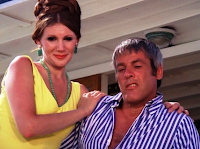
Louise Troy and Kevin McCarthy.
"Full Fathom Five," shown the week after the pilot's premiere, doesn't feature a villain of Wo Fat's notoriety. However, it does offer Kevin McCarthy--who specialized in slimy characters--as Victor Reese, who teams with his wife (Louise Troy) to scam and then murder lonely women with money. Interestingly, the Five-O team might have never suspected Reese if an attorney hadn't pressured McGarrett to search for a missing heiress. In an effective ironic twist, the heiress turns out to be alive. However, while investigating her disappearance, Danny uncovers ten cases where single women with no close relatives had disappeared at the rate of one per month.

When McGarrett assigns a female detective (Patricia Smith), with no field experience, to go undercover as Reese's next target, Danny takes exception.

DANNY:  I don't like it.

McGARRETT:  Nobody asked you.
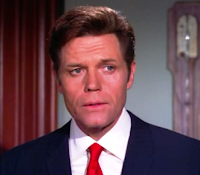
Jack Lord as Steve McGarrett.
As with most of the show's episodes, the focus is on the investigation. We don't get a glimpse of the personal lives of McGarrett, Danny, Kam Fong (Chin Ho), or Zulu (Kono). But we do get plenty of stunning Hawaiian scenery, a lively shootout at the climax, and the terrific opening credits (voted #4 all-time in 2010 by TV Guide readers--and it should have ranked higher). Surprisingly, though, McGarrett never utters his signature line: "Book'em, Danno!"

For the record, Jack Lord was a last minute replacement as Steve McGarrett. Creator Leonard Freeman originally wanted Richard Boone (allegedly, Gregory Peck was also in the discussion). Lord's no-nonsense attitude was perfect for the part, though, and he played McGarrett for 12 years, making Hawaii Five-O the longest running detective series prior to Law & Order (which is a hybrid anyway).

Stephen J. Cannell (The Rockford Files, The A-Team) tried to revive Five-O with a 1997 pilot starring Gary Busey and MacArthur, who returned as Danny (now governor of Hawaii!). It didn't sell, but, of course, the 2010 series revival became a hit for CBS.
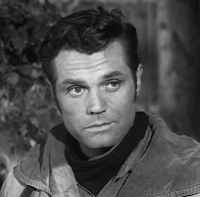
Jack Lord as Linc.
In 1960, eight years before his signature Five-O role, Jack Lord starred in Walk Like a Dragon, an underrated "B" film written and directed by James Clavell (best known as the author of Shogun). Set in California after the Civil War, it features Lord as Linc Bartlett, a small town freight line owner on a trip to San Francisco. He buys a nineteen-year-old Chinese girl, being sold as a slave, to rescue her from a certain life as a prostitute. He gives the girl, Kim (Nobu McCarthy), her freedom--but she has nowhere to go and still considers Linc her owner. Linc ends up taking Kim and a young Chinese man named Cheng Lu (James Shigeta) to his home town of Jerico--where they all have to cope with the devastating impacts of racial prejudice.
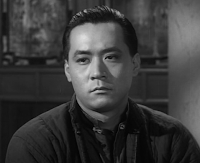
James Shigeta as Cheng Yu.
As in Shogun, Clavell does a masterful job of showing what it's like to be thrust into a totally different culture. He eschews subtitles when the Chinese characters speak, giving the viewer a taste of what it's like to not understand potentially important conversations (incidentally, the Shogun miniseries avoid subtitles as well). In one telling scene, Cheng Lu's uncle speaks in broken English in front of Linc, only to speak it fluently to Cheng Yu in private. He explains to his nephew: "If you want to stay alive, you always have to follow certain rules."
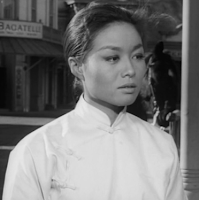
Nobu McCarthy as Kim.
Each of the three main characters struggle with the sudden changes in their lives. Linc realizes he's fallen in love with Kim, but knows their life as a married couple would be a very difficult one. Cheng Lu doesn't want to play by the "rules" like his uncle; he wants to be treated with the same respect as men like Linc. And Kim finds herself caught in the middle, unsure whether to pursue a challenging future with the man she loves or a more traditional one with a man she respects.
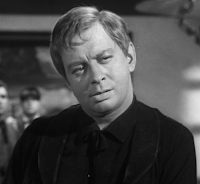
Mel Torme--the gunfighter?
The cast is uniformly fine, with Lord giving one of his best performances as the conflicted Linc--although Shigeta steals the film. A major surprise is Mel Torme as Deacon, a Bible-quoting gunfighter dressed in black. It's a fascinating casting choice and, frankly, Mel handles the part well. He also sings the atypical title tune.