Showing posts with label interviews. Show all posts

Monday, September 5, 2022

An Interview with Sunset Blvd's Nancy Olson Livingston

Actress Nancy Olson Livingston shot to fame at the age of 22 when she earned a Best Supporting Actress nomination for Sunset Blvd. (1950). She subsequently became one of the most in-demand actresses of the 1950s, starring alongside William Holden (Union Station, Force of Arms, etc.), John Wayne (Big Jim McLain), Jane Wyman (So Big), Bing Crosby (Mr. Music), and Van Heflin (Battle Cry). Nancy reduced her workload in the late 1950s to spend more time with her family. However, she made occasional guest appearances on TV series such as Alfred Hitchcock Presents and The Big Valley. She also starred on Broadway in The Tunnel of Love, Send Me No Flowers, and Mary, Mary. Starting in 1960, Nancy Olson Livingtson appeared in five Walt Disney films over a 12-year period, including Pollyanna, The Absent-Minded Professor, and Snowball Express. Her autobiography A Front Row Seat: An Intimate Look at Broadway, Hollywood, and the Age of Glamour will be published this November.


Café:  How would you describe your experience of working with director Billy Wilder on Sunset Blvd.?

Nancy Olson in Canadian Pacific.
Nancy Olson Livingston:  It was a profound experience because I had only done one picture before Sunset Blvd. That was Canadian Pacific (1949) with Randolph Scott, who was old enough to be my father. At least, I had the experience of being in front of the camera and knowing what the set-up was and how it operated. I was also going to UCLA and majoring in theater arts. I was under contract to Paramount, which lent me to 20th Century-Fox to do Canadian Pacific. I was fascinated that I could walk around the Paramount lot and go to the commissary to have lunch. I did that to get acquainted with what the studio was all about. I certainly knew who Billy Wilder was. I had seen his films and I was a great admirer of his work. He would stop me on the lot and engage me in long conversations: “What was it like to be born and raised in the Midwest? Your father is a doctor, what was that like? Tell me about your college life at UCLA.” It was bizarre. Why in the world would Billy Wilder want to know all these things? When I was cast in Sunset Blvd. and read the script, I realized that my character, Betty Schaefer, was an aspiring writer. She had to innately have a way of speaking that would make you believe she was a writer. She had to be able to speak well, to use language well, to be confident. I eventually came to understand that’s why I was cast. I would visit the set before I started my scenes and was always warmly welcomed. I worked with Edith Head, who did the wardrobes, and I was wearing what she wanted me to wear. And Billy said: “I don’t like that. I like what she wore yesterday when she came to visit.” So, I wore my own clothes in Sunset Blvd. I had not been in California long enough to know where to shop. I did not have a great wardrobe. What was absolutely clear was that Billy Wilder wanted me to be me. Betty Schaefer was me.

Café:  What was your biggest challenge in Sunset Blvd.?

Nancy Olson Livingston:  The first day of work. It’s my first scene in the movie where Betty comes into the office of this producer and asks about the script that Joe Gillis (William Holden), who was sitting there, wrote. Betty didn’t know who Joe Gillis was, so she was very honest about what she thought about the script. We rehearsed that scene several times. When I said that we were ready, Billy said “Shoot!” and we started the scene. There was a moment where I kind of stuttered a little, but I kept going. When the scene was finished, I said: “Please, Mr. Wilder (eventually I called him Billy), could we please do it again?” I didn’t feel totally comfortable at that moment. But he said: “Nope. It was fine.” Now, this is something that Shirley MacLaine and I talked about years later. He never wanted to shoot a scene more than once. You often had the feeling that you could do it a little better, that you didn’t bring something into it that you wanted to. I was upset about that. But I learned that you better know what you’re doing from the beginning.

Café:  Why do you think Sunset Blvd. continues to resonate with film fans over 70 years after it was made?

Nancy Olson Livingston:  Sunset Blvd. resonates not only with film fans, but with the general public. I had an experience about a year ago when I went into Saks Fifth Avenue and I walked into the cosmetics department. This man, who was the general manager, suddenly came over to me and said: “I know who you are. I saw Sunset Blvd. three weeks ago. You’re Nancy Olson.” I was 91 or 92. When you watch Sunset Blvd., it’s old-fashioned—the clothes, the cars, everything is of a different era. And yet, it has an up-to-date understanding. It feels today. And that is because it reveals the truth. I wrote about that in my book: “Sunset Blvd. tells the brutal truth about a part of the motion picture business and how it can ruin one’s life. To be exploited for other people’s profit can be both painful and humiliating. Even though one is paid sometimes a great deal and receives tremendous ego-fulfilling rewards, to be portrayed as larger than life is distorting and destroys the delicate balance between reality and fantasy.” Everything about Sunset Blvd. tells the truth. Joe Gillis is a desperate man who is at the end of his rope. He can’t pay his car loan. He can’t pay his rent. And when he gets into Norma Desmond’s house, he decides to sell his soul for his survival. And Betty Schaefer, my character, falls in love with this man who has sold his soul. It’s about human nature. It’s about who we all are and how we conduct our lives. Movie stars were a commodity back then. Marilyn Monroe is a perfect example. She was so exaggerated, but she was also vulnerable. She was created bigger and bigger than she really was. Ultimately, movie stars are thrown away, like Norma Desmond and, to a great extent, Marilyn Monroe. So, Sunset Blvd. survives because it tells the truth about an aspect of life which is kind of generally true.

Café:  I also think Sunset Blvd. has one of the great openings in movie history, with Joe’s body floating in the swimming pool as he provides the voice-over narration.

Nancy Olson Livingston:  You want to know what the real beginning was? It was filmed with bodies in a morgue. Joe is under the sheets with all the other bodies and he starts to talk with them. When the studio showed the movie at a test showing, the audience laughed. People thought it was funny and kind of ridiculous. So, Billy went back and re-edited and started at the point where Joe’s body is floating in the pool.

Café:  You made four films with William Holden, whom you have described as a good friend. What do you think was the secret to the onscreen chemistry between the two of you?

Nancy Olson and William Holden in Sunset Blvd.
Nancy Olson Livingston:  We were very alike. He was from Pasadena. I was from Milwaukee. There was a common ground. We really began to love each other. I was married. He was married. He did make a slight pass at me during the shooting of Sunset Blvd., which I’ve written about. It became so clear to him that nothing was going to ever happen. That was the end of it and we became friends. We loved hugging and kissing (laughs). I don’t know why, but it felt wonderful and comforting to be held by him. We enjoyed each other and we liked each other. Years after Bill and I had stopped working together, I was at an airport with my husband Alan Livingston and, as we were walking to board a plane, I heard a voice from behind me: “Nancy!” I turned around and it was Bill. I cried out: “Bill!” And we spontaneously ran as fast as we could and went into an embrace. He gave me a kiss and said: “My God, how are you? I haven’t seen you for two years. I understand you’re remarried now. Are you happy?” It was one of those things. A man was walking by as we were talking and laughing and he taps us on the shoulder: “Excuse me, but this is better than watching an old movie.” 

Café:  You starred in five Walt Disney films over 12 years, starting with Pollyanna in 1960. What led to your Disney connection?

Nancy Olson in The Absent-Minded Professor.
Nancy Olson Livingston:  I had not done a movie for a long time and figured I wasn’t going to do another movie. I did not want to be a movie star. That was a lesson I learned in Sunset Blvd. Being a movie star was isolating and lonely and unreal. I was 32 and I thought it was over. So, I am in Majorca, picking up my children who were visiting their father and stepmother. And I got a phone call and it was Mr. Disney. He said: “Nancy, this is Walt Disney. We are working on a movie here and are spending a lot more money than we usually do. It’s an all-star cast. Every part has been cast with a star. We have John Mills’ daughter, Hayley, who is fantastic, to play Pollyanna. We have Jane Wyman, Richard Egan, Karl Malden, Adolphe Menjou, Agnes Moorehead…and we want you.” I thought that was interesting. He said they were shooting at the end of August. I was planning on going to California to visit my parents anyway. I was living in New York at the time. But I had to bring the children back to school. Walt said I’d be finished by the middle of September. I said I had a governess who could take the kids back to school. I told him: “You know something…I’ll do it.” And that began my work with Walt Disney. I enjoyed it. My children had fun coming and visiting me on the set. I finished Pollyanna and thought that was the end of it. I never even asked what he was going to pay me. That wasn’t an issue. About a year later, I get a call from my agent saying that Disney is doing The Absent-Minded Professor with Fred MacMurray and wanted me for Fred’s love interest. Fred was twenty years older than me. Casting at that time was really out of whack. I loved Fred MacMurray’s work. He was a brilliant actor. He just had a natural sense for it. I read The Absent-Minded Professor script and decided I'd do it. I made it and then went back to New York. The next year, they decided to do a sequel because The Absent-Minded Professor was a huge success. So, I did Son of Flubber. By the way, sequels are never as good as the original. At least, that’s my opinion. I felt very comfortable on the Disney lot. Walt Disney made everyone call him Walt—including the grips. There was a unique friendliness that pervaded the lot. It was interesting and different from any place I’d ever worked before. I think Walt Disney was from the Midwest, too, and a homespun, middle-class kind of background. He was a Republican. I’m a big Democrat. Fred MacMurray was a big Republican, so the two of them got along wonderfully. Fred grew up in Wisconsin so the two of us had a kind of bond and told stories to each other about our experiences growing up. Because I wanted to work every once in a while, the Disney folks would call me. I did Smith! (1969) with Glenn Ford and Snowball Express (1972) with Dean Jones, which was not a very good film. But if you ever see Snowball Express, that was the absolute best that I ever looked when I was photographed. I saw it the other day and I was amazed. 

Café:  I think the first half of Snowball Express was pretty good, but the second half just turns silly.

Nancy Olson Livingston:  But don’t you agree that I look very well photographed?

Café:  Well, you always looked good in your films. Now, you appeared with many of the biggest stars of the 1950s and 1960s: William Holden, Jane Wyman, Fred MacMurray, John Wayne, Bing Crosby, and Glenn Ford. Who were some of your favorite co-stars and why?

John Wayne and Nancy Olson in Big Jim McLain.
Nancy Olson Livingston: Making Big Jim McLain with John Wayne was an interesting experience. It was a terrible script. When I read it, I thought that nobody was going to see this film. It’ll come out, get terrible reviews, and get shown on Saturday nights with another big film. But I thought I should have the experience of working with a true icon like John Wayne and it was made in Honolulu, which I loved. I found John Wayne to be an amazing person and very mysterious as to who he really was. Everybody called him Duke; I called him John. He never corrected me. We became really wonderful friends. For years, whenever we saw each other, we embraced and were happy to see each other. He was not the least flirtatious. Now, Bing Crosby had cold blue eyes. He put himself at a distance from almost everyone. He had a group of cronies around all the time, buttering him up. However, he and I became friends. The whole cast, crew, and director (of Mr. Music) treated me like I was a kind of charming child and that was odd. I was beginning to date Alan Lerner, my first husband, so it didn’t much matter. But I realized I was much too young to play opposite Bing as his love interest. When I was in Battle Cry, my marriage to Alan Lerner was beginning to have terrible problems. He ultimately married eight times, so he was a man with problems. I was too young and naïve to understand them, because he was fascinating and brilliant and would be with the most interesting people. He knew the best writers and producers in New York and the theatre was extremely interesting at that time. I was very happy to marry him, but it eventually became obvious it was not going to end well. There was a point where Warner Bros. called and asked if I would do Battle Cry. I said yes. There were so many stars in Battle Cry that I had a limited story with Aldo Ray. Aldo, bless him, kind of fell in love with me. I needed that. Please understand that we never had an affair. But when we had a long scene, he would prolong it--and it felt good. 

Café:  Excluding Sunset Blvd., what was your favorite of your films and why?

Nancy Olson Livingston:  The first thing that pops in my head is The Absent-Minded Professor, because it was so much fun and such a wonderful script. Fred MacMurray was marvelous. But there were very few films that lived up to Sunset Blvd. That was just an amazing experience.

Café:  You played Lloyd Bridges’ wife in the 1984 TV series Paper Dolls, which revolved around the fashion industry. How would you describe that experience?

Nancy Olson Livingston:  I only worked one or two days a week and maybe not at all the next week. It was a great cast and we all became friends. It was a nice interruption and just fun to be on a set and act a little.

Café:  Were there any roles you turned down or wish you had pursued during your career?

Nancy Olson Livingston:  No. My acting career was only a third of my life and eventually an eighth of my life. It was interesting, but it was not my life. As I write about in my book, my experiences outside of films were just as interesting or more so. Life is a fascinating, extraordinary experience. I’ve lived a long time and I’ve been extremely lucky. I was lucky having the parents I did, growing up where I did, how I grew up. Even my first marriage, which ended so painfully, had its moments. My Fair Lady was dedicated to me. I sat there and watched it being created. I had the most amazing experiences with my second husband, Alan Livingston, the president of Capitol Records. He started at Capitol after he got out of the Army and college. He went to Paramount, where they wanted him to write children’s albums, which he had never even thought of doing. But he created Bozo the Clown and other albums that became bestsellers. Then, he put Frank Sinatra with the right conductor and changed his whole career. He made Nat Cole a soloist instead of a pianist. Then, he left Capitol and went to NBC television and created Bonanza. After several years, he went back to Capitol and signed The Beach Boys. I gave parties for The Beatles and The Band. Alan Livingston ended up with the first American company in China. So, my life was varied and anybody who lives this long will have success and failure, happiness and heartbreak, sadness and joy. You can’t live this long without having all of it.

Café:  Thank you so much for much for taking the time to talk with us today.

Nancy Olson Livingston:  I enjoyed it.


A Front Row Seat: An Intimate Look at Broadway, Hollywood, and the Age of Glamour by Nancy Olson Livingston will be published by the University of Kentucky Press on November 15, 2022. It's 408 pages and features 44 black & white photos.

Sunday, May 1, 2022

The Columbus Moving Picture Show: A Festival for Classic Movie Fans

The inaugural Columbus Moving Picture Show will take place May 26 - 29, 2022, at the Renaissance Columbus Downtown Hotel in Columbus, Ohio. The festival will feature 16mm showings of classic films from the silent days to the 1960s, some of them with live musical accompaniment. There will also be vendors, seminars, and book signings by authors such as Scott Eyman (Cary Grant: A Brilliant Disguise) and James D’Arc (When Hollywood Came to Utah). Festival organizer Samantha Glasser recently took time out of her busy schedule to talk with us about the Columbus Moving Picture Show.

Café:  Over 35 films, short features, and a Red Ryder serial will be shown from Thursday through Sunday. What are some of the titles you’re most excited about presenting?

Samantha Glasser:  I always get excited by the rarest titles, the things you can't see anywhere else. The Silent Fragments program is a collection of three silent films that only exist partially due to decomposition. They survive because the films were issued as cut-downs on 16mm and collectors of that format held the only copies. I'm also looking forward to Stork Bites Man, which is based on a book I enjoyed a lot about a man's perspective of a pregnancy. It stars Jackie Cooper, who was once in Our Gang, and it was through that series that I discovered classic movies in the first place. 

Café:  Which silent films will feature live musical accompaniment?

SG:  All of the silent films feature live piano accompaniment by either David Drazin or Dr. Philip Carli. 

Café:  What are the seminars that are being presented?

SG:  Ed Hulse will present a preview of his forthcoming book Wage Slaves in the Dream Factory, which is about the low-budget studios that operated during the studio era. Eric Grayson has been working for years to compile and restore the King of the Kongo serial starring Boris Karloff and will give a presentation on that process. Nick Santa Maria has an upcoming book titled The Annotated Abbott and Costello and he will give a presentation on that beloved comedy team. Nancy Vass's mother was an actress in a local film company called Kelly's Klean Komedies in the silent movie era, and she will present some of her mother's mementos. 

Café:  What kinds of movie memorabilia will be offered for purchase in the vendor room?

SG:  The dealer room is really a treasure chest of movie-related items. You can find original movie posters (one-sheets, half sheets, window cards, inserts, lobby cards, heralds), pressbooks, stills, autographs, books, movie magazines, 8mm and 16mm films, laserdiscs, DVDs and Blu-rays, kitsch, and more. 

Café:  Does the $65 weekend pass cover the cost of everything?

SG:  The weekend pass covers everything except the t-shirt. It gives you access to the film screenings, the dealer room, the book signings and the seminars and comes with a free program book. 

Café:  Can festival attendees get a discount for hotel rooms and, if so, must they book their rooms by a certain date?

SG:  Yes, they can register at $144 per night at the Renaissance Downtown Hotel, but only until May 3rd.

Café:  What inspired you and the other organizers to launch the Columbus Moving Picture Show?

SG:  I have attended Cinevent for years and worked as a staff member for the last several. Michael Haynes asked me if I would be interested in taking over the show someday and I said yes. Someday came sooner rather than later. 

Café:  I saw where you named Mary Pickford, Van Johnson, Dick Powell, and Betty Hutton as some of your favorite classic movie stars. Name a favorite film for each one!  (I love Dick Powell in Murder, My Sweet…but also really like Cornered and You Never Can Tell).

Esther Williams and Van Johnson
in Thrill of a Romance.
SG:  My Best Girl is always the silent movie I recommend to people because it is sweet and relatively modern so people forget they're watching a silent film. I love Van Johnson in Thrill of a Romance; that's my go-to if I need a pick-me-up. Gold Diggers of 1933 is an incredibly fun movie all around, and Dick sings some great songs in it. Betty Hutton is fantastic in Annie Get Your Gun. I love her fearlessness in front of the camera. I know many people like to say Betty is no Judy Garland, but I don't think Judy could have been as funny as Betty is in that movie. 

Café:  Finally, where can Café readers learn more about the Columbus Moving Picture Show?

SG:  Check out our website https://www.columbusmovingpictureshow.com!

Café:  Thanks so much for talking with us, Samantha.

Thursday, October 8, 2020

Scott Eyman Discusses His New Biography "Cary Grant: A Brilliant Disguise"

On October 20th, Simon & Schuster will publish Scott Eyman's new biography Cary Grant: A Brilliant Disguise. Eyman, a former literary critic for The Palm Beach Post, has written the bestsellers Pieces of My Heart and You Must Remember This (both with Robert Wagner) and John Wayne: The Life and Legend. He has also written biographies about about Hollywood greats such as Cecil B. DeMille, Louis B. Mayer, John Ford, Ernst Lubitsch and Henry Fonda and James Stewart. We had the opportunity to ask him some questions about his new book on the life of screen legend Cary Grant.

Café:  There have been numerous Cary Grant biographies, including ones by his daughter Jennifer Grant and ex-wife Dyan Cannon. What inspired you to write Cary Grant: A Brilliant Disguise?

Scott Eyman:  Reading his diary. He kept it for about five months in 1918, when he was 14 years old. There is no mention of his mother, one or two passing references to his father. Most of the time he’s cutting school to go to the movies or the music hall. Especially the music hall. What struck me was how self-contained he was, and how indifferent he was to any family or society expectations. He was a street kid. Later that year, he made his break by getting kicked out of school and apprenticing with a troupe of acrobats. It was going to be a performer’s life for Archie.   

Café:  You include a great quote from the actor: “I have spent the greater part of my life fluctuating between Archie Leach and Cary Grant, unsure of each, suspecting each.” Why do you think Archie Leach felt the need to “create” the Cary Grant persona that he displayed in public and in movies?

SE:  Archie was born working class and felt he had to fit into the niche of currently popular actors of the time, who ran to elegance – Noel Coward, Leslie Howard, etc. Given his looks, it was a perfectly rational decision. Also, it was a way of building a barrier between himself and his beginnings. That said, he often made a point of talking about Bristol, and occasionally worked “Archie Leach” into scripts as an in-joke. He wanted people to realize that he was in on the joke, and I think it was also his way of signaling he wasn’t a phony or hypocrite.

Café:   Do you believe that, in his later years, he became more comfortable reconciling his private and public lives? If so, what drove this change?

SE:  Very much so. It was a combination of LSD and quitting show business. LSD worked for him in a way that therapy hadn’t, enabled him to reconcile with himself. When he retired at the age of 62, he no longer had to worry about being exposed as an imposter, which I think was an ongoing cause of anxiety.

Café:  You state that Cary Grant was conservative in choosing roles, turning down challenging ones in films such as Tender Is the Night (1962) and The Cincinnati Kid (1965). What do you think would have been the impact on his career had he accepted riskier roles?

Cary Grant in None But the Lonely Heart.
SE:  He would be regarded less as a screen archetype and consum-mate comedian, more as a consummate actor. But he was psychologically conservative. Once he established a persona and discovered how the public liked to see him, he rarely (None But the Lonely Heart, Father Goose, etc.) deviated from it. That said, I don’t know that he regretted turning down the likes of A Star is Born or The Third Man. I’m inclined to doubt it. He had his reasons, and they had to do with his psychological needs.

Café It was interesting to learn that Grant was also involved behind the scenes in making films, suggesting a remake of the British film Mandy, sending scripts to director Leo McCarey, etc. Had his career started later, could you envision him as a star/filmmaker along the lines of Clint Eastwood or Warren Beatty?

SE:  His timing was wrong for that. There were no equivalents of those careers in that era because the system wasn’t set up to service actors who wanted control of their careers. It was a classic tradeoff: we give you all this money and in return you do what we want you to do. The system began to change in the 1950s, with people like Burt Lancaster taking almost complete control of what they did. And Grant moved into production late in that decade, but that was about keeping more money, not creative experimentation. 

Café What do you consider Cary Grant’s best film performances and why?

SE:  Notorious and None But the Lonely Heart, because he dares to expose his anger and general prickliness. I love To Catch a Thief as a star turn. Among the comedies, Bringing Up Baby and His Girl Friday. And despite the fact that he hated his performance, I love two-thirds of Arsenic and Old Lace if only for his energy and technique, at least until I get exhausted during the last half-hour. 

Café You’ve written biographies of John Wayne, James Stewart and Henry Fonda, Louis B. Mayer, Cecil DeMille, and other great actors and filmmakers. Who intrigues you as a future subject for a biography?

SE:  No comment. Lots of writers like to talk about what they’re writing, but I’m not one of them. I find it reduces my energy about a project, the build-up of internal compression I need to write a book. Suffice it to say that the next one will be about one of the major artists of the 20th century.


Cary Grant: A Brilliant Disguise (576 pages) is available for booksellers such as Amazon and Barnes & Noble.

Monday, October 21, 2019

An Interview with Constance Towers


Born in Whitefish, Montana, Constance Towers became interested in show business in the first grade—when talent scouts visited her schools looking for young radio performers. She appeared in radio plays as a child and later studied music at the Juilliard School in New York City. Constance Towers made her film debut in the 1955 Blake Edwards comedy Bring Your Smile Along. She subsequently appeared in major motion pictures such as The Horse Soldiers (1959), Sergeant Rutledge (1960), The Naked Kiss (1964), and Fate Is the Hunter (1964). She has acted alongside actors such as John Wayne, William Holden, Glenn Ford, and Raymond Burr. Constance Towers also gained acclaim working on Broadway and on television. Her stage roles include a revival of The King and I with Yul Brynner. On television, she has won numerous awards for her performances in the daytime dramas Capitol, CBS Daytime 90, and General Hospital. Ms. Towers married actor and former U.S. ambassador to Mexico John Gavin in 1974; they remained together until his death in 2018. Constance Towers has been passionately involved in many charities, to include the Children’s Bureau of California, the National Health Foundation, and the Blue Ribbon of the Los Angeles Music Center.

Café:  You worked with two of the greatest auteurs of American cinema: John Ford and Samuel Fuller. How would you describe your experiences with each of them?

The Horse Soldiers with John Wayne.
Constance Towers:  The experiences were very different. Both were gentlemen, but John Ford was the epitome of being a gentleman until you really got to know him and then his sense of humor came through. He was bawdy in his own way. Sammy Fuller was totally uninhibited and so much fun because he communicated on a raw level. He really knew how to find the right words to help you find where you were trying to go emotionally as an actor. And because he was the writer, he knew the intent of the writing. Because he was the director, he knew what he wanted to bring out of the actor. He just understood the complete arc of what he had written. That was a treasure. As I said, he was totally uninhibited so he had a way of reaching those children in The Naked Kiss. He sat on the floor and just became a kid and worked with them. Both John Ford and Sammy were great directors in their own way. John Ford was a communicator on a different level. He certainly knew what he wanted from his actors and sometimes played a trick on an actor to get just the right emotion. There's the famous story of Victor McLaglen in The Informer, when he took him out and got him drunk the night before his big scene. The next morning, McLaglen sat down, found himself in front of the camera, and said: "Oh, my god." And then he gave an Academy Award performance. So, John Ford and Sammy Fuller were very different, but both were brilliant and great artists in their own way.

Café:  Our favorite of your movies is Samuel Fuller's The Naked Kiss and you recently discussed it at the Niagara Falls International Film Festival. What are some of your memories of starring in that cult classic?

In Samuel Fuller's The Naked Kiss.
Constance Towers:  Sam got truly honest performances out of the children, creating some of the most charming and touching moments in film. It was hard work. We did it in 21 days. It was a lot of filming and a lot of emotion to cover in that short time. I have great memories of working with Sam, because he was this wonderful director who communicated with you--and sometimes shocked you. If he felt he didn't have everyone's attention on the set, he shot off a gun he had. The bullets were blanks, of course, but can you imagine that today? Back then, you could do it without people leaving the studio and running back down the street. He had a way of communicating with everybody on a very human level, giving approval to you on what you were doing. It was a very enjoyable experience.

Café:  What was your reaction when you first read the script?

Constance Towers:  I sat and read the script with Sam and he explained every scene as we came to it. It was a different experience because I could discuss it with the director and the writer. As you envisioned each scene as an actor, he was there to help explain anything you didn't understand. I was concerned about the subject matter because child molestation was not a buzzword at that time. It was a whispered and dark secret that people were aware of, but unwilling to talk about it. Sam Fuller was very courageous. You've seen all of his movies and you know the subject matter of his films has a strong moral and message to it. Certainly, The Naked Kiss had a strong message. Today, child molestation and pedophilia are something that people readily talk about. It's on the front page of our papers practically every day, but it was not back then.

Café:  You guest-starred on Perry Mason five times. We’ve interviewed other actresses (e.g., Julie Adams, Jacqueline Scott, Ruta Lee) who enjoyed their time on that series and spoke highly of producer Gail Patrick. Was your experience similar?

With Raymond Burr in
"The Case of the Ugly Duckling."
Constance Towers:  I loved it. I had such fun on that show. Gail Patrick was a wonderful lady, such an intelligent woman. I'd have to go back and research to be sure, but I think she was one of the first female producers of successful TV series. Raymond Burr was intelligent and such a good actor.  Working with him was a handful, though, because he was so much fun. One of the stories about him is that he was having abdominal surgery around Christmas time. So, the nurses prepared him for the operation, which involved shaving the area. They got him all ready for the operation, sedated him, and sent him into the operating room. When they removed the sheet, printed across his stomach were the words: "Do not open until Christmas." He had this sense of humor that people weren't aware of because Perry Mason was very serious. Working with him was just a joy because he was such fun and was a brilliant actor.

Café:  How did you come to be cast in the 1977-78 Broadway revival of The King and I with Yul Brynner?

With Lillian Gish in Anya.
Constance Towers:  My career started in New York and I went back there after doing The Horse SoldiersThe Naked Kiss, and other films. I went there at the request of Edwin Lester, who was the director of the Civic Light Opera in Los Angeles. He thought I was right for the lead in the stage musical Anya, which was the play Anastasia set to the music of Rachmaninoff. I opened in it, but unfortunately there was a newspaper strike at the time and they were building the subway on Sixth Avenue near the Ziegfeld Theatre. So, we opened under a lot of problems at Christmas time. Frank Loesser, who was the producer of Anya, withdrew, so a golfing friend of George Abbott's--the great Mr. Abbott, the director--took over as producer. So, the show lacked a certain amount of support, even though Hal Prince was sitting there during rehearsals, helping Mr. Abbott. We were open for just three weeks, but I was fortunate that Richard Rodgers saw Anya and took me under his wing and cast me in his production of Show Boat at Lincoln Center in New York that summer. I just had one of those great experiences playing Julie, which was the Helen Morgan role. I sang the song "Bill" and had standing ovations every night, which was a great thrill. I continued to work for Richard Rodgers. I probably did more of The Sound of Music around the country for Mr. Rodgers than I did The King and I. Anyway, when they were casting The King and I revival with Yul Brynner, Mr. Rodgers called and asked if I would play Mrs. Anna and, of course, I said yes.

Café:  You recently reprised your role of Helena Cassadine for a couple of flashback episodes of General Hospital. You’ve made numerous appearances over the last 20 years as GH’s most famous villain. Why do you think Helena remains so popular?

As Helena Cassadine.
Constance Towers:  It's very interesting. When I first took the role, I thought: "Oh, what have I just done?" This is the villain of all villainesses and people hate the villain. I always played characters who were as pure as driven snow. Maybe they ended up on Perry Mason as the one who did it, but the least suspected of all characters. Suddenly, here was a character who was a magic marker villainess, over-the-top evil, and the richest woman in the world. Other actors didn't want to have a scene with me, because when I left their office, they were dead! So, I thought what am I doing to myself. But the character proved to be popular. People walk up to me wherever I go and say: "I just love to hate you!" And I say: "You don't mind that I'm so evil?" And they say: "No. Do more. We love it." We found the vulnerability in Helena Cassadine, which makes people feel a little sorry for her. She loved her grandson, Prince Nikolas, and he was her Achilles heel. She made mistakes because of him. That made her human and people loved that. Now, even though I've died four times on the show and managed to come back, I'm appearing in everyone's nightmares. They wake up and think, oh god, I thought she was really here! The writers keep the character alive that way, which is a very clever device. I just love playing Helena and however they write her, it's great to go back and play the character.

Café:  You probably can’t tell us, but is Helena Cassadine really dead?

Constance Towers:  She's coming back and they always talk about her. One time, my grandson Nikolas pushed me off a cliff and killed me. I came back and one of the characters said: "How did you survive?" And Helena said: "Just one mighty burst of adrenaline." Then, she walked away. The audience just accepted that she was alive. As Helena, I once killed my son Stefan and had him thrown off the back of a yacht. He was totally drunk, having consumed poison and a lot of wine. About three weeks later, he walked in on me. The first line I had after seeing him was: "I knew I shouldn't have taught you how to swim." So, other characters come back just like Helena. Who knows what they have in store for her?

Café:  How did you and your late husband John Gavin meet?

Constance Towers:  His godfather was Jimmy McHugh, the songwriter. He wrote "Don't Blame Me," "On the Sunny Side of the Street," and many other classic songs. We met in New York when I was singing in the Plaza Hotel. He told me I should call him if I went to Southern California. So, when I came out to California, I did. He invited me to a big party and took me out on the porch and introduced me to John Gavin. My impression was that he was just an absolutely gorgeous man. But he was engaged to someone else and just went off into the sunset. About five years later, I was married and my then-husband said that a very good friend of his was coming to dinner and John Gavin walked in the door with his wife. We became good friends. When we both divorced, we started going out and then we married. That's how that happened.

Café:  You sang on albums such as The King and I and Constance Towers Sings to The Horse Soldiers.  Did you ever consider a concurrent career as a singer?

Constance Towers' first film.
Constance Towers:  Well, I always had a career as a singer. I started out in New York, singing in the Maisonette in the St. Regis Hotel, which was one of the two rooms one could appear in as a cabaret kind of singer. I also sang at the Plaza. Both were big venues. I've been in musicals on Broadway for ten years. I've always been concurrently a singer as well as an actress. I've only sung in films a few times. I did in my first film, Bring Your Smile Along, which was Blake Edwards' first directorial effort at Columbia Pictures. Surprisingly, the first song I sing in the movie is "Don't Blame Me," which was written by Jimmy McHugh. I had not met John Gavin yet. I sang a song named "Lorena," which was an old Civil War song, in The Horse Soldiers and it ended up on the cutting room floor. I also sang with the children in The Naked Kiss.

Café:  Didn't you also sing during one of your guest appearances on Perry Mason?

Constance Towers:  That's right. I forgot that. That was my first one hour show and they had me play a cabaret singer and I sang in it.

Café:  You have been actively involved with many charities over the years. How did Project Connie come about and what is its mission?

Constance Towers:  In 1985, my husband John Gavin was U.S. ambassador to Mexico. And Mexico had that very tragic, horrible earthquake. I went into the streets with the Red Cross and tried to help wherever I could. I was just confronted by so many children who were either orphaned or seriously injured. One boy, a soccer player, had lost both legs at the hip. I brought him to UCLA. His one dream was to walk again. People contributed money and the UCLA rehabilitation center worked to help him walk on prostheses, which proved to be impossible for him. But at least, we gave him the opportunity to try. The staff then gave him a really hotshot skateboard. He could put his body on that skateboard and zip around to wherever he wanted to go, giving him mobility. He's now an older man and has a computer business in Mexico City. We did a lot of rehabilitation like that. Another little boy lost both arms at the elbows. I happened to have a friend in Mexico City, who lost both arms when he was taking down a kite on the Fourth of July and it hit in an electrical wire. He was a very successful businessman. So, he took this little boy under his wing and helped him emotionally as well as physically. He helped him get prostheses, so he had arms and hands that worked. It just changed the world for this little boy. We then decided to start Project Connie. We chose the name because it made it easier to raise money when people knew it was me. I think it would have been harder to do on my own if we were just living in Mexico without all the power of the United States. It was wonderful to be able to reach out and leave a lasting mark as the U.S. ambassador and the U.S. ambassador's wife. When my husband was no longer ambassador,  I put this project under the umbrella of the United Peace Movement and that's where it has remained. It has the people to watch the money and find situations that need it.

Café:  Last year, you starred in the family fantasy The Storyteller. Do you have any upcoming projects or appearances you’d like to share with our readers?

Rita Hayworth--the subject of
a new documentary.
Constance Towers:  At the moment, I'm doing a documentary on the 100th birthday celebration of Rita Hayworth. When I was at Columbia Pictures, Rita Hayworth was making the Rodgers and Hart musical Pal Joey. I didn't know her. I was just the young starlet on the lot and she was the big star. In the documentary, I'm going to take people onto the Columbia lot, which has retained some of the original buildings, where I met people like John Ford and Gregory Peck for the first time. Mr. Cohn was the big mogul of Columbia Pictures. His dining room is still there. I will be taking people around the Columbia lot and talking about Rita Hayworth and her contributions to film and why she's still one of the great film goddesses. I'll also be talking about Columbia as I knew it back in those days. It should be fun.


Café: 
 Thank you so much, Ms. Towers, for taking time out of your day to speak with us.

Constance Towers:  You're welcome.

You can follow Constance Towers on her Facebook page and Instagram.

Thursday, September 5, 2019

An Interview with Barbara Bain

Barbara Bain was born in Chicago and attended the University of Illinois at Urbana-Champaign where she studied sociology and philosophy. After graduating in 1952, she moved to New York to study dance with acclaimed dancer and choreographer Martha Graham. She became interested in acting, studied with Lee Strasberg, and was cast in stage roles, including a touring company of Paddy Chayefsky’s Middle of the Night. That led to guest star roles in TV shows such as Adventures in Paradise, Perry Mason, and Richard Diamond, Private Detective. In 1966, producer Bruce Geller cast Barbara Bain as Cinnamon Carter in the hit TV series Mission: Impossible. She won three consecutive Emmys for Outstanding Continued Performance by an Actress in a Leading Role in a Dramatic Series. She left Mission: Impossible after three seasons and appeared in acclaimed made-for-TV films such as Goodnight, My Love (1972) and A Summer Without Boys (1973). From 1975-77, Barbara Bain starred in the science fiction TV series Space: 1999. She has continued to act in films and television and on the stage for the last four decades. She won Los Angeles Drama Critics Circle and DramaLogue Awards for her work in Arthur Kopit's Wings, Samuel Beckett's Happy Days, and Eugène Ionesco's The Chairs.

Café:  I have read where Bruce Geller created the role of Cinnamon Carter on Mission: Impossible for you. How did that come about? And were you and then-husband Martin Landau cast at the same time?

Martin Landau and Barbara Bain.
Barbara Bain:  Martin was teaching an acting class. We were all there trying to become better actors. We were young back then--and awfully cute (laughs). Bruce Geller was a writer who had been brought out from New York. Martin wanted writers to see the actor's process. Bruce was quite captivated with watching us, so he wrote the part of Rollin Hand--the man of a thousand roles--for Martin. When he got to the part of "the girl," as Cinnamon was then known, he wrote it for me--although he wasn't clear about that in the beginning. He had to deal with the network and various folks because I was an unknown actress. Even though I had done a number of guest-starring roles, they kept saying: "Who is she? Who is this girl?" Bruce didn't tell me about any of that. So, I had to keep going in for auditions until the last person who needed to see me was Lucille Ball (who ran Desilu Productions), which, of course, was terrifying at the time. I walked in and she took one look at me. "Looks okay to me," she said in her very deep voice. And there I was on the show. So, Martin and I weren't cast exactly at the same time. He was cast first and then me. It was a very exciting, extraordinary time. I was fortunate to work with Bruce Geller. He told the writers: "Write anything. She can do it." That was handing me something golden on a plate, a dream for any actress.

Café:  You mentioned Bruce Geller was in your acting class. Did he aspire to be an actor at one time?

Barbara Bain:  Never, never. Bruce Geller could hardly say three words in a row. He was the most taciturn human being I have ever known. He was in the class solely as a writer. There were a number of writers in the class. At the time, Martin and others had this idea to try to get the writers to understand and develop a relationship with the actor's process. The same thing for directors. Directors are looking for results and actors are going through a process to get those results. The writer, director, and actor have to all try to understand each other in some way to create something. That was the intent. Chinatown writer Robert Towne--Bobby Towne, we called him at the time--was in that class. Nicholson was, too. It was quite a wonderful time for all of us. We would talk through the night after class. We were just so full of ourselves at the time, if you know know what I mean (laughs).

Cinnamon disguised as
a blind princess.
Café:  In her book Tough Choices: A Memoir, Carly Fiorina noted that Cinnamon “neither hid her intellect nor her beauty…she was a full partner to the men on the team.” Were you aware of your character’s impact on young women when you were playing the role?

Barbara Bain:  There wasn't a woman in that regard on television at the time. Young women were writing to me and saying: "I never thought of becoming a so-and-so, but because of watching you on Mission: Impossible, I'm going to get my degree." As the years have gone on, I have gotten a lot of comments like that. For example, I just received a letter from a woman who has retired from NASA and said that she was inspired to pursue her dream because of watching me on Mission: Impossible. I'm just extraordinarily moved by all of this. You're not sure of the impact you have while you're doing it. I'm forever being stopped in markets and told these stories, which is just great.

Café:  What was your favorite episode of Mission: Impossible and why?

The "racy little costume."
Barbara Bain:  You can't have a favorite. They're all like my kids. Certainly, I'm rather fond of the three episodes I won an Emmy for. One of them was called "Illusion." In another, I played a blind Russian tsarina ("The Heir Apparent"). And then there was one that I was captured in. I don't know the name of that one. I think those were the three, but it's been a long time. In "Illusion," which was kind of a take-off on Cabaret, I played a Marlene Dietrich-like character. I sang three songs and did a little dance in a supposedly East German nightclub wearing--for the time--a racy little costume. It had to be approved by CBS. Those were different times. (Click here to watch one of Cinnamon's nightclub numbers on our YouTube Channel.)

Café:  I also liked "The Seal," in which a cat was used to steal a jade seal from the bad guys.

Barbara Bain:  That was brilliant. This person had a trained cat that would do what he wanted him to.

Café:  Why did you and Martin Landau leave Mission: Impossible at the end of three highly-successful seasons?

Barbara Bain:  It's a sad and very difficult thing to explain. It had nothing to do with us leaving together. Some new people took over the show and they wanted to cut down the shooting schedule. They were very eager to have Bruce Geller leave, who was the heart and soul of the show. Martin had a year-to-year contract. The studio didn't like that and wanted to sign him to a longer contract. He did not want to sign one once he knew Bruce was leaving. He wanted to stay for a year and see who was taking over the show. He had that option. I had no option. I had a contract to fulfill. There was extraordinary confusion and misunderstanding on the part of "them"--a long list of names. So, I was caught up in this mess that had to do with Martin's contract. So they put out a lot of publicity that the two of us were standing at the studio gates and holding out for more money. It was never a money question. It was a contract question with Martin. I got caught in it...and it was totally awful. But the true story was only told once, about a year later in a TV Guide article. That's about as much as I want to talk about it. I did want to clarify that it never had to do with money.

Café:  Although the last four years of Mission: Impossible still featured some good episodes, the series was never the same after you and Martin Landau departed.

Barbara Bain:  They removed Bruce Geller from it. Bruce was the center of it. He was the one that understood every single moment of it. He was the one who wrote most of the scripts for the first year. You can't remove that person and expect it to remain the same. And, of course, the two of us departed and it was a different show.

Café:  Before we move on to another topic, I want to ask about the replacement of Steven Hill with Peter Graves as the IMF leader after the first season.

The IMF Team in the second
and third seasons.
Barbara Bain:  Steven had his difficulties that first year. Bruce did want him. He knew the various limitations Steven had in terms of shooting time and he was good with all that. We were all careful not to upset Steven or cause any incidents. It wasn't an easy first year, but we got through it. Of course, Peter was a grown-up; he wasn't like a silly kid. He was a very reliable, wonderful person and we didn't have to be skittish about offending him.

Café:  It always seemed like such a tight team.

Barbara Bain:  It was. And we kept it tight even in that first year, though it was more difficult to do so.

Café:  How would you describe your experience starring as Dr. Helena Russell with Martin Landau in the British science fiction series Space: 1999?

As Dr. Russell in Space: 1999.
Barbara Bain:  It was wonderful. It was very different obviously. The offer that came to us was very posh. One of the things that attracted me were the work hours. To do another U.S. television series, I would have missed a lot of time with my kids. In England, we were told that we would be finished at 5:20 every night--an odd number, but that was the number. That meant I could have dinner with my kids. I'm not so sure my kids were dying to see me at the time (laughs), but I did not want to miss those years. That was one of the considerations. Also, the idea for Space: 1999 was very exciting. The producers came here for some meetings and they really wanted us, which was nice. There was the adventure of going to England. We packed up and took the kids, of course, though the Brits thought that was unusual. Everything about it had appeal. We were there for almost four years; it was intriguing, wonderful, and exciting in so many ways. That group of people from Space: 1999 are still passionately connected to the show. In fact, I will attending a convention in Pennsylvania this month to celebrate Space: 1999. It has been exciting to remain connected to that show.

Café:  Your 1972 made-for-TV movie Goodnight, My Love, co-starring Richard Boone, has become something of a cult film. What was it like playing a femme fatale in a throwback 1940s film noir?

A publicity still with Richard Boone
and Michael Dunn.
Barbara Bain:  I'm just tickled. I didn't know that Goodbye, My Love had become any kind of cult film. I just loved doing that movie with Richard Boone and Michael Dunn. It was interesting to play this woman about whom we find out all kinds of things by the end. She's all "poor me" in the beginning and not so "poor me" by the end of it. I received extraordinary compliments about my performance. I spent some time with (director) Peter Hyams in the last year or two and we recalled making the film. Lee Strasberg (the famous acting teacher) said I was just wonderful. I can't even say it. I can't quote somebody else talking about me without being a little embarrassed. But after all these years, it was very nice to hear that from one's master teacher.

Café:  I recall it being a very good film. It's hard to see these days, as I don't believe it's been released on DVD. There's currently a print on YouTube, although the quality isn't great.

Barbara Bain:  It's nice to know that the things you did a long time ago still resonate. It feels good.

Café:  You have been actively involved in children’s literacy for many years. How did the non-profit Storyline Online (storylineonline.net) come about and what is its mission?

Reading The Kissing Hand for
Storyline Online.
Barbara Bain:  It's something that happened out of playing a board game with my younger daughter Juliet. It was called "Personal Preference" and you were given a card with three topics. Another player challenged you and you had to pick your most favorite thing. One of my cards had to do with reading to children and I hadn't picked it. And Juliet said: "Wait a minute. You always love to read to kids." I said: "Well, I do, but you all grew up in two minutes so I didn't get to read to anybody." She wanted her game point; that's what it was all about. But the next day, I got to thinking about it. I thought, wait a minute, why don't I go somewhere and read to kids? I considered a library, but then decided that kids in a library probably have someone reading to them. So, I went to a park, a sort of summer day camp for kids. And I asked the person in charge if I could read to the kids. We sat on the grass and I read stories to all different ages. That was where it started. Then, I went to Tom Bradley, our mayor (in Los Angeles) and to the Screen Actors Guild. I said: "Here is this enormous population of actors that can read...we have to read to get roles. It's a large population that likes an audience. And we have an awful lot of time on our hands." So, it was a a perfect fit for the Screen Actors Guild Foundation, which at the time was looking for some kind of project that had to do with the city and some kind of giving back. Within three or four weeks, it all happened. It was very fast for a specific project. That was the beginning of it almost twenty years ago.The actors went to the schools and to the kids' rooms and read. I went to a neighborhood called Watts and read for one day a week to kindergarten and first-grade students for 15 years. Ultimately, it morphed into an online program known as Storyline Online. It's enormously successful and involves actors from all over the globe. You pick a story and an actor reads it. It's a wonderful way to get kids interested in literature. I am a reader. I have been a reader my entire life. I love reading. It was just something I cared about tremendously. I find it exceedingly rewarding. Every time I would leave that kindergarten or first grade class, I was all excited and happy as well as the kids. There is something about that connection.

Café: It's a wonderful way to promote children reading.

Barbara Bain: It was so important to me. I remember getting my first library card and it had my name on it. It made me a very important person.

Café: You have been involved in the Los Angeles theater scene for many years—as an actress, director, and mentor to drama students. Which do you find more fulfilling:  your stage work or your work in film and television?

Barbara Bain:  You know, I love it all. I love the process. All these years later, I'm enamored with this ephemeral thing where you're trying to grab air all the time. In so doing, you're coming together with all these people and trying to make something. It's my second love affair. My first love affair was dance. I'm still dancing and taking classes. There are still things about dance class that I just love.

Café: Didn't you go to New York to study with choreographer Martha Graham?

Barbara Bain:  Yes. My first love was dance. And then, I segued into acting, which became my life, which was wonderful. I don't have a complaint in the universe. I've just had an extraordinary time and I'm still doing what I want to do.

Café: What can you tell us about your forthcoming appearance in Sofia Coppola’s On the Rocks, co-starring Bill Murray and Rashida Jones?

Barbara Bain:  You know as much about it as I'm allowed to speak about it. I had to sign a non-disclosure agreement, so I can't say anything until they start releasing press about it. Before I spoke with you, I asked if I could talk about it. And they said: "No. Not yet." So, my lips are sealed. But yes, it was great fun. Sofia Coppola is just a darling person. It was a wonderful experience.

Café: Are there other upcoming projects you’d like to share with our readers?

Barbara Bain:  I have a short film we did last summer, which is in a festival this weekend. It called Take My Hand, and will probably start hitting the festival circuit. I find short films very interesting to work on because they're mostly made by young people trying to get a feature film made. So, you can get a sense of what's on their mind, what they've written, and what kinds of things they're cooking up. Take My Hand stars Sondra Currie and Eileen Grubba and is directed by Alan J. Levi, who probably directed 500 television shows. He's a very knowledgeable director. We all know each other by working in The Actors Studio. It was something that Eileen started writing there for the two of us. It's great.

Café:  We look forward to seeing it. Thank you again for taking the time to talk with us and for sharing your love of acting and your passion for children's literacy.


Editor notes:

1.  The Mission: Impossible episode in which Cinnamon was captured may have been "The Exchange" from the third season.

2.  Breakaway: 2019, a Space: 1999 convention, will take place September 12-15, 2019, in Bethlehem, Pennsylvania. Click here for details.

3.  Reference the Mission: Impossible shooting schedule during the first season, Steven Hill left the set early on Friday afternoons and did not work on Saturday because he was an Orthodox Jew.

Sunday, April 14, 2019

An Interview with Ruta Lee: A Lively Conversation about Seven Brides, Marlene Dietrich, Perry Mason, Khrushchev...and More!

Ruta Lee made her big screen acting debut in Seven Brides for Seven Brothers in 1953 at the age of eighteen. She has been performing ever since! Her film roles have run the gamut from portraying Tyrone Power's girlfriend in Witness for the Prosecution (1957) to starring opposite the whole Rat Pack in Sergeants 3 (1962). She has guest-starred in dozens of television shows, including multiple appearances in classics such as Perry Mason, Gunsmoke, and The Andy Griffith Show. She has also gained acclaim as a stage actress with credits ranging from Hello, Dolly to Steel Magnolias.  Ruta Lee is a great believer in volunteerism and serves as the Chairman of the Board Emeritus for The Thalians, a non-profit organization that "raises funds to educate and enlighten the world about mental illness." She recently returned from Lithuania where she was the keynote speaker at a women's conference.

Café:  Your first movie role was as one of the brides in Seven Brides for Seven Brothers. What are some of your memories from making that classic musical?

Ruta Lee:  There are so many memories that it would probably take four weeks of us sitting down and talking about them. I think the best part was my mother, who took me to the audition, going into the church across from casting at MGM and getting on her knees and praying. I, on the other hand, went into the audition in my little ballet tights and shoes and danced for the choreographer. He told me to do a little ballet and do a little a jazz. Then, he said: "How about a little something folksy?" Well, I'm of Lithuanian descent and if there's one thing I know, it's a good Lithuanian polka. So, I did my polka for him. I'm not sure if it was my polka or my mother's prayers, but I got the job.

Café:  In Billy Wilder's Witness for the Prosecution, you played Tyrone Power's girlfriend. What was it like working with Wilder, Power, Charles Laughton, and Marlene Dietrich?

Ruta, as a brunette, and Tyrone Power.
Ruta Lee:  First of all, Billy Wilder was probably one of the most innately funny people that God put on this Earth. He has a wonderfully wild sense of humor. It showed up in a great deal of his work, like Some Like It Hot. When I first came into Witness for the Prosecution, it was several weeks after production had started. The studio had taken two huge sound stages and built a replica of the Old Bailey courtroom to three-quarters scale, which was incredible. I had been warned by the make-up department, who said: "Listen, Ruta, Charles Laughton is sometimes a nasty old gay who doesn't like young girls, so just do your work, know your lines, and everything will be fine." So, I came onto the set, in my little tight dress and perky hat, and everyone is sitting around in British tea circles. No one is saying hello to me or welcome. For the first time in my life, I wished the floor would open up and swallow me--that kind of a feeling. And, as I'm standing there, somebody walks up behind me, smacks me on my butt, and sends me flying across the stage. I turn around and it's Charles Laughton. He says: "That's the best damn ass I've seen in a long time." And I became his baby doll. He would sulk if I didn't come in to say good morning to him before anybody else. He taught me to play all kinds of games like Perquackey and Scrabble; he was quite the game player. He and his wife Elsa (Lanchester) would sometimes invite me to lunch in their dressing room. She was trying to watch his weight...ha, ha! They helped me with my middle British accent. High English and Cockney are rather easy, but that middle English was tougher. They were the dearest, most wonderful people and I will love Charles Laughton until the day I die. As for handsome Ty Power, I adored him. He was a lovely, lovely man and very sweet. I will never forget telling him that I hadn't seen Blood and Sand, which was a terribly important movie in his career. He arranged a screening of it for me. Then, of course, there was Marlene Dietrich. Marlene is one of the most professional people that I've ever known, but she was not exactly thrilled with young girls. When she saw my screen test for Witness of the Prosecution, she said "nein" when she saw the blonde hair and I was a brunette overnight. She was very cool and had little to do with me. She was a little bit warmer when I saw her in later years. Boy, though, I learned a lot from her. All you had to do was watch her. She knew about cinematography and lighting and what worked for her and what didn't. She'd say to our cinematographer: "I believe I'd like that inky under my chin here because I could use a little more light." He'd say: "Oh, Marlene, you don't need it. You're well lit. I'm taking care of you. We don't even have an inky." And she'd say "I do" and she'd open up a big trunk and there was the inky she needed for a light. I wish all of us had taken lessons from her because she really knew what she was doing.
(Note: An inky, or inky dink, is a small light of 100-250 watts.)

Café:  You were the female lead in Sergeants 3 (1962), which starred Frank Sinatra and the whole Rat Pack. How would you describe that experience?
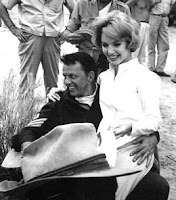
On the set with Frank Sinatra.
Ruta Lee:  The most fun of my life. We laughed all the way through making that film. Poor (director) John Sturges kept trying to get our attention. I tried to do all my work properly, but you could not help but laugh because Dean Martin is a truly funny man. Frank is a funny guy, Joey Bishop was a funny guy, and Sammy is one of the most delicious people ever. It was one big lark. And, of course, they all treated me like their little, baby sister that had to be taken care of. I thought, oh hell, I could have had an affair with all of them and written books...but I didn't.

Café:  You guest starred in almost every classic TV series in the 1960s (and many beyond that). What were some of your favorite guest star roles?
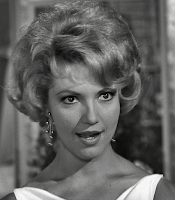
As a "bad girl" in Twilight Zone.
Ruta Lee:  I think that playing a bitchy, little tramp in The Twilight Zone ("A Short Drink from a Certain Fountain") was one of my favorites. When I got through doing a scene, there came a big round of applause from the crew members up on the catwalk. Later, when I finished work that day, they said the applause was because I was good and reminded the crew of their favorite: Carole Lombard. I thought, wow, what a compliment! I also believe I did a good job in a Bonanza episode ("A Woman Lost"), but it was before everyone's agent nominated them for an Emmy. I could have won one with the right publicity. One of the great learning experiences for me was the stuff I did on Perry Mason. Gail Patrick was a beautiful star from the 1930s and into the 1940s, who became a producer. She would hire me a lot. It was always very interesting to me that there was this exquisitely beautiful woman who was not afraid of young girls and not afraid of the competition. I did at least five Perry Mason episodes and that was almost like going to acting school. Working with that cast was absolutely wonderful. I could also say that about the work I did at Warner Bros. One of the mistakes that I made back then was that I said no when Warner Bros. wanted to put me under contract. The contract would have paid me $300 a week whereas I was doing one to two shows a month for $750 a week. But when you go under contract to a studio, you have a powerful machine behind you. You get lessons in whatever you need. You get a publicity department behind you. You get put into roles without having to audition for them. Still, I was very grateful, because I got to do shows like Cheyenne, Maverick, 77 Sunset Strip, and Hawaiian Eye. I was a fixture at Warner Bros. The house that I'm sitting in now I call the "House that Jack (Warner) Built" because my Warner Bros. salaries and residuals helped make the payments.

Café:  When we interviewed Julie Adams in 2013, she also said how much she enjoyed guest starring on Perry Mason.

Ruta Lee:  I don't know if this happened with Julie, but I would get invited as a guest to dinner parties, not every week, but maybe twice a year at Gail Patrick's home. She was married to a man named Cornwell, or Corny, Jackson. I just felt so honored to be among the elite of Hollywood and listen to their stories. It was a great honor and I will never forget Gail Patrick for that.

Café:  Were there any actors that you particularly enjoyed working with?

Ruta Lee:  I loved working with everybody. I am a very easy person to get along with and I enjoy people and their stories. Needless to say, Frank, Dean, and the boys were just the best. Jimmy Garner was great fun to work with on Maverick.

Café:  You have also appeared in a number of stage plays. What were some of your favorite stage roles and why?
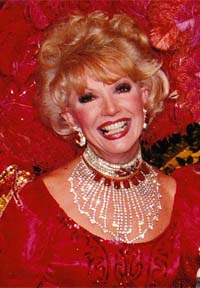
Ruta Lee in Hello, Dolly.
Ruta Lee:  My altogether favorite is one of the hardest roles to play and that's The Unsinkable Molly Brown. I played that role for the first time in Fort Worth, Texas, where I went on to perform it for 40 years. Because of Molly Brown, I became the darling of Fort Worth. The press would write that summer is here and Ruta is here, so everyone can enjoy their summer! It was a great role for me and the best part was the composer of the show, Meredith Wilson, came to see Molly Brown with his wife on opening night. When Meredith was interviewed by the press, he said: "Ruta is the best Molly of them all. If she had played it on Broadway, it would still be running." I also love Anne Get Your Gun, Bells Are RingingHello, Dolly, and The Best Little Whorehouse in Texas, which is the easiest and still a great role in which to strut your stuff.

Café:  You and your husband, business executive Webb Lowe, Jr., celebrated your 43rd wedding anniversary in February. How did you meet and what is the secret to your long marriage?
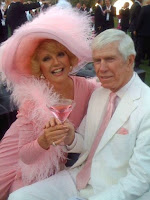
Ruta and her husband Webb.
Ruta Lee:  I'll answer the second question first. The secret to our long marriage is having a great sense of humor. My husband taught me something the first year we were married. As a new young bride, I'd get upset and distressed if he didn't hear what I had to say or didn't bring flowers on an occasion. He said to me: "Let me ask you something. At the end of the day, will this be important? At the end of the week? At the end of the month? At the end of the year, will this still be important and will you still be thinking about it?" I realized that nothing in life is worth stressing over. I'm not talking about serious tragedies, but the usual daily routine. If you can't just laugh it off, then you don't need to be married. Now, as to how I met him, that's a fun story. I had promised the Ladies Professional Golf Association (LPGA) that I'd be its guest star at an event in Naples, Florida. At the time, I was doing a show in Dallas, which was supposed to close on Sunday and then I'd go to Naples on Monday. The theater owners came to me and asked if I could play another week since my shows were selling out. I agreed to do two shows on Sunday, go to Naples, and return to Dallas. I hadn't been feeling well, but I threw myself together, flew to Miami, and ran across the tarmac to a small plane which took me to Naples. I put on the feather boas and long eyelashes and made my big appearance at the LPGA. The next day, of course, I had to return to Dallas for a show and I had a fluey thing going on. So, I put a babushka on my head, big sunglasses, and not a stitch of make-up. It's hot in Florida, so I carried my fur coat as I ran across the tarmac. I go over to American Airlines and they tell me it's a turnaround flight and that they'll pre-board me as soon as it gets cleaned up. So, I was leaning against the counter, my head in my hands, and looking down at the floor. I see a great pair of Gucci loafers coming towards me. And I look up a little further and see nice slacks with a crease on them. I look up a little higher to see a double-breasted blazer with gold buttons. A little further, there's a great tie. And then I see a shock of silver hair and a face that's a cross between Lee Marvin and Clint Eastwood. I said: "Be still my heart!" And he kept walking towards me...and then right past my counter and down the hall. I thought, oh shoot, we're just ships that pass in the night. So, the airline pre-boards me and I'm piling all my stuff under my seat and on the seat next to me. And all of a sudden, I look down and the same pair of shoes are standing there. And he said: "Is this seat taken?" And I said--for the last time in my life--no. And he leaned over and said: "Hello, my name is Webb Lowe." And I said: "Hello, my name is Ruta Lee. And we should be married, because then my name would be Ruta Lee Lowe and we could open a Chinese laundry."

Café:  That's a charming story! Now, I've read where you personally contacted Nikita Khrushchev in 1964, when he was the Premier of the Soviet Union, to secure the release of your grandmother from an internment camp. Can you provide the fascinating details?
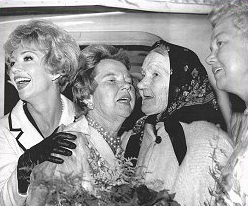
Ruta and family reunited.
Ruta Lee:  I had been trying for years to get my grandmother out of Siberia where she had been deported. She spent fifteen years there. Most of my family was deported to Siberia. No one knows why. We're not talking about brilliant, educated teachers and writers. These were peasant folk who tilled the land and grew their own vegetables to eat. My grandmother was finally permitted to go back to Lithuania with some of the family and we received word that she was dying. We tried to keep them alive by sending packages. You could only send forty-pound packages and the contents were dictated by the Communists...one pound of coffee, one pound of lard, one pair of socks...that kind  of thing. I came home from work one day and my mother was in a state of tears. We had received a letter, though much of it was blacked out, and my grandmother was thanking us for sending clothes for her to be buried in. She had been to a doctor and was told she was going to die. I was so distressed. She was my one remaining grandparent and I had never met any of them. I went out with friends that night and the more wine they poured, the more obvious it became that I should pick up the phone and call Khrushchev--so I did. In those days, there was person-to-person calling and you didn't pay for the call if you didn't get your party. If you got your party, you paid maybe twice as much. I kept calling and calling and the American operator would talk to the Russian operator who would talk with the Kremlin operator, who would get back to me and say: "Nyet, nyet, nyet." In the meantime, I called the Russian Embassy in Washington to get permission to go to Lithuania and I'd get "nyet" there, too. Finally, the Kremlin operator called back and said: "Mr. Khrushchev doesn't speak English. You speak to interpreter to Mr. Khrushchev." I remembered a good-looking young man who traveled with Khrushchev when he was here and had translated for him. Anyway, I spoke with the interpreter and he said: "Miss Lee, we would be very happy to have you travel to the Soviet Union. We know you here. We see your films here. Why don't you speak to your congressman about it?" And I said: "Excuse me, sir. What the hell does my congressman have to do with my traveling to your country? This is not a political matter. It is a matter of the heart. What are you going to do about it?" And he said: "In half an hour, present yourself again to the Soviet Embassy in Washington." I thought, oh no, here we go again! I hung up and a half-hour later I called the embassy. This time, I was connected immediately to the first secretary, who was Lithuanian. Of course, he knew me because I was the one doing the Voice of America broadcasts against Communism. It's an absolute miracle that within 48 hours, my parents and I were on a plane headed to Moscow and then to Lithuania. They took us to my grandmother and six months later, I was given permission to bring her and an aunt back to the United States. She lived for two years, two months, and two days.

Café:  That's an amazing story.

Ruta Lee:  I've been writing a book for the last ten years. One of these days, I'll hopefully get it together and finish it. Maybe you'll help me out by telling all your readers to go buy Ruta's book!

Café:  I will certainly do that. Now, I know you're passionate about volunteerism. You, along with other stars such as Debbie Reynolds, have been deeply involved with a charity called The Thalians for many years. Can you tell about its mission and about how others can help?
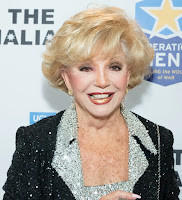
Ruta at a Thalians event.
Ruta Lee:  First of all, everyone can go online to thalians.org and read about us there. It all started in 1955 with a group of young actors who got tired of being called hard-drinking idiots who had nothing to contribute. We'd get together to laugh and play at parties, so we decided we should sell tickets and make a few dollars for a charity. So, we sent Jayne Mansfield and Mamie Van Doren to find out what charities were available. They came back a few months later and said that all the big charities were taken. But they had found a doctor who worked with emotionally-disturbed children at Mount Sinai Hospital. At first, we raised funds for the children and then, eighteen years later, we built a clinic and went from pediatric to geriatric care. We were very proud that this small group of Hollywood performers had shone a spotlight down into that dark pit, which is mental illness, and tried to bring it into the light of healing. Many years later, we changed our focus to returning veterans, who came back scarred not only physically but mentally. We joined up with a group at UCLA called Operation Mend. It deals with the broken arms and faces and we deal with the broken spirits through The Thalians. We ask everybody who has $5, $50, or $5 million to please contribute to The Thalians. We have raised millions of dollars by doing huge shows starring the stars of all-stars and they all did it gratis.

Café:  Do you have any upcoming events that you'd like to tell our readers about?

Ruta Lee:  Yes, The Thalians has an event at the Music Center in Los Angeles on the 18th of May. It's a wonderful luncheon and not a terribly expensive one. If you go to our website, you can read about it and call our office for more information.

Café:  Ruta, you've been a highly entertaining and informative interview subject. Thank you for all of your charity work and for all you've brought to classic movie and TV fans throughout the world.

Ruta Lee:  That's very kind of you. Thank you and all of your readers, Rick. God bless you all.