Showing posts with label piper laurie. Show all posts

Friday, October 10, 2014

Piper Laurie Elevates "Smoke Signal"

By her own admission, Piper Laurie didn't get a lot of good roles as a contract player at Universal in the 1950s. However, one of the exceptions was the blandly-titled Smoke Signal, an above-average Western that avoids the genre's most common cliches.

The action gets off to a quick start when a small Cavalry unit discovers a dead scout with an arrow in his back. It doesn't take long to realize that the previously-peaceful Utes are on the warpath. When they attack the soldiers, the Cavalry troop seeks refuge in a nearby fort. The situation there isn't much better. It turns out the fort has been surrounded for days and the scout sent to seek reinforcement--well, we know that he didn't get very far.

Dana Andrews and William Talman.
The newly-arrived Captain Harper (William Talman) discovers an old acquaintance, Brett Halliday (Dana Andrews), tied to a hitching post. A former Cavalry officer, Halliday deserted long ago and joined the Utes' tribe. Harper believes the Indians want to free Halliday, but the latter claims his life is in danger, too. He urges Harper to transport two boats to a nearby canyon river and seek escape by navigating the rapids.

Augmented with stunning scenery, Smoke Signal zips along efficiently, mixing character-driven scenes with action sequences involving Indian attacks or the perils of the river. Although Dana Andrews--who was on the downside of his career--is billed as the lead, it's Piper Laurie who holds the film together.

Piper Laurie and Andrews.
She portrays the daughter of the fort's commanding officer, who died at the hands of the Utes. In many Westerns, Laurie's character would have been a bitter daughter intent on revenge. However, in Smoke Signal, she's a strong, but quiet character intrigued with Halliday and why he forfeited his Army career. Some of her best scenes are simply intent looks--filled with curiosity--directed toward Halliday when she believes others are not watching.

Smoke Signal is peppered with familiar faces, to include Talman (Hamilton Burger on Perry Mason), William Schallert (the father on The Patty Duke Show), and Milburn Stone (Doc on Gunsmoke). However, the other cast standout is Douglas Spencer as a trapper that joins the soldiers. Surprisingly, the likable Spencer spent most of his Hollywood career as Ray Milland's stand-in. His best-known performance as a supporting player was as the reporter Scotty in 1951's The Thing.

Dana Andrews, who was still struggling with alcoholism at that time, gives an acceptable performance. Unfortunately, his character's eventual romance with Laurie doesn't work at all. First, at age 46, he was almost twice the age of his co-star. More importantly, the script doesn't give the two characters enough time together before they're smitten with each other. There are other flaws in Smoke Signal, too, starting with the unlikely reason that there just happens to be two boats in the fort.

A better title?
Still, it's an interesting Western and deserves credit for not turning the Indians into nameless villains. Halliday speaks of them sympathetically and the film's true bad guy turns out not to be one of the Utes. For the record, there are some smoke signals in the movie. Of course, that's just one more reason why I don't like the film's title. If the studio was going to go in that smokey direction, then--for the sake of accuracy--they should have called the movie Smoke Signals. Or better yet, why not go with the film's French title: The River of Last Chance?

Thursday, September 18, 2014

A Rock Hudson-Piper Laurie Double Feature

For much of the 1950s, Universal Studios paired Rock Hudson with its most promising young actresses in modestly-budgeted films. Sometimes, he was the star (Captain Lightfoot); other times, he played a supporting role (Bend of the River). He appeared in five movies with Julie Adams, four with Yvonne De Carlo, and two with Barbara Rush. Two of my favorite Rock Hudson films of this period are his pairings with Piper Laurie.

Charles Coburn in a familiar role.
Has Anybody Seen My Gal (1952). This sprightly 1920s comedy is really a vehicle for veteran Charles Coburn. He plays Samuel Fulton, a millionaire hypochondriac with no relatives, who wants to leave his fortune to the family of the woman who turned down his marriage proposal. He credits her rejection with providing the drive that led him to discover gold in Alaska and oil in Texas. He decides to learn about the now-deceased woman’s family before bequeathing the money.

James Dean in a bit part at the soda fountain.
Moving to Hilverton, a picturesque slice of Americana, Fulton—using an assumed identity—ingratiates himself with the Blaisdell family. He ends up living in their house and working as an assistant soda jerk in their drugstore. He becomes fond of the family, especially daughters Millicent (Piper Laurie) and Roberta (Gigi Perreau). However, everything changes when Fulton gives them a check for $100,000 anonymously through his solicitor.

Charles Coburn, who started making films in his late fifties, specialized in playing cigar-smoking, crafty curmudgeons. He’s right at home playing the Blaisdells’ secret guardian angel, getting son Howard out of gambling trouble and playing matchmaker to Millicent and nice guy/soda jerk Dan (Rock Hudson).

Gigi Perreau as Roberta.
Coburn also teams effectively with Gigi Perreau, a very likable child performer. Their scenes together display a natural charm, leaving one to wonder why they weren't teamed in another movie. Surprisingly, Perreau’s film career petered out after appearances in Bonzo Goes to College and The Man in the Gray Flannel Suit. She worked regularly, though, in television throughout the late 1950s and 1960s.

Piper Laurie and Rock Hudson.
Rock and Piper don’t have a lot of scenes together, but they make an endearing couple. They were good friends in real life and that comes through on the screen. His performance is a bit stiff; he hadn't developed the light touch that would make him a fine comedian. Piper relies on her innate effervescence and it serves her well. She even gets to sing a little. Plus, she also looks adorable in a parade of colorful dresses and hats.

One suspects  that both young performers wanted to sink their teeth in meatier roles. Still, they provide energy and youth appeal to this pleasant comedy that effectively recreates the 1920s on Universal’s backlot.

The Golden Blade (1953). While this studio-bound adventure can’t be described as high drama, it still provided a more rewarding challenge for the two young stars. They are clearly the headliners of this Baghdad opus about the (magical) Sword of Damascus.

Harum finds the amulet.
Rock plays Harum, a young man from Basra, who seeks revenge on the person responsible for his father's death and destruction of his village. His only clue to the villain's identity is an amulet his dying father ripped from his killer’s neck. Shortly after his arrival in Baghdad, Harum finds a sword made out of gold with the inscription: “Let him who can unsheathe this sword claim any crown as his reward.”

Harum gets to try out the golden blade when some soldiers try to quiet an outspoken young woman. It takes awhile for Harum to learn that the spunky lass is also a princess in disguise. Initially, they don't like each other, but--in this kind of movie--that's code for they're really attracted to each other, but don't want to admit it.

Harum pulls the sword out of the stone.
The Golden Blade isn't an original action flick, borrowing liberally from the legend of King Arthur and his sword Excalibur. Indeed, at one point in the film, the blade gets embedded to a stone wall and no one can remove it--except Harum, of course. Later, there's even a jousting tournament  for the hand of Princess Khairuzan. While this uneasy mixture of Arabian Nights and medieval knights seems disconcerting, Nathan Juran (The 7th Voyage of Sinbad) leaves little time to dwell on it. At a scant running time of 80 minutes, the closing credits of The Golden Blade are rolling before you know it.
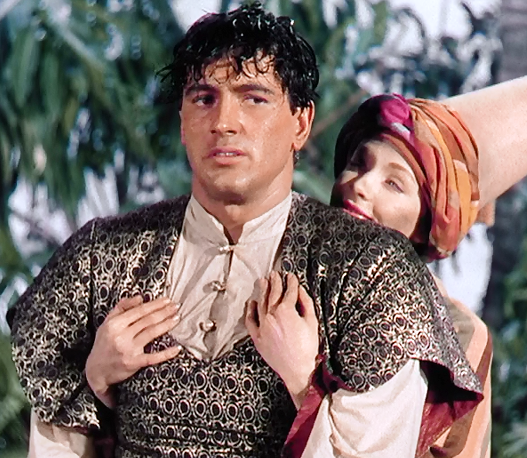
I love their facial expressions.
Rock Hudson always fared well in action roles and he seems to be having a grand time as the swashbuckling hero. Piper Laurie comes across as playful when disguised as a boy and later transforms into an elegant beauty. She and Rock have more scenes together than in their earlier film and their comfort level is once again visible on the screen. They both still look young, but there's more confidence in their acting--even if The Golden Blade is nothing more than a programmer.

Piper Laurie decked out in gold.
Rock would hone his skills for two more years before hitting it big opposite Jane Wyman in Douglas Sirk's melodramatic Magnificent Obsession. Piper Laurie would get an occasional good role (e.g., Smoke Signal), but ended her Universal contract out of frustration. She worked in live television and eventually landed a role opposite Paul Newman in The Hustler (1961). It was a supporting performance that would earn her the first of her three Academy Award nominations.

Thursday, August 28, 2014

Tyrone Power Goes Gambling on the Mississippi

Mark:  Since you spare me only a moment, I'll tell you very bluntly: You and I are in love with each other and we always will be. We've known it since that first moment in St. Louis. 

Angelique:  I could have you run out of town for speaking to me like this!

Mark:  No need to run me out. I'll be leaving tomorrow. You're not ready yet for marriage. And I won't be ready until you come to me. 

Angelique:  Why, you completely egotistical...

Mark:  Yes, it does sounds that way when put into words. But it's the only way a woman can be truly happy with a man. 

Tyrone Power plays a good hand.
For those who have never seen The Mississippi Gambler (1953), I don't think I'm giving away the end by saying that Angelique does indeed go to Mark en route to true happiness. Of course, along the way, three people die from a duel, an accidental death, and a suicide. Two women fall in love with the same man and the brother of one of them falls in love with the other. Plus, two men build and lose a fortune.

Yes, a whole lot happens in The Mississippi Gambler, which boasts a plot structured like a crooked river filled with unexpected bends. That's part of the film's charm, along with an appealing cast consisting of Tyrone Power (Mark), Piper Laurie (Angelique), John McIntire, Julie Adams, and Paul Cavanagh.

The film opens with Mark Fallon, the son of a New York fencing master, setting out to become a professional gambler on the Mississippi riverboats. He quickly befriends a con man (McIntire, in one of his best roles) and falls in love at first sight with Angelique, a stunning aristocratic woman. In fact, he rescues the latter from a runaway carriage, but negates his chivalry when he quips: "Sometimes, beautiful women and horses are upset by whistles."

Piper Laurie looking serious.
The film's central conflict arises when Mark beats Angelique's wimpy brother, Laurent, in a poker game. Mark gives Laurent a chance to walk away with minimal losses, but the hot-headed young man insists on continuing and loses his sister's diamond necklace, a family heirloom. None of this is Mark's fault, of course, but the stubborn Angelique refuses to acknowledge her brother's many weaknesses. That keeps her and Mark apart for almost the entire movie.

In spite of occasionally hokey dialogue, The Mississippi Gambler is a lively, entertaining yarn, Though shot on Universal-International's backlot, it looks fabulous (especially the interiors). Along with the colorful costumes, one would think that it was a costly film. However, given the studio's then-thrifty reputation, I suspect most of the budget went to pay Tyrone Power's salary. Actually, he made The Mississippi Gambler while on hiatus from his 20th Century-Fox contract and wisely took a percentage of the film's profits. It turned out to be one of 1953's biggest hits.

I recently watched The Mississippi Gambler at a film festival screening attended by star Piper Laurie. She said Power was also one of the film's producers, although not credited as such, adding:

I was in a competition for the part with Linda Christian, his wife. We both made screen tests. That was a frightening moment. I had never met with Power, although I had seen he and his wife walk into the commissary, dressed in white, looking like gods. I did my best (with the audition) and she did, too. They made us both wait for about a week and then I found out I had the job.


Piper's co-star and friend
Julie Adams.
It's hard to imagine any actress other than Piper Laurie as Angelique. Radiant, pouty, and charming, she makes it easy to believe that any man could fall instantly in love with her. That's no easy task when Julie Adams is also in the movie. Incidentally, the two actresses became friends during their days as contract players at Universal--and remain so today. They toured Korea together in the early 1950s, performing musical numbers for servicemen.

As for Linda Christian, she eventually got to play Angelique--in a Lux Radio Theater production with her husband. She and Tyrone Power would divorce three years later.

Monday, August 25, 2014

An Interview with Piper Laurie: The Three-Time Oscar Nominee Discusses Her Career in Film, Live Television, and the Stage

Piper's inscription reads: "To Rick from the
Classic Film & TV Cafe."
The highlight of last July's Western Film Fair was--for me--the opportunity to spend 45 minutes sitting next to actress Piper Laurie. While she signed photos for charity, she graciously and thoughtfully answered all my questions about her 64 years in show business. It's an impressive career that netted her Oscar nominations for The Hustler, Carrie, and Children of a Lesser God.

Café:  When you first started in movies, you signed a seven-year contract with Universal, which you later described as a "prison that shielded...creativity." If you could go back, knowing what you know now, would you sign it again?

Piper Laurie:  No, I wouldn't. But, you know, I learned something from all my mistakes and it has made me who I am. That's part of life. I got to work more than most of the contract players. If I had been a different sort of person that could really speak up and fight for myself, I might have gotten--might have gotten--better parts. I doubt it, because they just didn't have those kinds of scripts.

Café:  Early in your career, you were paired multiple times with Rock Hudson and Tony Curtis. What were they like on and off the screen?

In The Golden Blade.
PL:  Well, Tony and I were good friends early on before we were put under contract. I met him when I was about 15. He came to my acting class and joined it. He flirted with me and we had some movie dates. He was a lot of fun. I liked him and he liked me. And then something very weird happened after I was signed at his studio. There seemed to be something going on, even though we were put together in lots of movies. It was never quite the same comfortable camaraderie that we had originally. Rock Hudson, on the other hand, was just a delight. Just a big laugh for a big eater. He was always broke, so he'd come to my mother's kitchen and get fed. He was a lovely man and I think he became a really accomplished actor. He got by early on, but I think he became very good later on in light comedy.

Piper Laurie and Rock Hudson.
Café:  There's a great photo in your book of the two of you at a costume ball.

PL:  We were at some charity benefit. I went as the Greek goddess Circe and carried a live baby pig with me. Rock Hudson was my date and he was dressed as one of my conquerors in dark make-up. He did look bizarre. 

Café:  You starred in several live TV dramas like the Playhouse 90 production of The Days of Wine and Roses with Cliff Robertson. How did live television compare to being on the stage?

PL:  It's similar, but live television is much more extreme. It's really walking on the high wire. I don't think people today understand that when you did the show, not only could you not do it again, but it was going out on the air at that moment to everyone in the country. And whatever mistakes you made, that was it. You would live with it for the rest of your career. It was really chancy. It was a daredevil act. I was terrified and forced myself to do it, because I thought I should and thought I could. And it was very rewarding.

Piper and Paul Newman in The Hustler.
Café:  You wrote in your autobiography that you were "too close" to appreciate The Hustler after you made it, but realized years later that it was a great movie. Have you felt that way about any other of your movies?

PL:  Yes, I recently saw Tim that I made in Australia.

Café:  It's a very good film.

PL:  Well, I liked it, too. I saw it and I was better than I thought I was. I either think I'm worse or I'm better. I'm a little out of my mind when I actually finish a project and my perspective is just not accurate. 

Café:  Both you and your co-star Mel Gibson give fine performances in TimDid you see his potential then as a big star and future director?

Mel Gibson and Piper in Tim.
PL:  Absolutely. I knew he would be a big star. I begged him not to come to America. I knew that once the movie was seen that people would want him to come. I said please stay here for another year or two and continue to work in the theater, which he had been doing. And he didn't pay any attention to me (laughs). It took several years before Tim was released. In the meantime, he made the Mad Max movies and became a big star. As a result of that, Tim was finally released. It's still rarely seen. 

Café:  In your autobiography, you credit Carrie with giving you a "third career." It's a compelling film that has aged wonderfully. How did you come to be cast in it?

Piper as Sissy Spacek's terrifying
mother in Carrie.
PL:  I was living in the country in Woodstock, New York, and they had been looking for someone to play the mother. I hadn't worked in fifteen years in a movie and some people I knew mentioned my name to Brian De Palma. An old agent sent me the script. I read the script and I thought it was just not very good. My husband (film critic Joe Morgenstern) said that Brian De Palma has a comedic approach to what he does. I thought, oh, I misread the whole thing...it's satiric. It's going to be a comedy. On that basis, I took the train into New York City and met De Palma, whom I liked enormously. I guess he liked me. By the time I got back to Woodstock, I heard he wanted me to do the movie. Weeks later, when I went out to rehearse, I had comedic things I had worked out. During rehearsals, De Palma said: "Piper, if you do that, you're going to get a laugh." That really floored me. So, I changed my interpretation slightly. At any rate, that's how I got the part.

Café:  What led to your directing of the 2006 short film Property?

Piper at the Western Film Fair in 2014.
PL:  I'd had a trauma in my life. I had been living in my home for many years in the Hollywood Hills. There was a freak accident when a city worker mowed down a fire hydrant up above my house in the hills. And all night long, the water gushed down the street and ran down into my backyard and undermined everything. The whole hill came crashing down on my house. I was in bed at the time. It was nine o'clock in the morning and I was watching Meet the Press. I felt something shoving at my back. I looked out the window and, in the corner of my eye, I saw something moving--it was the hill. The mud was at the window. So, I just moved as fast as I could and got out of the house and drove away. The city promised it would take complete responsibility. I stayed in an apartment for four years while they rebuilt everything. I had to put all the things I created in storage--all my films, my paintings, my sculptures...everything that I valued. So, I was living in this stark apartment  and I just needed something. I started to fill my life again with whatever I could creatively. I realized I was in love with the short story "Property" by James Lasdun and I'd love to see it as a movie. So, I set out to make that happen.

Café:  You seem to be a harsh critic of your own performances. Which ones are you the most proud of?

Piper in A Little Night Music.
PL:  I guess, after all these long years, The Hustler and Carrie. I liked what I did in Tim. I liked what I did in the Playhouse 90 live show The Days of Wine and Roses, which was rough and not as slick as the movie. My interpretation differed from Lee Remick's, who was lovely in the film version--but different. I like my stage work, though I've never had it recorded. I really enjoyed working on stage. I did The Glass Menagerie on Broadway with Maureen Stapleton; that felt like it was good work. I liked the one-person play I did about Zelda Fitzgerald on tour, which William Luce wrote. And I just recently did my first stage musical, A Little Night Music. I played Madame Armfeldt in a production in Santa Barbara that opened a brand new theater there. I had a wonderful time. I'm also proud of the singing and dancing--for me--in Ain't Misbehavin'.

Café:  Did your ex-husband, film critic Joe Morgenstern, ever review any of your movies?

PL:  During the major part of our marriage, I wasn't making movies. I was going to see a lot of them. The first time he decided he would review me was for The Grass Harp (1995). He stated in the review that he had been married to me once and may have been prejudiced. He was very kind to me and I think nice about the movie. 

Café:  And lastly, you've starred with many of the finest actors of the last 60 years. Who were some of your favorites and why?

PL:  George C. Scott, Paul Newman, Gregory Peck, Jack Lemmon, and one of my idols, Claude Rains. 


Piper Laurie will appear at the Mid-Atlantic Nostalgia Convention in Hunt Valley, Maryland, September 18-20, 2014. The convention's screening schedule includes the aforementioned Playhouse 90 adaptation of The Days of Wine and Roses.

Thursday, July 17, 2014

The Western Film Fair Brings Classic Stars and Fans Together

Hawthorne Hotel and Conference Center.
Last week, I joined over 500 Western movie buffs as they assembled in Winston-Salem, NC for the 37th annual Western Film Fair. One of the oldest fan conventions in the U.S., this year's event featured guest stars such as Piper Laurie (The Hustler, Carrie), Jon Provost (Timmy on Lassie), Johnny Crawford (The Rifleman), Parker Stevenson (The Hardy Boys/Nancy Drew Mysteries), and Joyce DeWitt (Three's Company). All the celebrities had a Western connection, ranging from Piper Laurie's co-starring role in 1955's Smoke Signal to Parker Stevenson's guest appearance on the contemporary Western TV series Longmire.

The format was the standard one for film fan conventions, consisting of: panel discussions and autograph sessions with the stars; movie screenings; and a room full of vendors selling DVDs, movie posters, comic books, etc. My goal was to interview some of the celebrities for this blog, though--having never attended a fan festival--I didn't know if my plans were realistic.

The wonderful Piper Laurie.
On my first afternoon, I approached Piper Laurie at the autograph table and asked if I could interview her. I spent the next 45 minutes sitting next to her, asking detailed questions about her career, her co-stars (e.g., Rock Hudson, Tony Curtis), and personal life as she stopped periodically to autograph photographs. The charming Ms. Laurie discussed life as a Universal contract player in the 1950s, her three Oscar-nominated performances, and acting on the stage and in live television drama. If my Western Film Fair experience had ended right there, I would have deemed it an unqualified success.

Parker Stevenson--on the right--and me.
Still, that same afternoon, I scored interviews with Jon Provost and Parker Stevenson. Both actors were incredibly gracious and gave delightful interviews. Stevenson even insisted on taking a selfie of the two of us, warning me not to crop myself out of the picture. The only disappointment of the day was a minor one. I spent a half-hour sitting next to Johnny Crawford--but a constant stream of fans prevented an interview.

Most of the stars signed the Western Film Fair program for free. However, they charged $20 to $30 for an autographed photo and $10 to autograph an item provided by a fan. One gentleman had Piper Laurie sign a mint-condition, one-sheet poster of her horror film Ruby, which undoubtedly increased the value of that collectible significantly. By the way, Ms. Laurie posted a sign stating that all the proceeds from her autographs would be donated to the Wounded Warriors Project. Such a classy lady!

Johnny Crawford.
I was amazed by the patience exhibited by the stars, who would listen intently as gushing fans described favorite TV episodes or other stars they had met. Some of these encounters lasted for five to ten minutes (even when other people were waiting in line). None of the celebrities charged to pose for a photograph with one of their fans. I know these stars appear at fan conventions to make money, but, frankly, I was impressed at the way they treated their fans.

Jim Rosin with one of his books.
On the second day, I interviewed Jim Rosin, an actor and writer who penned several episodes of Quincy M.E. (and played an alien in the popular cult film The Adventures of Buckaroo Banzai). Rosin has also written several books on classic TV series such as Wagon Train, Route 66, and The Naked City. That's no surprise as he was a great storyteller, sharing anecdotes about working with Jack Klugman, interviewing George Maharis, etc. Rosin also served as the moderator for the panel discussions with the stars.

After screening the Western Smoke Signal, I stayed for the panel discussion with Piper Laurie. Jim Rosin spent the first half-hour asking questions about her career, from her start in Hollywood at age 18 to a recent appearance in the stage musical A Little Night Music. Ms. Laurie then spent another thirty minutes fielding questions from the audience of about 60 people. Of her Smoke Signal co-star Dana Andrews, Piper Laurie said she idolized him as a teen ("My girlfriend and I would go to see films he did with Linda Darnell six times"). Yet, when she first met him at his Burbank home, he was "out cold" from intoxication in the backseat of his car. He struggled with alcoholism throughout the making of Smoke Signal. Ms. Laurie ended, though, by adding: "Mr. Andrews became sober, rehabilitated himself completely, became president of the Screen Actors Guild, and became a useful member of society and a star of Broadway after all this."

Tommy Hildreth, one of the organizers.
That evening, after the panel discussion, I watched The Mississippi Gambler starring Tyrone Power and Piper Laurie (she won the role over Linda Christian, who was then Mrs. Power). The film, which also featured Julie Adams, was shown on 16mm. I learned later that the print belonged to Tommy Hildreth, one of the Western Film Fair organizers. When I asked him to name some of his all-time favorite guests at the event, he deferred initially. But when I pressed for an answer, he admitted that Julie Adams and Piper Laurie were probably his favorites, adding that he had been a fan of both actresses since the 1950s.

The Purple Monster!
During the convention's three days, over 70 digital and 16mm films were screened in multiple rooms, from ten o'clock in the morning until after midnight. While most of them were "B" Westerns featuring cowboy stars such as Hoot Gibson, there were also TV series episodes and serials. The latter included one of my childhood favorites, The Purple Monster Strikes, about an evil Martian decked out in a very cool--if impractical--costume.

Bob "Fuzzy" Brooks.
A primary attraction for many of the Western Film Fair attendees was the vendor room. Collectors scoured the vendor tables carefully, looking for desired items at good prices. Of course, you could also purchase non-collectibles such as Fuzzy's Bunkhouse Brew Coffee, which was being sold by Bob (Fuzzy) Brooks. Heck, Fuzzy has a Facebook page (Westerns Trails Stars of the Silver Screen) with almost 6,000 "likes." He has been a staple at the Western Film Fair for the last four years. Decked out in full Western gear, he certainly attracts attention. In fact, he recounted an amusing story about going to an Atlanta restaurant in his fuzzy outfit and being mistaken for Stinky Pete from Toy Story.

A WFF attendee.
I missed the awards banquet, the convention's culminating event, on Saturday evening. I'm sure it was a delightful affair--combining live music, the presentation of the Ernest Tubbs Award, and attendance by many of the stars. Yet, for all the celebrities and the movies, Hildreth made an insightful observation when asked about the enduring appeal of the Western Film Fair: "I think a lot of people would come even without the guest stars. They look forward to getting together year after year with their friends and talking about the Westerns they love."