Showing posts with label barbara bel geddes. Show all posts

Monday, August 11, 2025

Seven Things to Know About Alfred Hitchcock Presents

1. Alfred Hitchcock's daughter, Pat, appeared in ten episodes of Alfred Hitchcock Presents. Her first appearance was in the season1 episode "Into Thin Air." Its premise was based on an urban myth known as "The Vanishing Hotel Room," which also served as the basis for the novel and film So Long at the Fair (the latter starred Jean Simmons and Dirk Bogarde). Pat also appeared in the memorable season 3 episode "The Glass Eye" (but more on that later).

2. The final episode of Alfred Hitchcock Presents was never broadcast on network television. Written by Robert Bloch (Psycho), it dealt with a manipulative woman, an easily-influenced young man, and the famous magician's trick of sawing a woman in half. NBC censors nixed the episode for being too disturbing. However, was included in the show's syndication package and has since been shown on TV frequently!

Barbara Bel Geddes.
3. The two most famous episodes are undoubtedly "Man from the South" and "Lamb to the Slaughter." The latter, directed by Hitchcock from a Roald Dahl teleplay, stars Barbara Bel Geddes as a woman who murders her cheating husband with a frozen leg of lamb. It earned Emmy nominations for Hitchcock (Best Direction) and Dahl (Best Teleplay Writing). In 2009, TV Guide ranked "Lamb to the Slaughter" at No. 59 on its list of the 100 Greatest TV Episodes. "Man from the South," based on another Dahl story, stars Steve McQueen as a young man who makes a macabre bet on how many times in a row a lighter will light. The episode co-stars Peter Lorre and McQueen's then-wife Neile Adams. Both "Man from the South" and "Lamb to the Slaughter" were also adapted for the 1979-88 TV series Tales of the Unexpected.

Steve McQueen in "Man from the South."
4. A number of prominent writers had stories that were adapted or wrote teleplays for Alfred Hitchcock Presents, including: Ray Bradbury, John Cheever, Roald Dahl, Saki, Garson Kanin, Eric Ambler, Robert Bloch, Stirling Silliphant, Richard Levinson and William Link, Dorothy L. Sayers, Ira Levin, Charles Beaumont, and Cornell Woolrich.

5. CBS broadcast Alfred Hitchcock Presents for its first five seasons and the show was perennially ranked in the Top 30 shows according to the Nielsen ratings. The ratings dropped when it moved to NBC in 1960 and was aired opposite The Many Loves of Dobie Gillis. Although it never cracked the Top 30 again, Alfred Hitchcock Presents ran for seven seasons and 268 episodes. The show expanded to an hour in 1962 and was appropriately retitled The Alfred Hitchcock Hour. In that incarnation, it lasted three more seasons and 93 episodes.
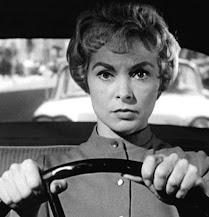
Janet Leigh in Psycho.
6. When Alfred Hitchcock's plans to make Psycho in 1959 were nearly rejected by Paramount, the director cut production costs by using his Alfred Hitchcock Presents TV crew. Specifically, he "borrowed" the show's cinematographer (John L. Russell), set designer (George Milo), script supervisor (Marshall Schlom), and assistant director (Hilton A. Green) to make Psycho.

7. My favorite episode may be "The Glass Eye" from the third season. The remarkable cast features Jessica Tandy, Tom Conway, William Shatner, and Pat Hitchcock. Shatner's character tells the story of his sister, a lonely woman who becomes infatuated with a handsome ventriloquist and longs to meet him. As with many episodes, it ends with a devious twist--but this one packs a wallop (thanks largely to Tandy's acting). Stirling Silliphant (Route 66 co-creator and Oscar winner for In the Heat of the Night) penned the teleplay.

Wednesday, August 8, 2012

The Five Best "Alfred Hitchcock Presents" Episodes

In terms of longevity, Alfred Hitchcock Presents was the most successful American television anthology series. It ran from 1955 to 1962 in a half-hour format and then from 1962 to 1965 as The Alfred Hitchcock Hour. The list below includes only the 268 half-hour episodes.

Barbara Bel Geddes looking calm.
1. Lamb to the Slaughter - When a meek housewife (Barbara Bel Geddes) learns that her cheating husband is leaving her, she whacks him--fatally--with a frozen leg of lamb. She then calmly calls the police to report that her husband was murdered by an intruder. This darkly amusing tale, written by Roald Dahl, works to perfection--right down to the killer punch line. It was one of only 17 episodes (of the total 268) directed by Hitchcock.

2. Man from the South - Based on another Roald Dahl story, this episode stars Steve McQueen as a young man who bets a wealthy oddball (Peter Lorre) that he can light his lighter ten times in a row. If he can, he wins Lorre's snazzy convertible. But if the lighter fares to produce a flame just once, he loses a finger. A suspenseful, well-acted classic featuring another one of Dahl's trademark twists.

Vera Miles in Revenge.
3. Revenge - The very first episode of Alfred Hitchcock Presents raised the bar very high. A distraught woman (Vera Miles) tells her husband she has been assaulted. When the police investigation goes nowhere, the couple seek their justice and go looking for the assailant. In a long-running series featuring a number of memorable twist endings, "Revenge" features perhaps the most potent one. Directed by Hitchcock.

4. The Glass Eye - Director Robert Stevens won an Emmy for this haunting tale of a middle-aged woman (Jessica Tandy) who falls in love from afar with a ventriloquist she has never met. After they begin exchanging letters, he agrees to meet her--with disastrous results. This beautifully written teleplay (by Stirling Silliphant) provided underused actor Tom Conway (George Sanders' brother) with his last good role. It's ultimately a very sad story of two lonely people.

Billy Mumy with loaded gun.
5. Bang! You're Dead - Hitchcock directed this wonderfully tense episode about a young boy (Billy Mumy) who mistakes a real gun for a toy pistol and spends the day playing with it. The worst part: the gun is loaded. Mumy's success as Will Robinson on Lost in Space has obscured his finest TV work, as in this episode and the "It's a Good Life" episode of The Twilight Zone.

Honorable Mentions:  Breakdown (a Hitch-directed episode with Joseph Cotten as a man paralyzed in his car), One More Mile to Go (a man with a corpse in his car trunk), and Victim Four (a Paul Henreid-directed episode about a woman whose bad headaches are really bad). It's interesting to note that both Alfred Hitchcock Presents and The Twilight Zone featured adaptations of Ambrose Bierce's An Occurrence at Owl Creek Bridge. However, The Twilight Zone episode was actually a short French feature filmed two years before its broadcast on Twilight Zone.

Sunday, January 24, 2010

Underrated Performer of the Week: Barbara Bel Geddes

Quality—not quantity—defined Barbara Bel Geddes’ career in film and television. She only made twelve films, but two of them are beloved classics:       I Remember Mama and Vertigo. On the small screen, she starred in possibly the most famous episode of Alfred Hitchcock Presents and became a household name to a new generation in the 1980s as “Miss Ellie” Ewing on Dallas.

Bel Geddes, whose father was an architect and stage designer, fell in love with the theatre at an early age. She was 18 when she made her Broadway debut as Dottie Coburn in the 1941 comedy Out of the Frying Pan. When she won a 1947 New York Drama Critics Award for Deep Are the Roots, Hollywood came calling.

Bel Geddes made her film debut opposite Henry Fonda and Vincent Price in The Long Night (1948), a remake of the brooding 1939 French classic Le Jour se lève. The following year, Bel Geddes landed her most memorable film role as Irene Dunne’s daughter in I Remember Mama, a heartfelt ode to motherhood. She received an Academy Award nomination for Best Supporting Actress.

After solid performances in Panic in the Streets (1950) and Fourteen Hours (1951), Bel Geddes’ film career stalled when she was investigated by the House Committee on Un-American Activities. Although she was not one of “The Hollywood Ten”, she turned her focus back to the theatre, where she appeared on Broadway in The Moon Is Blue and The Living Room. In 1956, Bel Geddes earned raves as Maggie the Cat in the original stage version of Tennessee Williams’ Cat on a Hot Tin Roof. She earned Tony Award nominations for Williams’ play and for the 1961 comedy Mary, Mary.

She returned to Hollywood in 1958 to star in Alfred Hitchcock’s masterpiece Vertigo. She played Midge (see photo above), James Stewart’s quietly-suffering female friend who longed to be more than just a friend. The part eventually led to four appearances on Hitch’s TV series Alfred Hitchcock Presents. The best of those episodes—indeed, one of the best in the series’ entire run—was “Lamb to the Slaughter.” It featured Bel Geddes as a woman who kills her cheating husband with a frozen leg of lamb. (There’s more to the story, but no spoilers here!)

By 1978, Bel Geddes was working sporadically when she was offered the part of matriarch Ellie Ewing in the CBS prime time soap Dallas. When the show blossomed into a ratings behemoth, she became known to a whole new generation as simply “Miss Ellie.” The part earned her an Emmy Award for Outstanding Lead Actress. She left Dallas after heart surgery in 1983 and was replaced by Donna Reed. When viewers rejected the “new” Miss Ellie, Bel Geddes was convinced to return to the role until shortly before Dallas left the airwaves in 1991.

Barbara Bel Geddes subsequently retired to Maine. She died of lung cancer in 2005. She was married twice.