 |
The villain appears in a pre-title
sequence--but he's masked. |
Dr. Peter Tompson's medical practice in a small Cornish village has not gone well--that will happen when 13 patients die suddenly within a year of one's arrival. The baffled physician writes a letter to his former medical professor, Sir James Forbes, stating: "Our village has been beset by a number of mysterious and fatal maladies...the victims have no will to live." Sir James' daughter Sylvia, a friend of Peter's wife, suggests an impromptu visit.
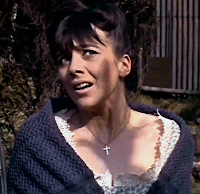 |
| A frightened Alice. |
Following their arrival, Sir James learns that things are worse than described. A group of aristocratic young men, affiliated with the local squire, run roughshod over the town. The frightened villagers distrust the new visitors. And, worst of all, Peter's wife Alice looks pale, displays a loss of appetite, and acts very defensive about the unusual cut on her hand. She also seems to have an obsessive interest in the handsome and wealthy Squire Hamilton.
Released in 1966,
The Plague of the Zombies exhibits all the traits that made Hammer Films synonymous with horror cinema: a strong cast; an atmospheric setting; an interesting plot; and production values that disguise the modest budget.
 |
| Andre Morell as Sir James. |
The cast in
Plague is anchored by Andre Morell, a classically trained actor who worked on the British stage with the likes of John Gielgud, Alec Guinness, and Robert Donat. Morell made his Hammer debut in 1959 as one of the screen's finest Dr. Watsons opposite Peter Cushing's Sherlock Holmes in
The Hound of the Baskervilles. Morell brings his authoritative presence to the role of Sir James--a perfect counterpart to the charming villain played by John Carson. The best supporting performance belongs to Jacqueline Pearce as the vulnerable Alice.
Director John Gilling filmed
The Plague of the Zombies back-to-back with
The Reptile. The films also share the same crew, the same setting, and some of the same performers (the most prominent of which is Pearce
, who plays a more significant role in
The Reptile). A journeyman director, Gilling brings surprising visual flair to
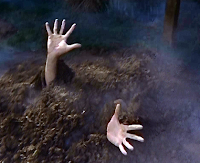
The Plague of the Zombies. He employs an effective blue color scheme--from the deep-blue night sky to the blue-tinted zombies. The first zombie appearance is played for chills as the creature--almost silhouetted again the sky--tosses a woman's corpse toward Sylvia. Another effective scene has hands rising up out of the earth.
The only thing that keeps
Plague from ranking with Hammer's best is the derivative nature of the plot. Although Hammer attempts to mask it with a different setting and better acting, a key element of the plot--why the squire wants to turn people into zombies--appears to have been lifted from the 1932 Bela Lugosi film
White Zombie.

Hammer released
The Plague of the Zombies on a double-bill with
Dracula: Prince of Darkness, a fair entry in its usually entertaining
Dracula series with Christopher Lee. The poster promised vampire fangs for the young male movie theatre patrons--so they could "bite back." The girls in the audience got "zombie glasses" to defend themselves. I'm still pondering the zombie glasses...it's pretty easy to recognize a zombie (especially if they're tinted blue and move in a lumbering fashion). So, I'm not sure if those glasses really provide much in the way of zombie protection.
This post is part of the
Hammer Halloween Blogathon hosted by the Classic Film & TV Café. Click here view the complete blogathon schedule.