Showing posts with label danny kaye. Show all posts

Friday, February 15, 2019

Is "The Court Jester" the Best Classic Movie Comedy?

I recently watched The Court Jester (1955) for perhaps the tenth time--and laughed just as much as the first time. I realize comedy is very subjective as some folks prefer broad laughs and others opt for dark humor. But I'm hard pressed to think of a classic film comedy that's as nearly perfect as The Court Jester.

For the uninitiated, it's a medieval tale in which the Black Fox (a sort of Robin Hood) plots to restore the rightful heir to the throne: a royal baby with a purple pimpernel birthmark on his posterior. Danny Kaye plays Hawkins, a minor member of the Black Fox's gang, who is given the mission of smuggling the baby into the palace and getting the key to a secret passageway to the Black Fox. Of course, Hawkins is not entrusted with this mission alone; he is accompanied by Jean (Glynis Johns), one of the Black Fox's senior officers.

En route to the palace, Hawkins and Jean encounter the new royal jester Giacomo ("King of jesters and jester of kings"). Learning that no one in the king's court has ever seen Giacomo, they hatch a quick scheme that has Hawkins assuming the identity of the jester.

Danny Kaye and Basil Rathbone: "Get it? Got it. Good!"
They don't know, of course, that the villainous Sir Ravenhurst (Basil Rathbone) has hired Giacomo to assassinate three of the king's advisors. Nor could they anticipate that Princess Gwendolyn's lady-in-waiting, Griselda, has promised that a handsome stranger will rescue the princess from an undesirable marriage. To ensure that Hawkins/Giacomo meets the princess's expectations, Griselda (Mildred Natwick) hypnotizes him into thinking he's the medieval version of Rudolph Valentino.

Cecil Parker and Angela Lansbury.
Written and directed by Melvin Frank and Norman Panama, The Court Jester is a textbook example of how to tailor a film to fit its star's skills. Danny Kaye's physicality, quick delivery of dialogue, and exaggerated facial expressions are masterfully exploited in at least five classic comic routines. The most famous, of course, is the "Chalice from the Palace", but almost equally as funny are: Hawkins portraying an old man who is hard of hearing; the romancing of Princess Gwendolyn as Hawkins snaps in and out of his hypnotic trance; Hawkins' "get it, got it, good" exchanges with Ravenhurst, and the climatic sword fight. Simply put, it's the best part ever for the multi-talented Kaye.

Glynis Johns as Jean.
When I think of movies in which every role is ideally cast, three films come to mind: The Wizard of Oz, The Adventures of Robin Hood...and The Court Jester. It should come as no surprise that marvelous actors such as Lansbury, Rathbone, Natwick, and Johns possess impeccable comic timing. But it's also apparent that care was put into casting even the smaller parts. Cecil Parker is a delight as the king whose principal focus is on selecting wenches for a feast. Even Robert Middleton, who played his share of villains, generates laughs as Sir Griswold as he tries to remember which goblet contains the pellet with the poison.

Danny Kaye and Mildred Natwick.
Naturally, even the best comedians can falter without a funny script, so it's fortunate that The Court Jester was written (and directed) by Frank and Panama. Their greatest accomplishment is with how they incorporate the aforementioned laugh-out-loud gags into a carefully crafted spoof of costume adventures such as Errol Flynn's Robin Hood. The two writers, who met while students at the University of Chicago, worked together for three decades and penned the scripts for films such as Mr. Blandings Builds His Dream House, The Road to Utopia (the finest Road picture), and White Christmas (Danny Kaye's second-best film).

It's not all perfect. The opening musical number, while clever and lively, goes on too long. (Still, it serves the purpose of introducing Hawkins' acrobatic friends, which become important later.) Once Hawkins assumes the guise of Giacomo, The Court Jester rolls along at a frolicking pace. From that point on, it may produce the most laughs per minute of any comedy (only A Shot in the Dark comes close). And I must say that my wife and I have never shown The Court Jester to anyone who didn't have a grand time.

So is it the best classic movie comedy? I honestly can't think of a better one, so I'll say yes! Get it? Got it. Good!


This review is part of the Adoring Angela Lansbury Blogathon hosted by Realweegiemidget Reviews.

Below is the scene where a hypnotized Hawkins is sent to woo Princess Gwendolyn. It's the fourth most-watched clip (out of over 100) on the Cafe's YouTube channel.

Monday, August 13, 2018

A Song Is Born: Fabulous Music But a Waste of Danny Kaye

Danny Kaye as Hobart Frisbee.
A musical remake of Ball of Fire must have been one of the easiest pitches of all time. After all, the original 1941 comedy--penned by Billy Wilder and Charles Brackett--was about a bunch of academics writing an encyclopedia about music. Ball of Fire starred Gary Cooper as a naïve musicologist and Barbara Stanwyck as a brash nightclub singer who shakes up his world. The remake, A Song Is Born substitutes Danny Kaye and Virginia Mayo. It retains the plot, adds songs, and features many of the finest musicians working in the U.S. in 1948. How could it go wrong?

It gets off to a promising start with Professor Hobart Frisbee (Kaye) realizing that music has changed in the seven years that he and his colleagues have sequestered themselves to write their encyclopedia. To gain an appreciation for this "new" music, Frisbee embarks on a tour of New York City nightclubs. This serves as a great excuse for a musical montage featuring Tommy Dorsey, the Golden Gate Quartette, Lionel Hampton, Louis Armstrong, Charlie Barnet, and others.

Virginia Mayo as Honey.
Frisbee also encounters Honey Swanson (Mayo), a pretty singer who needs to find a place to lay low when the police close in on her gangster boyfriend. Honey decides that Frisbee's Totten Music Foundation would be the ideal temporary hideout--never mind that she'd be living with seven intellectual bachelors.

Given the source material, music, and Danny Kaye, I expected A Song Is Born to be much better than a middling musical that smolders without catching fire. Except for the opening jungle chant number, Kaye neither sings nor dances. In his Kaye biography Nobody's Fool, author Martin Gottfried notes that the comedian had temporarily split from his wife Sylvia Fine following his affair with Eve Arden. Fine wrote many of her husband's songs and she refused to be involved with A Song Is Born. As a result, Danny Kaye "did not--he would not--find anyone else to write material for him."

Benny Goodman as a professor.
Without the fabulous music and a fully functional Kaye, the second half of A Song Is Born lumbers along toward its obvious climax. To her credit, Virginia Mayo tries her best to keep the film afloat and occasionally succeeds (as in the "yum-yum" scene).

It was Mayo's fourth film with Danny Kaye, having teamed with him previously in Wonder ManThe Kid From Brooklyn, and The Secret Life of Walter Mitty. She even had a bit part in Kaye's Up in Arms. By the way, Steve Cochran, who played the villain in A Song Is Born, appeared with Mayo six times (including The Best Years of Our Lives and White Heat).

In addition to its plot, A Song Is Born shares other connections with Ball of Fire. Howard Hawks directed both films and Gregg Tolan served as his cinematographer. Mary Field also plays Miss Totten, the benefactor of the music foundation, in both films. Hawks expressed little enthusiasm for A Song Is Born, claiming that he made it only because Sam Goldwyn "pestered" and "annoyed" him into it.

Fortunately for Danny Kaye, his best films--White Christmas and The Court Jester--were still to come. And if A Song Is Born is nothing but a footnote in his long career, it's an still an interesting one that documents some of the great jazz and popular music instrumentalists of its era.

Monday, May 15, 2017

Five Stars Blogathon: Cary Grant Tops My List of Favorite Stars

This is my contribution to the Five Stars Blogathon in support of National Classic Movie Day. I encourage you to check out all the posts to this wonderful blogathon. When my fellow contributor Rick asked me to write about my five favorite film stars, I came up with four of them quickly. It was a challenge, though, to determine who to place in that last slot!

1. Cary Grant - Debonair and dashingly handsome, I most admire Cary Grant for his versatility. He can play zany roles in comedies like Holiday, charming heroes in escapist fare such as To Catch a Thief, or serious roles like the bitter government agent in Notorious. My favorite Cary Grant movies: Bringing Up Baby, North By Northwest, and The Bishop's Wife.


2.  Deborah Kerr - This gracious, understated actress lights up the silver screen with her compelling presence. She can play a lonely woman whose passion erupts on a sandy beach (From Here to Eternity) or an elegant governess in which a dance is the only way to convey her feelings (The King and I). She can even convincingly play three women in the same film (the under-appreciated Life and Times of Colonel Blimp). My favorite Deborah Kerr films must include Black Narcissus and The Chalk Garden.

3.  David Niven - This classy performer has a unique gift: He makes any movie better when he's in it. Although he became a Hollywood star, it's surprising how many supporting roles he had throughout his career. He flew alongside Errol Flynn in The Dawn Patrol, eluded Inspector Clouseau in The Pink Panther, and was one of the hotel residents in Separate Tables. He was also an entertaining writer, as evidenced by his delightful books Bring On the Empty Horses and The Moon's a Balloon. Some of my favorite films with this multifaceted actor: A Matter of Life and Death (aka Stairway to Heaven), The Birds and the Bees, and The Guns of Navarone.

4.  Danny Kaye - I always thought this gifted actor/dancer/singer should have been a bigger star. He was an absolute master of comic timing, as evidenced by the hilarious "Chalice in the Palace" and "Get it? Got it. Good!" routines in The Court Jester. He was also incredibly graceful on the dance floor, as he wonderfully displayed with Vera-Ellen in the lovely White Christmas number "The Best Things Happen While You're Dancing." These two also happen to be my favorite Danny Kaye movies.

5.  Katharine Hepburn - I am sure this strong-willed, intelligent actress will show up on many lists in this blogathon--and rightfully so. Like Cary Grant, she was equally at home in comedy and drama. She also managed to remain a star for an incredible five decades (six if you count a trio of made-for-TV movies and a small role in Love Affair). My favorite Katharine Hepburn films include Holiday, Desk Set, and Guess Who's Coming to Dinner.

Honorable Mentions:  Charles Laughton, Alec Guinness, Alastair Sim, Vincent Price, and Gene Tierney.

Monday, November 2, 2015

DVD Spotlight: Danny Kaye - Legends (six episodes from The Danny Kaye Show)

With TV variety series near the peak of their popularity in 1963, CBS offered a new show to one of Hollywood's most versatile performers: Danny Kaye. The comedian-singer-dancer had already hosted several successful television specials, so he was an obvious choice. The Danny Kaye Show ran for four years and 120 episodes, earning an Emmy for Outstanding Variety Series in 1966. MVD Entertainment Group recently released a two-disc DVD set called Danny Kaye - Legends, which contains the following six episodes of The Danny Kaye Show.

November 4, 1964 (S2 E7): Lucille Ball and John Gary,

December 9, 1964 (S2 E12): Tony Bennett, Imogene Coca, and the Clinger Sisters (there were four of them).

September 25, 1965 (S3, E3): Shirley Jones and the Righteous Brothers.

January 4, 1967 (S4, E16): Louis Armstrong and the Kessler Twins (singer-dancers Alice and Ellen).

January 11, 1967 (S4, E17): Liberace and Vikki Carr.

March 1, 1967 (S4, E24): George Burns and French singer Mirelle Mathieu.

The first two episodes are in B&W, but the other four show off the colorful costumes and sets. As indicated above, Kaye mixed well-known guest stars with promising young talent, such as Mirelle Mathieu. The French songstress was just 18 when she sang on the show--in her native language, no less. (Although she never gained fame in the U.S., she forged a long, successful career in France.)

George Burns and Danny Kaye.
Series regulars included Harvey Korman, Joyce Van Patten, orchestra leader Paul Weston, and youngster Victoria Meyerink (a semi-regular starting in 1965). Predictably, Korman shines in the numerous comedy skits, but he also proves to be a capable singer. Weston was already an acclaimed composer and arranger, who had worked with some of the biggest names in music (e.g., Johnny Mercer, Bing Crosby, Dinah Shore, etc.).

Satchmo on his trumpet.
The format of The Danny Kaye Show adhered to the standard variety series formula. Kaye usually opened with a musical number, sometimes being joined by a guest star. Comedy sketches followed, featuring Kaye and his guests or perhaps just the star by himself. There would be two or three songs performed by that week's musical headliner. Kaye typically closed the show by talking with the audience, sometimes inviting one of his fans to join him on stage. (Interestingly, though he was still a fluid dancer, Kaye didn't dance all that much.)

Lucy and Danny as the Scottish butler.
My favorite episodes among the ones included on Danny Kaye - Legends feature Lucille Ball and Shirley Jones. Lucy's episode ends with a brilliant sketch in which the two actors play six parts in a stage production called "Love Has Nine Lives." These marvelous comedians seem to be having as much as the audience as they enter and exit scenes portraying different characters (at various times in the play, each of them plays the same character).

Kaye and the lovely Ms. Jones.
Shirley Jones' episode is a delight from start to finish as she displays her first-rate singing and comedic talents. The Righteous Brothers are also on hand to sing their #1 hit "You've Lost That Lovin' Feeling." The show ends with an extravagant "man vs. woman" trial--performed totally in song--with Harvey Korman as the judge, the Righteous Brothers as the attorneys, and Danny and Shirley as their clients.

The DVDs are packaged nicely, but there are no extras. There is a series of separate menus that conveniently list all the song performances separately. Visual quality is fine for a 50-year-old television series.

Classic television fans, and especially Danny Kaye admirers, will enjoy this two-disk set. The only downside is that Danny Kaye - Legends will leave you wishing there was a larger set featuring other guests such as Gene Kelly, Mary Tyler Moore, Glynnis Johns, Nat King Cole, Dick Van Dyke, and Harry Belafonte.


Danny Kaye - Legends is available from the MVD Entertainment Group and retail outlets. Jonas PR provided a copy of this DVD set for this review.

Thursday, April 2, 2015

Danny Kaye Gets Up in Arms

Danny Kaye's feature-length film debut is a serviceable musical comedy intended as a showcase for its star and radio singing sensation Dinah Shore. In that regard, Up in Arms (1944) works well enough, though Kaye became a more controlled--and more effective--entertainer in later films such as the comedy classic The Court Jester (1955) and perennial favorite White Christmas (1954).

Dinah singing "Now I Know."
Kaye plays Danny Weems, a hypochondriac who works as an elevator operator so he can be near the many physicians working in his building. He fancies himself in love with a nurse named Mary (Constance Dowling), although he'd be better matched with Mary's friend Virgina (Dinah Shore). To complicate matters, it's instant love for Mary when she meets Danny's pal Joe (Dana Andrews). Before these romantic entanglements can be worked out, all four friends wind up in the Army--with Danny accidentally smuggling Mary aboard the ship carrying his unit into action.

In character for the "Theater Lobby"
number written by his wife Sylvia Fine.
Kaye seems determined to carry this flimsy plot by himself if required. He employs physical comedy, uses a wide variety of different voices, and sings nonsensical songs at breakneck speed. Most of his routines are very funny, but he could have benefited from more structure and a better supporting cast. Dana Andrews has little to do and seems out of place. Constance Dowling has one funny scene with Danny. The only other performer to stand out is Dinah Shore, who shows why she was successful enough to get her own radio show, Call to Music, in 1943.

Indeed, Danny and Dinah provide three good reasons to watch Up in Arms: her rendition of the Oscar-nominated ballad "Now I Know"; Danny's appropriately-titled "Theater Lobby Number," which is a musical "summary" of a made-up movie with Kaye playing all the characters; and, best of all, Danny and Dinah combining for "Tess's Torch Song." The last number is a hoot, with Goldwyn Girls sprouting from giant vases in the background and the two stars repeating each other's nonsensical lyrics with perfection. In fact, it's so good that--instead of a closing scene--there's a short reprise of "Tess's Torch Song" just prior to the closing credits.

Danny, Dinah, and Goldwyn Girls in giant vases!

Virgina Mayo.
Speaking of the Goldwyn Girls, one of them is played by Virgina Mayo (in fact, she has a brief speaking part as a WAC named Joanna). While she and Kaye never share a scene together, the two subsequently teamed up for Wonder Man (1945), The Kid from Brooklyn (1946), The Secret Life of Walter Mitty (1947), and A Song Is Born (1948).

Dinah Shore appeared in only a handful of films and never achieved silver screen stardom. That probably didn't bother her much, since she remained a recording star through the 1950s and also achieved success on television. After a career lull during the 1960s, she made a comeback as a popular daytime talk show host in the 1970s.

Thursday, December 4, 2014

Remembering Television's Original Peter Pan

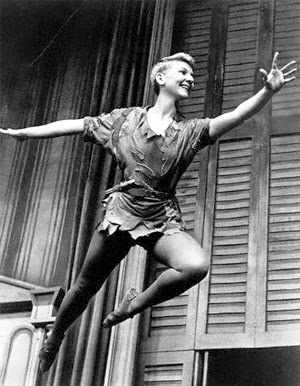
Mary Martin as Peter Pan.
With NBC mounting a new live production of Peter Pan on December 4th, I wanted to pay homage to the network's earlier version starring Mary Martin. That classic television special premiered almost 60 years ago, originally as an episode of the anthology series Producer's Showcase. Its success was immediate—Peter Pan became the most watched program in the brief history of network TV. Even more surprisingly, it provided what turned out to be its star's signature role.

In Ronald L. Davis' book Mary Martin, Broadway Legend, the author includes this quote from Ms. Martin: "Peter Pan is perhaps the most important thing, to me, that I have ever done in theater." That's high praise from a legendary star who is also identified with two Rodgers and Hammerstein classic stage musicals: South Pacific and The Sound of Music.

Whole books have been devoted to the history of James M. Barrie’s Peter Pan, which was originally written as a play in 1904 and later transformed into a novel (also known as Peter and Wendy). Actually, Peter made his first appearance as a character in Barrie’s 1902 novel The Little White Bird (portions of which were later published as Peter Pan in Kensington Gardens). Barrie bequeathed all profits from Peter Pan to the Great Ormond Street Hospital for children.
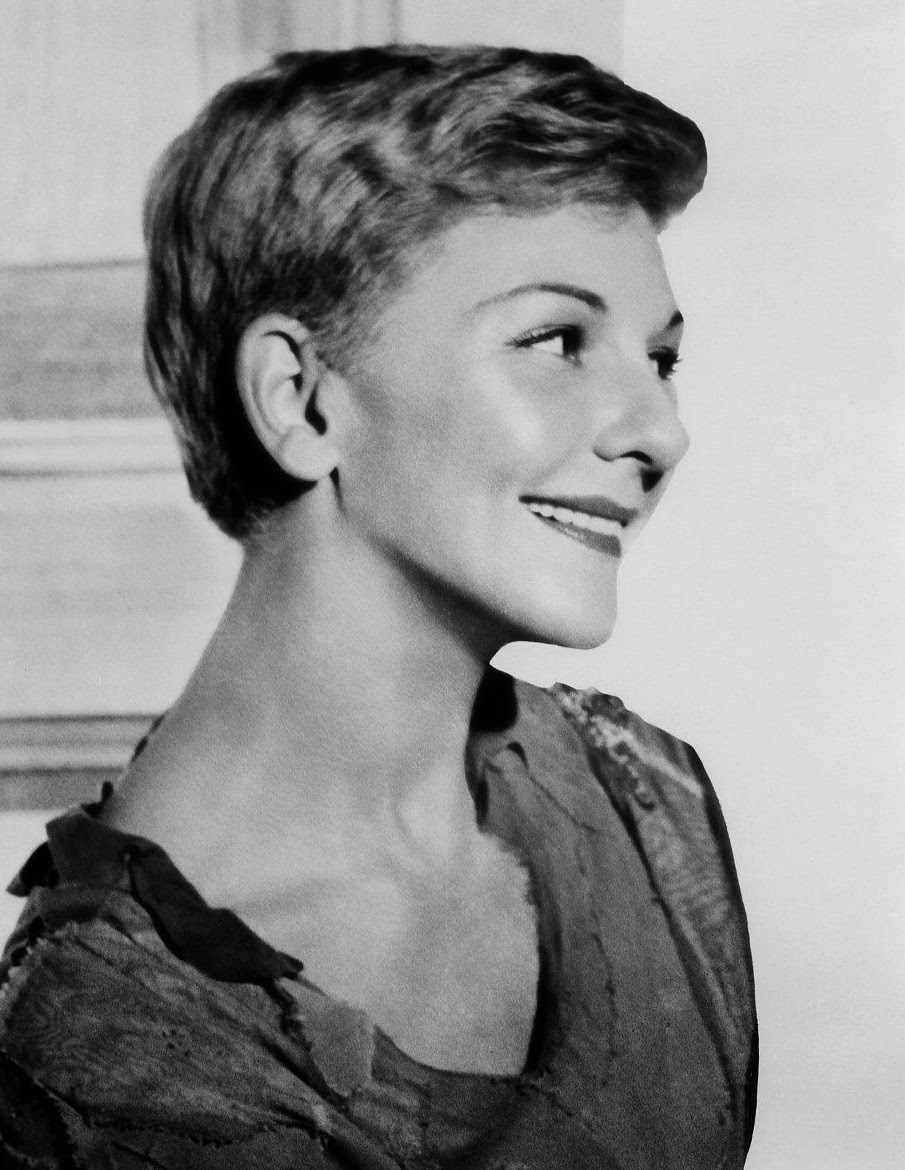
Martin was 41--but didn't look
her age!
In 1954, producer Edwin Lester and stage director Jerome Robbins came up with the idea to transform Barrie's Peter Pan into a Broadway musical. Ironically, just a year before, Walt Disney had adapted Barrie's play into an animated film with songs (though it's not really a musical). Lester hit the jackpot when Mary Martin agreed to play Peter Pan, a part typically portrayed by actresses. Martin was already a huge Broadway star, having won a Tony award for South Pacific.

From the beginning, the intent was to mount a stage musical and then "film" it for NBC television. Moose Charlap and Carolyn Leigh wrote the songs for the original version, which included now-favorites "I've Gotta Crow" and "I'm Flying." After a West Coast tryout, director Robbins decided to add more songs and turned to Jule Styne (already a popular songwriter) and Betty Comden and Adolph Green (who had teamed with Leonard Bernstein for On the Town). The most notable contributions from Styne, Comden and Green were the songs "Never Never Land" and "Wendy."
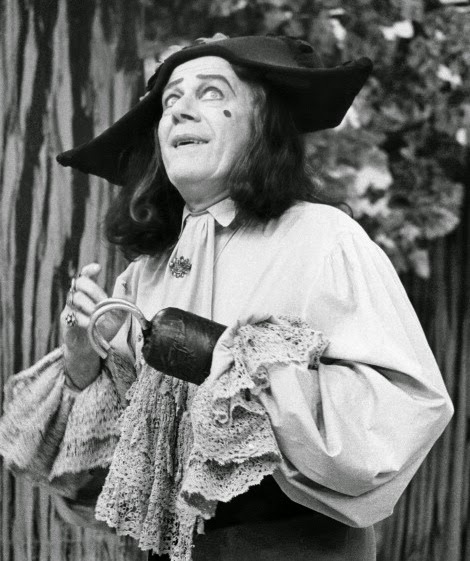
Cyril Ritchard made a delightful
Captain Hook.
The Peter Pan musical opened on Broadway in October 1954 and, despite a planned limited run that lasted just 152 performances, earned Tony awards for Mary Martin and her co-star Cyril Ritchard (who, as is tradition, played Mr. Darling and Captain Hook).

The stage musical was then recreated on NBC's sound stages for Producer's Showcase and broadcast in March 1955. It was both a popular and critical success, earning Mary Martin an Emmy. NBC showed another live telecast with the same cast the following year. Then, in 1960, NBC mounted a third production, which was recorded as a stand-alone television special. This version was subsequently rebroadcast on NBC in 1963, 1966, 1973, and 1989. It has since been shown on the Disney Channel and released on DVD.
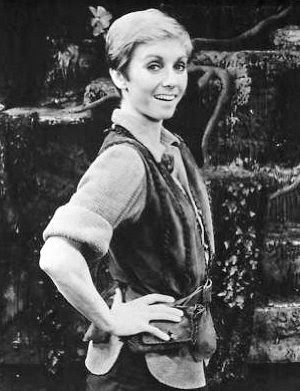
Sandy Duncan as Peter.
Although the Mary Martin Peter Pan (as dubbed by its fans) is the most famous, there have other adaptations of the Broadway musical on stage and on television. Sandy Duncan received a Tony nomination for a 1980 revival, which co-starred George Rose as Captain Hook.  In 1991, gymnast Cathy Rigby starred in a “theater in the round” revival. She also received a Tony nomination and later reprised the role in 1992 and 1998. My wife and I saw Lulu (To Sir, With Love) as Peter Pan in a West End production in the mid-1980s (she was fabulous!).
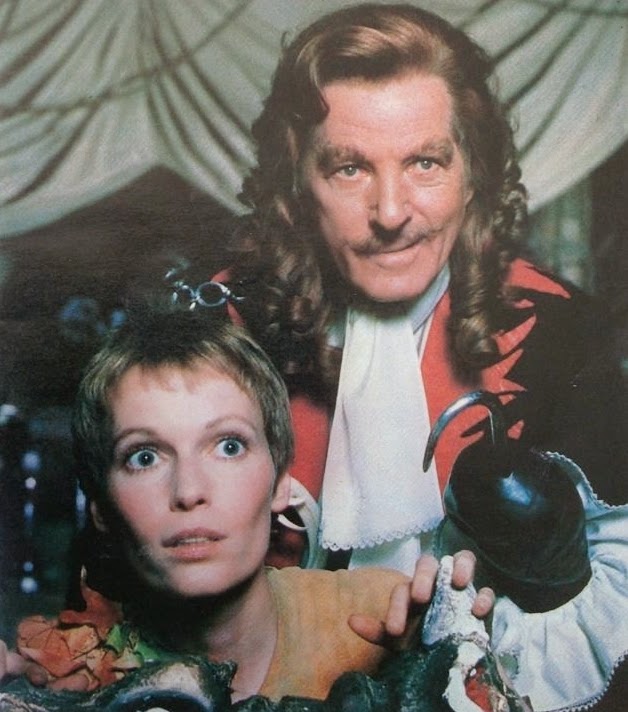
Mia Farrow and Danny Kaye.
Despite the steady stage revivals, the only attempt to replace Mary Martin as Peter Pan on TV occurred in 1976. The Hallmark Hall of Fame broadcast an entirely new musical with songs by Anthony Newley and Leslie Bricusse. Mia Farrow portrayed Peter with Danny Kaye as Captain Hook. Despite a game cast, it was a rather mundane affair that was quickly dismissed by critics and viewers.

That brings us back to NBC’s Peter Pan Live! starring Allison Williams as Peter and Christopher Walken as Captain Hook. I hope it captures the spirit of the original, which Mary Martin described aptly in the aforementioned biography: “Neverland is the way I would like real life to be...timeless, free, mischievous, filled with gaiety, tenderness, and magic."

Saturday, December 12, 2009

12 Days of Christmas: Bing Crosby and Danny Kaye Team Up for a "White Christmas"

There was a time when I grumbled because White Christmas was shown every Yuletide season while Holiday Inn (1942) only made sporadic appearances. Most critics consider the latter film, in which the song “White Christmas” was introduced, to be the superior musical. It was only after my wife and I acquired both films on video that I recognized the virtues of White Christmas. It’s a near-perfect blend of music and comedy, with the cast and crew at, or near, the peak of their careers. With apologies to the amazing Fred Astaire, White Christmas holds up much better than Holiday Inn, thanks largely to one of Danny Kaye’s most delightful performances.

He plays Private Phil Davis, who saves the life of popular crooner Captain Bob Wallace (Bing Crosby) during World War II. After the war, Phil and Bob team up to form a hugely-successful duo that plays nightclubs, has its own radio show, and eventually produces Broadway musicals. Concerned that Bob will never settle down, Phil tries to play matchmaker. He finds a promising love interest for Bob in Betty Haynes (Rosemary Clooney), half of a singing sister act (the other half being the spunky Vera-Ellen as Judy).

Phil and Bob follow the Haynes Sisters to Vermont, where the girls are scheduled to perform at a holiday resort. In their surprise, they learn that the inn is run by Tom Waverly (Dean Jagger), a retired general who commanded their unit during the war. The inn is doing very poorly financially, so Phil and Bob decide to put on a big show to drum up business.

It’s a thin premise for a two-hour musical, but it works amazingly well. The dance numbers are staged energetically, with the highlight being Danny and Vera-Ellen dancing outside a nightclub to the melodic “The Best Things Happen While You’re Dancing.” A lively performer with sex appeal, Vera-Ellen makes an ideal partner for the graceful, athletic Kaye. The two appeared together in two previous Kaye comedies (The Kid From Brooklyn and Wonder Man), though Virginia Mayo played the lead opposite Danny in both films.

Crosby and Clooney generate a more subdued, but no less effective, chemistry. Their duet “Count Your Blessings” was the big hit song from the film.

The most effective pairing in the film, though, is the one between Crosby and Kaye. They’re a sensational team, whether doing musical numbers or comedy (their version of “Sisters”, done originally as a joke on the set, is hysterically funny). Their relationship reminds me of Crosby and Bob Hope in the Road movies—which makes sense, considering that writers Norman Panama and Melvin Frank also penned the wacky Road to Utopia (as well as The Court Jester, Danny’s best film). Incredibly, Kaye was not the first choice to play Phil Davis. He took over at the last minute when Donald O’Connor dropped out of the film.

The postscript to White Christmas is a bittersweet one. Vera-Ellen made only one more movie and retired from acting at the age of 36. Rosemary Clooney never had another good film role. Director Michael Curtiz, who helmed such classics as The Adventures of Robin Hood and Casablanca, suffered a declining career. Bing Crosby and Danny Kaye would also make fewer films, but each had one more memorable role to go: Bing in The Country Girl (which earned Grace Kelly an Oscar) and Danny in his finest role in The Court Jester.

My wife and I were lucky enough see the theatrical re-release of White Christmas in the 1980s. It looked splendid on the big screen in VistaVision (it was the first film produced in that widescreen process). In 2004, White Christmas was adapted as a stage musical and had a limited run on Broadway.