EARTH-X is the first of three collected serials based on an
“alternate history” version of the Marvel Universe. On all three, the story
concept is credited to Alex Ross (whose fame had crested following his work on
MARVELS and KINGDOM COME) and Jim Krueger. Ross’s hyper-realistic art, however,
appears only on covers and in character sketches, with other artists tapped to
perform the chores of visual storytelling, Jean Paul Leon being credited with the entirety of EARTH-X. I
have not yet re-read the two sequels, but my recollection is that neither felt
as thematically unified as EARTH-X.
To be sure, any unity
in the Krueger-Leon series is rather akin to that of the Frankenstein Monster,
being composed of many disparate parts. On one level—perhaps the most important
in terms of marketing the series—is that EARTH X is, like MARVELS, a love
letter to Silver Age Marvel. However, where MARVELS attempts to tell the story
of the share continuity from the point of view of the common man, EARTH-X
concerns itself with seeing the “gods” of the Marvelverse through a funhouse
mirror, darkly.
This particular iteration-- which, for sake of conciseness,
I’ll assign to Krueger, since he’s the one doing the heavy lifting—is most
concerned with a particular aspect of Marvel: the grandiose
apocalypse-scenarios given their fullest form by the team of Stan Lee and Jack
Kirby. There had of course been earth-shattering events in comic books long
before Lee and Kirby collaborated. However, features like FANTASTIC FOUR and
THOR gave Kirby the imaginative canvasses on which he could unleash the full
extent of his visual imagination, while Lee provided characterizational context
for the contending forces. No other collaborations of the period—Fox/Sekowky,
Thomas/Adams, or even Lee/Ditko—were as good at bringing the familiar world to
the brink of chaos.
In any alternate-world story, the pleasurable distortion of
the commonplace is one of the key appeals of the re-imagining. Thus, EARTH-X posits a Marvel-world in which
the boundaries between the human and the superhuman have been erased—or at
least Krueger claims that they have. In practice, the reader doesn’t see that
much of people who used to be rank-and-file humans. In keeping with works
ranging from X-MEN’s “Days of Future Past” narrative to the aforementioned
KINGDOM COME, EARTH-X is mostly about the weird, funhouse-mirror versions of
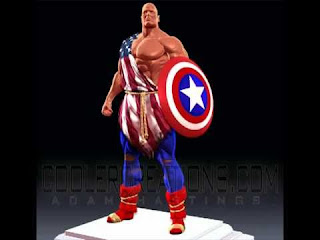
Marvel’s heroes and villains. Some of the mutations have special resonance
within the story, on in the context of Marvel’s storied history, while others
seem to be the results of mere whimsy, along the line of Alex Ross saying, “I
think I’ll make the new Captain America bald.”
Even though the title of EARTH-X sounds like a reference to
Marvel’s inescapable mutant franchise, Krueger’s plot hinges on the Lee-Kirby
backstory fot the Inhumans. These
FANTASTIC FOUR alumni were originally a race of genetically-advanced
Earthpeople, though Lee and Kirby quickly retconned the characters into a experimental
project by the alien Kree, a breeding-ground for super-warriors designed to
serve the Kree’s martial endeavors. Without dwelling on assorted plot
complications, the Inhumans’ capacity for self-mutation is at the root of the
entire Earth’s big transformation—though this comes about as a response to yet other
aspects of Marvelverse continuity.
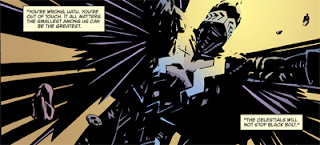
I said earlier that Krueger’s opus was a love letter to
Silver Age Marvel. The majority of the primary characters debuted in the 1960s:
the Fantastic Four, Iron Man, Thor, the Avengers, Captain America (technically
a reboot of the Timely version), the Hulk, the Inhumans, the X-Men, and the
Black Panther— and most are Lee-Kirby characters. Krueger finds some space for such
non-Kirby characters as Spider-Man, Doctor Strange, and Daredevil, though these
are all relegated to lesser roles in what seems like a predominantly Kirbyesque
catastrophe.
At the same time, EARTH-X
is not “sixties retro” in the least, for the Inhumans-Kree core of the plot is
folded into an even more cosmic scenario borrowed from the following decade:
Jack Kirby’s 1970s ETERNALS series.
Kirby designed the short-lived series to stand apart from the regular
Marvel universe, but a few years after the end of the series (and the end of
Kirby’s contract with Marvel)
“continuity savant” Roy Thomas devoted
several issues of THOR to
blending “Eternals-Earth” with that of “mainstream Marvel.”
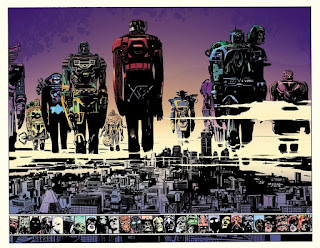
Certainly Kirby’s ETERNALS exceeded the Inhumans-Kree
plotline in sheer scope. Mysterious extraterrestrial titans, the Celestials,
arrive on Earth, standing as imperturbable sentinels that do not deign to
interact with humankind. It soon comes out that the Celestials are responsible
for engineering not only the human race, but two other races, the Eternals and
the Deviants, whose special powers and weapons caused early humankind to regard the
Eternals as gods and the Deviants as demons. Roy Thomas seemingly sweated
blood, finding ways to make it possible co-existence between science-fiction
gods like Kirby’s “Zuras” and the already established “magic-based god” known
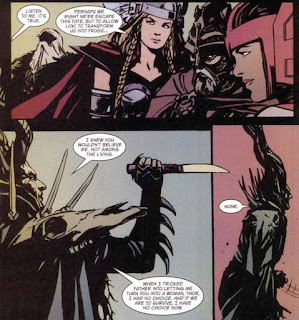
as Zeus. Since Krueger isn’t interested in the “magical gods” of Marvel—or for
that matter, the mystical dimensions of Doctor Strange-- he simply explains
away all of the Marvel gods as a race of metamorphic aliens. In Krueger’s
cosmos, only science fiction can beat science fiction.
The transformation of Marvel-Earth is, in the long run,
brought about to keep the Celestials from simply extinguishing Earth when
they’re finished with it. However,
Krueger’s plot is far from linear, and the mystery of humanity’s transformation
often takes a backseat to showing this or that Marvel character in a weird new
situation. A few are “old favorites” in name only: Matt “Daredevil” Murdock is
said to be dead, but a new Daredevil, who is “without fear” because he can’t be
killed, has taken his place.
Two-members
of the Fantastic Four—the Invisible Woman and the Human Torch—have died, along
with the super-group’s foremost enemy Doctor Doom; as a result, Mister
Fantastic has become a recluse who lives in Doom’s castle, seeking for the
solution to the transformation.
In one of Alex Ross’s better re-conceptions,
the Hulk, once a goliath with a tiny mind, has become separated into a truly
mindless brute controlled by a juvenile version of Bruce Banner. If nothing else, this re-conception provides some nostalgia for a particular issue of the first INCREDIBLE HULK
series, wherein young Rick Jones was temporarily able to control the mammoth man-monster.
Children have become less common now that everyone has new powers, though oddly
enough the aged-looking Captain America is forced to battle a new incarnation
of the Red Skull: a mutant kid so young that he doesn’t even know who Hitler
was.
Though there are some resonant moments regarding the various
transformations of heroes and villains, Krueger is at his most philosophical
when dealing with two onlookers, both of whom were Kirby creations. The older
creation, co-authored by Stan Lee, is the alien Watcher, who provides a running
commentary on Marvel’s history for the benefit of a less well-informed
observer. This is Aaron Stack, a.k.a. Machine Man, whom Kirby solely created
for a Marvel’s feature based on Stanley Kubrick’s “2001: a Space Odyssey.”
(Amusingly, Aaron is brought into the Watcher’s abode amid imagery that
strongly references the imagery of the Kubrick film—to say nothing of the
film’s relevance in terms of
“alien
experiments.”)
The Watcher, who has been stricken blind by an unknown
assailant, wants to make living robot Aaron into a new Watcher.To do so, the
Watcher must try to convert Aaron to a disinterested viewpoint of humanity’s
struggle. Here’s the Watcher trying to go all Nietzsche on Aaron Stack,
explaning why human beings resented their superhuman saviors:
…to be saved is to be weak. And to be weak, one must
acknowledge that one exists in a constant state of need. Thar, in his normal
state, man is found to be lacking.
No less Nietzschean is the Watcher’s statement on eternal
warfare:
Mankind cannot live in peace with [sic] himself. His nature denies this.
While these philosophical ruminations have some broad
applicability to the theme of EARTH-X, Krueger doesn’t succeed in making the
Watcher’s credo fit into his easy acceptance of the Celestials’ ruthless
agenda. Aaron Stack, as defender of humanity, is also not quite able to refute
the Watcher’s vow of non-interference by the jejune statement: “To do nothing in the face of need—that’s
evil.”
Like many of the Marvel-DC multi-character epics, EARTH-X
loses perspective by dint of concentrating only on superhuman protagonists.
Even the script for
2004's INCREDIBLES, whose author ostensibly did not intend to
invoke Nietzsche, hones in on more of the conflict between savior and saved
more profoundly than does Krueger’s opus. Still, there is enough of a symbolic
discourse here to rate EARTH-X as an interesting mythcomic.